I’ve just returned to the office after delivering my last teaching session of 2025 (a tutorial on Differential Equations and Complex Analysis). I’m up to date with all my grading too, so I’m done with teaching for 2025.
Yesterday we had our Physics Department Christmas Celebration, which was very enjoyable. We went to a restaurant in Maynooth (The Avenue) and afterwards to a local pub (Brady’s). I didn’t stay out too late, though, because I had teaching today and I’m too old for that sort of thing. I got up quite early this morning, actually, although I have to admit it took even longer than usual for effective brain functioning to commence…
I was planning to go home directly after my tutorial and finish a few small jobs in my study, but I don’t particularly want to get drenched so I think I’ll finish them here on campus and hope that the current deluge passes soon…
This paper reminded me of a paper I wrote a long time ago (in 1991, when I was at Queen Mary) about primordial magnetic fields and galaxy formation. It had its origins in a lunchtime talk I gave which was based on an old paper from the 1970s by Ira Wasserman. All I did was go through the paper and add a few small comments to update it, including some more recent observational constraints and mentions of dark non-baryonic matter; the Wasserman paper was framed in a model in which all the matter in the Universe was baryonic.
Anyway, the talk went down quite well and I was encouraged to write it up. I did so, and submitted it to a journal (MNRAS). Not unreasonably, it was rejected on the grounds that it didn’t have sufficient original content. I therefore expanded the discussion and submitted it as a review article to Comments on Astrophysics. That journal is now defunct, but the paper can be found on NASA/ADS here. It’s even got some citations!
You will see I was advocating a larger magnetic field than in the recent one, with a view to affecting galaxy formation directly rather than larger scale features of the Universe. An important point is that primordial magnetic fields can have a large effect soon after recombination, so they might play a role in the formation of galaxies at high redshift which we are struggling to explain. At least – unlike some of the more exotic explanations that have been proposed – we know that magnetic fields actually exist…
The week ahead is the last week of the teaching term at Maynooth and, since I don’t have any sessions scheduled for Friday 19th December, I will finish on Thursday 18th and take the Friday off. I don’t think there’ll be many people – either staff or students – around on Friday anyway.
Tomorrow (Monday) is the infamous “Student Xmas” in Maynooth where many undergraduates spend the day getting drunk rather than attending lectures or tutorials. Many start drinking in the morning and carry on until the pubs close in the early hours. I wouldn’t mind this excess too much, but the town is usually in a terrible mess on Tuesday morning, with fast food containers, broken bottles and vomit littering the streets. I have a lecture at 2pm on Monday (tomorrow) which will go ahead and a telecon at 4pm. After those I’ll be making my way home and keeping well out of it until I have to navigate a passage through the debris on Tuesday morning.
Two pubs, Brady’s amd The Roost promote this pre-Chrtistmas celebration vigorously on social media. I imagine their takings are substantial. I wonder if they – or indeed the Student’s Union – pay a little to help clear up the aftermath?
On Tuesday I have three lectures, but one of them (at 11am) will be the final class test for Differential Equations and Complex Analysis so there’s little for me to do but sit there, invigilating. I have promised to get the answers corrected and returned before the break so I’ll have to do them by Thursday, the date of the last tutorial. Our Department Christmas Celebration is on the afternoon of Wednesday 17th, so I’ll have to fit the grading in on Tuesday evening or Wednesday morning.
The other two lectures on Tuesday are Engineering Mathematics, followed by another on Wednesday. I was going to use one of the Tuesday slots for the final class test for this module, but a number of students asked me to postpone it because they anticipate being hung over. I don’t mind but the only available time with a suitable room is Thursday, so they won’t get their marks until after the holiday, for which I feel no need to apologise. It’s good to have the three lecture slots because I missed an hour last week because of the power cut owing to Storm Bram.
The weather is rather strange today, as a result of Storm Bram which is approaching from the South. The storm is bringing warm air with it, so the temperature is around 15°C which is very mild for December. The prevailing winds are usually westerly or south-westerly.
Heavy rain fell overnight, especially in the South. It’s clearer now and the winds are starting to pick up. Although Maynooth is relatively sheltered we’re still expecting gusts up to 100 km/h. As a precaution, the large tent which is usually situated outside the John Hume building has been dismantled to stop it blowing away.
Campus remains open and lectures are going ahead as normal.
At least mine are…
UPDATE: 4.25pm. I spoke to soon. I have a teaching session between 2pm and 4pm on Tuesdays; I usually take a break halfway through, as I did this afternoon. Chatting with some students in the interval we noted the wind was picking up and discussed the possibility of a power cut. We obviously tempted fate, as no sooner had we resumed for the second half when all the power went off. It came on intermittently a few times, but at 3.30pm I called off the lecture. It was too dark to see the blackboard and no other AV equipment was working. When I got back to the Physics Department, where the power was also off, as it appeared to be for the whole campus, a colleague who lives nearby told me that our area of Maynooth still had power. So I headed home, via Dunnes (which has a generator) to buy a few things. As I walked through Maynooth some lights were on, some were off. The worst affected area seemed to be to the north-west and around campus. Anyway, I’m home safely and can continue working here as long as the power stays on.
P.S. The storm is named after Bram Stoker, author of Dracula, who was born in Dublin.
This week is the penultimate week of teaching term at Maynooth and, as usual at this stage of the Semester, we’re getting busier and busier. The examinations for January have been sent off for printing and are (presumably) ready to go, and I’m up to date with all my coursework gradin so I am, miraculously, on schedule as far as teaching is concerned. I should finish covering the respective syllabuses by Tuesday 16th, with the remaining teaching sessions devoted to revision. I don’t have any lectures on Fridays this term, so my teaching ends, a day before the end of term, on Thursday 18th December. To celebrate the end of term I’ll be presenting the students in the last session of my Engineering Mathematics module the gift of a final Class Test. I’m not sure when I’ll get to correct it. Oh, and our Department Christmas Dinner is on Wednesday 17th.
I’ll soon have to decide when to pause the publication of new papers at the Open Journal of Astrophysics and prepared for next year’s Volume 9. A certain person is insisting that I take a complete break for at least a week, so I think we’ll probably stop on Christmas Eve and begin again in the New Year.
In the meantime, term goes on. I have three lectures to get ready for tomorrow. Incidentally, my mid-Semester feedback suggested that I start each lecture with an introduction to say what I’m going to be covering. Here are some examples of what I’ve been doing in response:
I was worried I might have to miss last night’s concert by National Symphony Orchestra Ireland conducted by Anja Bihlmaier at the National Concert Hall. I bought the ticket some weeks ago and was looking forward to it, but I had been a bit unwell earlier in the week and didn’t want to go only to cough all the way through, possibly infecting others on the way. By Friday afternoon, however, I felt a lot better and took the decision to go for it. I’m very glad I did because I enjoyed the music enormously and didn’t cough or sneeze once!
There were only two items on the menu, another pairing of Mozart and Bruckner.
In the first half we heard the Piano Concerto No. 15 by Wolfgang Amadeus Mozart played by Boris Giltberg. This piece was written in 1784 when the composer had reached the ripe old age of 28. It’s an enjoyable and entertaining piece, not perhaps as profound as some of the later piano concertos (Mozart wrote 27 altogether), but well worth listening to. It’s also regarded as one of the most difficult to play, though Boris Giltberg made it look easy enough and was clearly enjoying himself while he played it as I’m sure did the composer when he performed it for the first time in Vienna. The three movements follow a standard fast-slow-fast pattern; the last being a sprightly Rondo, part of which features in the soundtrack of an episode of Inspector Morse: Who Killed Harry Field?
After generous applause, Giltberg returned to the stage to play a very solo encore piece. I didn’t recognize it, but someone I know who was there told me it was by Robert Schumann but didn’t know the name. When I got home I spent a good half-hour going through recordings until I finally identified it as the Arabeske in C Major. Anyway, it was a very nice way to send us into the wine break.
After the interval we had Anton Bruckner‘s monumental Symphony No. 9, which was unfinished at Bruckner’s death in 1896. Insufficient material was recovered after the composer’s death to enable a reconstruction of the missing 4th movement, so this work is generally performed in its incomplete state with only three movements. Even so, it’s an immense work in both length and ambition, lasting over an hour in performance and calling for a large orchestra.
The majestic first movement (marked Feierlich, Misterioso; solemn & mysterious) with its soaring themes and thunderous climaxes always puts me in mind of a mountaineering expedition, with wonderful vistas to experience but with danger lurking at every step. At times it’s rapturously beautiful, at times terrifying. It’s not actually about mountaineering, of course – Bruckner meant this symphony to be an expression of his religious faith, which, in the latter years of his life must have been pretty shaky if the music is anything to go by.
The second movement (Scherzo) is all juddering rhythms, jagged themes and harsh dissonances reminiscent (to me) of Shostakovich. It alternates between menacing, playful and cryptic; the frenzied animation of central Trio section is especially disconcerting.
The last movement (Adagio) begins restlessly, with an unaccompanied violin theme and then becomes more obviously religious in character in various passages of hymn-like quality, still punctuated by stark crescendi. In this movement Bruckner doffs his cap in the direction of Richard Wagner, especially when the four Wagner tubas appear, and the movement reaches yet another climax with the brass bellowing out the initial violin theme. This dies away and the movement comes to an unresolved, poignant conclusion. With a long pause in silence as if to say “that’s all he wrote”, the concert came to an end.
Although I’ve loved this work for many years I’ve only ever heard it once before in concert. The live performance definitely adds other dimensions you will miss on a recording and I enjoyed it enormously. For one thing you can see how hard the musicians – especially the cellos and basses – have to work. The sight of a large symphony orchestra working together to produce amazing sounds is quite something.
The National Symphony Orchestra Ireland may not be the Berlin Philharmonic but I was generally very impressed, there was split note in the brass section near the end, but this was a minor blemish. The performance was very warmly received by the audience. The NCH wasn’t full, but it was quite a good attendance.
That’s not quite the end of my concert-going for 2025. I’m off to Messiah next week. Well, you have to, don’t you? It’s Christmas..
Yesterday afternoon I acted as Chair of the viva voce examination for a PhD degree in the Department of Mathematics & Statistics at Maynooth University. I have done this once before at Maynooth, in the Department of Biology, but had to look back through my archive of blog posts to find out when that was: it was in June 2023.
For those of you not familiar with how this works, a PhD involves doing research into a particular topic and then writing up what you’ve done in a thesis. The thesis is a substantial piece of work, often in the region of 100,000 words (200 pages or so), which is then assessed by two examiners (one internal to the university at which the research was done, and one external). They read copies of the thesis and write preliminary reports on it. Then the candidate has to defend it in an oral examination, which was what happened yesterday, after which they make a recommendation to the university about whether the degree should be awarded.
There aren’t many rules for how a viva voce examination should be conducted or how long it should last, but the can be as short as, say, 90 minutes and can be as long as 5 hours or more. The examiners usually ask a mixture of questions, some about the details of the work presented and some about the general background. Sometimes, especially in Mathematics, the candidate might be asked to use the chalkboard to explain something, as was the case yesterday.
The unpredictable content of a viva voce examination makes it very difficult to prepare for, and it can be difficult and stressful for the candidate (as well as just tiring, as it can drag on for a long time). However, call me old-fashioned but I think if you’re going to get to call youself Doctor of Philosophy you should expect to have to work for it.
I found it interesting when I first arrived here that viva voce examinations at Maynooth follow a similar practice to those at my previous institution, Cardiff University my previous institution, in that each viva has a Chair as well as the usual internal and external examiners. The Chair is really only present to ensure fair play, that proper procedure is followed, and that all the paperwork is done in timely fashion. The Chair is rarely (if ever) called upon to intervene in the viva itself, though I have on some previous occasions done so, mainly to ask if the candidate and/or examiners would like to take a comfort break. Other than that it’s just a matter of sitting quietly and getting on with something else while the viva proceeds.
I have done quite a lot of examinations as internal or external examiner over the years and most institutions don’t have a Chair – only the two examiners and the candidate are present. Cardiff University is an exception: I chaired a quite a few vivas when I was there. The difference there was that the Chair was from the same School (Physics & Astronomy) as the candidate, whereas in Maynooth the Chair must be from a different Department (which is why I was asked to Chair examinations in Biology and, more recently, Mathematics).
I think having an independent Chair is a good idea, but I do understand that it involves finding a person willing to do it which, it seems, sometimes slows down the organization of a viva, as the process does not start until a Chair is appointed.
Anyway, in this case it all went well. The candidate passed, the forms were filled in and sent to the relevant people. Now there are just minor corrections to be done, everything approved at the relevant Faculty meeting, and then the PhD degree can be conferred.
I’ve come down with some sort of lurgy and had to cancel a tutorial that was due to take place today, which I am sorry about. I did, however, manage to rise from my sick bed earlier this morning to publish a paper at the Open Journal of Astrophysics. When I checked the publishing dashboard I saw that this one is paper No. 425. This is a significant figure if you reckon by the cost of an Article Processing Charge (APC) at Monthly Notices of the Royal Astronomical Society. The current APC is £2356 per paper. If you multiply this by 425 the result is just over a million pounds (£1,001,300 to be exact). The Open Journal of Astrophysics, being a Diamond Open Access journal, is totally free for authors.
I mentioned a couple of weeks ago, that this is a small fraction of the money being wasted by the astronomical community worldwide on publication charges but if even a small operation like ours can save a million pounds, just think of what could happen if we all published this way! For one thing, there would certainly be more money available for actual research. That doesn’t only go for astronomy, of course: almost every scientific discipline is being ripped off by publishers who have hijacked the Open Access movement to generate income from APCs.
I’ll repeat the quotation I posted yesterday about a scandal relating to corporate publishing giant Elsevier
The scandal exposes the windfall profits of scientific publishers, who in recent years have amassed billions of dollars in earnings from public funds earmarked for science.
It’s a shocking idea, I know, but what if we spent public funds on what they are supposed to be spent on rather than handing millions to greedy publishers?
Today, 1st December, is World Aids Day, which is dedicated to raising awareness of the AIDS pandemic caused by the spread of HIV infection, mourning those who have died of the disease, and showing solidarity with those living with HIV. In my case it’s also a day for remembering how lucky I have been.
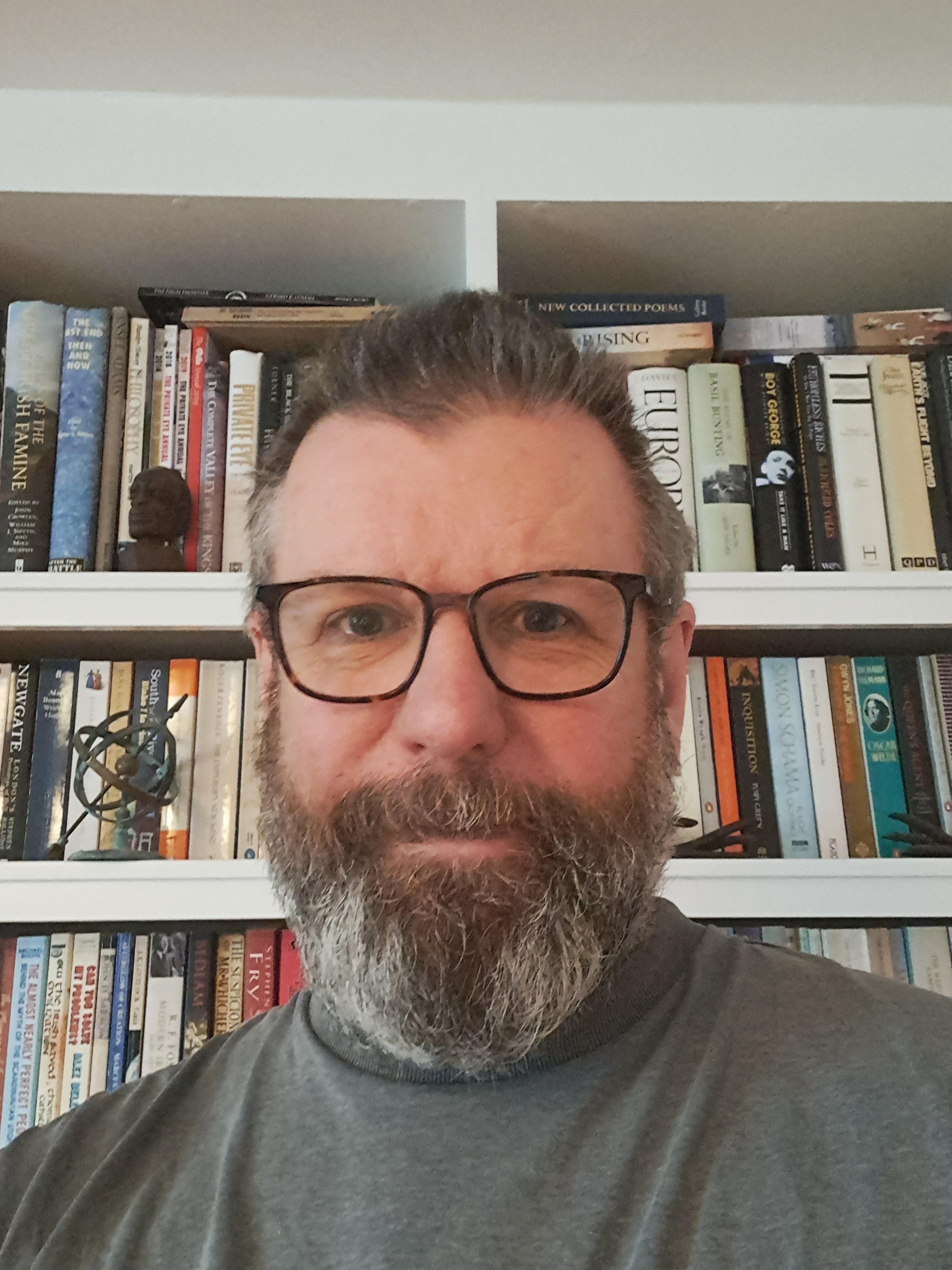
Here’s me just about to leave the house this morning with my red ribbon.
Maynooth University Library, home of the famous cat
Today is 1st December 2025, which means that it’s eight years to the day since I started work at Maynooth University. Despite the frustrations, I’m still very happy I made the move all that time ago.
We’ve now had more than a year since the merger of the former Departments of Theoretical and Experimental Physics. This has gone pretty well, actually, with significant improvements in terms of some steps forward in rationalising teaching. It does, however, feel less like a merger and more like an acquisition, with the theoretical activity effectively subsumed into the old Experimental Physics department. I suppose that was inevitable given the relative sizes of the two former Departments, but it has led to a loss of identity and the loss of the group spirit we use to have in Theoretical Physics. To add to this a number of familiar faces have left – two of my own PhD students, Aonghus Hunter-McCabe and Aoibhinn Gallagher have graduated and left, as have others with different supervisors. I am delighted for their success, of course, but will miss having them around.
I continue to enjoy teaching, and was pleasantly surprised to continue doing the same modules this academic year as last. The big change in that regard has been the adoption of different assessment methods to deal with the possibility of students using AI to do their coursework. That seems to be going reasonably well, though I’ll have to wait until the January examinations to see the outcomes.
The thing I’m probably most proud of over the past eight years is, with the huge help of staff at Maynooth University Library, getting the Open Journal of Astrophysics off the ground and attracting some excellent papers. This year has seen yet more significant growth, publications this year set to reach 200, after 120 in 2024 and just 50 the year before that (2024). We’re still smaller than many of the mainstream astrophysics journals, but we’re still growing…
Anyway, eight years of service mean that only two remain until I can claim the full state pension. I’ll be retiring as soon as I can afford to. There were Open Days at Maynooth on Friday and Saturday (28th and 29th November, respectively). These were for prospective students to enter in September 2026. Since I don’t teach any first or second year Physics modules now, and that is likely to continue, it looks like I’ll never see any of that intake in class.
The views presented here are personal and not necessarily those of my employer (or anyone else for that matter).
Feel free to comment on any of the posts on this blog but comments may be moderated; anonymous comments and any considered by me to be vexatious and/or abusive and/or defamatory will not be accepted. I do not necessarily endorse, support, sanction, encourage, verify or agree with the opinions or statements of any information or other content in the comments on this site and do not in any way guarantee their accuracy or reliability.