Archive for the Biographical Category

Homes from Home in Pune

Posted in Biographical, History, The Universe and Stuff with tags , , , on October 16, 2017 by telescoper

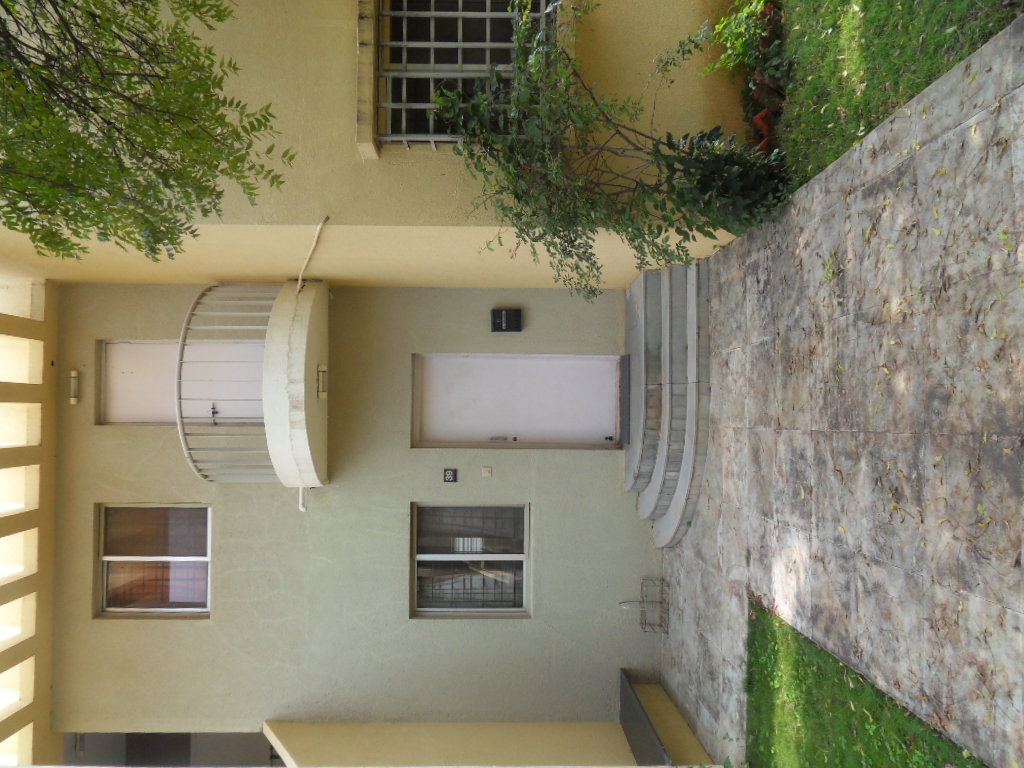
Since I’m coming back tomorrow I thought I’d wander around this morning and take a few pictures of where I’ve been staying most of the last 10 days or so. First, this is a snap of the housing complex which contains my guest apartment.

I’m actually in the first building on the right. Here is the front door.

The faculty at both IUCAA (Pune) and TFIR (Mumbai) live in housing areas provided by their respective institutions, so they form quite a close-knit community. Some of the senior staff in IUCAA are housed just round the corner from my place.

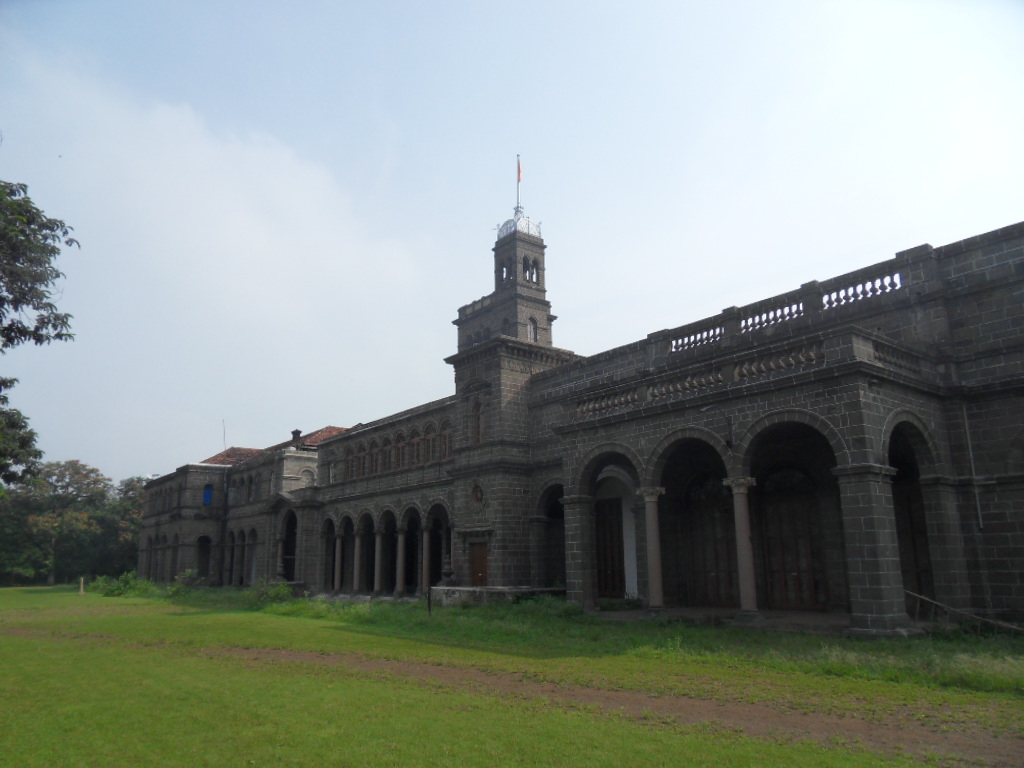
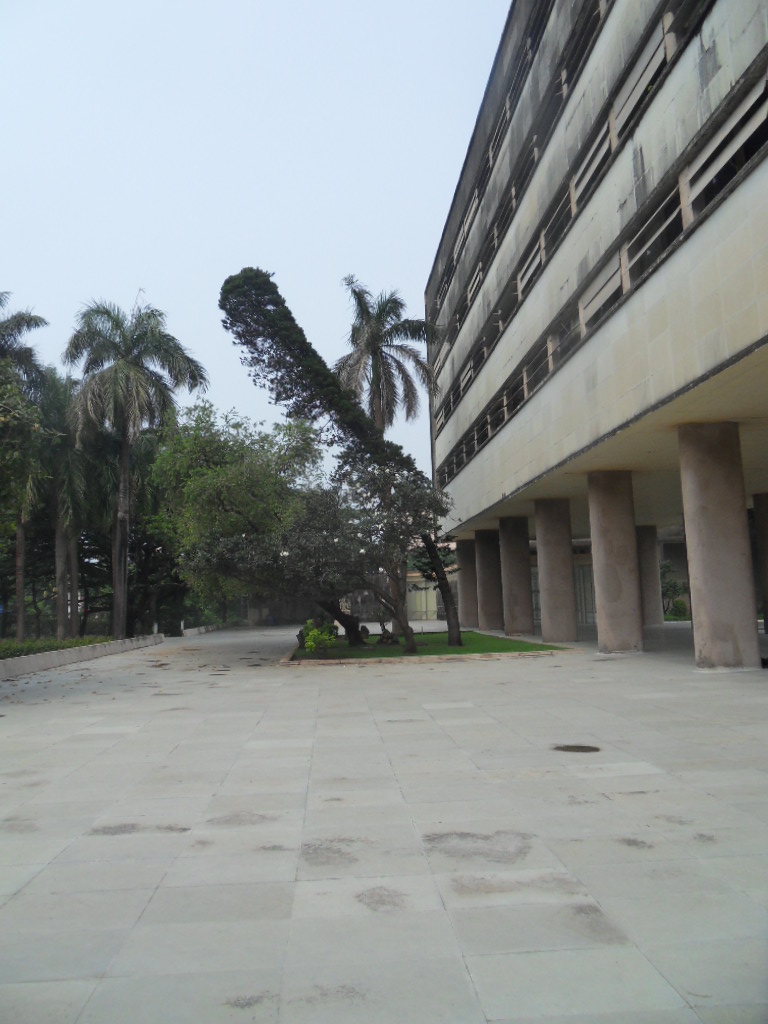
IUCAA is on the Pune University Campus (except that it has its own entrance from the main road that runs along the Northern edge of the campus, where there is a security post. There are a few of these around the IUCAA site itself, so it is very secure and quite private. The campus is large with many tree-lined roads. At its heart, on a small hill, you can find this building:

This is (or was) the Raj Bhavan (`Government House’) and it was essentially the Governor of Maharashtra’s residence during the Monsoon season. Built in 1866, it was a sort of home-from-home when Bombay (the state capital) became too unbearable.

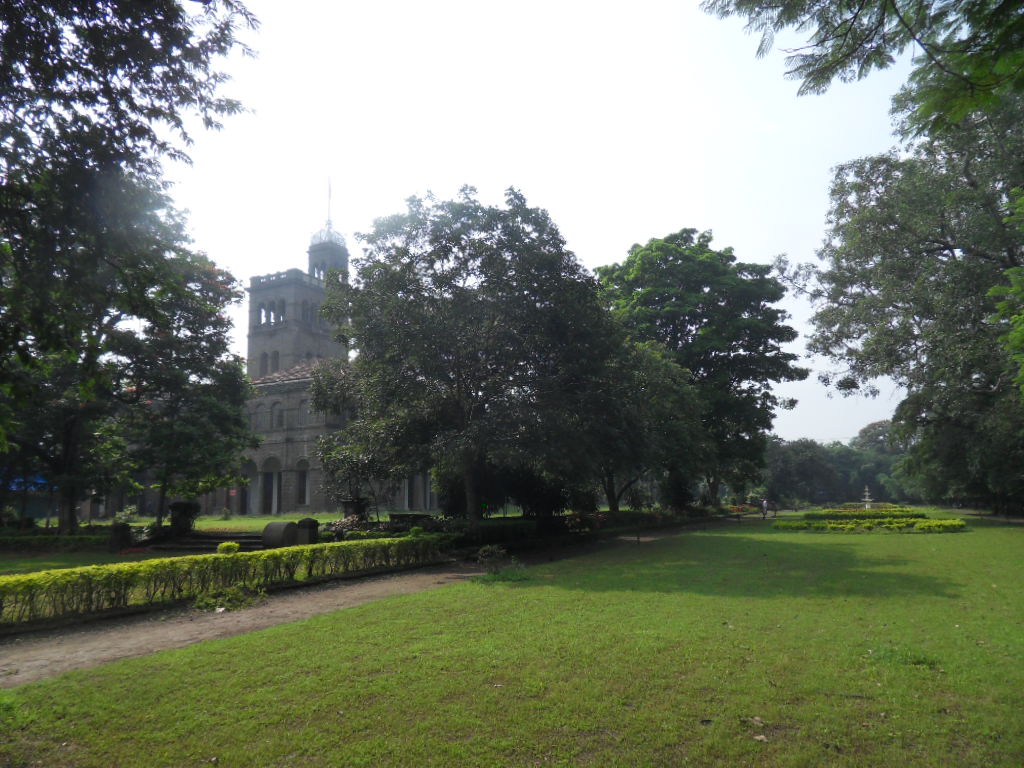
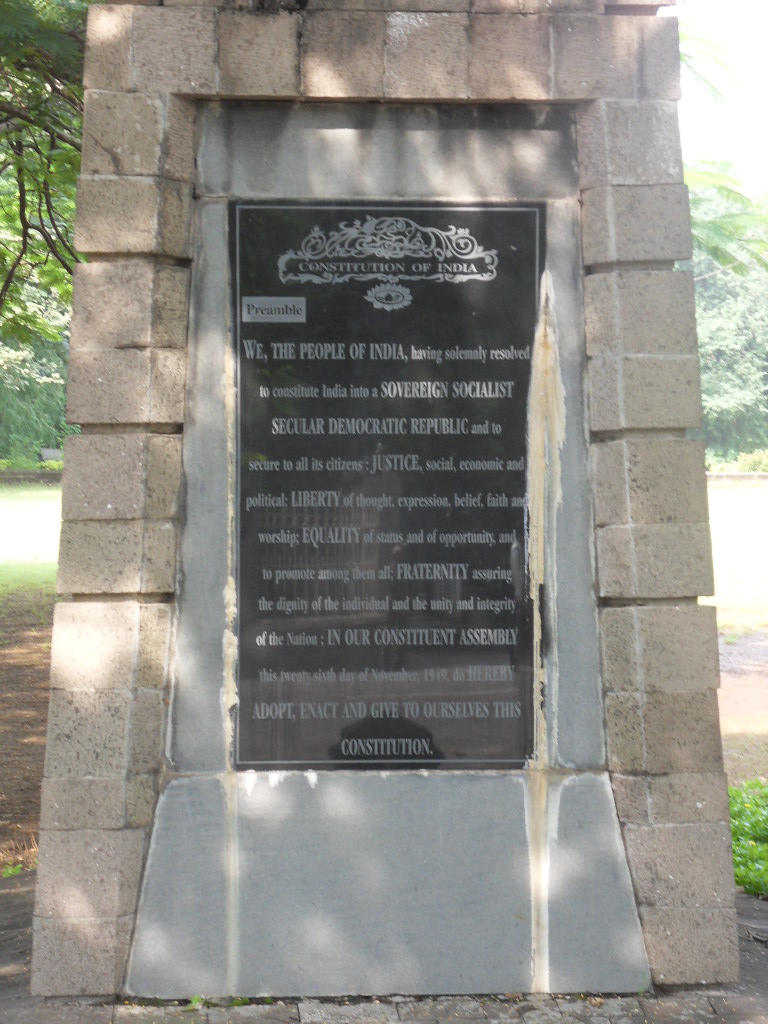
When I was last here in 1994, this was the Main Building of the University and was quite busy. Now, however, it seems to be disused and is in a state of some disrepair, the gardens also need a bit of love and attention. There are many new buildings around the University of Pune campus (including a modern administration block nearby). Since this building is a relic of the old colonial days it may be that it will be demolished to make way for something that better suits modern India. By the way, there’s a stone slab just next to the site of this building that displays the preamble to the Constitution of India, as adopted in 1949.

Anyway, this afternoon and evening promise to be quite busy. There is a press conference at IUCAA at 6.30pm about the gravitational waves discovery I mentioned a few days ago. There will be presentations before a viewing of the live feed from Washington DC then there’ll be a panel answering questions from the press. They’ve asked me to be on the panel, so I might appear in the India media, but as I’m leaving first thing tomorrow morning I probably won’t see any of the coverage!

Before the Storm…

Posted in Biographical, History with tags , , , , on October 16, 2017 by telescoper

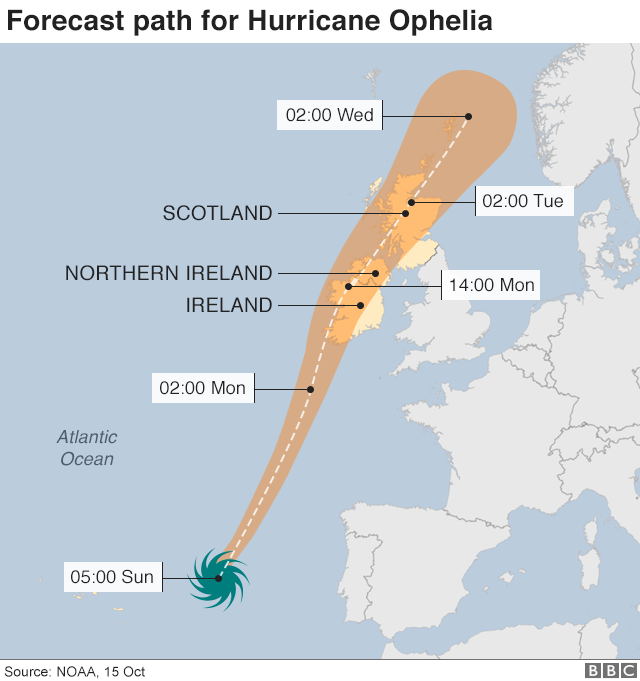
Nearly at the end of my short visit to India I find myself checking on the UK news. Home thoughts from abroad and all that. Anyway, it’s quite a coincidence that Hurricane Ophelia is arriving,  exactly on the thirtieth anniversary of the famous `Great Storm‘ that wrought destruction across the South-East of England in 1987. The path of Ophelia is rather different from that of the 1987 `Hurricane’, and it looks like Ireland will bear the brunt over the next day or two, as the storm will weaken as it encounters land, though there will be strong winds far outside the path denoted in this map:


I hope the damage from this storm  isn’t too bad and that people in its path stay safely out of harm’s way, especially in Ireland. It’s possible the winds may affect my current home in Wales too. I hope I don’t get back tomorrow evening to find the roof has blown off!

Thirty years ago today I was living in Brighton as a graduate student at the University of Sussex. On October 16th 1987 (a Friday) I woke up to find the electricity had been cut off. Without breakfast I struggled out to find the street lined with fallen trees, smashed cars and houses with broken windows. I got to the railway station to get the train to Falmer (where the University of Sussex is located) only to find that no trains were running. I walked home and went back to bed. It took several days for normal service to resume. When I did get up to campus the following week, I found that almost all the trees in Stanmer Park had come down and were combed flat on the top of the hill.

The Great Storm of 1987 , according to weather forecaster Michael Fish, was “not a hurricane” had nevertheless caused enormours destruction. And I had slept through the whole thing…

Here’s the infamous weather forecast broadcast on the Thursday evening:

and here is the BBC News from the following day:


Farewell to TIFR

Posted in Art, Biographical with tags , , , on October 15, 2017 by telescoper

I got up early again this morning to travel back to Pune for the final few days of this trip. Last night I had a pleasant dinner with my host Subha Majumdar at the Indigo Deli to round off my short stay in Mumbai. The food was nice, but it was a tad overpriced in my opinion. We passed by the Leopold Cafe on the way home; that was the scene of a terrorist atrocity in 2008 I remember having tea there in 1994, after returning from a boat trip to Elephant Island.

I went sightseeing yesterday morning but forgot to take my camera with me then. I left reasonably early so that I could wander around before it got too hot – the afternoon was sweltering on Friday – but when I arrived at my main destination (the National Gallery of Modern art) I found it didn’t open until 11am, so I had to find somewhere for a cup of tea (which wasn’t difficult). When it opened I found a pricing strategy that is common in India: 20 rupees for Indians and 500 rupees for foreigners! Still, 500 rupees is only about £6 and though small the gallery is well worth seeing.

When I returned to the TIFR `Colony’ I picked up my camera and took a few snaps of the Tata Institute for Fundamental Research before spending the afternoon in the office. As you can see, TIFR is set in lovely grounds with some gorgeous trees. It’s also right next to the sea, but the view wasn’t great yesterday as it was misty. Later on there were heavy thunderstorms.

Now I think I’ll take a short nap. It’s just after 10am, but I was up before 5am after just a few hours sleep. I hope I wake up in time for lunch!

Going Doolally

Posted in Biographical, History with tags , , on October 14, 2017 by telescoper

Yesterday evening, after my seminar and discussions I went with members of the cosmology group at the Tata Institute for Fundamental Research to a place called the Doolally Tap Room which is not far from TIFR. Thundery clouds had gathered and rain was in the air so we took a taxi there and back.

It’s a nice, modern-looking bar with a range of craft beers and food. The Belgian Witbier and Abbey Tripel went down well, but I wasn’t tempted to try Mango Cider. It was a very pleasant evening, but I was dog tired after it and crashed out as soon as I got back to the TIFR guesthouse.

The name Doolally Tap Room is a very clever name for a bar. The word Doolally (or sometimes Dolally), as it is used in English especially in `going Doolally’ etc, generally means `deranged’ or `crazy’ (often as a result of being confined somewhere involuntarily, rather like cabin fever), is thought to derive from Deolali a place in Maharashtra (the state which contains both Mumbai and Pune). Deolali was used as a transit camp for British Army soldiers waiting to be deployed, many of whom became extremely bored stuck there in the heat.

Interestingly though the original phrase describing the madness induced by such boredom was `Deolali Tap’ (the latter word from a Hindhi word meaning `fever’). Doolally Tap Room therefore works rather well as a play on words.

There are of course many words in contemporary English that have their origins in Indian languages: here are 50 of them, which may or may not surprise you: atoll, avatar, bandana, bangle, bazaar, Blighty, bungalow, cashmere, catamaran, char, cheroot, cheetah, chintz, chit, chokey, chutney, cot, cummerbund, curry, dinghy, doolally, dungarees, guru, gymkhana, hullabaloo, jodhpur, jungle, juggernaut, jute, khaki, kedgeree, loot, nirvana, pariah, pashmina, polo, pukka, pundit, purdah, pyjamas, sari, shampoo, shawl, swastika, teak, thug, toddy, typhoon, verandah, and yoga.

Reminded by the above old British Army connection with doolally I can’t resist mentioning the phrase `When I was in Poona…‘. One doesn’t hear it much these days but aficianados of older humorous novels and radio comedy will recognize it as a kind of catchphrase introducing a boring old ex-soldier. It appears thus in Eric Patridge’s Dictionary of Catch Phrases (2003):

The legacy of Pune’s past as a large British Army base is still apparent: a large area in the centre is still called `Camp’ and there is still a tendency among some to refer to non-vegetarian restaurants as `Military’ (though I’m told this is more the case in Southern India, where the traditional local food is entirely vegetarian). In Maharashtra the diet is very mixed, but I’ve eaten relatively little meat since I came here.

All of which rambling might suggest that I’ve gone Doolally, or indeed that I’m turning into an old bore, but I’m actually enjoying this trip very much indeed. It’s fascinating not only to see what has changed in India in the 23 years since I was last here, but also what has remained the same. Moreover, everyone I have met here has been so friendly and hospitable that it’s been an absolute pleasure all round.

Memories of Mumbai

Posted in Biographical with tags , , on October 11, 2017 by telescoper

My first trip to India was in early 1994 and I passed through Bombay (as it was then called) on my way to and from Poona (Pune). My flight from London to Bombay arrived at about three o’clock in the morning and I was greeted outside the immigration area by a young man holding a sign with my name on it who had my train tickets for the next leg of the journey. The train didn’t leave until 6.30am so he asked me what I wanted to do until then. I said I thought I would just go to the station if it was open and wait there. He looked surprised, but said that, yes, the station was open all night. He then kindly offered me a lift in his car as he was heading home and would be going roughly in that direction.

When we got to Bombay Victoria I realised why he had been surprised. I had assumed the station would be fairly empty and I might be able to sleep on a bench or something. When I walked into the concourse it was jam-packed with people sleeping all over the floor. I wandered in sheepishly, the only westerner to be seen, and started to look for what platform my train would be leaving from. Immediately I was surrounded by beggars – women with small babies, cripples, people with gruesome scabs and sores – all pushing me around and pleading for money. Then a teenage boy tried to lift my walkman from my pocket and I started to feel not just uncomfortable but scared.

Pretty soon, though, an official from the State Railways saw my predicament and came to my rescue. Delivering numerous clips around ears he speedily liberated me from my oppressors, took me to into a small kiosk situated on the platform, and offered me a cup of tea. It had far too much sugar in it, but I drank it gratefully anyway. He asked me where I was going, and I told him. He was initially suspicious, I think, because the primary place westerners tended to visit in Pune those days was the Ashram run by Bhagwan Shree Rasjneesh where his disciplines were encouraged to participate in unrestricted sexual activities. When I told my friend from the railways that I actually going to visit IUCAA, which at that time was run by the famous Professor Narlikar, he beamed with relief. I think he wasn’t unique amongst Indians who thought that Rasjneesh was a fraud and his disciples gullible idiots.

It turned out that the train I was to take to Pune was actually already in the station but was being cleaned. Since they cleaned the first class compartments first, I was allowed to get on the train early, about 4.30, and immediately nodded off. I only woke up when the train pulled out of the station and started on its journey up towards the Deccan plateau.

I enjoyed the journey enormously, partly because the train was slow enough to allow me to take in all the sights, and partly because I was sharing a compartment with a very friendly Indian couple (a professor of engineering and his wife). They had done the customary thing when on a long railway journey in India, which is to consult the list of passenger names posted on the platform before the train left the station. When I woke up as the train left the station, they greeted me by name and introduced themselves. It was a refreshing change from the United Kingdom, where it is apparently forbidden to talk to strangers on a train.

I stayed about a month in Pune working with a colleague, Varun Sahni, on a lengthy article for Physics Reports. When that was over I had been invited to visit the Tata Institute for Fundamental Research in Bombay for a few days on my way home, so I got the train back to Victoria. Arriving on time, I left the train to be confronted by a crowd of small boys who tried to convince me that there were no taxis but that they would arrange one for me for a price of 200 rupees. That was way over the odds for a taxi (at the time) so I laughed and said no thanks.

Proceeding out of the station to the taxi rank, I realised that they had been telling the truth. All the taxis in Bombay were on strike that day. I started to panic. How am I going to get to TIFR? Then I remembered that I was to have asked the taxi driver for “Navy Nagar Bus Stop”, which is right next to the guest house I was supposed to stay in.

I thought that if there’s a bus stop there must be a bus, so I found a policeman and asked him where the buses went from. He gave me very clear directions and told me I needed the Number 11. I found the stop without much difficulty, but then there was a hitch. The buses themselves were red double-decker Routemaster types just like those you could find in London. Unfortunately, though, the numbers were written in Marathi script which I couldn’t read. Only when a bus went past did I see that the arabic numerals “11” were written on the back. A few minutes later I was joined at the bus stop by an Indian guy so I asked him if he could tell me the numbers of the buses as they came into view. He asked me where I was going, so I told him and it turned out he was going there too. Sorted.

On the bus I sat with my luggage around me and the front of the lower saloon facing backwards. All the locals peered at me like I was an exhibit in a museum, but most of them smiled. A couple of stops into the journey an old man got on wearing a scruffy coat. He looked rather poorly and had some sort of skin condition. He sat facing me and started scratching himself through his coat. I started to feel quite uncomfortable because this performance went on for some time. Then he started to unbutton his coat as if he was going to take it off. It was then that I realised the cause of his discomfort as a chicken poked its head out.

The bus was quite slow and the journey quite long so, when I finally got to the TIFR guest house, it was quite late. When I found the building, I was pleased to see my host, a physicist called TP Singh, in the lobby talking on the phone. He had his back towards me and was in the middle of a heated conversation, so I waited until he had finished before introducing myself. After a few minutes he put the phone down and turned around, so I offered my handshake and said hello.

He had a look of complete confusion on his face which gradually gave way to relief. “Peter!”, he shouted. “How did you get here?”

I got the bus, was my answer. It turned out he had found out in the afternoon (when I had already left Pune) that there would be no taxis,  so he had sent the TIFR car and driver to meet me at the station. I hadn’t seen the driver amongst the crowds and wasn’t expecting to be met anyway. In those days I didn’t have a mobile phone so there was no way of warning me about it. After scouring the station, the driver had returned to TIFR and reported that I was missing. When I had arrived at the guest house, my host had actually been on the phone to the local police in order to report me lost.

It was during this short visit of three days or so before flying back to London that I behaved as a tourist although I was taken around by students and staff from TIFR which was nicer than the more usual guided tour. I visited the Gateway to India, had tea at the Cafe Leopold, and took a boat to Elephanta Island.

Mumbai (as it is now called) is an enormous, bustling city in which extreme wealth and abject poverty can be found in close proximity and where religious tensions are never far away. Riots are fairly commonplace and there are powerful grievances between the different social groups and claims of police corruption. The sheer scale of the place means that no casual visitor can hope to understand what it  is really like to live. But my visit there left me with an impression of a city full of energy and determination in which there is much kindness to be found not far below the surface.


Return to IUCAA

Posted in Biographical, The Universe and Stuff with tags , on October 8, 2017 by telescoper

This afternoon I roused myself from my slumbers and took a stroll around the campus of the Inter-University Centre for Astronomy and Astrophysics (IUCAA). You can read more about IUCAA here.

I was last here in 1994, at which time I was working with Varun Sahni on a long review article for Physics Reports. We didn’t quite get it all finished during the month or so I was here then, but it was submitted the following year.

Given that was over twenty years ago it shouldn’t really be a surprise that I don’t remember the place all that well, but in fact it has changed quite considerably with lots of new buildings. I’m not staying in the guest accommodation area I was in last time, but in a new part just round the corner. I’ve got a small apartment, actually,including a kitchen but I think I’ll be eating at the refectory most of the time.

Anyway, here are some snaps of parts of the IUCAA complex I did recognize:

There are four statues in the main quadrangle which is featured in the first three pictures. These are of:  Sir Isaac Newton (seated under the tree), Albert Einstein (standing with hands in pockets); Galileo Galilei (in the robe with arms akimbo); and Aryabhata the great Indian mathematician-astronomer. It’s quite hard to get all four into one picture, even from the roof!

Anyway, there’s dinner and drinks coming up at 7.30 so that’ll do for a first post. The meeting starts tomorrow morning and I’ll try to tweet/blog about interesting bits until it finishes at the end of the week. The meeting is called Post-Planck Cosmology: Enigma, Challenges and Visions, so I’ll try tweeting with #PPCIUCAA2017 as the hashtag and see if it catches on!

A Passage to India

Posted in Biographical, Uncategorized on October 7, 2017 by telescoper

So. Here I am at Gate A10 at Heathrow Terminal 5 waiting to board a flight to Mumbai whence I shall be travelling to Pune for a conference on cosmology at which I’ll be giving an invited talk.

I’ll be back online when I get to the other side, but for the time being there will be a short interruption…

..it’s 2.30am tomorrow local time, but still 10pm today UK time. The driver who is taking me from Mumbai to Pune has stopped the car and  is having a short break as we’ve still got another couple of hours to go.

Well, I finally made it to IUCAA about 4.30 in the morning local time (midnight UK time). After doing the paperwork I was led to my guest room and then crashed out. It’s now about 12.45 and I’ve only been up an hour! My body clock must still be on UK time!

Although the Boeing 767 that brought me to Mumbai was very full, the trip was relatively smooth and on schedule. I have to admit that my heart sank when I saw how crowded the immigration hall was. That’s not really what you want to see after a long hour flight, but to be fair I’ve seen worse at Heathrow. Anyway, it took about an hour to get through the passport check etc and was then met by the driver of the car that had been sent to meet me.

It’s still monsoon time in this part of India and it was raining off and on but it was still warm when I left the terminal building, about 28 degrees in fact. It’s quite sunny today in Pune.

The car journey wasn’t quite long though mainly on an `Express Way’. At some point the volume of traffic made it quite scary, as my car dodged between heavy lorries. Lane discipline isn’t really a thing around here! I was thinking I might doze in the car but it was a bit of a white knuckle ride so I remained awake the whole time. That probably accounts for why I was so tired on arrival. Either that or I’m just getting old.

Flying Visit

Posted in Biographical on October 5, 2017 by telescoper

No time for a proper post today. I’m currently sitting in Dublin Airport waiting for a flight back to Cardiff. I flew over the Irish Sea yesterday (in an aeroplane) and stayed the night here in Ireland in order to have as full a day as possible. Mission accomplished I’m now on my home.

An aeroplane of the type used to fly passengers.


“What have you been doing?”, I hear you ask. Well, you’ll just have to wait and see…

The Autumnal Equinox

Posted in Biographical, Cricket with tags , , , , , on September 22, 2017 by telescoper

So here we are then. The Autumnal Equinox (in the Northern hemisphere) takes place this evening, at 21.02 BST (20.02 GMT) at which point the plane of Earth’s equator passes through the centre of the Sun’s disk. This is traditionally taken to be the end of summer. It was a lovely morning in Cardiff, sunny and warm. Looking back over the posts I’ve written at this time of year since I started blogging in 2008, it’s notable how many times we’ve had a period of good weather around the autumnal equinox. The local traditional name for this is the `Little Summer of St Michael’. Anyway, here’s am excerpt from the post I wrote in 2008 on this:

The weather is unsettling. It’s warm, but somehow the warmth doesn’t quite fill the air; somewhere inside it there’s a chill that reminds you that autumn is not far away.

I find this kind of weather a bit spooky because it always takes me back to the time when I left home to go to University, as thousands of fledgling students are about to do this year in their turn.

This morning I had some business to attend to near my home. In fact it was in an office in Temple Court on Cathedral Road. I hadn’t been there before and it was only when I got there that I realised that the building used to be a synagogue. Opened in 1897 this was built at the same time as the grand houses on Cathedral Road. It hasn’t been used as a synagogue for some time, and the building has been substantially extended at the rear, but it is still a Grade II listed building.

My little errand completed I decided to make the most of the weather by watching the morning’s play on the last day of the County Championship match between Glamorgan and Gloucestershire at the SSE Swalec Stadium in Sophia Gardens. Some playing was lost yesterday because of rain; the forecast had suggested a complete washout, but the rain cleared much earlier than predicted. Glamorgan had been all out for 442 in their first innings. Gloucestershire found batting pretty comfortable but lost a flurry of wickets on Thursday afternoon and ended up declaring on 399 for 8 after 110 overs to have a go at Glamorgan for 15 overs late on. They had an early success with the ball, removing Brown for 13, with the score on 15, but opener Nick Selman and Andrew Salter, promoted to No. 3, took them to the close. I watched them bat together all the way to lunch, as Glamorgan proceeded serenely to 154 for 1.

Here are the players going off for lunch:

The game seems to be drifting to a draw, the likelihood of which is increased even further by the fact that rain is forecast this afternoon, so it wasn’t the most exciting cricket I’ve ever watched, but it’s good to end the season with Glamorgan doing well. A sudden declaration with 40-50 overs left might give Glamorgan the chance of a win, but the pitch is very flat and I can’t see a result being forced. I’m pretty sure the plan is to give Glamorgan’s batsmen a chance to build up a bit of confidence for next season. I just checked the score, in fact, to find that Nick Selman has scored a century, which will do him a power of good!

Our new students arrive for `induction’ next week – including the new PhD students involved with our Centre for Doctoral Training who will be attending a Launch Event that starts on Sunday afternoon. I have a few last-minute jobs to do connected with that this afternoon so I’d better get on with them if I want to get finished so I can enjoy the first Amser Jazz Time of the new season!

R.I.P Leon Mestel (1927-2017)

Posted in Biographical with tags , , on September 18, 2017 by telescoper

Leon Mestel FRS, photographed by Lucinda Douglas-Menzies

I heard this weekend the very sad news that on Friday 15th September 2017, we lost one of our great astrophysicists. Professor Leon Mestel FRS, pictured abvove, passsed away, peacefully in his sleep, at Addenbrooke’s Hospital. He was 90 years old.

Leon Mestel was a scientist of the highest distinction. Elected a Fellow of the Royal Society in 1977, his research interests were very broad, encompassing, but not restricted to, the areas of star formation and structure, especially stellar magnetism and astrophysical magnetohydrodynamics. Among his contributions in other areas were important papers on gravitational collapse and equilibrium in the context of galaxy dynamics, of which the classic `Mestel Disk’ is just one example. He has been awarded both the Eddington Medal (1993) and the Gold Medal (2002) of the Royal Astronomical Society. He had great physical insight which was backed up with prodigious mathematical skill and an encyclopedic knowledge of astrophysics. He also had great powers of concentration and the determination to tackle the kind of extremely challenging problems that scared off lesser intellects. Leon  was an ‘old school’ theoretical astrophysicist who was held in very high regard across the astrophysics community, and he will be greatly missed.

Others more expert than me will be able to pay proper tribute to his scientific work, so I’ll restrict myself here to a few personal reminiscences.

Leon Mestel was Professor in the Astronomy Centre at the University of Sussex when I joined it to start my DPhil in 1985. We new postgraduate research research students were required to take four courses on various aspects of astronomy, and pass oral examinations on them, before being allowed to progress beyond the first year. One of these courses was a course on Stellar Structure, taught by Leon Mestel. His lectures were pretty intense – and, I have to say, not made any easier to understand by his truly terrible handwriting on the blackboard! – but I learned a huge amount from them. I still have the lecture notes I took, in fact.

I had a root around in my old files this morning and found this evidence that I once knew something about stars!


All of us found Leon very scary to start with. He was intellectually quite intimidating and seemed to be a rather fierce and irascible character. That opinion changed when, a few weeks into term, he invited us to his house in Lewes for a social evening. We were all a bit nervous on the way there, unsure of what to expect, but as it turns out Leon was a marvellously entertaining and avuncular host. He had a wicked sense of humour and a seemingly inexhaustible stream of jokes, across a spectrum from groan-worthy puns to very risqué stories, including a  liberal measure of archetypal Jewish humour.  Leon’s father was a Rabbi, actually.  That evening broke the ice and we all realised that the was one of the good guys. That he came across as grumpy sometimes was because he was concentrating very hard, but it was rather easy to make him laugh and bring that twinkle to his eye that we will all remember.

His sharp brain and very broad knowledge meant that Leon could spot bullshit at a  considerable distance and, while he often seemed to be snoozing through  our weekly seminar,  he invariably woke up at the end and asked a penetrating question. Since one of his main interests was the role of magnetic fields in astrophysics, a subject that sends many astrophysicists screaming from the room, he would often choose something about magnetism as a question. When I was there his main focus was on the fiendishly difficult problem of building a self-consistent model of the pulsar magnetosphere. He was, however, genuinely interested in all branches of astrophysics and always recognised good work when he saw it, especially from younger scientists.

During my time as a PhD student I had some problems that required me to take quite a lot of time off. Leon was extremely kind and supportive during this period, and he even bent the rules a bit to avoid putting me through the formal process of interrupting my studies. When I was back at work and just about finishing my thesis in 1988 it was Leon who came to see me in person, with a big smile on his face, and offered me a postdoctoral position at Sussex to follow my graduate studies. I nearly fell off my chair with surprise and gratitude.

After I joined the staff later in 1988, it became a bit of a ritual for us to visit the Senior Common Room (which was situated in what is now Bramber House) for lunch, followed by coffee. It turned out that Leon liked to do the Times crossword with his post-lunch coffee. He wasn’t at all averse to a collaborative effort on tricky research problems, and it was thus with crosswords too. We both preferred the Guardian puzzle, actually, but he saved that one for after work and did the Times one because the paper was provided free in the SCR. There was also a Chambers dictionary.

I left Sussex in 1990 and Leon retired in 1992. I didn’t see as much of him after that, except for the occasion when he and my former DPhil supervisor John Barrow organized a meeting in 2004 about Eddington at which I was honoured to be asked to give a talk about the 1919 eclipse expeditions. That was a very nice occasion at which Leon was in sparkling form. Thereafter I saw him occasionally at the RAS Club, but in recent years he didn’t come so often as he found it increasingly difficult to get around.

Leon Mestel was not only a great astrophysicist but also a great character.  I’m so very sorry I can’t attend his funeral (which is being held tomorrow), but I send heartfelt condolences to his family, friends and colleagues.

Rest in Peace Leon Mestel FRS (1917-2017)