Archive for the Biographical Category

CMB Spectral Distortions Revisited

Posted in Biographical, The Universe and Stuff with tags , , , , , , , , , on July 27, 2017 by telescoper

While uploading some bibliographic information for bureaucratic purposes yesterday I noticed that an old paper of mine had recently attracted a number of citations. The paper was written while I was a postdoctoral research fellow in the Astronomy Centre at the University of Sussex in 1990, but not published until 1991 by which time I had moved to Queen Mary College (as it was then called). The citation history of this article is actually quite interesting:

You can see that it was cited a bit immediately after publication, then endured a long spell from 1997 to 2012 in which nobody seemed interested in it, then experienced something of a revival. It currently has a total of about 49 citations, which doesn’t exactly make it a classic in a field which is extremely active, but it’s nice to see it hasn’t been forgotten entirely.

Here is the abstract of the paper:

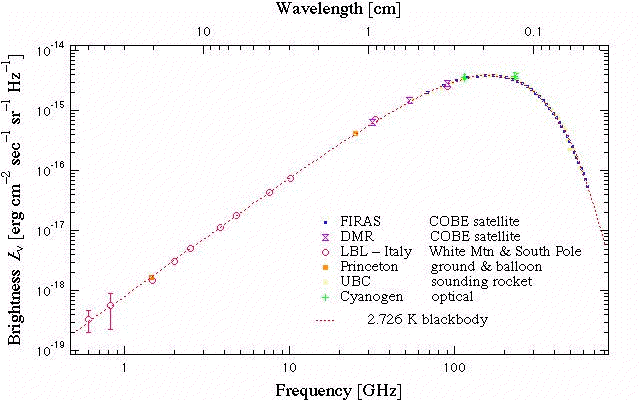
As the abstract makes clear we wrote this paper in response to a measurement of the spectrum of the cosmic microwave background radiation by the FIRAS instrument on the satellite COBE that had demonstrated that it was extremely well fitted by a Planck spectrum, with little room for any deviation away from a perfect black-body shape. Here’s the measured curve from COBE and some other experiments at the time:

The accuracy of the fit allows one to place limits on any process happening in the early Universe that might produce a distortion of the spectrum. There are a number of things that could do this. Any energy released in the early Universe takes time to thermalise, i.e. for the radiation field and the matter to come into thermal equilibrium via Compton scattering, double Compton scattering and Bremsstrahlung. Imperfect thermalisation produces a spectrum which doesn’t quite match the Planck curve.

Two types of distortion are possible, both introduced in classic papers from 1969 and 1970 by Rashid Sunyaev and Ya. B. Zel’dovich. One type is called a y-distortion (which corresponds to photons being shifted from low frequency and the other is called a μ-distortion, which is described by inserting a chemical potential term to the usual Planck formula for the black-body spectrum. Observational limits on both forms of distortion are very tight : |y|<1.5 ×10-5; |μ|<1.5 ×10-5, which places stringent limits on any energy release, including that which would arise from the dissipation of primordial acoustic waves (which is what John and I concentrated on in the paper).

So why did interest in this get revived a few years ago? The answer to that is that advances in relevant technology have now made it possible to think about an experiment that can measure much smaller spectral distortions than has hitherto been possible. A proposal for an experiment, called PIXIE, which includes such a measurement, is described here. Although spectral distortions are only a secondary science goal for PIXIE, it could push down the upper limits quoted above by a factor of 1000 or so, at which level we should expect to see departures from the Planck curve within the standard model, which would be a very important test of basic cosmological theory.

That all depends on whether PIXIE – or something like it – goes ahead.


Deep Time and Doggerland

Posted in Biographical, Music, The Universe and Stuff with tags , , , , , on July 24, 2017 by telescoper

One of the bonuses on offer during the BBC Proms season on Radio 3 is the opportunity to listen to the fascinating discussions recorded over the road from the Albert Hall at Imperial College and broadcast during the intervals under the title of Proms Extra. Last week (at Prom Number 4) there was a discussion with the title Deep Time, taking its theme from the UK premier of a fascinating composition of the same name by Sir Harrison Birtwistle.

The Proms Extra programme focussed on `Deep Time’ in the sense in which it is used in geological, i.e. time as inferred from rock strata and the fossil record. In the course of the discussion mention was made of Doggerland which is not, as you might imagine, a theme park devoted to outdoor sexual activities, but an area now submerged beneath the North Sea that connected Great Britain to continental Europe during and after the last glacial period. About 12,000 years ago at the start of the Holocene Era, it is thought that the area now covered by the North Sea looked something like this:

(Picture credit: this website). Obviously the cities marked on the map where not there at the time! Britain was connected to mainland at this time, although much of the land mass was under glaciers at the time. At the end of the last ice age the glaciers retreated, sea levels rose and the area once covered by Doggerland was submerged. It is thought that this happened around 8500 years ago. Great Britain has been separated from the continent by less than 10,000 years.

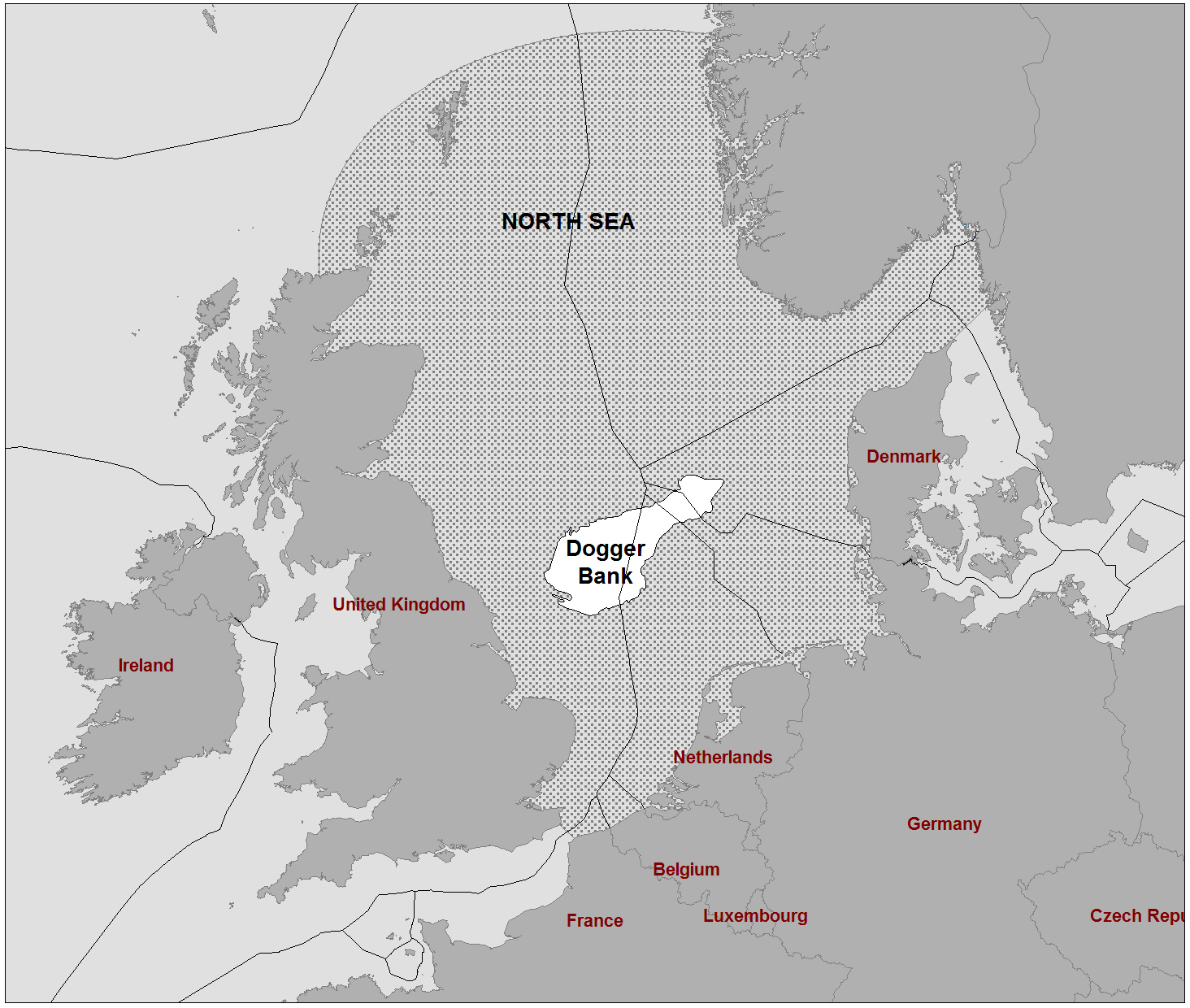
Doggerland gets its name from the Dogger Bank, a huge sandbank off the North-Eastern coast of England which is thought to be a glacial moraine left behind by the retreating ice sheet. The Dogger bank lies about 60 miles from the coast, and is about 60 miles wide by 100 miles long. The water is quite shallow – typically 20 metres deep and is a well-known fishing area. Its name derives from old Dutch fishing vessels called doggers who specialised in catching cod. Here’s a map (from here) showing the Dogger Bank:

When I was a teenager I had the opportunity, with a few friends from school, to go out from Newcastle in a trawler to the Dogger Bank. The skipper insisted that the Dogger Bank was, in places, so shallow that you could paddle around on it with your trousers rolled up. We all believed him, but he was clearly having us on!

The other thing I remember about that trip in a trawler – apart from the all-pervasive smell of fish – was that a bit of storm brewed up on the way home. All my school friends got sea-sick, but I didn’t. That was the first time I realised that I don’t suffer from seasickness. I can enjoy travelling on ships and boats without having to worry about it.

Dogger is of course also the name of one of the sea areas used in the Shipping Forecast: it is East of the coastal area Tyne, South of Forties, North of Humber and West of German Bight. Whenever I hear the shipping forecast on the radio, I always feel a bit of nostalgia when I hear the names of these areas read out.

Anyway, trawlers operating at the Dogger Bank frequently bring up bits of ancient animals (including mammoth and rhinoceros) as well as prehistoric human artefacts, showing that the area was at one time inhabited. I don’t think anybody knows exactly how long it took Doggerland to become submerged, but it may well have involved one or more catastrophic flooding events. If there were people living on Doggerland then,  they obviously had to migrate one way or the other..


Birthday Spam!

Posted in Biographical, History with tags , on July 5, 2017 by telescoper


I am reliably informed that the form of tinned meat known as Spam was first made available to the public exactly eighty years ago today, on 5th July 1937. The product is manufactured by the American Hormel Food Corporation, who own the trademark of the name.

Spam came to Britain largely because of the Second World War, during which food was in very short supply and  it was imported in large quantities via the Atlantic convoys. It was also part of a GI’s standard rations. I have to admit that I haven’t eaten spam for quite a long time, though I had it regularly when I was younger. It was served quite often as part of my school dinner, but I particularly enjoyed it in the form of a spam fritter from the local fish & chip shop:

And, finally, no discussion of spam would be complete without this..

Film Noir, Physics, and the Futility of Existence

Posted in Biographical, Literature, The Universe and Stuff with tags , , , , , on July 5, 2017 by telescoper

Last night I decided to treat myself to the umpteenth viewing of a DVD of the  classical film  Double Indemnity. It’s a great movie that repays repeated viewing and is historically important for many reasons, not least because when it was released in 1944 it immediately established much of the language and iconography of the genre that has come to be known as Film Noir , which I’ve written about on a number of occasions on this blog; see here, for example.

After watching the film I had a look on Twitter to see if I had any messages and saw a thread about how modern physics inspires, in some people, an all-pervading sense of existential angst.  In the light of that discussion I decided to use my morning off to rehash that old post and add a few embellishments.

It’s difficult to define exactly what turns a film noir, but there are some common characteristics. First the male lead protagonist is far from the dashing romantic character portrayed in mainstream Hollywood fare. Often a troubled and dysfunctional character, cynical and hard-bitten, distrustful and alienated, the classic noir anti-hero is often a private investigator or in any case a loner who lives in a kind of moral vacuum. To counterpoint this, the female lead is usually a femme fatale, glamorous but duplicitous, sexy and dangerous, manipulative and assertive. There are definitely shades of Macbeth in that the female lead is usually a more compelling and impressive personality than the supposed hero. The inversion of stereotypical roles also serves to hold a “dark mirror” up to society, an effect which other elements of these films also strive to achieve.

The plots usually deal with the seedy side of human life: crime, betrayal, jealousy and revenge, much of it sexually motivated. Narrative strategies involve repeated use of flashbacks, first-person voiceovers, dream-like sequences, and unresolved episodes that emphasize the overall lack of moral direction. The photography is dominated by high contrast lights surrounding the protagonists with dark, threatening shadows while odd angles and unbalanced framing produce unstable, disorienting images. The chiaroscuro lighting makes even mundane encounters seem charged with danger or erotic suspense.
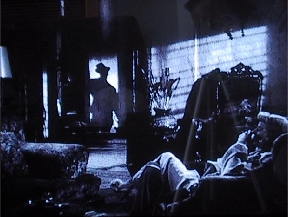
di6

This is a still from Double Indemnity which shows a number of trademark features. The shadows cast by Venetian blinds on the wall, the cigarette being smoked by Barbara Stanwyck and the curious construction of the mise en scene are all very characteristic of the style. What is even more wonderful about this particular shot however is the way the shadow of Fred McMurray’s character enters the scene before he does. The Barbara Stanwyck character is just about to shoot him with a pearl-handled revolver; this image seems to be hinting that he is already on his way to the underworld even before he arrives in the room.

Noir settings are almost exclusively urban: the resulting iconography consists of images of dark night-time cities with rain-soaked streets reflecting dazzling neon lights that intrude into the picture and fracture the composition. Interiors are almost always cramped and claustrophobic: dingy hotel rooms, night clubs or even the backs of taxi cabs. The dark outside world presses in on the characters and is full of danger. Soundtracks often include jazz in the bebop style from the late 1940s or early 1950s, with its jagged melodic lines and stuttering rythms, emphasizing the psychological instability displayed by the characters and settings.

The protagonists are trapped, perhaps just by mischance, in an alienating lonely world, usually a night-time city, where they are constantly in danger for their lives. The chaotic, random violence of this world gives rise to feelings of persecution and paranoia and a sense that life is absurd, meaningless, without order or purpose, and governed by contingency rather than design.

Much has been written about the origins of Film Noir, but it does seem clear to me that, although it is essentially an American style, it owes many of its roots to European existentialism, a point further reinforced by the fact that many great movie directors of the noir period (including the great Billy Wilder, who directed Double Indemnity) were in fact European emigres.

Anyway, I digress. What I wanted to say really was that during the course of watching all these wonderful films from a bygone age it struck me how much the language and iconography of modern cosmology shares this existentialist heritage. Our new standard cosmological model is full of references to the “dark” sector (dark matter and dark energy) which dominates the energy budget of the Universe, but which not just invisible but also unfathomable. The cosmos is lit by garish starlight from small islands of luminosity embedded in this sea of darkness. Long chains of bright galaxies stretch across space like rows of streetlights whose glare fractures and disturbs the celestial dark. We cling to a precarious existence on a tiny rock that is surrounded by danger. Even the stuff from which our atoms are made is completely overshadowed by alien matter. The universe is oblivious to us and we are irrelevant to it.

But it’s not only the surface imagery of cosmology that resembles that of a noir movie. The existentialist trend runs deep. Cosmology seems to be abandoning the idea that there is a design behind it all. The idea that there is a single explanatory principle “a theory of everything” that accounts for why our Universe is the way it is and why life is possible within it, is losing ground to the idea that there is a multiverse in which all possible laws of nature are realised; we just live in a place where life happens to be possible. I’m not at all convinced that it is a good route for science to follow, but many cosmologists seem to be accepting this kind of thing as the best we will ever do to explain the Universe.

The physicist Steven Weinberg summed up the way this view of the Universe challenges us:

It is almost irresistible for humans to believe that we have some special relation to the universe, that human life is not just a more-or-less farcical outcome of a chain of accidents reaching back to the first three minutes, but that we were somehow built in from the beginning. … It is very hard to realise that this is all just a tiny part of an overwhelmingly hostile universe. It is even harder to realise that this present universe has evolved from an unspeakably unfamiliar early condition, and faces a future extinction of endless cold or intolerable heat. The more the universe seems comprehensible, the more it also seems pointless.

In an interview he put it thus:

I believe that there is no point in the universe that can be discovered by the methods of science. I believe that what we have found so far, an impersonal universe in which it is not particularly directed toward human beings is what we are going to continue to find. And that when we find the ultimate laws of nature they will have a chilling, cold impersonal quality about them.

The influential American horror writer Howard Phillips Lovecraft (known to his friends as “H.P.”), wrote a letter in 1919 that argued much the same:

As you are aware, I have never been able to soothe myself with the sugary delusions of religion; for these things stand convicted of the utmost absurdity in light of modern scientific knowledge. With Nietzsche, I have been forced to confess that mankind as a whole has no goal or purpose whatsoever, but is a mere superfluous speck in the unfathomable vortices of infinity and eternity. Accordingly, I have hardly been able to experience anything which one could call real happiness; or to take as vital an interest in human affairs as can one who still retains the hallucination of a “great purpose” in the general plan of terrestrial life. … However, I have never permitted these circumstances to react upon my daily life; for it is obvious that although I have “nothing to live for”, I certainly have just as much as any other of the insignificant bacteria called human beings. I have thus been content to observe the phenomena about me with something like objective interest, and to feel a certain tranquillity which comes from perfect acceptance of my place as an inconsequential atom. In ceasing to care about most things, I have likewise ceased to suffer in many ways. There is a real restfulness in the scientific conviction that nothing matters very much; that the only legitimate aim of humanity is to minimise acute suffering for the majority, and to derive whatever satisfaction is derivable from the exercise of the mind in the pursuit of truth (from Letter to Reinhardt Kleiner  (14 September 1919), in Selected Letters I, 1911-1924 edited by August Derleth and Donald Wandrei, pp. 86-87).

I’ve thought about this quite a lot over the last few years and am gradually finding myself more and more in agreement with Lovecraft. I would say further that that one of the few things that make life bearable is the futility of existence. Futility is very reassuring. If all the shit that happens in this world were designed to serve some higher purpose then that really would be terrifying. And even more reassuring than its futility is the knowledge that we will soon return to dust and be quickly forgotten.

Here’s  Weinberg again, from the same interview quoted above:

…if there is no point in the universe that we discover by the methods of science, there is a point that we can give the universe by the way we live, by loving each other, by discovering things about nature, by creating works of art. And that — in a way, although we are not the stars in a cosmic drama, if the only drama we’re starring in is one that we are making up as we go along, it is not entirely ignoble that faced with this unloving, impersonal universe we make a little island of warmth and love and science and art for ourselves. That’s not an entirely despicable role for us to play.

Inspired by this, I’m going to make a point of existence not by doing science nor creating a work of art, but by making a nice cup of tea.

Astronomical and Other Events this Week

Posted in Biographical, The Universe and Stuff with tags , , , , , on July 4, 2017 by telescoper

This week sees the 2017 National Astronomy Meeting which is taking place in Hull (which, for those of you unfamiliar with British geography, is in the Midlands). I usually try to attend this annual event but this year haven’t been able to make it owing to other commitments. I’m particularly sad about this because I’ll miss seeing two old friends (Nick Kaiser and Marek Kukula) being presented with their RAS medals. Moreover, one of the pieces of astronomical research announced at this meeting that has been making headlines features my office mate and fellow resident of Pontcanna, Dr Emily Drabek-Maunder.

Anyway, to keep up with what’s going on at NAM2017 you can follow announcements on twitter:

This week also sees a meeting in Cambridge on Gravity and Black Holes to celebrate the 75th birthday of Stephen Hawking, which goes on until tomorrow (Wednesday 5th). This conference also looks like a very good one, covering a much wider range of topics than its title perhaps suggests. Stephen’s birthday was actually in January, but I hope it’s not too late to wish him many happy returns!

Finally, though not a conference as such, there’s annual Royal Society Summer Science exhibition going on in London this week too. This is a showcase for a wealth of scientific research including, this year, an exhibit about gravitational waves called Listening to Einstein’s Universe. There’s even a promotional video featuring some of my colleagues at Cardiff University (along with many others):

Anyway, if you’re in London and at a loose end and interested in science and that, do pop into the Royal Society and have a look. The Summer Science Exhibition is always well worth a visit!


Cosmology Caption Competition

Posted in Biographical, The Universe and Stuff with tags , , on July 3, 2017 by telescoper

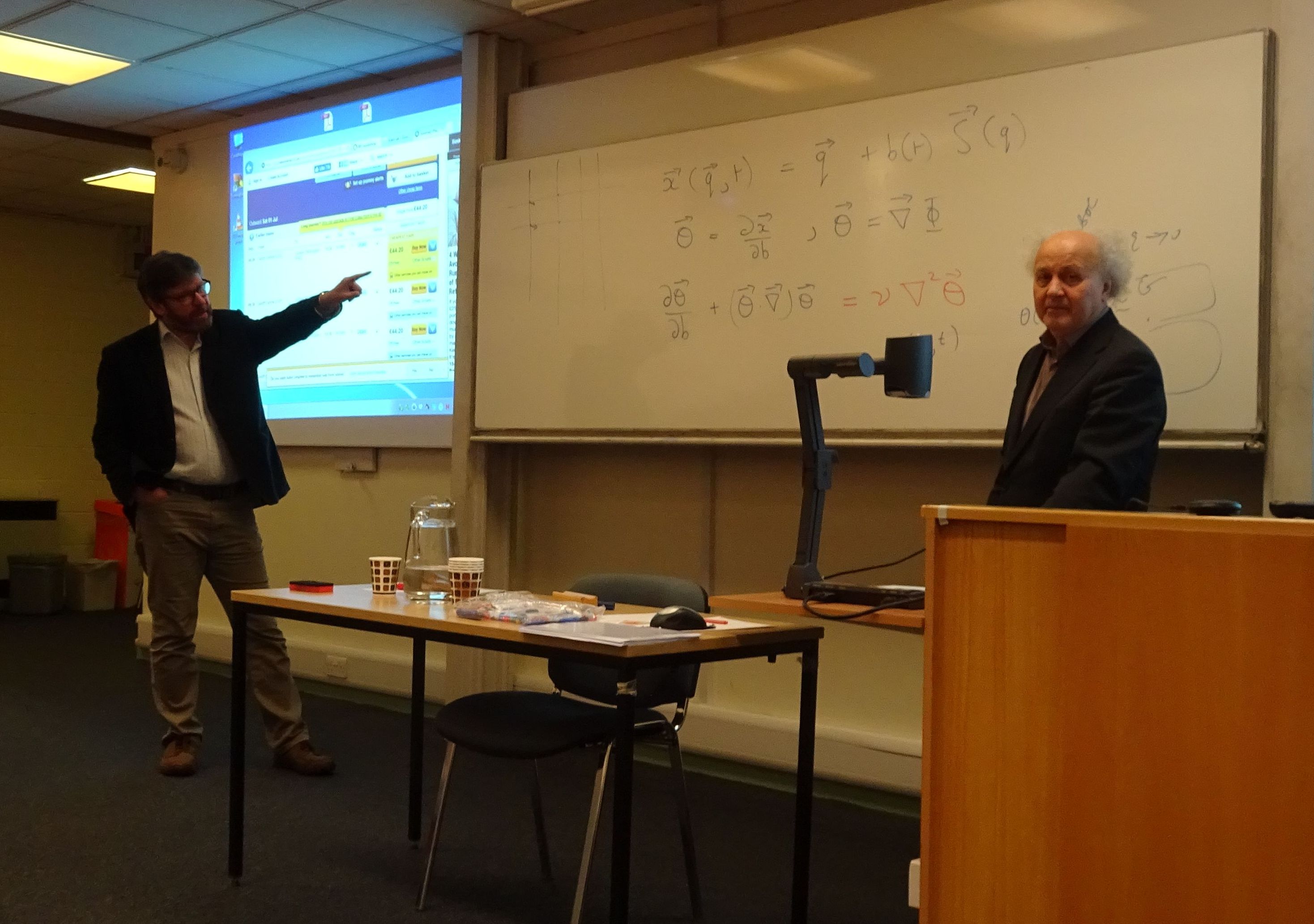
I’ve been a bit busy today so in lieu of a proper post I thought I’d try for a bit of audience participation. In one of the discussion sessions at last week’s workshop on Isotropic Random Fields in Astrophysics I was called upon to deliver a very short impromptu talk on cosmological applications of Burger’s Burgers Equation, during the course of which the following photograph was taken. Appropriate (or inappropriate) suggestions for captions, please, through the comments box!

Biographical Note

Posted in Biographical, Cardiff, Crosswords with tags , , on July 1, 2017 by telescoper

It’s 1st July 2017, which means that it is ten years to the day since I officially started work at Cardiff University (for the first time). Can it really be so long ago? 

Quite a lot has happened in the intervening decade, including spending three and a half years at the University of Sussex before returning to Cardiff last summer.

The first of July was actually a Sunday in 2007, so my last day at work in my previous position at the University of Nottingham was Friday 29th June. I remember they threw a nice leaving party that afternoon and also persuaded me to sign up to Facebook to keep in touch. Facebook reminded me of this on Thursday.

I was a bit slow in putting my house in Beeston on the market in 2007, and rented a flat in Cardiff while I sorted that out. Unfortunately the Credit Crunch and I didn’t actually manage to move permanently to a little house in Pontcanna for almost a year. In the meantime I had to travel regularly to and fro between Cardiff and Nottingham by train.

The main thing I remember about the summer of 2007 was the extensive flooding, much of which was located in South Wales and up the Severn towards Gloucester and beyond. That is precisely the route that the train takes from Cardiff to Nottingham so I had quite a few travel problems!

I didn’t actually start blogging until 2008 when I was firmly established in the house I bought here in Cardiff, and which I’m sitting now as I write this rambling post. 

They say that ‘all good things come to an end’, which implies that this blog should carry on forever. Maybe I’ll keep it going until its tenth anniversary, after which…well, we’ll see. Vitae Summa Brevis Spem Nos Vetat Incohare Longam.

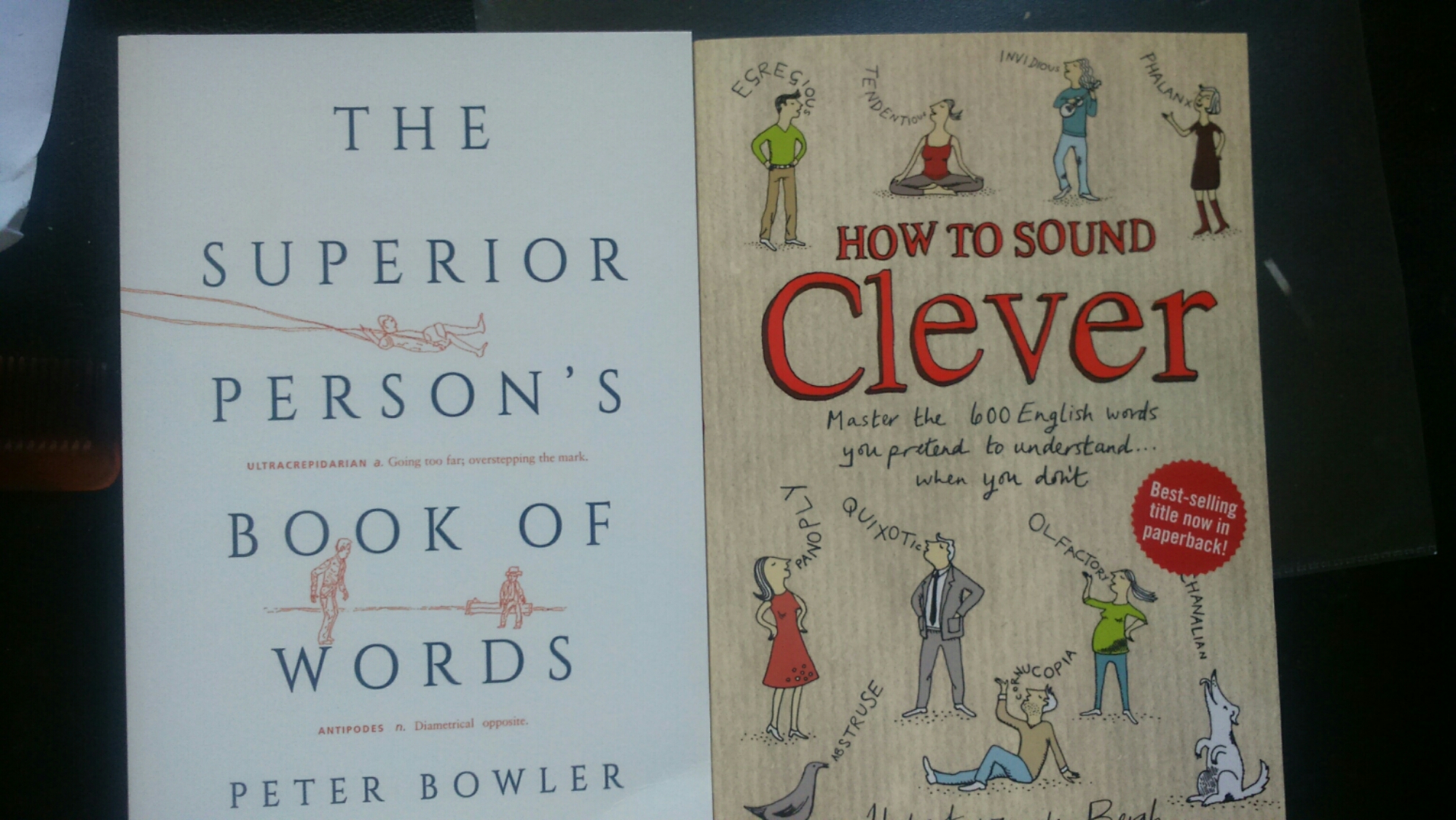
Anyway, although pipped at the post for this year’s Beard of Summer award I did receive a bit of good news in today’s paper by way of compensation!

In fact the two books arrived in the post yesterday. I’ll be disposing of them at work in due course..


MSc Opportunities in Data-Intensive Physics and Astrophysics

Posted in Biographical, Education with tags , , , , on June 22, 2017 by telescoper

Back to the office after external examining duties, I received an email this morning to say that the results have now been posted in Cambridge. I also had an email from Miss Lemon at Sussex that told me that their finalists’ results went up last Friday. We did ours in Cardiff last week. This provides me with a timely opportunity to congratulate all students at all three of these institutions – and indeed everywhere else – on their success!

It also occurred to me tha,t now that most students know how well they’ve done in their undergraduate degree, some may be thinking about further study, at postgraduate level. It seems a good opportunity to remind potential applicants about our two brand new MSc courses at Masters (MSc) level, called Data-Intensive Physics and Data-Intensive Astrophysics and they are both taught jointly by staff in the School of Physics and Astronomy and the School of Computer Science and Informatics in a kind of major/minor combination.

The aim of these courses is twofold.

One is to provide specialist postgraduate training for students wishing to go into academic research in a ‘data-intensive’ area of physics or astrophysics, by which I mean a field which involves the analysis and manipulation of very large or complex data sets and/or the use of high-performance computing for, e.g., simulation work. There is a shortage of postgraduates with the necessary combination of skills to undertake academic research in such areas, and we plan to try to fill the gap with these courses.

The other aim is to cater for students who may not have made up their mind whether to go into academic research, but wish to keep their options open while pursuing a postgraduate course. The unique combination of physics/astrophysics and computer science will give those with these qualifications the option of either continuing or going into another sphere of data-intensive research in the wider world of Big Data.

The motivation for these courses has been further strengthened recently by the announcement earlier this year of extra funding for PhD research in Data-Intensive Physics. We’ve been selecting students for this programme and making other preparations for the arrival of the first cohort in September. We’ve had many more applicants than we can accommodate this time, but this looks set to be a growth area for the future so anyone thinking of putting themselves in a good position for a PhD in Data-Intensive Physics or Astrophysics in the future might think about preparing by taking a Masters in Data-Intensive Physics or Astrophysics now!

I just checked on our admissions system and saw, as expected, conditional offers turning into firm acceptances now that the finals exam results are being published across the country but we have still got plenty of room on these courses so if you’re thinking about applying, please be assured that we’re still accepting new applications!


Cambridge Heat

Posted in Biographical on June 19, 2017 by telescoper

I’m in Cambridge, where it is very hot, for a few days on external examining duty for Part II and Part III of the Natural Sciences Tripos (Physics).

My trip here from Cardiff didn’t go entirely as planned. I had intended to catch the 10.26 from Cardiff to London Paddington, but the train that should have formed that service was so late that it was cancelled, or rather `retimed’ to be the 10.56. That train trundled through countryside getting later and later until it stopped entirely at Hayes, where it got stuck behind a stricken overhead power line. And at Hayes we sat for the best part of an hour. I had planned to arrive at Paddington at about 12.30, but actually got there at 2.30…

I didn’t arrive in Cambridge until after 4pm, and was not inconsiderably flustered. I hadn’t even had any lunch, though I was somewhat relieved to discover that the other external examiner had similar problems and was actually even later than me. Fortunately we were able to rearrange the meeting we had planned and managed to get through (by about 8pm) the preparations needed for the meeting of the Board of Examiners planned for tomorrow morning at 9.30am.

A couple of beers and burger later I’m now in my hotel room and feeling a little more mellow.

It’s a bit warmer than previous years I’ve been here at this time of year, but otherwise it’s the same: we passed crowds of young people in their glad rags queuing for various May Balls. No doubt we’ll meet the bedraggled remnants tomorrow morning on the way back to the Cavendish.

And now, if you’ll excuse me I’m going to have a cup of tea and relax. It’s been a long day…

Week Ending

Posted in Biographical on June 16, 2017 by telescoper

I’ve spent most of today involved in interviewing prospective PhD students for our new Centre for Doctoral Training in Data-Intensive Science run jointly between the universities of Bristol and Swansea which I advertised on here just a couple of months ago. I spent most of Monday in Bristol meeting representatives of industrial and other businesses, who are offering placement opportunities for PhD students on this new scheme. This activity is taking up quite a lot of my time these days and it’s not over yet as we haven’t yet finished the process of recruiting students which has to be done in connection with our academic and business partners.

I’ll be in Cambridge for the first half of next week, on external examining duties, and then the following week we have our little workshop on Random Fields. People generally think that, once our undergraduate lecture courses are finished and associated examinations are marked, we are free to do research until October. If only. There are many other things to be done.

Anyway that’s enough for this week. I’m off to the pub for a pint. Have a good weekend!