Archive for the Biographical Category

Examination Time Again

Posted in Biographical, Education with tags , , , , , on May 11, 2015 by telescoper

Once again it’s time for examinations at the University of Sussex, so here’s a lazy rehash of my previous offerings on the subject that I’ve posted around this time each year since I started blogging.

My feelings about examinations agree pretty much with those of  William Wordsworth, who studied at the same University as me, as expressed in this quotation from The Prelude:

Of College labours, of the Lecturer’s room
All studded round, as thick as chairs could stand,
With loyal students, faithful to their books,
Half-and-half idlers, hardy recusants,
And honest dunces–of important days,
Examinations, when the man was weighed
As in a balance! of excessive hopes,
Tremblings withal and commendable fears,
Small jealousies, and triumphs good or bad–
Let others that know more speak as they know.
Such glory was but little sought by me,
And little won.

It seems to me a great a pity that our system of education – both at School and University – places such a great emphasis on examination and assessment to the detriment of real learning. On previous occasions, before I moved to the University of Sussex, I’ve bemoaned the role that modularisation has played in this process, especially in my own discipline of physics.

Don’t get me wrong. I’m not opposed to modularisation in principle. I just think the way modules are used in many British universities fails to develop any understanding of the interconnection between different aspects of the subject. That’s an educational disaster because what is most exciting and compelling about physics is its essential unity. Splitting it into little boxes, taught on their own with no relationship to the other boxes, provides us with no scope to nurture the kind of lateral thinking that is key to the way physicists attempt to solve problems. The small size of many module makes the syllabus very “bitty” and fragmented. No sooner have you started to explore something at a proper level than the module is over. More advanced modules, following perhaps the following year, have to recap a large fraction of the earlier modules so there isn’t time to go as deep as one would like even over the whole curriculum.

In most UK universities (including Sussex), tudents take 120 “credits” in a year, split into two semesters. In many institutions, these are split into 10-credit modules with an examination at the end of each semester; there are two semesters per year. Laboratories, projects, and other continuously-assessed work do not involve a written examination, so the system means that a typical  student will have 5 written examination papers in January and another 5 in May. Each paper is usually of two hours’ duration.

Such an arrangement means a heavy ratio of assessment to education, one that has risen sharply over the last decades,  with the undeniable result that academic standards in physics have fallen across the sector. The system encourages students to think of modules as little bit-sized bits of education to be consumed and then forgotten. Instead of learning to rely on their brains to solve problems, students tend to approach learning by memorising chunks of their notes and regurgitating them in the exam. I find it very sad when students ask me what derivations they should memorize to prepare for examinations. A brain is so much more than a memory device. What we should be doing is giving students the confidence to think for themselves and use their intellect to its full potential rather than encouraging rote learning.

You can contrast this diet of examinations with the regime when I was an undergraduate. My entire degree result was based on six three-hour written examinations taken at the end of my final year, rather than something like 30 examinations taken over 3 years. Moreover, my finals were all in a three-day period. Morning and afternoon exams for three consecutive days is an ordeal I wouldn’t wish on anyone so I’m not saying the old days were better, but I do think we’ve gone far too far to the opposite extreme. The one good thing about the system I went through was that there was no possibility of passing examinations on memory alone. Since they were so close together there was no way of mugging up anything in between them. I only got through  by figuring things out in the exam room.

I think the system we have here at the University of Sussex is much better than I’ve experienced elsewhere. For a start the basic module size is 15 credits. This means that students are usually only doing four things in parallel, and they consequently have fewer examinations, especially since they also take laboratory classes and other modules which don’t have a set examination at the end. There’s also a sizeable continuously assessed component (30%) for most modules so it doesn’t all rest on one paper. Although in my view there’s still too much emphasis on assessment and too little on the joy of finding things out, it’s much less pronounced than elsewhere. Maybe that’s one of the reasons why the Department of Physics & Astronomy does so consistently well in the National Student Survey?

We also have modules called Skills in Physics which focus on developing the problem-solving skills I mentioned above; these are taught through a mixture of lectures and small-group tutorials. I don’t know what the students think of these sessions, but I always enjoy them because the problems set for each session are generally a bit wacky, some of them being very testing. In fact I’d say that I’m very impressed at the technical level of the modules in the Department of Physics & Astronomy generally. I’ve been teaching Green’s Functions, Conformal Transformations and the Calculus of Variations to second-year students this semester. Those topics weren’t on the syllabus at all in my previous institution!

Anyway, my Theoretical Physics paper is next week (on 18th May) so I’ll find out if the students managed to learn anything despite having such a lousy lecturer. Which reminds me, I must remember to post some worked examples online to help them with their revision.
100 Years of Ladybird Books

Posted in Biographical, Education, Literature with tags , , , , on May 10, 2015 by telescoper

And now for something completely different.

Not a lot of people know that this year marks the centenary of Ladybird Books. That name is redolent with nostalgia for me and I suspect also for many other readers of this blog, as the Ladybird series played a major part in my education. I’ve written on a previous occasion about what a slow learner I was as a child – I didn’t really speak until I well after my third birthday  – but once I got the hang of books I became a voracious reader, with the Ladybird series forming a large part of my diet. Once a month or so on a Friday in the School of Mathematical and Physical Sciences we have afternoon tea and cake just to bring staff and students together for an informal gathering. Each time the cake has a different theme and this time we decided to celebrate the centenary of  Ladybird Books, not least because they played such a significant role in my education.

Here is the cake (designed by the inestimable Dorothy Lamb, who also knitted some Ladybird toys for the occasion). The two covers chosen were from the Ladbybird Junior Science Series, Lights, Mirrors and Lenses and Magnets, Bulbs and Batteries both of which editions were published in 1962. Seeing these covers again brought back a flood of memories of my own childhood in the 1960s.

LadyBird

I wish to make it clear that we did request, and were granted, copyright clearance by Penguin Books (who own the Ladybird imprint) to reproduce the covers, not that they lasted very long – about 20 minutes after that picture was taken the cake had been entirely consumed.

Anyway, we weren’t the only people in Sussex to be celebrating the centenary of Ladybird books.  Today (10th May 2015) was the last day of an exhibition called Ladybird by Design at the splendid De La Warr Pavilion in Bexhill-on-Sea. If you missed it here’s a video describing it.

P.S. I should also mention that one of the interesting things about Sussex University  is the abundance of ladybirds on Falmer campus. I’m not sure what makes it such an attractive residence for these fascinating creatures, but no doubt there will be an entomologist out there who can tell me!

Polling Day Memories

Posted in Biographical, Politics with tags , , , , on May 7, 2015 by telescoper

At last we’ve reached General Election day and I’ve just been to cast my vote in the crypt of St George’s Church in Kemptown, very close to my Brighton residence.  It was quite busy this morning when I got there, and I had to queue to get my ballot paper. I don’t know what the turnout is like this time, but I hope it’s good. I don’t think there’s really any excuse for not voting, although some people seem to prefer to whinge than to vote.

I doubt if I’ll stay up late tonight to watch the results come in. Polls don’t close until 10pm and until then there’s a blackout of press coverage relating to the vote so there’s nothing to follow until quite late at night, when I’m usually tucked up in bed with my cocoa.  The latest opinion polls suggest that the Conservative Party may just get the biggest share of the vote, but it is highly unlikely they’ll win a majority of the seats. The likelihood therefore is abother hung parliament, at which point there’ll be some frantic negotiation behind the scenes. It will still be interesting to see how the horse-trading works out over the next few days, but after three weeks of phoney war we’ll soon have to face up to reality. I’m not really looking forward to that.

On the corresponding Polling Day eighteen years ago in 1997 I was actually in Lawrence, Kansas. Don’t ask me why. I’d arranged a postal vote, but had to watch the proceedings from afar on the TV. Some expat British friends of mine decided to hold a party that night in their house and I went along to drink beer while the results came in. Watching a British election from the midwest USA is a bit strange, but it’s improved by the fact that the polls close in the UK at what is early evening Kansas-time and it’s all pretty much over by midnight.

That election I was swept up in the euphoria generated by the prospect of a New Labour government with its slogan “Things can only get better”. When they won a landslide majority we celebrated in grand style, singing Jerusalem in the back garden and then tottered not-too-soberly to a tattoo parlour to have a red rose put on my arm.

We had a great time that night, and the good vibes continued after I returned to London from my short stay at the University of Kansas. It didn’t take long, however, for my enthusiasm to wane. Instead of doing the really radical things their large majority would have allowed, they didn’t seem to have the gumption to tackle the really important issues. Then of course Blair took us into Iraq and, despite having voted Labour all my life before then, I vowed never again to vote for the Labour Party while it was led by the people that made that decision.

But I’ve still got the red rose tattoo and this time I returned to the fold by voting for Nancy Platts in Brighton Kemptown. I wasn’t initially very impressed with Ed Miliband but I have changed my mind over the last few weeks. I think during this campaign he has behaved with great dignity and strength of character in the face of some pretty nasty personal attacks from his political opponents. Now I really hope that Ed Miliband leads the next Goverment of the United Kingdom, although it will probably only be able to do so in some sort of coalition with the Scottish Nationalist Party and possibly the Liberal Democrats.

For what it’s worth, my predictions for the consituencies in Brighton is that Labour will win both Kemptown and Hove, whereas in Pavilion Caroline Lucas of the Green Pary will hold the seat for the Conservatives.

But whether or not you agree with my political opinions, please get out there and vote. Tomorrow, VE Day, is the 70th Anniversary of the end of the Second World War in Europe. Remember that as you cast your vote, and have faith in the democracy so many gave their lives to defend.

Dark Energy and its Discontents – the Talk

Posted in Biographical, Books, The Universe and Stuff with tags , , , on April 28, 2015 by telescoper

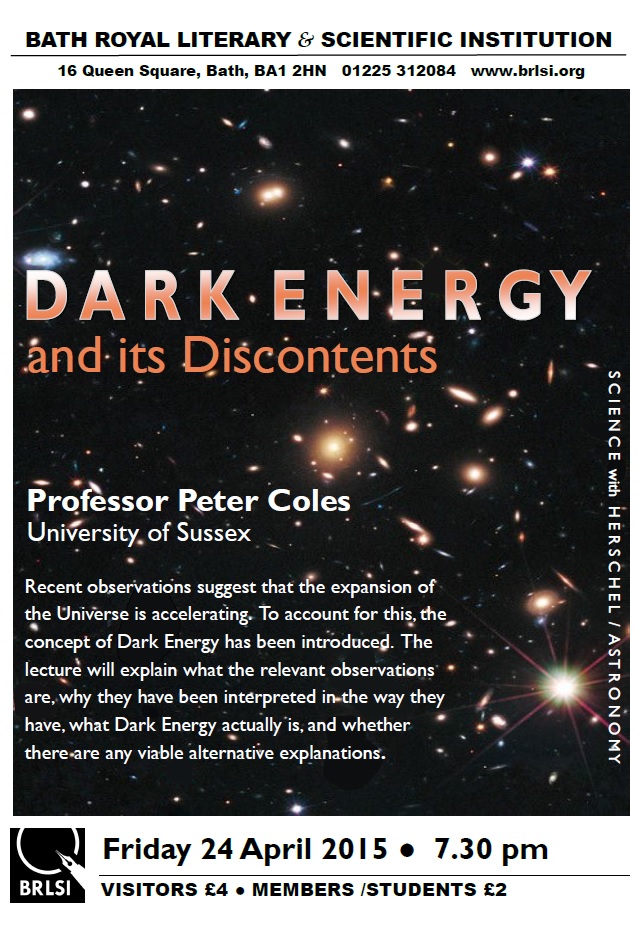
Yet another very busy day, so I just have time to post the slides of the talk I gave last week, on  Friday 24th April 2015, entitled Dark Energy and its Discontents, at the very posh-sounding Bath Royal Literary and Scientific Institution. Here is the poster


Bath_lecture


And here are the slides – though I didn’t get through them all on the night!…

A Happy Hubble Coincidence

Posted in Biographical, Books, The Universe and Stuff with tags , , , on April 25, 2015 by telescoper

image

Preoccupied with getting ready for my talk in Bath  I forgot t post an item pointing out that yesterday was the 25th anniversary of the launch of the Hubble Space Telescope. Can it really be so long?

Anyway, many happy returns to Hubble. I did manage to preempt the celebrations however by choosing the above picture of the Hubble Ultra Deep Field as the background fo the poster advertising the talk.

Anyway it went reasonably well. There was a full house and questions went on quite a while. Thanks to Bath Royal Literary and Scientific Institution for the invitation!

Dark Energy and its Discontents

Posted in Biographical, Books, The Universe and Stuff with tags , on April 24, 2015 by telescoper

Just time for a spot of gratuitous self-promotion. I shall be giving a public lecture tonight, Friday 24th April 2015, entitled Dark Energy and its Discontents, at the very posh-sounding Bath Royal Literary and Scientific Institution.
I am just finishing the slides for the talk, and packing some dark energy in my bag to use as a demonstration.
Here is the poster for tonight’s event, which explains all…

Bath_lecture

Perhaps I’ll see the odd reader of this blog there?

Mental Health at Work – to Declare or not to Declare?

Posted in Biographical, Mental Health with tags , on April 19, 2015 by telescoper

I couldn’t resist a comment on a recent article in the Times Higher  (written in response to an earlier piece expressing an opposite view). The question addressed by these articles is whether a member of University staff should be open about mental health issues or not. The latest comes down firmly on “no” side. Although I understand the argument, I disagree very strongly with this conclusion.

In fact I’ve taken this a bit further than just disclosing my problems to my employer; I’ve even blogged about them, both here and elsewhere. I also stood up in the University of Sussex Senate about two years ago and spoke about them there. That latter episode was in response to the attempts by some members of Senate to play down the extent of the violence and intimidation associated with a protest on campus that erupted into a full-scale riot on March 2013, accompanied by theft, vandalism and arson. Since violence is the root cause of my longstanding troubles I was incensed by the casual attitude some academics displayed about something that should never be tolerated. I don’t know whether my intervention had any effect on the discussion but I felt I had to make my point. It still troubles me, in fact, that the culprits have still not been brought to justice, and that some of them undoubtedly remain at large on campus even today.

Anyway, two full years have passed since then and I have received nothing but supportive comments from colleagues both in the School and among senior managers in the University.

When I applied for my current job at Sussex, it was just after I’d recovered from a serious breakdown. When I was offered the position, paperwork arrived that included a form on which to declare any health issues (including mental health). I have moved around several times in my career and have never made a declaration on such a form before, but this time I felt that I should especially because I was still taking medication then. I did wonder whether I might be declared unfit to take up a job that promised to have a fair share of stress associated with it. In the end, though, what happened was that I was put in touch with the Occupational Health department who offered their services if there was anything they could do to help. All these discussions were confidential.

I think it is very important that staff do declare problems with depression or other mental health issues. That’s the only way to be sure of getting the support you need. It’s also important for your colleagues to be able to put arrangements in place if you need to take some time off. On top of all that, employers need to learn how widespread such problems can be so they can try to deal with any factors that might exacerbate existing conditions, such as work-related stress.

Going back to the article in the Times Higher, though. I should say that I can understand the author’s reluctance. It took me twenty-five years so I am hardly in a position to criticise anyone! I was particularly struck by this section:

To disguise my illness, I try my best to be the very opposite of what depressed people are. I become the funniest, the smiliest and the most supportive colleague at work. At times, the performance succeeds and I feel a fleeting sense of being invincible. However, this feeling quickly dissipates and I am left feeling utterly alone, dark and lost. A colleague once said to me that she thought I was the most positive person she had ever met and that everyone enjoyed working with me. I couldn’t say anything to her in that moment. But if I was to speak my truth, it would have been to tell her that I was probably the darkest and saddest of her colleagues. That darkness frightens the hell out of me – so I keep it to myself.

That will ring very true to anyone who is living with mental illness; it becomes part of who you are, and it does mean that you find somethings very difficult or impossible that other people take for granted, no matter how effective your medication is. Putting on a brave face is just one way to avoid dealing with it, but it’s just a form of denial. Another common avoidance strategy is to make up fake excuses for absence from events that fill you with dread. I’ve done that a number of times over the years and although it provides short-term relief, it leaves you with a sense of shame at your own dishonesty that is damaging in the long run to your sense of self-worth and will only serve to give you a reputation for unreliability. The darkness can indeed be frightening but it does not follow that you should keep it to yourself. You should share it – not necessarily with friends and colleagues, who may not know how to help – but with compassionate and highly trained professional counsellors who really can help. It will also help your institution provide more and better assistance.

This is not to say that there isn’t a downside to being open about mental health issues. Now that my own genie is not only out of the bottle but all over the internet I do wonder what the future holds in store for my career beyond my current position. Then again I’m not at all sure what I want to happen. Only time will tell.

End of Term Balls

Posted in Biographical, Education with tags , , , , on April 18, 2015 by telescoper

I haven’t had time to post for the last couple of days because I’ve been too bust with end-of-term business (and pleasure). Yesterday (Friday) was the last day of teaching term and this week I had to get a lot of things finished because of various deadlines, as well as attending numerous meetings. It’s been quite an exhausting week, not just because of that but also because by tradition the two departments within the School of Mathematical and Physical Sciences at the University of Sussex, the Department of Mathematics and the Department of Physics & Astronomy, hold their annual Staff-Student Balls on consecutive days. When I arrived here just over two years ago I decided that I should attend both or neither, as to attend at only one would look like favouritism. In fact this is the third time I’ve attended both of them. Let no-one say I don’t take my obligations seriously.  It’s a tough job, but someone has to do it. Holding both balls so close together  poses some problems for a person of my age, but I coped and also tried to weigh them up relative to each other and see  which was  most impressive.

Actually, both were really well organized. The Mathematics Ball was held in the elegant Hilton Metropole hotel and the Physics one in the Holiday Inn, both on the seafront. As has been the case in previous years the Mathematics ball is a bit more refined and sedate, the Physics one a little more raucous. Also this year there was a very large difference in the number of people going, with over 200 at the Physics Ball and only just over half that number at the Mathematics one. In terms of all-round fun I have to declare the Physics Ball the winner last year, but both occasions were very enjoyable. I’d like to say a very public thank you to the organizers of both events, especially Sinem and Jordan for Mathematics and Francis for Physics. Very well done.

The highlight of the Physics Ball was an after-dinner speech by particle physicist Jon Butterworth, who has an excellent blog called Life and Physics on the Guardian website. I’ve actually been in contact with Jon many times through social media (especially Twitter) over a period of over six years, but we never actually met in person until last night. I think he was a bit nervous beforehand because he had never done an after-dinner speech before, in the end though his talk was funny and wise, and extremely well received. Mind you, I did make it easy for him by giving a short speech to introduce him, and after a speech by me almost anyone would look good!

Thereafter the evening continued with drinking and dancing. After a while most people present were rather tired and emotional.  I even think some might even have been drunk. I eventually got home about 2am, after declining an invitation to go to the after-party. I’m far too old for that sort of thing. Social events like this can be a little bit difficult, for a number of reasons. One is that there’s an inevitable “distance” between students and staff, not just in terms of age but also in the sense that the staff have positions of responsibility for the students. Students are not children, of course, so we’re not legally  in loco parentis, but something of that kind of relationship is definitely there. Although it doesn’t stop either side letting their hair down once in a while, I always find there’s a little bit of tension especially if the revels get a bit out of hand. To help occasions like this run smoothly I think it’s the responsibility of the staff members present to drink heavily in order to put the students at ease. United by a common bond of inebriation, the staff-student divide crumbles and a good time is had by all.

There’s another thing I find a bit strange. Chatting to students last night was the first time I had spoken to many of my students like that, i.e. outside the lecture  or tutorial. I see the same faces in my lectures day in, day out but all I do is talk to them about physics. I really don’t know much about them at all. But it is especially nice when on occasions like this students come up, as several did last night, and say that they enjoyed my lectures. Actually, it’s more than just nice. Amid all the bureaucracy and committee meetings, it’s very valuable to be reminded what the job is really all about.


P.S. Apologies for not having any pictures. I left my phone in the office on Friday when I went home to get changed. I will post some if anyone can supply appropriate images. Or, better still, inappropriate ones!


Interlude

Posted in Biographical, Uncategorized with tags , , on April 1, 2015 by telescoper

The University of Sussex is closing down for a week to allow people to take a breather around Easter weekend. After this afternoon’s staff meeting, I will heading off for a week’s holiday and probably won’t be blogging until I get back, primarily because I won’t have an internet connection where I’m going. That’s a deliberate decision, by the way….

So, as the saying goes, there will now follow a short intermission….

PS. The suitably restful and very typical bit of 1950s  “light” music accompanying this is called Pastoral Montage, and it was written by South African born composer Gideon Fagan.


Found in Translation…

Posted in Biographical, Books, Books, Talks and Reviews with tags on March 30, 2015 by telescoper

A nice surprise was waiting for me when I arrived at work this morning in the form of a parcel from Oxford University Press containing six copies of the new Arabic edition of my book  Cosmology: A Very Short Introduction. I think I’ve put them the right way up. I was a bit confused because they open the opposite way to books in English, as arabic is read from right to left rather than from left to right.

VSI-Arabic

Anyway, although I can’t read Arabic it’s nice to have these to put with the other foreign editions, including these. I still can’t remember whether the first one is Japanese or Korean…

vsi_6

vsi_2

vsi_3

Vsi_5

vsi_4

…still, it’s interesting to see how they’ve chosen different covers for the different translations, and at least I know what my name looks like in Russian Bulgarian!