Archive for the Biographical Category

Science, Art and The Song of the Lyre Bird

Posted in Biographical, Science Politics, The Universe and Stuff with tags , , , , , , , on February 10, 2015 by telescoper

I’ve posted this before but I thought I would do so again, just because it’s so marvellous.

I wonder what you felt as you watched it?  What went through your mind? Amusement? Fascination?  I’ll tell you how it was for me when I first saw it.  I marvelled.

Seeing the extraordinary behaviour of this incredible creature filled me with a sense of wonder. But I also began to wonder in another sense too. How did the Lyre Bird evolve its bizarre strategy? How does it learn to be such an accurate mimic? How does it produce such a fascinating variety of sounds? How can there be an evolutionary advantage in luring a potential mate to the sound of foresters and a chainsaw?

The Lyre Bird deploys its resources in such an elaborate and expensive way that you might be inclined to mock it, if all it does is draw females to “look at its plumes”.  I can think of quite a few blokes who adopt not-too-dissimilar strategies, if truth be told. But if you could ask a Lyre Bird it would probably answer that it does this because that’s what it does. The song defines the bird. That’s its nature.

I was moved to post the clip some time ago in response to a characteristically snide and ill-informed piece by Simon Jenkins in the Guardian. Jenkins indulges in an anti-science rant every now and again. Sometimes he has a point, in fact. But that article was just puerile. Perhaps he had a bad experience of science at school and never got over it.

I suppose I can understand why some people are cynical about scientists stepping into the public eye to proselytise about science. After all, it’s also quite easy to come up with examples of  scientists who have made mistakes. Sadly, there are also cases of outright dishonesty. The inference is that science is no good because scientists are fallible. But scientists are people, no better and no worse than the rest. To err is human and all that.  We shouldn’t expect scientists to be superhuman any more than we should believe the occasional megalomaniac who says they are.

To many people fundamental physics is a just a load of incomprehensible gibberish, the Large Hadron Collider a monstrous waste of money, and astronomy of no greater value to the world than astrology. Any scientist trying to communicate science to the public must be trying to hoodwink them, to rob them of the schools and hospitals that their taxes should be building and sacrifice their hard-earned income on the altar of yet another phoney religion.

And now the BBC is participating in this con-trick by actually broadcasting popular programmes about science that have generated huge and appreciative audiences. Simon Jenkins obviously feels threatened by it. He’s probably not alone.

I don’t  have anything like the public profile of the target of Jenkins’ vitriol, Lord Rees, but I try to do my share of science communication. I give public lectures from time to time and write popular articles, whenever I’m asked. I also answer science questions by email from the general public, and some of the pieces I post on here receive a reasonably wide distribution too.

Why do I (and most of my colleagues) do all this sort of stuff? Is it because we’re after your money?  Actually, no it isn’t. Not directly, anyway.

I do all this stuff because, after 25 years as a scientist, I still have a sense of wonder about the universe. I want to share that as much as I can with others. Moreover,  I’ve been lucky enough to find a career that allows me to get paid for indulging my scientific curiosity and I’m fully aware that it’s Joe Public that pays for me to do it. I’m happy they do so, and happier still that people will turn up on a rainy night to hear me talk about cosmology or astrophysics. I do this because I love doing science, and want other people to love it  too.

Scientists are wont to play the utilitarian card when asked about why the public should fund fundamental research. Lord Rees did this in his Reith Lectures, in fact. Physics has given us countless spin-offs – TV sets, digital computers,  the internet, you name it – that have created wealth for UK plc out of all proportion to the modest investment it has received. If you think the British government spends too much on science, then perhaps you could try to find the excessive sum on this picture.

Yes, the LHC is expensive but the cost was shared by a large number of countries and was spread over a long time. The financial burden to the UK now amounts to the cost of a cup of coffee per year for each taxpayer in the country. I’d compare this wonderful exercise in friendly international cooperation with the billions we’re about to waste on the Trident nuclear weapons programme which is being built on the assumption that international relations must involve mutual hatred.

This is the sort of argument that gets politicians interested, but scientists must be wary of it. If particle physics is good because it has spin-offs that can be applied in, e.g. medicine, then why not just give the money to medical research?

I’m not often put in situations where I have to answer questions like why we should spend money on astronomy or particle physics but, when I am, I always feel uncomfortable wheeling out the economic impact argument. Not because I don’t believe it’s true, but because I don’t think it’s the real reason for doing science. I know the following argument won’t cut any ice in the Treasury, but it’s what I really think as a scientist (and a human being).

What makes humans different from other animals? What defines us? I don’t know what the full answer to that is, or even if it has a single answer, but I’d say one of the things that we do is ask questions and try to answer them. Science isn’t the only way we do this. There are many complementary modes of enquiry of which the scientific method is just one. Generally speaking, though, we’re curious creatures.

I think the state should support science but I also think it should support the fine arts, literature, humanities and the rest, for their own sake. Because they’re things we do. They  make us human. Without them we’re just like any other animal that consumes and reproduces.

So the real reason why the government should support science is the song of the Lyre Bird.  No, I don’t mean as an elaborate mating ritual. I don’t think physics will help you pull the birds. What I mean is that even in this materialistic, money-obsessed world we still haven’t lost the  need to wonder, for the joy it brings and for the way it stimulates our minds; science doesn’t inhibit wonder, as Jenkins argues,  it sparks it.

Now, anyone want to see my plumes?

Digit Ratio Survey

Posted in Bad Statistics, Biographical with tags , , , on February 9, 2015 by telescoper

I was intrigued by an article I found at the weekend which reports on a (no doubt rigorous) scientific study that claims a connection between the relative lengths of index and ring fingers and the propensity to be promiscuous. The assertion is that people whose ring finger is longer than their index finger like to play around, while those whose index finger is longer than their ring finger are inclined to fidelity. Obviously, since the study involves the University of Oxford’s Department of Experimental Psychology, there can be do doubt whatsoever about its reliablity or scientific credibility, just like the dozens of other things supposed to be correlated with digit ratio. Ahem.

I do remember a similar study some time ago that claimed that men with with a longer index finger (2D) than ring finger (4D) (i.e. with a 2D:4D digit ratio greater than one) were much more likely to be gay than those with a digit ratio lower than one. Taken with this new finding it proves what we all knew all along: that heterosexuals are far more likely to be promiscuous than homosexuals.

For the record, here is a photograph of my left hand (which, on reflection, is similar to my right, and which clearly shows a 2D:4D ratio greater than unity):

wpid-wp-1423482539378.jpeg

Inspired by the stunning application of the scientific method described in the report, I have decided to carry out a rigorous study of my own. I have heard that, at least among males, it is much more common to have digit ratio less than one than greater than one but I can’t say I’ve noticed it myself. Furthermore previously unanswered question in the literature is whether there is a connection between digit ratio and the propensity to read blogs. I will know subject this to rigorous scientific scrutiny by inviting readers of this blog to complete the following simply survey. I look forward to publishing my findings in due course in the Journal of Irreproducible Results.

PS. The actual paper on which the report was based is by Rafael Wlodarski, John Manning, and R. I. M. Dunbar,

Potato Head Blues

Posted in Biographical, Jazz with tags , , on February 2, 2015 by telescoper

Up very early this cold and frosty morning to get a train back from Cardiff to Brighton, I listened to this track on my iPod and no longer felt either tired or cold. I have posted this before, but that was six years ago, so I hope you won’t mind me posting it again too much.

At one point in the film Manhattan, the character played by Woody Allen makes a list of the things that make life worth living. This record is one of them. Potato Head Blues was recorded on May 10th 1927 in the Okeh Studios in Chicago by Louis Armstrong and the Hot Seven. It’s not actually a blues, but we won’t quibble about that because whatever it is not it is definitely a timeless Jazz masterpiece.

The other members of the band are Johnny Dodds (clarinet, heard to good effect in the solo before Louis Armstrong), Johnny’s brother Warren “Baby” Dodds (drums), Louis Armstrong’s first wife Lil Armstrong (née Hardin, piano), Johnny St Cyr (banjo), Pete Briggs (brass bass or tuba) and John Thomas on trombone. But the star of the performance is, of course, Satchmo himself, who was at the absolute peak of his powers when this record was made. If you have any doubts about what a musical genius he was, go straight to the point (at about 1:50) where he announces his intent with a characteristic three note BA-DA-DAA, a device he used very often to kick off a solo. In this case it provides an entry into his famous stop-time chorus which is just breathtaking in its power, inventiveness and sheer beauty. Built from a succession of dazzling impromptu phrases, it explodes into a joyous climax which is beautifully sustained into the final ensemble chorus that follows.  If I ever had to go on one of those radio programmes that involve people picking their favourite pieces of music, this would definitely be one of my selections.


Cosmology – Confusion on a Higher Level?

Posted in Biographical, The Universe and Stuff with tags , , , , , on January 19, 2015 by telescoper

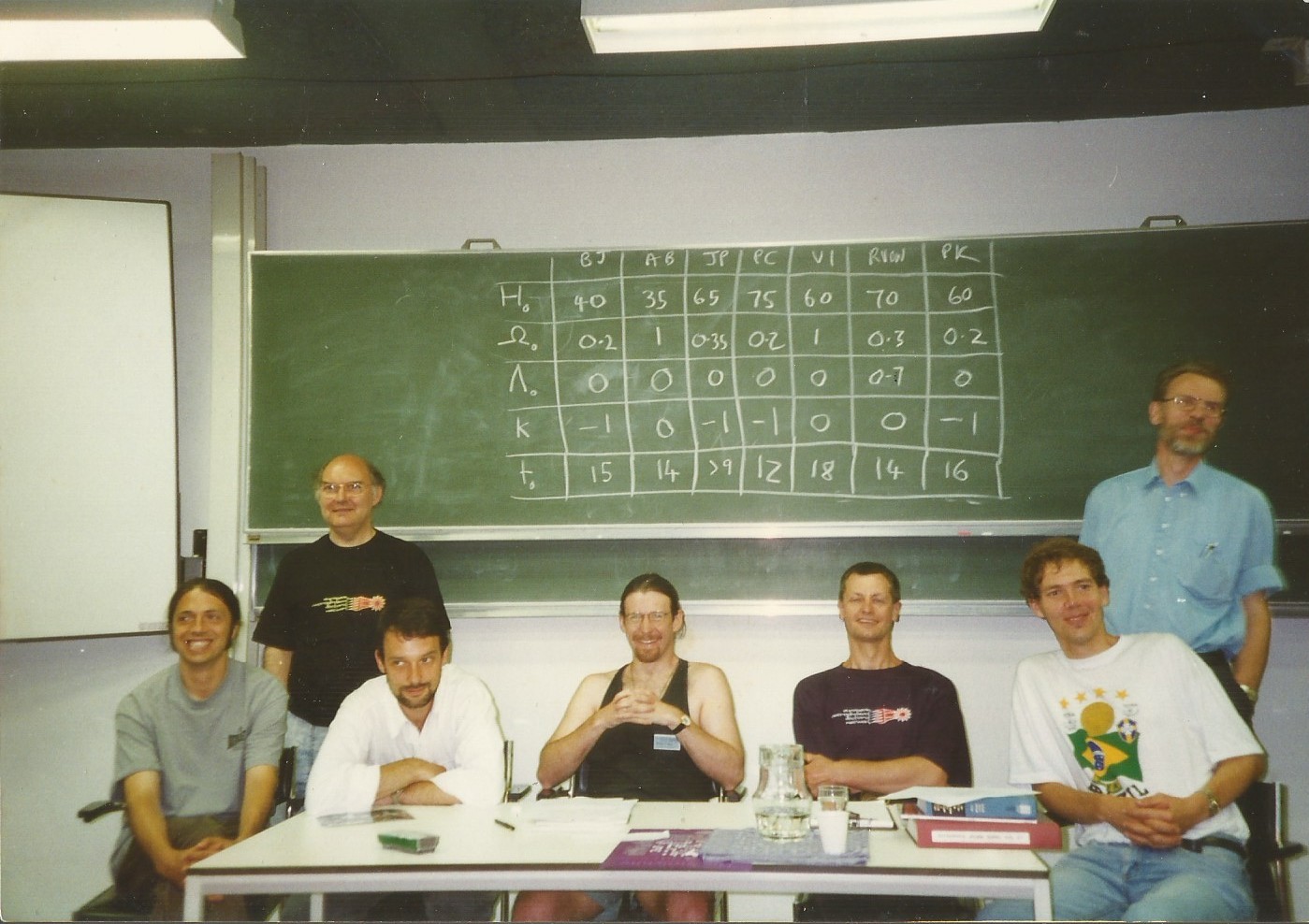
I’ve already posted the picture below, which was taken at a conference in Leiden (Netherlands) in 1995. Various shady characters masquerading as “experts” were asked by the audience of graduate students at a summer school to give their favoured values for the cosmological parameters (from top to bottom: the Hubble constant, density parameter, cosmological constant, curvature parameter and age of the Universe).

From left to right we have Alain Blanchard (AB), Bernard Jones (BJ, standing), John Peacock (JP), me (yes, with a beard and a pony tail – the shame of it), Vincent Icke (VI), Rien van de Weygaert (RW) and Peter Katgert (PK, standing). You can see on the blackboard that the only one to get anywhere close to correctly predicting the parameters of what would become the standard cosmological model was, in fact, Rien van de Weygaert.

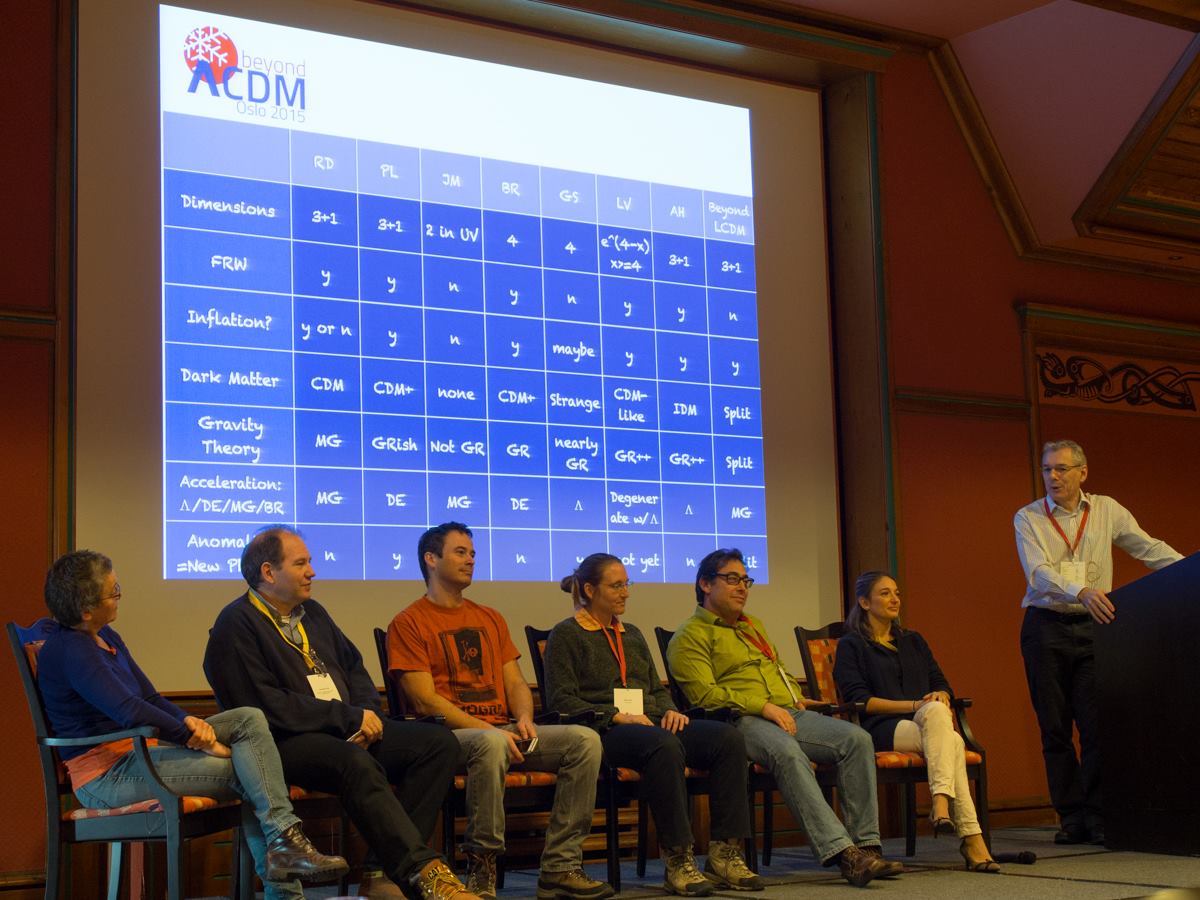
Well, my excuse for posting this again is the fact that a similar discussion was held at a meeting in Oslo (Norway) at which a panel of experts and Alan Heavens did a similar thing. I wasn’t there myself but grabbed the evidence from facebook:

experts

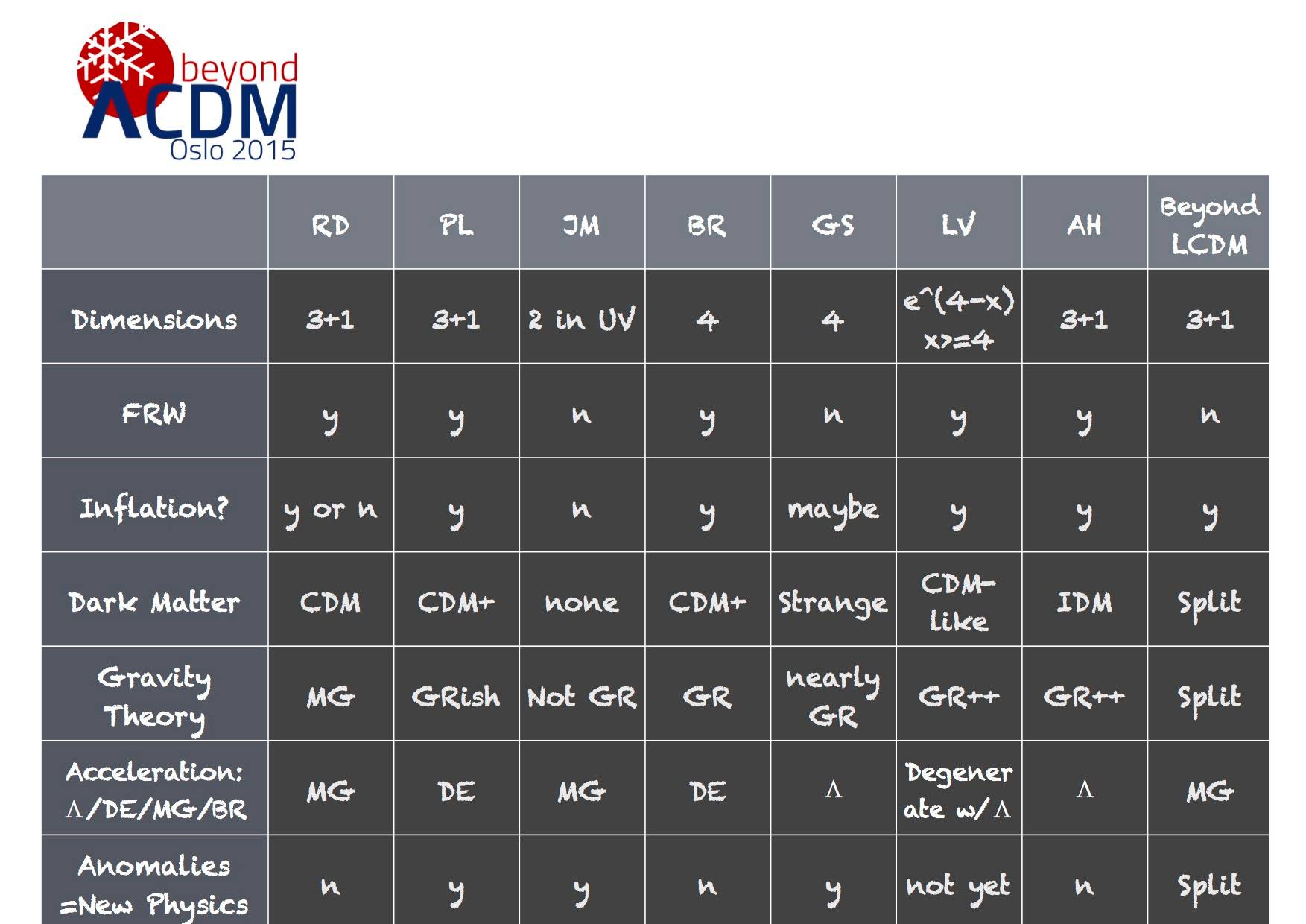
I’ll leave it as an exercise for the reader to identify the contributors. The 2015 version of the results is considerably more high-tech than the 1995 one, but in case you can’t read what is on the screen here are the responses:

panel_vote

The emphasis here is on possible departures from the standard model, whereas in 1995 the standard model hadn’t yet been established. I’m not sure exactly what questions were asked but I think my answers would have been: 3+1;  maybe; maybe; don’t know but (probably) not CDM; something indistinguishable from GR given current experiments; Lambda; and maybe. I’ve clearly become a skeptic in my old age.

Anyway, this “progress” reminded me of a quote I used to have on my office door when I was a graduate student in the Astronomy Centre at the University of Sussex many years ago:

We have not succeeded in answering all our problems. The answers we have found only serve to raise a whole set of new questions. In some ways we feel we are as confused as ever, but we believe we are confused on a higher level and about more important things.

The attribution of that quote is far from certain, but I was told that it was posted outside the mathematics reading room, Tromsø University. Which is in Norway. Apt, or what?

Mathematics, Astronomy and the National Secular Society

Posted in Biographical, History, Politics with tags , , , , on January 17, 2015 by telescoper

I imagine that a  great many people have been thinking hard recently about democracy, free speech and religious belief in the wake of the Charlie Hebdo murders in Paris. There’s also been a great deal of stuff in the print media covering these issues. I just want to mention one thing that I have decided to do, namely to join the National Secular Society an organization that campaigns against religious privilege.

Let me reproduce a statement from their webpage here:

The National Secular Society works towards a society in which all citizens, regardless of religious belief, or lack of religious belief, can live together fairly and cohesively. We campaign for a secular democracy with a separation of religion and state, where everyone’s Human Rights are respected equally.

We work in the UK and Europe to challenge the disproportionate influence of religion on governments and in public life. We provide a secular voice in the media, defending freedom and equality as a counterbalance to the powerful religious lobby and some of the more destructive religious impulses that can threaten human rights worldwide.

The National Secular Society is a non-party-political organisation with members from across the social and political spectrum. Our Honorary Associates include MPs and peers, as well as leading figures from politics, journalism, law and the arts.

The NSS is a democratic and independent non-profit organisation which receives no funding from government or other public bodies. Our campaigning is wholly supported by our members and supporters, people like you who share our belief in the urgent need to keep religion and politics separate.

One of the National Secular Society’s very active current campaings is against the egregious Local Government (Religious etc Observances) Bill, which includes a provision that would require local councillors to attend sessions that involve prayers. This bill is wholly unacceptable to me, as it is perfectly possible for councillors of a religious persuasion to pray whenever they like, either before during or after a meeting, without requiring non-believers to be present.

I respect the right of others to whatever religious belief they choose and would not interrupt or disrupt an act of religious observance, but imposing such actions on others is simply unacceptable. I don’t think religious services should be imposed in schools and colleges, and I don’t see why this is any different.

Anyway, the general point is that I firmly believe that the only way we will ever develop a society that allows people of all cultures and beliefs to live in peace with each other and in atmosphere of mutual respect is to remove any reference to religion from our political and legal establishment. It’s a ridiculous anachronism that Bishops of the Church of England sit in the House of Lords, for example.

You’ll all no doubt be glad to know that I’m not going to “preach” about this at length here, although I may from time to time post on matters related to the National Secular Society (NSS), though hopefully in such a way as it doesn’t get confused with that other NSS the National Student Survey. I will however include a little story as a kind of postscript.

When I tweeted about the National Secular Society recently a friend of mine pointed out a curious connection between it, astronomy, and my former employer, Cardiff University. The first ever Professor of Mathematics and Astronomy at the University College of South Wales and Monmouthsire (which eventually became Cardiff University) was a distinguished chap by the name of Henry William Lloyd Tanner, who was appointed to his position in 1883. In November 1883 there was a vigorous campaign by religious types to have him removed because of his connections with the National Secular Society (which was founded way back in 1866); you can read about it here. The campagign did not succeed, and H.W. Lloyd Tanner remained in post until 1909.

We have at least made some progress since 1883, in that nowadays a Professor would not be threatened with the sack on the basis of his religious beliefs or lack of them, but there’s a long way to go before our nation is a truly secular society.

Lognormality Revisited

Posted in Biographical, Science Politics, The Universe and Stuff with tags , , , , , on January 14, 2015 by telescoper

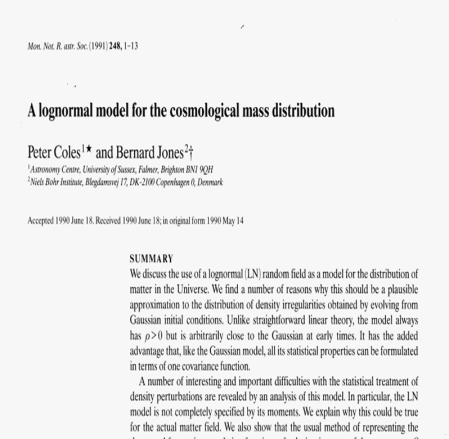
I was looking up the reference for an old paper of mine on ADS yesterday and was surprised to find that it is continuing to attract citations. Thinking about the paper reminds me off the fun time I had in Copenhagen while it was written.   I was invited there in 1990 by Bernard Jones, who used to work at the Niels Bohr Institute.  I stayed there several weeks over the May/June period which is the best time of year  for Denmark; it’s sufficiently far North (about the same latitude as Aberdeen) that the summer days are very long, and when it’s light until almost midnight it’s very tempting to spend a lot of time out late at night..

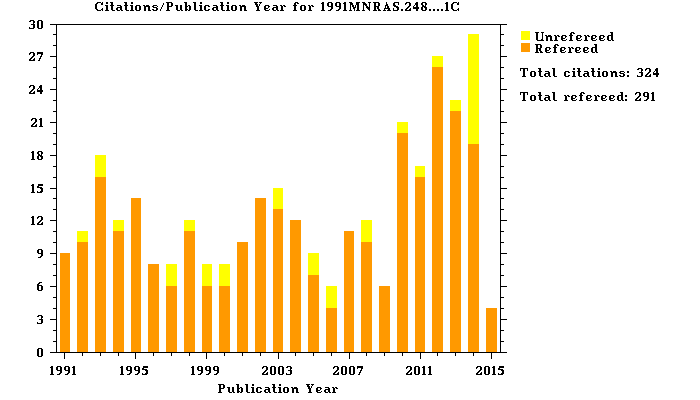
As well as being great fun, that little visit also produced what has turned out to be  my most-cited paper. In fact the whole project was conceived, work done, written up and submitted in the space of a couple of months. I’ve never been very good at grabbing citations – I’m more likely to fall off bandwagons rather than jump onto them – but this little paper seems to keep getting citations. It hasn’t got that many by the standards of some papers, but it’s carried on being referred to for almost twenty years, which I’m quite proud of; you can see the citations-per-year statistics even seen to be have increased recently. The model we proposed turned out to be extremely useful in a range of situations, which I suppose accounts for the citation longevity:

lognormal

I don’t think this is my best paper, but it’s definitely the one I had most fun working on. I remember we had the idea of doing something with lognormal distributions over coffee one day,  and just a few weeks later the paper was  finished. In some ways it’s the most simple-minded paper I’ve ever written – and that’s up against some pretty stiff competition – but there you go.

Picture1

The lognormal seemed an interesting idea to explore because it applies to non-linear processes in much the same way as the normal distribution does to linear ones. What I mean is that if you have a quantity Y which is the sum of n independent effects, Y=X1+X2+…+Xn, then the distribution of Y tends to be normal by virtue of the Central Limit Theorem regardless of what the distribution of the Xi is  If, however, the process is multiplicative so  Y=X1×X2×…×Xn then since log Y = log X1 + log X2 + …+log Xn then the Central Limit Theorem tends to make log Y normal, which is what the lognormal distribution means.

The lognormal is a good distribution for things produced by multiplicative processes, such as hierarchical fragmentation or coagulation processes: the distribution of sizes of the pebbles on Brighton beach  is quite a good example. It also crops up quite often in the theory of turbulence.

I’ll mention one other thing  about this distribution, just because it’s fun. The lognormal distribution is an example of a distribution that’s not completely determined by knowledge of its moments. Most people assume that if you know all the moments of a distribution then that has to specify the distribution uniquely, but it ain’t necessarily so.

If you’re wondering why I mentioned citations, it’s because it looks like they’re going to play a big part in the Research Excellence Framework, yet another new bureaucratical exercise to attempt to measure the quality of research done in UK universities. Unfortunately, using citations isn’t straightforward. Different disciplines have hugely different citation rates, for one thing. Should one count self-citations?. Also how do you aportion citations to multi-author papers? Suppose a paper with a thousand citations has 25 authors. Does each of them get the thousand citations, or should each get 1000/25? Or, put it another way, how does a single-author paper with 100 citations compare to a 50 author paper with 101?

Or perhaps the REF panels should use the logarithm of the number of citations instead?

Conchita Wurst wins 2014 Beard of the Year poll

Posted in Beards, Biographical with tags , , , on December 29, 2014 by telescoper

Many congratulations to the fabulous Conchita Wurst, who has won the coveted title of Beard of the Year 2014. I finished in 3rd place. Huge thanks to everyone who voted for me. I’m quite chuffed to have finished in the top 5 actually, and am delighted that Conchita Wurst was the winner in the end.

In fact I was in the lead until two days before the end of polling. However, on Saturday 20th December, I checked the voting and found Conchita already was on top of me, pulling away. The resulting surge was extremely impressive and exciting to witness…

I would have happily settled for second place but then, on Monday 22nd, the last day of voting, Bartosz Bialkowski, who wasn’t on the shortlist until that point, made an unexpected appearance and quickly romped up the table. I’ve never heard of Bartosz Bialkowski before that day, actually. Apparently he plays in goal for Ipswich Town, in the Midlands. Anyway, although many will be surprised that 2nd place went to someone who isn’t among the list of official contenders, there’s no doubt he has an impressive beard and enthusiastic support from Ipswich Town supporters who no doubt were responsible both for his late inclusion in the list and in the heavy voting on Monday that relegated me to 3rd place.

Anyway, that’s it for Beard of the Year. My brief venture into the limelight is over, and I’ll now return to my normal state of well-deserved obscurity…

kmflett's avatarKmflett's Blog

Beard Liberation Front

Press release 28th December

Conchita Wurst tops Eurovision win with Beard of the Year victory

wurst

The Beard Liberation Front, the informal network of beard wearers, has said that in the best supported contest since 1995, the winner of this year’s Eurovision in May Conchita Wurst has also won the 2014 Beard of the Year poll with 33.54% of the vote.

The singer narrowly beat Ipswich Town goal keeper Bartosz Bialkowski who made a late bid for the title with 31.89% and University of Sussex academic Peter Coles who polled consistently well throughout the three weeks of the poll to end on 14.58%.

Other well known beard wearers including cricketer Moeen Ali and author Philip Ardagh also polled well.

BLF Organiser Keith Flett said, The Beard Liberation Front stands for diversity of dress and appearance and the breadth of appeal of this year’s winners underlines that. Let’s…

View original post 135 more words

The Submarines of Burlington House

Posted in Art, Biographical on December 12, 2014 by telescoper

image

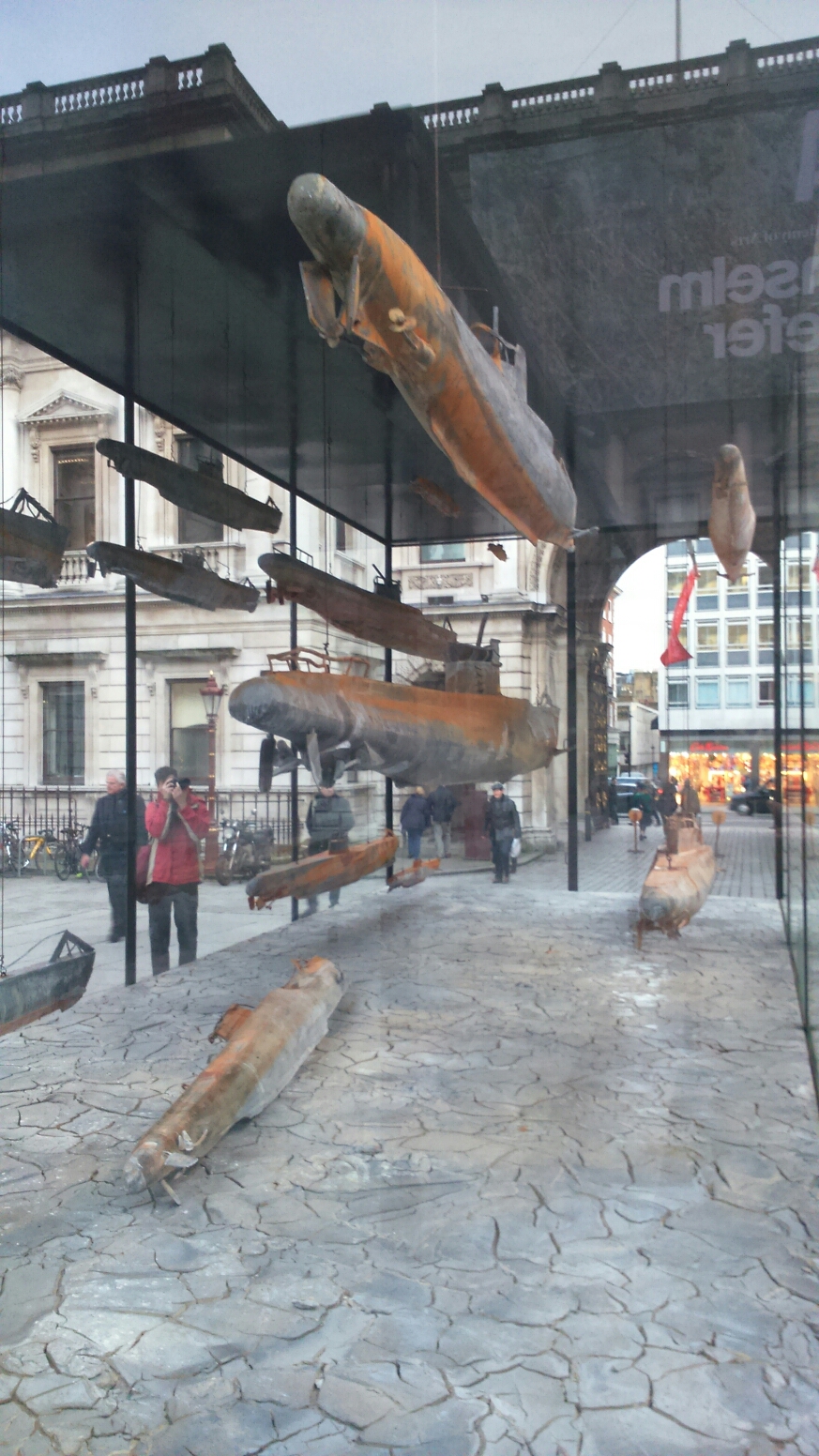
I’m in London for the Monthly Open Meeting of the Royal Astronomical Society, followed by dinner with the Club. I just popped into the courtyard of Burlington House in front of the Royal Academy of Arts to see what was going on, and I found this giant fish tank full of tiny rusty submarines. Not sure what it represents but at least It makes a change! It’s part of an exhibition by Anselm Kiefer, apparently.

In Praise Of The Oldie

Posted in Biographical, Crosswords with tags on December 9, 2014 by telescoper

Feeling the effects of advancing years, and ahead of another weekend out of circulation, I purchased a copy of the December edition of The Oldie last week to help pass the time. I heartily recommend this magazine to readers of a certain age for its eclectic mixture of articles, cartoons and, best of all from my point of view, a splendid crossword (set by Antico). In fact there are two crosswords, a tricky thematic cryptic puzzle called Genius, and a straightforward definition puzzle, namely, a little harshly, Moron. For the December edition there was a bumper-sized Genius puzzle which took me a good hour to solve, a distraction that I found most welcome. I’ve posted off my solution already in the hope that I can win another dictionary to add to my collection.

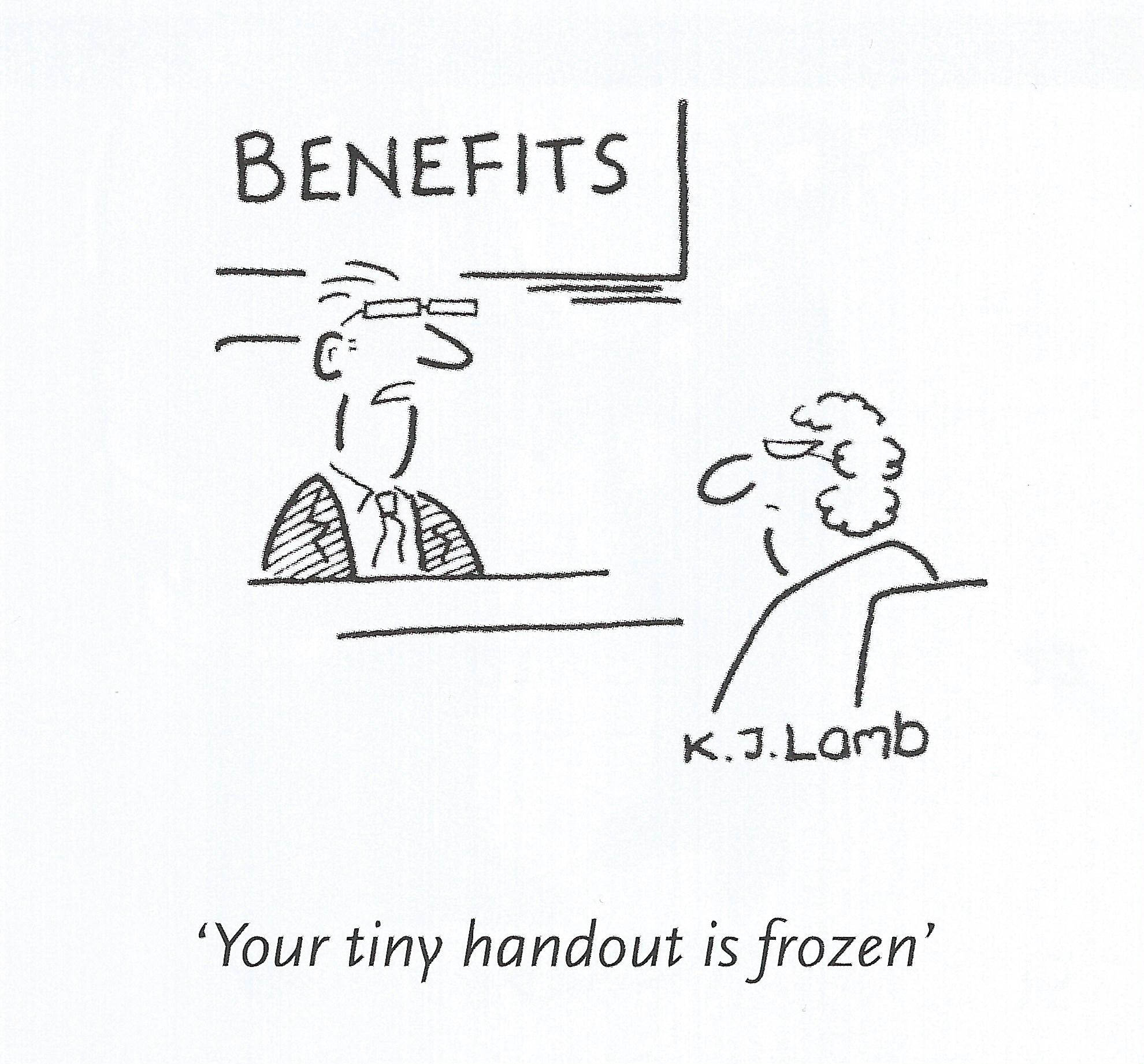
The Christmas OLdie also included a calendar which is already hanging on my office wall. Here is a cartoon from the calendar, which tickled me because of its topicality and operatic connection:


oldie

I’ve decided to take out a year’s subscription, so I hope they’ll forgive any copyright infringement involved in including that cartoon!

Starlink Memories

Posted in Biographical with tags , , , , , , , on December 3, 2014 by telescoper

This lunchtime I put on a black tie and went to the funeral of Stuart Keir, who died suddenly a few weeks ago at the aged of 55. Stuart had only just retired, on grounds of ill health, having worked in IT services for over twenty years here at the University of Sussex. When I first started in 1985 the observational astronomers at Sussex were primarily based at the Royal Greenwich Observatory (RGO), which was at that time located in Herstmonceux and Stuart was one of the staff there supporting the computer systems. The RGO moved to Cambridge in 1990 (for reasons which still escape me) at which point some of the astronomers and support staff relocated permanently to the University of Sussex while others went to Cambridge; Stuart moved to Sussex when the Starlink node was consolidated here following the loss of the RGO.

stuart

Stuart Keir

I remember Stuart very well from my life here as a PhD student and then as a postdoc in the Astronomy Unit, both before and after he moved full-time to Falmer campus. He wasn’t always the easiest of characters to work with – he insisted on doing everything his own way, which sometimes conflicted with what the astronomers wanted – but it has to be said that he did usually know better than us about the important things. He also worked extremely hard at his job and was definitely a great help to me during my time at Sussex. I’m very sad that he didn’t have long to enjoy his well-earned retirement.

The news of Stuart’s death made me all nostalgic for my days as a PhD student, when life was definitely much simpler. It also made me look back affectionately at the Starlink system as it was in the 80s. I had been lucky enough to get a series of temporary jobs, between school and university and during summer vacations at university, that involved the use of VAX computers of exactly the same type as that used in Starlink so I was well prepared when I started my PhD. In fact, looking back, I still think the native Virtual Memory System (VMS) and Digital Command Language (DCL) were terrific to work with. Unfortunately it seems that DEC, the company that manufactured the VAX systems, made some unwise business decisions and they lost ground to SUN. During the 1990s there was a rapid phase transition within Starlink from VAX machines to a range of SUN workstations.

Much of the value of Starlink in the old days was the connectivity it provided in what was basically a pre-internet (enabled by DECNET) which allowed sharing of software across all UK astronomy groups. In this sense it was an important step towards Open Science. The growth of the internet however let to a reduced role for Starlink from the mid-1990s onwards. Stuart transferred from Starlink to general IT services at the University of Sussex when Starlink was winding down.

In its heyday, Starlink was a great resource that provided a superb environment for astronomical researchers. It would have been nothing, however, without the dedicated team of Starlink Managers like Stuart who managed the local nodes and worked so help the astronomers that worked there. Data-intensive subjects like astronomy depend as much now as they did then on the hard work of computer support staff, an effort that is in my view not given anything like sufficient recognition by universities and other research institutions.

Rest in Peace, Stuart Keir.