Archive for the Biographical Category

Arrivederci L’Aquila!

Posted in Architecture, Biographical with tags , on October 17, 2014 by telescoper

So here I am, then. In the British Airways Lounge at Roma Fiumicino Airport waiting for a flight back to Gatport Airwick. This morning’s bus journey from L’Aquila was as incident-free as the outbound journey, and I actually got to the airport about 10 minutes early. As I always do I planned the journey so I’d arrive in plenty of time for my flight, so now I get to relax and drink free wine among the Business Class types until I’m called to totter to the gate.

Fiumicino is strange airport, clearly built in the 1960s with the intention that it should look futuristic but with the inevitable result that it now feels incredibly dated, like a 1950s Science Fiction film.

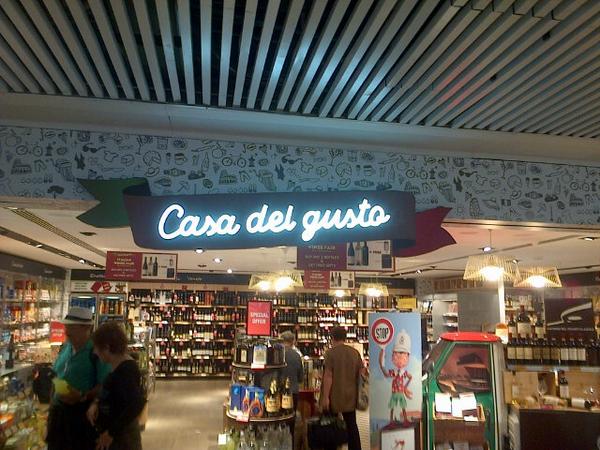
Anyway, I’ve at last got a bit of time to kill so I’ll take the opportunity to brush up on my Italian. Let’s try translating this:

gusto

It’s obvious of course. House of Wind.

Ciao Ciao

Choose My Mugshot

Posted in Beards, Biographical on October 15, 2014 by telescoper

For some time now staff and students of the School of Mathematical & Physical Sciences at the University of Sussex have complained that the picture of me on my office door is of a non-bearded person. Recently therefore I made a visit to a professional photographer so he could take a picture of the hirsute me and tried his best to make me look presentable in the process. I am now told I have to pick one of the following three shortlisted photographic representations. They all suffer from the problem that they look like me, so I have no idea what to pick. I thought I’d have a bit of a laugh and see if I can crowd-source a favourite.

Here are the contenders:


Please vote here

Arrival in L’Aquila

Posted in Biographical, The Universe and Stuff with tags , on October 7, 2014 by telescoper

If you were baffled by yesterday’s post then I hope today’s will explain. Yesterday, after an early morning meeting at the University of Sussex, I took the train to Gatwick Airport and thence a flight to Rome; hence volare. The British Airways Flight to Fiumicino Airport I was on arrived about 8 minutes ahead of schedule at 18.12, and I managed to get my luggage and clear passport control and all that in time to catch the 7pm coach to my present location, the city of L’Aquila, which is in the Abruzzo region, about 65 miles East of Rome. I’ve never made this trip before so I was a bit anxious about finding my way here and indeed it would have been a pain had I not caught the 7pm bus, because that would have meant either waiting for the next one (not until 9.30) or going by an alternative route involving a train and a different coach. As it happened, I needn’t have worried.

I’m here to attend a meeting entitled Multiple Messengers and Challenges in Astroparticle Physics, which is taking place at the Gran Sasso Science Institute. As well as the cosmology sessions, which are directly related to my own research, I’m hoping over the next ten days or so to take the opportunity to catch up on the  wider developments in astroparticle physics.

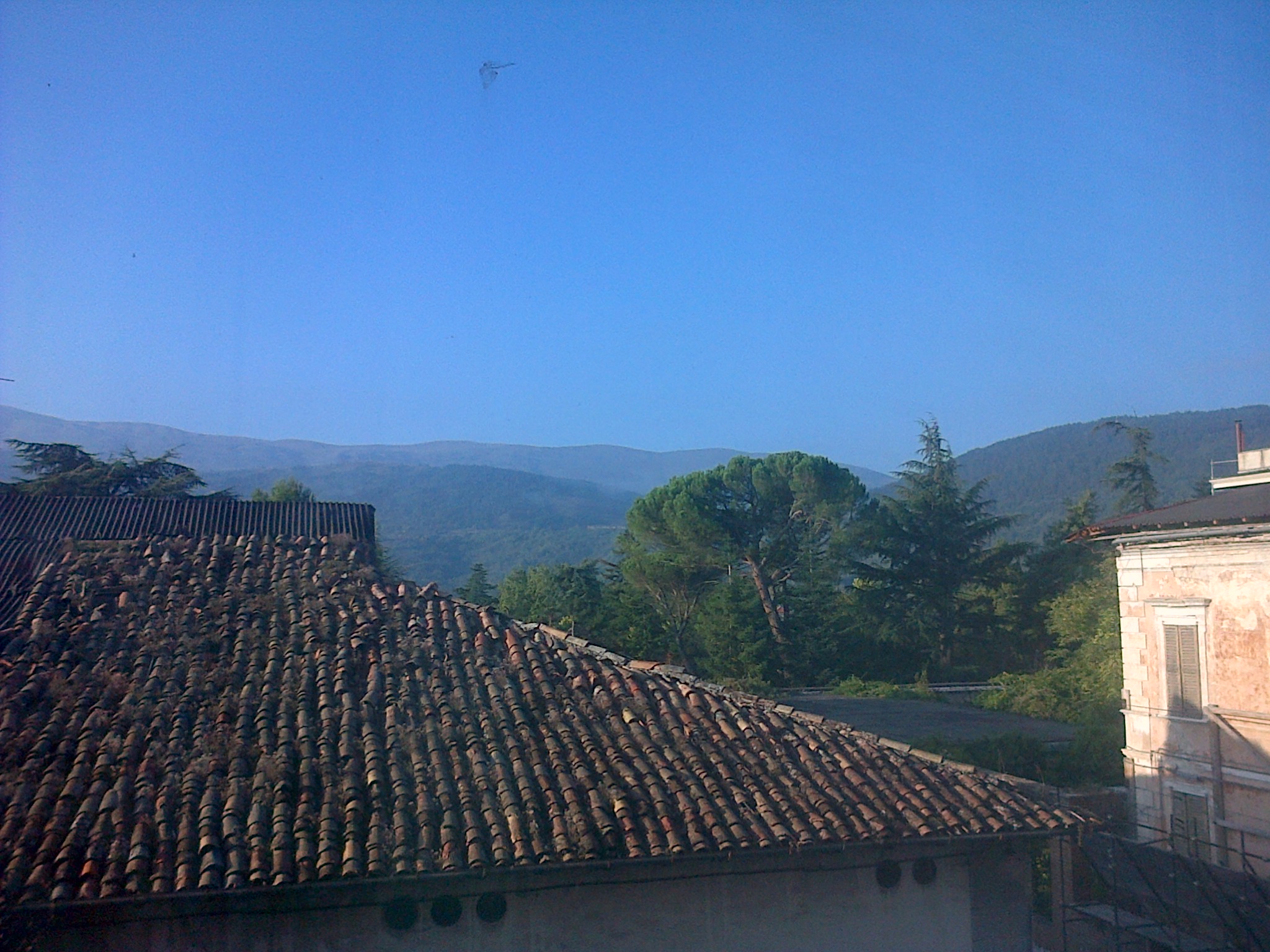
L’Aquila was badly damaged by an earthquake in 2009 and there was plenty of evidence of repair and reconstruction work still going on. I’ll take a few pictures here and there, but for the time being I’ll just share the view from my hotel window for the enjoyment of any readers back in rainy England…

IMG-20141007-00420

Mathematical and Physical Sciences Open Day at Sussex

Posted in Biographical, Education with tags , , , , on October 4, 2014 by telescoper

It’s another open day at the University of Sussex so I’m on campus again to help out as best I can, although I have to admit that all the hard work is being done by others! It’s been extremely busy so far; in fact, I’m told that about 6000 visitors are on campus today. This a good sign for the forthcoming admissions round, probably buoyed by the improved position of the University of Sussex in the latest set of league tables and in excellent employment prospects for graduates.

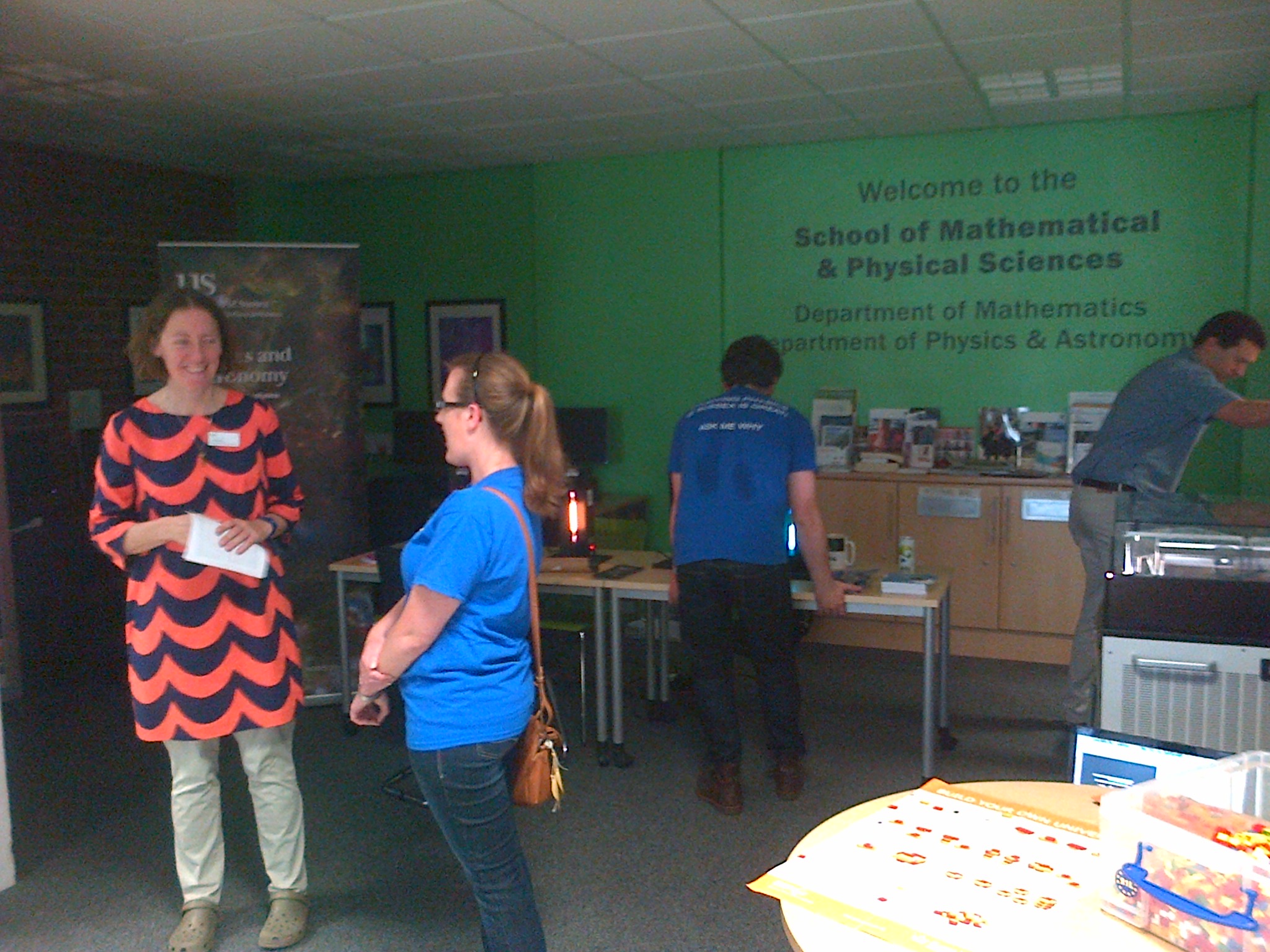
Anyway the good folks of  the Department of Physics & Astronomy  and Department of Mathematics were here bright and early to get things ready:

IMG-20141004-00413

IMG-20141004-00414

All morning we’ve had a steady stream of visitors to the School of Mathematical and Physical Sciences (which comprises both Departments mentioned above). While I’m at it let me just give a special mention to Darren Baskill’s Outreach Team (seen in the team photograph below).
outreachThey have had absolutely amazing year, running a huge range of events and activities that have reached a staggering 14,000 people of all ages (including 12,000 of school age).

Anyway, I think I’ll toddle off and see if I can sit in on one of today’s lectures. It’s about time I learned something.


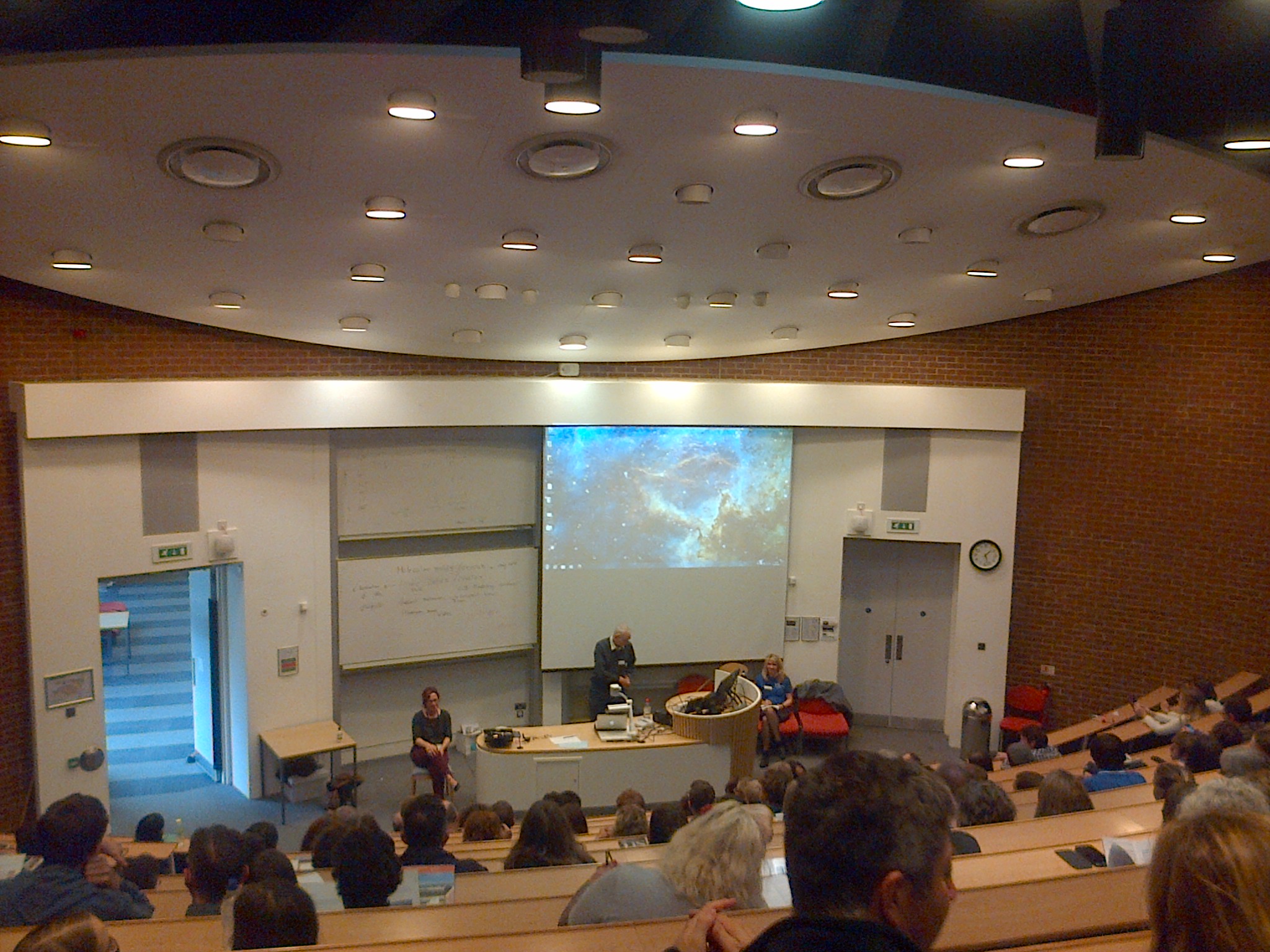
UPDATE: Here is Mark Hindmarsh about to get started on his lecture.

IMG-20141004-00415

You could have knocked me down with a feather when I saw that he had included a quote from this blog in his talk:

I’ve worked in some good physics departments in my time, but the Department of Sussex is completely unique both for the level of support it offers students and the fact that so many of the undergraduates are so highly motivated.

And, yes, I did mean every word of that.

Sunday Diversions

Posted in Biographical, Brighton with tags , , , on September 28, 2014 by telescoper

Remind me never again to travel on a Sunday. Needing to get back for some important meetings tomorrow I set out from Cardiff this lunchtime leaving plenty of time for the journey. Just as well.

For a start, First Great Western trains were disrupted by “planned engineering work”. Not very well planned, obviously. The train I got on was to be diverted via Bath Spa, adding about an hour to the usual journey time. But that wasn’t the main cause of vexation.

When it arrived at a crowded platform at Cardiff Central, the 12.53 consisted of just seven coaches, three of which were First Class. To add to the chaos and consternation, Coach B, in which several people standing beside me had reserved seats, did not exist.

Not having a reservation in a real or imaginary coach, rather than stand for 3 hours I went and sat in any empty First Class carriage and when the guard arrived I paid the £15 upgrade to Weekend First, congratulating First Great Western on a cleverly-worked scam. Deliberately running a short train on a busy route to increase revenue this way is cynical and exploitative but that’s what it means to run a train company these days.

Anyway, the weather being quite nice when I arrived in Paddington I walked through Kensington Gardens and along the Serpentine before heading down to Victoria.

Stage two of my journey via Southern Railways turned out to be no better. More “planned engineering works” meant all Victoria to Brighton trains were diverted through Littlehampton. A replacement bus from Three Bridges was offered as an alternative “possibly a little quicker” but having no confidence at all that a bus would actually materialise I stayed on the train as it trundled through rural Sussex.

I got to Brighton Station around 7pm, about 6 hours after leaving Cardiff Central, but at least I got a bus straight away.

I hope the rest of the week isn’t as exasperating as today, but something tells me that it might be..

Autumn Leaves In Cardiff

Posted in Biographical, Cardiff with tags , on September 27, 2014 by telescoper

Back in Cardiff for a couple of days to get some more writing done, I took a break to have a cup of tea in the garden. All the signs that summer is now over have now shown themselves: the start of undergraduate lectures (Monday); the Autumnal Equinox (Tuesday); the end of the County Championship on Friday; and so on.

Here in Cardiff the weather is still warm, but the leaves are turning brown and starting to fall. Conkers too. And, most spectacularly, the Virginia Creeper growing at the back of my house has turned blood red. It does look pretty, but I’m sure it’s not good for the gutters or the chimney stack above..

Life, Work and Postgraduate Research

Posted in Biographical, Crosswords, Education with tags , , , , on September 21, 2014 by telescoper

A very busy Freshers’ Week at the University of Sussex is now behind us and lectures proper start tomorrow morning. As far as I was concerned all the Freshers’ events were superimposed on a week that was already filled with other things, some good (of which more anon), and some not so good (of which I will say nothing further).

After welcome receptions at the weekend, Freshers’ Week for me began with an induction lecture with all the new students in the School of Mathematical and Physical Sciences (MPS) or at least as many as could rouse themselves for a 10am start the day after a big welcome party. In the event, the turnout was good. I then gave another little speech at a much less formal event in the Creativity Zone (which is situated in the building occupied by MPS. I then had to dash off to a couple of meetings but when I returned a couple of hours later the party was still going, so I helped myself to a beer and rejoined the socializing.

IMG-20140915-00402

Welcome to the new students in MPS!

And so it was for the rest of the week, dominated by meetings of one sort or another including one in London, until Friday and my last formal induction task in the form of a session for new postgraduate students in MPS. Since this happened at the end of Induction Week there wasn’t much of a practical nature say to the students that they hadn’t already heard during the School-based induction sessions that preceded it, so I decided to scrap the Powerpoint I had planned to use and just give a general pep talk. Doing so was quite an interesting experience because it reminded me of the time I started my own postgraduate education, here at Sussex.

As a matter of fact it was on the corresponding day in 1985 (Sunday 22nd September) that I moved down to Brighton in advance of starting my DPhil (as Sussex doctorates were called in those days). It’s hard to believe that was 29 years ago. As it turned out, I finished my thesis within three years and stayed on here at Sussex as a postdoctoral research fellow in the Astronomy Centre until 1990, whereupon I left to take up a teaching and research position at what is now Queen Mary, University of London. That was the start of a mini-tour of UK universities that ended up with me returning to Sussex last year as Head of the same school in which I started my research career.

This morning I noticed a story in the Times Higher about the loneliness and sense of isolation often faced by postgraduate research students which often leads to a crisis of confidence. I can certainly attest to that, for reasons I will try to explain below, so tried to reassure the students about it in the induction session on Friday.

The point is that a postgraduate research degree is very different from a programme of undergraduate study. For one thing, as a research student you are expected to work on your own a great deal of the time. That’s because nobody else will be doing precisely the same project so, although other students will help you out with some things, you’re not trying to solve the same problems as your peers as is the case with an undergraduate. Your supervisor will help you of course and make suggestions (of varying degrees of helpfulness), but a PhD is still a challenge that you have to meet on your own. I don’t think it is good supervisory practice to look over a research student’s shoulder all the time. It’s part of the purpose of a PhD that the student learns to go it alone. There is a balance of course, but my own supervisor was rather “hands off” and I regard that as the right way to supervise. I’ve always encouraged my own students to do things their own way rather than try to direct them too much.

That loneliness is tough in itself, but there’s also the scary fact that you do not usually know whether your problem has a solution, let alone whether you yourself can find it. There is no answer at the back of the book; if there were you would not be doing research. A good supervisor will suggest a project that he or she thinks is both interesting and feasible, but the expectation is that you will very quickly be in a position where you know more about that topic than your supervisor.

I think almost every research student goes through a phase in which they feel out of their depth. There are times when you get thoroughly stuck and you begin to think you will never crack it. Self-doubt, crisis of confidence, call it what you will, I think everyone who has done a postgraduate degree has experienced it. I certainly did. A year into my PhD I felt I was getting nowhere with the first problem I had been given to solve. All the other research students seemed much cleverer and more confident than me. Had I made a big mistake thinking I could this? I started to panic and began to think about what kind of job I should go into if I abandoned the idea of pursuing a career in research.

So why didn’t I quit? There were a number of factors, including the support and encouragement of my supervisor, staff and fellow students in the Astronomy Centre, and the fact that I loved living in Brighton, but above all it was because I knew that I would feel frustrated for the rest of my life if I didn’t see it through. I’m a bit obsessive about things like that. I can never leave a crossword unfinished either.

What happened was that after some discussion with my supervisor I shelved that first troublesome problem and tried another, much easier one. I cracked that fairly quickly and it became my first proper publication. Moreover, thinking about that other problem revealed that there was a way to finesse the difficulty I had failed to overcome in the first project. I returned to the first project and this time saw it through to completion. With my supervisor’s help that became my second paper, published in 1987.

I know it’s wrong to draw inferences about other people from one’s own particular experiences, but I do feel that there are general lessons. One is that if you are going to complete a research degree you have to have a sense of determination that borders on obsession. I was talking to a well-known physicist at a meeting not long ago and he told me that when he interviews prospective physics students he asks them “Can you live without physics?”. If the answer is “yes” then he tells them not to do a PhD. It’s not just a take-it-or-leave-it kind of job being a scientist. You have to immerse yourself in it and be prepared to put long hours in. When things are going well you will be so excited that you will find it as hard to stop as it is when you’re struggling. I’d imagine it is the just same for other disciplines.

The other, equally important, lesson to be learned is that it is essential to do other things as well. Being “stuck” on a problem is part-and-parcel of mathematics or physics research, but sometimes battering your head against the same thing for days on end just makes it less and less likely you will crack it. The human brain is a wonderful thing, but it can get stuck in a rut. One way to avoid this happening is to have more than one thing to think about.

I’ve lost count of the number of times I’ve been stuck on the last clue in a crossword. What I always do in that situation is put it down and do something else for a bit. It could even be something as trivial as making a cup of tea, just as long as I don’t think about the clue at all while I’m doing it. Nearly always when I come back to it and look at it afresh I can solve it. I have a large stack of prize dictionaries to prove that this works!

It can be difficult to force yourself to pause in this way. I’m sure that I’m not the only physicist who has been unable to sleep for thinking about their research. I do think however that it is essential to learn how to effect your own mental reboot. In the context of my PhD research this involved simply turning to a different research problem, but I think the same purpose can be served in many other ways: taking a break, going for a walk, playing sport, listening to or playing music, reading poetry, doing a crossword, or even just taking time out to socialize with your friends. Time spent sitting at your desk isn’t guaranteed to be productive.

So, for what it’s worth here is my advice to new postgraduate students. Work hard. Enjoy the challenge. Listen to advice from your supervisor, but remember that the PhD is your opportunity to establish your own identity as a researcher. Above all, in the words of the Desiderata:

Beyond a wholesome discipline,
be gentle with yourself.

Never feel guilty about establishing a proper work-life balance. Having more than one dimension to your life is will not only improve your well-being but also make you a better researcher.

Market Garden

Posted in Biographical, History with tags , , , on September 17, 2014 by telescoper

I’m just back to Brighton after a meeting in London so I hope you will excuse me for my brevity on this occasion. On the other hand I feel obliged to note an important anniversary.

Seventy years ago today, on 17th September 1944, the largest airborne operation in military history began. Operation Market Garden (as it was called) saw about 35,000 Allied troops dropped by parachute or landed in gliders behind German lines in Holland, with the aim of seizing key bridges in order to allow infantry and armoured divisions to advance, eventually into Germany. Of more immediate tactical importance was that capture of the Northernmost bridges over the Rhine at Arnhem would prevent German reinforcements from moving South to confront the advancing troops and armoured vehicles of XXX Corps whose job was to punch a hole in the German defences and link up with the airborne troops.


Operation_MARKET-GARDEN_-_82.Airborne_near_Grave

Motivated by the belief that German armies in the West were exhausted and on the brink of collapse as well as the desire if possible to finish the war before Christmas, Operation Market Garden was daring and imaginative, but began to unravel right from the outset and ended as a disastrous failure, with the loss of many lives.

I’m not a military historian, so am not competent to add anything significant to the huge amount that has been written about what went wrong, but I will add a personal note. A cousin of my Grandfather flew to Arnhem with the 1st British Airborne division whose job was to take and hold the bridges over the Rhine that would open the door to an invasion of Germany. Sadly, he was one of those many troops who never even made it to their objective. In fact he was dead before he even hit the ground; his unit was dropped virtually on top of heavily armed German forces and had no chance of defending themselves. I had always been told that he had been dropped by parachute, but the records at the cemetery revealed that was wrong; he was on a glider which was badly shot up during its approach.

In fact the action at Arnhem involved two bridges, one a railway bridge at Oosterbeek and the other a road bridge in Arnhem itself. British paratroopers did manage to capture one end of the road bridge, but never succeeded in securing both ends of the structure. Cut off from the much larger force pinned down near their landing zones they were eventually forced to surrender simply because they had run out of ammunition. The other units that landed near Arnhem never made their objectives and had to dig in and hope for reinforcements that never came. They fought a brave but desperate defensive action until 25th September when some were successfully evacuated across the Rhine. The original battle orders had specified they were to hold their ground for 48 hours until relieved by armour and infantry advancing from the South.

Some years ago, after attending a conference in Leiden, I took time out to visit Oosterbeek cemetery, where  1437 soldiers lie buried. Such was the chaos at Arnhem that bodies of fallen soldiers are still being discovered in gardens and woods; as there were so many dead that there was only time to bury them in shallow graves where they had fallen. As remains are discovered they are removed and reburied in Oosterbeek. When I visited the cemetery about 20 years ago, there were several brand new graves.

The local people looked on in horror as their potential liberators were cut down. It must have been deeply traumatizing for them. I think it is telling that when, in 1969, the British Army proposed bringing to an end the annual ceremonies in commemoration of these events, local Dutch civilians insisted that they continue.

As I stood by the grave I couldn’t help thinking of how lucky members of my generation are that we have not been called on to make such a sacrifice. The failure of Operation Market Garden had other terrible consequences. The winter of 1944/45 was a bitter one for Dutch civilians in the part of their country that had not been liberated, with many thousands dying from hunger and cold.

And of course had the Allies succeeded in penetrating into Germany in 1944 the post-war map of Europe would probably have been very different. Had Market Garden been successful would there have been 45 years of Cold War?


Six Years In The Dark

Posted in Biographical with tags on September 16, 2014 by telescoper

When I logged onto WordPress to write yesterday’s post I received a message that it was the 6th anniversary of my registration with them as a blogger and thus took my first step into the blogosphere; that was way back on 15th September 2008. I actually wrote my first post that day too. Here it is, in all its glory:

So here we are then. I’ve finally decided to start writing a blog. I’ve been reading quite a few of them recently and most appeared to consist of a load of ill-informed opinionated drivel. So I thought “I can do that!”. And here we are.

I don’t know who (if anyone) will be reading this or even what I’m going to write, but let’s see how it goes until everyone concerned gets bored with it.

And before I start, I’d like to thank Phil Brown from the British Association for the Advancement of Science for inviting me to set this up. I never would have got around to it if he hadn’t done so.

So blame him!

Unfortunately I didn’t really know what I was doing on my first day at blogging – no change there then –  and I didn’t actually manage to figure out how to publish this earth-shattering piece. It was only after I’d written my second post that I realized that the first one wasn’t actually live, so the two appear in the wrong order in my archive.

I’d like to take this opportunity to send my best wishes, and to thank, everyone who reads this blog, however occasionally. According to the WordPress stats, I’ve got readers from all round the world, including one in the Vatican! If you’re interested in statistics then, as of 9.15 this morning, I have published 2537 blog posts in all, and have received 2,032,090 hits altogether; I get an average of about 1300 per day, but this varies in a very erratic fashion. There have been 20,201 comments published on here and 857,904 rejected as spam or abuse; a lot goes on behind the scenes that you don’t want to know about!

Anyway, the numbers don’t really matter but it does mean a lot to know that there are people who find my ramblings interesting enough to look at, and sometimes even to come back for more! This blog is read by a number of powerful and influential people too, as well as John Womersley….


The Arrival of the Queen of Sheba

Posted in Biographical, Music with tags , , , on September 14, 2014 by telescoper

It’s been such a hectic week getting ready for our new arrivals at the University of Sussex that I’ve been largely limited to posting short items and recycled material. Today is no exception either, as I have been on campus again for another Freshers’ induction week event and now have to prepare a talk for new students in the School of Mathematical and Physical Sciences for tomorrow morning. Anyway, all these busy preparations made me think today of the famous instrumental passage from Act III of Handel’s Oratorio Solomon which depict in wonderfully lively fashion  similar preparations preceding the Arrival of the Queen of Sheba. I know that’s a feeble pretext for posting a bit of music, but I thought I’d at least put a little twist on it by including a performance rather different from what you might be expecting.

This version of The Arrival of the Queen of Sheba is by wonderful Welsh harpist Glenda Clwyd whom I remember hearing play at a couple of events when I was living in Cardiff. This clip is of an impromptu performance and there are a couple of small mistakes, but I think it’s a lovely rendition, the uniquely gentle sound of the harp making it less frantic than most versions.