Archive for the Biographical Category

Value for Money?

Posted in Art, Biographical, Finance, Science Politics with tags , , , , , on February 4, 2010 by telescoper

Looking at the BBC website at lunchtime while I munched a sandwich I’d bought for £1.40, the item that really caught my eye was a story about the sale of a sculpture at Sotheby’s for £65 million. The starting price for this particular work (L’Homme qui Marche by Alberto Giacometti) was set at £12 million, but only took a few minutes for the bidding to reach its final level. An anonymous bidder now gets to keep the sculpture, which will probably now be kept in a private location, or possibly even a bank vault.

Let me make it clear at the start that I’m not going to embark on a rant about modern art in general or Giacometti in particular. A couple of years ago I went to an exhibition of his work at the Museum of Modern Art in Louisiana, just north of Copenhagen (in Denmark) and I found his strange elongated figures really fascinating. He started out making small ones that he stretched and scratched  obsessively to get the shape he wanted. Over time the figures got larger, but he didn’t make many of them. I suppose the rarity of his work has something to do with why they are so valuable, which they obviously are.

But when I say they’re fascinating, I don’t necessarily mean £65 million worth of fascinating….

The point that has always really fascinated me about this sort of thing is exactly how something can acquire such an absurdly high commercial value and what it is that makes any collector decide to pay such a huge price. A work of art obviously has some intrinsic worth, but there doesn’t seem to me to be any simple relation between aesthetic, technical or historical considerations and the market value. That’s not just the case for modern art, either. Go to the Louvre in Paris and you’ll see hordes of people clamouring around a small, drab and frankly rather uninteresting painting called the   Mona Lisa –  and ignoring the dozens of wonderful things all around them in the same room, and even in the corridor leading to it. Some process – I don’t know what – has assigned a particular status to this painting and not to others which seem to me to have at least as much value, in an artistic sense. Not that I’ve any right claim my judgement is any better than anyone else’s, of course.

A similarly mysterious process goes on with other collectible things. Take wine, for example. I like a glass of wine now and then – or rather more often than that, if truth be told. I am, however, very fortunate that I don’t have a particularly discerning palate. I can tell the difference between cheap-and-nasty stuff and pretty good stuff but, generally speaking, my taste has saturated by the time the price reaches about £25 a bottle, and often long before that. That’s great because it means I can have a perfectly enjoyable evening drinking a bottle costing £15 when if I’d been an expert I would be unsatisfied unless I spent a lot more.

Years ago I went with a friend of mine to a house clearance in rural Sussex. He was an interior designer and he liked to buy old furniture from country houses and do it up to sell on. It’s a good plan, actually – old furniture is far better made than the modern stuff. Anyway in the middle of a whole load of junk was a case of vintage wine. Not just any wine, either. It was, in fact, Chateau Petrus – one of the finest Pomerols. It wasn’t a specialist auction, however, and nobody seemed to think it had any value. Bidding was slow when it came up in front of the auctioneer so I bid for it. In the end I bought the case (12 bottles) for about £300. When I got it home I realised what I had got. It turned out £300 per bottle would have been cheap. I was scared to open any of the bottles in case the wine was off or I didn’t like it, so I put it away. I sold the case some years later for about £6500.

Having told that story though, my main point is to wonder out loud about those wines that cost thousands of pounds per bottle. There is a roaring trade in these things – even ones that are two hundred years old – but I don’t think their value has anything to do with how  they are likely to taste. In the local wine merchant – conveniently located about 20 yards from my house – price is a good indicator of taste, but the scaling doesn’t apply at the extreme end of the fine wine market. Some other process is involved.

A house also  has a value that doesn’t have anything to do with anything other than what someone will pay to buy it.  But what sets this price? The market, obviously, but that is guided and controlled by Estate Agents who influence values in strange and subtle ways.

I suppose this all just goes to show I don’t know anything about economics, a point I’m now no doubt going to reinforce.

Governments also have to decide how much to spend on different things: health, education, defence, and so on. You can argue with the way their priorities work out at any given time, but the thing that baffles me is what the process is that leads to a decision to spend X on hospitals and Y on education. How can anyone possibly decide the relative value of £1 spent on health versus £1 spent on education?

I strongly support the notion that the government should support the performing arts, such as  the Opera. But how much it should spend is an unfathomable question to me. Some will say nothing, some would say more. Who decides? Clearly someone does.

And that brings us back home to science. The ongoing ructions about the financial crisis  at the Science and Technology Facilities Council –  unfolding in front of a parliamentary select committee –  seem to me to be really about the process by which value is assigned different bits of science by the people who hold the purse strings but probably don’t know much at all about science. I place a high value on astronomical research and, within that field, on cosmology. But that’s a personal judgement. Others will disagree. We all end up working in those areas we find  more interesting than the others so we can’t really be unbiased, but I think I’m more even-handed than many when it comes to the scientific merits of other fields. Having said that, it would take a lot of doing to convince me that the scientific value for money involved in sending, say, another probe to the Moon was anything like as high as, say, exploiting the full potential of the Herschel observatory.

Worse still, all spending on  blue skies research looks like to be cut back severely at the expense of shorter-term activity that leads to immediate commercial spinoffs. Commerce clearly trumps curiosity in the value game. If the STFC debacle was – as certainly seems likely to me – the result of a deliberate high-level decision, then who was it and what were their reasons for placing so little value on the quest to understand the most fundamental properties of the Universe?

And why doesn’t science have patrons like the anonymous buyer of the Giacometti figure? £65 million would solve an awful lot of STFC’s problems, as long as we stop certain people from wasting it on silly moon missions….

Cheers to Two Fellow Bloggers

Posted in Biographical, Jazz with tags , , , , , , , on February 3, 2010 by telescoper

Last Friday I went as usual with a bunch of Cardiff astronomers to the local pub, The Poet’s Corner, for a traditional end-of-the-week drink or two. This is by no means the most upmarket hostelry in the vicinity of the School of Physics & Astronomy, but it’s quite friendly and serves pretty good beer. The older generation have been finding their way there after work each Friday for some time now, but more recently we’ve found quite a few of our postgrads ending up there too, usually playing pool while the oldies indulge in a chinwag.

Last week, I was a bit surprised to bump into a fellow astro-blogger and Cardiff PhD student , Rob Simpson (orbitingfrog), in the pub. I’m one of the regulars, but he’s not usually there.  It turned out it was a special occasion and he was celebrating, as he’d just been offered a postdoctoral research fellowship at the University of Oxford starting in March.  I mention this partly to offer my congratulations on here – well done Rob! – and partly to demonstrate that despite all the doom and gloom about STFC there are still opportunities for talented people to carve out a career in UK astronomy. As long as they finish writing up their thesis, that is…

It was interesting to chat with Rob about his blog, something I rarely get the chance to do. I don’t know many bloggers personally. His site has been around much longer than mine, he gets way more readers than me, and I also think our audiences are quite different. 

The number of people reading my blog has been growing steadily since I started and  I now  average about 1000 unique hits a day, few compared with many sites, but many more than I would have anticipated when I started. However, on top of this trend there are large fluctuations depending on what I’m posting about. All the recent doom and gloom about STFC  generated a lot of readers, no doubt in the same way that bad news sells newspapers, as did the ongoing story of Mark Brake of which more, perhaps, soon. Moreover, some of my referrals come from very peculiar places. A couple of my jazz and poetry pieces are now linked from wikipedia articles, although who put them there I don’t know. I’m flattered, of course, but just hope that nobody actually thinks I’m some kind of expert. Generally speaking I’m very surprised that people read this sort of post at all, but I guess it’s not the same people that read the more obviously science-based posts.

However, there is at least one astronomer that reads the jazz and poetry posts too, and that’s another blogger called Sarah Kendrew (her blog is here; she’s a postdoc in the Netherlands). We had a little electronic chat a few days ago, during which I discovered that she plays the oboe and was interested to know if there’s any jazz on that instrument. Jazz owes at least part of its origin to the marching bands of New Orleans which typically used army surplus musical instruments – trumpet, trombone, clarinet, etc. When jazz moved off the streets and into the bordellos of Storeyville, pianos were added, the portable brass bass or tuba replaced by a double string bass, and individual bass and snare drums were incorporated in a drum kit. Later on, saxophones became increasingly popular in jazz groups of various sizes, and so on. As the music developed and diversified I think pretty much every instrument there is has been used to play some form of Jazz. For some reason, though, the oboe never caught on as a jazz instrument. I don’t know why. Answers on a postcard.

This got my curiosity going, so I hunted around and found this  video on Youtube of Yusef Lateef playing oboe in 1963 with the Adderley Brothers (Julian, also known as “Cannonball”, and Nat). I’d never seen it before, and although I don’t think Lateef sounds all that fluent, it’s a really interesting sound and I’m very grateful to Sarah for prodding me in it’s direction. The tune is called Brother John.

P.S. If anyone wants to challenge me to find a bit of jazz involving an instrument of their choice, please feel free!

Stephen Fry was right…

Posted in Biographical with tags , , on February 2, 2010 by telescoper

I’ve recently been reminded of a comment made by Britain’s only remaining National Treasure, Stephen Fry, in the Guardian a while ago.

“I don’t know about you but whenever I read a blog I do not let my eye drop below half the screen in case I accidentally hit the bit where the comments reside. Of all the stinking, sliding, scuttling, weird, entomological creatures that inhabit the floor of the internet those comments on blogs are the most unbearable, almost beyond imagining,”

There’s also a similar piece by David Mitchell that expresses the same sort of view.

Let me say straight away that I’m not referring to the comments posted on this blog recently. I always enjoy reading the threads on here, even if – or perhaps actually because – they fly off at unpredictable tangents from the main point of the original item. I would never have imagined that Bob Kirshner’s guest post would have led to an in-depth discussion of lavatory seats, for example. I disagree with quite a lot of the opinions expressed, but it’s actually quite nice to give people the opportunity to get something off their chest, as long as they remain civilised – which they usually do.

So please keep commenting on here, and please don’t be scared to look at the comments either. Some of them may indeed be weird, but they’re not going to disturb your piece of mind. Stephen Fry and David Mitchell were referring   to the sort of stuff you often see on higher-profile sites, especially newspapers, where the online comments are filled with  drivel so moronic that it’s actually depressing to think that there are people lurking out there capable of writing it. These guys (Mitchell and Fry) are in the public eye and so they attract a great deal of comment themselves, much of it staggering in its inanity and abusiveness.

One might have expected a bit better from the readership of the Times Higher, an organ which I thought was read by academics and university-based professionals who presumably must have received some sort of education themselves before gaining employment that involves attempting to educate others. However, the comments following the piece I blogged about recently contains, as well as  some sensible reactions (both for and against my actions),  a few that are just puerile and others that barely conceal the writer’s bigotry. Clearly not everyone who works in a university is either articulate or rational. But then I knew that already.

One particular commenter, the presumably pseudonymous John Fitzpatrick, states

As for Coles, what an effete and bitchy little man he has exposed himself as. How he can face his students and colleagues after that is simply amazing.

Amazing it may be, but I certainly can and do face my students and colleagues, although I usually refrain from exposing myself. I’m sure they don’t all agree with what I did, but my conscience is clear. I don’t have the luxury of anonymity anyway.

The Times Higher asked me to contact them if I felt any of the comments were defamatory or abusive so they could remove them, but I replied to say I thought it was better to leave them all there whatever they said. In their own way, they speak  eloquently  for the very point of view they are trying to oppose…

A Little Respect

Posted in Biographical, Music with tags , on February 1, 2010 by telescoper

To point out that 1989 wasn’t all bad, and to draw a line under yesterday’s revelations, here’s something that brings back very happy memories for me 20+ years on. This is Erasure, performing live during their Wild! tour that year.

The F-word

Posted in Biographical with tags , , , , , , , on January 31, 2010 by telescoper

Once upon a time, a young man was walking home, alone, from a nightclub on Brighton’s seafront towards the house he shared with some friends. It was a warm summer night or, rather, morning, as it was about 3am. As he crossed King’s Road and began to walk up Preston Street, a group of four youths appeared from the direction of the West Pier, ran across the road and attacked him. He fought back, hitting one of them on the nose and drawing blood, but was soon overpowered and fell to the ground under a rain of fists. He was repeatedly kicked while he lay on the road, and soon lapsed into unconsciousness while the onslaught continued.

To this day he can’t remember how long this went on for, nor can he remember anything at all about the people who eventually came to his assistance. But he can remember the word that was being shouted continually as he was systematically beaten. The word was FAGGOT.

This happened in the 1980s, and the young man was me. At the time I was a postgraduate student at the University of Sussex, and I had just spent the evening at the Zap Club (now sadly defunct). On Wednesdays, this establishment played host to  Club Shame, a gay one-nighter that was extremely popular and well-known around the town. Unfortunately, this made people leaving it in the early hours of the morning easy targets for the many queerbashers who got their kicks beating up gay men for no other reason than that they were gay.

I was actually one of the lucky ones. Apparently, shortly after I fell to the ground and passed out, a group of passers-by chased off the youths who had attacked me, helped me to my feet, and helped me get home.  The commotion when I arrived woke up a couple of my friends who cleaned me up, and gave me a glass of whisky. I was rattled, angry at the gratuitous violence visited on me by complete strangers, and frustrated by the clear demonstration of my own inability to defend myself.   I had a black eye, a fat lip and a lot of bruises but there turned out to be no lasting physical damage. Although I don’t like to admit it, I  have quite a few psychological scars that have stayed with me ever since. I don’t even tell many  people about this episode because my weakness embarrasses me. Still, at least I didn’t end up dead, like poor Jody Dobrowski.

Neither I nor any of the friends (also gay) who helped me ever even thought about reporting the incident to the Police. The Brighton police at that time were notorious for dismissing complaints of gay-bashing despite the fact it was an endemic problem. People I knew who had reported such incidents usually found themselves being investigated rather than their assailants. In those days the law did not recognize homophobic offences as hate crimes. Far from it, in fact. Attacking a gay person was, if anything, considered to be a mitigating circumstance. This attitude was fuelled by a number of high-profile cases (including a number of murders) where gay-bashers had been acquitted or charged with lesser offences after claiming their victim had provoked them.

Now fast-forward about 20 years. Attitudes have definitely changed, and so has the law. Certain types of criminal offence are now officially recognized as hate crimes: the list treats sexual orientation as equivalent to race, gender, religious belief and disability in such matters. The Police are now obliged to treat these with due seriousness, and penalties for those found guilty of crimes exacerbated by homophobia are consequently more severe. All Police forces now have special units for dealing with them; here is an example.

These changes are mirrored in other aspects of life too. For example, employment law relating to discrimination or harassment in the workplace now puts sexual orientation on the same footing as race, gender, disability and religious belief. In many universities in the UK, staff have been required to attend training in Equality and Diversity matters not only to raise awareness of the legal framework under which we all have to work, but also to promote a sensitivity to these issues in order to improve the working environment for both staff and students.

This training isn’t about over-zealous busybodies. Under the law, employers have a vicarious liability for the conduct of their staff with regard to harassment and discrimination. This means that a University can be sued if, for example, one of its employees commits harassment, and it can be shown that it did not make appropriate efforts to ensure its staff did not engage in such activities.

Of course not everyone approves of these changes. Some staff  have refused point-blank to attend Equality and Diversity training, even though it’s compulsory. Others attend grudgingly, muttering about “political correctness gone mad”. You may think all this is a bit heavy handed, but I can tell you it makes a real difference to the lives of people who, without this legal protection, would be victimised, harassed or discriminated against.  It is, also, the law.

I think the efforts that have been made to improve the legal situation have been (at least partly) responsible for the changes in society’s attitudes over the last twenty years, which have been extremely positive. I’m old enough to remember very different times. That’s not to say that there’s no bigotry any more. Even in this day and age, violent crimes against gay men are still disturbingly common and Police attitudes not always helpful.

Somewhat closer to home, a recent story in the Times Higher pointed out that relatively few universities have made it onto the list of gay-friendly employers compiled by the campaigning organisation Stonewall. My experience generally, having worked in a number of UK universities (Sussex, Queen Mary, Nottingham and Cardiff), is that they are  friendly and comfortable places for an openly gay person to work. So much so, in fact, that there’s no real need to make a big deal of one’s sexual identity. It doesn’t really have much to do with the way you do your work – certainly not if it’s astrophysics – and work-related social events are, as a rule, very inclusive.

However, even in the supposedly enlightened environment of a University there do remain islands of bigotry, and not just about gay and lesbian staff.  Sexism is a major problem, at least in science subjects, and will probably remain so until the gender balance improves, which it slowly doing, despite the actions of certain professors who actively block attempts to encourage more female applicants to permanent positions.

I also agree with the main point made by the Times Higher article which is that, despite what the law says, universities still do not seem to me to treat sexual orientation with the same seriousness as, say, race or gender discrimination. Fairly predictably, the online version of the article attracted some nasty comments of a homophobic nature which were subsequently removed according to the terms and conditions of the website.

Recent experiences of my own (relating to this blog) seemed relevant so I passed them onto the Times Higher after reading this story. I didn’t think they would consider it important enough to publish, as in the grand scheme of things it involved a relatively minor offence, so I was a bit surprised to find a full story in this week’s edition. It caught me on the hop a bit because I wasn’t even told they were going to run it at all, let alone straight away and I didn’t get the chance to see the final copy. Thankfully, it’s quite accurate, matter-of-fact, and avoids sensationalism.

I’m not going to put all the details here, because as far as I’m concerned it’s all over and there’s nothing to be gained by going over it again. The relevance to the earlier Times Higher story is clear, however. In a nutshell, I made a complaint about a comment on this blog, involving offensively homophobic language, to the University of Nottingham, the employer of the person who made it. I was not asked to give evidence to the subsequent “investigation”, was not told how it was conducted or how it arrived at its decision, and was not even informed of its outcome for months after it had been completed, and only then after I made repeated requests. My subsequent requests for information about the conduct of the investigation were refused. The University of Nottingham also refused to confirm whether the culprit had ever attended Equality and Diversity training.

What was it I had objected to? It was the F-word – FAGGOT, universally recognized as grossly offensive and, as I’ve explained, one about which my I also have my own particular reasons for objecting to. I was appalled that a former colleague could use that word in a manner that seemed (and still seems) to me to have been calculated to be offensive, subsequent “apologies” notwithstanding. The “investigation”, however, disagreed and accepted the defence that it was meant as a joke. I wonder what they would have decided if I’d been black and had been called a “n****r”?

At the time, I asked for advice on what to do about this. Stonewall encouraged me to report it to the Police, on grounds of criminal harassment. This seemed to me to be excessive, since it had resulted in no physical harm or loss by me and would use up a lot of police time to little effect and a lot of embarassment to others at Nottingham that this had (and has) nothing to do with. A gay-friendly solicitor in Cardiff explained how I could pursue a civil case against the individual and/or employer but that it would be very expensive and damages, if awarded at all, would probably be very small. In the end, therefore, I decided to take the advice of our Equality and Diversity Officer in Cardiff  and reported it instead to the University of Nottingham to deal with internally. What a waste of time that was.

I’m sure there will be some readers of this post who think I over-reacted to the comment in question, and that I’ve blown this matter out of all proportion; this indeed seems to be the prevailing view among the comments on the Times Higher thread. You’re all entitled to your opinion, of course. I fully admit that, for reasons that should now be obvious, I am unable to respond particularly rationally to being called a faggot. But then I don’t see why, in this day and age,  I should be expected to. Things are supposed to have moved on, in case you didn’t know. Anyway, I  don’t think I over-reacted and, in this case, I happen to think it’s my opinion that counts. That’s what the law says too, as a matter of fact.

I’m not claiming to be whiter than white. I am fully aware that I’ve made comments on this blog that have offended some people of whom I am very fond. I’m very sorry that I’ve caused offence in this way. I also admit some of my jokes are a bit off-colour. I tend to be direct in my criticism of those I think deserve it. I think I know how to take a joke too; growing up as  gay teenager in 1970s Newcastle gave me quite a thick skin. I can take forthright criticism too – I should; I’ve had plenty of practice! But I will not accept being called a faggot. Everyone has their limits, and that is mine.

If you don’t like it then, frankly, you can F-off.

In the Bleak Midwinter

Posted in Biographical, Cricket, Poetry, Science Politics with tags , , , , , , on January 9, 2010 by telescoper

Apologies for my posts being a bit thin lately. It turned out to be quite a strange week, as I’ll explain in due course, but I thought I’d take the opportunity now to catch up a little bit. I apologize in advance for the rambling nature of this contribution, but if you read this blog regularly you’ll be used to that.

We’re all now back at work after the Christmas break, but this was always going to be an unusual week because it’s the last one before the mid-year examinations start. During this time there are revision lectures, but the timetable isn’t as full as in term-time proper, so  it’s more like a half-way house than a genuine return to full-time work. Although I’m always glad not to be thrown into full-time teaching or examination marking straight away after the break, I always find this hiatus slightly disorienting.

This year things are even stranger than usual because, after largely escaping the bad weather that has affected the rest of the country since before Christmas, snow and ice finally arrived with a vengeance in Cardiff on Tuesday night. It wasn’t too bad where I live, quite near the city centre, but a lot of snow fell up in rural areas, especially up in the valleys, with the result that quite a few members of staff couldn’t make it into work.

Talking of the weather gives me the excuse to include this absolutely beautiful picture of snow-bound Britain taken by NASA’s Earth Observatory satellite:

The problem wasn’t so much the snow itself, but the fact that the temperature dropped steeply soon after it fell leaving roads and pavements coated with sheets of ice. My regular refuse collection, scheduled for Wednesday, didn’t happen because the trucks couldn’t make it through the treacherous conditions, and buses and trains were severely disrupted. I think there’s been a similar picture across most of the United Kingdom.

Incidentally, the well-known Christmas carol from which I took the title of this post began life as a poem by Christina Rossetti, the first verse of which goes

In the bleak mid-winter
Frosty wind made moan,
Earth stood hard as iron,
Water like a stone;
Snow had fallen, snow on snow,
Snow on snow,
In the bleak mid-winter
Long ago.

I don’t know why but, as the snow was falling heavily in the early hours of Wednesday morning, I woke up with terrible stomach pains, so bad that they kept me awake all night. I assume that this was some sort of belated reaction to yuletide over- indulgence rather than anything more serious because the discomfort eventually died away and I was left with mere exhaustion after losing a whole night’s sleep. Rather than risk walking in through the snow, I retreated to bed and slept most of Wednesday although I didn’t eat or drink anything the whole day.

Columbo kept me good company during this unpleasant episode. Usually if we’re in the house at the same time he sometimes stays by my side, but he’s at other times quite happy to potter around, or sleep on his own in  a place of his choosing.  I think he knew something wasn’t right, because he never left me alone all day which is quite unusual. Alternatively, he may just have found it warmer being next to me than elsewhere. Who knows?

My guts apparently having recovered, I went into the department on Thursday for a busy day of project interviews. These are held half-way through the third year in order to assess the students progress on their projects. In between the interviews I was trying to keep up with progress on the last day of the test match between South Africa and England taking place in Cape Town, where the weather was somewhat different to Cardiff. The match had been coming to the boil, eventually ending in a draw as England’s last pair once again staved off what looked likely to be a defeat. Shades of Monty last summer! Although it was clearly a gripping finale, I’m glad in a way that I didn’t get to follow it more closely. I always get an uneasy churning feeling in my stomach during tense passages of play, and after what had happened the day before I think that was best avoided.

Yesterday (Friday) was the date of the January meeting of the Royal Astronomical Society in London, and I decided to show my faith in the public transport system by making the round trip to London.  No-one can accuse me of having lost my spirit of adventure! Some trains had been cancelled, but those still running seemed to be on time and I thought the odds weren’t too bad.

The specialist Discussion Meeting featured a programme dedicated to the legacy of XMM, a highly successful X-ray satellite that has just had its funding axed by STFC. Later on, during the Ordinary Meeting there was an interesting talk by Alan Fitzsimmons about the impact of a small asteroid with the Earth that took place in October 2008,  and Matt Griffin presented some of the stunning new results from Herschel. RAS Discussion meetings are always held on the 2nd Friday of the month. Astronomical historian Alan Chapman reminded the Society that the corresponding meeting 80 years ago, on 10th January 1930,  was an important event in the development of the theory of the expanding universe.

Fully recovered from my tummy problems, I rounded the week off with a trip to the RAS Club for a nice dinner at the Athenaeum. Turnout was a bit lower than usual, presumably because of the inclement weather. This was the so-called Parish Meeting, at which various items of Club business are carried out, including the election of new members and Club officers. Professor Donald Lynden-Bell recently announced his retirement from the position of President and this was his last occasion in the Chair; the resulting Presidential Election was a close-run affair won by Professor Dame Carole Jordan. The election of new members is an archaic and slightly dotty process which always leaves me wondering how I managed to get elected myself. At one point during these proceedings the Club finds itself to be “without Officers”,  whereupon the most junior member (by length of membership rather than age) suddenly becomes important. On this occasion, this turned out to be me but since I didn’t know what I was supposed to do, I fluffed it. If I’d known I might have seized the opportunity to stage a coup d’etat. Other than this, it seemed to go off without any major hitches and eventually we dispersed into the freezing night to make our ways home.

As usual on Club nights I took the 10.45pm train from Paddington to Cardiff. In the prevailing meteorological circumstances I was a bit nervous about getting home, but my fears were groundless. The train was warm and, with Ipod, Guardian and Private Eye crosswords, and the last 100 pages of a novel to occupy me, the journey was remarkably pleasant. We got to Cardiff 4 minutes ahead of schedule.

A Compression of Distances

Posted in Biographical, Poetry, The Universe and Stuff with tags , , , on December 28, 2009 by telescoper

I’m back in Cardiff after a few days of yuletide indulgence in my home town of Newcastle upon Tyne in the North East of England. And very nice it was too, although my mass has increased as a consequence. We didn’t do much except eat and drink, although we did manage a scenic drive on Boxing Day through the beautiful Northumberland countryside, even more beautiful than usual because of the covering of snow that fell heavily before Christmas and never got round to melting.

Last year I did the round trip from Cardiff to Newcastle by train, which is quite a lengthy ordeal, but this year the powers that be have decided to close the main railway line from South Wales into England (via Bristol) because of engineering work. Route B, via Cheltenham and Birmingham, was also closed, so the only way to do the journey by train would have been via Manchester, a trip of around 8 hours each way. It wasn’t a very difficult decision therefore to abandon the railways this year and fly, which turned out to be remarkably painless. Although we landed in snow at Newcastle the planes both ways were on time and, with a flying time of less than an hour, I had much more time for sloth and gluttony.

Just before I left for my short break a book sent from Cinnamon Press popped through my letterbox. I occasionally post bits of poetry on here, and if there’s any doubt about copyright I always check with the publisher before putting them online. I had a nice exchange of emails with this particular publisher as a result of which they sent me a collection of poems they thought I might like to feature. This one is called A Compression of Distances and it’s by a poet quite new to me, Daphne Gloag.

Poetry books are ideal for reading on short trips on train or plane. They’re usually slim so they are easy to carry and you can read them one poem at a time in between pesky interruptions, such as take-off and landing. I didn’t have time to read this one before leaving so I put it in my pocket and took it with me. Given the changed mode of travel this year, the title seemed quite appropriate for this journey!

Anyway, it’s a very interesting collection altogether but there are a few poems at the end, taken from a  much longer collection called Beginnings, which seem to me to be the most appropriate to put on here. I agree wholeheartedly with the comments  on the jacket by John Latham

Her poems are remarkable, especially in the way she has successfully taken complex concepts in modern science – particularly cosmology – and integrated them successfully and seamlessly into poems which speak of the human condition in an effective and moving manner.

I have to say that it is a difficult task to combine modern physics with poetry. Often, attempts to do this either completely trivialise the scientific content or become tiresomely didactic. I think these poems get it just right. What Daphne Gloag does is to juxtapose  ideas from comtemporary cosmology (inflation, dark matter, etc) with diverse aspects of human experience. The parallels are often very moving as well as ingeneous. The poems are also preceded by brief explanations of the physics. Here is one of the best examples.

The children’s charity concert:
matter and antimatter

Particles and antiparticles are interchangeable, but just after the big bang the process whereby they kept annihilating each other ended by producing very slightly more matter than antimatter, making the universe possible.

Arriving at the church for the children’s charity concert
we remembered the words of Richard Feynman:
Created and annihilated,
created and annihilated –
what a waste of time.

He was speaking of those particles and antiparticles
at the beginning of time
annihilated in explosions of light.

In the church the children were playing
for the refugees of Kosovo;
our granddaughter’s long hair shone
like the sheen of her violin.
She did not know
she was a child of that hair’s breadth victory
of particles over antiparticles
in the early universe: annihilation
for all but a few, a final imbalance
just enough for making galaxies and worlds
and at that end of time
those children and the making of their years.

They played Bach and Twinkle twinkle little star,
not knowing what a star is
or the violence of stars,
not knowing they were perfected children
of the violent universe,
not knowing the years piled up on the scrap heaps
of that country they’d raised money for…
the man with his ear sawn off slowly
and fed to a dog like offal, the girl
with her legs torn off, her family machine gunned,
blown into darkness.

So many annihilations of perfected years.
But also those children in their panache of light.

You can order a copy of A Compression of Distances by Daphne Gloag directly from the publisher.

Sad Streets

Posted in Biographical with tags , , , on December 15, 2009 by telescoper

I noticed yesterday that an old post of mine about my childhood in Benwell, Newcastle upon Tyne, was attracting some interest. It’s one of the interesting things about running a blog that, quite often, an old post you thought was dead seems to get someone’s attention who sends it  on to some others and then, all of a sudden, it’s getting dozens of readers. I’m not sure who or what was having a look at this particular one, but it did spur me on to try to dispel my hangover after the staff Christmas lunch by having a look around the web to see if anything new had turned up since I last posted about Benwell.

At first I was delighted to find this photograph, taken sometime in the sixties,  showing the old trolley bus terminus at Delaval Road. This view is eastwards, looking along Benwell Lane towards Newcastle itself. The road going south towards the river (to the right) is Delaval Road and the complicated system of wires overhead enabled the electrically powered trolley buses to turn around and head back into town. These buses were phased out when I was little, but I remember them quite clearly, especially the rather comical palaver involved in trying to keep them attached to the wires.

To the left of the picture you can see a wall with trees behind. This marked the southern end of a small wood (“The Spinney”) inside which was the small cottage we lived in. The road behind the camera, the continuation of Benwell lane, is Whickham View.

It was nice to see this picture. It made me all nostalgic. Benwell was never actually Belgravia, of course. It wasn’t at all a wealthy neighbourhood and parts of it were quite rough, but my childhood there was pretty happy and there was a real sense of community to the place, helped by the presence of lots of little shops and good transport links.

Now look at essentially the same view, taken in 2009.

Superficially, the area hasn’t changed that much but all the shops are boarded up and all the houses abandoned. Even the road itself is in a state of disrepair. In fact, all the once busy streets leading down towards the Tyne to the south of Benwell Lane are now quite deserted and the whole area scheduled for demolition. You can see many more pictures of this depressing scene here.

I moved away from Newcastle in 1982 when I went to University. I therefore missed the terrible effect that the recession of the 1980s had on the streets I had grown up in. It also had a direct effect on my father, who separated from my mother when I was about 12. He ran a small business selling educational supplies (paper, pens, art materials etc) to schools and pre-school playgroups. Most of it was wholesale but he also ran a small shop which, at first, was on Benwell Lane. In fact it was one of the two shops you can see by the light blue car in the first picture, although this snap was taken a while before he took it over. I think it was a cake shop before that.

After some modest success he moved just along the road a bit to slightly larger premises on the corner of Whickham View and Delaval Road, i.e. just to the right of where the camera is positioned on the opposite side of the road to the greengrocers.  He lived in a flat above this new shop, which formerly sold wool and was run by an old lady called Mrs Ludgate.

As time went on and the recession bit harder, the social and material fabric of Benwell gradually deteriorated. There were increasingly frequent burglaries and car thefts. It became a no-go zone at night. His  business started to fail and debts began to mount. The stress of watching the neighbourhood falling apart and coping with the constant threat of break-ins at the shop and his flat eventually got too much for him. He packed everything he could into his van and fled to the South coast to live with his sister in Weymouth, leaving the dilapidated shop and all his debts behind. I’m sure there’s a similar story behind all the other empty shops in Benwell.

Looking at these bleak photographs of the deserted streets and houses of my youth filled me with sadness, not least because they seem like portents of the future of British science. In ten years time will we all be poring over pictures of abandoned observatories and research labs?

Interesting Times

Posted in Biographical, Science Politics, The Universe and Stuff with tags , , , on December 14, 2009 by telescoper

The next few days promise to be extremely interesting, although there is more than a hint of the Chinese Curse in that statement! Today is the day of our annual departmental Christmas Lunch. That’s not itself the subject of any kind of curse, but if last year’s is anything to go by it may take several days to recover from it. I’m preparing myself for it mentality as I write.

Tomorrow, however, 15th December, is the date of the next meeting of the Council of the Science and Technology Facilities Council. On their agenda is the programme of cuts that is proposed as a result of the recent prioritisation exercises initiated to try to find a way out of their ongoing funding crisis. This programme has been through various committees before reaching the Council and, if the Council accepts it, the plans will be unveiled at a press conference on Wednesday 16th (at 2pm) and those about to die will be informed immediately. I’ll try to post a summary on here as soon as I get the facts.

I don’t have any particular inside information who is going to get the chop, but rumour suggests that there will be cuts right across the board. I think it’s going to be very grim news indeed, especially because there is an additional £600 million of savings to be found over the next few years on top of the current shortfall. It’s bound to be a terrible Christmas for those about to find out their contracts are being axed, and no happy New Years for a while either.

I’m not privy to the Council discussions or to the recommendations that have been passed to them so it’s not my place to say what they should do. However, in the unlikely event that anyone from STFC Council is reading this, I hope he/she at least bears in mind that it is not – or at least it shouldn’t be – the job of the Council simply to rubber stamp everything that is passed before it. I wonder, though, if the current Council has the guts to pass a vote of no confidence in the STFC Executive? I doubt it, because there’s been no reason to have confidence in them for the past two years and no such motion has been carried.

Ironically, later in the week there’s going to be a big jamboree in Madrid, at which the initial results of the Science Demonstration Phase of Herschel will be announced. Quite a few of the Cardiff crowd are going along and will be presenting some of the wonderful things that they’ve been working on for the past few weeks. I’ve seen quite a lot of the data from the SPIRE instrument and it’s truly amazing. At least there’s some (infrared) light among the darkness. However, it’s all covered by an ESA press embargo until Wednesday…

War Games

Posted in Biographical, History with tags , , , , , on December 13, 2009 by telescoper

It’s strange how esoteric facts – dates, numbers, names or whatever – can stay with you for years despite your best efforts to forget them. I have a notoriously bad memory for most things. I struggle to remember my own phone number, for example.  However, today’s date, it seems, will be stuck in my rather chaotic mental filing system forever although it probably remains obscure for most readers of this blog. In fact, 13th December 2009 is the 70th anniversary of  the Battle of the River Plate which took place on December 13th 1939.

You’re probably wondering why I remember this so well, so I have to go into confessional mode to explain. When I was a youngster, about 11 or 12, for some reason I developed a complete fascination for naval history. I don’t really know how this happened because there’s no seafaring tradition in my family and I wasn’t brought up near the sea either. The first manifestation of this interest was that I borrowed every book I could find in the local library on the subject of naval warfare. I then moved onto the idea of actually recreating famous battles using die-cast models, a very large table (or more often  a floor) and printed tables of hit probabilities. I spent hours engrossed in this type of thing, after school, until the interest faded or, in other words, I grew out of it.

I think I found naval battles absorbing for a number of reasons. First was that it was easier to see them as a kind of game than with hand-to-hand combat, the thought of which always unsettled me. A battle fought at a distance of many miles,  in which one never really sees one’s enemy, seemed to me a less personal and more abstract kind of thing. Another thing was that the pace was very slow: the large range and relatively slow speed of surface warships meant that an engagement would unfold over many hours, and it was possible to recreate it more or less in real time.

Since the Battle of the River Plate involved a small number of ships, it was a set piece I fought several times (as both British and German captain) against various schoolmates. The most interesting thing I learned through all these re-runs was that, whoever was in charge on whichever side, the result of all our games was always a German victory. I think it’s this that makes me remember it all so well, because what really happened way back in 1939 was remarkably different. So, with my apologies for turning back into a teenage anorak, let me give you a quick account of what happened and why it was all so fascinating to me.

The Admiral Graf Spee was a German warship that was sent to the South Atlantic at the outbreak of World War II in order to sink allied merchant shipping. The Treaty of Versailles that ended  World War I had forbidden Germany from building really big warships, such as battleships, but the Graf Spee packed a much more powerful punch than most ships of its relatively small size. Technically a heavy cruiser, the Graf Spee quickly acquired the more accurate nickname of pocket battleship because she was heavily armoured, fast, and with a powerful main armament of  six 11-inch guns, more than a match for any of the Royal Navy’s  own heavy cruisers.

Under  the captaincy of  Hans Langsdorff, the Graf Spee was initially very successful in sinking  nine merchantships in the Indian Ocean and off the coast of South Africa. Langsdorff, however, was absolutely scrupulous in his behaviour towards the crews of the ships he sank, taking pains to rescue all the crews and ensuring that no lives were lost. Merchant seamen held on the Graf Spee were unstinting in their respect for this most chivalrous and kindly man.

The Graf Spee was enjoying such success that, back home in Blighty, the Admiralty decided to assemble ships into eight separate forces to look for her.  Sensing that things might get a bit hot around the African coast, Langsdorff disappeared into the deep ocean and headed across to the other side of the Atlantic to seek rich pickings in the main shipping lane leading from the ports of Buenos Aires and Montevideo. One of the British hunting groups – Force G – had anticipated this move.

Commanded by Commodore Henry Harwood, Force G consisted of two light cruisers of the Leander class, HMS Ajax (Harwood was on board this ship, which was captained by Charles Woodhouse) and HMS Achilles (captained by Edward Parry, from the New Zealand division of the Royal Navy) and one heavy cruiser HMS Exeter, captained by Frederick “Hooky” Bell. Although Harwood had the numerical advantage, his ships were severely outgunned:  there were only 8-inch guns on the Exeter and 6-inch guns on the Ajax and Achilles. He knew that if they came upon the Graf Spee they would certainly have a fight on their hands, but he knew he had to attack and he prepared the best plan he could think of.

Early in the morning of 13th December 1939 the Graf Spee appeared on the horizon to the North of Force G, and the British ships took to their action stations. Harwood’s battle plan was to separate his forces and engage from two sides in an attempt to split the Graf Spee‘s main armament. He also knew that Graf Spee‘s guns had much longer range than any of his ships as well as firing much larger shells. He had to close quickly in order to have any hope of scoring a hit with his lighter guns. The British ships were only lightly armoured and could not absorb heavy shells from their opponent without being seriously damaged, so this was a very risky strategy, but it was a gamble he felt he had to take.

In our childish after-school wargames, in fact, the Graf Spee always won. All you have to do as commander of the German ship is keep your distance. The British cruisers have an edge in speed, but not by an enormous factor. As long as you manoeuvre in such a way as to keep them at reasonable distance, the accuracy of your long-range gunnery will see you through. Like a boxer with a longer reach than your opponent, you keep out of trouble and score with straight jabs instead of mixing it up at close range.

However, on the bridge of the Graf Spee, Langsdorff made a couple of serious mistakes. The first was not entirely his fault. His lookouts had misidentified the British ships as one light cruiser and two destroyers. Langsdorff jumped to the conclusion that the ships he could see were actually convoy escort vessels and that, beyond the horizon behind them to the south, would be a collection of merchant ships that would be entirely at his mercy once he had disposed of their relatively light protection. He therefore gave the order to increase speed and close with the oncoming ships. A few minutes later he was told of the initial error of identification, but although these were clearly not convoy escorts he still couldn’t believe that such lightly armed ships would come charging at him the way these ones were.

This is when Langsdorff  made his real blunder. Realising that these were warships that were actually looking for him, rather than just escorting unarmed merchantmen, he decided that the only reason they would engage him now – when they were clearly outgunned – was that they were trying to push him out towards the bigger ships he thought would be to the north. He had received intelligence that British battlegroup (Force H), containing the battlecruiser Renown  and the aircraft carrier Ark Royal, might be sailing south to find him, as they had  been spotted leaving harbour in Gibraltar some days earlier. Langsdorff therefore continued to close, his error giving the British a chance to fight at close range. It was an opportunity they did not expect to come their way, and they did their best to take advantage of it. However, the Graf Spee was still the strong favourite to win the battle because of her superior firepower and protective armour.

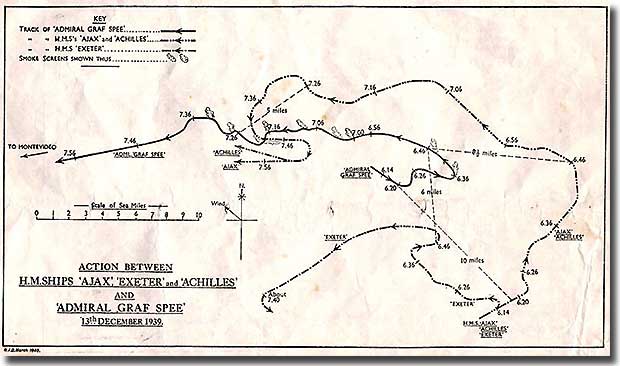
What happened thereafter is shown in the map below, taken from the official Admiralty report into the battle. You can see that Harwood attacked from the south, with Exeter initially turning to port while Ajax and Achilles turned starboard. Langsdorff realised the main threat came from Exeter so he concentrated all his main guns on her, leaving his secondary 5.9 inch guns to engage the two lighter cruisers as they used their superior speed to attack from the other side.

The accuracy of the Graf Spee‘s gunnery soon had Exeter in all sorts of trouble: three out of four main gun turrets were out of action, and the other was being aimed by a gunnery officer standing on the roof with binoculars as the control systems were all shot to pieces; the bridge had been hit, killing most of the officers and knocking out the steering controls, so that for the rest of the battle Exeter was navigated using a small compass taken from one of the ship’s boats; she was also listing about 7 degrees and taking in water. In all, Exeter took seven direct hits from 11-inch shells and 61 of her crew were killed. It was a grim situation but, in the middle of all this, she did manage to score a direct hit on the Graf Spee which didn’t appear at first to be critical but which, it later emerged, was another  stroke of luck for the British.

RiverPlateBattleChart
Realising that Exeter could not go on taking such heavy punishment, and with his own ships too far away to inflict any real damage on their target, Harwood decided to throw caution to the winds, charging repeatedly with Ajax and Achilles to almost suicidally close range to fire torpedoes, and then turning side on to fire full broadsides at the Graf Spee. Although they only inflicted superficial damage, and didn’t by any means emerge unscathed themselves, they did succeed in putting Langsdorff off  his stroke. While Graf Spee switched her attention to the Ajax and Achilles, Exeter used the  breathing space given to her by the courageous action of her sister ships to retire, heavily damaged, under the cover of a smokescreen, southwards to the Falkland Islands for emergency repairs.

Harwood knew he could not carry on the battle with only two ships, so he fell back, expecting the Graf Spee to come after him scenting victory. However, to his surprise, Langsdorff had apparently decided not to finish off the two ligher vessels – nor had he made sure of the Exeter – but instead was steaming due West towards the estuary of River Plate and the port of Montevideo, in neutral Uruguay. The British  fell back and shadowed him, wondering what on earth he was up to.

The reason for Langsdorff’s strange actions seems to be the 8-inch shell hit from the Exeter, which had put the Graf Spee‘s fuel systems out of action. This meant that she only had a few hours fuel left and if she didn’t make it into harbour for repairs then she would be a sitting duck. There were no friendly ports within range, so there was no alternative but to head for the nearest neutral one, which was Montevideo.

The following morning  (14th December 1939) found the Admiral Graf Spee at anchor in Montevideo. The naval battle was over, but another fascinating episode was just starting. The Hague Convention allowed warships to effect repairs in neutral harbours, but only those  that improved their seaworthiness not their fighting efficiency. The British knew that if the Graf Spee came out of harbour she could brush aside force waiting outside in the Estuary. The Ajax and Achilles had been joined by HMS Cumberland, a similar ship to Exeter, but the odds were against them being able to cope. The larger warships of Force H were in fact on their way but would take days to get there.

The British therefore launched an elaborate deception scheme. Unencrypted messages were sent (accidentally on purpose) suggesting battleships were arriving, false  requisitions for aviation fuel for the Ark Royal‘s aircraft were tendered. Phoney wireless traffic filled the Uruguayan airwaves and the notoriously leaky telephone system in Montevideo was used as a highly effective rumour mill. The three British ships outside the harbour busied themselves with making as much smoke as they could to give the impression that a large number of ships were gathering close to the shore.

The Germans were entirely deceived and were convinced that the Graf Spee was cornered by a huge fleet of British warships. Langsdorff took stock. He had used up most of his ammunition in the preceding battle and only had enough left for about 20 minutes action. He had to follow the obligations of international treaties and leave port by 17th December otherwise his ship would be interned. He had been ordered that the latter was not acceptable. He made his decision.

On the appointed date, the Graf Spee slipped out of harbour and proceeded slowly along the Estuary watched by a huge crowd wondering what was going to happen. It appeared that much of the crew had remained behind, suggesting that there might be a skeleton crew onboard preparing to fight one last suicidal battle. Suddenly she stopped. A small launch was seen to leave. A few minutes later a series of enormous explosions ripped the ship apart. Langsdorff had decided to avoid any further loss of life and also avoid the ship falling into enemy hands by deliberately scuttling her. The Admiral Graf Spee sank in the deepest part of the channel, where she remains to this day.

I’m aware of a growing sense of guilt at reliving my childhood fascination with this episode through this blog post. Coming back to it as an adult, however, I am painfully aware of the things I didn’t think about at all when I was much younger. The reality isn’t a game, of course. Over a hundred brave men died in the Battle of the River Plate – 36 on board the Graf Spee and 72 on the British ships (most on HMS Exeter) and one, Captain Langsdorff, committed suicide (on 19th December 1939, by shooting himself in the head while wrapped in the flag of the German Navy).

In fact the character that most exemplifies the sense of tragedy surrounding this story is Hans Langsdorff. An experienced naval officer who served at the Battle of Jutland in 1917 and, by all accounts, a decent and humane man, I see him as someone compelled to fight by a sense of duty rather than anything else. He certainly had no ill-will towards his enemies, and spoke with great admiration of the courage shown by his adversaries. He clearly had no taste for the indiscriminate sinking of defenceless merchant vessels which was what he had been called upon to do.   He may not have been particulrly effective as a tactical commander during the battle, but his errors largely arose from him being supplied with incorrect information.

It should also be noted that, at the funeral of the German sailors who had died in the Battle of the River Plate, Langsdorff gave the traditional German military salute, in contrast to all other officers present who gave the Nazi straight-arm version.