Archive for the Biographical Category

Index Rerum

Posted in Biographical, Science Politics with tags , , , , , , , , , on September 29, 2009 by telescoper

Following on from yesterday’s post about the forthcoming Research Excellence Framework that plans to use citations as a measure of research quality, I thought I would have a little rant on the subject of bibliometrics.

Recently one particular measure of scientific productivity has established itself as the norm for assessing job applications, grant proposals and for other related tasks. This is called the h-index, named after the physicist Jorge Hirsch, who introduced it in a paper in 2005. This is quite a simple index to define and to calculate (given an appropriately accurate bibliographic database). The definition  is that an individual has an h-index of  h if that individual has published h papers with at least h citations. If the author has published N papers in total then the other N-h must have no more than h citations. This is a bit like the Eddington number.  A citation, as if you didn’t know,  is basically an occurrence of that paper in the reference list of another paper.

To calculate it is easy. You just go to the appropriate database – such as the NASA ADS system – search for all papers with a given author and request the results to be returned sorted by decreasing citation count. You scan down the list until the number of citations falls below the position in the ordered list.

Incidentally, one of the issues here is whether to count only refereed journal publications or all articles (including books and conference proceedings). The argument in favour of the former is that the latter are often of lower quality. I think that is in illogical argument because good papers will get cited wherever they are published. Related to this is the fact that some people would like to count “high-impact” journals only, but if you’ve chosen citations as your measure of quality the choice of journal is irrelevant. Indeed a paper that is highly cited despite being in a lesser journal should if anything be given a higher weight than one with the same number of citations published  in, e.g., Nature. Of course it’s just a matter of time before the hideously overpriced academic journals run by the publishing mafia go out of business anyway so before long this question will simply vanish.

The h-index has some advantages over more obvious measures, such as the average number of citations, as it is not skewed by one or two publications with enormous numbers of hits. It also, at least to some extent, represents both quantity and quality in a single number. For whatever reasons in recent times h has undoubtedly become common currency (at least in physics and astronomy) as being a quick and easy measure of a person’s scientific oomph.

Incidentally, it has been claimed that this index can be fitted well by a formula h ~ sqrt(T)/2 where T is the total number of citations. This works in my case. If it works for everyone, doesn’t  it mean that h is actually of no more use than T in assessing research productivity?

Typical values of h vary enormously from field to field – even within each discipline – and vary a lot between observational and theoretical researchers. In extragalactic astronomy, for example, you might expect a good established observer to have an h-index around 40 or more whereas some other branches of astronomy have much lower citation rates. The top dogs in the field of cosmology are all theorists, though. People like Carlos Frenk, George Efstathiou, and Martin Rees all have very high h-indices.  At the extreme end of the scale, string theorist Ed Witten is in the citation stratosphere with an h-index well over a hundred.

I was tempted to put up examples of individuals’ h-numbers but decided instead just to illustrate things with my own. That way the only person to get embarrased is me. My own index value is modest – to say the least – at a meagre 27 (according to ADS).   Does that mean Ed Witten is four times the scientist I am? Of course not. He’s much better than that. So how exactly should one use h as an actual metric,  for allocating funds or prioritising job applications,  and what are the likely pitfalls? I don’t know the answer to the first one, but I have some suggestions for other metrics that avoid some of its shortcomings.

One of these addresses an obvious deficiency of h. Suppose we have an individual who writes one brilliant paper that gets 100 citations and another who is one author amongst 100 on another paper that has the same impact. In terms of total citations, both papers register the same value, but there’s no question in my mind that the first case deserves more credit. One remedy is to normalise the citations of each paper by the number of authors, essentially sharing citations equally between all those that contributed to the paper. This is quite easy to do on ADS also, and in my case it gives  a value of 19. Trying the same thing on various other astronomers, astrophysicists and cosmologists reveals that the h index of an observer is likely to reduce by a factor of 3-4 when calculated in this way – whereas theorists (who generally work in smaller groups) suffer less. I imagine Ed Witten’s index doesn’t change much when calculated on a normalized basis, although I haven’t calculated it myself.

Observers  complain that this normalized measure is unfair to them, but I’ve yet to hear a reasoned argument as to why this is so. I don’t see why 100 people should get the same credit for a single piece of work:  it seems  like obvious overcounting to me.

Another possibility – if you want to measure leadership too – is to calculate the h index using only those papers on which the individual concerned is the first author. This is  a bit more of a fiddle to do but mine comes out as 20 when done in this way.  This is considerably higher than most of my professorial colleagues even though my raw h value is smaller. Using first author papers only is also probably a good way of identifying lurkers: people who add themselves to any paper they can get their hands on but never take the lead. Mentioning no names of  course.  I propose using the ratio of  unnormalized to normalized h-indices as an appropriate lurker detector…

Finally in this list of bibliometrica is the so-called g-index. This is defined in a slightly more complicated way than h: given a set of articles ranked in decreasing order of citation numbers, g is defined to be the largest number such that the top g articles altogether received at least g2 citations. This is a bit like h but takes extra account of the average citations of the top papers. My own g-index is about 47. Obviously I like this one because my number looks bigger, but I’m pretty confident others go up even more than mine!

Of course you can play with these things to your heart’s content, combining ideas from each definition: the normalized g-factor, for example. The message is, though, that although h definitely contains some information, any attempt to condense such complicated information into a single number is never going to be entirely successful.

Comments, particularly with suggestions of alternative metrics are welcome via the box. Even from lurkers.

The Evidence

Posted in Biographical, The Universe and Stuff with tags , , , on September 25, 2009 by telescoper

Further to my recent post about the evidence for a low-density Universe, I thought I’d embarrass all concerned with this image, taken in Leiden in 1995.

Various shady characters masquerading as “experts” were asked by the audience of graduate students at a summer school to give their favoured values for the cosmological parameters (from top to bottom: the Hubble constant, density parameter, cosmological constant, curvature parameter and age of the Universe).

From left to right we have Alain Blanchard (AB), Bernard Jones (BJ, standing), John Peacock (JP), me (yes, with a beard and a pony tail – the shame of it), Vincent Icke (VI), Rien van de Weygaert (RW) and Peter Katgert (PK, standing). You can see on the blackboard that the only one to get anywhere close to correctly predicting the parameters of what would become the standard cosmological model was, in fact, Rien van de Weygaert.

Cranks Anonymous

Posted in Biographical, Books, Talks and Reviews, The Universe and Stuff with tags , , , , on September 22, 2009 by telescoper

Sean Carroll, blogger-in-chief at Cosmic Variance, has ventured abroad from his palatial Californian residence and is currently slumming it in a little town called Oxford where he is attending a small conference in celebration of the 70th birthday of George Ellis. In fact he’s been posting regular live commentaries on the proceedings which I’ve been following with great interest. It looks an interesting and unusual meeting because it involves both physicists and philosophers and it is based around a series of debates on topics of current interest. See Sean’s posts here, here and here for expert summaries of the three days of the meeting.

Today’s dispatches included an account of George’s own talk which appears to have involved delivering a polemic against the multiverse, something he has been known to do from time to time. I posted something on it myself, in fact. I don’t think I’m as fundamentally opposed as Geroge to the idea that we might live in a bit of space-time that may belong to some sort of larger collection in which other bits have different properties, but it does bother me how many physicists talk about the multiverse as if it were an established fact. There certainly isn’t any observational evidence that this is true and the theoretical arguments usually advanced are far from rigorous.The multiverse certainly is  a fun thing to think about, I just don’t think it’s really needed.

There is one red herring that regularly floats into arguments about the multiverse, and that concerns testability. Different bits of the multiverse can’t be observed directly by an observer in a particular place, so it is often said that the idea isn’t testable. I don’t think that’s the right way to look at it. If there is a compelling physical theory that can account convincingly for a realised multiverse then that theory really should have other necessary consequences that are testable, otherwise there’s no point. Test the theory in some other way and you test whether the  multiverse emanating from it is sound too.

However, that fairly obvious statement isn’t really the point of this piece. As I was reading Sean’s blog post for today you could have knocked me down with a feather when I saw my name crop up:

Orthodoxy is based on the beliefs held by elites. Consider the story of Peter Coles, who tried to claim back in the 1990’s that the matter density was only 30% of the critical density. He was threatened by a cosmological bigwig, who told him he’d be regarded as a crank if he kept it up. On a related note, we have to admit that even scientists base beliefs on philosophical agendas and rationalize after the fact. That’s often what’s going on when scientists invoke “beauty” as a criterion.

George was actually talking about a paper we co-wrote for Nature in which we went through the different arguments that had been used to estimate the average density of matter in the Universe, tried to weigh up which were the more reliable, and came to the conclusion that the answer was in the range 20 to 40 percent of the critical density. There was a considerable theoretical prejudice at the time, especially from adherents of  inflation, that the density should be very close to the critical value, so we were running against the crowd to some extent. I remember we got quite a lot of press coverage at the time and I was invited to go on Radio 4 to talk about it, so it was an interesting period for me. Working with George was a tremendous experience too.

I won’t name the “bigwig” George referred to, although I will say it was a theorist; it’s more fun for those working in the field to guess for themselves! Opinions among other astronomers and physicists were divided. One prominent observational cosmologist was furious that we had criticized his work (which had yielded a high value of the density). On the other hand, Martin Rees (now “Lord” but then just plain “Sir”) said that he thought we were pushing at an open door and was surprised at the fuss.

Later on, in 1996, we expanded the article into a book in which we covered the ground more deeply but came to the same conclusion as before.  The book and the article it was based on are now both very dated because of the huge advances in observational cosmology over the last decade. However, the intervening years have shown that we were right in our assessment: the standard cosmology has about 30% of the critical density.

Of course there was one major thing we didn’t anticipate which was the discovery in the late 1990s of dark energy which, to be fair, had been suggested by others more prescient than us as early as 1990. You can’t win ’em all.

So that’s the story of my emergence as a crank, a title to which I’ve tried my utmost to do justice since then. Actually, I would have liked to have had the chance to go to George’s meeting in Oxford, primarily to greet my ertswhile collaborator whom I haven’t seen for ages. But it was invitation-only. I can’t work out whether these days I’m too cranky or not cranky enough to get to go to such things. Looking at the reports of the talks, I rather think it could be the latter.

Now, anyone care to risk the libel laws and guess who Professor BigWig was?

Also Sprach Zarathustra

Posted in Biographical, Music, Poetry with tags , , , , on September 8, 2009 by telescoper

Today is the 60th anniversary of the death of the great composer Richard Strauss in 1949. I’ve already used up the music which is probably the most appropriate for this occasion, so I thought I’d mark it instead with a clip from the work that is probably most familiar to my likely readership, Also Sprach Zarathustra, as used in the closing stages of Stanley Kubrick’s masterpiece 2001: A Space Odyssey.

This little clip is from the final stages of the film, though the music itself is from the opening segment of the Strauss work, the part that represents the Sunrise.

For people of my age, this music is inextricably linked not only with the film, but also with the TV coverage of the moon landings that happened about the same time as its release, about 40 years ago, and for which it also provided the theme music. I don’t know which came first. I’d love to be able to say that these events are behind what made me become an astrophysicist but, as I’ve explained before, the truth is somewhat different.

Anyway, the theme of transfiguration and rebirth depicted in the movie  seems to me to be one more closely related to Strauss’ earlier work Tod und Verklärung,  and it always makes me think of the following lines from East Coker, the second of the Four Quartets by TS Eliot:

Old men ought to be explorers
Here or there does not matter
We must be still and still moving
Into another intensity
For a further union, a deeper communion
Through the dark cold and the empty desolation,
The wave cry, the wind cry, the vast waters
Of the petrel and the porpoise. In my end is my beginning.

Flame Academy

Posted in Biographical, The Universe and Stuff with tags , , , , , , , on September 2, 2009 by telescoper

I heard on the radio this morning from that nice Mr Cowan that today is the anniversary of the start of the Great Fire of London which burned for four days in 1666. That provides for a bit of delayed synchronicity with yesterday’s post about the dreadful fires in the outskirts of Los Angeles and a similar conflagration in Athens (which now thankfully appears to be under control).

Fires are of course terrifying phenomena, and it must be among most people’s nightmares to be caught in one. The cambridge physicist Steve Gull experienced this at first hand when his boat exploded and caught fire recently. I’ll take this opportunity to wish him a speedy recovery from his injuries.

But frightening as such happenings are, a flame (the visible, light emitting part of a fire) can also be a very beautiful and fascinating spectacle. Flames are stable long-lived phenomena involving combustion in which a “fuel”, often some kind of hydrocarbon, reacts with an oxidizing element which, in the case of natural wildfires at any rate, is usually oxygen. However, along the way, many intermediate radicals are generated and the self-sustaining nature of the flame is maintained by intricate reaction kinetics.

The shape and colour of a flame is determined not just by its temperature but also, in a complicated way, by diffusion, convection and gravity. In a diffusion flame, the fuel and the oxidizing agent diffuse into each other and the rate of diffusion consequently limits the rate at which the flame spreads. Usually combustion takes place only at the edge of the flame: the interior contains unburnt fuel. A candle flame is usually relatively quiescent because the flow of material in it is predominantly laminar. However, at higher speeds you can find turbulent flames, like in the picture below!

Sometimes convection carries some of the combustion products away from the source of the flame. In a candle flame, for example, incomplete combustion forms soot particles which are convected upwards and then incandesce inside the flame giving it a yellow colour. Gravity limits the motion of heavier products away from the source. In a microgravity environment, flames look very different!

All this stuff about flames also gives me the opportunity to mention the great Russian physicist Yakov Borisovich Zel’dovich. To us cosmologists he is best known for his work on the large-scale structure of the Universe, but he only started to work on that subject relatively late in his career during the 1960s.  He in fact began his career as a physical chemist and arguably his greatest contribution to science was that he developed the first completely physically based theory of flame propagation (together with Frank-Kamenetskii). No doubt he used insights gained from this work, together with his studies of detonation and shock waves, in the Soviet nuclear bomb programme in which he was a central figure.

But one thing even Zel’dovich couldn’t explain is why fires are such fascinating things to look at. I remember years ago having a fire in my back garden to get rid of garden rubbish. The more it burned the more things  I wanted to throw on it,  to see how well they would burn rather than to get rid of them. I ended up spending hours finding things to burn, building up a huge inferno, before finally retiring indoors, blackened with soot.

I let the fire die down, but it smouldered for three days.

Audio Video Disco

Posted in Biographical, The Universe and Stuff with tags , , on August 26, 2009 by telescoper

2656852604_d321d54df1

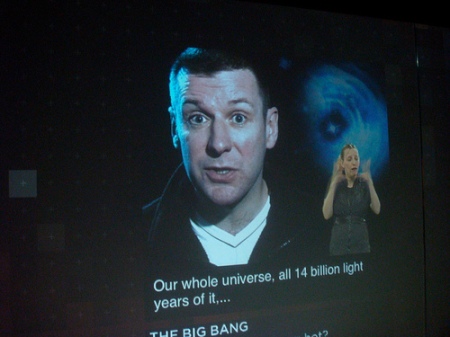
This scary picture is taken from an interactive exhibit in the Weller Galleries of the Royal Observatory at Greenwich, which opened in 2007. The exhibit, I mean, not the Royal Observatory. I remember going down there to record the video segments, but had forgotten all about it until somebody found this image on the net and drew my attention to it.

The exhibit consists of a series of display screens with various astronomical and cosmological concepts and questions on them, along with appropriate images. Visitors touch the screens to bring up the video segments in which distinguished astronomers (or me) attempt to provide explanations.

The lady to the bottom right is probably providing a sign language translation of my contribution. Or she could simply be screaming and waving her hands in terror. Wouldn’t you?

PS. If you want an explanation of the title of this blog post, I’ll translate Audio Video Disco from the latin for you. It means “I hear, I see, I learn”. Since they have to touch the screen, I might have added “I touch” which would be Tango….

Music 101

Posted in Biographical, Music with tags , , , , , , , , , , on August 17, 2009 by telescoper

Regular readers of this blog will know that I’m a very laid-back kind of guy, unlikely to take an irrational dislike to anything or anyone and in possession of an easy-going and tolerant nature not disposed to any form of grumpiness.

However, I’ve decided to celebrate the fact that I’ve finished marking all my resit examinations by letting my hair down a bit and giving you a list of my musical pet hates. The title is an allusion to  George Orwell’s 1984, wherein Room 101 was a personalised torture chamber containing a prisoner’s own worst nightmare. Here I’ve confined myself to music. I was going to include rap but, as I said, I’ve decided to confine myself to music.

Brass Bands. I don’t mind brass bands – particularly colliery bands and the Salvation Army band – at Christmas or for singing hymns to, but I’ve put them on my list for the excruciating brass-band arrangements of classical or jazz that make my skin crawl. You wouldn’t want to play Jimi Hendrix on the banjo, and you shouldn’t let a brass band play Wagner.

Elvis Presley. His music was largely nicked from much more talented black musicians, and his inferior versions became popular simply because he was white and (when he was young) good-looking. He wasn’t even average as a singer. During his later years he became a monument to extreme self-indulgence and dreadful Las Vegas Kitsch, a bloated laughing-stock in a sequinned jumpsuit. I like a lot of Rock’n’Roll, but Elvis was the pits.

Brahms & Liszt . Where the majestic journey of the Germanic romantic tradition veered off into a tedious cul-de-sac. Turgid and impenetrable on the one hand, flowery and overwrought on the other. But what about Brahms’ German Requiem? I’m with George Bernard Shaw, who said that it was a work to be “patiently borne only by a corpse”. When invited to hear the work for a second time, he declined. “There are are some sacrifices which should not be demanded twice from any man; and one of them is listening to Brahms’ Reqiuem.” I could have added Schumann to this too, but then I would have lost the reference to Cockney rhyming slang.

Period Instruments My heart always sinks when I pick up a CD of a much-loved piece only to read the dreaded words “played on period instruments”. Read “played on inferior instruments (and probably out of tune too)”. Why on Earth would anyone prefer the buttock-clenchingly awful scraping sound made by a baroque cello or viola da gamba to a proper instrument? And as for the so-called “natural trumpet”, words fail me.

I’ve added this from Anton, which makes the point better than I could!

periodinstruments

Barbershop Quartets Close-harmony singing can be wonderful to listen to – I’m a great admirer of Welsh male voice choirs, for example. However, the whining fake joviality of a Barbershop quartet is quite unendurable. Cut my throat with a razor rather than make me listen to one!

The Four Seasons I’m prepared to accept that Antonio Vivaldi might have written a reasonably competent piece of music in The Four Seasons. After all, he wrote so many little concerti that he’d be expected to come up with one half-decent one just by chance. The problem is that I’ve heard it so many times, in lifts, shops and, worst of all, at the other end of a telephone call centre line – and usually in very badly played versions – that I think I’ll commit murder the next time I hear it. And don’t get me started on Nigel Kennedy either.

Pan Pipes I dream of the day when it is possible to walk along a British high street without my ears being assaulted by faux Andean tootling to the accompaniment of overamplified muzak. Those guys may dress like Incas but they’ve probably never been closer to South America than Weston-super-mare. And do they think people can’t tell they’re miming?

Hector Berlioz Revoltingly overblown bombastic nonsense from a man whose ego exceeded his talent by as large a factor as you can find. My music teacher at School loved Berlioz, with the result that his vacuous splurgy ramblings were inflicted on me and my classmates lesson after lesson. The normally generous Giuseppe Verdi said that Berlioz “was a poor, sick fellow, full of fury against the world at large, bitter and spiteful.” Perhaps he couldn’t come to terms with his own mediocrity.

Folk Singers I like a lot of folk music, but don’t like English folk singers,  especially those that sing in a made-up west country accent and stick their fingers in their ears as they do so. If we have to listen to their irritating nasal droning, then at least they should have the courtesy to unblock their ears and suffer with the rest of us.

Harpsichords I could have included these under “period instruments”, but I think they deserve to be singled out for special mention. There might have been an excuse for playing a harpsichord in the days before the pianoforte was invented, but they should now all be destroyed to save us from the hideous plinky-plonky jingly-jangly noise they make. “Like two skeletons copulating on a tin roof” was how Sir Thomas Beecham described them, and who am I to disagree? Nothing was ever written for the harpsichord that didn’t sound better when played on the piano.

So there you are. That’s my list. If you feel like relieving a bit of stress feel free to add your own via the comments box. But please keep your contributions as measured and reasonable as mine.

Da Capo

Posted in Biographical with tags , , on August 15, 2009 by telescoper

Last week was a most momentous week, a milestone in the continuing advance of my professional career. I have tasted power. Capo di Tutti Capi!

But only for three days.

Actually it wasn’t that great. All I had to do one sign one form, with the costings for a search grant for one of our physics professors. There was nothing to it. I didn’t even have to read it, and a pen was provided too.

The point is that almost everyone was away last week and, although I was off Monday and Tuesday touring with my folks, for the latter part of the week I was designated Head of School (in the absence of the actual Head, the Deputy Head, the Director of Undergraduate Studies, and the School Manager..). I’m clearly quite a long way down the line of inheritance.

One of the reasons everyone is taking their leave now is that the A-level results are due in next week and quite a few folks will have to be back for that, to deal with next academic year’s undergraduate admissions procedures. I’m not involved directly in this process but it’s very important for the School of course.

I always think the admissions system for Universities (UCAS) is very strange. If you were going to set up a system from scratch you certainly wouldn’t have made it the way it is. Universities are given quotas of students by the government (via the funding Councils) and this is passed on to each department as a recruitment target. The departments organize interviews, open days, and all the rest of the paraphernalia of admissions practice. They then make offers to selected students in terms of A-level grades. The students, for their part, do this for several universities, getting several offers, from which they accept one as their first-choice “Firm” offer and another, usually lower, as a second-choice  “Insurance”  offer. The students then wait for their A-level results to see if they get into either of their selected departments.

Although each department has a fixed target number to recruit, it is impossible to know exactly how many will make the grades that are offered. Departments generally make more offers than they have places because some will not make the grades. However, if the success rate is higher than expected (or, as the government would put it,  if educational standards continue to rise) the department has to take too many students in. If not enough students make their grades, near- misses might be accepted but generally it’s difficult to make up a shortfall at this late stage except by going into Clearing, a pool of applicants who didn’t make it into either of their two choices.

According to today’s Guardian, the government’s recent decision to put the brakes on university expansion, combined with an increased number of applicants for university places generated by the economic recession, means that many students are unlikely to get a place at all this year.

In physics nationally there has been a substantial increase in the number of applicants over the past few years, and my own department at Cardiff University is set to meet its quota quite comfortably and is unlikely to take any students from clearing. Applications are buoyant here, at least partly because Cardiff is such an interesting place to live and offers such a vibrant social scene for students. We’re also in a special position because we get many applications from prospective students inside Wales who want to remain here to study. Cardiff University is one of only three insitutions in Wales that offer physics degrees (Aberystwyth and Swansea being the other two).

We would like to be able to increase the number of students we recruit in order to finance expansion of our staff numbers, but given the freeze on funded places from the government we would have to take quota from other departments to do so. Whether the University will allow us to do this is not at all clear, although there are departments that struggle to fill their existing quotas. Whatever happens in future years, I hope there aren’t too many disappointments in store for prospective students next week when their A-level results land on their doormat.

Anyway, the fact that we’ve reached this time of year reminds me that the start of the new academic year is not far off, and the cycle of academic life is soon to start again.  Once more, from the top!

Along the bent and Devon-facing seashore

Posted in Biographical with tags , , , , on August 14, 2009 by telescoper

I’ve been off for a few days because my folks have been visiting from Newcastle. The good weather (on Tuesday, at least) gave us the opportunity to go for a drive around the Gower peninsula to the west of Swansea, seeing  some of the sights. I don’t think I’m very good at travelogues, but here are a few memories of the trip.

Along the north coast first: Penclawdd, Crofty and Llanrhidian. Weobley Castle stands decaying and forlorn, overlooking a salt marsh grazed by sheep and horses. In the distance, over the estuary, a nondescript town. Through binoculars I see they’re building a new Asda. What was there 700 years ago when they built the Castle?

Rossili Bay, at the western end of the peninsula. Beaches and dunes under cliffs. Caravans as far as the eye can see. Impatient surfers waiting in wet-suits for the tide to come in. Don’t they check the tide tables? The smell of Fish and Chips fails to lure us.

We drive south. White cottages shining bright in the sunshine, then down steep hills into cool dark tunnels formed by trees either side of the narrow roads, their leaves meeting overhead. I wonder what it’s like down here when it’s raining: the road must turn into a torrent. Then up on top again. Bright sunshine, a small airport and more caravans.

Driving south we come again to the jagged coast and see  Devon  along the horizon in front of us. I’m surprised it is so clear, as it must be at least 30 miles away. It’s dark and solid, a featureless granite wall. It reminds me of Dylan Thomas Reminiscences of Childhood ..

There was another world where with my friends I used to dawdle on half holidays along the bent and Devon-facing seashore…

I had always thought he just knew that Devon was there, not that he had actually seen it. I decide I like the word “dawdle”.

Port Eynon, at the southernmost tip of the Gower. A small beach between two headlands with a larger beach to one side. Fish and Chips and hot tea offer themselves. This time we accept. Inside the café (“The Captain’s Table”) an old newspaper in a frame on the wall tells stories of smuggling and wreck sales. Another, dated 1916, says that three lifeboat men had drowned while trying to rescue a ship that had foundered off the headland where the derelict oyster pans lie.

The sand dunes behind the beach are covered in wild flowers and they are covered in turn with vividly coloured beetles and butterflies. The tide is still out and it’s too far to walk over the rocks to get to the sea to have a paddle.  It’s not difficult to imagine a boat coming to grief in this place. There are flags all over warning about the dangers of the current. It must be a desolate place in the winter.

I think about retirement.

We pass a church with a memorial to the brave men who lost their lives that day in 1916. The lifeboat station was moved in 1919 because the place was too dangerous. Stopping to read the inscription, I’m almost run over on the narrow road by a big van carrying surfers and their gear. I wonder why they’re in such a hurry when the tide is out.

We try to avoid getting snarled up in traffic in Swansea on the way home. We fail.

As an afterthought, we head for The Mumbles, park the car and walk. Ambling along the curved promenade in the evening sunshine, a large and lumpy lady waddles towards us with sweat running down  pale pink arms;  her voluminous black dress conceals a hefty bosom that makes me think of two sacks of Tyne coal. It turns out The Mumbles is named after the French Mamelles – meaning breasts – although it takes its name from the shape of two small islands off Mumbles Head rather than from some distant ancestor of the lady I’ve just seen.

The long promenade sweeps along the side of Swansea bay to the pier and a lighthouse. The tide is still out. It seems miles to the sea, over nasty rocks that look like cinder. No beach. On the esplanade dozens of boats lie stranded, like befuddled whales that have run aground to their doom.

Dogs carry sticks and people carry ice-creams.

It’s evening now and I wonder why the tide seems to have been out everywhere we’ve been since morning.

On the inland side of the Mumbles there is a hotch-potch of closed-down pubs  and up-market bistros, next door to one another, an amusement hall and, next to it, tennis courts. The inevitable Fish and Chips. Nearer the pier  there’s an open-air Café called Verdi’s. It’s packed and doing a roaring trade in ice-creams. The waiters are very handsome but I’m not convinced they are Italian. A man sings “Just one Cornetto” and laughs loudly, but nobody else does.

Back to the car, through the centre of Swansea, and then home in less than an hour. Pimms and Lemonade in the garden before going to the pub for dinner.

Oratorio

Posted in Biographical, The Universe and Stuff with tags , , on July 16, 2009 by telescoper

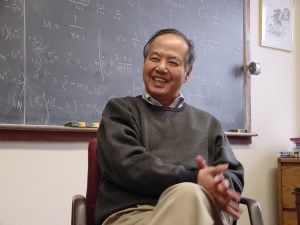
T.D.1.jpg_copyBlogging about graduation ceremonies yesterday, I was reminded that a few years ago I had to deliver an oration on behalf of a very famous physicist who was awarded an honorary doctorate at the University of Nottingham. The recipient was TD Lee (shown left) who, together with CN Yang, won the Nobel Prize for Physics in 1957 for his work on parity violation. I thought you might find it interesting to  read the text of the oration, which I just found on my laptop this morning:

PROFESSOR TSUNG-DAO LEE

ORATION DELIVERED BY PROFESSOR PETER COLES

ON MONDAY 17 JULY 2006

Chancellor, Vice-Chancellor, Ladies and Gentlemen, it is both a pleasure and a privilege to present Professor Tsung-Dao Lee for the award of an honorary degree.  Professor Lee is a distinguished theoretical physicist whose work over many years has been characterized, in the words of Dr J Robert Oppenheimer, by “a remarkable freshness, versatility and style.”

Tsung-Dao Lee was born in Shanghai and educated at Suzhou University Middle School in Shanghai.  Fleeing the Japanese invasion, he left Shanghai in 1941.  His education was interrupted by war.  In 1945 he entered the National Southwest University in Kunming as a sophomore.  He was soon recognized as an outstanding young scientist and in 1946 was awarded a Chinese Government Scholarship enabling him to start a PhD in Physics under Professor Enrico Fermi at the University of Chicago.  He gained his doctorate in physics in 1950 with a thesis on the Hydrogen Content of White Dwarf Stars, and subsequently served as a research associate at the Yerkes Astronomical Observatory of the University of Chicago in Williams Bay, Wisconsin.

Astronomy is a science that concerns the very large, but it was in the physics of the very small that Professor Lee was to do his most famous work.  After one year as a research associate and lecturer at the University of California in Berkeley, he became a fellow of the Institute of Advanced Study in Princeton and, in 1953, he accepted an assistant professorship position at Columbia University in New York.  Two and a half years later, he became the youngest full professor in the history of Columbia University.  During this time he often collaborated with Chen Ning Yang whom he had known as a fellow student in Chicago.  In 1956 they co-authored a paper whose impact was both immediate and profound.  Only a year later, Lee and Yang were jointly awarded the Nobel Prize in Physics.  Professor Lee was thirty-one at the time and was the second youngest scientist ever to receive this distinction.  (The youngest was Sir Lawrence Bragg who shared the Physics Prize with his father in 1915, at the age of twenty-five.)

It is usually difficult to explain the ideas of theoretical physics to non-experts.  The mathematical language is inaccessible to those without specialist training.  But some of the greatest achievements in this field are so bold and so original that they appear, at least with hindsight, to be astonishingly simple.  The work of Lee and Yang on parity violation in elementary particle interactions is an outstanding example.

Subatomic particles interact with each other in very complicated ways.  In high energy collisions, particles can be scattered, destroyed or transformed into other particles.  But governing these changes are universal rules involving things that never change.  The existence of these conservation laws is a manifestation of the symmetries possessed by the mathematical theory of particle interactions.

Lee and Yang focussed on a particular attribute called parity, which relates to the “handedness” of a particle and symmetry with respect to mirror reflections.  Physicists had previously assumed that the laws of nature do not distinguish between left- and right-handed states: a left-handed object when seen in a mirror should be indistinguishable from a right-handed one.  This symmetry suggests that parity should be conserved in particle interactions, as it is in many other physical processes.  Unfortunately this chain of thought led to a puzzling deadlock in our understanding of the so-called weak nuclear interaction.  Lee and Yang made the revolutionary suggestion that parity is not conserved in weak interactions and consequently that the laws of nature must have a built-in handedness.  A year later their theory was tested experimentally and found to be correct.  Their penetrating insight led to a radical overhaul of the theory of weak interactions and to many further discoveries.  Physicists around the world said “Of course!  Why didn’t I think of that?”

This classic “Eureka moment” happened half a century ago, but Professor Lee has since made a host of equally distinguished contributions to fields as diverse as astrophysics, statistical mechanics, field theory and turbulence.  He was made Enrico Fermi Professor at Columbia in 1964 and University Professor there in 1984.  With typical energy and enthusiasm he took up the post of director of the RIKEN Research Center at Brookhaven National Laboratories in 1998.  He has played a prominent role in the advancement of science in China, including roles as director of physics institutes in Beijing and Zhejiang.

Professor Lee has received numerous awards and honours from around the world, including the Albert Einstein Award in Science, the Bude Medal, the Galileo Galilei Medal, the Order of Merit, Grande Ufficiale of Italy, the Science for Peace Prize, the China National-International Cooperation Award, the New York City Science Award, the Pope Joannes Paulis Medal, Il Ministero dell’Interno Medal of the Government of Italy and the New York Academy of Sciences Award.  His recognition even extends beyond this world, for in 1997 Small Planet 3443 was named in his honour.

Chancellor, Vice-Chancellor, to you and to the whole congregation I present Professor Tsung-Dao Lee as eminently worthy to receive the degree of Doctor of Science, honoris causa.