Archive for the Biographical Category

Graduandi Graduati

Posted in Biographical with tags , , , on July 15, 2009 by telescoper

Today was the day of the graduation ceremony for Cardiff  University‘s School of Physics & Astronomy, which took place in the fine surroundings of St David’s Hall. It’s a proud day for the students and their parents so, before anything else, let me offer my congratulations to all those who graduated today. Congratulations and well done to you all!

I put on my robes in the Green Room and was in the academic staff procession at the beginning and end of the ceremony. I also sat on stage during the conferment of degrees and the speech by the University’s President, Lord Kinnock. Some of the proceedings were conducted in Welsh – including the actual degree award – but it was comprehensible enough for all foreigners (even the English) to follow what was going on.

Graduation ceremonies are funny things. With all their costumes and weird traditions, they do seem a bit absurd. On the other hand, even in these modern times, we live with all kinds of  rituals and I don’t see why we shouldn’t celebrate academic achievement in this way.

Graduation is a grammatical phenomenon too. The word “graduation” is derived from the latin word gradus meaning a step, from which was eventually made the mediaeval latin verb graduare, meaning to take a degree. The past participle  of this is formed via the supine graduatus, hence the English noun “graduate” (i.e. one who has taken a degree). The word graduand, on the other hand, which is used before and during the ceremony to describe those about to graduate is from the  gerundive form graduandus meaning “to be graduated”. What really happens, therefore, is that students swap their gerundives for participles, although I suspect most participants don’t think of it in quite those terms…

The academic procession is quite colourful because staff wear the gown appropriate to their highest degree. Colours and styles vary greatly from one University to another even within the United Kingdom, and there are even more variations on show when schools contain staff who got their degrees abroad. Since I got my doctorate from the University of Sussex, which was created in the 1960s, the academic garb I have to wear on these occasions  is actually quite modern-looking. With its raised collar, red ribbons and capped shoulders it’s also more than a little bit camp. It often brings  a few comments when I’m in the procession, but I usually reply by saying I bought the outfit at Ann Summers.

Graduation of course isn’t just about education. It’s also a rite of passage on the way to adulthood and independence, so the presence of the parents at the ceremony adds another emotional dimension to the goings-on. Although everyone is rightly proud of the achievement – either their own in the case of the graduands or that of others in the case of the guests – there’s also a bit of sadness to go with the goodbyes. The new graduates were invited back to the School for a reception after this morning’s ceremony, along with parents and friends. That provided a more informal opportunity to say goodbye. Some, of course, are continuing their studies either at Cardiff or elsewhere so I’ll be seeing at least some of them again.

Although this was my first attendance at the Cardiff University graduation, I’ve been to  graduation ceremonies at several universities as a staff member. They differ in detail but largely follow the same basic format. Compared to others I’ve been at, the Cardiff version is very friendly and rather informal. For one thing, the Vice-Chancellor actually shakes hands with all the graduands as they cross the stage. At Nottingham University, for example, where I was before moving here, the V-C just sat there reading a book and occasionally nodded as they trooped across in front of him.

The venue for Cardiff’s graduation is also right in the city centre, so all day you can find students in their regalia wandering through the town (sometimes with their doting parents in tow). I like this a lot because it gives the University a much greater sense of belonging to the city than is the case when everything happens on a campus miles out of town.

The most remarkable thing  I noticed in the ceremony was not to do with Physics & Astronomy, but with Cardiff’s School of Psychology which is much larger and in which at least 90% of the graduates were female. In our School the proportions aren’t exactly reversed but are about 75% male to 25% female.

I’ve also been through two graduations on the other side of the fence, as it were. My first degree came from Cambridge so I had to participate in the even more archaic ceremony for that institution. The whole thing is done in Latin there (or was when I graduated) and involves each graduand holding a finger held out by their College’s Praelector and then kneeling down in front of the presiding dignitary, who is either the Vice-Chancellor ot the Chancellor. I can’t remember which. It’s also worth mentioning that although I did Natural Sciences (specialising in Theoretical Physics), the degree I got was Bachelor of Arts. Other than that, and the fact that the graduands walk to the Senate House from their College through the streets of Cambridge,  I don’t remember much about actual ceremony.

I was very nervous for my first graduation. The reason was that my parents had divorced some years before and my Mum had re-married. My Dad wouldn’t speak to her or her second husband. Immediately after the ceremony there was a garden party at my college, Magdalene, at which the two parts of my family occupied positions at opposite corners of the lawn and I scuttled between them trying to keep everyone happy. It was like that for the rest of the day and I have to say it was very stressful.

A few years later I got my doctorate (actually DPhil) from the University of Sussex. The ceremony in that case was in the Brighton Centre on the seafront. It was pretty much the same deal again with the warring factions, but I enjoyed the whole day a lot more that time. And I got the gown.

Why the Big Bang is Wrong…

Posted in Biographical, The Universe and Stuff with tags , , on July 7, 2009 by telescoper

I suspect that I’m not the only physicist who has a filing cabinet filled with unsolicited correspondence from people with wacky views on everything from UFOs to Dark Matter. Being a cosmologist, I probably get more of this stuff than those working in less speculative branches of physics. Because I’ve written a few things that appeared in the public domain (and even appeared on TV and radio a few times), I probably even get more than most cosmologists (except the really  famous ones of course).

I would estimate that I get two or three items of correspondence of this kind per week. Many “alternative” cosmologists have now discovered email, but there are still a lot who send their ideas through regular post. In fact, whenever I get a envelope with an address on it that has been typed by an old-fashioned typewriter it’s usually a dead giveaway that it’s going to be one of  those. Sometimes they are just letters (typed or handwritten), but sometimes they are complete manuscripts often with wonderfully batty illustrations. I have one in front of me now called Dark Matter, The Great Pyramid and the Theory of Crystal Healing. I might even go so far as to call that one bogus. I have an entire filing cabinet in my office at work filled with things like it. I could make a fortune if I set up a journal for these people. Alarmingly, electrical engineers figure prominently in my files. They seem particularly keen to explain why Einstein was wrong…

I never reply, of course. I don’t have time, for one thing.  I’m also doubtful whether there’s anything useful to be gained by trying to engage in a scientific argument with people whose grip on the basic concepts is so tenuous (as perhaps it is on reality). Even if they have some scientific training, their knowledge and understanding of physics is usually pretty poor.

I should explain that, whenever I can, if someone writes or emails with a genuine question about physics or astronomy – which often happens – I always reply. I think that’s a responsibility for anyone who gets taxpayers’ money. However, I don’t reply to letters that are confrontational or aggressive or which imply that modern science is some sort of conspiracy to conceal the real truth.

One particular correspondent started writing to me after the publication of my little book, Cosmology: A Very Short Introduction. I won’t gave his name, but he was an individual who had some scientific training (not an electrical engineer, I hasten to add). This chap sent a terse letter to me pointing out that the Big Bang theory was obviously completely wrong.  The reason was  obvious to anyone who understood thermodynamics. He had spent a lifetime designing high-quality refrigeration equipment  and therefore knew what he was talking about (or so he said).

His point was that, according to  the Big Bang theory, the Universe cools as it expands. Its current temperature is about 3 Kelvin (-270 Celsius or therabouts) but it is now expanding. Turning the clock back gives a Universe that was hotter when it was younger. He thought this was all wrong.

The argument is false, my correspondent asserted, because the Universe – by definition –  hasn’t got any surroundings and therefore isn’t expanding into anything. Since it isn’t pushing against anything it can’t do any work. The internal energy of the gas must therefore remain constant and since the internal energy of an ideal gas is only a function of its temperature, the expansion of the Universe must therefore be at a constant temperature (i.e. isothermal, rather than adiabatic, as in the Big Bang theory). He backed up his argument with bona fide experimental results on the free expansion of gases.

I didn’t reply and filed the letter away. Another came, and I did likewise. Increasingly overcome by some form of apoplexy his letters got ruder and ruder, eventually blaming me for the decline of the British education system and demanding that I be fired from my job. Finally, he wrote to the President of the Royal Society demanding that I be “struck off” – not that I’ve ever been “struck on” – and forbidden (on grounds of incompetence) ever to teach thermodynamics in a University.

Actually, I’ve never taught thermodynamics in any University anyway, but I’ve kept the letter (which was cc-ed to me) in case I am ever asked. It’s much better than a sick note….

This is a good example of a little knowledge being a dangerous thing. My correspondent clearly knew something about thermodynamics. But, obviously, I don’t agree with him that the Big Bang is wrong.

Although I never actually replied to this question myself, I thought it might be fun to turn this into a little competition, so here’s a challenge for you: provide the clearest and most succint explanation of why the temperature of the expanding Universe does fall with time, despite what my correspondent thought.

Answers via the comment box please, in language suitable for a nutter non-physicist.

Mummified by Beer

Posted in Biographical with tags , on June 24, 2009 by telescoper

Years ago I went on holiday to Egypt with a friend. It wasn’t the usual kind of holiday because we didn’t stay in a hotel, but at the house of my friend’s cousin Moira who worked in the Cairo American College, in a suburb of the city. Since we were both pretty skint at that time we got an incredibly cheap flight to Cairo from London via Bucharest with the Romanian airline Tarom. The less said about the flight the better, especially the food on it, because it made Ryanair look positively luxurious, but at least we got there alive.

The first evening there we were both very tired and a bit overwhelmed by the surroundings, but we decided to go into one of the local bars for a quick drink before going to bed. Only two kinds of beer were available, both called Stella. (I should point out for legal reasons that this is not Stella Artois that we’re talking about!) The Egyptian Stella came in two varieties: Stella National (which was one Egyptian pound for a pint bottle; about 20p in British money then) and Stella Export (5 Egyptian pounds). Being impoverished, I ordered a pint of the National version. It tasted slightly odd, but basically OK. I drank up and went back to the house.

The next morning I had the worst hangover I’ve ever had in my life. I couldn’t understand it. I saw Moira at breakfast and she told me I looked dreadful. I explained that I had only had one pint the night before. She looked at me in horror.

“You didn’t drink the Stella National, did you?”

I said yes, I did, but I only had a pint.

She explained that the reason the “National” version was so cheap was that it contained something to stop it going off in the hot climate. The “Export” version didn’t have this ingredient because they couldn’t possibly export it if it did. The preserving agent turned out to be formaldehyde, which is used in embalming corpses.

Mabel’s Dream

Posted in Biographical, Jazz with tags , , , on June 22, 2009 by telescoper

I could attempt to make a cheesy Radio 2 kind of link between my previous post and this one, along the lines of “From one dream to another..” but I don’t think I’ll bother.

Years ago my mum told me that she heard the tune Mabel’s Dream played on the piano by a friend of the family by the name of Johnny Handle. Best known as a folk musician (and founder member of a well-known band called The High Level Ranters) he is also a music teacher and musicologist with a wide range of interests in music.  I read somewhere that this lovely tune was originally written by Jelly Roll Morton and performed by him on solo piano, but I’ve never managed to locate a solo version. However, every time I try looking for it (which I did this evening) I seem to come across something really nice. Today was no exception.

By far the most famous recording of Mabel’s Dream was made by King Oliver and his Creole Jazz Band in Chicago in 1923. This was the band that the young Louis Armstrong belonged to before going on to make the classic Hot Fives and Hot Sevens, one of which I posted a bit ago. It’s interesting how different the earlier band sounds:  with two cornets (King Oliver and Louis Armstrong), clarinet (Johnny Dodds), and trombone (Honore Dutrey) playing  together virtually all the time except for short improvised solo breaks. King Oliver usually played lead cornet, at least in their earlier recordings, with Louis Armstrong playing a decorative counterpoint around him rather like a clarinettist might. Later on, they swapped leads freely and completely intuitively producing a sound that was entirely unique.

The ensemble playing is intricate, but the band had no written music preferring to work exclusively from “head” arrangements. Their music is consistently delightful to listen to, even though the recordings are very low-fi, with a succession of marchy themes that makes it impossible not to want to tap your feet when you listen to them. You can find their version of Mabel’s Dream here.

Over time, this classic type of polyphonic Jazz- derived from its New Orleans roots – gradually morphed  into musical form dominated by much simpler arrangements and a succession of virtuoso solos. This change was also reflected in the differing fortunes of Louis Armstrong and King Oliver. The former went on to become an international celebrity, while the latter lost all his savings when his bank went bust during the Wall Street Crash. He ended his days working as a janitor, and died in poverty in a dingy rooming house in Savannah, Georgia in 1938.

When the traditional Jazz revival happened after the Second Wold War, many fans turned against the Hot Sevens because they weren’t genuine “Noo Awlins” meaning that they hankered after music that was made more collectively and had less emphasis on the soloists. Across Europe in particular, many bands tried to recreate the sound of the earlier era of American Jazz, with varying degrees of success. 

Looking around for a version of Mabel’s Dream, I came across the following clip from a French band called The High Society Jazz Band which I think is just gorgeous. The recording was made at a live performance in 1960, at the height of the “trad” revival. The lineup of the band is just like King Oliver’s many years earlier, complete with the front line of two cornets, clarinet and trombone as well as piano, drums, banjo and sousaphone. Mostly it’s a deliberate note-for-note copy of the King Oliver version, but at a slightly slower tempo. Normally I don’t really go for deliberate copies like this, even if they’re meant as a tribute, but any two cornettists willing and able to copy Louis Armstrong and King Oliver deserve the greatest respect! Hats off , then, to Pierre Merlin and Claude Rabanit (two names quite new to me) for doing such a great job. In fact, I also like Pierre Atlan’s take on Johnny Dodd’s clarinet breaks, and the trombonist (Mowgli Jospin) deserves a mention for his name alone!

Midsummer Madness

Posted in Biographical, Music, Poetry with tags , , on June 21, 2009 by telescoper

I’ve just realised that the Summer Solstice happened this morning at about 6.47am British Summer Time (5h 46m 45s UTC). Astronomy buffs will know that’s the time when the Sun reaches its most northerly position in the sky, leading to the longest day in the northern hemisphere.

Since it’s also the bicentennial year of Felix Mendelssohn it was a no-brainer to decide to celebrate by picking one of the beautiful pieces he wrote as music for the play A Midsummer Night’s Dream by William Shakespeare.

Whenever anyone mentions that play I can’t help remembering the version of it we did at School. I only got to act in two plays when I was a schoolboy, but they were both authentically Shakespearean in the sense that all the parts, including the female ones, were played by boys. It was an all-boys school, you see. My best role was undoubtedly as Lady Macbeth in the Scottish play – a much more interesting part than her husband, if you ask me. The only other attempt at acting I ever engaged in was in A Midsummer Night’s Dream. Although I say so myself, my Bottom was the talk of the sixth form.

(I was going to say “and thereby hangs a tail”, but decided not to…)

I should also mention that I also saw Andy Lawrence playing the same part in the Queen Mary Players production of The Dream. I wonder if he remembers doing that?

Curiously, the phrase from which I got the title of this post (“this is very midsummer madness”) is not from this play but from Twelfth Night, a play whose title refers to winter time. I think it might have been a joke.

Anyway, I’m rambling. This clip is a plug for a new recording which sounds pretty good to me. I’ve picked the wonderful Notturno:

Postscript: I’m aware that some people might have been offended by some of the clerihews recently posted on this site. Sometimes the lure of a rhyme can take these into areas best left unvisited. I’d therefore like to offer these, the closing lines of A Midsummer Night’s Dream, by way of an apology. I’ve also now taken the Clerihews themselves offline, owing to a number of attempts to post  abusive and/or threatening comments on that page (none of which came from anyone actually named there).

If we shadows have offended,
Think but this, and all is mended,
That you have but slumber’d here
While these visions did appear.
And this weak and idle theme,
No more yielding but a dream,
Gentles, do not reprehend:
if you pardon, we will mend:
And, as I am an honest Puck,
If we have unearned luck
Now to ‘scape the serpent’s tongue,
We will make amends ere long;
Else the Puck a liar call;
So, good night unto you all.
Give me your hands, if we be friends,
And Robin shall restore amends.

I’m glad at least that nobody tried to do a clerihew about Puck. I mean, how could you possible find a rhyme for “Robin Goodfellow”?

Potato Head Blues

Posted in Biographical, Jazz with tags , , on June 12, 2009 by telescoper

I’ve just spent several hours ploughing through yet more examination scripts – first year ones, not needed before the finals Examination Board. By way of a bit of refreshment I thought I’d listen to this, and enjoyed it so much I thought I’d share it on here.

At one point in the film Manhattan, the character played by Woody Allen makes a list of the things that make life worth living. This record is one of them. Potato Head Blues was recorded on May 10th 1927 in the Okeh Studios in Chicago by Louis Armstrong and the Hot Seven. It’s not actually a blues, but we won’t quibble about that because whatever it is not it is definitely a timeless Jazz masterpiece.

The other members of the band are Johnny Dodds (clarinet, heard to good effect in the solo before Louis Armstrong), Johnny’s brother Warren “Baby” Dodds (drums), Louis Armstrong’s first wife Lil Armstrong (née Hardin, piano), Johnny St Cyr (banjo), Pete Briggs (brass bass or tuba) and John Thomas on trombone. But the star of the performance is, of course, Satchmo himself, who was at the absolute peak of his powers when this record was made. If you have any doubts about what a musical genius he was, go straight to the point (at about 1:50) where he launches into his famous stop-time solo chorus which is just breathtaking in its power and inventiveness. Built from a succession of dazzling impromptu phrases, it explodes into a joyous climax which is beautifully sustained into the final ensemble chorus that follows.  Enjoy!

Examination Matters

Posted in Biographical, Education with tags , , on June 10, 2009 by telescoper

I made it safely back to Blighty last night and have spent the day catching up on a few things. I wasn’t really planning to post anything today, but after looking through the comments on my previous item I thought it was probably a good idea to move on!

My trip to Copenhagen was carefully timed to miss the mammoth examiners’ meeting that took place yesterday in the Cardiff School of Physics & Astronomy, at which decisions were made about the degree classes of the graduating students. Final results have to be confirmed by the University but, following a longstanding tradition, provisional pass lists went up on the boards immediately after the meeting.

When I came in this morning I was delighted to hear that the meeting went off fairly smoothly and also delighted to see the pass lists had very good news for many of the students I know quite well personally. Particular congratulations to all the students who got First Class Honours, some of whom will be taking another step on the academic treadmill and going on to do PhDs here and there. I’m not really sorry I missed the examiners’ meeting, but I am sorry I wasn’t here to congratulate the soon-to-be-graduates in person.

I remember that when I finished my degree and got the result I didn’t actually feel much euphoria, only exhaustion. When I was younger, exams were always times of enormous stress for me. I guess that’s because, when I first went to School, I was very far behind everyone else and, as one of the “slow” kids, I was almost thrown in the educational wastebin. I gradually caught up but for a long time felt that I was still regarded as a bit of a dunderhead so, to prove I wasn’t a fake,  to myself as much as anyone else, I worked very hard at all the examinations I had to take. It was only when I got to University that I realised all the stress wasn’t worth it. It’s nice to pass but you shouldn’t become obsessed with grades and certificates. Examinations seem to have an almost overwhelming significance when they’re the only thing on your horizon, but years later you will look back on them as being of very little real importance (regardless of whether you did well or not).

My feelings about examinations agree pretty much with William Wordsworth, who studied at the same University as me, as expressed in this quotation from The Prelude:

Of College labours, of the Lecturer’s room
All studded round, as thick as chairs could stand,
With loyal students, faithful to their books,
Half-and-half idlers, hardy recusants,
And honest dunces–of important days,
Examinations, when the man was weighed
As in a balance! of excessive hopes,
Tremblings withal and commendable fears,
Small jealousies, and triumphs good or bad–
Let others that know more speak as they know.
Such glory was but little sought by me,
And little won.

It seems to me a great a pity that our system of education – both at School and University – places such a great emphasis on examination and assessment, to the detriment of real learning. The biggest bane of physics education is the way modular degrees have been implemented. Don’t get me wrong. I’m not opposed to modularisation in principle. I just think the way we teach modules in British university fails to develop any understanding of the interconnection between different aspects of the subject. That’s an educational disaster because what is most exciting and compelling about physics is its essential unity. Splitting it into little boxes, taught on their own with no relationship to the other boxes, provides us with no scope to nurture the kind of lateral thinking that is key to the way physicists attempt to solve problems. The small size of each module makes the syllabus very “bitty” and fragmented. No sooner have you started to explore something at a proper level than the module is over. More advanced modules, following perhaps the following year, have to recap a large fraction of the earlier modules so there isn’t time to go as deep as one would like even over the whole curriculum.

Our students take 120 “credits” in a year, split into two semesters. These are usually split into 10-credit modules with an examination at the end of each semester. Laboratories and other continuously-assessed work does not involve a written examination, but the system means that a typical  student will have 5 written examination papers in January and another 5 in May. Each paper is two hours.

These factors mean that the ratio of assessment to education has risen sharply over the last decades with the undeniable result that academic standards have fallen in physics. The system encourages students to think of modules as little bit-sized bits of education to be consumed and then forgotten. Instead of learning to rely on their brains to solve problems, students tend to approach learning by memorising chunks of their notes and regurgitating them in the exam. I find it very sad when students ask me what derivations they should memorize to prepare for examinations. A brain is much more than a memory device. What we should be doing is giving students the confidence to think for themselves.

You can contrast this diet of examinations with the regime when I was an undergraduate. My entire degree result was based on six three-hour written examinations taken at the end of my final year, rather than something like 30 examinations taken over 3 years. Moreover, my finals were all in a three-day period. Morning and afternoon exams for three consecutive days is an ordeal I wouldn’t wish on anyone so I’m not saying the old days were better, but I do think we’ve gone far too far to the opposite extreme. The one good thing about the system I went through was that there was no possibility of passing examinations on memory alone. Since they were so close together there was no way of mugging up anything in between them. I only got through  by figuring things out in the exam room.

I don’t want to denigrate the success of our high achievers. They have taken the course we have given them and done extremely well. They deserve admiration and praise. What I’m saying is that I don’t think the education we provide does justice to their talents. That’s our fault, not theirs…

Notes from the North

Posted in Biographical, The Universe and Stuff with tags , , on June 8, 2009 by telescoper

Just time for a quick post today. I’m in Copenhagen for a short meeting entitled “Cosmology and Astroparticle Physics from the LHC to Planck“. The meeting only lasts today and tomorrow morning, but it’s been a lot of fun so far and has offered me the chance to chat with a lot of people I don’t often get the chance to talk to.

I suppose the only thing from the meeting I really want to mention in this short post is the  current status of Planck, which is currently about a million km from Earth. Both instruments (the High Frequency Instrument HFI and Low Frequency Instrument LFI) are still performing fine and the satellite,  having now been injected into its rather large orbit around L2, is  cooling down to its operating temperature. So far so good. There will be more tests at the beginning of July, after which it will start its real business of scanning the sky to make maps of the primordial temperature  fluctuations.

Today I gave my (usual) talk about cosmic anomalies (which I’ve blogged about before), but there were also interesting talks about possible interpretation of the positron excess observed in the direction of the Galactic Centre,  on a model of anisotropic dark energy  and a wacky contribution by Igor Novikov about semi-traversible wormholes.

Meanwhile, over lunch and dinner the various European participants of the meeting mulled over the results from the elections to the European parliament which completed yesterday.

The results generally showed a move to the right across Europe. In the United Kingdom this also happened, as the Labour Party’s share of the vote collapsed to just under 16%. I’m not going to shed any tears for them, but I am shamed to admit that my country will now be represented in the European Parliament by two members of the British National Party – a bunch of neo-Nazi thugs who are doing the best they can for their own ends to exploit peoples’ discontent with the mainstream parties. Fortunately their share of the vote (about 6%, on a very low turnout) remained relatively small and was, in fact, less than that of the Green Party. Nevertheless with the 65th anniversary of D-Day only a few days ago, it is depressing that so many people have forgotten the sacrifices that previous generations made to save this country from exactly that  kind of fascist. I hope this disaster is not repeated at the next general election. This kind of monstrosity makes the arcane world of cosmology suddenly seem so irrelevant.

Returning to Lognormality

Posted in Biographical, Science Politics, The Universe and Stuff with tags , , , on June 7, 2009 by telescoper

I’m off later today for a short trip to Copenhagen, a place I always enjoy visiting. I particularly remember a very nice time I had there back in 1990 when I was invited by Bernard Jones, who used to work at the Niels Bohr Institute.  I stayed there several weeks over the May/June period which is the best time of year  for Denmark; it’s sufficiently far North that the summer days are very long, and when it’s light until almost midnight it’s very tempting to spend a lot of time out late at night.

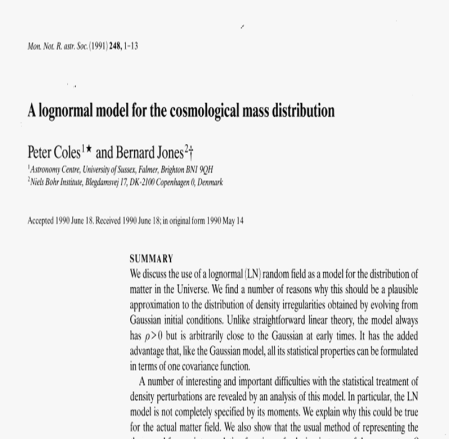
As well as being great fun, that little visit also produced my most-cited paper. I’ve never been very good at grabbing citations – I’m more likely to fall off bandwagons rather than jump onto them – but this little paper seems to keep getting citations. It hasn’t got that many by the standards of some papers, but it’s carried on being referred to for almost twenty years, which I’m quite proud of; you can see the citations per year statistics are fairly flat. The model we proposed turned out to be extremely useful in a range of situations, hence the long half-life.

nph-ref_history

I don’t think this is my best paper, but it’s definitely the one I had most fun working on. I remember we had the idea of doing something with lognormal distributions over coffee one day,  and just a few weeks later the paper was  finished. In some ways it’s the most simple-minded paper I’ve ever written – and that’s up against some pretty stiff competition – but there you go.

Picture1

The lognormal seemed an interesting idea to explore because it applies to non-linear processes in much the same way as the normal distribution does to linear ones. What I mean is that if you have a quantity Y which is the sum of n independent effects, Y=X1+X2+…+Xn, then the distribution of Y tends to be normal by virtue of the Central Limit Theorem regardless of what the distribution of the Xi is  If, however, the process is multiplicative so  Y=X1×X2×…×Xn then since log Y = log X1 + log X2 + …+log Xn then the Central Limit Theorem tends to make log Y normal, which is what the lognormal distribution means.

The lognormal is a good distribution for things produced by multiplicative processes, such as hierarchical fragmentation or coagulation processes: the distribution of sizes of the pebbles on Brighton beach  is quite a good example. It also crops up quite often in the theory of turbulence.

I;ll mention one other thing  about this distribution, just because it’s fun. The lognormal distribution is an example of a distribution that’s not completely determined by knowledge of its moments. Most people assume that if you know all the moments of a distribution then that has to specify the distribution uniquely, but it ain’t necessarily so.

If you’re wondering why I mentioned citations, it’s because it looks like they’re going to play a big part in the Research Excellence Framework, yet another new bureaucratical exercise to attempt to measure the quality of research done in UK universities. Unfortunately, using citations isn’t straightforward. Different disciplines have hugely different citation rates, for one thing. Should one count self-citations?. Also how do you aportion citations to multi-author papers? Suppose a paper with a thousand citations has 25 authors. Does each of them get the thousand citations, or should each get 1000/25? Or, put it another way, how does a single-author paper with 100 citations compare to a 50 author paper with 101?

Or perhaps the REF should use the logarithm of the number of citations instead?

Lulu

Posted in Biographical, Opera with tags , , , on June 6, 2009 by telescoper

On Thursday (4th June) I went to the first night of the Royal Opera’s new production of Lulu, an Opera by Alban Berg. I was planning to blog about this yesterday but after the Opera my birthday celebrations descended into drunken chaos and I ended up getting back very late to Cardiff yesterday; I had to catch up a number of things so I didn’t have time. After the performance and dinner in a nearby restaurant we sat out on Joao’s roofgarden in Notting Hill drinking until the sun started to come up. That part is a bit of blur, but judging by the scale of my hangover yesterday it must have been good. Anyway, I’ve now recovered enough write something about the Opera.

Before Thursday I hadn’t seen Lulu in a live performance, although I do have it on DVD so I knew a bit about it. Berg was a student of Arnold Schoenberg, but he developed his own take on the twelve-tone techniques developed by his mentor. Not everyone finds  serialist music easy to enjoy, but I think if you’re going to have a go at it this Opera is one of the best places to start. I think the score for Lulu is completely wonderful: it’s constantly changing texture, sometimes lushly romantic (with a big  nod in the direction of Mahler in Act I), sometimes bleak and jagged. Sometimes there is no music at all and the singers use a stylised method of vocalisation in between speaking and singing (called Sprechstimme). This  is used only sparingly in Lulu, but it is wonderfully effective dramatically when it is.

The Orchestra of the Royal Opera House, conducted by Antonio Pappano, were absolutely fantastic throughout the performance. I’m no musician but I reckon this music must be extremely difficult to play, especially in the brass section, but they played with great passion as well as flawless precision. They really brought Berg’s music to life, and invested it with a vitality that positively glowed throughout the performance. With playing like this, it was easy to understand why Berg is such an influential composer: you can hear in this Opera the ideas behind many Hollywood movie scores, for example.

So what about the Opera itself? The play revolves around the character of Lulu, an enigmatic figure who is at times innocent and vulnerable and at others cynical and manipulative. Her personality is only revealed to us through her interactions with men, all of which end in disaster. Lulu’s first husband has a heart attack and dies; her second commits suicide. She then shoots another man and is imprisoned but eventually escapes. By the end of the opera, many years later on, she has wound up in London and is living in poverty working as a prostitute. She dies at the hands of Jack the Ripper.

The structure of the Opera is like a mirror, with Lulu’s reversal of fortunes happening after an intermezzo in the middle of Act 2, at the centre of which there is a remarkable musical palindrome (shown above). Before this her role in the drama is to drive the men around her into obsession, madness and death, although she never appears to understand why she has this effect on them. After the dramatic fulcrum of the piece she becomes more and more of a victim. The reason for this is not some great change in her own psychological make-up but just that she is getting older and  losing her looks. No longer sexually desirable, she has lost the only way of controlling the men in her life. From this point on, her decline is inexorable and death inevitable.

The new production is quite unlike the recording I have on DVD in that the staging is resolutely minimal. There is no set, just an occasional translucent screen, the costumes are modern and colours are monochrome. Lulu is dressed at one point  in a black cocktail dress very like that worn by Audrey Hepburn in Breakfast at Tiffany’s. This might have been a deliberate reference to the parallels between Lulu and Holly Golightly (at least in Truman Capote’s novella, which is a much darker concoction than the film based on it); soprano Agneta Eichenholz bears more than a passing resemblance to Audrey Hepburn too. Her slender build -unusual for an opera singer with such a powerful voice – allowed her to play Lulu’s vulnerable aspects very well.

Against a sparse backdrop  the characters emerge as series of grotesques, which – at least in principle – is not a bad way of  presenting this Opera. Set in such a way it appears as a piece of absurdist theatre which is definitely part of what it represents. There are two problems, however.

One is that the sets give very little clue as to the location of the drama: I wouldn’t have known that the last scene was meant to be Victorian London unless I’d seen it before, so Jack the Ripper’s appearance must have been very  confusing to those who hadn’t picked up on that. Lulu is also meant to be a lot older in the last Act, but no attempt is made to age her in this production.  The libretto makes repeated reference to a painting of her, and it serves at the end to remind her of her age, but no portrait ever appears; I found that a bizarre omission.

The other problem is that there are strong links between the story of Lulu and the Grand Guignol  genre of horror plays, with their  opulently macabre  stagings and exaggeratedly gory endings. Throwing all those connections  away robs the Opera of all of its schlock value and, with that, a great deal of the irony needed to make this blackest of black comedies work the way it should. The killing of Lulu in fact happens off stage in this production which makes the ending very tame. I wouldn’t want to go over-the-top in depicting the horror of Lulu’s death – I wanted to see an Opera, not a snuff movie – but the audience should be shocked by the brutality of her final moments; these are the key to what the Opera is about. Perhaps the director was concerned not to let the drama descend into mere titillation. There’s always a danger of crossing the line into vulgar pornography in depicting explicit sexuality and violence, but I think this production is too afraid of taking risks. This opera should feel more dangerous than this setting allows it to be. Ypu’re not meant to feel comfortable about this Opera.

Although limited by the stylized nature of the production, the principals were good. Agneta Eichenholz’s is a  desensitized creature, damaged by abuse and inhabiting a moral vacuum. Her detachment in the face of the death and destruction around her is perfectly judged. She sang beautifully for the most part but – possibly because of first night nerves – her voice came apart on a couple of high notes early on. Other characters worth mentioning are Michael Volle who was outstanding as Dr Schön and Philip Langridge in the dual role of the Prince and the Marquis.

This morning I read Andrew Clements’ review in the Guardian which I thought was a bit harsh: only two stars doesn’t really do justice to a fascinating evening. I would have  given three stars for the quality of the music alone. Personally, I could have listened to the whole thing in a concert performance and still enjoyed it. But having decided to go for a full staging,  it seems to me a bit perverse to have stripped  it down so drastically. Clements claimed he was “bored” by what happened on stage. I certainly wasn’t, but I did find myself more perplexed by the production than by the moral ambivalence of the story itself, so I’d have to say it didn’t really do justice to an Opera which I still think of as masterpiece.