Archive for the Biographical Category

Highlights

Posted in Biographical, The Universe and Stuff with tags , , on November 2, 2009 by telescoper

Despite popular demand, here is more of the Unravelling the Universe show I posted a little bit from a few days ago. My total screen time on this programme only amounted to a couple of minutes, so I asked if it was possible to do an appropriate edit of the hour-long footage. Unfortunately, Ed got the wrong idea, so removed most of the highlights and left practically only the few minutes with me in them. You just can’t get the help these days.

The film  was shot in a studio in Greenford and I had to hang around there a long time before they even started shooting. I think that was because of the lights. I need a special form of  illumination if I am to present the illusion of having three dimensions. The director had insisted I wear my leather jacket for the sequence and under the very powerful lights I was sweating so much I had to wear make-up to stop me shining.

They reckon that there is a ratio of about 100:1 of film shot to film broadcast on programmes like this, and this is probably even higher when the subject is as inarticulate as me. In my memory it certainly took several hours just for my little bits.

If nothing else this tape gives you the chance to see Rocky Kolb in a splendid jumper that puts that of the new Lucasian professor well and truly in the shade. What was that about chromodynamics?

The Monster Mash

Posted in Biographical, Music with tags , on October 31, 2009 by telescoper

I explained this time last year how I’m not really a big fan of Halloween and don’t tend to celebrate it. However, I decided to make an exception this year and post the following little video which seems to be appropriate for the occasion. It’s made of bits of old horror B-movies but the music – by Bobby “Boris” Pickett and the Crypt-kickers is actually the second single I ever bought, way back in 1973. I wonder if you can guess what the first one was?

The Michael Green Experience

Posted in Biographical, The Universe and Stuff with tags , , , on October 30, 2009 by telescoper

It’s been a couple of weeks since the University of Cambridge announced that the successor to Stephen Hawking as Lucasian Professor  of Mathematics would be Michael Green, who is best known for his work on string theory. Heartiest congratulations to him for reaching a position of such eminence.

I was trying to think of a suitable way of marking the occasion of his election to this prestigious post when I suddenly remembered that we were actually on a TV programme together years ago. The show in question was called Unravelling the Universe and was first broadcast in December 1991 as part of a science documentary series called Equinox.

I eventually found my ancient VHS copy of the broadcast master tape of this show and persuaded Ed and Stephen, two of the excellent elves that work in the School of Physics & Astronomy here at Cardiff University, to transfer it to a digital format and put a bit on Youtube for all to see. Many thanks to them for their help.

Other people involved in the programme included Rocky Kolb, Chris Isham and Paul Davies but the short (2-and-a-half minute) clip below features just Michael Green (who basically put the show together) and myself (who was just there to make up the numbers), plus wonderful narration by the late great Peter Jones.

Michael Green hasn’t changed a bit in 18 years. In fact, I saw him last year and am sure he was even wearing the same sweater.

I, on the other hand….Oh dear.

Automatonophobia

Posted in Biographical with tags , , , on October 25, 2009 by telescoper

OK. I admit it. I’m  automatonophobic.

I don’t think I have many irrational fears. I don’t like snakes, and am certainly a bit frightened of them, but there’s nothing irrational about that. They’re nasty and likely to be poisonous. I don’t like slugs either, especially when they eat things in my garden. They’re unpleasant but easy to deal with and I’m not at all scared of them. Likewise spiders and insects.

But  ventriloquists’ dummies give me nightmares every time.

 When I was a little boy my grandfather took me to the Spanish City in Whitley Bay. There was an amusement arcade there and one of the attractions was thing called   The Laughing Sailor. You put a penny in the slot and a hideous  automaton  – very similar to the dummy a ventriloquist might use, except in mock-nautical attire – began to lurch backwards and forwards, flailing its arms, staring maniacally and emitting a loud mechanical cackle that was supposed to represent a laugh. The minute it started doing its turn I burst into tears and ran screaming out of the building. I’ve hated such things ever since.

The anxiety that these objects induce has now been given a name: automatonophobia, which is defined as “a persistent, abnormal, and unwarranted fear of ventriloquist’s dummies, animatronic creatures or wax statues”. Abnormal? No way. They’re simply horrible.

I’m clearly not the only one who thinks so, because there was an article in The Independent a few years ago by Neil Norman that exactly expressed the fear and loathing I feel about these creepy little dolls. Feature films  including Magic and Dead of Night, and episodes of The Twilight Zone and Hammer House of Horror have taken it further by playing with the idea that  a ventriloquist’s dummy has been possessed by some sort of malign power which  uses it to wreak terror on those around.

 We’re not talking about a benign wooden doll like Pinocchio who metamorphoses into a real boy; we’re talking about a ghastly staring-faced mannequin that is brought to life by its operator, the ventriloquist,  by inserting his hand up its backside. The dummy never looks human, but can speak and displays some human traits, usually nasty ones. The essence of a ventriloquist act is to generate the illusion  that one is watching two personalities sparring with each other when in reality the two voices are coming from the same person. Schizophrenia here we come.

It must be very clever to be able to throw your voice,  but I always had the nagging suspicion that ventriloquists use dummies to express the things they find it difficult to say through their own mouth, and so to give life to their darkest thoughts. 

Best of all the attempts to realise the sinister potential of this relationship in a movie is the “Ventriloquist’s Dummy” episode, directed by Alberto Cavalcanti, in Dead of Night, the 1945 portmanteau that some regard as Britain’s greatest horror film. Here is the part that tells  the tale of Michael Redgrave’s ventriloquist being sweatily possessed by the spirit of his malevolent dummy, Hugo. It’s old and creaky, but I find it absolutely terrifying.

So what is it about these man-child mannequins – they are always male – that makes them so creepy? First, there is their appearance: the mad, swivelling, psychotic eyes beneath arched eyebrows and that crude parody of a mouth (with painted teeth) that opens and shuts with a mechanical sound like a trap. Then there are the badly articulated limbs,  like those of a dead thing. When at rest,  their eyes remain open, their mouths fixed in a diabolic grimace. Moreover, with their rouged cheeks, lurid red lips and unnatural eyelashes, all ventriloquist’s dummies look like the badly embalmed corpses of small boys. And they always end up sitting on the knee of a horrible pervert.  Necrophilia and paedophilia all in one sick package. Yuck.

Worst of all, perhaps, is the voice. The high-pitched squawk that emerges is one of the most unpleasant sounds a human being can make. Even if you find it tolerable when you know that it comes from the ventriloquist, the last thing you want  is the dummy to start talking on its own.

I started writing this with the cathartic intention of exorcising the demon that appears whenever I see one of these wretched things. It didn’t work. However, I have now decided to take my mind off this track with a change of thread. Here’s a little quiz. I wonder if anyone can spot the connection between this post and the history of cosmology?

Alternatively, if you’re brave, you could try a bit of catharsis of your own and reveal your worst phobias through the comments box…

Classic Collection

Posted in Biographical, Music with tags , , on October 16, 2009 by telescoper

I’ve been told on more than one occasion that some people find all the stuff about opera and poetry and the like is a bit too highbrow for them. In an effort to make myself more commercially relevant I’ve therefore decided to include something a bit different from my usual line of music posts.

Twenty years ago, while I was still living in Brighton, I didn’t go to the Opera or to classical music concerts at all, but instead went out most nights to various nightclubs (most of which have now closed down). This was all before I became too old and decrepid to be anything but an embarrassment in such a context. I also had a habit of buying singles of the records I heard night after night in the clubs which I would play before going out to get me into the mood for a boogie. I like dancing, in case you hadn’t guessed.

In recently sorted through my old vinyl record collection and hunted through Youtube to find the corresponding videos. So here are three examples from my own classic collection which will hopefully prevent any further accusations that this blog is too erudite. It won’t do much for my street cred with the younger generation, though, as these records are all older than most students.

First one up is from the cheesy end of the spectrum. It’s the sublime Bananarama, doing a very camp cover version of the Supremes’ hit Nathan Jones. I want you to pay particularly close attention to the video as I expect you all to learn the moves. There’ll be a test. Right hand on right hip. Left arm extended. Ready? Go!

Number two in my hit parade belongs to the commercial wing of the Acid House movement that swept through dance clubs during the late 1980s. S’Express released Hey Music Lover in 1989 and it immediately became one of my favourite things to dance to. It’s nowhere near as effective watching it on a small screen, away from the thumping sounds and whirling psychedelic environment of a nightclub, but this one always used to make the blood rush to my head and it also seemed to get the best out of the best dancers. Note the sly references to Federico Fellini in the video.

Lastly but definitely not leastly is easily the best dance record of the classical period under consideration. It deserves to be in the collection because it still packs the dance floors twenty years on. Fabulously funky, tantalising trippy and devilishly danceable, this was a huge hit in 1990 for the fantastic Dee-Lite – here is a medley of their hit Groove is in the Heart.

And that’s enough of that.

I Did Expect the Spanish Inquisition…

Posted in Biographical, Science Politics with tags , , , on October 14, 2009 by telescoper

So that was it. D-Day.

Our application to the Science and Technology Facilities Council (STFC) for a rolling grant to cover the next 5 years of astronomy research went in a  few months ago. Over the summer we got feedback from independent referees. But today was the crunch. The dreaded panel visit.

In the old days the grants panel used to visit the applicants at their own institute, chat to the postdocs and staff, help themselves to free food, and generally get a feel for the place over a period of a couple of days. Now, all that cosiness has gone. Nowadays the applicants visit the panel.  Mohammed and the Mountain and all that (except I’m not sure which is which).

A large group of astronomers are involved in this application, but STFC rules permit only three representatives to make the pilgrimage to Swindon in order to testify in front of the experts. I was among the chosen few, although I was not particularly grateful for this honour.

This would have been stressful enough, but there is grim talk of slashed budgets and looming financial disaster for UK astronomy. The successful launch of Planck and Herschel in May, followed by the exceptionally promising snippets of data that we’ve been getting, has strengthened what was already a very strong case. These events should have given us all the cards. The trouble is, it looks like the casino has gone bust.

We were all a bit nervous, I can tell you, as we travelled to Swindon on the early train from Cardiff. Steve Eales is Principal Investigator on the grant and he’s a self-confessed morning person so he went on a ludicrously early train in case something happened to delay him. Derek Ward-Thompson and I followed on a more sensible one, but we all got there safely and on time in the end.

We started with a presentation by Steve which he delivered in superb style, keeping exactly to time but also ticking all the boxes we were asked to cover in the instructions we got. The science updates from the last 6 months are really impressive, and it was all made even more dramatic when he told the panel that the new Herschel images they were seeing were not public and therefore that they shouldn’t look at them.

Then we were due for 45 minutes questioning by the panel. I thought it might be something like Blind Date because there were three of us to do the answering. Question Number One for Contestant Number Two, that sort of thing, except that we anticipated slightly more technical questions and we weren’t expecting Cilla Black to be there.

But there weren’t many questions at all. In fact, I had only one question (on the cosmology part). It was curiously anti-climactic after having had a near-sleepless night worrying about it. This could mean either that they’d already decided to close us down, that they’d already decided we were brilliant, or that they already knew there was no money so there wasn’t any point in asking anything.

So 25 minutes into the 45 allotted we were shown the door and headed back to Cardiff by train. It was like Monty Python in reverse: we did expect the Spanish Inquisition, but it never happened…

We jabbered nervously on the return journey because the adrenalin was still going, speculating about what it all meant but not coming to any real conclusions except that Steve had given a great presentation and that we had all answered the questions as well as we could have been expected to. It’s all out of our hands now.

The trouble is that we’re not likely to get a new grant announcement until April 2010, which is actually when the grant is supposed to start. The postdoctoral researchers we currently employ will have to wait until then to hear about possible extensions to their contracts. Perhaps by April  the management will have sorted out the current STFC crisis so we can get on and do some science with the wonderful new data.

On the other hand, perhaps not….

Darwin and After

Posted in Biographical, Science Politics with tags , , , , , , , , on October 10, 2009 by telescoper

Another sign that the academic year is back into full swing is that the monthly meetings of the Royal Astronomical Society have started up again after the usual summer hiatus. Since I’ve got a very heavy week coming up, I thought I’d take the advantage of a bit of breathing space in my timetable to attend yesterday’s meeting and catch up with the gossip at the Club afterwards.

The highlight of the day’s events was the annual George Darwin Lecture which was given this year by Neil Gehrels from the NASA Goddard Space Flight Center on the subject Gamma Ray Bursts and the Birth of Black Holes: Discoveries by SWIFT. This is a very hot topic (of course) and the lecture did full justice to it. The RAS has two other “prize” lectures – the Gerald Whitrow Lecture and the Harold Jeffreys Lecture – which are used to invite eminent speakers from around the world. They’re not always successful as lectures because the speakers sometimes try to make them too specialised and too detailed, but this one was exceptionally clear and well delivered. I enjoyed it, as well as learning a lot; that’s the essence of a good lecture I think.

The main task for visiting speakers when it comes to the George Darwin Lecture is to give their talk without revealing the fact that they hadn’t realised that Charles Darwin had a famous astronomical son!

Then to the Athenaeum, for drinks and dinner, where the current financial crisis at STFC was in the background of a lot of the conversation. Rumours abounded but I didn’t pick up any hard information about what is likely to happen to our funding next year. I suspect that’s because even STFC doesn’t know. After a bit of wine, though, conversation moved onto other,  less depressing, things including football, cheese and the Welsh landscape.

The colleague sitting next to me (an old friend from Queen Mary days, now at Imperial College) reminded me that in January last year Joao Magueijo invited me to give the vote of thanks at his inaugural lecture (as long as I promised to try to make my speech as short and as funny as possible). It turns out his lecture was only twenty minutes long, which didn’t give as much time as I’d hoped to think of something to say so I resorted to a couple of off-colour jokes and a facetious remark about how the brevity of Imperial’s lectures explained why their students never seemed to know anything. I got a very good laugh from the packed lecture theatre, but was told off afterwards by a senior physicist from the Imperial physics department. That particular episode is something I often think about, the pomposity of some of the staff reminding me that I’m not unhappy at not getting a job there I applied for a few years ago.

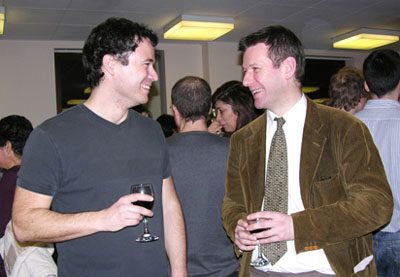
Actually, I just remembered that they took pictures at the party afterwards so here’s one of me and Joao having a chuckle afterwards. Notice I had put a tie on for the occasion, but Joao’s wardrobe is strictly T-shirts only.

37079699

After Friday’s dinner (roast partridge, if you want to know) I got the last train back to Cardiff from Paddington, snoozing comfortably for a large part of the journey. On time until just outside Cardiff Central, the train then sat motionless on the track almost within sight of the platform owing to the presence of a broken down goods train in front of us. We finally got into the station 50 (FIFTY) minutes late, and I didn’t get home until well after 2am.

Index Rerum

Posted in Biographical, Science Politics with tags , , , , , , , , , on September 29, 2009 by telescoper

Following on from yesterday’s post about the forthcoming Research Excellence Framework that plans to use citations as a measure of research quality, I thought I would have a little rant on the subject of bibliometrics.

Recently one particular measure of scientific productivity has established itself as the norm for assessing job applications, grant proposals and for other related tasks. This is called the h-index, named after the physicist Jorge Hirsch, who introduced it in a paper in 2005. This is quite a simple index to define and to calculate (given an appropriately accurate bibliographic database). The definition  is that an individual has an h-index of  h if that individual has published h papers with at least h citations. If the author has published N papers in total then the other N-h must have no more than h citations. This is a bit like the Eddington number.  A citation, as if you didn’t know,  is basically an occurrence of that paper in the reference list of another paper.

To calculate it is easy. You just go to the appropriate database – such as the NASA ADS system – search for all papers with a given author and request the results to be returned sorted by decreasing citation count. You scan down the list until the number of citations falls below the position in the ordered list.

Incidentally, one of the issues here is whether to count only refereed journal publications or all articles (including books and conference proceedings). The argument in favour of the former is that the latter are often of lower quality. I think that is in illogical argument because good papers will get cited wherever they are published. Related to this is the fact that some people would like to count “high-impact” journals only, but if you’ve chosen citations as your measure of quality the choice of journal is irrelevant. Indeed a paper that is highly cited despite being in a lesser journal should if anything be given a higher weight than one with the same number of citations published  in, e.g., Nature. Of course it’s just a matter of time before the hideously overpriced academic journals run by the publishing mafia go out of business anyway so before long this question will simply vanish.

The h-index has some advantages over more obvious measures, such as the average number of citations, as it is not skewed by one or two publications with enormous numbers of hits. It also, at least to some extent, represents both quantity and quality in a single number. For whatever reasons in recent times h has undoubtedly become common currency (at least in physics and astronomy) as being a quick and easy measure of a person’s scientific oomph.

Incidentally, it has been claimed that this index can be fitted well by a formula h ~ sqrt(T)/2 where T is the total number of citations. This works in my case. If it works for everyone, doesn’t  it mean that h is actually of no more use than T in assessing research productivity?

Typical values of h vary enormously from field to field – even within each discipline – and vary a lot between observational and theoretical researchers. In extragalactic astronomy, for example, you might expect a good established observer to have an h-index around 40 or more whereas some other branches of astronomy have much lower citation rates. The top dogs in the field of cosmology are all theorists, though. People like Carlos Frenk, George Efstathiou, and Martin Rees all have very high h-indices.  At the extreme end of the scale, string theorist Ed Witten is in the citation stratosphere with an h-index well over a hundred.

I was tempted to put up examples of individuals’ h-numbers but decided instead just to illustrate things with my own. That way the only person to get embarrased is me. My own index value is modest – to say the least – at a meagre 27 (according to ADS).   Does that mean Ed Witten is four times the scientist I am? Of course not. He’s much better than that. So how exactly should one use h as an actual metric,  for allocating funds or prioritising job applications,  and what are the likely pitfalls? I don’t know the answer to the first one, but I have some suggestions for other metrics that avoid some of its shortcomings.

One of these addresses an obvious deficiency of h. Suppose we have an individual who writes one brilliant paper that gets 100 citations and another who is one author amongst 100 on another paper that has the same impact. In terms of total citations, both papers register the same value, but there’s no question in my mind that the first case deserves more credit. One remedy is to normalise the citations of each paper by the number of authors, essentially sharing citations equally between all those that contributed to the paper. This is quite easy to do on ADS also, and in my case it gives  a value of 19. Trying the same thing on various other astronomers, astrophysicists and cosmologists reveals that the h index of an observer is likely to reduce by a factor of 3-4 when calculated in this way – whereas theorists (who generally work in smaller groups) suffer less. I imagine Ed Witten’s index doesn’t change much when calculated on a normalized basis, although I haven’t calculated it myself.

Observers  complain that this normalized measure is unfair to them, but I’ve yet to hear a reasoned argument as to why this is so. I don’t see why 100 people should get the same credit for a single piece of work:  it seems  like obvious overcounting to me.

Another possibility – if you want to measure leadership too – is to calculate the h index using only those papers on which the individual concerned is the first author. This is  a bit more of a fiddle to do but mine comes out as 20 when done in this way.  This is considerably higher than most of my professorial colleagues even though my raw h value is smaller. Using first author papers only is also probably a good way of identifying lurkers: people who add themselves to any paper they can get their hands on but never take the lead. Mentioning no names of  course.  I propose using the ratio of  unnormalized to normalized h-indices as an appropriate lurker detector…

Finally in this list of bibliometrica is the so-called g-index. This is defined in a slightly more complicated way than h: given a set of articles ranked in decreasing order of citation numbers, g is defined to be the largest number such that the top g articles altogether received at least g2 citations. This is a bit like h but takes extra account of the average citations of the top papers. My own g-index is about 47. Obviously I like this one because my number looks bigger, but I’m pretty confident others go up even more than mine!

Of course you can play with these things to your heart’s content, combining ideas from each definition: the normalized g-factor, for example. The message is, though, that although h definitely contains some information, any attempt to condense such complicated information into a single number is never going to be entirely successful.

Comments, particularly with suggestions of alternative metrics are welcome via the box. Even from lurkers.

The Evidence

Posted in Biographical, The Universe and Stuff with tags , , , on September 25, 2009 by telescoper

Further to my recent post about the evidence for a low-density Universe, I thought I’d embarrass all concerned with this image, taken in Leiden in 1995.

Various shady characters masquerading as “experts” were asked by the audience of graduate students at a summer school to give their favoured values for the cosmological parameters (from top to bottom: the Hubble constant, density parameter, cosmological constant, curvature parameter and age of the Universe).

From left to right we have Alain Blanchard (AB), Bernard Jones (BJ, standing), John Peacock (JP), me (yes, with a beard and a pony tail – the shame of it), Vincent Icke (VI), Rien van de Weygaert (RW) and Peter Katgert (PK, standing). You can see on the blackboard that the only one to get anywhere close to correctly predicting the parameters of what would become the standard cosmological model was, in fact, Rien van de Weygaert.

Cranks Anonymous

Posted in Biographical, Books, Talks and Reviews, The Universe and Stuff with tags , , , , on September 22, 2009 by telescoper

Sean Carroll, blogger-in-chief at Cosmic Variance, has ventured abroad from his palatial Californian residence and is currently slumming it in a little town called Oxford where he is attending a small conference in celebration of the 70th birthday of George Ellis. In fact he’s been posting regular live commentaries on the proceedings which I’ve been following with great interest. It looks an interesting and unusual meeting because it involves both physicists and philosophers and it is based around a series of debates on topics of current interest. See Sean’s posts here, here and here for expert summaries of the three days of the meeting.

Today’s dispatches included an account of George’s own talk which appears to have involved delivering a polemic against the multiverse, something he has been known to do from time to time. I posted something on it myself, in fact. I don’t think I’m as fundamentally opposed as Geroge to the idea that we might live in a bit of space-time that may belong to some sort of larger collection in which other bits have different properties, but it does bother me how many physicists talk about the multiverse as if it were an established fact. There certainly isn’t any observational evidence that this is true and the theoretical arguments usually advanced are far from rigorous.The multiverse certainly is  a fun thing to think about, I just don’t think it’s really needed.

There is one red herring that regularly floats into arguments about the multiverse, and that concerns testability. Different bits of the multiverse can’t be observed directly by an observer in a particular place, so it is often said that the idea isn’t testable. I don’t think that’s the right way to look at it. If there is a compelling physical theory that can account convincingly for a realised multiverse then that theory really should have other necessary consequences that are testable, otherwise there’s no point. Test the theory in some other way and you test whether the  multiverse emanating from it is sound too.

However, that fairly obvious statement isn’t really the point of this piece. As I was reading Sean’s blog post for today you could have knocked me down with a feather when I saw my name crop up:

Orthodoxy is based on the beliefs held by elites. Consider the story of Peter Coles, who tried to claim back in the 1990’s that the matter density was only 30% of the critical density. He was threatened by a cosmological bigwig, who told him he’d be regarded as a crank if he kept it up. On a related note, we have to admit that even scientists base beliefs on philosophical agendas and rationalize after the fact. That’s often what’s going on when scientists invoke “beauty” as a criterion.

George was actually talking about a paper we co-wrote for Nature in which we went through the different arguments that had been used to estimate the average density of matter in the Universe, tried to weigh up which were the more reliable, and came to the conclusion that the answer was in the range 20 to 40 percent of the critical density. There was a considerable theoretical prejudice at the time, especially from adherents of  inflation, that the density should be very close to the critical value, so we were running against the crowd to some extent. I remember we got quite a lot of press coverage at the time and I was invited to go on Radio 4 to talk about it, so it was an interesting period for me. Working with George was a tremendous experience too.

I won’t name the “bigwig” George referred to, although I will say it was a theorist; it’s more fun for those working in the field to guess for themselves! Opinions among other astronomers and physicists were divided. One prominent observational cosmologist was furious that we had criticized his work (which had yielded a high value of the density). On the other hand, Martin Rees (now “Lord” but then just plain “Sir”) said that he thought we were pushing at an open door and was surprised at the fuss.

Later on, in 1996, we expanded the article into a book in which we covered the ground more deeply but came to the same conclusion as before.  The book and the article it was based on are now both very dated because of the huge advances in observational cosmology over the last decade. However, the intervening years have shown that we were right in our assessment: the standard cosmology has about 30% of the critical density.

Of course there was one major thing we didn’t anticipate which was the discovery in the late 1990s of dark energy which, to be fair, had been suggested by others more prescient than us as early as 1990. You can’t win ’em all.

So that’s the story of my emergence as a crank, a title to which I’ve tried my utmost to do justice since then. Actually, I would have liked to have had the chance to go to George’s meeting in Oxford, primarily to greet my ertswhile collaborator whom I haven’t seen for ages. But it was invitation-only. I can’t work out whether these days I’m too cranky or not cranky enough to get to go to such things. Looking at the reports of the talks, I rather think it could be the latter.

Now, anyone care to risk the libel laws and guess who Professor BigWig was?