Archive for the Biographical Category

Webern, Strauss and Mendelssohn at the NCH

Posted in Biographical, Music with tags , , , , , , , , , , on April 29, 2023 by telescoper

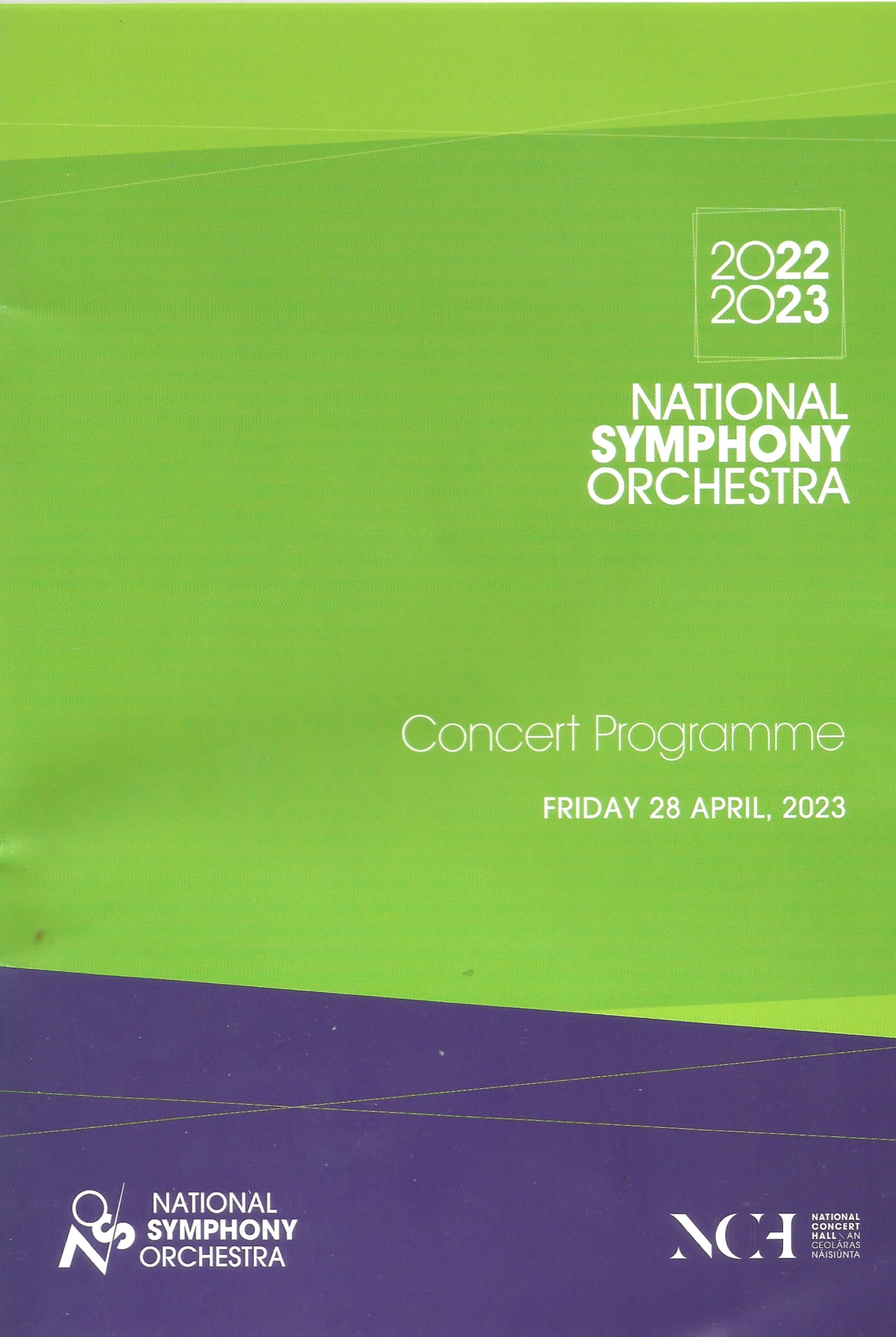
Looking back through my old blog posts, I find that the last time I went to a concert at the National Concert Hall was 10th February 2023. Owing to pressure of work I’ve had neither the time nor the energy to make the trip into Dublin since then, but last night I finally managed to get there for the excellent programme shown above, which was also broadcast live on RTÉ Lyric FM.

On this occasion the National Symphony Orchestra was conducted by Ruth Reinhardt, who last conducted the Orchestra during the pandemic in one of those weird occasions for which most of the musicians were masked, as was she. Anyway, for tonight’s performance she was unmasked long with the rest of the band.

Anton Webern’s Passacaglia (his Opus 1) was a new one on me. It’s not in the 12-tone style he adopted later as a member of the 2nd Viennese School, and can properly be regarded as a (very) late Romantic piece. It’s an intriguing variation of the Passacaglia form (originally a stately dance in triple time built on a bass theme) in that it’s not really a dance and it’s not in triple time, but it is introduced by a theme of eight notes played pizzicato on the strings, which is then followed by a set of variations. The piece only runs about 12 minutes but it packs a lot in. I found it very absorbing and enjoyed it enormously.

The Four Last Songs were published after his death, so Richard Strauss never heard them performed. The very first time they were performed was in 1950 at the Royal Albert Hall, by the London Philharmonia. One can only imagine what it must have been like for the orchestra making this music live for the very first time.  Apparently the first time any of them had seen the score was when they turned up for the rehearsal. I’m sure they knew as soon as they started playing that it was a masterpiece.

Last night we heard these songs sung by Amanda Majeski, who arrived on stage resplendent in a black evening gown. I was somewhat surprised to see her using a score for this performance. I would have thought that this was such a standard component of the repertoire that all sopranos would know all the songs off by heart. Perhaps it was just nerves, but I thought the first song, Frühling, lacked warmth but as the concert went on Amanda Majeski got into her stride and by the time she got to Im Abendrot (my favourite) she reached the right level of intensity.

I must single out the leader of the National Symphony Orchestra Elaine Clark for her gorgeous playing of the lovely violin solo in the third song, Beim Schlafengehen. I don’t mind admitting that it brought a tear to my eye.

Incidentally, as far as I know the Four Last Songs were not specifically intended to be performed together as they inevitably are these days. Although the last is my favourite, I think the first three (all based on poems by Herman Hesse) have much more in common with each other than Im Abendrot (which is a poem by Joseph von Eichendorff).

After the wine break we had Symphony No. 3 (“Scottish”) by Felix Mendelssohn. Inspired by a visit to Scotland in 1829 – the first movement was actually composed that year in Edinburgh – it wasn’t completed until over a decade later and should probably be No. 5, but who’s counting? It’s a piece on four movements, with little or no break between them. The first movement starts with a slow theme, like a hymn, but then becomes much more reminiscent of the Hebrides Overture composed in 1830. The landscape of the other three movements is very varied, sometimes cheery, sometimes lush, sometimes tempestuous. The final movement Allegro Vivacissimo has a marking guerriro (“warlike”), which in parts it is, but it also has calmer and more reflective passages before the rumbustious finale.

I always enjoy watching the musicians in these concerts, and could see last night that they were all enjoying themselves hugely. Well done to Ruth Reinhardt and the National Symphony Orchestra for an excellent performance. The hall was by no means full, which was a shame, but the concert was warmly appreciated by those of us there in the audience and no doubt by those listening on the radio.

Now there’s only a month or so to the finale of this concert season so I must try to make the most of the few remaining performances before the summer break…

Teaching those who want to learn

Posted in Biographical, Education, mathematics, Maynooth with tags , , , on April 21, 2023 by telescoper

Yesterday afternoon I ran the last formal Computational Physics laboratory of the term. As is often the case with these sessions, the students were given a Python task to work through, with assistance available from myself and a demonstrator (and indeed other students). We have 25 students registered on this module, who are split into two groups, so about a dozen students were in yesterday’s session. That’s a comfortable number to make sure everyone can get some help.

This is the sixth year I’ve done this module, and I decided a long time ago that the best way to ensure that students learn the necessary skills is to give them things to do and let them work things out for themselves (with help where necessary). A couple of years ago, on my module feedback questionnaire, a student wrote an intended criticism along the lines of – “It’s like he expects us to learn to code by doing it ourselves, rather than him teaching us”. That is, of course, exactly what I intended, though we do give plenty of help during the labs.

Just as the best way to learn a foreign language is by speaking it, the best way to learn coding is by writing programs. Some of the students on this module have done any before, so for them the early stages of the module are rather straightforward. At least half the class, however, haven’t done any programming, so for them it’s a fairly steep learning curve.

Anyway, it being the last formal session of term this week’s task was a rather challenging one, involving the solution of a boundary value problem via the shooting method. It’s a good exercise because it brings together methods for solving ordinary differential equations with root-finding, as well as requiring some thought as to the general construction of a code that combines these two.

As expected, given the difference in background of the students, some finished this in good time, but others went more slowly. Some very excellent things happened, though, which made me very happy with the the whole experience.

One was that instead of leaving as soon as they had finished, a few of the students who had completed the task early stayed behind to help their friends. I encourage this, but it doesn’t always happen as much as yesterday. It’s called teamwork, and it’s essential not only in physics but also in everyday life.

The lab session was supposed to finish at 4pm, but not all students were done by then. Another excellent thing though was they didn’t just quit when they had run out of time. I stayed well past 4pm to help those who were determined to finish. In one case it was just a ‘0’ that should have been a ‘1’ in the index of an array that stopped it working. I don’t know why it took me so long to spot this, but we got there in the end.

One student, however, had another class at 4pm so left, only to return at five to continue. The student finally left, having completed the exercise, at about 6.45. The persistence shown by the students in refusing to be defeated was truly admirable. This harks back to a piece of advice I gave some time ago:

If you really want to develop as a physicist, don’t just solve a lot of easy problems; challenge yourself by tackling difficult ones too. Don’t be afraid to get “stuck” or make a mistake, as those are both necessary parts of the learning process. Above all, develop the confidence in your ability to take on a problem and back yourself to solve it and don’t be deterred if the answer doesn’t come quickly!

You may say that if it took some students much longer than the allocated time to finish then the problem was too difficult. That may be the case, but do you ever really learn if you’re not stretched? There is a place for straightforward formulaic tasks in higher education, but there’s much more to a university education than doing things like that.

Obviously the lab took up much more of my time as I had originally planned – more than double, in fact – but I went home pleased with a good day’s work. As I’ve said on this blog many times before, there are few things more rewarding than teaching students who want to learn.

The Cyclic Universe of the UK Astronomy Grant System

Posted in Biographical, Science Politics, The Universe and Stuff with tags , , , on April 17, 2023 by telescoper

I stumbled by accident yesterday on a bit of news relating to UK Astronomy Grant funding via the Science and Technology Facilities Council (STFC). I am of course completely out of that system, and have been for years, but I am nevertheless quite nosy so was interested to find out about the changes. Thanks to Alan Heavens and Paul Crowther for enlightening me.

Way back in 2010 I wrote in somewhat critical terms about the new-style Consolidated Grants that STFC was planning to introduce. This system replaced a dual approach of so-called “Standard Grants” – which were typically rather small, usually funding one postdoctoral researcher and bits and bobs – and “Rolling Grants” – which were usually larger, covering all the activities of a department or institution – with a single system of “Consolidated Grants”. The Standard Grants were “responsive”, in that investigators could put in an application whenever they wanted, whereas Rolling Grants were on a fixed timetable. After the change, the responsive mode went out the window and Departments were forced to apply collectively, once every three years.

Much of the reason for the change was the administrative cost of the system. There were huge numbers of standard grant applications. Back in the mists of time there were two application deadlines per year so it was a heavy burden on the panels and the Swindon office, especially since so little funding was available in the first place. Standard grants were also the first to get squeezed when there was a funding shortfall, whereas Rolling grants generally carried on rolling.

Well, the news is that the current Astronomy grant round, with applications in 2022 and grants starting in 2023, will see the last of these Consolidated Grants. From this year on, there will be a new system of – wait for it – “Small” and “Large” grants, thought these are officially called Type 1 and Type 2. The Small Awards scheme is described here and it looks very much like the old Standard Grant system. Details of the Large grants scheme are not yet available, but I believe they will start next year. You can find more details here (PDF).

So now it seems something very like the old system is returning, and there are no doubt the same worries that Large grants will eat up most of the money, leaving very little for the Small grants. Déjà vu.

Anyway, the way I came across this piece of news was via the announcement of a clutch of PDRA positions in cosmology and extragalactic astrophysics at the University of Sussex (where I worked from 2013-16). It seems the Astronomy Centre must have done pretty well in the (final) STFC Consolidated Grant round, which is very good to hear! It seems there might be a bit more money generally in the grant line this year too, which is also good news.

The Other Side of Easter

Posted in Biographical, Maynooth with tags , on April 16, 2023 by telescoper

I haven’t been reading my work email for a few days as I’ve been working from home during the recent Easter mini-break and wanted to catch up on a few things without too many distractions. Having to return to campus tomorrow, however, I decided with some trepidation to see what had accumulated in my inbox while I wasn’t looking and got a rather pleasant surprise.

Just before Easter I mentioned that I had been granted a half-year sabbatical for next academic year. Well, reading my email this morning I found a letter saying that it had been decided to change that to a full year, which is what I originally requested:

The period of sabbatical leave granted is from 1st September 2023 to 31st August 2024.

So having spent a bit of time thinking about how to spend the reduced period, I’m now back to square one (but in a good way). I’m not sure why the powers that be changed their mind on this. Perhaps they’re even keener to get me out of the way than I thought?

The revised schedule means that I will still be around in Maynooth for the August repeat examinations (and marking thereof), but I hope to leave shortly after that is all done and dusted. I’m sure I will miss the teaching next year, but I’m looking forward to being able to concentrate on research and to working in a different environment for a time.

All this means that we will shortly have an advertisement for a sabbatical replacement lecturer in the Department of Theoretical Physics at Maynooth University to cover my teaching while I’m absent. Watch this space. Obviously I will help advertise the position, but I can’t play any further role in the recruitment process.

Anyway, the immediate focus of my attention will be the remaining three weeks of teaching for this Semester. I have a couple more Computational Physics laboratory sessions to organize, as well as the final batch of lectures for Advanced Electromagnetism. That will be followed by an intense period of grading project work, revision lectures, and finally correcting examination scripts. The Examination Period in Maynooth starts on Friday 12th May, but the two with which I am directly involved take place on Thursday 18th and Saturday 20th.

But for now, back to my inbox…

Voices

Posted in Biographical, Education, Poetry with tags , , , on April 15, 2023 by telescoper

Not long ago I did a post about an anthology of Poems I studied at school many years ago. I bought that second-hand at the same time as I bought the three volumes shown above, Books 1-3 of Voices (edited by Geoffrey Summerfield). I seem to remember that we studied these at an earlier stage of 11+ education, probably in consecutive years before O-level. I remember the covers quite well, especially the rather spooky picture on Book 3.

They’re quite interesting books, each of which contains an eclectic collection of poems, including traditional rhymes and there is even some music at the back to accompany some of the verses that work as songs.

Anyone else remember these books?

Why Are Universities So International?

Posted in Biographical, Education, Maynooth on April 15, 2023 by telescoper

This is an interesting post about internationalization in universities. The Faculty in the Department of Theoretical Physics at Maynooth provides a good illustration. It includes seven people, only two of whom were born in Ireland. The others were born in the Netherlands, Norway, Czech Republic, USA and UK. The blog post says there are two reasons why universities are so international: specialization and diversification. Both of these do apply, but there is a third reason, which concerns personal life, love, the pursuit of happiness, politics, and so on. I gave my reasons for moving to Ireland here.

The personal dimension shouldn’t be ignored, though it is much more complex than the others. Academics are people after all.

4gravitons's avatar4 gravitons

Worldwide, only about one in thirty people live in a different country from where they were born. Wander onto a university campus, though, and you may get a different impression. The bigger the university and the stronger its research, the more international its employees become. You’ll see international PhD students, international professors, and especially international temporary researchers like postdocs.

I’ve met quite a few people who are surprised by this. I hear the same question again and again, from curious Danes at outreach events to a tired border guard in the pre-clearance area of the Toronto airport: why are you, an American, working here?

It’s not, on the face of it, an unreasonable question. Moving internationally is hard and expensive. You may have to take your possessions across the ocean, learn new languages and customs, and navigate an unfamiliar bureaucracy. You begin as a temporary resident, not…

View original post 437 more words

The Gruber Prize for Cosmology 2023: Richard Ellis

Posted in Biographical, The Universe and Stuff with tags , , on April 13, 2023 by telescoper
Professor Richard Ellis

I’m delighted to be able to convey the news that the 2023 Gruber Prize for Cosmology has been awarded to Richard Ellis. Heartiest congratulations to him! The official announcement reads:

Over the past five decades Richard Ellis’s innovations have reimagined cosmology in fundamental ways. His observations have pushed the cosmic horizon—how far across the universe we can see—to a period close to the development of the first galaxies. Meanwhile the instruments he conceived, then shepherded through development and execution, have transformed myriad astronomical methodologies.

The full citation is here:

The Gruber Foundation is pleased to present the 2023 Cosmology Prize to Richard Ellis for his numerous contributions in the fields of galaxy evolution, the onset of cosmic dawn and reionization in the high redshift universe, and the detection of the earliest galaxies via the Hubble Ultra Deep Field study. 

Richard Ellis has also driven several frontier instrumental developments in optical astronomy, especially the use of multi-object spectroscopy to study many galaxies in the same field of view.  These included the “autofib” instrument, the “2dF” facility on the Anglo-Australian Telescope, which led to the discovery of baryon acoustic oscillations, the “LDSS” on the Herschel Telescope, which studied the redshifts of faint galaxies, and the “PFS” currently under commissioning on the Subaru Telescope to study dark matter and dark energy.

There’s a lot more information and biographical material in the full press release here.

If I can add just a couple of personal comments. Way back in 1985, when I was about to start my PhD DPhil, I attended an SERC summer school for new research students held in Durham. The lectures on Observational Cosmology at that school were delivered by Richard Ellis. I still have the notes, in fact. In many ways, this was my first encounter with modern cosmology. Quite few things have changed since then of course, but it was a formative experience. One thing I particularly remember is his discussion of the Hubble constant controversy:

 You will see that there were two main estimates, one low and one high, both about three sigma away from the currently-favoured value of around 70. Plus ça change, plus c’est la même chose…

The second comment is that Richard was the external member on the panel that awarded me my first Chair position way back in 1998. Gosh. Was that really 25 years ago? Still, it goes to show that even an eminent scientist such as Richard can sometimes make an error of judgement!

Personal Internet History

Posted in Biographical with tags , , , on April 9, 2023 by telescoper

The above graphic, which comes from here, has been doing the rounds on social media and has been eliciting quite a few responses from people of my age or older, about when they started using the internet, so I couldn’t resist a comment or two.

My first experiences of anything like the modern internet was using the computers at the (now defunct) British Gas On Line Inspection Centre (OLIC) in Cramlington, Northumberland. I wrote about this here. That would have been in 1981, in between leaving school and starting University (which I did in 1982). I also went back to OLIC work in the summer holidays while still an undergraduate.

At OLIC did quite a lot of coding (on projects related to pattern recognition), most of which was on VAX computers (and also the odd PDP 11/45). Incidentally, when I later started as a research student in 1985 I was delighted to discover that the STARLINK system in use at Sussex and throughout the UK was also VAX-based because I was already fluent in the command language (DCL) as well as the database software DATATRIEVE. Another reason I am grateful for the experience I gained at OLIC is that, working in that environment, I had to learn to make my code (which, incidentally, was all in Fortran-77) conform to various very strict standards which is no doubt why I am a bit of a stickler when it comes to scripts written in my Computational Physics lab!

Anyway, the Vax computers in use in OLIC and in STARLINK were connected by a thing called DECnet. This allowed users to send emails to other machines. The format of email addresses was much simpler than in use today, being of the form “host::username“. One could send files that way too; the alternative, via, FTP was terribly unreliable. DECnet provided a fast method of communication, but did require the receiving system to be accessible when you tried to send and would fail if this were not the case. Later email protocols would keep trying to send messages if at first they did not succeed.

While working at OLIC, where the powers that be were paranoid about industrial espionage, sending things this way essentially required the sender to log into the receiver’s machine, which terrified the systems people and it was soon blocked. STARLINK allowed this, however, as did the U.S. Space Physics Analysis Network (US-SPAN), the European Space Physics Analysis Network (E-SPAN), and by 1989 there were 17,000 nodes worldwide.

Sending emails outside DECnet was a rigmarole, involving including SMTP% followed by the external address. Messages inevitably had lengthy headers indicating the circuitous taken to reach the destination and often took some time to reach their destination. I was regularly using email in 1985, and if that counts as internet usage, then I started way to the left of the start of the graphic.

I didn’t use the world wide web until later. I’m not sure when, but it must have been around 1991 or so. The arXiv in roughly the form it exists now started in 1993, but it had precursors in the form of an email distribution list and, later, FTP access. Initially, it was based at Los Alamos National Laboratory (LANL) with a mirror site in SISSA (Trieste) that was used by those of us in Europe. In the beginning, arXiv was quite a small-scale thing and it wasn’t that easy to upload full papers including figures. In fact the SISSA system was run from a single IBM 386 PC (called “Babbage”).

The astrophysics section of arXiv (astro-ph) started in April 1992. Although astrophysicists generally were quick to latch on to this new method of distributing preprints, it took me a little time to get onto arXiv: my first papers did not appear there until February 1993; my first publication was in 1986 so there are quite a few of my early papers that aren’t on arXiv at all. In 1993 I was working at Queen Mary & Westfield College (as it was then called). I was working a lot with collaborators based in Italy at the time and they decided to start posting our joint papers on arXiv. Without that impetus it would have taken me much longer to get to grips with it.

Just a Closer Walk with Thee

Posted in Biographical, Jazz with tags , on April 9, 2023 by telescoper

When my father passed away in 2007, the main music music played at his funeral was the hymn or spiritual (and of course Jazz standard) Just a Closer Walk with Thee. It’s a lovely old traditional tune that often plays a central role in New Orleans style funerals and is a melody that, at least for me, has a deep association with loss and bereavement. The recording that was played on that occasion was this one, made at the same session as the track I posted a few days ago, featuring the same personnel (including my Dad on the drums), but with vocals by a fine Jazz and Blues singer by the name of Annie Jenkins.

Easter Time and Sabbaticals

Posted in Biographical, Maynooth with tags on April 6, 2023 by telescoper

So it’s Maundy Thursday, i.e. the day before Good Friday, on which we are supposed to wash the feet of our disciples. Not having been issued with any disciples, I’ll have to give that bit a miss and just work as normal for the rest of today.

Tomorrow is a holiday, as is next Monday, Easter Monday. The rest of next week is a study break, a welcome pause before we embark on the rest of term.

There will still be three weeks of teaching before the end of the Semester when we return on 17th April, but I’ve actually done my last lecture in Computational Physics. I’ve taught them all the things they need for the rest of the module. When they get back students will be mainly working in groups on their mini-projects which are due in by 5th May. The other module I teach will carry on as usual until the end of term.

Anyway, the three weeks that have passed between the St Patrick’s Day study break and today have flown by, but at least I’ve kept up to date.

Yesterday I found out that I have been granted a sabbatical for half of next academic year. I had asked for a full year, but that wasn’t agreed, so I now have to decide whether to disappear from August 2023 to January 2024 or from February 2024 to July 2024. I’ve only got the Easter break to decide which option to take, so I’ll have to spend a bit of time trying to work out what to do. I had planned two different trips during a full-year sabbatical. I’ll probably have to drop one of them. I also made plans for my research students, which I’ll have to change. I’m sure I can work something out though.

My two biggest classes are in Semester 1 so I’d probably get more personal benefit from taking the first option, but it might be harder to find a replacement to teach these modules given the shorter notice. It will also be tricky to make the necessary arrangements with potential hosts elsewhere by August, which tends to motivate the second option. I’ll have to think about it.

The last time I had a sabbatical break was in 2005, when I was at the University of Nottingham. That also was just one semester. After an abortive attempt to get a J-1 visa so I could visit the University of California at Berkeley, I ended up going to Toronto, which was very nice, but instead of giving my teaching to someone else for the term I missed, it was just moved to the second semester so I had a double load when I returned. I hope nobody tries that trick this time!

At least this time there won’t be a problem with visas et cetera, as I intend to exploit the freedom of movement I have within the European Union…