Just time for an early morning post before I get the train in order to attend the second day of this year’s Irish National Astronomy Meeting at Dunsink Observatory (in the above picture, which I took yesterday morning). Incidentally, Dunsink Observatory is Réadlann Dhún Sinche in the Irish language.
Thinking about this meeting ahead of the event reminded me of a loose end, which I managed to tidy up this week.
Contemporary Physics being a commercial journal the paper was published behind a paywall. The publication rules however allowed the paper to be made freely available after an embargo period of one year.
I had intended to put the paper on arXiv in June 2020 when the embargo period lapsed, but at that point Covid-19 had taken hold, my workload went through the roof and I forgot about it until this week when a combination of my forthcoming trip to Dunsink and the appearance of my student’s first paper on arXiv conspired to remind me. Finally, therefore, the paper has now appeared in a fully open-access form on the arXiv here, just over two years later.
The title is A Revolution in Science: the Eclipse Expeditions of 1919 and the abstract reads:
The first direct experimental test of Einstein’s theory of general relativity involved a pair of expeditions to measure the bending of light at a total solar eclipse that took place one hundred years ago, on 29 May 1919. So famous is this experiment, and so dramatic was the impact on Einstein himself, that history tends not to recognise the controversy that surrounded the results at the time. In this article, I discuss the experiment in its scientific and historical background context and explain why it was, and is, such an important episode in the development of modern physics.
It’s quite a busy day today. I spent a slice of of this morning attending the Autumn Examination Board (online). Students taking repeat exams will get their results on Friday which, coincidentally, is the same day that this year’s Leaving Certificate Examinations will come out.
I have one major task to finish today, completing the revisions of a paper to get it ready to resubmit. I’ve been struggling with this over the last few days but I think only minor changes are left to do so I should get it done after lunch. I’ll be at the Irish National Astronomy Meeting tomorrow (Thursday) and Friday so I’d like to get that done before that.
I already have two causes for celebration today. The first is that my first Maynooth PhD student’s first paper has now hit the arXiv. The second is that today is the last day of my three-year as Head of the Department of Theoretical Physics. As I wrote on the occasion of my appointment:
It’s about three years now since I stepped down as Head of School at the University of Sussex at which point I didn’t imagine I would be stepping up to be Head of Anything again, but to be honest this position has a smaller and much better defined set of responsibilities than the one I used to hold so I’m actually quite looking forward to it.
The idea that the job would have “a smaller and much better defined set of responsibilities” turns out to have been one of the worst miscalculations of my life, entirely for reasons outside the Department and not only because of the pandemic. Suffice to say that it’s been a difficult three years. I have to say though that the staff and students in the Department have been great to work with over this period, and their support is the only thing that made the job bearable. I will of course be continuing to work with them as a teacher and researcher and will do the best I can to support my replacement, assuming the University management gets around to appointing a successor, which it has yet to do despite having many months to do so.
On Friday evening I got an email to tell me I’d won a prize on the Euromillions lottery. My excitement was short-lived, however, as I discovered on checking my ticket that my winnings amounted to the princely sum of €5, not the jackpot of nearly €100 million.
As regular readers of this blog might know, I play the Euromillions every week. I use the same numbers each time and always stake the minimum amount (€2.50) . Some think it is strange, but I see it partly as one of those little rituals we all invent for ourselves and partly as a small price to pay for a little frisson of excitement when the numbers are drawn.
But I do sometimes wonder what on Earth I would do if I won the huge jackpot prize. I have no dependents. I don’t have a car and have no interest in getting one, especially a fancy one. I don’t need a bigger house, or a yacht, or a private jet. Frankly, there’s nothing that I would really want to buy that I couldn’t buy already. It’s not that I have a huge salary, just that I’m not exactly very materialistic. I would of course pay of my mortgage, but that wouldn’t make much of a dent in €100 million!
Would I quit my job? Would I quit teaching? If you had asked me those questions a decade ago I would have said a firm “no” but now I’m not so sure. If I could ditch the admin stuff, I would of course do so. I still enjoy teaching and research, though. On the other hand I’m pushing sixty now, and my departure from a paid position would open up opportunities for someone younger. I might carry on in some voluntary arrangement if this were possible.
So what would I do with the money? I think what I would probably do is set up some sort of philanthropic foundation to give most of it to good causes, including the arts and sciences; the latter would include a big donation to arXiv.
One thing I wouldn’t do would be to give the money directly to universities, as any donation would be swallowed up by the central coffers and most of it would probably just be wasted on management salaries and vanity projects instead of education and research. I suppose if I set up a foundation I could give grants directly to researchers and students for specific purposes bypassing the top layer.
Anyway, all this is notional because I only won €5. Maybe next week…
I’m aware that tomorrow (Monday 29th August) is a Bank Holiday across the Irish Sea, but here on the Emerald Isle we had our August Bank Holiday at the start of the month so tomorrow I’ll be working. Among the important events to take place next week is the final Examination Board of 2021/2 on Wednesday morning at which we see all the results of all the students not just those from our Department. After that final check the marks will be released to students on Friday 2nd September and they’ll be able to discuss their situation with staff on Consultation Day which is Tuesday of next week (6th September).
The term of my appointment as Head of the Department of Theoretical Physics ends on Wednesday August 31st. I did try to step down a year ago. Here is what I wrote then:
Over the last few days, in an exhausted and demoralized state, I have been looking back over the best part of two years I have been Head of the Department of Theoretical Physics at Maynooth University – most of which has coincided with the Covid-19 pandemic. Frankly, I have found the burden of administration on top of the heavy teaching load required of me to be unmanageable. Because we are a very small Department teaching a full degree course, all of us have to teach many more modules than is reasonable for for staff who are expected to do research as well. I had to teach five modules* last academic year; that would have been bad enough even without having to do everything online and without the additional and frequently onerous duties associated with the Head of Department. There is no prospect of that burden decreasing for the foreseeable future.
For reasons which now escape me I agreed to carry on for one more year until the end of the three-year term to which I was appointed. I regret that “the burden”, far from decreasing, has continued to increase, to the extent that last year we had to cope with staff shortages too.
As it happens I will be spending Thursday and Friday at the Irish National Astronomy Meeting which this year is at the historic Dunsink Observatory (just outside Dublin and not far from Maynooth). I was last there on a trip to Dublin many years ago so I am looking forward to seeing it again as well as listening to the talks. The programme seems very broad and varied, so it should be interesting. The last one of these I attended in person was in Armagh in 2019, before Covid intervened and meetings became virtual. I’m not giving a talk this time, so hopefully it will be a fairly relaxed occasion.
Knowing that I was due to step down as HoD on 31st August I booked a week’s annual leave the following week (5th-9th September inclusive). I have had very little opportunity to take holidays over the past three years, so I am looking forward to a little bit of peace and quiet before the academic term starts. Before that, however, I have two research papers which are almost finished and which I’d really like to submit by Wednesday (and another which will have to wait until I return from leave). I’ve had little time to do research over the last three years either.
This year’s Leaving Certificate results are due out on Friday 2nd September and first-round CAO offers go out on Thursday 8th August. There will then be a scramble to allocate places, but I shall be blissfully out of the way for at least part of that. I will of course be back for the start of teaching (for returning students on 19th September and for new students on 26th September). As I have mentioned before that there is a serious student accommodation crisis in Ireland which will probably disrupt the studies of many students. I have yet to hear of any steps that my institution is taking to mitigate the looming disaster. It’s going to be a very challenging Semester, even without being Head of Department.
Yesterday I was having a bit of a clear-out of my office at home ahead of the new teaching term when I came across the above clipping at the back of a box of old papers. It’s from the Newcastle Evening Chronicle in 1981 and it shows the number of A-levels passed that summer by pupils at the Royal Grammar School in Newcastle, which I went to.
I don’t know why I’ve kept this for so long, neither do I know why the local paper felt important to list this information. It probably isn’t allowed to publish such things these days owing to Data Protection regulations but it did so routinely back then. I think it’s OK to publish it now because it has been in the public domain, technically speaking, for over 40 years. The Chronicle also published O-level passes with names, and I have the list with me in it from 1979.
A few things struck me about this list. One is that, while I can put faces to many of the names, there are many to which I can not. Indeed some of the names don’t ring any bells at all. I’m sure I’ve been forgotten by most people in the list too! When I arrived at the school in 1974 I was assigned to a “House” called Eldon along with about 30 other boys. In the first year we were placed at desks in our classroom in alphabetical order. Obviously the first people I got to know were those sitting in adjacent desks. It’s interesting that seven years on, the two names preceding mine in the list above were also in Eldon and had been sitting next to me on the very first day I arrived and they are among the few people from RGS that I am still in regular contact with.
The Sixth Form (two years, “Lower 6th” and “Upper Sixth” to coincide with the length of the A-level course) was divided into Arts and Sciences. The Arts are listed first in alphabetical order, then the Sciences. I was in the latter group. My 4 A-levels were Mathematics, Further Mathematics, Physics & Chemistry. I also did two special papers, in Physics and Chemistry. After A-levels, along with about 20 of the people on the above list, I stayed on for a “7th term” to do the Cambridge Entrance Examination, and the rest is history.
I also note that very few of us had only a single first initial like me. That’s a Coles family trait. My Dad always said that you only use one name so why have extras?
One final comment. Near the bottom of the list you will see the name “J M Webb”. That name is not to do with the James Webb of Space Telescope fame, but Jonathan Webb did go on to play Rugby for England. I didn’t know him well at school because, as well as being separated by alphabetical considerations, he was in a different House (Horsley if I remember correctly).
Once upon a time (over a decade ago when I was still in Cardiff), I wrote a paper with PhD student Ian Harrison on the biggest (most massive) galaxy clusters. I even wrote a blog post about it. It was based on an interesting branch of statistical theory called extreme value statistics which I posted about in general terms here.
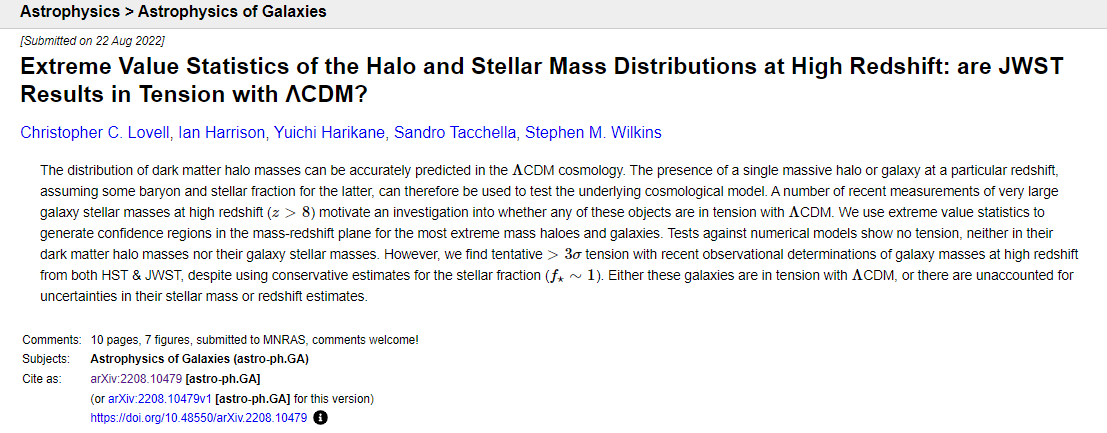
Well now the recent spate of observations of high-redshift galaxies by the James Webb Space Telescope has inspired Chris Lovell (who was a student at Cardiff back in the day then moved to Sussex to do his PhD and is now at the University of Hertfordshire) and Ian Harrison (who is back in Cardiff as a postdoc after a spell in the Midlands), and others at Cambridge and Sussex, to apply the extreme value statistics idea not to clusters but to galaxies. Here is the abstract:
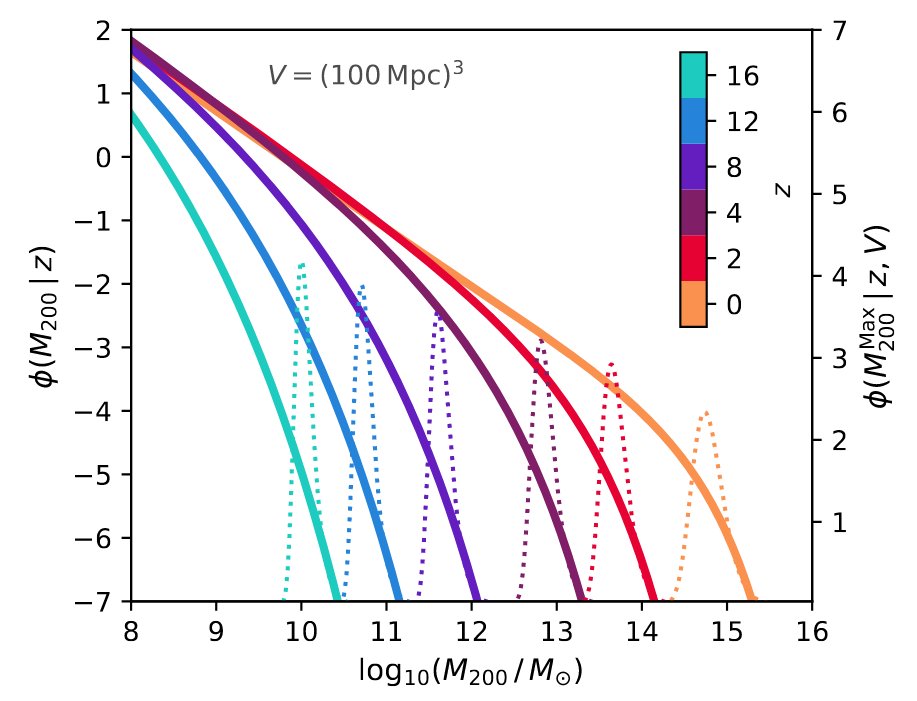
The basic idea of galaxy formation in the standard ΛCDM cosmological model is that galaxies form in dark matter haloes that grow hierarchically so that the typical size of galaxies increases with time. The most massive haloes at high redshift should therefore be less massive than the most massive haloes at low redshift, as neatly illustrated by this figure, which shows the theoretical halo mass function (solid lines) and the predicted distribution of the most massive halo (dashed lines) at a number of redshifts, for a fixed volume of 100 Mpc3.
The colour-coding is with redshift as per the legend, with light blue the highest (z=16).
Of course we don’t observe the halo mass directly and the connection between this mass and the luminosity of a galaxy sitting in it is likely to be complicated because the formation of the stars that produce the light is a rather messy process; the ratio of mass to light is consequently hard to predict. Moreover we don’t even have overwhelmingly convincing measurements of the redshifts yet. A brief summary of the conclusions of this paper, however, is that is some of the big early galaxies recently observed by JWST seem to be a big too big for comfort if we take their observed properties at face value. A lot more observational work will be needed, however, before we can draw definite conclusions about whether the standard model is consistent with these new observations.
Not long ago I had lunch with a friend and former colleague from Sussex now working elsewhere. During the conversation I found myself saying words to the effect of “It’s only easy being a manager of something if you don’t care”. Speaking in the context of University management I meant “care” about the things that matter, i.e. staff and students and teaching and research, not metrics, rankings and key performance indicators.
Over the years that I’ve worked in universities, I’ve seen them systematically taken over by people who really don’t care at all about the important things. The result among ordinary staff is exhaustion caused by the overwork required to meet arbitrary criteria of productivity imposed by a remote and uncaring managerial class. Universities are thus a microcosm of neoliberal society at large, with the management being the propertied class, the academics being the workers, and the students being mere commodities.
The drive to alienate and demoralize staff through overwork accelerated during the Covid-19 pandemic. Teaching staff were required to transform their working methods, undertake countless hours of unpaid overtime and suffer long periods of isolation and stress. Being a Head of Department with lots of responsibilities but no actual power and no reduction in teaching load to compensate for the administrative burden, compounded this They did it because they knew there was an emergency and because they actually care. In return for this sacrifice they have generally received no appreciation except for platitudes and nothing by way of financial compensation, with the notable exception of Queen’s University Belfast which paid a bonus to staff in recognition of their exceptional efforts. Well done to them, but they are the exception rather than the rule. Elsewhere the only reward for efforts during the pandemic looks likely to be real-terms cuts in pay.
My worry, which is rapidly becoming reality, is that in the post-pandemic era The Management, aware of how far their employees were prepared to go during the pandemic, will continue to take them completely for granted, increase their workload by recruiting more and more students to be taught with fewer and fewer resources, all of it driven by financial targets. Why do we continue to put up with this gross exploitation? Are we doomed forever to labour under the dead weight of managerialism?
Over the past few weeks I’ve seen a number of articles about quiet quitting, most recently this one in the Guardian. Roughly speaking “quiet quitting” means fulfilling one’s contract but not going any further – no work at evening or weekends, taking one’s full holiday entitlement, and so on. Staff have generally done these things because they care but that care has been and is still being systematically exploited. Indeed, it says something about the way higher education institutions operate nowadays that “working to contract” is generally regarded as a form of industrial action! Universities would grind to a halt without the good will of staff, and there’s very little of that still left. In my own case, my employer still hasn’t fulfilled the terms of my employment contract almost five years after I joined.
So am I now going to join the ranks of those quitting quietly? You might very well think that. I couldn’t possibly comment. What I will say is that my union, IFUT, is going to ballot its members next month on industrial action over pay. I think you can probably guess which way I’ll be voting…
These days many of Ireland’s newspapers are carrying stories about the drastic shortage of accommodation for students ahead of the start of the new academic year.; see, for example, here and here. Sinn Féin spokesperson on Further and Higher Education, Rose Conway-Walsh, has called on the Government to prepare emergency measures to tackle the crisis “before it’s too late”.
Unfortunately I think it’s already too late. I think this year we’re going to see a complete breakdown of the University system and that’s even without the industrial action that looks likely to take place. Although third-level institutions could have done more, the root cause is the funding model. There’s also a lack of housing nationally which is caused by systematic underinvestment over many years.
To illustrate the problems let’s look at Maynooth University, where I work. Some of the issues here are common across the University sector but some are specific. Maynooth is Ireland’s only real “University Town” in the sense that the University constitutes a very large part of the population; the local football team is even called Maynooth University Town. This is often used as a selling point for the University and indeed Maynooth is a pleasant place to work and study, but this year the special status of Maynooth is exacerbating the national crisis.
The number of permanent residents in Maynooth is about 15,000 and there is a similar number of students (13,700, including about 11000 undergraduates), so the population almost doubles during teaching term. Both populations are steadily rising. The University is recruiting more and more students without comparable increase in student housing – this year looks like being another record intake – but there is also pressure on housing due to other factors, particularly the dramatic expansion of the Intel plant in nearby Leixlip, with many of the new workers trying to find places to live in Maynooth. New properties are being built but at a rate much slower than the demand is increasing.
It is now mid-August, about a month before term starts for returning students. This is the time when foreign students start arriving and looking for accommodation. As a matter of fact I have two PhD students due to start in September, both of whom are new to Ireland. Usually getting in ahead of the home students helps them find somewhere ahead of the rush, but this year there is absolutely no accommodation to be found in Maynooth. I don’t mean there’s a shortage. I mean there isn’t anything. And the incoming first-year students haven’t even started looking yet.
This year’s Leaving Certificate results will not be out until September 5th. After that more than 3000 students will begin looking for accommodation. But the supply is already exhausted in August. Some will find accommodation on campus, but at the moment there are over 800 Ukrainian refugees living in the halls who will have to leave at the end of August to make way for students, but where will they go? And in any case there spaces vacated will only accommodate a fraction of the new arrivals.
There’s also the question of cost. The law of supply and demand is merciless in this situation so as private accommodation is so scarce, the rents payable have soared. That’s fine if you’re a landlord, of course…
The only solution I can see in the short term is temporary accommodation in caravans or tents or perhaps in large buildings such as sports halls. That’s highly unsatisfactory of course, but the alternative is lengthy commuting which is exhausting and which we saw last year leads to widespread disengagement.
Maynooth has just opened a new building on campus, the TSI Building, with large teaching rooms anticipating ever-increasing class sizes driven by the bums-on-seats mandate. But how many students will be able to attend?
New Teaching Room in the TSI Building
I’ve been arguing for over a year that we need to accept the reality that many students will not be able to attend on-campus sessions as we would like them to so we should invest in remote teaching methods to allow them to study at home. We did this during the pandemic emergency and we should do it during the accommodation emergency too. I am appalled that Maynooth has not bothered to install proper lecture capture facilities in its teaching rooms. These facilities were commonplace in the UK long before the pandemic and it’s shocking that they are not deployed routinely in Maynooth. I have better lecture capture facilities in my study at home than the University provides in its lecture theatres.
Although this crisis has been brewing for many months, the Irish Government has done little to help. Individual universities have also been staring into the headlights and doing nothing. Government funding per student has been falling steadily so Universities wishing to maintain their income have been forced to recruit more students, despite the lack of investment in accommodation and other infrastructure.
It’s stressful enough for academic staff having to contend with this looming disaster, but I can hardly imagine how awful it must be for students. All I can do is apologize, which is something the people really responsible will not do.
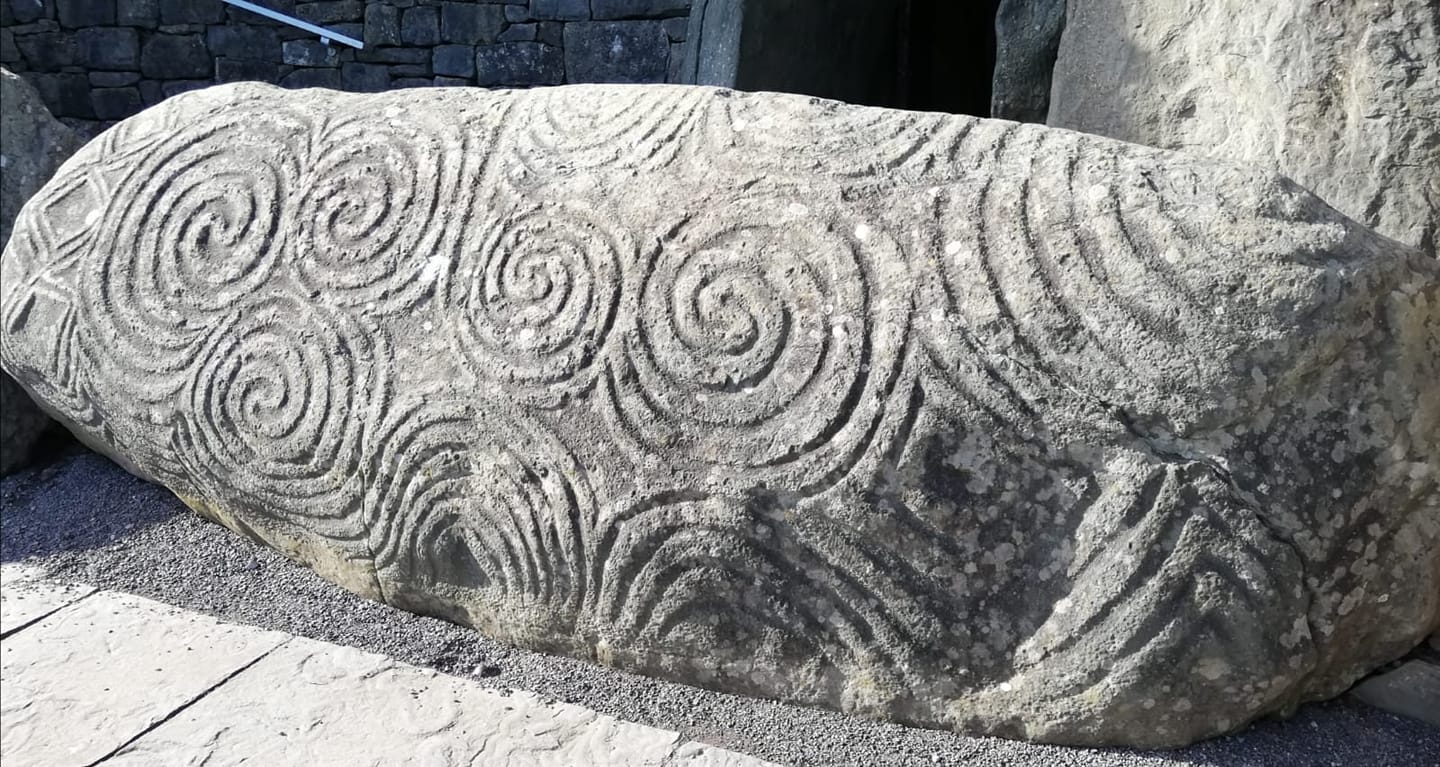
This morning I realized that almost exactly four years ago I visited the megalithic passage tomb at Knowth. In my post about that visit I mentioned the extraordinary stone carvings found outside the tomb and their possible connection with astronomy. Following on from ChorizoGate I can finally reveal that the solution to this ancient mystery is in fact gastronomical.
Images from the passage tomb at KnowthImages of sausages
ChorizoGate distracted me from mentioning on here that the Repeat Examination period started on Wednesday. I usually write a post at the start of an Exam period to wish all the students good luck, but this time the first examination for which I am responsible took place yesterday morning, and I’ve already marked the scripts so in that case the die is already cast. I send my best wishes to all other students taking repeat examinations, though, including the first-years taking my paper later on this afternoon.
Today’s examination doesn’t finish until 5.30pm so I’ll have to collect the scripts on my way home to mark them over the weekend. I have another three examinations on my own modules next Wednesday but because of ongoing staffing issues I am also responsible for marking several examinations for modules I didn’t teach. I’ve got a busy week ahead so I want to finish marking today’s paper before it starts,
I also thought it was worth mentioning for any university teachers out there reading this that although they are held at roughly the same time of year in the two countries there’s a difference in the way resits are handled in the institutions I’ve worked at in the United Kingdom and the way repeats work here in Maynooth which is implied by the slightly different name.
In UK institutions with which I am familiar students generally take resits when, because they have failed one or more examinations during the year, they have not accumulated sufficient credits to proceed to the next year of their course. Passing the resit allows them to retrieve lost credit, but their mark is generally capped at a bare pass (usually 40%). That means the student gets the credit they need for their degree but their average (which determines whether they get 1st, 2nd or 3rd class Honours) is negatively affected.
This is the case unless a student has extenuating circumstances affecting the earlier examination, such as bad health or family emergency, in which case they take the resit as a `sit’, i.e. for the first time with an uncapped mark.
Here in Maynooth, repeat examinations are generally taken for the same reasons as in the UK but the mark obtained is not capped. When I’ve told former UK colleagues that our repeat examinations are not capped they generally don’t like the idea because they feel that it might lead to many students playing games, i.e. deliberately not taking exams in May with the intention of spreading some of their examination load into August. There’s not much sign of students actually doing that in my Department, to be honest, for the reason that the results from the repeat examination period are not confirmed until early September so that students that deploy this strategy do not know whether they are going to be able to start their course again until a couple of weeks before term. That could cause lots of problems securing accommodation, etc, so it doesn’t seem to me to be a good strategy.
I’d welcome comments for or against whether resits/repeats should be capped/uncapped and on what practice is adopted in your institution(s).
The views presented here are personal and not necessarily those of my employer (or anyone else for that matter).
Feel free to comment on any of the posts on this blog but comments may be moderated; anonymous comments and any considered by me to be vexatious and/or abusive and/or defamatory will not be accepted. I do not necessarily endorse, support, sanction, encourage, verify or agree with the opinions or statements of any information or other content in the comments on this site and do not in any way guarantee their accuracy or reliability.







 In the Dark