Archive for the Biographical Category

Writing, Publishing and Blogging

Posted in Biographical, Maynooth on June 8, 2022 by telescoper

This morning I saw this bit of guidance about writing a blog produced by a colleague from Maynooth:

I’m not sure how well I’ve followed this guidance over the last 14 years or so but was struck by the assertion that “a blogpost is a publication”. It reminded me of a webinar I did a while ago about Open Access publication which led to a discussion of whether or not a preprint is a publication. Taking the definition of “publish” to be “to issue to the public”, I think it is. In the digital era methods of publication are much simpler and more diverse than in the days when everything was circulated on paper and although I haven’t thought much about it before, I agree on this basis that a blog post is indeed a publication.

That means I have 5942 publications! Or actually 5943 after I’ve published this one. Not counting a couple of hundred “proper” ones, of course…

Anyway I have never really seen a good reason why this blog should be entirely about my professional life. It is true that the most popular posts have proved to be about my research interests but people seem to read the other stuff too so I see no reason to be restrictive.

A dozen years ago I wrote a post about how and why I started blogging, and what follows is an edited version of that.

Lots of people have asked me over the years why I have a blog and why I apparently spend so much time writing it. Well, for me, there are two answers. The first is just that I enjoy writing. I think because of that I’ve always been able to write stuff fairly quickly and developed a little bit of a knack for it. I also sometimes find it easiest to figure out what I actually think about something by trying to write about it. Publishing a post written for this reason is almost irrelevant and there have been a few occasions when I’ve regretted posting items in which I’ve been “thinking out loud” in this way. Sometimes it’s good to remember that people may actually read what you write…

When I started blogging I realized that it gave me the chance to write about things quite different from the usual themes I had previously tackled in publications. I’d written scientific papers, textbooks, lecture notes, popular books and newspaper articles before but most had  been quite strictly controlled by editors and were always related to my scientific work.

It was only after I’d been blogging quite a while that I started doing music and poetry items, entirely for my own amusement, like keeping a scrapbook, but if people actually enjoy things that I’ve put up that they’d never seen before then all the better. I know a lot of people think I’m a pretentious twat for posting about poetry or Opera or modern jazz – some have said as much to my face, in fact – but that’s what I like. There’s enough blogs about pop music, TV celebrities and computer games already, not that I’d be able to write about them. I’m flattered too by the fact that some of my music and other posts have been linked to Wikipedia articles – and, no, I didn’t put them there!

The other reason I had for starting to blog is much more personal. I moved job from Nottingham to Cardiff in 2007, but I got caught up in the credit crunch and was unable to sell my old house for quite a while. I spent far too much time commuting from Nottingham to Cardiff and back for the weekends and got thoroughly depressed, a state of mind not helped by some other issues which I won’t go into. In the middle of this my father died. Though not entirely unexpected, I did have to take some time out to deal with it. He hadn’t left a will, and I had to sort out the legal side of things as well as dispose of his belongings and arrange the funeral. In the aftermath of all that I had pangs of nostalgia for my childhood in Newcastle and an urge to connect with all that through writing down some thoughts and memories. Many of my early posts on here were quite morbidly introspective and probably not much fun for anyone to read, but I found writing them quite cathartic, as indeed I’ve found other posts for different reasons.

Anyway, knowing my tendency to write bits and bobs and then forget about them, quite a few people had encouraged me to start writing a blog but I hadn’t done it because I didn’t know how to go about setting one up. Fortunately, after a public talk I’d given, Phil Brown of the British Association for the Advancement of Science gave me a few pointers to getting started writing a blog. After finally managing to sell off the Nottingham house and after relocating fully to Cardiff, I started blogging in 2008.

So there you are.  That’s some of why and most of how I came to start writing this blog. I wish I could say I had a mission to change the world, but it’s really just partly a big exercise in self-indulgence and partly a piece of occupational therapy.

I would add two things in my defence. One is that I think that among all the other stuff, I do a bit of public service on here. Any bits of news about funding, exciting or controversial science results and things I think my colleagues might find interesting tend to go on here and I do think that’s a useful thing to do. People in my own Department sometimes find things first from reading here, which I think adds a healthy bit of transparency to the otherwise closed world of academic life. The other thing to say is that, contrary to popular opinion, I don’t actually spend a huge amount of time writing the blog. Much of it is recycled and the rest thrown together quite quickly. I know it’s rubbish, but at least its fast…

Some time ago I came across the idea of a “commonplace book“. To paraphrase Wikipedia

Such books came into use in the middle ages and were essentially scrapbooks, filled with items of every kind: medical recipes, quotes, letters, poems, tables of weights and measures, proverbs, prayers, legal formulas. Commonplaces were used by readers, writers, students, and humanists as aids for remembering or developing useful concepts ideas or facts they had learned. Each commonplace book was unique to its creator’s particular interests.

Dare I say, just like a blog?
R.I.P. Richard Hills (1945-2022)

Posted in Biographical, The Universe and Stuff with tags , , on June 7, 2022 by telescoper

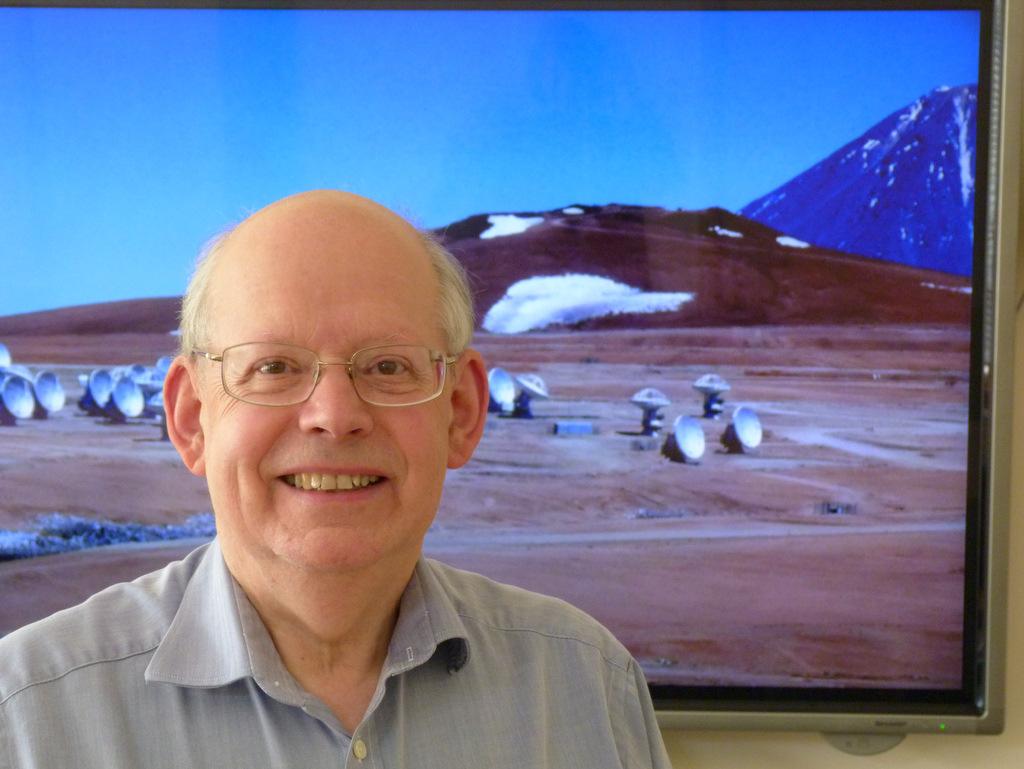
Yet again I find myself having to pass on some sad news. I heard yesterday that Professor Richard Hills FRS lately at the Mullard Radio Astronomy Observatory of the Cavendish Laboratory in Cambridge, passed away on 5th June at the age of 76. Richard was a specialist in radio and sub-mm astronomy, being heavily involved in the James Clerk Maxwell Telescope (JCMT) and more recently the Atacama Large Millimetre Array (ALMA; shown in the background above).

I remember two encounters with Richard particularly well.

The first was when I was an undergraduate student at Cambridge. I did a final-year theory project that involved making a computer simulation of a laser. I had to attend a viva voce examination with two members of staff after submitting my project report. Richard was the one of the pair and, although it was not his specialist subject, he seemed genuinely interested in what I’d done. He managed to ask some very searching questions at the same time as being very friendly and encouraging. I must have answered quite well because they gave me a very good mark!

The other was much more recent occasion when I gave a seminar at the Cavendish about phase correlations in cosmological fields. As an expert in interferometry he knew a lot about this from a different perspective and again he asked some very interesting questions, ending up with a discussion of the closure phase.

Richard Hills was a very eminent scientist who made a huge range of contributions to astronomy, for which he was elected a Fellow of the Royal Society in 2014. He will be greatly missed by his friends, family and colleagues in Cambridge and around the world to whom I send my condolences.

R.I.P. Richard Edwin Hills (1945-2022)

Lá Saoire i mí Mheitheamh

Posted in Biographical, Irish Language, Maynooth on June 6, 2022 by telescoper

Today has been (and indeed continues to be) the June Bank Holiday (Lá Saoire i mí Mheitheamh) in Ireland. It is the equivalent of the usual May Bank Holiday in the UK in that both have their origin in the old festival of Whitsuntide (or Pentecost) which falls on the 7th Sunday after Easter. Because the date of Easter moves around in the calendar so does Whit Sunday, but it is usually in late May or early June. Here in Ireland the Bank Holiday is always on the first Monday in June whereas on the other side of the Irish Sea it is on the last Monday in May (except for this year when it was moved at the behest of some old Queen).

Although I’m only at beginners’ level in Irish, the phrase Lá Saoire i mí Mheitheamh gives me a chance to bore you about it. It’s actually quite a straightforward phrase until you reach the last word: “Lá” means “day” and “Saoire” means “leave” or “vacation” so “Lá Saoire” means “holiday”; “i” is a prepositional pronoun meaning “in” and “mí” means “month”. So far so good.

The word for June however is Meitheamh (at least when it is in the nominative singular case). As an Indo-European language, Irish is distantly related to Latin which has six grammatical cases for nouns (actually seven if you count the rarely used locative case). Irish has only four cases – there’s no ablative and, curiously, no real distinction between nominative and accusative (though there is for some pronouns). That leaves nominative, dative, genitive, and vocative. The dative case– used after simple prepositions – is only rarely distinct from the nominative so basically the ones you have to learn are the genitive and the vocative.

Whereas in Latin cases are indicated by changes to the end of noun, in Irish they involve initial mutations. In the example of “mí Mheitheamh” meaning “month of June”, requiring the genitive form of “June”, the initial consonant “M” undergoes lenition (softening) to sound more like a “v”. In old Irish texts this would be indicated by a dot over the M but in modern orthography it is indicated by writing an “h” after the consonant. This is called a séimhiú (pronounced “shay-voo” ). Note the softened m in the middle of that word too but it’s not a mutation – it’s just part of the regular spelling of the word, as is the -mh at the end of Meitheamh. There’s also a softened “t” in the middle of Meitheamh which makes it vrtually disappear in pronunciation. Meitheamh is thus pronounced something like “Meh-hiv” whereas “Mheitheamh” is something like “Veh-hiv”.

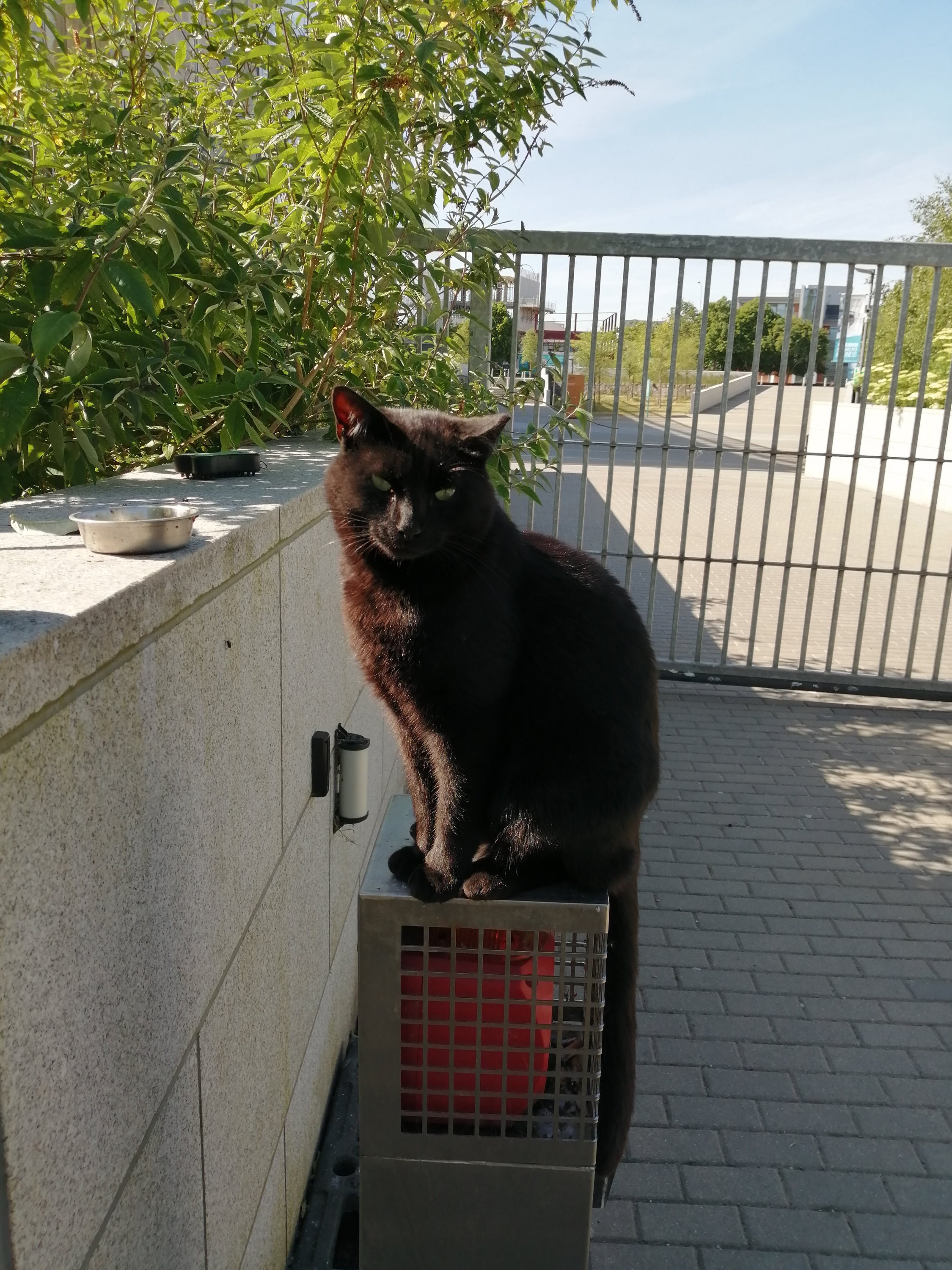
Anyway, here’s a picture of Maynooth University Library Cat.

The last ten years

Posted in Biographical on June 4, 2022 by telescoper

Time passes.

Today, as I find myself another year older, I was thinking back over what things of a personal nature have happened in the last ten years. In that time I moved from Cardiff to Sussex and back to Cardiff and then here to Maynooth.

When I was chatting to John Ellis over lunch at the ITP meeting last week he said to me “You move around quite a lot, don’t you?”. I replied “Yes, that has been remarked upon”. He seemed to think that was funny.

I don’t think I’ll be moving jobs again. Sometime in the next ten years I’ll be retiring, hopefully sooner rather than later. At any rate in less than three months I’ll be stepping down as Head of Department, hopefully spending more time on teaching and research and less on pointless bullshit.

Another notable thing that happened in the last decade was that I had a nervous breakdown. I spent a few weeks in a psychiatric institution but recovered well enough to return to work quite quickly. Fortunately, and contrary to my pessimistic expectations, and despite the stresses caused by the pandemic, I have suffered no significant recurrences and am now not even taking any medication (unless you count wine). So that’s all good.

The last ten years also saw my Mam cruelly taken by dementia; she passed away in 2019. Now all my grandparents and both my parents have gone.

The other thing I realised today is that I am now older than my late collaborator and colleague Francesco Lucchin, with whom I wrote a cosmology text book, was when he passed away twenty years ago, in 2002.

Time passes.

Anyway, I’ve done very little today except relax, read and listen to music and to complete the self-indulgence I’m now going to cook dinner and drink some wine while I watch some football on the telly.

R.I.P. David Matravers

Posted in Biographical, The Universe and Stuff with tags , , , on June 3, 2022 by telescoper
David Matravers, pictured on his 80th birthday in December 2017 (Picture Credit: ICG)

I was very sad this morning to hear via George Ellis of the death at the age of 84 of David Matravers. A South African by borth, David moved to (then) Portsmouth Polytechnic in 1990, just before it became the University of Portsmouth, where he set up a group in cosmology and relativity with the Mathematics Department. Though initially small, that group grew steadily branching out into other areas, including observational cosmology, and became, in 2002, the Institute of Cosmology and Gravitation which is recognized throughout the world as a centre of excellence in research. I see it did particularly well in the recent Research Excellence Framework, for example.

NOTE: I am grateful to David Wands for pointing out that David Matravers wasn’t the first Director of the ICG as I said in an earlier version of this post: that was Roy Maartens. David Matravers actually retired just as the ICG was being set up but played a huge role in its creation.

David Matravers is rightly regarded as its founding father of research in cosmology and gravitation at Portsmouth. He therefore leaves a wonderful legacy not only in the ICG itself but in the many alumni who have passed through it at various stages of their careers and are now carrying on their work all around the globe.

During the 1990s I saw David Matravers quite regularly as he visited Queen Mary & Westfield College where I was working at the time to attend our relativity seminars and talk to the relativity group. He was a very cheerful and engaging chap who was always keen to encourage early career researchers. I was in that category at the time and, although I never worked directly with David, he was always very kind and supportive to me. What struck me in particular about him were his enthusiasm and determination, which is no doubt why he was so successful at building up the ICG from scratch. He will be greatly missed.

My condolences to his friends, colleagues and family.

Rest in peace, David Matravers (1937-2022).

Fuzzy Cosmology at ITP2022

Posted in Biographical, Talks and Reviews, The Universe and Stuff with tags , , , on May 26, 2022 by telescoper

As I usually do when I give a talk (which hasn’t been for a while) I’ve uploaded the slides for the presentation I gave at the Irish Theoretical Physics meeting at DIAS this morning. The title of the talk was Fuzzy Cosmology and the abstract reads:

I discuss some applications of the Schrodinger-Poisson wave-mechanical approach to
cosmological structure formation. The most obvious use of this formalism is to “fuzzy” dark matter,
i.e. dark matter consisting of extremely light particles whose effective de Broglie wavelength is
sufficiently large to be astrophysically relevant, but it can be used to model more general scenarios
and has a number of advantages over standard methods based on Eulerian perturbation theory. I
illustrate the formalism with some calculations for cosmic voids and discuss its application to the
cosmological reconstruction problem(s).

I think it went reasonably well despite there being a hitch at the start because the touchpad on my laptop stopped working. Fortunately I was able to produce an emergency mouse. Anyway, here is a picture of me taken during the talk to prove I was there..

ITP 2022

Posted in Biographical, Maynooth with tags , , on May 25, 2022 by telescoper

Just a quick note to say I’ve spent today not only out of the office but out of Maynooth at the first conference I’ve attended since before the pandemic started. The Irish Theoretical Physics Meeting (ITP22) is taking place from today (Wednesday 25th) to Friday 27th at the Dublin Institute for Advanced Studies. I’ll be commuting from Maynooth for the rest of this week. There is quite a big contingent from the Department of Theoretical Physics at Maynooth in fact.

My talk isn’t until tomorrow morning but I chaired one of the sessions this afternoon. It’s an interesting meeting with an eclectic mixture of talks and lots of time for the sort of face-to-face discussion we’ve all missed for so long. If that weren’t enough it’s also a nice change from marking examinations…!

Maynooth University Library Cat Update

Posted in Biographical, Maynooth with tags on May 24, 2022 by telescoper
Picture Credit: Joost Slingerland

I’ve been at home today, doing the last of my examination marking, doing some Open Journal business, and preparing a presentation for later this week so I’m indebted to my colleague Dr Joost Slingerland for the above picture of Maynooth University Library Cat.

I’ve seen him quite a few times recently, as I’ve been on South Campus to collect exam scripts etc, and he seems in fine feline fettle. In the picture he looks like he’s guarding his Library from unwelcome visitors.

Soon the exams will be over and the campus will be relatively quiet again, though no doubt he will continue to be kept well provisioned and not short of company when he wants some.

The Death of the Hubble Parameter

Posted in Biographical, The Universe and Stuff with tags on May 23, 2022 by telescoper

It’s been a very busy day so in lieu of a proper post I thought I’d recycle an old joke with a new picture I took on my way to collect some examination scripts earlier today for marking.

I’m sad to have to use the medium of this blog to report the tragic death of the Hubble parameter. It had been declining for some time and, despite appearing to pick up recently, the end was somewhat inevitable. Condolences to the other parameters, especially Ω (who was in a close relationship with H), on this sad loss.

An older version of this joke, posted 11 years ago, can be found here.

Notes on Eurovision

Posted in Biographical, Music, Politics with tags , , , , on May 15, 2022 by telescoper

To nobody’s surprise Ukraine won last night’s Eurovision song contest after collecting a huge dollop of the televotes. After the jury votes, the United Kingdom’s entry was in the lead which surprised me because I thought it wasn’t much of a song at all. I’ve never been very good at picking the tunes that do well though. I didn’t like Ukraine’s entry – Stefania by the Kalush Orchestra – much either, but obviously there are special circumstances this year and I’m not at all sorry that they won.

In fact I thought the best song – and the best singer – by a long way was the Lithuanian entry sung by Monika Liu, who held the stage brilliantly by standing there and singing, without any fancy staging. She finished a disappointing 14th.

Monika Liu

Other entries I enjoyed were: Spain, catchy dance number with excellent choreography that finished 3rd; Moldova, an energetic performance full of humour (7th); and Norway, whose entry Give that Wolf a Banana was enjoyably deranged (10th). The less said about the other entries the better. I’m still as baffled by how Sam Ryder’s entry for the UK, Space Man, did so well in the jury votes as I am that Lithuania did so badly there, but there you go. What do I know?

I’ll state without comment that the Ukrainian jury gave a maximum douze points to the United Kingdom, but in return the UK jury gave Ukraine nil points

Anyway, three things struck me as I sipped my wine and watched the show:

  1. Ironically the Opera on the radio last night was Wagner’s Die Meistersinger von Nürnberg which is about a sixteenth century song contest that resembles the Eurovision versiononly in the length of time it goes on for. Perhaps someone should write a modern music drama called Die Meistersinger von Eurovision?
  2. I think the Research Excellence Framework would be much more fun if it were done like the Eurovision Song Contest. Each University regardless of size could be given the same distribution of scores to allocate to the others (but not itself). I can see interesting patterns emerging during that!
  3. When I was formally presented with my DPhil in the summer of 1989, the graduation ceremony took place on the same stage (at the Brighton Centre) on which Abba won the Eurovision Song Contest in 1974 with their song Waterloo.