So we have arrived at October 31st, Hallowe’en or, in pagan terms, Samhain. This, a cross-quarter day – roughly halfway between the Autumnal Equinox and the Winter Solstice – represents the start of winter (“the dark half of the year“) in the Celtic calendar. As it turns out I didn’t get any trick-or-treaters this evening. I think the torrential rain put the dampeners on any such adventures, and I could scarcely hear the fireworks for the sound of the rain stotting down on my roof.
Despite my own reservations about Hallowe’en, I’ve decided to resurrect the following little video which seems to be appropriate for the occasion. It’s made of bits of old horror B-movies but the music – by Bobby “Boris” Pickett and the Crypt-kickers is actually the second 7″ single I ever bought, way back in 1973…
The recent takeover of Twitter by Elon Musk, and the likely removal of content moderation with all that implies for increased toxic behaviour, has led me to reconsider my use of social media. I know I’m not alone in this either. Over the weekend I noticed quite a few of my friends quitting Twitter for Mastodon so I thought I’d give it a go.
Mastodon is a microblogging service with a similar look and functionality to Twitter but there are some big differences. For a start Mastodon is not run from a single website. It is a distributed network of servers around the world running open-source software; each server is called an ‘instance’. This means that it is not owned by a single individual or company and the different instances can have different moderation policies. Any person or organization capable of operating a server running the software, and willing to take on the legal issues, can federate to the overall network.
For another thing it is community led, with each instance run by volunteers. It is free of charge, has no advertising , so none of those annoying ‘promoted tweets’, nor any creepy algorithms trying to influence your behaviour, and above all does not exist to serve the ego of a billionaire owner with sociopathic tendencies.
Then there is the moderation policy. I joined the original server `mastodon.social’ (where I am the usual @telescoper) which has the following rules:
Hopefully this will deter those who spend all their time on Twitter sending abuse from joining Mastodon. This server is based in Germany, hence number 5. Although I think it was included for other reasons, it reminds me that defamation is a criminal offence in Germany, punishable by a prison sentence. A certain individual who has a habit of posting defamatory messages about me on Twitter should bear this in mind…
Anyway, I’ve only just got onto the platform and am still finding my way around. I only have a handful of followers, compared to the 7000+ I have on Twitter. For the time being I’m still on Twitter, but if it goes well then I intend to leave that to the trolls and bigots. I’m sick of spending so much time blocking objectionable people and seeing decent people abused.
P.S. One thing I think would be handy would be an API that allows me to publish these blog posts automatically on Mastodon like I do on Twitter, but I haven’t seen one yet…
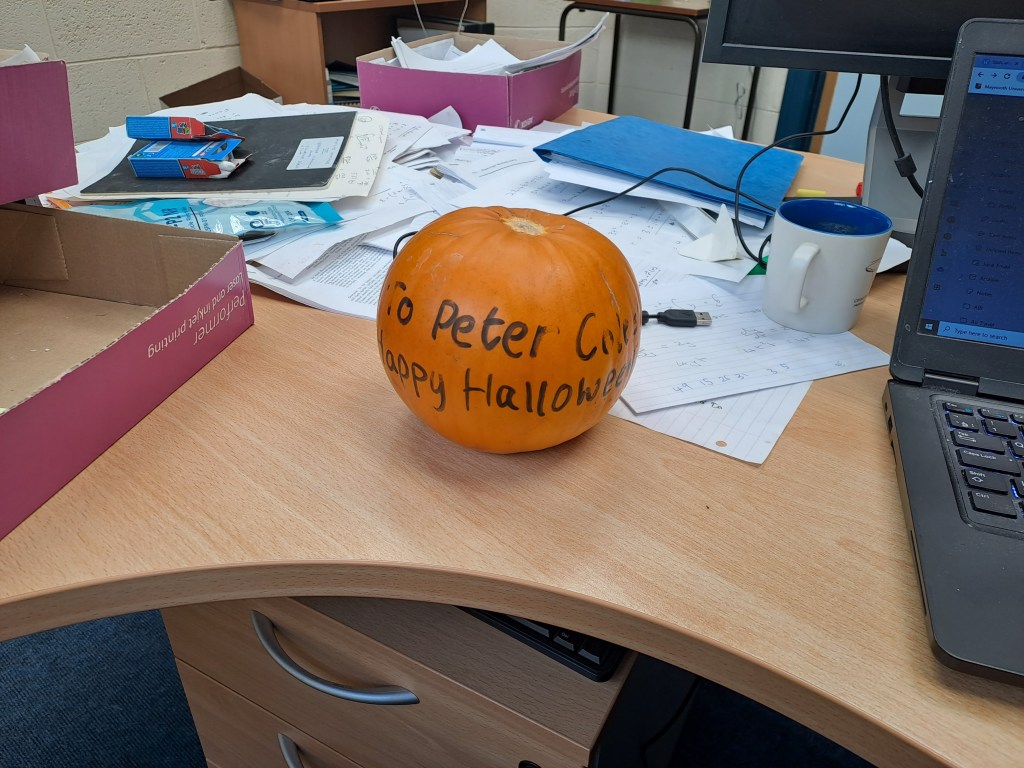
Yesterday my Vector Calculus students gave me the above Hallowe’en gift, which was nice of them, although I did chastise them for missing the apostrophe. Of course Hallowe’en itself is not until Monday, but that is a Bank Holiday in Ireland and the rest of next week is Study Week so there are no lectures or tutorials.
Hallowe’en is, in pagan terminology, Samhain. This, a cross-quarter day – roughly halfway between the Autumnal Equinox and the Winter Solstice, represents the start of winter (“the dark half of the year“) in the Celtic calendar. Samhain is actually November 1st but in Celtic tradition the day begins and ends at sunset, so the celebrations begin on the evening of 31st.
Incidentally, Samhain is pronounced something like “sawin”. The h after the m denotes lenition of the consonant (which in older forms of Irish would have been denoted by a dot on top of the m) so when followed by a broad vowel the m is pronounced like the English “w”; when followed by a slender vowel or none “mh” is pronounced “v” or in other words like the German “w” (which makes it easier to remember). I only mention this because I will be resuming my Irish language education after the break with classes every week for the rest of the academic year. Hopefully I’ll make some progress.
This term has been very tiring so far. I have to teach a very big first-year class this year which meant adding another tutorial group. Although I stepped down as Head of Department at the end of August the powers that be delayed appointing a replacement until well into term which caused a lot of unnecessary stress for everyone. Once we got under way, though, everything has settled down reasonably well.
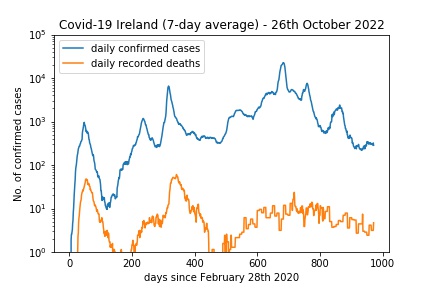
One thing I was a bit worried about this term was that the resumption of in-person teaching would lead to a surge in Covid-19 cases, not only in Maynooth but across the country. However there isn’t any evidence of significant increases in the latest figures (updated weekly nowadays, on Wednesdays):
Some students have come down with Covid-19 of course but not in the numbers I had feared. Also despite accommodation shortages and other difficulties, attendance at lectures and tutorials has so far held up well.
I like having the study break. I’ve never previously worked at an institution that has such a thing, but I think 12 weeks of non-stop teaching would be extremely exhausting. Anyway, after the break we have a further six weeks of teaching until December 16th, which is the official end of term, but for now I have Monday off completely and the rest of the week without teaching duties. That’s not to say I’ll be on holiday though. I have a number of tasks to catch up on, including setting examination papers for January…
Not long ago I posted an item about the Summer Programme for Undergraduate Research (SPUR) at Maynooth University. This past summer I had two undergraduate students doing research projects with me funded under this scheme. They were both involved with making Monte Carlo simulations of galaxy clustering and using them to test various statistical analysis tools. The Department of Theoretical Physics actually had five students on three different projects, which is quite a lot for a small Department. The University as a whole had 57 SPUR students so we had almost ten percent of the total!
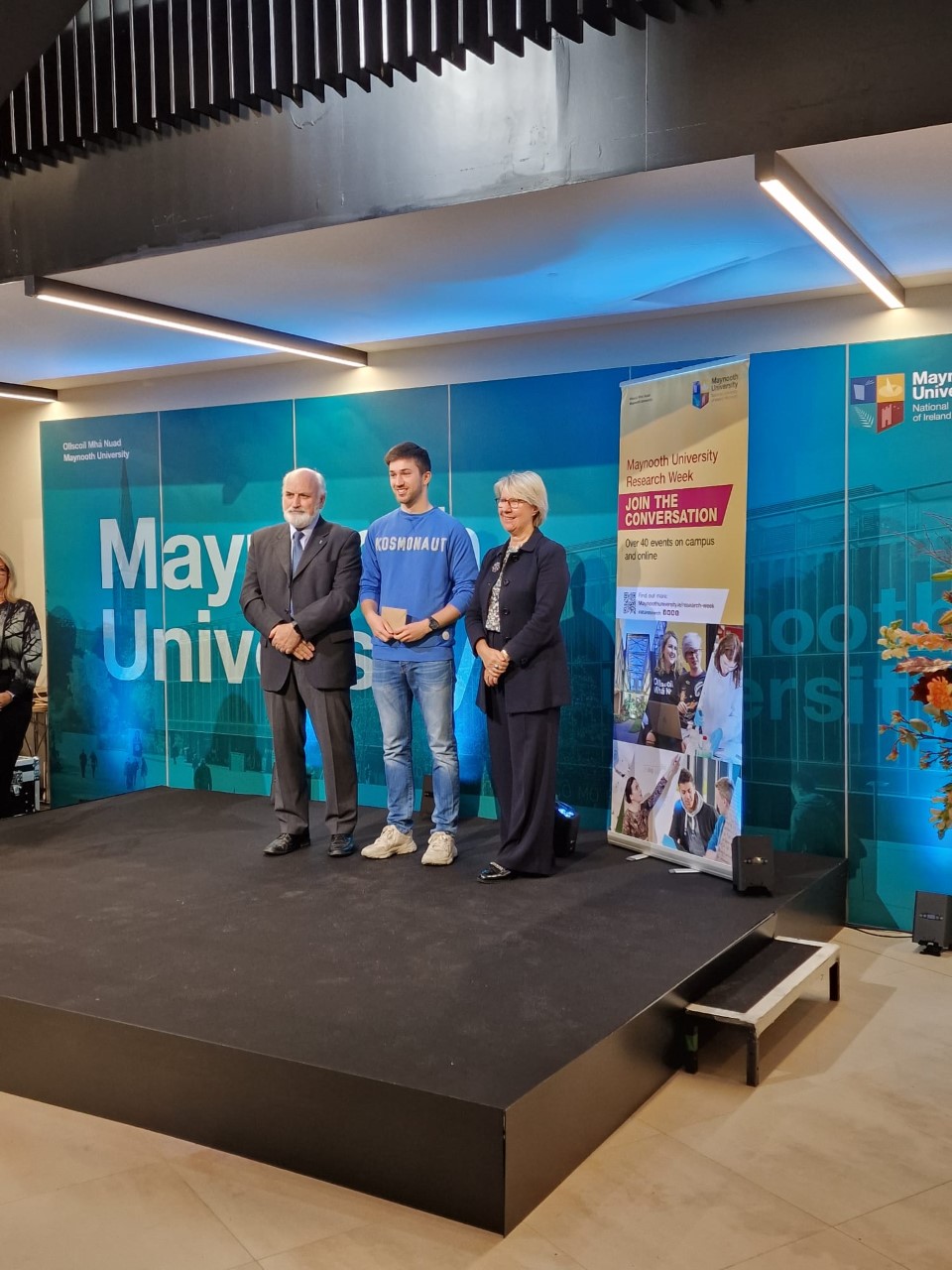
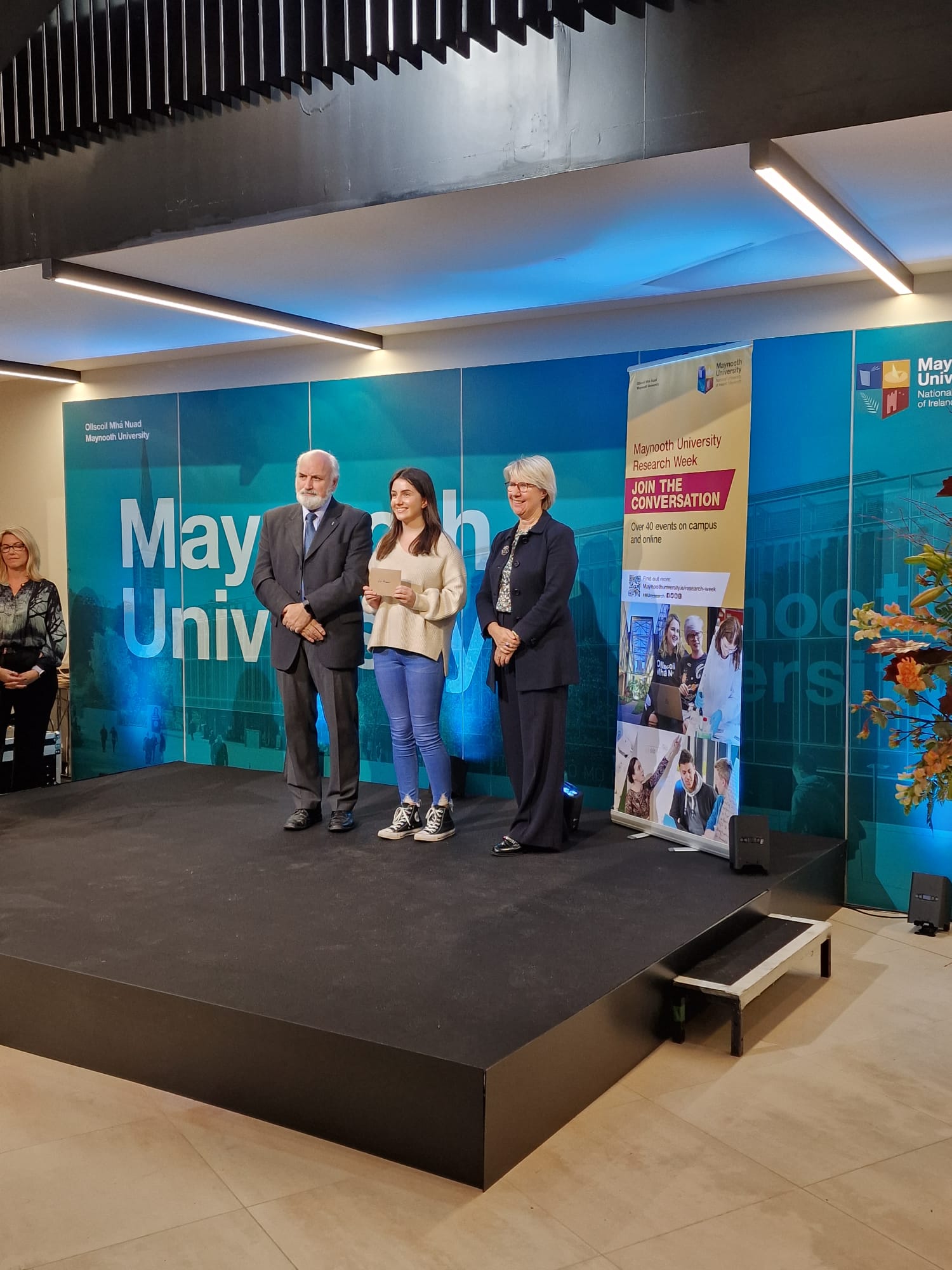
Well, earlier this week there was a Research Symposium at which all the summer’s research undergraduates presented posters on their work, with prizes being awarded for the best. I couldn’t attend the Symposium because of other commitments but I was delighted to find out that both my students won prizes – that’s two out of the five awarded. Here are the pictures of them being presented with their awards at the ceremony yesterday, flanked by the Vice-for Research and Innovation, Brian Donnellan and the President, Eeva Leinonen.
The Theoretical Physics Prize Winners, Pawel and Lisa
The awards ceremony was held in the foyer of the new TSI building yesterday afternoon, which wasn’t an ideal choice because the acoustic is very poor and lots of students were making their way to and from lectures. I didn’t hear a word of the speeches, actually. Nevertheless it was nice to see Pawel (top prize in the Science and Engineering category) and Lisa (audience choice prize winner) collect their awards. It was a pleasure to work with both of them this summer!
Incidentally, the SPUR students are paid for the projects, which last for (usually) six weeks but can be extended. I wish we could offer these projects to every student who wanted one, actually, but we just can’t afford to do that. I don’t agree with unpaid internships as these can only be taken up by students who have access to enough income to cover living expenses over the summer, so are discriminatory. We select students based on an application form and their academic performance.
Although I no longer live in Britain, every morning I look at the UK news media to check the previous night’s football results and find out who is the latest Prime Minister.
I think we need to know whether the lettuce voted leaf or romaine ‘cos the answer to that little gem could be the tip of the iceberg that may end up determining whether its popularity will rocket… (continued, p. 94)
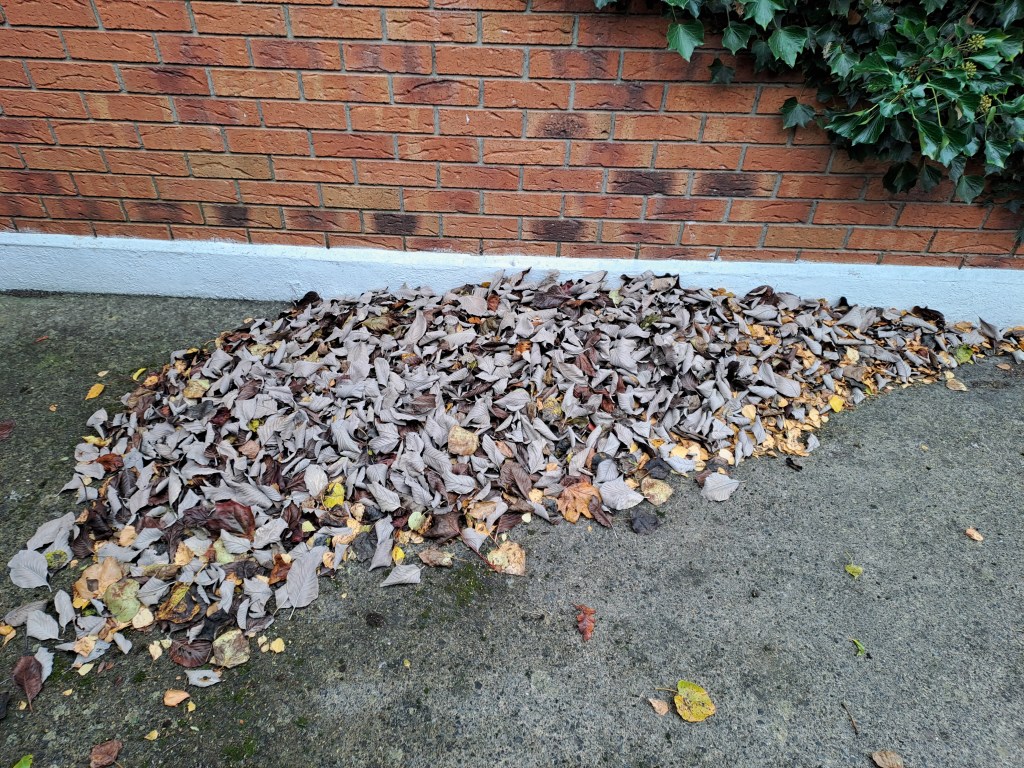
Autumn is definitely here. It’s very nice to live in a tree-lined street but the consequence of that at this time of year is that there are leaves everywhere. They don’t call it “fall” for nothing. Actually I let the leaves lie until they compost down on the actual garden but unfortunately the side of my house is a bit of wind trap and they tend to accumulate there in large quantities. When they do start to break down it makes a slippery hazard for anyone visiting, especially if it rains.
So this lunchtime I cleared away most of the leaves from the path leading up to my front door, in which task I was joined by a little robin who was no doubt hoping I would disturb some bugs or at any rate something edible when I swept up the leaves. I’m not sure this is the same robin that came in my house earlier this year, but it wasn’t afraid to come very close.
Reading a little about robins I discovered that many don’t live to reach their first birthday, but those that do have a good chance of living quite a while longer. The record is 19 years! Today’s robin could be the same one I’ve seen before, but I can’t be certain.
That reminded me that it was about time to start putting the bird feeders out again so I went out and bought some seed and peanuts and fat balls, although I think I’ll keep those for when it’s a bit colder.
At some point soon I’ll have to get the ladders out and trim back the ivy which is once again reaching the top of the wall. That will have to wait a few days, though, as my garden refuse bin is now full and won’t be empty again until Wednesday.
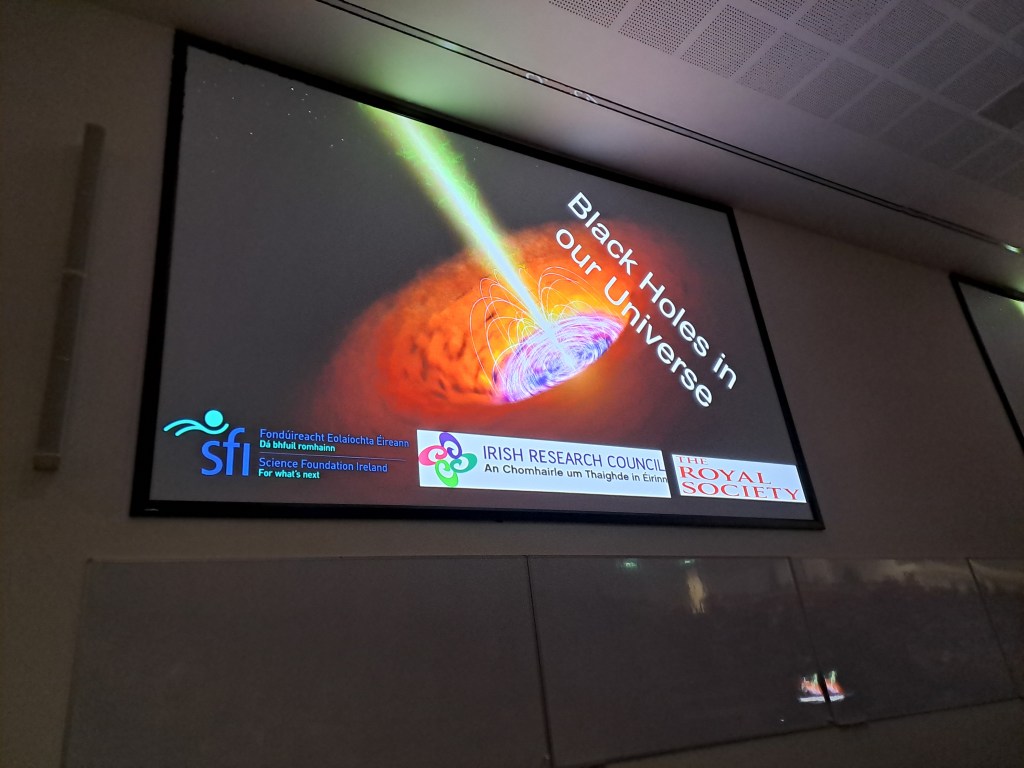
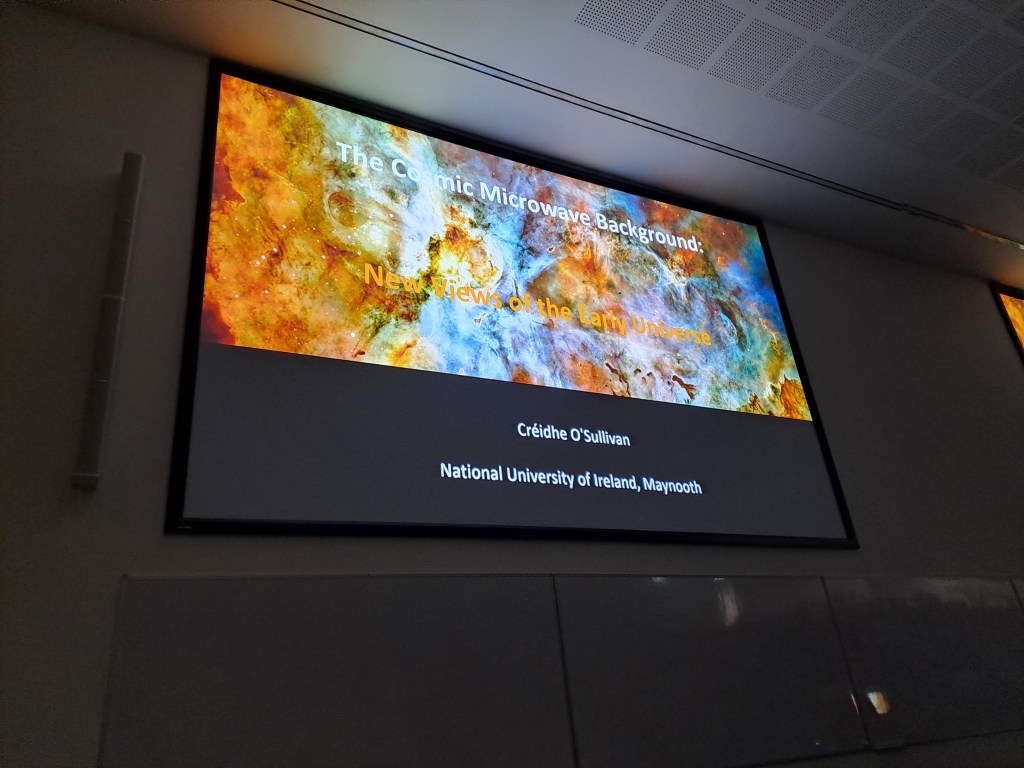
Last night I participated in an event at Maynooth for Space Week which I think went very well. We had a big audience so the decision to move to a bigger lecture theatre was a good one. Nobody took count but I think we had as many as 400 people of all ages, including some very young kids, some students and a variety of others.
I was the last one up to speak and took a few pictures at the three talks before mine but obviously couldn’t take a picture of mine so I’ve included a pic of some of the hi-tech equipment I used for a couple of demonstrations:
If anyone wants to see the pictures I showed you can find them here:
There was an official photographer there last night so I’ll upload any pictures I come across in due course. Watch this space.
UPDATE: Here’s a picture of the four speakers
Last night’s four speakers: Créidhe O’Sullivan, Me, Emma Whelan and John Regan
Anyway, thank you to everyone for coming last night and especially to all the people who helped organize and run the event, including our student volunteers. We’re planning to do similar event for space week next year and hopefully this will become a regular feature in the calendar.
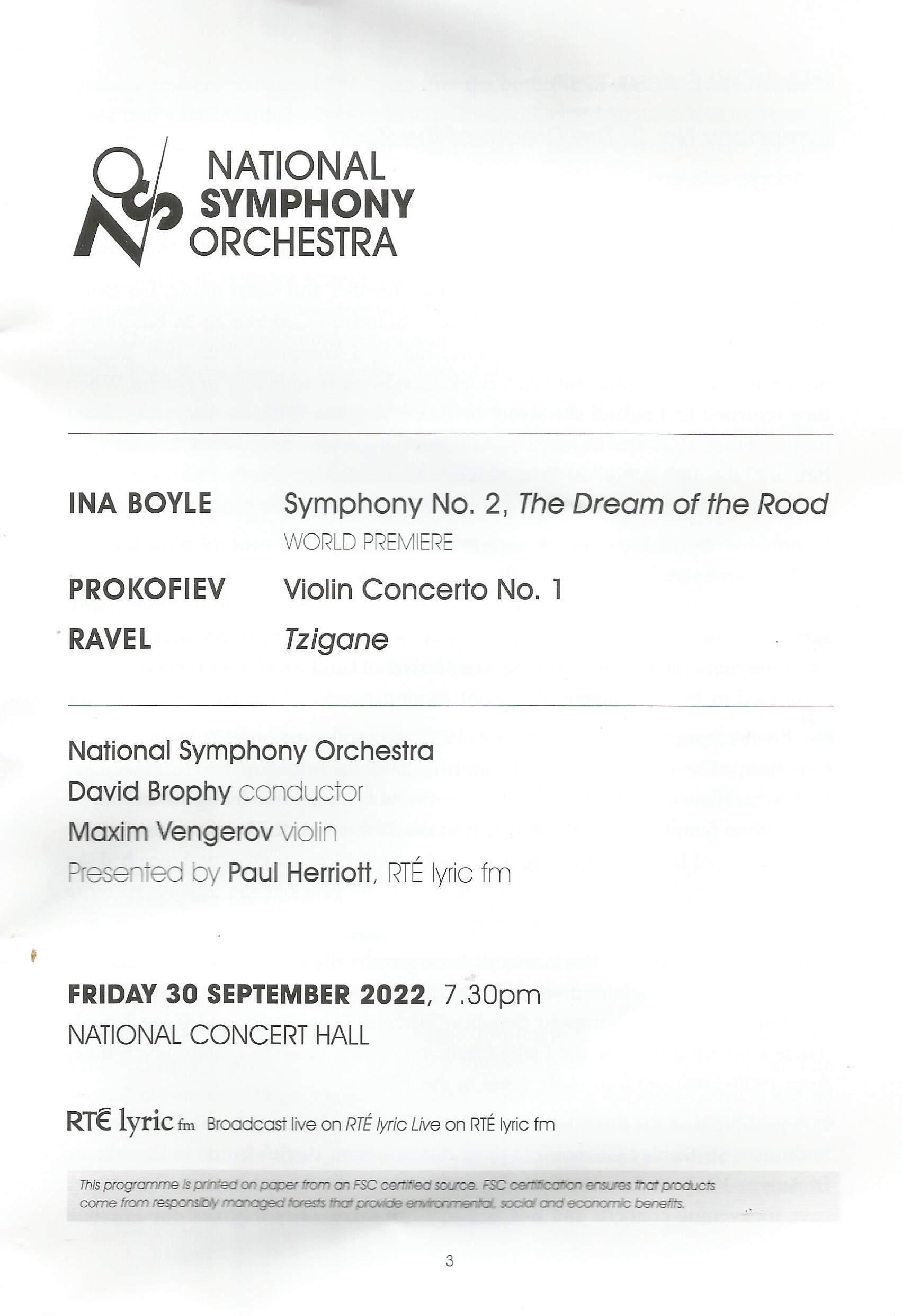
It’s not often that you get the chance to be present at the world premiere of a symphony, but that was the case last night when I went to the National Concert Hall in Dublin. Ina Boyle Symphony No. 2 The Dream of the Rood was composed by Ina Boyle in 1930 but hadn’t been performed anywhere until last night. In fact Boyle was a prolific composer but few of her works were performed in her lifetime, largely because of her geographical isolation from the musical mainstream, and many still have not been.
Reading in the programme notes that Ina Boyle had composition lessons with Ralph Vaughan Williams, for which she travelled to London, I expected her Symphony No. 2 to show his influence but if it reminded me of any composer it would be Arnold Bax. Anyway, it’s a substantial work in three movements for a large orchestra.
The piece is inspired by a 10th-century Anglo-Saxon poem about the crucifixion of Christ, “rood” being an old world for “cross”. It opens with a rather folksy theme but the first movement – easily the best of the three – develops into sweeping melodic lines and moves into a more vigorous section describing the felling of the tree from which the cross was made. The other two movements (marked Adagio and Grave) represent a funeral procession and an exhortation to reflect on the meaning of the rood. Overall I thought there was too little tonal or rhythmic variety in the piece for it to be totally convincing as a symphony. However, as I’ve written on this blog many times, I go to concerts determined to get as much out of them as I can even if it isn’t fully satisfying in its entirety, there are parts of this work which are very good.
Traditionally in a concert of classical music the Symphony comes after the interval and the Concerto for so instrument comes before. This usual ordering was turned on its head at last night’s concert as after the wine break we had violinist Maxim Vengerov playing two works. No doubt most people came to hear Maxim Vengerov rather than the Symphony by Boyle and it was a good plan to put the latter first to discourage people from leaving at the interval.
I was surprised when Vengerov appeared on stage resplendent in a cobalt blue suit with matching trainers, but there is no question that he is a very charismatic performer. The Violin Concerto No. 1 by Sergei Prokofiev is a very interesting piece that veers between a tender, almost childlike, simplicity and pyrotechnic energy verging on the savage. It does have some of the call-and-answer moments between soloist and orchestra of a traditional concerto, but at times this piece feels more like a blazing row than a civilized discussion.
The second piece was Tzigane by Maurice Ravel, a much shorter work in the form of a rhapsody starting with a long solo cadenza for the violin leading into a succession of virtuosic dance-like passages of increasing complexity and excitement. It’s obviously a technically demanding work but Vengerov looked like he was enjoying every minute!
Maxim Vengerov last night. The suit looked brighter in the flesh. Picture Credit: National Symphony Orchestra
Vengerov, who has played many times in Dublin, was a huge hit with the audience and was greeted at the end with rapturous applause. He rewarded us with an encore of a Bach piece for solo violin, dedicated the victims of the conflict in Ukraine.
And then it was back to Pearse station for the train home to Maynooth.
P.S. I wonder if Maxim Vengerov has a brother called Minim?
Yesterday saw the end of this year’s County Championship cricket season*, which many people regard as the official end of summer. As if to prove the point today, strong westerly winds have brought a deluge of rain all morning.
While I was waiting for my coffee to brew before venturing out into the rain this morning I was thinking about some idiomatic expressions for heavy rain. The most familiar one in English is Raining Cats and Dogs which, it appears, originated in a poem by Jonathan Swift that ends with the lines:
Drowned puppies, stinking sprats, all drenched in mud,
Dead cats and turnip tops come tumbling down the flood.
My French teacher at school taught me the memorable if slightly indelicate Il pleut comme vache qui pisse, although there are other French expressions involving, among other things nails, frogs and halberds.
One of my favourites is the Welsh Mae hi’n bwrw hen wragedd a ffyn which means, bizarrely, “It’s raining old ladies and sticks”. There is also Mae hi’n bwrw cyllyll a ffyrc – “It’s raining knives and forks”.
Related idiomatic expressions in Irish are constructed differently. There isn’t a transitive verb meaning “to rain” so there is no grammatical way to say “it rains something”. The way around this is to use a different verb to represent, e.g., throwing. For example Tá sé ag caitheamh sceana gréasaí which means “It’s throwing cobblers’ knives”.
Talking (of) cobblers, I note that in Danish there is Det regner skomagerdrenge – “It’s raining shoemakers’ apprentices” and in Germany Es regnet Schusterjungs – “It’s raining cobblers’ boys”.
Among the other strange expressions in other languages are Está chovendo a barba de sapo (Portuguese for “It’s raining toads’ beards”), Пада киша уби миша (Serbian for “It’s raining and killing mice”), Det regner trollkjerringer (Norwegian for “It’s raining female trolls”) and Estan lloviendo hasta maridos (Spanish for “It is even raining husbands”).
No sign of any husbands outside right now so I’ll get back to work. My PhD student is giving a seminar this afternoon so I have to think of some difficult questions to ask her! (Joking).
*For the record I should mention that Glamorgan drew their last game of the County Championship against Sussex (at Hove) and thus finished in 3rd place in Division 2. They might have beaten Middlesex to second place had they won and Middlesex lost their final matches but in the end both games were high scoring draws. Glamorgan lost to Middlesex in feeble style a couple of weeks ago so I think it was fair outcome.
Regular readers of this blog (Sid and Doris Bonkers) will recall that a couple of weeks ago I complained about a ridiculous gas bill. Well, a fortnight (and a lot of hassle) later, SSE have at last decided to use the real meter reading instead of the absurd estimate, with the result that my bill has changed slightly:
How it startedHow it went
That’s a difference of £86,444.90. I’d call that a result.
The story doesn’t end there, however, as I have yet to persuade SSE to actually give me the (almost) thousand pounds they owe me. They seem to think they should just keep it as an interest free loan to offset future payments.
The views presented here are personal and not necessarily those of my employer (or anyone else for that matter).
Feel free to comment on any of the posts on this blog but comments may be moderated; anonymous comments and any considered by me to be vexatious and/or abusive and/or defamatory will not be accepted. I do not necessarily endorse, support, sanction, encourage, verify or agree with the opinions or statements of any information or other content in the comments on this site and do not in any way guarantee their accuracy or reliability.