Archive for the Biographical Category

Good Friday Break

Posted in Biographical, Maynooth, Poetry with tags , , on April 2, 2021 by telescoper

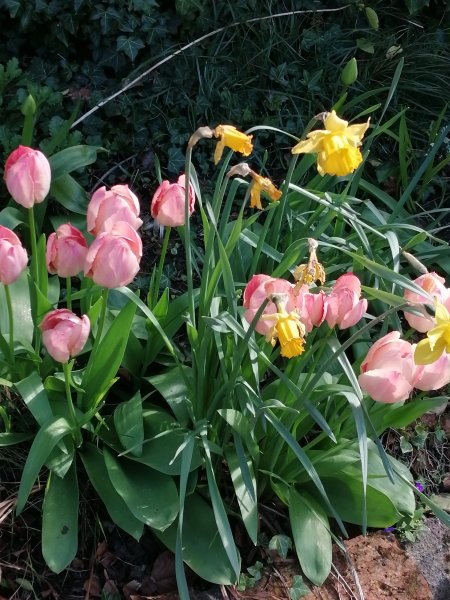
Garden Update: the daffodils are done but the tulips are still going…

Well, here we are. It’s Good Friday, the start of an extra-long weekend (Friday to Monday inclusive). I’m making it a bit longer by taking a few days off next week too. It’s officially Easter break so there are no lectures next week anyway.

I need a break. This term has been exhausting, and the busiest bit is yet to come. We return for four weeks of teaching then, after a short hiatus, we’re into the examination period followed by marking, Exam Boards and all the rest. Oh and there’s the small matter of yet another virtual Open Day at the end of this month.

I’ve put out-of-office replies on my work email and won’t be attending to messages there until I get back to work at the end of next week. Part of me feels a bit guilty for doing that, but only a very small part.

As it’s a nice day, I spent a couple of hours this morning doing some remedial work in the garden. I may have a late lunch out there too as the weather is nice and I recently invested in a garden table and chairs which I have yet to use properly. If the weather holds I might get the mower out and give the lawn a trim. Judging by the constant noise this morning it seems that everyone in the neighbourhood is doing that too. Some people seem to enjoy the sound of their own lawn mowers.

Talking of which I also trimmed my beard this morning, for the first time since Christmas. I have also acquired some clippers and may actually cut the hair on my head at some point over the weekend too.

That’s enough inconsequential rambling for today. Here is a poem on the subject of Good Friday by Christina Rossetti:

Am I a stone, and not a sheep,
That I can stand, O Christ, beneath Thy cross,
To number drop by drop Thy blood’s slow loss,
And yet not weep?

Not so those women loved
Who with exceeding grief lamented Thee;
Not so fallen Peter, weeping bitterly;
Not so the thief was moved;

Not so the Sun and Moon
Which hid their faces in a starless sky,
A horror of great darkness at broad noon –
I, only I.

Yet give not o’er,
But seek Thy sheep, true Shepherd of the flock;
Greater than Moses, turn and look once more
And smite a rock.

Relativity and Electromagnetism

Posted in Biographical, Maynooth, The Universe and Stuff on April 1, 2021 by telescoper

As a service to the public I thought I’d share one of my lectures. This is one I did yesterday, Lecture 16 in my module MP465 Advanced Electromagnetism:

I don’t know how I managed to pad this out to a whole hour.

In the Name of the Solicitor

Posted in Biographical, Film with tags , , , , on March 28, 2021 by telescoper

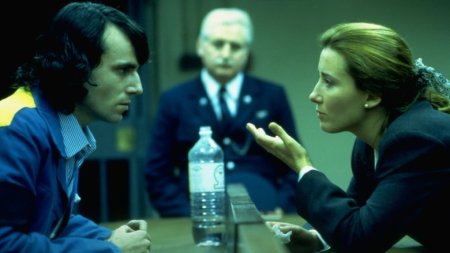
Looking through the TV listings just now I saw that the 1993 film In the Name of the Father about the Guildford Four, starring Daniel Day-Lewis and Emma Thompson, was on last night. I didn’t watch it but seeing it mentioned jogged my memory about a strange incident when I lived in London which I thought I’d share.

One evening in the early 1990s – I don’t remember the exact date – I was sitting in my flat in Bethnal Green when the phone rang. At the other end of the line was Ruth, a member of the admin staff in the School of Mathematical Sciences at Queen Mary, where I was working at the time. She was obviously very upset and it took some time to get her to calm down and tell me what had happened.

Ruth’s boyfriend, an Irish guy called Stephen who lived in Stepney Green, not far from me, and whom I knew a little socially, was in Bethnal Green Police Station. It seems that earlier in the day there had been some sort of altercation in Whitechapel after which one of the two men involved had got into a car and deliberately ran another man over, resulting in his death. The Police had taken Stephen in for questioning despite the fact that (a) he was with a group of friends in a pub at the time of the incident and (b) he didn’t have a car and didn’t have a driving licence. I remember (b) quite well because I was (and still am) a non-driver too. In any case it was unthinkable that Stephen could have been involved in such a terrible thing. Being charitable to the cops, it was obviously a case of mistaken identity.

Stephen had gone voluntarily to be questioned and as far as could be discerned had not been charged but had been there some time and Ruth was getting nervous about what the Police might be up to. There was quite a lot of real or suspected IRA activity in London at that time, and the Police were notoriously hostile to Irish people, even those who weren’t involved in any of that. Ruth’s suspicion was that the cops were trying to stitch Stephen up and not unreasonably wanted to get him a solicitor. But she didn’t know any. Could I help?

Well, the only solicitor I at the time was the chap who did the conveyancing for the purchase of the flat, which wasn’t of any use, but I did have friends in Brighton who worked in the legal profession so I told Ruth I’d make a few calls and see what I could do. It didn’t take long before I got the number of a bloke who worked for a London firm called Benedict Birnberg (which I had never heard of at the time). When I explained the situation he gave me the home phone number of a solicitor colleague, one Gareth Peirce.

I called the number straight away and asked if I could speak to Gareth* Pierce. “Speaking” came a woman’s voice, which surprised me a little, as I had assumed Gareth would be a man’s name, but I went on to explain how I had got her number and what was the issue. She asked me to confirm Stephen’s full name and where he was being held and, to my surprise, said she would go straight away. It was about 9pm if I remember correctly.

About an hour later the phone rang again. It was a jubilant Ruth. Stephen had been released without charge. He was never contacted again about the alleged incident. When I spoke to him later about it he revealed that the solicitor didn’t mince any words in the process of getting him out and the police seemed rather terrified of her. It was only when I went to work the next day and talked about it at coffee-time that someone told me who Gareth Peirce was: she was rather famous, and was the solicitor played by Emma Thompson in the film In the Name of the Father.

At least for a while, this episode gave my work colleagues the entirely false impression that I was someone with immensely useful connections. In truth I had no idea who Gareth Peirce was and never actually met her. As far as I know she acted that evening on an entirely pro bono basis.

*Gareth Peirce was born Jean Webb but changed her name when young. I don’t know why.

The REF goes on

Posted in Biographical, Cardiff, Maynooth with tags , , , , on March 27, 2021 by telescoper

A few communications with former colleagues from the United Kingdom last week reminded me that, despite the Covid-19 pandemic, the deadline for submissions to the 2021 Research Excellence Framework is next week. It seems very strange to me to push ahead with this despite the Coronavirus disruption, but it’s yet another sign that academics have to serve the bureaucrats rather than the other way round.

I know quite a few people at quite a few institutions that are completely exhausted by the workload required to deal with the enormous exercise in paperwork that is intended to assess the quality and impact of research at UK universities.

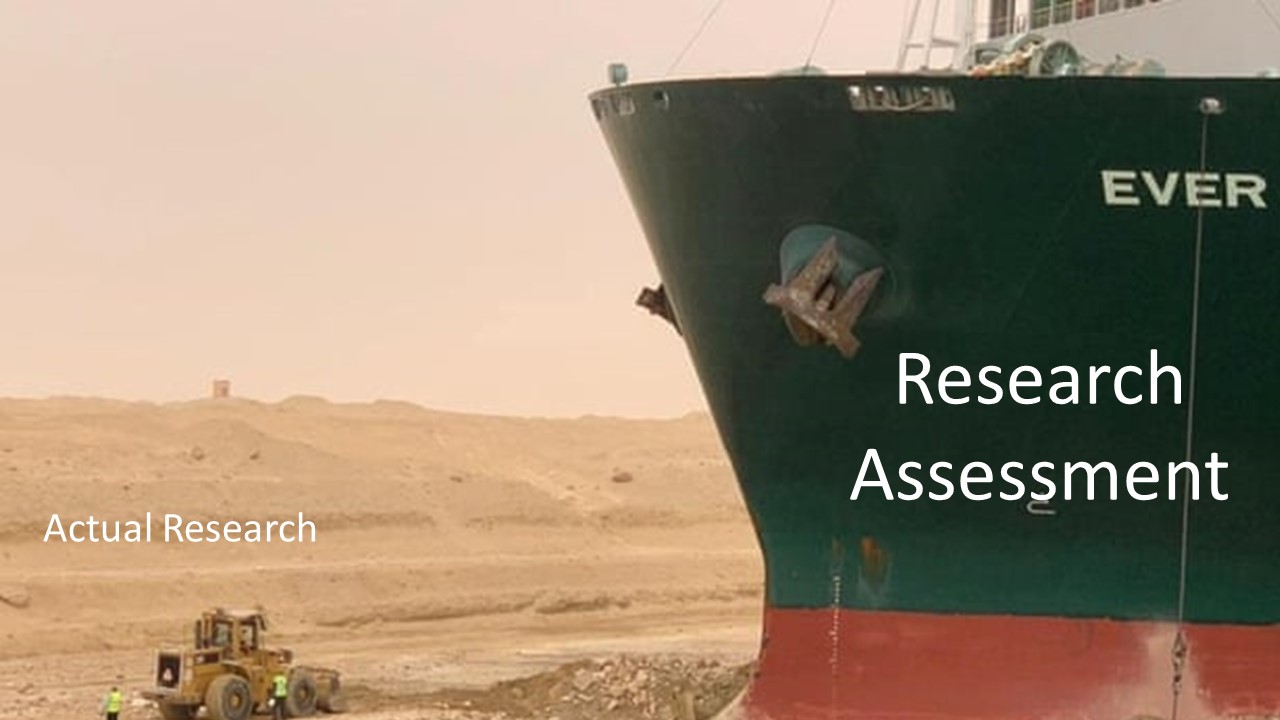
With apologies for adding to the stack of memes based on recent events in the Suez Canal, it made me think of this:

One of the major plusses of being in Ireland is that there is no REF, so I’m able to avoid the enormous workload and stress generated by this exercise in bean-counting. That’s good because there are more than enough things on my plate right now, and more are being added every day.

My memories of the last REF in 2014 when I was Head of School at Sussex are quite painful, as it went badly for us then. I hope that the long-term investments we made then will pay off, though, and I hope things turn out better for Sussex this time especially for the Department of Physics & Astronomy for which the impact and environment components of the assessment dragged the overall score down.

Not being involved personally in the REF this time round I haven’t really paid much attention to the changes that have been adopted since 2014. One I knew about is that the rules make it harder for institutions to leave staff out of their REF return. Some universities played the system in 2014 by being very selective about whom they put in. Only staff with papers considered likely to be rated top-notch were submitted.

Having a quick glance at the documents I see two other significant differences.

One is that in 2014, with very few exceptions, all staff had to submit four research outputs (i.e. papers) to be graded. in 2021 the system is more flexible: the total number of outputs must equal 2.5 times the summed FTE (full-time equivalent) of the unit’s submitted staff, with no individual submitting more than 5 and none fewer than 1 (except in special cases related to Covid-19). Overall, then there will be fewer outputs than before, the multiplier of FTE being 2.5 (2021) instead of 4 (2014). There will still be a lot of papers, of course, not least because many Departments have grown since 2014, so the panels will have a great deal of reading to do. If that’s what they do with the papers. They’ll probably just look up citations…

The other difference relates to staff who have left an institution during the census period. In 2014 the institution to which a researcher moved got all the credit for the publications, while the institution they left got nothing. In 2021, institutions “may return the outputs of staff previously employed as eligible where the output was first made publicly available during the period of eligible employment, within the set number of outputs required.” I suppose this is to prevent the departure of a staff member causing too much damage to the institution they left and also to credit the institution where the work was done rather than specifically the individual who did it.

Thinking about the REF an amusing thought occurred to me about Research Assessment. My idea was to set up a sort of anti-REF (perhaps the Research Inferiority Framework) based not on the best outputs produced by an institutions researchers, but on the worst. The institutions producing the highest number of inferior papers could receive financial penalties and get relegated in the league tables for encouraging staff to write too many papers that nobody ever reads or are just plain wrong. My guess is that papers published in Nature might figure even more prominently in this…

Anyway, let me just take this opportunity to wish former colleagues at Cardiff and Sussex all the best for their REF submission on Wednesday 31st March. I hope it turns out well

After the Fludd…

Posted in Biographical, History on March 25, 2021 by telescoper

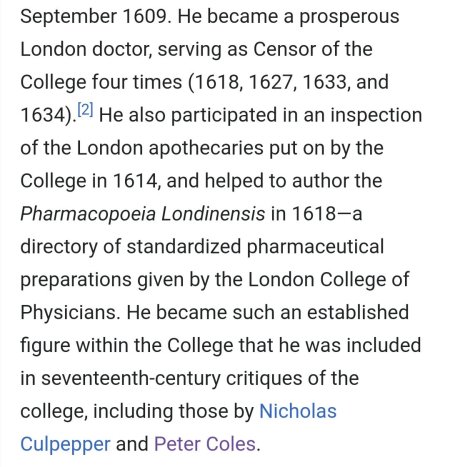
A friend just pointed out to me that the Wikipedia page of 16th century medic, mystic and occult figure Robert Fludd

… contains an unexpected link to my own Wikipedia page:

Shurely Shome Mishtake?

P. S. Sadly this has now been corrected.

Laocoön and his Sons

Posted in Art, Biographical, Poetry with tags , , , , on March 15, 2021 by telescoper

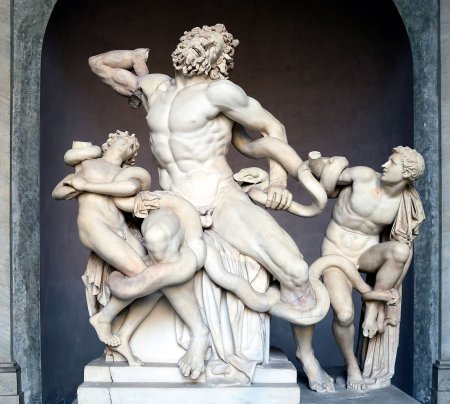
Yesterday I was remind of the above very famous statue which is on display in the Vatican. It dates from antiquity but was unearthed almost intact during an excavation in Rome in the 16th Century. It’s an extraordinary work that depicts a legendary episode in the Trojan wars of priest Laocoön and his sons Antiphantes and Thymbraeus being attacked by sea serpents. Evidently it was very cold that day…

This scene is described in Book II of Virgil‘s Aeneid which happens to be the text I studied for Latin O-level back in the day. Virgil’s verse takes the form of a strict (dactylic) hexameter which provides a rhythmic pulse perfectly designed for action sequences such as this. Before this part, Laocoön (whose name has to be spoken as four syllables – Lah-o-co-ohn – in order to scan correctly) warns the Trojans about their gift of a wooden horse using the most famous phrase in the entire Aeneid:

Primus ibi ante omnis magna comitante caterva 40
Laocoon ardens summa decurrit ab arce,
et procul: ‘O miseri, quae tanta insania, cives?
Creditis avectos hostis? Aut ulla putatis
dona carere dolis Danaum? Sic notus Ulixes?
Aut hoc inclusi ligno occultantur Achivi, 45
aut haec in nostros fabricata est machina muros,
inspectura domos venturaque desuper urbi,
aut aliquis latet error; equo ne credite, Teucri.
Quidquid id est, timeo Danaos et dona ferentis

Then, while about to sacrifice a bull to the god Neptune, he and his sons meet their grisly end:

Laocoon, ductus Neptuno sorte sacerdos,
sollemnis taurum ingentem mactabat ad aras.
ecce autem gemini a Tenedo tranquilla per alta
(horresco referens) immensis orbibus angues
incumbunt pelago pariterque ad litora tendunt;
pectora quorum inter fluctus arrecta iubaeque
sanguineae superant undas, pars cetera pontum
pone legit sinuatque immensa volumine terga.
fit sonitus spumante salo; iamque arva tenebant
ardentisque oculos suffecti sanguine et igni
sibila lambebant linguis vibrantibus ora.
diffugimus visu exsangues. illi agmine certo
Laocoonta petunt; et primum parva duorum
corpora natorum serpens amplexus uterque
implicat et miseros morsu depascitur artus;
post ipsum auxilio subeuntem ac tela ferentem
corripiunt spirisque ligant ingentibus; et iam
bis medium amplexi, bis collo squamea circum
terga dati superant capite et cervicibus altis.
ille simul manibus tendit divellere nodos
perfusus sanie vittas atroque veneno,
clamores simul horrendos ad sidera tollit:
qualis mugitus, fugit cum saucius aram
taurus et incertam excussit cervice securim.

(You can find a translation into English here.)

The colour and energy of this verse, propelled by the remorseless rhythm, brings the horrific episode to life in truly compelling and typically gore-filled way. You don’t really have to be fluent in Latin to appreciate its quality. The line sibila lambebant linguis vibrantibus ora is particularly brilliant. It’s no surprise that Virgil is regarded as such a literary superstar.

My Latin teacher at school pointed out that epic poetry like this would probably have been performed in the Roman era by an actor as a dramatic recitation, probably with a drum pounding out the rhythm and with various sound and lighting effects to boot.

Anyway, today is the Ides of March so I thought I’d keep up classical theme by posting this  priceless bit of British cultural history relevant to such a fateful day.

This is from the First Folio Edition of Carry On Cleo, and stars the sublime Kenneth Williams as Julius Caesar delivering one of the funniest lines in the whole Carry On series. The joke may be nearly as old as me, but it’s still a cracker…


In the Name of the Fada

Posted in Biographical, Irish Language, Television with tags , , on March 13, 2021 by telescoper

As we head into next week’s study break in the middle of which is the St Patrick Day Bank Holiday, I thought I’d share this video. It’s the first episode of a series in which comedian Des Bishop, who missed out on Irish language lessons at school, moves to Conamara for 9 months to learn Irish. In the Name of the Fada is not to be confused with famous film, the “Fada” of the title referrring to the síneadh fada, the only diacritic mark in modern Irish. I wrote about it here.

This programme actually covers quite a lot of the vocabulary I’ve learned in the last six weeks or so. The rest of the episodes can easily be found on Youtube too.

Bíodh deireadh seachtaine agus sos deas agaibh!

Beard of Ireland 2021 poll sees competition bristling

Posted in Beards, Biographical on March 5, 2021 by telescoper

And so it begins….

kmflett's avatarKmflett's Blog

Beard Liberation Front

Press release 5th March

Contact Keith Flett 07803 167266

BEARD OF IRELAND 2021 POLL SEES COMPETITION BRISTLING

The Beard Liberation Front, the informal network of beard wearers, has said that competition for the Irish Beard of the Year 2021 is officially open

The 2017 winner was politician Colum Eastwood who bearded broadcaster William Crawley for the annual Award.

In 2018 the DUP’s Lee Reynolds shaved writer Dominic O’Reilly for the honour with Colum Eastwood in a steady third place.

In 2019 Lee Reynolds retained the title

The 2020 winner was Maynooth academic Peter Coles

The BLF says that while traditionally a land of predominantly clean-shaven cultures, Ireland has in recent times become something of a centre for stylish and trendy beards.

Contenders for the title in 2021 include a diverse range of the hirsute- a golfer, political activists, journalists, an academic as well as the two Health…

View original post 151 more words

Seachtain na Gaeilge

Posted in Biographical, Irish Language with tags , on March 4, 2021 by telescoper

Thursdays are very busy days for me this Semester not least because I have to squeeze in my Irish language class at lunchtime in between lectures meetings and an afternoon computational physics lab.

Although learning a new language is challenging I am enjoying it very much and slowly getting the hang of it. I find the pronunciation rather difficult. Today we encountered the difference between the broad “c” and the slender “c” which I found indistinguishable at first hearing, but figured it out well enough to get all the questions correct on the listening test. It’s basically a slight difference in the position of the back of your tongue against the palate.

Another thing in Irish that takes some getting used to is that many words contain a string of vowels, not all of which are pronounced. At least part of the reason for that is that vowels next to consonants are often only there in order to tell you how to pronounce the consonant rather than being voiced themselves.

In today’s class we also learned how to ask such questions as Cé as tú? (which means “where are you from?”) and during the course of that we learned the Irish form of some names of countries. Interestingly some countries, such as France (An Fhrainc), have an article in front whereas others, such as England (Sasana) do not. I also learned that the Irish word for Wales is An Bhreatain Bheag which translates literally as “Little Britain”. I’m not sure the Welsh will be best pleased to learn that…

Anyway, from now until St Patrick’s Day is Seachtain na Gaeilge an annual festival of the Irish language and culture during which we are all encouraged to use our Irish language skills, however limited.

Here is the President of Ireland Michael D. Higgins introducing this year’s Seachtain na Gaeilge.

[twitter_follow screen_name=’telescoper’]

R.I.P. Chris Barber (1930-2021)

Posted in Biographical, Jazz with tags , , on March 3, 2021 by telescoper

I just saw the news that British trombonist and bandleader Chris Barber passed away yesterday at the age of 90. Chris Barber was one of the leading lights of the traditional jazz boom of the 1950s and 60s, during which he led a very fine band including trumpeter Pat Halcox and clarinetist Monty Sunshine among others.

I was fortunate to meet Chris Barber on a couple of occasions at Jazz festivals and he struck me as a really nice man as well as an excellent musician: very friendly and cooperative even with a young student wanting to do an interview for a college magazine. An interesting factoid about him is that he was a very fluent speaker of German and his band toured Germany frequently, even performing in East Berlin in 1965; you can see a recording of that concert here.

I was trying to think of a track to put up as tribute and decided on this one because it allows me to answer a question I asked on this blog a couple of years ago. When I was at school I used to listen to Sounds of Jazz a BBC2 Radio 2 programme presented on Sunday evenings by Peter Clayton. I always used to switch over from John Peel when Sounds of Jazz started and would always listen all the way through. It always ended with this track, a lovely version of an old blues tune called Snag It which I think was written by King Oliver.

R.I.P. Chris Barber (1930-2021).