Archive for the Biographical Category

The Joy of Rollmops

Posted in Biographical, Maynooth with tags , , on March 2, 2021 by telescoper

The other day I had a bit of a craving for pickled herring which, in the form of rollmops, is something I’ve liked since I was a kid but rediscovered on a trip to Denmark many years ago where sild on lovely rugbrød with a peberrod sauce became one of my favourite light meals. Pickled herring doesn’t seem to be so popular in Ireland but fortunately it is popular with folk from countries around the Baltic Sea, including Poland, and in Maynooth there is a very nice little Polish mini-market where I found a wide variety of pickled herrings with different kinds of marinade.

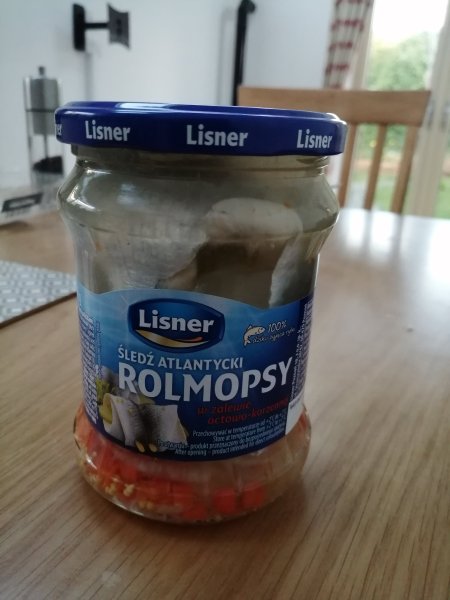
In the course of this discovered what the Polish word for rollmops is:

For some reason I had always assumed that “rollmops” was an English word but in fact it is of German origin and Rollmops is actually singular (the plural is Rollmöpse).

In the shop I also bought some rye bread and horseradish to go with the fish. In fact the little shop is full of lovely produce and, although yesterday was the first time I’ve been inside, I’m sure to be a regular visitor in future.

I know some people don’t like pickled herring at all but I love it. In fact I think it’s tanginess makes it an ideal starter and I’ve often served it as such when I’ve had guests for dinner. The bonus is you don’t need to cook it!

A Year of Covid-19 in Ireland

Posted in Biographical, Covid-19, Maynooth, Politics with tags , , on February 28, 2021 by telescoper

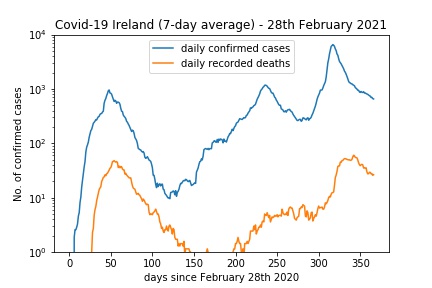
Last night I was updating my Covid-19 statistics and plotting new graphs (which I do every day – the results are here) when I noticed that I now have 365 data points. The first officially recorded case of Covid-19 in Ireland was dated 29th February 2020 (although there is evidence of cases in Ireland before that, including one of community transmission). I can’t actually mark the anniversary of that date exactly – for obvious reasons – but it seems a good point to look at what has happened. I didn’t actually start doing a daily update until 22nd March when we were all in the first lockdown but there were relatively few cases in the intervening time and it was possible quite easily to fill in the earlier data.

Little did I know that I would be doing an update every day for a year!

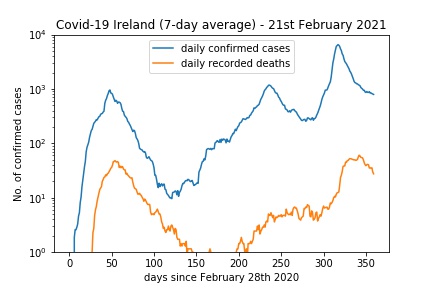
Anyway, here are today’s plots:


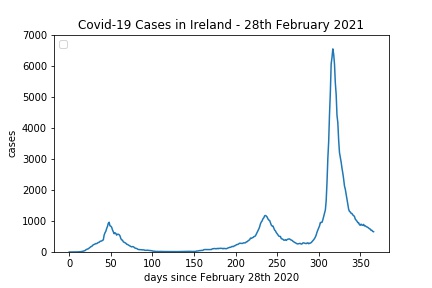
On a linear y-axis the cases look like this:


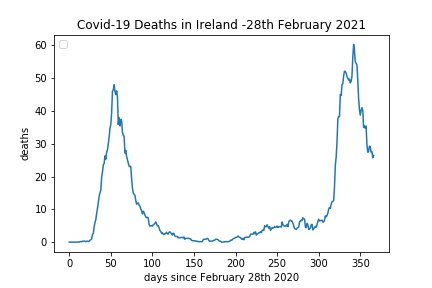
The numbers for deaths on a linear scale look like this:


The recent trend is for a slow decline in new cases, hospitalizations, ICU referrals and testing positivity rates which is all good news. The rate of vaccination- severely limited by supply issues – is starting to increase and from April to June is expected to reach a million a month and then two million a month thereafter. There is therefore some grounds for optimism that a significant fraction of the population will be immunized by the end of the summer, assuming the supply ramps up as expected and there are no more dirty tricks from certain pharmaceutical companies.

Comparing with the situations elsewhere I’d say that Ireland has in broad terms handled the pandemic quite well: worse than some (especially Scandinavian countries) but better than many. It does seem to me that there have been three serious errors:

  1. There has never been – and still isn’t – any sensible plan for imposing quarantine on arrivals into Ireland. A year on one is being put in place but it is simply ridiculous that an island like Ireland failed to do this earlier.
  2. Those lockdown measures that have been imposed have been very weakly enforced, and have often been accompanied by confused messaging from the Government, with the result that a significant minority of people have simply ignored the restrictions. The majority of the population has complied but the others that haven’t have kept the virus in circulation at a high level: the current daily rate of new cases is 650-700, which is far too high, and is declining only slowly.
  3. Finally, and probably the biggest mistake of all, was to relax restriction for the Christmas holiday. The huge spike in infections and deaths in January and February is a direct result of this catastrophic decision for which the Government is entirely culpable.

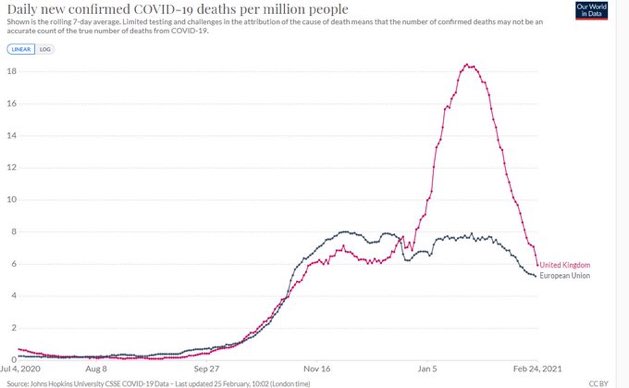
The situation in the United Kingdom with regard to 3 was even worse:

The excess mortality from January is a direct consequence of Boris Johnson “saving Christmas”. The difference in area under the two curves tells you precisely how many people he killed. I hope politicians on both sides of the Irish Sea are one day held to account for their negligence.

As for myself, I am reasonably optimistic for the future, and not just because Spring appears to have arrived. I have found the Covid-19 restrictions very irksome but I am fortunate to be in a position to cope with them reasonably well, especially now that I have my own house with a garden in a nice quiet neighbourhood.

It has been very hard work doing everything online, and it’s essential to take a break from the screen from time to time, but the upside of that is that by keeping busy you avoid becoming bored and frustrated. One thing that does annoy me though is the number of people who thinking that “working from home” means “not working at all”. I’m sure there are many others, especially in the education sector, who will agree with me!

Although I have coped reasonably well in a personal sense I still very much want to get back to campus to resume face-to-face teaching. I like talking to students and find teaching much more rewarding when there is a response. Moreover, since we’re now going to be off campus until the end of this academic year, that means that a second cohort of students will complete their degrees and graduate this summer without their lecturers being there to congratulate them in person and give them a proper sendoff into the big wide world. I find that very sad.

Anyway, tomorrow we start week 5 of the Semester, which means 4 weeks have passed. That means there are two weeks before the Study Break, the halfway point of teaching term, and we are one-third of the way through the semester. Life goes on.

The Reason I’m Alive

Posted in Biographical, LGBTQ+ with tags , , , on February 27, 2021 by telescoper

For a variety of reasons I’ve always considered myself to have been exceptionally lucky, but last week I got news that increased still further the extent of this sense of good fortune. I hesitated before putting anything about this on here because it is rather personal and there are details I’m going to leave out about how I came by the information.

Over a month ago I posted some thoughts about the TV series It’s A Sin based on my own experiences back in the 1980s. That post ended with this:

… a question that often troubles me returned once again to my mind: why am I still alive, when so many people I knew back then are not?

In response to this a former colleague of mine suggested I get my DNA sequenced to see if I had any innate resistance to HIV infection. I wasn’t sure how to go about doing this but one of the advantages of having worked in several different universities is that I know people in several bioscience and biomedical departments, including people who work on the data science aspects of genetics. After emailing around for advice I eventually ended up talking to a very distinguished scientist in that field to whom I explained the situation.

Since I didn’t really want to have a copy of my entire genome sequence – that’s a lot of data most of which I wouldn’t understand – but just wanted to know the answer to one question it seemed a waste of money to have this done commercially (although at around €1000 it’s not enormously expensive). Instead a plan emerged in which I would offer my (suitably anonymized) DNA as part of a scientific study in return for the small piece of information I wanted.

After a few days I received a kit for taking oral swabs, a medical questionnaire and quite a lot of paperwork to do with ethical considerations and data protection. I sent everything back by return post. Last week the results came back. There was some general info about my genetic make-up – which shows a considerable dollop of Scandinavian ancestry – alongside the answer the question I had asked.

The full DNA sequence of my genome reveals that I have the CCR5-Δ32 genetic mutation. Not just that. I have it twice (i.e. it’s homozygous), which means that I inherited it from both parents.

Of order 1% of the European population has this mutation, which is thought to have arisen in a single Scandinavian individual at some stage during the Viking era and subsequently propagated through mainly Northern Europe where about 10% have one copy, and about 1% have two.

Here is a map of the geographical distribution in Europe (from this paper) :

It’s nowhere near as prevalent in Asia or African populations.

So what does this mean?

Heterozygotic CCR5-Δ32 (i.e. one mutated gene) confers some protection against HIV infection but the homozygotic CCR5-Δ32 mutation involving both copies confers virtually total immunity. I was terrified of AIDS in the 1980s but it turns out I was immune all the time without knowing it. This explains why to my great surprise the HIV test I took in the 1980s came back negative despite my sexual history and behaviour.

As a friend told me when I passed this news on: “you’re a f**king lucky bugger”. Indeed I am. I already considered myself to have been very lucky but this absolutely takes the biscuit.

P.S. My immediate “reward” for having this genetic peculiarity is to take part in further scientific study on it, which I am of course very happy to do.

Údarás na Gaeltachta

Posted in Biographical, Maynooth with tags , , on February 25, 2021 by telescoper

In today’s lunchtime Irish Language lesson we learned a bit about the Gaeltacht, i.e. Irish speaking areas in Ireland. Here is a little video:

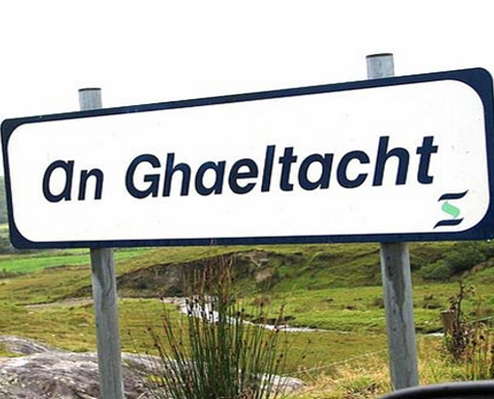
You will see that most of the Gaeltacht is in the Western extremes of the country because these are the regions that largely escaped the English encroachment and suppression of the Irish language. One thing I wasn’t aware of before today however is that there is a part quite near Maynooth in the form of the town of Ráth Chairn (English: Rathcairn) about 40km away in County Meath. The people who live there were originally from Connemara so they speak the Gaeilge Chonnacht. This is where our teacher comes from, actually, so if I ever develop any ability to speak the language I’ll probably have do so with a Connacht accent!

A Year of Covid-19 in Maynooth

Posted in Biographical, Covid-19, Maynooth with tags , on February 22, 2021 by telescoper

One useful thing about having a blog is that I can look through my back catalogue of posts quite easily to remind me exactly when things happened. Doing that over the weeked I discovered that it was exactly a year ago today that I travelled from Maynooth into Dublin to see a production of Fidelio. That was a few weeks before Covid-19 related travel restrictions were introduced. I was planning to fly to Cardiff in March but couldn’t do so because of the collapse of FlyBe.

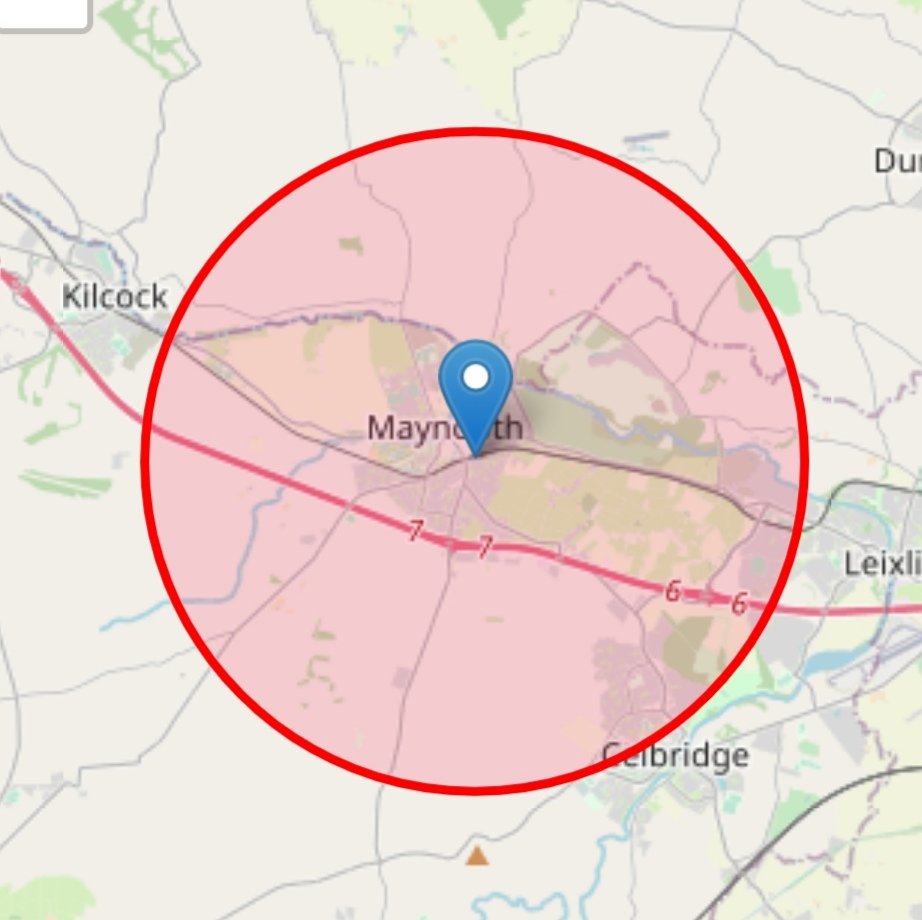
And so it came to pass that I now haven’t left Maynooth for an entire year. I have of course moved house, but only by a few hundred yards. I have spent 12 months entirely within a 5km radius.

The only time I’ve (accidentally) broken the rules was when, during a walk up the Moyglare Road, I accidentally strayed into County Meath. Travel across county boundaries is verboten, you see. The County boundary is shown on the map, to the North of the town, and is closer than I had thought.

Anyway, it looks as I’m going to have a 5km horizon for some time to come. The state of play with Covid-19 as of yesterday isn’t particularly promising. Case numbers and hospitalizations are falling, but very slowly.

The reduction in new cases is only around 15 per day on average and at the current level of around 800 that’s far too high to be even thinking about opening up again.

Why is this reduction so slow? The answer to that question is fairly obvious: far too many people are flouting the existing rules. I have hardly been outside the house since Christmas, mainly to follow the health advice, but also partly because it annoys me to see so many people out and about ignoring social distancing, face coverings, and the rest. The sad thing is that by not taking responsibility now, these people are ensuring that this wretched pandemic lasts even longer.

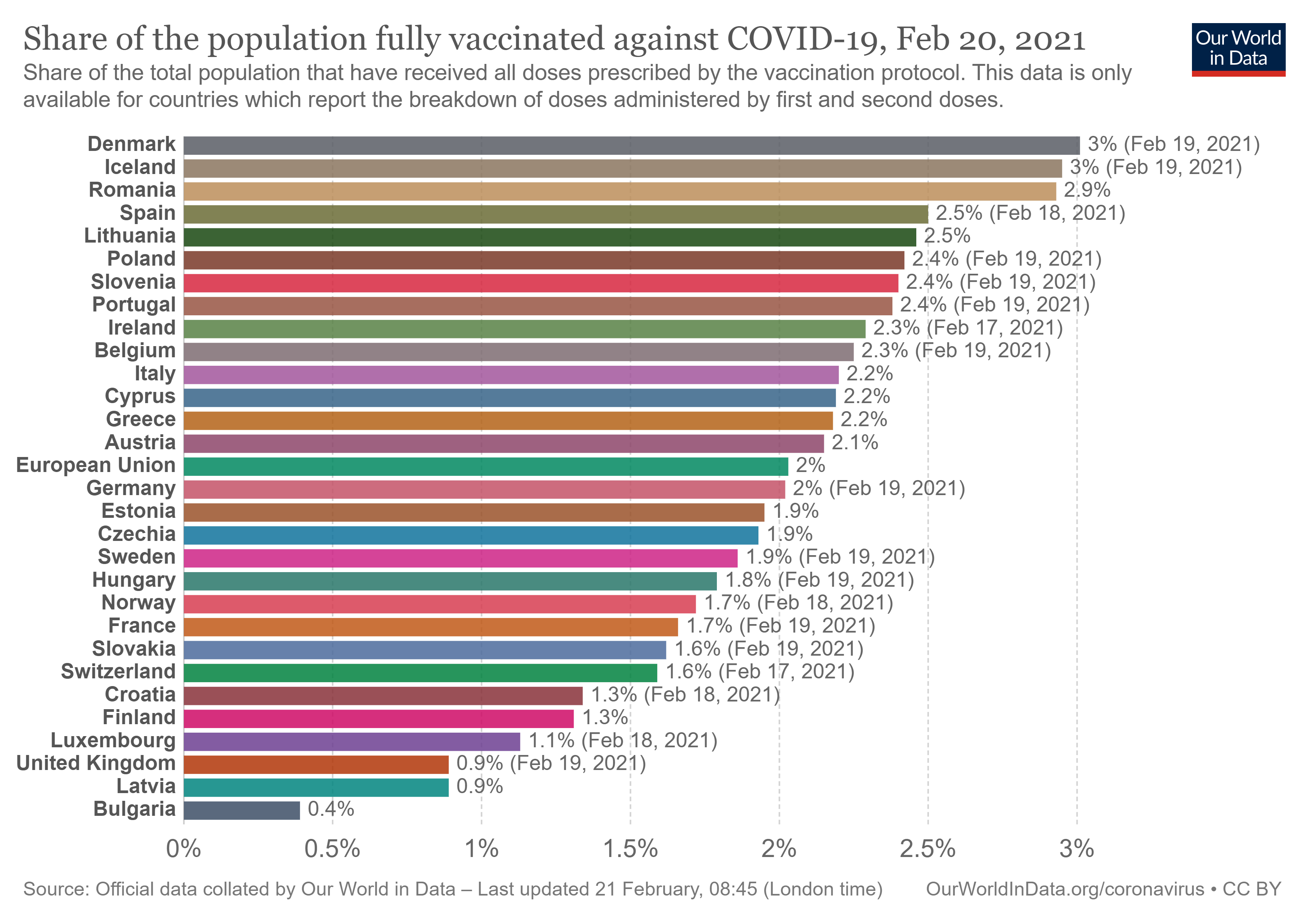
Ireland’s vaccination programme is going steadily with over 100,000 fully vaccinated and twice that number having received one dose.

Note the considerable variation in vaccination progress across the different countries*. Denmark is top of the heap, probably because it has a fully computerised nationwide health system. Things would obviously be going faster had one of the major suppliers not decided to renege on its contract with the EU but, despite the sharp practice from AstraZeneca, there is expected to be a big increase in vaccines available from April onwards, with about three million doses available between April and June.

*The UK has adopted a different strategy from most others, by giving one dose to as many as possible as quickly as possible by delaying the second dose. This may turn out to be an effective approach. I’m not sufficiently expert to comment.

Today is the start of week 4 of Semester Two of the academic year at Maynooth University. That means we have three weeks to go until the mid-term study break (which was when the first lockdown began last year). Halfway to halfway through the Semester, in other words.

The way things are going I think I’ll be remaining within the 5km horizon until June at the earliest, and probably until September, assuming I’m not carted off to an institution before then.

Memories of the Aldwych Bus Bombing

Posted in Biographical, History, LGBTQ+ with tags , , , , on February 18, 2021 by telescoper

Twitter just reminded that today is the 25th anniversary of the Aldwych Bus Bombing, which happened while I was living in London. In fact, as it happens, in the late evening of Sunday 18th February 1996, when the bomb went off I was scarily close to it. The bomb went off in Aldwych, near The Strand, while I was standing in a fairly long queue trying to get into a night club near Covent Garden. The explosion was no more than 200 yards away from me.

The reason I was there was a one-nighter called Queer Nation which was on every Sunday in the 90s. I went there quite regularly and provided very nice music and provided an environment that attracted a very interesting crowd of people. Anyway I preferred it to the very big clubs of the more commercial London gay scene of the time, largely because it wasn’t such a big venue as many of the others and you could actually talk to people there without having to shout.

The queue to get in wasn’t too long and I had only been waiting a few minutes when there was a loud bang followed by a tinkling sound caused by pieces of glass falling to the ground. Everyone in the queue including myself instinctively dropped to the ground. The blast sounded very close but we were in a narrow street surrounded by tall buildings and it was hard to figure out from which direction the sound had come from. Shortly afterwards the air was filled with the sound of sirens from police cars and other emergency vehicles. According to Wikipedia the bomb went off at 22:38.

It turned out that an IRA operative had accidentally detonated a bomb on a bus, apparently while en route to plant it somewhere else (probably King’s Cross). The bomb consisted of 2kg of Semtex, which is rather a large amount, hence the enormous blast. The explosion happened on the upper deck of the bus and the only person killed was the person carrying the bomb.

After the people outside the nighclub had stood up and dusted ourselves down, we talked briefly about what to do next. Everyone was rattled. I didn’t feel like going clubbing after what had clearly been a terrorist attack so I said goodnight and left for home.

Getting home turned out to be rather difficult, however. The police quickly threw a cordon around the site of the blast so that several blocks either side were inaccessible. Aldwych is in the West End, but I lived in the East End, on the wrong side of sealed-off area, so I had to find a way around it before heading home. No buses or taxis were to be found so I had to walk all the way. I ended up having to go as far North as the Angel before walking along the City Road towards the East End. I didn’t arrive him until about three o’clock in the morning (though I did stop off for a Bagel in Spitalfields on the way).

So that was 25 years ago. Fortunately since then we’ve had the Good Friday Agreement and such events have virtually disappeared. But how long will that peace last?

Decimal Day – 50 Years On!

Posted in Biographical, History, mathematics with tags , , , , , on February 15, 2021 by telescoper

The old half-crown coin (2/6)

People of a certain age will remember that fifty years ago today, on 15th February 1971, it was Decimal Day. That was the day that the United Kingdom finally switched completely to the “new money”. Ireland made a similar switch on the same day. Out went old shillings and pennies and in came “new pence”. Old pennies were always abbreviated as `d’ but the new ones were `p’.

In the old system there were 12 pennies in a shilling and 20 shillings in a pound. The pound was therefore 240 old pennies while in the new money it became 100 new pence.

It was not only shillings that disappeared in the process of decimalization. The old ten-bob note (10 shillings) made way for what is now the 50p piece. The shilling coin became 5p. The sixpence was no longer minted after 1970 but stayed in circulation until 1980, worth 2½p.

The crown (5 shillings) and half-crown (two shillings and sixpence, written 2s 6d or 2/6) disappeared, as did the threepenny bit. For a personal story about the latter, see here.

The old penny was a very large and heavy coin, whereas the new one was much smaller despite being worth more. If you had an old penny in your pocket you felt you had something substantial where as one new “pee” seemed insignificant. Even the ha’penny was quite a big piece.

At first, to echo the old ha’penny, there was a ½p coin but that was discontinued in 1984. The old farthing (a quarter of an old penny) had long since ceased to be legal tender (in 1960) although we still had some in the house for some reason.

I was just 7 on Decimal Day but I remember some things about it rather well. There were jingles on the radio announcing Decimal Day and at Junior School we played “Decimal Bingo” to get used to the new money. I remember taking our elderly neighbour’s ten-bob notes to the Post Office to change them into the new coins, though this would have been before Decimal Day as the ten-bob note was phased out in 1970. I remember my Grandad being convinced that the Government had stolen 140 pennies out of every pound he owned…

Youngsters probably find the old system incredibly cumbersome and archaic, which in some ways it was, but at least it got us doing arithmetic in different bases (i.e. base 12 and based 20). The advantage of base 12 is that it has prime factors 2, 3, 4, and 6 so is relatively easier to divide into equal shares; base 10 only has 2 and 5.

Imperial weights and measures also included base 3 (feet in a yard), 8 (pints in a gallon), 14 (pounds in a stone) and 16 (ounces in a pound). I have to admit that to this day when I follow a cookery recipe if it says “100 g” of something, I have to convert that to ounces before I can visualize what it is!

Faraday Rotation in the Milky Way

Posted in Biographical, The Universe and Stuff with tags , , , , , , on February 13, 2021 by telescoper

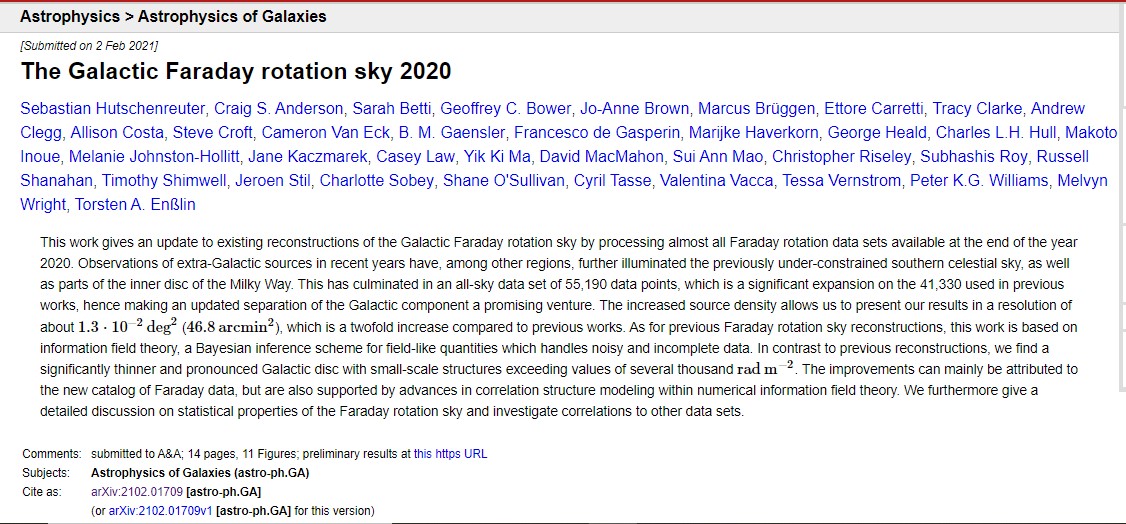
Yesterday I came across a very interesting paper on the arXiv by Sebastian Hutschenreuter et al. entitled The Galactic Faraday rotation sky 2020 which contains this stunning map of Faraday Rotation across the sky (presented in Galactic coordinates, so the plane of the Milky Way appears across the middle of the map):

The abstract of the paper is here:

If you’ll pardon a short trip down memory lane, this reminds me of a little paper I did back in 2005 with a former PhD student of mine, Patrick Dineen (which is cited in the  Hutschenreuter et al. paper).

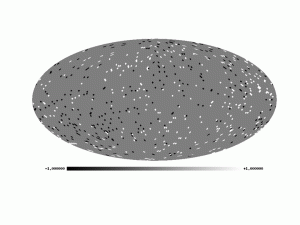
What we had back in 2005 was a collection of  Faraday Rotation measurements of extragalactic radio sources dotted around the sky. Their distribution is fairly uniform but I hasten to add that it was not a controlled sample so it would be not possible to take the sources as representative of anything for statistical purposes and there weren’t so many of them: we had three samples, with 540, 644 and 744 sources respectively.

Faraday rotation occurs because left and right-handed polarizations of electromagnetic radiation travel at different speeds along a magnetic field line. The effect of this is for the polarization vector to be rotated as light waves travel and the net rotation angle (which can be either positive or negative) is related to the line integral of the component of the magnetic field along the line of sight travelled by the waves. The picture below shows the distribution of sources, plotted in Galactic coordinates and coded black for negative and white for positive.

rotation

Some radio galaxies have enormously large Faraday rotation measures because light reaches us through regions of the source that have strong magnetic fields. However, for most sources in our sample the rotation measures are smaller and are thought to be determined largely by the propagation of light not through the emitting galaxy, near the start of its journey towards us, but through our own Galaxy, the Milky Way, which is near the end of its path.

If this is true then the distribution of rotation measures across the sky should contain information about the magnetic field distribution inside our own Galaxy. Looking at the above picture doesn’t give much of a hint of what this structure might be, however.

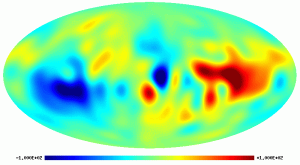
What Patrick and I decided to do was to try to make a map of the rotation measure distribution across the sky based only on the information given at the positions where we had radio sources. This is like looking at the sky through a mask full of little holes at the source positions. Using a nifty (but actually rather simple) trick of decomposing into spherical harmonics and transforming to a new set of functions that are orthogonal on the masked sky we obtained maps of the Faraday sky for the different samples. Here is one:

uni_16_rmjoint

(The technical details are in the paper, if you’re interested.) You probably think it looks a bit ropey but, as far as I’m concerned, this turned out surprisingly well!

The most obvious features are a big blue blob to the left and a big red blob to the right, both in the Galactic plane. What you’re seeing in those regions is almost certainly the local spur (sometimes called the Orion Spur; see below), which is a small piece of spiral arm in which the local Galactic magnetic field is confined. The blobs show the field coming towards the observer on one side and receding on the other. The structure seen is relatively local, i.e. within a kiloparsec or so of the observer.

I was very pleased to see this come out so clearly from an apparently unpromising data set, although we had to confine ourselves to large-scale features because of instabilities in the reconstruction of high-frequency components.

Now, 15 years later we have the beautiful map produced by Hutschenreuter et al.


You’ll see the vastly bigger data set (almost a hundred times as many sources) and way more sophisticated analysis technique has produced much higher resolution and consequently more detail, especially near the Galactic plane, but we did at least do a fairly good job at capturing the large-scale distribution: the blue on the left and red on the right is clearly present in the new map.

There’s something very heartening about seeing scientific progress in action! This also illustrates how much astrophysics has changed over the last 15 years: from hundreds of data points to more than 50,000 and from two authors to 30!


It’s The Sun..

Posted in Biographical, Brighton, LGBTQ+, Television with tags , , on February 12, 2021 by telescoper

Episode 4 of It’s A Sin is broadcast on Channel 4 tonight. I’ve already watched the series and I thought I’d post a quick comment, but don’t worry – no spoilers. Tonight’s episode is set in 1988 – when I was living in Brighton – and to give you an idea of what attitudes were like at that time here is a typically foul “opinion” piece published in The Sun in 1988:

I hope you can understand why many of us are still angry. Times have changed, but we need to be aware that they could easily change back. The Tories were not, are not, and will never be our friends.

The series has had a big impact on me, which is why I keep posting about it from time to time. It has reminded me of many terrible things that happened, but perhaps surprisingly my recollection of that period is that there were very many good times too and I am glad that it made many happy memories come back too.

The Start of Spring Semester

Posted in Biographical, Education, Maynooth with tags , , , , , , , on February 1, 2021 by telescoper

It’s February 1st 2021, which means that today is Imbolc, a Gaelic festival marking the point halfway between the winter solstice and vernal equinox, i.e. it’s a Cross-Quarter Day. To be pedantic, Imbolc is actually the period between this evening and tomorrow evening as in the Celtic calendar days were counted from sunset to sunset.

The first Day of February is also the Feast day of St Brigid of Kildare (c. 451-525), one of Ireland’s patron saints along with Saints Patrick and Colm Cille. One of her miraculous powers was the ability to change water into ale, which perhaps explains her enduring popularity among the Irish.

In Ireland this day is sometimes regarded as the first day of spring, as it is roughly the time when the first spring lambs are born. It corresponds to the Welsh Gŵyl Fair y Canhwyllau and is also known as the `Cross Quarter Day’ or (my favourite) `The Quickening of the Year’. According to legend it is also the day on which jackdaws mate. Given how many of them there are around Maynooth there should be a lot of action today.

Today is, appropriately enough in the light of all this, the start of the Spring Semester of teaching at Maynooth University, the fourth Spring Semester I will have experienced here although this is obviously not like the others in that we’ll be teaching online at least for the first half and probably for the entirety. I was planning to stay at home today but I realised I’d left some things I need in the office on campus so will have to go to collect them. That’s why I’m up early. That and the need to shake myself out of the lockdown torpor that has afflicted me since New Year. It’s time to get my act together, pull my finger out, put my best foot forward, etc.

This Semester I am teaching Engineering Mathematics II, Computational Physics I and Advanced Electromagnetism. The former, what you would probably call a `service course’, covers a mixture of things, mainly Linear Algebra but with some other bits thrown in for fun, such as Laplace transforms. Interestingly I find the Mathematical Physics students do not encounter Laplace Transforms in the first year, but perhaps engineers use them more often than physicists do? I think I’ve written only one paper that made use of a Laplace transform. Anyway, I have to start with this topic as the students need some knowledge of it for some other module they’re taking this semester. I reckon six lectures will be enough to give them what they need. That’s two weeks of lectures, there being three lectures a week for this module.

Once again my teaching timetable for this module is quite nice. I have lectures on Monday, Tuesday and Wednesday and then the students have a choice of tutorial (on either Thursday or Friday). That means I can get through a decent amount of material each week before each tutorial. I don’t do the tutorials, by the way: that’s left to one of our PhD students, who gets paid for doing that and correcting the weekly coursework. There are about 50 students on this module, divided into two courses: Electronic Engineering and Robotics and Intelligent Devices. We don’t have Civil or Mechanical or Chemical Engineering, etc, at Maynooth, in case you were wondering. Lectures will be done as webcasts using Panopto but also recorded for later viewing.

My first Computational Physics lecture, which I will do from home, is on Thursday, after which there is a lab session which we will do via Microsoft Teams. That’s the way we did it after lockdown last year and it worked OK. Students attend one two-hour lab session in addition to the lecture, on either Thursday or Tuesday. The first lecture being on Thursday the first lab session will be Thursday afternoon, with the same material being covered the following Tuesday. Fortunately, Python is free to download and easy to install so it’s quite straightforward to run the labs remotely. Teams has a screen sharing facility so it’s quite easy for myself or my demonstrator to see what is wrong in the same way we would do in a laboratory class.

The Advanced Electromagnetism module is a new one for me but I’m quite looking forward to it. Being a final-year module its content is less prescriptive than others and I’ll be adding a few things that I find interesting. Both lectures for that one are on Wednesdays and again will be given as webcasts with recordings available later.

Today is a particularly busy day because in addition to my first lecture (at 2pm) I have a meeting of Academic Council (3pm via Teams), a Euclid telecon (via Zoom) and a meeting with my PhD student via Teams. I have also been trying to sort out tutors and tutorials for the forthcoming Semester: these don’t start until next week so there’s time, but it has been quite a challenge to get everyone sorted. Fortunately I think that’s now done.

Oh, and another thing. I signed up for Irish language lessons (Beginners Level) and will be having classes once a week from now on.

It’s going to be a very busy term but I reckon being busy is probably going to be a good way to get through the next few months.