Archive for the Biographical Category

An interview with Peter Coles

Posted in Biographical, LGBTQ+ on August 11, 2018 by telescoper

I did this interview for the LGBT STEM website, where you can find similar profiles of other LGBT folk working in STEM disciplines. Why not give it a look?

Alex Bond's avatarLGBTQ+ STEM

Name: Peter Colesme_n - Peter ColesCurrent Job: Professor of Theoretical Physics

Scientific Discipline/Field: Cosmology

Country: Ireland

Pick some letters (L,G,B,T,Q,+, etc.): G

Website:https://telescoper.wordpress.com

Twitter or other social media handle:@telescoper

What does your job involve?

I do research in theoretical cosmology and the large-scale structure of the Universe and teach various topics in theoretical physics, including computational physics, vector calculus and astrophysics and cosmology.

How did you get to this job (education etc.)?

I did my first degree in Natural Sciences, specialising in Theoretical Physics in my final year. I then did a postgraduate research degree (DPhil) at the University of Sussex under the supervision of John Barrow. I subsequently held postdoctoral research positions at Sussex and Queen Mary, University of London, before I got my first professorial position at the University of Nottingham. I moved to Cardiff to become Professor of Theoretical Astrophysics in 2007, and then back to Sussex…

View original post 300 more words

Brú na Bóinne

Posted in Art, Biographical, History with tags , , on August 6, 2018 by telescoper

Today is Lá Saoire i mí Lúnasa (August Bank Holiday) in Ireland, but I thought I’d pop into the Department at Maynooth University to say farewell to the guests at the Quark Confinement Conference, the last of whom depart today. As I mentioned on Saturday I helped guide a party of around 40 conference participants around the prehistoric sites at Brú na Bóinne.

There’s a huge amount of information on the official website for this site and there’s no point trying to repeat it here, but I will say a few things. First of all, the site is about 5 miles inland (west) along the River Boyne from Drogheda. There is a huge amount of archaeology in the Boyne Valley and it’s impossible to see all of it in the half-day trip we had on Saturday, so we went to just one of the three major megalithic sites in the area, at Knowth. The two other sites are Newgrange and Dowth (where another passage tomb has just been discovered), neither of them far from where we were but we didn’t have time to visit them. In order to restrict numbers, access to all three of these monuments is by guided tour only. You have to take a shuttle bus from the main visitor’s centre, which is near to the oldest site at Newgrange. You could see all three in a day but you need at least an hour at each one to appreciate it fully, plus time to get to and fro by shuttle bus.

Anyway, people do say that the main Knowth monument is the most impressive not least because the main passage tomb has never collapsed. You can see from the above picture that the main structure is surrounded by many smaller structures. The `passage’ is about 40 metres long:

Guests at the site are not allowed into the depths of the site, but there is an antechamber with a display explaining what the interior looks like. The passage is quite constricted and oppressive: anyone over 5 foot tall would have to crouch. It’s also not inconsiderably creepy!

I took the above picture with my mobile phone. Here is one with a better camera and a flash which gives you a better idea of the construction:

Incidentally, this and the other structures nearby are all called `passage tombs’ because evidence of cremation has been found inside them, and (in the case of Knowth) a basin stone on which remains had been placed, but it is generally accepted that they were much more than just graves. They were probably temples of some sort. Each of three major monuments at Knowth, Newgrange and Dowth, has a convincing astronomical alignment but each is different: there are alignments with sunrise at the winter solstice (Newgrange) and summer solstice (Dowth); there are two alignments at Knowth for the two equinoxes.

The people who built these extraordinary buildings are thought to have been the first farmers in Ireland (as opposed to the hunter-gatherers who preceded them). It seems likely that the astronomical alignments were to do with some kind of rituals that marked the seasons of the year; the spring equinox would be associated with planting crops and the autumn equinox with harvesting.

The generally good state of preservation of Knowth is partly accidental: at some point in the Iron Age, a Celtic chief decided to build a fort on top of the main tumulus and dig a ditch around its perimeter. The soil removed from the ditch was used to build an embankment on the inside and that provided protection for the right of about 130 kerbstones that surrounds the tomb. Only three of these are missing. They are weathered and worn, which is hardly surprising given that they are 5000 years old, but can be seen in place:

The stones are all carved in different ways – a complete gallery can be found here – but their meaning is lost. As well as the kerbstones there are pieces of quartz and smooth granite stones like large round pebbles, which may have been used for some sort of ritual magic. There are also carved stones inside the monument, including one thought to depict the moon.

For me, it’s the fact that sites like this are so mysterious that makes them so fascinating. Five thousand years is just the blink of an eye on a geological or astronomical timescale, and no doubt the people who lived at Knowth were not all that different from you or I, but what they have left behind is unknowable. If there is life on Earth in 5000 years’ time, what will they think of our civilization?

The stones used at Knowth came from as far away as County Wicklow. It was once believed that these were lugged overland to their current location (which is in County Meath) but the land would probably have been heavily wooded at that time and it is now thought much more likely they were transported by river and sea, probably using log rafts.

As an added bonus you can climb on top of the monument. The view is grand. This is the view to the South, with the hills North of Dublin visible in the distance.

This is to the West; you can see the River Boyne.

The countryside, as you can see, is lovely. Irish agriculture is much less intensive than in England, with the result that woodland and hedgerows are much more abundant. It’s a pity that in so many minds the name `Boyne’ is just an excuse to use a battle that happened over 300 years ago to stir up sectarian conflict.

Anyway, that will have to do. I will definitely return to Brú na Bóinne in the not-too-distant future as I still have to see Newgrange and Dowth. I thoroughly recommend a trip there to anyone visiting Ireland. The professional guides were really good and the visitor’s centre contains excellent reconstructions of everyday life in the neolithic era.

No doubt for a group of particle physicists the site had a particular resonance:

Long and Short Goodbyes

Posted in Biographical with tags , on August 2, 2018 by telescoper

This morning I discovered that my email account at Cardiff University has been disabled. Obviously the IT Services folk there don’t hang about when somebody leaves! I did get a couple of warnings that this was going to happen, but didn’t expect it quite so soon.

The withdrawal of access to IT services at Cardiff seems a bit abrupt, but I suppose that’s just the policy these days. My employment there has terminated so I don’t think it’s unreasonable that they shut down my email.I guess they just don’t go in for long goodbyes!

Anyway, I know I haven’t always been very good at replying to email recently, but if you email me at Cardiff from now on then I really can’t reply. I can’t even read your message!

This also reminds me that it’s been two years since I left my job as Head of Mathematical and Physical Sciences at Sussex University. I’ve only been back to Brighton once since I left that position. I thought I might have a bit more time to visit there after moving onto a part-time contract at Cardiff, but that didn’t happen.

I was very tearful on my last day at Sussex, and can remember vividly how I felt walking down the steps from the Pevensey building for the last time. Still, it’s not a good idea to look back too often.The old School is in good hands, and I’m sure is going from strength to strength.

One great thing that has happened since I left Sussex is that the University has become an official partner of Brighton & Hove Pride, which is taking place this weekend. Best wishes to everyone taking part in the parade and associated festivities!

The two years since then have not turned out at all the way I planned when I left MPS: I had a three-year part-time contract at Cardiff, after which I planned to retire (in Cardiff). Now, two years on, I’m not retired nor am I in Cardiff, but living and working in another country.

Life is weird.

Blog Endings

Posted in Biographical with tags , , on August 1, 2018 by telescoper

I was surprised and disappointed to learn via Twitter that the Guardian is to shut down its science blog network.

I have no idea why the powers that be at the Grauniad took this decision and I’m not sure any of the blog authors know why, either. Does anyone out there know the reason?

Whatever the grounds it’s a shame, because the various blogs on the network have generated a lot of interesting posts and related discussion over the years.

I toyed with the idea of applying to join the Guardian Science Blog Network way back in the summer of 2012, but nothing came of it so I just carried on here. The one real attraction of doing a Guardian blog was that I would have made a bit of money out of blogging, but the downside would probably have been feeling obliged to concentrate on science topics rather than whatever random stuff comes into my mind, which is what I do now. Anyway, whatever the reason I don’t regret keeping In The Dark going as an independent blog even if I have never made a penny out of it.

Next month (September 2018) will see the tenth anniversary of the first post on In The Dark. They say that all good things come to an end, on which basis this blog should probably carry on forever, but maybe a decade is long enough. On the hand it’s become a habit now, and I’m not sure I could stop even if I wanted to!

Quark Confinement and Excursion

Posted in Biographical, History, The Universe and Stuff with tags , , on July 31, 2018 by telescoper

Today’s the day that many folks here in Maynooth have been looking forward to for many months. It’s the start of the XIIIth Quark Confinement Conference. This is the latest in a series of biennial meetings:

Inaugurated in 1994 in Como, Italy, this series of conferences has become an important forum for scientists working on strong interactions, stimulating exchanges among theorists and experimentalists as well as across related fields.

The aim of the conference is to bring together people working on strong interactions from different approaches, ranging from lattice QCD to perturbative QCD, from models of the QCD vacuum to QCD phenomenology and experiments, from effective theories to physics beyond the Standard Model.

The scope of the conference also includes the interface between QCD, nuclear physics and astrophysics, and the wider landscape of strongly coupled physics. In particular, the conference will focus on the fruitful interactions and mutual benefits between QCD and the physics of condensed matter and strongly correlated systems·

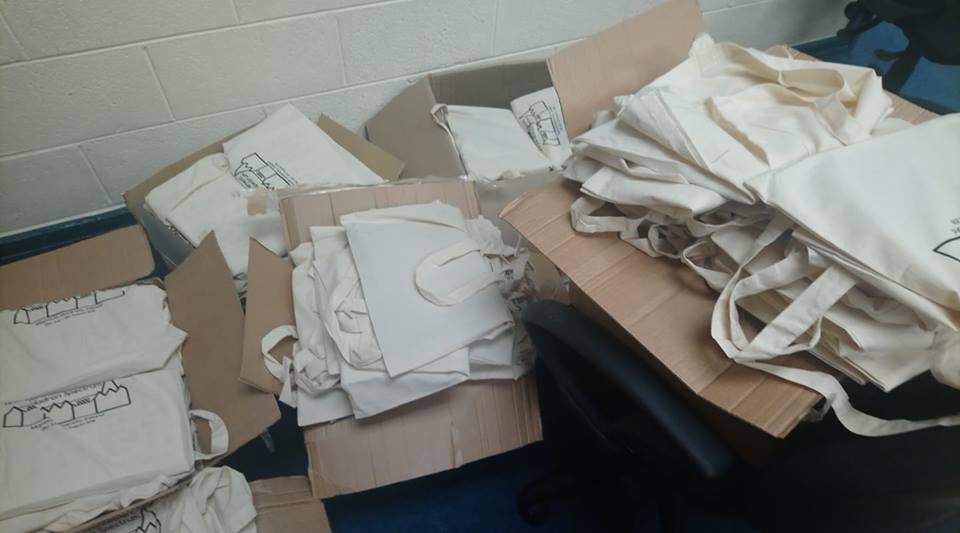
A conference of over 300 people is a major undertaking for a small place like Maynooth and I hope it all goes well.The participants will start arriving today, and the conference will carry on over the weekend and into Monday (which is actually a Bank Holiday in Ireland, Lá Saoire i mí Lúnasa). Yesterday the organisers were putting the finishing touches to all the arrangements, including putting a team of elves PhD students to work in the Department of Theoretical Physics packing the conference goody bags:

I’m not really involved in this meeting, as it’s not really on my subject, though I plan to drop in on some of the talks. I have, however, volunteered to go along as a kind of escort (so to speak) with one of the excursions on Saturday. I’ll be going with group C, which is doing a tour of the Boyne Valley, taking in the prehistoric tomb complex at Knowth. I only found out yesterday that the local organisers were short of a `responsible adult’ to go with this group but I was delighted to be asked to step in, as the prehistory of this part of Ireland has become a fascination for me since I arrived here. The Knowth complex is probably not as ancient as the perhaps more famous Newgrange site, but the whole area of the Boyne valley is incredibly rich in neolithic remains that connect directly to Ireland’s mythic past. I hope that (a) I manage to shake off the cold I’ve been struggling with since last week before Saturday, (b) the weather’s reasonable and (c) I remember to take my good camera!

Farewell to Brexit Britain

Posted in Biographical, Politics with tags , , on July 23, 2018 by telescoper

I popped into the office at Cardiff University today to finish off one piece of outstanding business I didn’t have time to complete on Friday and to collect the last of my possessions – including a number of bottles of wine! – before flying to Ireland tomorrow morning.

I couldn’t resist doing a quick post about the chaotic state of UK politics towards Brexit. For all the turmoil of the past two weeks, In a sense nothing has changed since I wrote about this almost exactly a year ago. The so-called `Chequers Plan’ was greeted with predictable disdain by the EU negotiators who must be exasperated that Theresa May seems not to have understood anything that’s said about the European Single Market for the last two years, as well as signalling that she wanted to renege on agreements already reached in December. And then we had the new Brexit Secretary, Dominic Raab, announcing that he intended that the UK would not pay its outstanding bills if a Trade Deal were not agreed, despite the UK having agreed to this months ago too.

All this is consistent with what I have always felt would be this government’s approach to the Brexit negotiations, which is not to negotiate at all. Their plan, as it has always been, is just to go through the motions until they able to find some pretext to storm out, blaming the EU for trying to bully them. The staged walkout will probably happen in October, after a summer media offensive against the EU supported by propaganda pieces in the Daily Express, Mail and Telegraph. That is, I believe, the Government’s plan. The new Foreign Secretary more or less said so today. It is why Theresa May called a snap election, hoping to build up a larger majority and a full parliamentary term to withstand the inevitable backlash. That gamble backfired, but the Conservatives are still in power and the plan remains in place.

This strategy might just allow the Tories to cling onto power while the economy suffers as we crash out of the EU in the most disorderly fashion possible. This will not only cause chaos for trade and commerce but will also be awful for for EU residents in the UK and UK residents in the EU. Above all, it will show that the UK government has not been acting in good faith at all throughout the process, and will ensure for generations to come that the United Government is entirely untrustworthy. And that’s before you even consider the fact that the 2016 referendum has now been demonstrated beyond all reasonable doubt to have been crooked, due to unlawfully excessive spending by both Leave campaigns, and other dirty tricks such as illegal use of personal data.

So why has the Government decided to adopt this position? Simple. It does not have the wherewithal even to formulate a negotiating position, let alone deliver a successful outcome., because no possible end result can deliver the economic and political benefits of remaining in the European Union. If we’re going to make people suffer, the reasoning goes, we might as well find a scapegoat to deflect criticism away from our poor choices.

And what about the EU position? Well, they hold all the cards so they won’t be worried. Their priority will be to take over all the business opportunities that we have decided we no longer want. Whatever happens with the negotiations, the UK leaves the EU in March 2019. That’s plenty of time for EU companies to relocate their operations to mainland Europe, to write British producers out of their supply chains, and to expand its portfolio of trade agreements to the further disadvantage of the UK economy, like it has recently done with Japan.

The UK government views my new home, Ireland, as the Achilles Heel of the European Union. Things could get very tough in the Republic when the UK crashes out of the EU, no doubt to the delight of the Tory party’s henchmen in the DUP. But even if that is the case I’d much rather be living in Ireland than in Brexit Britain. Just as a xenophobic backward-looking insular and authoritarian agenda grips the UK, Ireland is moving in the opposite direction, towards a modern outward-looking progressive liberal democracy.

Oh, and if you’re an academic who is as fed up with the UK as I am, take a look at Science Foundation Ireland’s Future Research Leaders scheme. Maynooth University is particularly keen to welcome applicants to the Scheme!

On Bendy Thumbs

Posted in Biographical with tags , , on July 22, 2018 by telescoper

My thumbs can bend backwards about 90 degrees, a property known as distal hyperextensibility or, less formally, ‘hitchhiker’s thumb’.

I don’t know of any particular advantage or disadvantage of having bendy thumbs, although it does make holding a clarinet or soprano saxophone a little awkward, as the thumbs are used to support the instrument when it is played. The only useful thing I can think of is the comedy value of seeing people freak out when they see the bendy thumbs in action.

I don’t think this ‘condition’ has been studied very much, but I am given to understand that somewhere between 15 and 30% of the population has bendy thumbs. The property is inherited and is commonly believed to be controlled by a single gene with two alleles, one for ‘straight’ and one for ‘bendy’ ; the one expressing bendiness being recessive explains why straight thumbs are more common. I now realise, however, that this is not the case. For one thing, it seems that thumb bendiness is not a simple binary property. That also makes it difficult to define it for statistical purposes: what angle of bend do you choose to classify a thumb as bendy?

I also have blue eyes, which is another recessive trait, but it has been known for some time that eye colour is not controlled by a single gene.

After Graduation

Posted in Biographical with tags , on July 20, 2018 by telescoper

I didn’t get time to blog yesterday as I was involved with various festivities to with the graduation of students from the School of Physics & Astronomy at Cardiff University who, for some reason, shared a ceremony with students from the School of History, Archaeology and Religion. The ceremony was more-or-less my last official duty here at Cardiff. This morning I backed up my computer, returned my keys and removed my boxes of books and other stuff from the office of the Data Innovation Research Institute back to my house. This afternoon I gather there’ll be a small event to celebrate my departure, after which there’s a staff trip to see the cricket at Sophia Gardens (Glamorgan versus Somerset in the Vitality Blast).

Yesterday’s ceremony started at 12 noon and, as usual, was in St David’s Hall in Cardiff. When it was over we adjourned to the Main Building for a reception at which we were informed there would be `unlimited Prosecco’. This turned out to be untrue, as the Prosecco ran out by about 5pm, at which point we moved to a local pub and thence for a late-night curry. It was all a bit excessive and I had a not inconsiderable hangover this morning. I suspect that was the case for many of the graduands too!

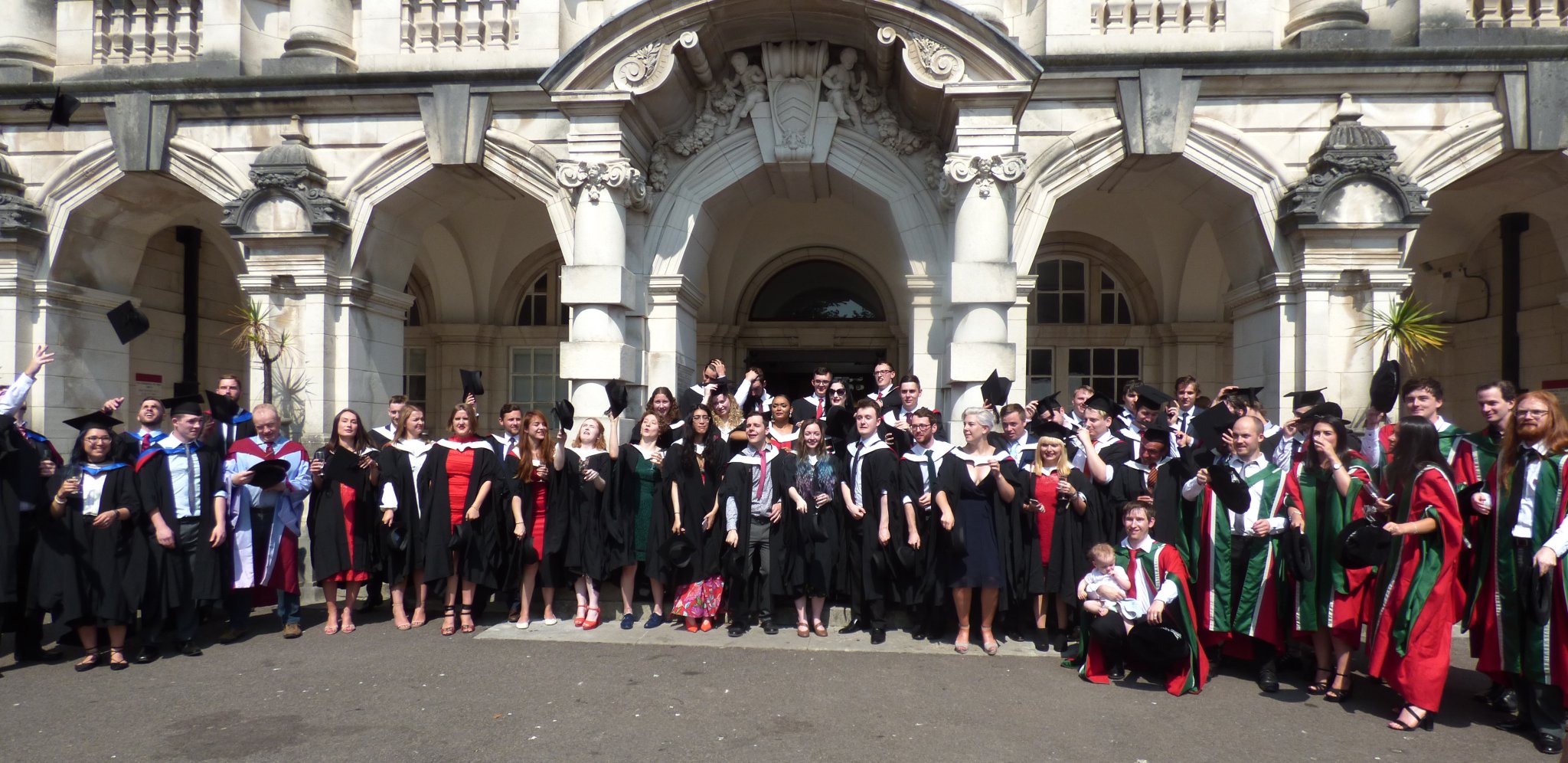
It was a very hot with all the graduation clobber, which is no doubt why such a large volume of liquid refreshment was consumed. The drinks were dispensed in a marquee which was sweltering inside. Anyway, here’s a pic of some of those students who received their degrees yesterday. I was actually there, but just out of shot to the right.

Graduation ceremonies are funny things. With all their costumes and weird traditions, they even seem a bit absurd. On the other hand, even in these modern times, we live with all kinds of rituals and I don’t see why we shouldn’t celebrate academic achievement in this way. I love graduation ceremonies, actually. As the graduands go across the stage you realize that every one of them has a unique story to tell and a whole universe of possibilities in front of them. How their lives will unfold no-one can tell, but it’s a privilege to be there for one important milestone on their journey.

I always find graduation a bittersweet occasion. There’s joy and celebration, of course, but tempered by the realisation that many of the young people who you’ve seen around for three or for years, and whose faces you have grown accustomed to, will disappear into the big wide world never to be seen again.

Graduation of course isn’t just about dressing up. Nor is it only about recognising academic achievement. It’s also a rite of passage on the way to adulthood and independence, so the presence of the parents at the ceremony adds another emotional dimension to the goings-on. Although everyone is rightly proud of the achievement – either their own in the case of the graduands or that of others in the case of the guests – there’s also a bit of sadness to go with the goodbyes. It always seems that as a lecturer you are only just getting to know students by the time they graduate, but that’s enough to miss them when they go.

Anyway, all this is a roundabout way of saying congratulations once more to everyone who graduated yesterday, and I wish you all the very best for the future!

My Time Out in Astrophysics

Posted in Biographical, Brighton, LGBTQ+, Mental Health with tags , , , , , on July 13, 2018 by telescoper

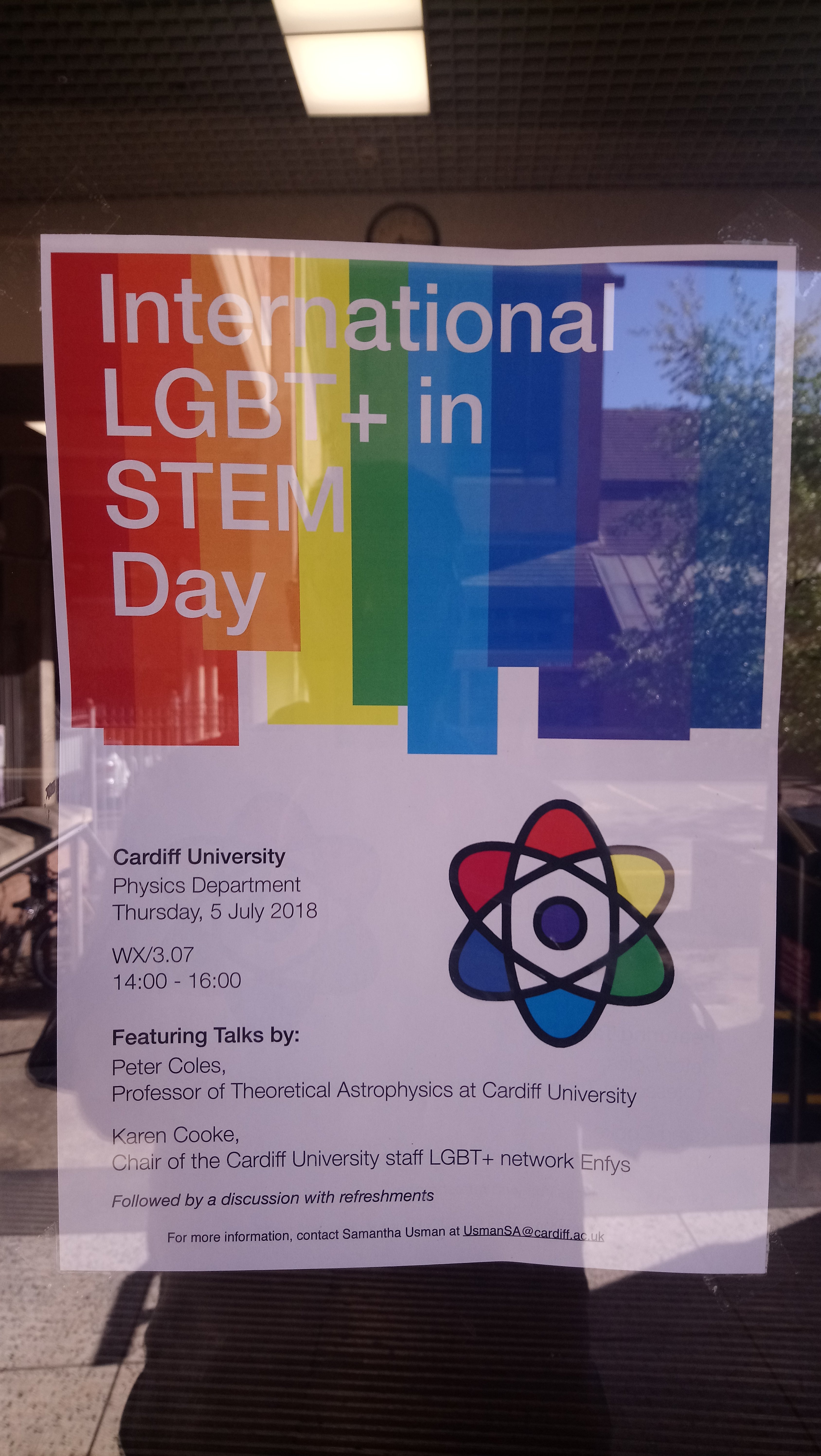
Last week I did a little talk in Cardiff for LGBT Stem Day, which was similar to another I gave earlier this year at the IOP in London at the launch of the LGBT Physical Sciences Climate Survey. I intended to post a summary of the earlier presentation but somehow never got round to it. Doing the more recent one reminded me that I’d forgotten to write up my notes, so here goes.

What I was trying to do in these talks was to explain why I thought (a) the Climate Survey and (b) LGBT STEM day were so important, from the perspective of someone who has been `out’ for over thirty years while pursuing a career in astrophysics. I thought it might be useful to include some personal reminiscences along the way as in both cases most of the audience members were too young to remember what things were like over thirty years ago.

Although I knew I was gay when I was an undergraduate at Cambridge, I wasn’t very open about it except to my closest friends. I also didn’t do much about it either, apart from developing a number of crushes that were doomed to be unrequited. In my final year I decided that I would try to get a place to do a PhD (or, as it turned out, a DPhil). I applied to a few places around the country, and was very happy to get an offer from Sussex and started my postgraduate studies there in 1985. The reputation of Brighton as being a very `gay’ place to live was definitely part of that decision although it was really the topic of my research project that was the decisive factor.

One of the first things I did during `Freshers Week’ at Sussex was join the GaySoc (as it was called) and I gradually became more involved in it as time went on. Initially, though, I kept that part of my life separate from my academic life and wasn’t really all that open in the Department in which I worked. My decision to change that was largely because of things going on in the outside world that convinced me that there was a need to stand up and be counted.

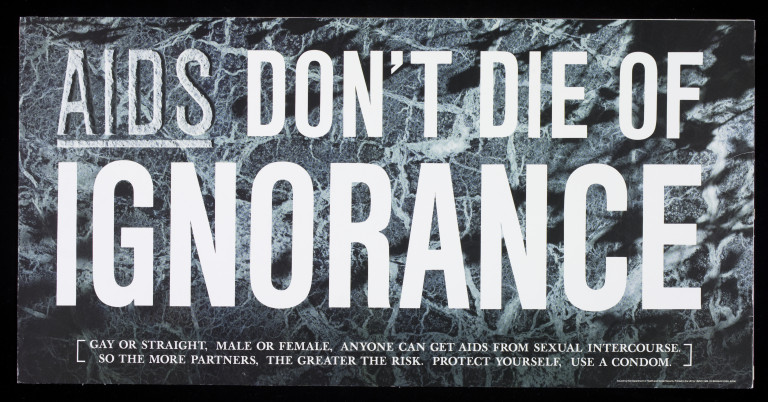
One of these was the AIDS `panic’ exacerbated by the Thatcher Government’s awful advertising campaign, an example of which you can see above. It was a very frightening time to be gay, not only because of the fear of contracting AIDS oneself  but also because of the hostility that arose as a reaction to the `gay plague’.

Although I wasn’t really sexually active as an undergraduate at Cambridge, I had been while I was at school in Newcastle up until 1982. At this time gay sex was illegal with a person under the age of 21, but I had no difficulty finding partners when I was a teenager. I assumed that, as a result of this period of my life,  I would be found HIV+. When I eventually did have a test in 1986 I was quite shocked to find I was negative, so much so that I had another test to make sure. I was lucky, countless others were not.

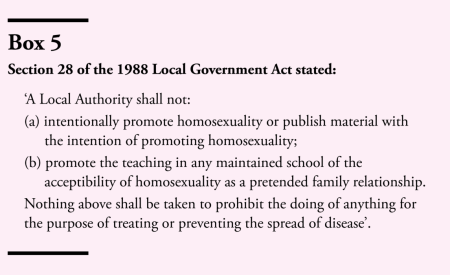
The second thing that made me want to come out was the Local Government Act (1988), which included the now infamous Section 28 (above). This was the subject of the first political demonstrations I ever attended, but we failed to stop it becoming law.

Anyway, I just got fed up of hearing people making ill-informed generalisations during this time. Rather than make a big public statement about being gay, I just resolved to not let such comments pass. I think it only took a few intercessions in the tea room or Falmer Bar for it to become widely known in the Department that I was gay. That was how I came out in astrophysics, and thereafter almost everyone just seemed to know.

I have to say that for quite a long time in this period my general presumption was that a majority of heterosexual people were actively hostile to LGBT+ people, and that would always remain the case. There were quite a few gay people in Brighton who felt the same and their reaction was to become separatists. The logic was that straight people were always going to be horrible, so to hell with them. You could drink in gay bars, eat in gay restaurants, live in a gay part of the town, etc, and thereby minimise interaction with the hostile majority. This seemed an attractive lifestyle to me for some time, but I gradually began to feel that if there was ever going to be a chance of things changing for the better, LGBT+ people had to engage and form alliances. That strategy seems to have worked for the wider community, and I applaud the many straight people who have become allies.

It hadn’t been fear that my sexuality would have a negative impact on my academic career that had held me back – I never really thought I was going to have an academic career until near the end of my time as a research student – it was more fear of confrontation with colleagues who would be hostile. That never really happened. Over the past thirty-odd years, the vast majority of people I’ve known through astrophysics have been friendly and welcoming. There have been exceptions of course, but I won’t waste my time on them here.

Now fast forward to 2018. Not only has Section 28 gone (it was repealed first in Scotland in 2000,  and then nin England & Wales in 2003), but since 2003 the Age of Consent is now equal for everyone and more recently we now have Equal Marriage. If you had asked me back in 1985 whether I thought there was any chance of this happening even on a thirty year timescale, I would have laughed at you.

But although many things have changed for the better, the fact remains that LGBT+ people still face widespread hostility and violence. Bullying is rife in schools, many people are still afraid to come out in their workplace, and in many situations there is still a threat of violence. I know what impact the latter can have, as I have experienced it myself and is has caused me mental health problems throughout my life. In fact, I have found it much harder to be open about my mental health problems than I ever did about being gay!

There are increasing signs of a backlash against LGBT+ people, most obviously in Trump’s America. The rights we have won over the years could so easily be taken away and my fear is that if we are complacent and pretend that everything is fixed because we have equal marriage then we will soon see those rights being eroded. We have to remain active and visible, and keep pushing against all forms of discrimination, harassment and bullying wherever it happens. And the first step in doing that is to raise awareness among everyone that it is still a problem.

Now to some specific points about working in STEM.

First, my own experiences caused me not to perceive science being a difficult environment to be gay, but I am aware that many people have quite different perceptions, often with good reasons. One thing that feeds negative perceptions is simply the lack of positive statements. I remember, over a decade ago, being asked by representative of a major STEM organisation if I could think of anything they could do to make them appear more inclusive to LGBT+ people. I looked at the `equal opportunities’ bit on their website and found that it mentioned gender, race, disability, etc but entirely omitted sexual orientation. What message does that send to an LGBT+ person? The omission was not deliberate, but the perception might well be otherwise. Many institutions display posters about LGBT+ matters, and some staff (either LGBT+ or `allies’) wear rainbow lanyards to carry their ID cards. But what if you’re a student who sees these everywhere else other than your own department? Has nobody bothered to put posters up, or has some arsehole torn them all down?

Another important issue is visibility. Students and early career researchers may be deterred from continuing a career in STEM simply because they don’t see other LGBT+ people doing likewise. I know of at least one student who was on the verge of dropping out of a physics degree because `there are no gay people in physics’. Fortunately he said that to a member of staff who knew he was wrong, as her office was next door to mine, but this does illustrate another problem of perception in STEM fields. In Arts and Humanities subjects it’s much easier to be visible as LGBT+ through your work. You even research matters related to gender or sexuality in literature, for example. It’s rather harder when you do theoretical astrophysics. But what’s wrong with having a rainbow icon on your powerpoint?

When giving my talk at the IOP I got into a discussion about `role models’. I am horrified at the thought that anyone would think of me as a `role model’. I don’t like using that term because it seems to me to imply some sort of ideal to which others should aspire, which seems to me rather arrogant. What I do think is important is for as imany LGBT+ people as possible to say `I’m LGBT+ and I’m in STEM: if I can do it and be like me, warts and all, then you can do it and be like you!’

A comment that I’ve heard about LGBT+ people in STEM goes along the lines of `We don’t need all this political stuff in science. You should just concentrate on your research’. Another version I heard from a senior scientist recently was effectively `I’m not prejudiced at all. I don’t care about your sexuality. I’m only interested in your research!’. I think this kind of stance is not uncommon, actually, but I couldn’t disagree more with it.

Science is, above all, a human activity. It’s not done by robots or calculating machines. It’s done by people. And I don’t think you will get the best science out of your research time unless you create a working environment in which everyone feels comfortable and happy being themselves. Just a few small gestures can go a long way towards creating a department or research group that’s genuinely inclusive for all the people in it.

Of course some STEM subjects have other diversity and inclusivity issues to address. For example, there is a persistent gender imbalance in UK Physics that has resisted many initiatives to encourage more women to enter the field. I’m not arguing that LGBT+ matters more than this or indeed more than race or disability or anything else. It is, however, my firm belief that taking measures to make workplace as inclusive as possible actually benefits everyone  in it. That’s partly because it’s the way to build the best team, and partly the way to get the best out of the team once you have assembled it, but it’s also a good thing to do for its own sake.

Another comment I got on Twitter a few weeks ago `When is it Straight STEM Day?’ Well, perhaps when 69% of heterosexual people feel uncomfortable in the workplace because of their sexuality, or when students are bullied at school for being straight, then perhaps there’ll be a need for it. In the meantime, you just need to recognise that despite the undeniable progress there has been over the past decades, there still isn’t anything like full symmetry between straight and gay.

Finally, and I think this brings me more-or-less back to where I started, events like the LGBT+ STEM Day and initiatives like the LGBT+ Climate Survey are vital because they acknowledge that we’re involved in a  process, not a fixed state and we have to recognise that this process could easily be pushed into reverse. All that’s needed for that to happen is for people to assume that everything is fine now and close their eyes to the overwhelming evidence that it really isn’t.

POSTSCRIPT: A thought that occurred to me while I was writing this relates to inclusivity within the LGBT+ community itself. When I arrived at Sussex in 1985, I joined `GaySoc’. A few years later that became `Lesbian & Gay Soc’. It took a lot longer for Bisexuals to be acknowledged, and even longer for Trans people. Only last week the annual Gay Pride March in London was disrupted by anti-transgender campaigners. Some of us still have a lot to learn about what it means to be inclusive.


After Extra Time

Posted in Biographical, Football with tags , , , , , , on July 12, 2018 by telescoper

My blogging activities have been a little thin over the last few days as I’ve been in a race against time to submit a grant application. The deadline for that was 4pm today. I was advised to submit it `in good time’, however, and managed to do that. The electronic submission receipt is time-stamped 3:59:47. I guess that’s what they call `Just-in-time Delivery’!

It’s my first attempt at a grant application in the Irish system and I had very little notice of the funding call. It took me quite a while to figure out how to construct a budget using rules that are different from the UK, and that left me relatively little time to write the science case. I cobbled something together but don’t expect it is coherent enough to get funded. On the other hand, I might get some useful feedback on what to do better next time. This approach doesn’t work in the UK system, because for many schemes there you can only apply once every three years.

Anyway, to get a break from grant-writing yesterday evening, I strolled around my local in Maynooth for a pint and to watch a bit of the World Cup Semi-Final between England and Croatia. I got there just in time to see Croatia’s equalizer, which drew huge cheers from the (predominantly Irish) crowd, and decided to stay until the end. Croatia’s second goal got an even bigger cheer, though it wasn’t exactly a surprise even if it did take them until extra time to score it. From what I saw, Croatia thoroughly deserved to win. Congratulations to them.

(In case you’re wondering, yes I did bet on Croatia to go through. But only €50, at 5/2….)

It has been a strange World Cup for England. With Germany, Argentina, Spain, Portugal and Brazil (and Italy not even qualifying) it seemed that the fates had paved a relatively easy route to the final. I do think, however, that people overestimated the quality of the England team: they lost to Belgium’s B-team in their last group game and only just scraped past Colombia in the following round. It’s true that they beat Sweden comfortably in the Quarter Final, but I thought that was more because Sweden were poor than because England were good.

In the end I think Croatia won because England displayed a longstanding weakness of English teams – an inability to maintain possession of the ball in midfield.  Against teams with good attacking players you just can’t afford to keep giving the ball away!  They also seemed to get very rattled when Croatia equalized. On the other hand, this is a very young England side which promises much in the future.  There’s plenty of time before the next World Cup for them to grow proper beards, for example. And one person who definitely deserves praise is manager Gareth Southgate, who has not only shown that he’s a pretty good tactician but also that he’s a very nice bloke, with a fine sense of sportsmanship.

So football’s not coming home after all. But where will it go? I do fancy France to win it, but I hope it’s a good final. I have a feeling that the 3rd/4th playoff between England and Belgium might be a good game too!