Archive for the Biographical Category

A Comment on Anonymous Comments

Posted in Biographical with tags , , , on February 5, 2018 by telescoper

My post last week has generated quite a lot of traffic among which is a larger-than-usual crop of abusive comments. Here’s just one example, a response to a comment of mine describing people posting such comments anonymously as `cowardly’.


Charming. I hope I don’t have to point out that the allegation therein is completely false and defamatory. Fortunately the WordPress software blocked it, along with several more of similar ilk. I don’t see why I should allow stuff like this to be published on my blog, especially if it’s anonymous, so I deleted them all. I thought I’d take this opportunity to remind readers of what it says on the front page of this blog:

Feel free to comment on any of the posts on this blog but comments may be moderated; anonymous comments and any considered by me to be abusive will not be accepted. I do not necessarily endorse, support, sanction, encourage, verify or agree with the opinions or statements of any information or other content in the comments on this site and do not in any way guarantee their accuracy or reliability.

I don’t mind people posting contrary views as long as they’re not abusive, but if you use a fake email address and/or a fake name then your comment will be blocked. If you’ve got something to say then at least have the courage to identify yourself!

When I first started blogging, almost a decade ago, I decided to have an open comment policy so that anyone and everyone could comment without any form of intervention. That turned out to be a disaster because of the number of automatically generated  SPAM comments that clogged up the boxes. I therefore switched on a SPAM filter so it could veto obvious garbage, but otherwise kept an open policy. The alternatives offered by WordPress include one that requires all comments to be from people registered at the site (which I thought would probably be a deterrent to people only wanting to comment on the odd post). Another option is to maintain a blacklist which treats all messages from persons on the list as SPAM. It’s also possible to block all comments entirely, of course, but I enjoy reading most of them so I think it would be a shame to do that just because of a few breaches of netiquette.

All went fairly well and I only had to ban a couple of individuals for abuse. I did for a time receive a stream of crudely abusive comments (of a personal nature) from various anonymous sources. These were mostly depressingly puerile and they didn’t affect me much but I did find it very disconcerting to think that there are people sitting out there with nothing better to do.

Since WordPress notifies me every time a  comment is posted, it is quite easy to remove this junk but I found it very tiresome (when there were several per day) and eventually decided to change my policy and automatically block comments from all anonymous sources. Since this requires a manual check into whether the identity information given with the comment is bona fide, comments from people who haven’t commented on this blog before may take a little while to get approved.

There are still comments on here which may appear to a reader anonymous (or with a pseudonym) on here, but these are from people who have identified themselves to me with a proper email address or who the software has identified through their IP address or information revealed by their web browser (which is probably more than you think…). I’m happy for people to comment without requiring they release their name to the world, and will do my best to ensure their confidentiality, but I’m not happy to publish comments from people whose identity I don’t know.

If you’re interested, as of today, 28,781 comments have been published on this blog. The number rejected as SPAM or abuse is 1,802,214. That means that fewer than 1 in 60 are accepted. I simply don’t have time to go through all the flagged comments individually, so I usually just delete them all.

Am I denying freedom of speech by rejecting anonymous comments? I don’t think so. If you want freedom of speech that much, you can write your own blog (anonymous or otherwise). And if every sight of this blog makes you want to write abusive comments, perhaps you should exercise your freedom not to read it.

I’d be interested to know from any fellow bloggers if they have the same problems with abusive comments. If not, perhaps I should start taking it personally!

More generally, I will not accept anonymous comments on the subject of the anonymity of comments, but any other contributions are welcome via the box.

Unless you’re banned.

The Future is Unpredictable

Posted in Biographical, Cardiff, Maynooth with tags , , on January 31, 2018 by telescoper

I decided to take the early morning flight from Cardiff to Dublin today as I have quite a few things to prepare before my first lecture at Maynooth, which is at 9am. I actually got up at 4am and took the 5.10am bus to the airport so that I would arrive in time to have a coffee and a bacon sandwich before the 6.55am flight. Everything went to plan apart from the inclement weather, which resulted in me getting soaked on the way to the bus stop. The plane struggled against a strong headwind, taking 70 minutes to get to Dublin instead of the usual 40, and there was quite a lot of turbulence en route but we arrived on time in Dublin in time for my bus to Maynooth. It was freezing cold this morning, and as I arrived in Maynooth it started snowing but has now stopped.

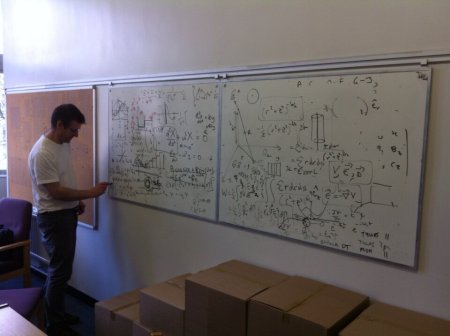
While waiting in the airport I checked Facebook, which reminded me that it was exactly five years ago today that I left Cardiff to take up the job of Head of Mathematical and Physical Sciences at the University of Sussex. One of my last acts was to sign the work of art I left on the whiteboard in my old office.

The initial term of my appointment at the University of Sussex was 5 years, which would have been finishing today had I stayed there. If somebody had told me then that within five years I would have left Sussex, returned to Cardiff temporarily, and be about to move permanently to Ireland it would have seemed most implausible. More importantly, way back then I had no plans to grow a beard!

It just goes to show that Niels Bohr was right when he stated that `Prediction is very difficult, especially about the future’….

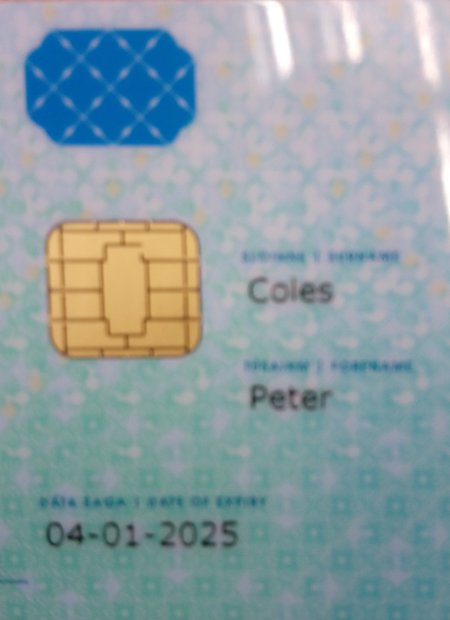
..on the other hand, when I got back to Maynooth I found that my new Public Services Card had arrived, which seems to make a definite prediction of the date of my ultimate demise:

Dictionary Distribution Day

Posted in Biographical, Cardiff, Crosswords, Uncategorized on January 30, 2018 by telescoper

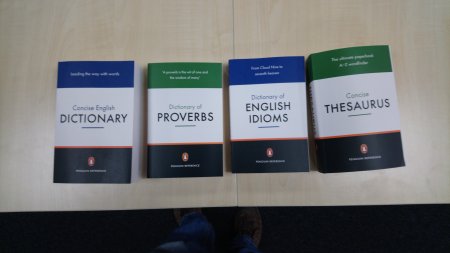
This set of dictionaries arrived last week while I was in Maynooth.

These – along with £15 in book tokens which arrived a while ago – form the prize for the Everyman Crossword competition in the Observer I won earlier this month.

Fortunately, my friendly neighbours accepted delivery of the books while I was out and I collected the parcel from them last night after work. I took them into work today and distributed them gratis to deserving members of the School of Physics & Astronomy before my first Physics of the Early Universe lecture this morning. I’ve got plenty of dictionaries already, you see.

I wonder if I’ll win any more before I move to Ireland?

The IKEA Universe

Posted in Biographical, The Universe and Stuff with tags , , , on January 29, 2018 by telescoper

I heard yesterday the sad news of Ingvar Kamprad, the founder of Swedish furniture chain IKEA.  People can be very snobbish about IKEA, but its emphasis on affordable design has been a boon for people on low incomes for many years. When I was an impoverished postdoc living in London I used it a lot, especially their Billy bookcases. I also have a very sturdy Omar in my bedroom…

I remember years ago  that while shopping in the IKEA at Neasden I discovered that they were running a competition, for which entrants had to complete the sentence:

I shop at IKEA because…

My entry completed it thus:

I shop at IKEA because it’s as cheap as fuck.

I didn’t win.

But I digress. Not many people are aware that IKEA also furnishes  important insights into modern cosmology, so I’ll try to explain here. I’ve blogged before about the current state of cosmology, but it’s probably a good idea to give a quick reminder before going any further. We have a standard cosmological model, known as the concordance cosmology, which accounts for most relevant observations in a pretty convincing way and is based on the idea that the Universe began with a Big Bang.  However, there are a few things about this model that are curious, to say the least.
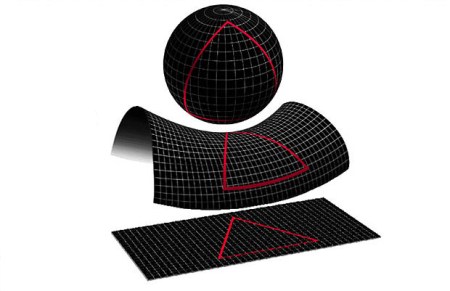
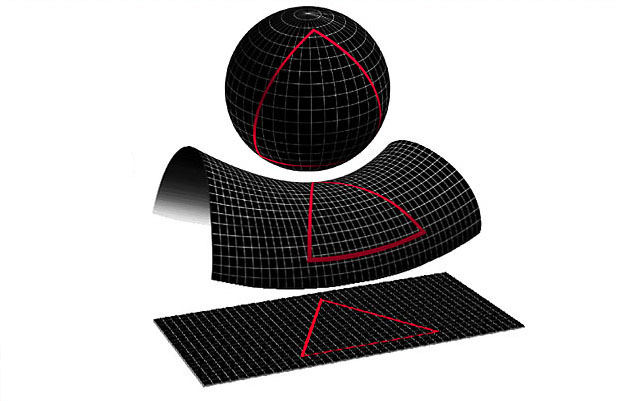
First, there is the spatial geometry of the Universe. According to Einstein’s general theory of relativity, universes come in three basic shapes: closed, open and flat. These are illustrated to the right. The flat space has “normal” geometry in which the interior angles of a triangle add up to 180 degrees. In a closed space the sum of the angles is greater than 180 degrees, and  in an open space it is less. Of course the space we live in is three-dimensional but the pictures show two-dimensional surfaces.

But you get the idea.

The point is that the flat space is very special. The two curved spaces are much more general because they can be described by a parameter called their curvature which could in principle take any value (either positive for a closed space, or negative for an open space). In other words the sphere at the top could have any radius from very small (large curvature) to very large (small curvature). Likewise with the “saddle” representing an open space. The flat space must have exactly zero curvature. There are many ways to be curved, but only one way to be flat.

Yet, as near as dammit, our Universe appears to be flat. So why, with all the other options theoretically available to it, did the Universe decide to choose the most special one, which also happens in my opinion to be also the most boring?

Then there is the way the Universe is put together. In order to be flat there must be an exact balance between the energy contained in the expansion of the Universe (positive kinetic energy) and the energy involved in the gravitational interactions between everything in it (negative potential energy). In general relativity, you see, the curvature relates to the total amount of energy.
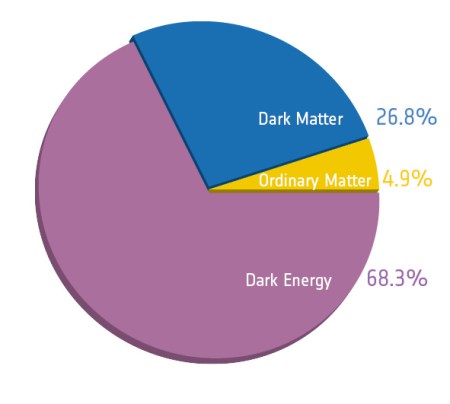
On the left you can see the breakdown of the various components involved in the standard model with the whole pie representing a flat Universe. You see there’s a vary strange mixture dominated by dark energy (which we don’t understand) and dark matter (which we don’t understand). The bit we understand a little bit better (because we can sometimes see it directly) is only 5% of the whole thing. The proportions do look very peculiar.

And then finally, there is the issue that I have ablogged about (here and there) previously, which is why the Universe appears to be a bit lop-sided and asymmetrical when we’d like it to be a bit more aesthetically pleasing.

All these curiosities are naturally accounted for in my New Theory of the Universe, which asserts that the Divine Creator actually bought  the entire Cosmos  in IKEA.

This hypothesis immediately explains why the Universe is flat. Absolutely everything in IKEA comes in flat packs. Curvature is not allowed.

But this is not the only success of my theory. When God got home He obviously opened the flat pack, found the instructions and read the dreaded words “EASY SELF-ASSEMBLY”. Even the omnipotent would struggle to follow the bizarre set of cartoons and diagrams that accompany even the simplest IKEA furniture. The result is therefore predictable: strange pieces that don’t seem to fit together, bits left over whose purpose is not at all clear, and an overall appearance that is not at all like one would have expected.

It’s clear  where the lop-sidedness comes in too. Probably some of the parts were left out so the whole thing isn’t  held together properly and is probably completely unstable. This sort of thing happens all the time with IKEA stuff. And why is it you can never find the right size Allen Key to sort it out?

So there you have it. My new Theory of the Universe. Some details need to be worked out, but it is as good an explanation of these issues as I have heard. I claim my Nobel Prize.

If anything will ever get me another trip to Sweden, this will…
Transitional Arrangements

Posted in Biographical, Education with tags , on January 27, 2018 by telescoper

So I’m here in Dublin airport again, waiting for a flight back to Cardiff. I woke up early this morning so decided to get the 6am Hopper Bus from Maynooth instead of the usual 7am one. There was no traffic and it took only 40 minutes so I’ve had time to have a coffee and a bacon sandwich, as well as finishing the FT prize crossword.

Anyway, teaching term starts next week in both Cardiff and Maynooth so it promises to be quite a hectic period. I’ll be teaching Physics of the Early Universe in Cardiff on Tuesdays and Computational Physics in Maynooth on Thursdays. I volunteered for the latter course primarily to brush up my Python skills, which are distinctly rusty.

At least I won’t have the problem that I had in Nottingham when I was teaching two modules in the same Semester, Cosmology and Theoretical Elementary Particle Physics, both for 3rd year students (so mostly the same students) and both timetabled in the same room. I remember one day turning up and starting a lecture on weak nuclear interactions only to realise I was meant to be doing something about the propagation of photons in an expanding universe.

The midweek to and fro between Wales and Ireland will continue until March where there is a divergence of arrangements for the Easter break. My calculations indicate that happens after 7 lectures  and therefore 7 midweek flights. Should be fun. At least I’m racking up the Avios…


R.I.P. Ursula Le Guin (1929-2018)

Posted in Biographical, Literature with tags , , on January 24, 2018 by telescoper

I heard some more very sad news this morning: that Ursula K. Le Guin passed away on Monday at the age of 88. She was a great writer of science fiction and fantasy literature who was highly original and also highly influential. When I heard the news this morning I went through my bookshelves. I haven’t kept all the books I devoured as a teenager, but I kept this one:

I must have had this for 40 years or more. A Wizard of Earthsea vies with Tolkien’s The Lord of the Rings and Mervyn Peake’s Gormenghast as the best books I have read in this genre, way above the standard fare of the Swords and Sorcery genre. I must read this again in memory of the author, as I suspect will many others of my age who read it in their teenage years.

R.I.P. Ursula K. Le Guin (1929-2018)

Hirsute cosmologist Peter Coles joins Beard of Winter poll after ‘write-in’ votes

Posted in Beards, Biographical on January 22, 2018 by telescoper

I see that, despite popular demand, Keith Flett, on behalf of the Beard Liberation Front, has at the last minute decided to give me another chance to fail to win a beard award. I’m currently in second place in the poll as it enters its final week…

kmflett's avatarKmflett's Blog

Beard Liberation Front

PRESS RELEASE 20th January

Contact Keith Flett      07803 167266

Hirsute cosmologist Peter Coles joins Beard of Winter poll after ‘write-in’ votes

The Beard Liberation Front, the informal network of beard wearers, has said that leading hirsute cosmologist Peter Coles has joined the Beard of Winter poll after write-in votes for him broke the threshold of 1% of the total poll

Mr Coles, based at Cardiff University and also at Maynooth in Ireland was a contender for Beard of the Year in 2014.

The Beard of Winter is the first of four seasonal awards that lead to the Beard of the Year Award in December 2018.

It focuses both on fuller organic beards, suitable for winter weather but also on beards that have made an early New Year impact in the public eye.

BLF Organiser Keith Flett said, Peter Coles has one of the most distinguished of scientific…

View original post 70 more words

Hamilton and the “Light-Bulb” Moment

Posted in Biographical, The Universe and Stuff with tags , , , , , , on January 5, 2018 by telescoper

In yesterday’s post I mentioned in passing the bridge (Broom Bridge) beside which William Rowan Hamilton first wrote down the fundamental result of quaternions after having a flash of genius while walking from Dunsink Observatory into Dublin.

That reminded me last night that a while ago I read a piece in Physics World (which you can read here, but only if you have a subscription) about whether breakthroughs in physics occur very often in the way of Hamilton’s – through sudden flashes of inspiration or, as they are called in the article,  “light-bulb moments” –  or are more often the result of solid hard graft, sweat and spadework? In other words, how much is inspiration and how much perspiration?

The piece includes some interesting comments from distinguished scientists about their own “Eureka” moments, which I’m sure will resonate with many researchers, not only physicists. Incidentally, the article refers to such moments as “claritons”, a word I’d never heard before, presumably intended to evoke solitons. It is interestin, though just how strongly the light-bulb has become so strongly associated with this sort of brainwave. You can find a short discussion of this here.

Anyway, I’m pretty sure that  most scientists – even the eminent individuals interviewed for the Physics World piece – have spent a large part of their time “stuck”. I know I have, but then I’m not really eminent anyway. In the long run it’s probably good to go through such periods as I think they’re essential for intellectual development, but they’re undoubtedly extremely frustrating at the time. How you get “unstuck” is a very mysterious process. I’m not a neuroscientist, but it seems to me that when you get really immersed in, say, a research problem, your subconscious brain gets drawn into what you think is a fully conscious process, to the extent that even when you’re apparently not thinking about something you really are. I’ve had ideas come to me in all kinds of weird situations: watching ducks paddling on a pond, listening to music, walking in a park, and even pushing a trolley around a supermarket. Often it seems that it’s precisely when you’re not thinking that you have your best ideas. It’s not always clear what acted as the trigger, but and when it is it is often something quite abstract. In the case I mentioned of the ducks on the pond it was just a question of thinking about reference frames. It was a nudge in the right direction, but I still had to do quite a lot of work to finish the calculation. Come to think of it, it’s usually at that conceptual level that such things happen rather than in the detailed working, at least in my case.

The Physics World piece also talks about ideas coming through dreams. That has happened to me too, but I think it’s basically the same phenomenon that I’ve just discussed. It seems to me that dreams are a product of your brain sorting through recent events or experiences and trying to make sense of them in terms of others it has filed away. This can help with a research problem by flagging up a connection with something else hidden away. I can remember at least two occasions when I’ve woken up from a dream with an exact understanding of what I’d been doing wrong and how I could fix it. It’s great to wake up in the morning with that kind of feeling!

I know it’s wrong to draw inferences about other people from one’s own particular experiences, but I do feel that there are some general lessons. One is that if you are going to be successful at research you have to have a sense of determination that borders on obsession. You have to immerse yourself in it and be prepared to put long hours in. When things are going well you will be so excited that you will find it as hard to stop as it is when you’re struggling. I’m writing as a physicist, but I imagine it is the just same for other disciplines.

The other, equally important, lesson to be learned is that it is essential to do other things as well as doing science. Being “stuck” on a problem is an essential part of mathematics or physics research, but sometimes battering your head against the same thing for days on end just makes it less and less likely you will crack it. The human brain is a wonderful thing, but it can get stuck in a rut. One way to avoid this happening is to have more than one thing to think about.

I’ve lost count of the number of times I’ve been stuck on the last clue in a crossword, which usually means that my facility for thinking laterally, which is so essential for solving cryptic puzzles, is not operating well. What I always do in that situation is put it down and do something else for a bit. It could even be something as trivial as making a cup of tea, just as long as I don’t think about the clue at all while I’m doing it. Nearly always when I come back to it and look at it afresh I can solve it. I have a large stack of prize dictionaries to prove that this works!

It can be difficult to force yourself to pause in this way. I’m sure that I’m not the only physicist who has been unable to sleep for thinking about their research. I do think however that it is essential to learn how to effect your own mental reboot. In the context of my research this involved simply turning to a different research problem, but I think the same purpose can be served in many other ways: taking a break, going for a walk, playing sport, listening to or playing music, reading poetry, doing a crossword, or even just taking time out to socialize with your friends. Time spent sitting at your desk isn’t guaranteed to be productive, and you should never feel guilty about taking a thinking break.

I’d be interested to receive examples of other “light-bulb” moments through the comments box. I’d also welcome comments from neuroscientists on my extremely naïve comments about how the brain works in such situations.


Planes, Trains and Quaternions

Posted in Biographical, History, mathematics, Maynooth with tags , , , , , , , , on January 4, 2018 by telescoper

Well, here I am in Maynooth for the first time in 2018. I flew over from Cardiff yesterday. The flight was rather bumpy owing to the strong winds following Storm Eleanor, and it was rather chilly waiting for the bus to Maynooth from Dublin Airport; nevertheless I got to my flat safely and on time and found everything in order after the Christmas break.

This morning I had to make a trip by train to Dublin city  to keep an appointment at the Intreo Centre in Parnell Street, which is about 15 minutes walk from Dublin Connolly train station. I bought an Adult Day Return which costs the princely sum of €8.80. Trains, stations and track in Ireland are maintained and operated by Irish Rail (Iarnród Éireann), which is publicly owned. Just saying.

The distance between Maynooth and Dublin about 25 km, which takes about 40 minutes on the local stopping train or about 25 minutes on the longer distance trains which run nonstop from Maynooth to Dublin. As it happens I took one of the fast trains this morning, which arrived on schedule, as did the return journey on a commuter train. My first experience of the Irish railway system was therefore rather positive.

I had thought of having a bit of a wander around the city on my way to Parnell Street but it was raining and very cold so I headed straight there. I arrived about 20 minutes ahead of my scheduled appointment, but was seen straight away.

The reason for the interview was to acquire a Personal Public Services Number (PPSN), which is the equivalent of the National Insurance Number we have in the United Kingdom. This number is needed to be registered properly on the tax and benefit system in Ireland and is the key to access a host of public services, the electoral roll, and so on. You have to present yourself in person to get a PPSN, presumably to reduce the opportunity for fraud, and I was told the interview would take 15 minutes. In fact, it only took about 5 minutes and at the end a photograph was taken to go on the ID card that is issued with the number on it.

So there I was, all finished before I was even due to start. The staff were very friendly and it all seems rather easy. Fingers crossed that the letter informing me of my number will arrive soon. It should take a week or so, so I’m told. After that I should be able to access as many personal services as I want whenever I want them. (Are you sure you have the right idea? Ed.)

For  the return trip  to Maynooth I got one of the slower commuter trains, stopping at intermediate stations and running right next to the Royal Canal, which runs from Dublin for 90 miles through  Counties Dublin, Kildare, Meath and Westmeath before entering County Longford, where it joins the River Shannon. One of the intermediate stations along the route next to the canal is Broombridge, the name of which stirred a distant memory.

A quick application of Google reminded me that the town of Broombridge is the site of the bridge (Broom Bridge) beside which William Rowan Hamilton first wrote down the fundamental result of quaternions (on 16th October 1843). Apparently he was walking from Dunsink Observatory into town when he had a sudden flash of inspiration  and wrote the result down on the spot, now marked by a plaque:

Picture Credit: Brian Dolan


This episode  is commemorated on 16th October each year by an annual Hamilton Walk. I look forward to reporting from the 2018 walk in due course!

P.S. Maynooth is home to the Hamilton Institute which promotes and facilitates research links between mathematics and other fields.


The Old Year’s Blog Statistics

Posted in Biographical on January 2, 2018 by telescoper

I’ve been back in the office (in Cardiff) today, where I’ve got through quite a lot of work – as well as doing my tax return at lunchtime – owing to the fact that there’s nobody else here. I’m about to go home and try to figure out which assortment of bins to put out but before doing that I thought I’d do a quick blog about the blog.

Once upon a time, in the good old days, WordPress used to publish the annual statistical summary page for its bloggers, but it discontinued that practice last year so now I’ll just write my own brief summary based on the data available via the usual dashboard. First, however, a picture:

Now, for those interested I got about 413K hits this year, just over 1100 a day, with about 212K unique views. That’s up a bit since last year, probably because I’ve posted more (442 articles this year, including reblogs). The two most popular posts were about the Bullying Scandal in Zurich and on the rumours surrounding a gravitational waves from a source in NGC 4993 (proved later to be true).

In 2017 there were 2610 comments on this blog, up about 10% on last year. No prizes for guessing who wrote the most comments.

Altogether since this blog started in 2008 to the end of 2017, it has been viewed 3,371,843 times by a total of 1,094,975 unique visitors (though, obviously, all my visitors are unique). I passed 3 million reads and 1 million visitors during the course of last year.