Archive for the Cardiff Category

The Immortal Regiment in Cardiff

Posted in Cardiff with tags , , on May 10, 2017 by telescoper

I was walking along Queen Street in Cardiff last night when I encountered a group of people – mainly women and children – singing and marching in front of me with flags, banners and photographs of men in uniform decorated with medals, all escorted by a couple of police officers. I couldn’t figure out who they were from behind so I caught up with them and asked one of their number what it was all about.

It turned out to be a local (Cardiff) version of the Immortal Regiment March, part of Russian celebrations of victory in World War Two (`The Great Patriotic War’) which take place on 10th May, one day later than our own VE Day. This is a huge event in Russia, involving many millions of people. The Cardiff event was, of course, relatively small but many of those marching were direct relatives of people who gave their lives during the Second World War. Those were the photographs they were carrying.

There has been a sizable Russian community in Cardiff for many years, large enough to sustain a Russian Orthodox Church and various community organizations throughout the city. More than a few of the academic staff of Cardiff University are of Russian origin. Yesterday’s march was a timely reminder not only of the horrors endured by so many on the Eastern front but also of the fact that Cardiff is a wonderfully cosmopolitan city.

Cardiff March for Science

Posted in Cardiff on April 22, 2017 by telescoper

Here’s a couple of snaps of today’s Cardiff March for Science. It was a friendly and fun occasion attended by (at a guess) a few hundred people.  

It started with a rally on the steps of the Senedd building:

The assembled throng then walked around Cardiff Bay to Techniquest. 

This one was taken by another participant, Jordan Cuff (a PhD student in Bioscience). I am actually in this picture, but you can only see my back…

It wasn’t a very demonstrative march -there was no chanting or anything like that – but then it wasn’t really intended to be a demonstration, more of a very polite celebration! 

Oh, and nice weather for it!

Cardiff, City of Cycling?

Posted in Bute Park, Cardiff with tags , , , , , , , on February 22, 2017 by telescoper

Two recent news items about Cardiff caught my attention so I thought I’d do a quick post. The first piece was about the terrible state of traffic congestion in the city. This doesn’t affect me directly as I normally work to work and back, but it has definitely got much worse in the last few years. The roads are regularly gridlocked, a situation made worse by the interminable and apparently pointless roadworks going on everywhere as well as absurdly slow and dysfunctional traffic lights. There’s a common view around these parts that this is being allowed to happen – or even engineered – so that Cardiff City Council can justify the introduction of congestion charging. This would be an unpopular move among motorists, but I think a congestion charge would not be a bad idea at all, as what the city really needs is to reduce the number of motor vehicles on its streets, to deal with the growing problem of pollution and long journey times.

One day, about six years ago,  I was almost run over three different times by three different vehicles. The first was near the car park in Sophia Gardens, where there are signs and road marking clearly indicating that there is a speed limit of 5 mph but where the normal speed of cars is probably more like 35; the guy who nearly killed me was doing about 60.

Next, in Bute Park, a heavy lorry belonging to the Council, engaged in some sort of “tree-management” business, thundered along the footpath past me. These paths used to be marked 5mph too, but the Council removed all the signs when it decided to build a huge road into the Park and encourage more vehicles to drive around inside. The lorry wasn’t going as fast as the Boy Racer of Sophia Gardens, but the size of the truck made it just as scary.

Finally, using a green light at the pedestrian crossing at Park Place I was narrowly missed by another car who had clearly jumped a red light to get onto the dual carriageway (Dumfries Place) leading to Newport Road.

I have to say things like this aren’t at all unusual, but that is the only time I’ve had three close encounters in one day! Although most car drivers behave responsibly, there seems to be a strong concentration of idiots in Cardiff whose antics are exacerbated by the hare-brained Highways Department of the local council. There are many things to enjoy about living in Cardiff, and the quality of life here is very good for a wide range of reasons, but of all the cities I’ve lived in it is by a long way the least friendly to pedestrians and cyclists.

Which brings me to the second news item, which is about Cardiff City Council’s ambitious new Cycling Strategy, which aims to double the number of trips made using cyclists over the next ten years. That still wouldn’t reach the level of Cambridge, where 30% of all journeys in the city are done by bicycle.

Cardiff has a long way to go to match Cambridge and further still to be like Copenhagen, one of the loveliest and most livable cities I’ve ever experienced, partly because of its traffic policies.

In the interest of balance I should also point out that I was once actually hit on a pedestrian crossing in Cardiff by a bicycle steered by a maniac who went through a red light. In this case, however, I did manage to push him off his bike as he tried to get away, so he ended up more seriously hurt than I was. I was hoping that a friendly car would run over his bike, which was lying in the road, but sadly that didn’t happen.

I hope in their desire to increase the number of cyclists, the town planners don’t forget those of us who travel on foot!

Women’s March in Cardiff 

Posted in Cardiff, Politics with tags , on January 21, 2017 by telescoper

Lots to do today so I’ll just make a note that this afternoon there was a Women’s March in Cardiff along with many around the world (including a huge one in Washington DC) to protest against misogyny and discrimination.

Here’s the scene near the statue of Nye Bevan on Queen Street (looking toward the Castle)  just before the March started around 1pm:

Love and respect to all who took part!

Cardiff Brewery Tap wins Beard Friendly Pub of the Year title (UK)

Posted in Beards, Cardiff on January 16, 2017 by telescoper

Another important accolade for Cardiff, winner of this year’s Beard Friendly Pub of the Year in the “Outside London” category!

There’s a news item about this prestigious award in the local media here.

kmflett's avatarKmflett's Blog

Beard Liberation Front

January 15th

Contact Keith flett                                            07803 167266

CARDIFF BREWERY TAP WINS BEARD FRIENDLY PUB OF THE YEAR TITLE

crafty

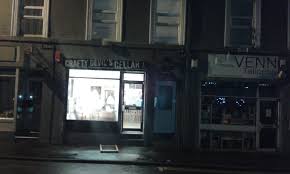
The Beard Liberation Front, the informal network of beard wearers, has said that the contest for the Beard Friendly Pub of the Year has concluded with the Crafty Devil Beer Cellar in Cardiff bearding the Cloudwater brewery tap in Manchester for the UK (outside of London) title

The Cock Tavern in Hackney won the overall poll but the result of the on-line vote saw a major new development with Brewery Taps- where drinkers socialise at the breweries themselves- coming second and third in the overall national vote.

The winners in 2016 included the Jolly Butchers in Stoke Newington, the Cock Tavern in central Hackney and the Bag of Nails in Bristol

Beard Friendly Pub, Bar, Tap 2017

UK

1 Crafty Devil Beer Cellar, Cardiff

2 Cloudwater Brewery Tap, Manchester

View original post 308 more words

Collapse at Sophia Gardens

Posted in Cardiff, History with tags , , on January 10, 2017 by telescoper

If the title of this post attracted the attention of cricket fans then I apologize, because it’s not about goings-on at the SWALEC Stadium in Cardiff but at the Sophia Gardens Pavilion which no longer exists (for reasons which will become obvious) but was an entertainment and exhibition venue built in 1951 as part of the Festival of Britain celebrations. You can see a (rather hilarious) Pathé News item about a fashion show held there in 1952 here.  It was also the venue in 1958 for the Empire and Commonwealth Games, held between July 18 and 26th, for boxing and wrestling matches. Owing to post-war austerity, the supply of building materials was heavily controlled so it was necessary to adapt a war surplus aeroplane hangar to provide the framework for the Pavilion. The hangar was obtained from Stormy Down aerodrome near Pyle, Bridgend in late 1949. The cost of dismantling and transporting it was £3,400 and rebuilding it in Sophia Gardens was estimated to cost £40,000. The Pavilion when completed seated approximately 2,500 people, and the final cost of construction was £80,000. It was opened officially on Friday 27th April 1951.

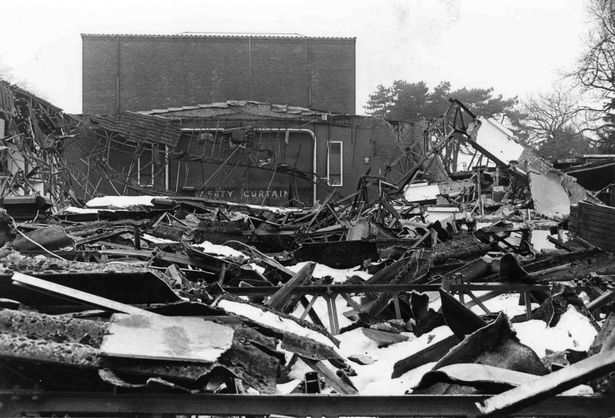
I was about to leave the office just now when I was reminded – by Derek The Weather – that at this time of year in 1982 (i.e. 35 years ago) Cardiff was in the grip of exceptionally severe weather. In fact it started snowing heavily on 7th January and carried on for 48 hours without a pause. It snowed so heavily, in fact, that the weight of snow caused the roof of the Sophia Gardens Pavilion to collapse:

cardiff-sophia-gdns

Fortunately no-one was inside. After the roof collapsed the Pavilion was demolished and the land it stood on is now a car park (a little way South of the cricket ground). I don’t know precisely when this event occurred, but it had happened by 13th January 1982. I know this because he collapse of the building led to the cancellation of a concert due to take place there on 13th January 1982 by Black Sabbath, which is apparently a popular beat combo of some sort.

Anyway, it looks like we’re due for some snow in the UK over the next few days although perhaps not in Cardiff and perhaps not heavy as 1982. Strangely, I have no memory of 1982 being a particularly severe winter. I was living in Newcastle at the time, but the weather maps suggest the severe conditions covered most of the country.

The “Pont” in Pontcanna

Posted in Cardiff, History with tags , on January 10, 2017 by telescoper

Regular readers of this blog (Sid and Doris Bonkers) will know that I currently reside in an area of Cardiff known as Pontcanna, which is part of the administrative district of the city known as Riverside.  Although Pontcanna does have a distinct identity as a community, there’s no precise definition that I can find of exactly where it is. Even Cardiff City Council doesn’t really recognize its existence: all my official mail has  “Riverside” in the address. Although I tell everyone I live in Pontcanna, I don’t have any official evidence that I do!

I’ve also often wondered about the origin of the name, as it definitely suggests a bridge of some sort (Pont is Welsh for bridge, cf  the French) and there are no bridges in the area. The name Canna is generally taken to refer to Saint Canna, whose name  is also associated with Canton, an area of modern Cardiff adjacent to Riverside but until the 19th Century a village in its own right. Since this is a very old name it’s logical to infer that the bridge is no more. However, the thing that always puzzled me is that the area of Pontcanna is actually quite small, and actually not all that close to the River Taff (the main river through Cardiff), which is even further from Canton, so there’s no obvious site for a bridge to have been, even if the bridge itself is long gone.

A chance conversation in a pub the other day however led me to a website that offers a solution to this conundrum., namely that the “Pont” in Pontcanna does not relate to a bridge over the River Taff, but over a small brook that used to run through the area shown on old maps and known (in English)  as the “White House Brook”.  This interpretation also casts doubt on the idea that “Canna” has anything to do with Saint Canna: it is possible that it derives instead from an old Welsh verb meaning “to whiten” although I’m by no means confident in that.

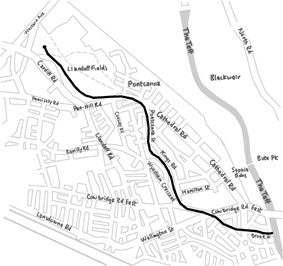
Here, according to my source, is the route of this brook:

cannamap

I’m sorry it’s low resolution, but it’s basically an annotated scan of a historical map. You can compare that with a modern map of the area around my house:

pontcanna

The River Taff can be seen to the upper right of the modern map. The White House Brook ran down what is now Cathedral Road before turning along the route of what is now Pontcanna Street. 

Construction of the  large houses on Cathedral Road, and others on surrounding streets, began around 1896, at a time when Cardiff’s population was expanding rapidly. Prior to that this area was mainly farmland, with a few cottages here and there. It is also part of the River Taff flood plain and was criss-crossed with ditches containing small streams, of which the White House Brook was the largest.

As the area became developed, water from these streams was diverted to form the sewer system for the new buildings and the White House Brook progressively dried up. What little remains of it now runs in a culvert, which eventually empties into the Taff.

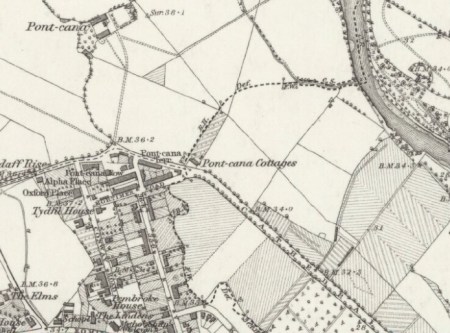
The bridge presumably disappeared at the same as the brook went underground around 1896, but the most likely candidate for it is a small bridge that stood near a row of cottages that lay between a small church (at the site of the Presbyterian Chuch on Gileston Road, marked on the modern map) and the end of what is now Teilo Street. These can be seen on this map, which  Bryn Jones directed me to (see comment below):

pontcanna_1886

The “Pont-cana cottages” (sic) were also demolished to make way for the new houses on Cathedral road and new roads either side of it. The best guess for the site of the bridge is close to the junction between Teilo Street and Cathedral Road. Note that in the first  map, Pontcanna is marked to the River Taff side of Cathedral road which is probably where the bridge was situated, very close to the end of my street. I feel more justified than ever in saying that I live in Pontcanna!

P.S. This map also shows another location marked “Pont-cana” to the North, on what are now called Llandaff Fields. I think refers to Pontcanna Farm, presumably named after the bridge. Perhaps the Pontcanna cottages may have been homes for farm workers?

P.P.S. Incidentally, I learned from this site that until 1858, Cathedral Road was only accessible by paying a toll at a booth on Cowbridge Road! Even in the old days, Pontcanna was an exlusive area!

Cardiff: City of the Unexpected

Posted in Cardiff, Literature with tags , , on September 18, 2016 by telescoper

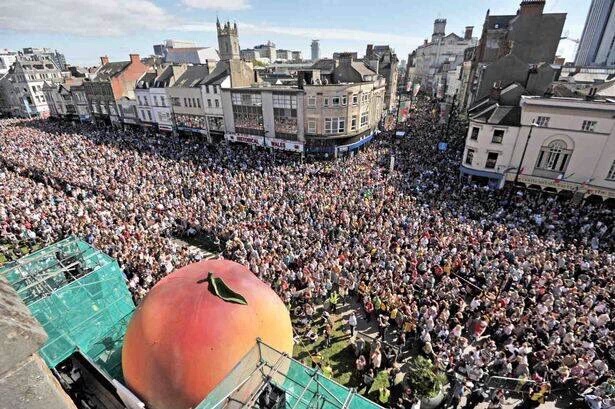
It’s been an extraordinary weekend in Cardiff as the city indulged in huge celebrations of the centenary of the birth of writer Roald Dahl, who was born in Llandaff.

I’ve been too busy with other things to see many of the events organised under the banner of City of the Unexpected, but to give you an idea of the scale here’s a shot of the crowds in front of Cardiff Castle watching the James and the Giant Peach episode.

image

The picture was taken by a member of the South Wales Fire service who were assisting at the event.

This happens also to be the welcome weekend for new students at Cardiff University, and I suspect many were a bit bemused by the goings-on!

It’s also worth mentioning that, as well as being a prolific author of children’s books, Road Dahl was the son of Norwegian immigrants. He was also a fighter pilot in the RAF during World War 2 who served with great distinction in North Africa and Greece, despite being seriously injured when his plane crashed while attempting to land.

Anyway, we’ll done to the organisers of this remarkable event which has put a big smile on the face of this great city.

Transitional Arrangements

Posted in Cardiff with tags on August 17, 2016 by telescoper

I hope you will excuse a short personal message.

I’ve noticed that quite a few people are emailing me at my Sussex address and are getting a message that I have left (which I have).

I am in fact currently on a month’s (unpaid) leave so that I can deal with a number of personal things. After that, from 1st September, I’ll be rejoining the School of Physics and Astronomy at Cardiff University.

My new email and other contact information should be set up shortly. In the meantime I am reading my email at Sussex, but only replying to very urgent messages. I am, after all, on leave.

I hope this clarifies the situation.

Anyway, it seems I picked a good time for for a holiday, as the weather in Cardiff is lovely!

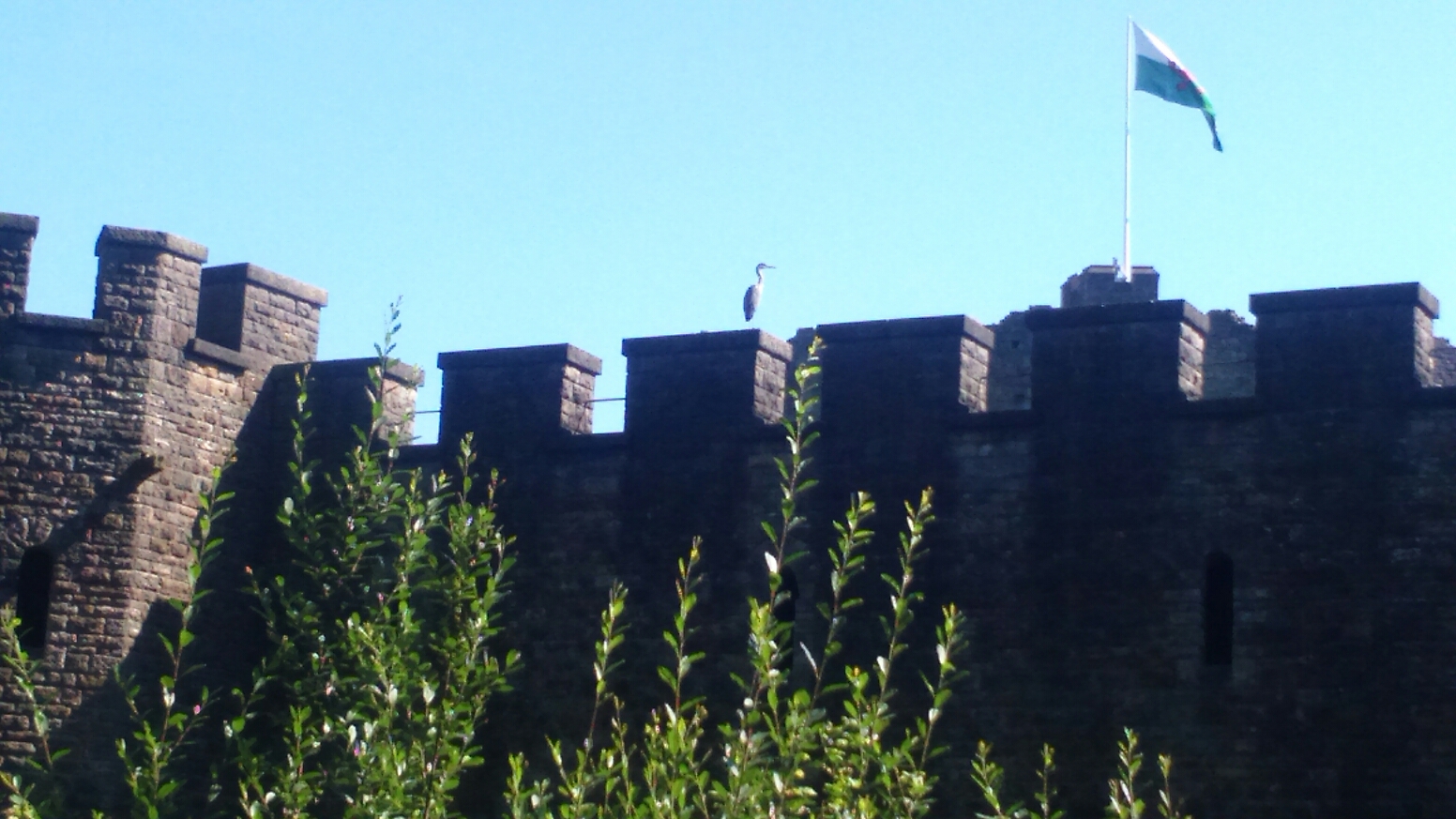
Here for no particular reason is a photograph I took of a heron on the battlements of Cardiff Castle.

image

Flaming June Again

Posted in Art, Biographical, Bute Park, History with tags , , , , on June 10, 2016 by telescoper

Since we’re in the middle of a modest heatwave I thought “Flaming June” would be a good title for a blog post. Until a few years ago I always thought that “Flaming June” was some sort of folk expression or quotation from a poem, but it is instead the title of this Pre-Raphaelite painting by Frederic Leighton of a lady wearing what looks like a dress made out of old curtains. Apparently the oleander branch seen in the upper right symbolizes the fragile link between sleep and death. It looks to me like she must be attending a lecture…

But I’m rambling. This has been an exhausting week, probably because I a few days off last week and have come back to one of the busiest periods of the academic year. The examination period is over so there are scripts to mark,  examiners’ meetings, class lists and the like, all parts of the arcane business of academic life. In fact I’ll be spending the first three days of next week in Cambridge where I’m External Examiner for Physics, and I have a lot to do here before I go.

In between all the meetings I had to attend yesterday I noticed that it was the 9th of June, a date of enormous cultural significance for those of us born on Tyneside, as Geordie Ridley’s famous music hall song The Blaydon Races begins “I went to Blaydon Races, ’twas on the 9th of June… The original Blaydon Races were horse races and site of the course is long since gone, but the name has recently been resurrected as a road race involving people on foot rather than on horseback. Incidentally, the usual “Whit Week” holiday in late May or early June is still referred to on Tyneside as “Race Week”.

All this reminded me of the occasion – over twenty years ago – when I entered the Great North Run for the first time. Nowadays this race – the biggest mass participation half-marathon race in the world, with 50,000 competitors – is run in September, but in those days it was held in June. As it happened, there was also a heatwave the first time I did it. I remember lining up at 9.30 on a Sunday morning on the start grid (I was number eleven thousand and something) while the stewards went round pleading with all the participants to take plenty of water as they went around as it was going to be very hot indeed and they didn’t want people suffering from dehydration.

In those days I was quite a keen long-distance runner and was fairly fit. I wasn’t that concerned about the heat but took the advice to heart and determined to stop at all the water stations on the way from Newcastle to South Shields. When we started I also took care not to go off too fast over the first mile or so, which is basically all downhill from the Town Moor to the Tyne Bridge. Not that you could go fast anyway, as the track was so crowded with runners.

I remember the wonderful feeling as we emerged onto the Tyne Bridge and took in the splendid view of the bridges along the river. When we got to Gateshead the crowds were out in large numbers cheering everyone on and I felt completely elated. The first water station was near Gateshead athletics stadium, and I took a drink there as I did at the next, and the next. After Gateshead the route heads towards the Felling bypass at about 4-5 miles and then the runners can see a long climb in front of them. A large thermometer showed the temperature on the road to be about 45 Celsius. Fortunately the people living in houses either side of the road were out in their front gardens offering encouragement and sometimes had their hoses out to shower people as they went past. At one point there was a fire engine that had made an impromptu fountain by the side of the road too.

Unfortunately, as I near the ten mile mark I started to feel a bit strange. I had never actually taken on water while I was running before this race; I never felt the need for it when on training runs. My stomach wasn’t used to the water sloshing around while I was running. I felt quite sick by the time we got to the top of the climb but when I saw the sea and felt its breath on my face I cheered up and descended the steep downward slope towards the seafront near Marsden Rock.

There’s a good mile and a half along the seafront to the finish, however, and I was definitely struggling really badly by then. I could see the finish line but it felt like it wasn’t getting any closer. I slowed to a crawl but kept going, finally reaching the grandstand where a large crowd shouted encouragement. I must have looked dreadful because I heard several people shouting out my number along with “keep going, son”  and “you’re nearly there”.

Eventually I got to the finish line but the feeder lanes were quite busy then – I was finishing at about the peak  time of about 1hr 50 – so I was forced to slow right down because of the people in front of me.

As I crossed the line, I stopped running and was immediately overcome with nausea. I bent over, hands on my knees and emptied the contents of my stomach – mainly water – all over the grass. I felt absolutely dreadful but, after a quick check from the St John Ambulance crew who were on hand, I recovered and found my folks who were nearby. After we got home and I had a shower I felt fine.

About a week later, when I had returned to my flat in London a letter arrived for me. I opened it up and found a small passport-sized photograph, with the caption “YOUR MOMENT OF TRIUMPH”. It turns out there was an automatic camera near the finishing line that snapped everyone crossing it along with a shot of the digital clock showing their finishing time. The idea is that you could order a blow-up of the picture for £25 to put on your wall.

In my case, though, the picture showed not a moment of splendid athletic achievement, but a bedraggled creature puking uncontrollably while those around him looked on in disgust. I didn’t order the blow-up of my throw-up.

Over the years I did the Great North Run a number of times – six or seven, I don’t remember exactly – and a few marathons too, but the strain of running on the roads around London gradually told on my knees and I had to stop because of recurrent pain and swelling. Eventually, a few years ago I surrendered to the inevitable and had arthroscopic surgery to sort out the damage to my knee joints. That seems to have fixed the problem, but my running days are over.