This blog has been going for over 16 years now. Those readers who have been following it all that time will remember that in October 2009, 15 years ago, I posted an item about Mark Brake, a Professor at the University of Glamorgan who falsely claimed on a funding application that he had a PhD from Cardiff University. I thought for old times’ sake I would post the article again…
P.S. This story was responsible for me being threatened with a libel action. My response was to pass on the name and address of my solicitor with the message “Go ahead. Make my day” (or words to that effect). I never heard back.
P.P.S. The University of Glamorgan no longer exists as such, as in April 2013 it merged with University of Wales, Newport, to form the University of South Wales.
Yesterday was the day that students in United Kingdom received this year’s A-level results. It seems the number of students getting the highest grades went up in England but down in Wales and Northern Ireland. That difference could be because of the timing of the transition from Covid-19 adjustments, with marks in Wales and Northern Ireland only returning to pre-pandemic levels this year; this may disadvantage applicants to universities this year, of course.
Another thing worth mentioning is that the number of students taking Physics A-level has increased by 12% this year, reversing a recent downward trend. In Physics, 31.5 per cent of students achieved the top grades. This was an increase from last year when 30.8 per cent were awarded an A or A*. That probably means that most students who applied to do Physics at university will get a place in their first-choice institution.
As always my advice to students who got disappointing results is
There’s always the clearing system and there’s every chance you can find a place somewhere good. If you’re reading this blog you might be interested in Physics and/or Astronomy so I’ll just mention that both Cardiff and Sussex have places in clearing and both are excellent choices.
At least you’ve got your results; students here in Ireland will have to wait next Friday (23rd August) to get to get theirs – not in the form of GCE A-levels, of course, but the School Leaving Certificate. I have been away all year so don’t know how admissions have been going for Maynooth but the intention seems to be to increase student numbers in any way possible despite the already huge student-staff ratio (the highest in Ireland) and lack of student accommodation. Anyway, Covid-19 adjustments are still in place in Ireland so the artificial inflation of Leaving Certificate grades will continue. It seems the Government doesn’t know how to get out of the system it has locked itself into and is intent on leaving it for the next Government to sort out.
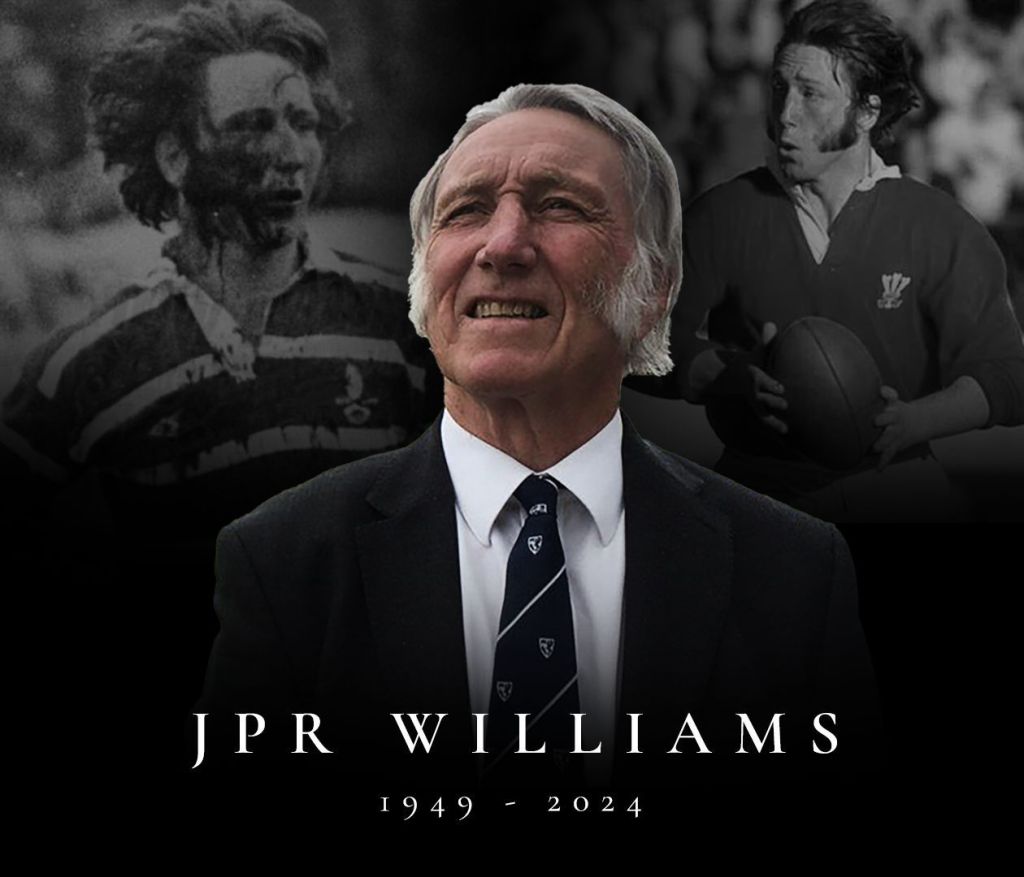
A cold and miserable day in Cardiff yesterday got even sadder when news came out of the death of Welsh rugby legend John Peter Rhys Williams known universally as “JPR” after the winger John James Williams (another great player), joined the national team and became “JJ”. JPR was one of the superb players who dominated Welsh rugby in the 1970s; he stood out even in such exalted company. In my opinion JPR is was the greatest full-back ever.
JPR was instantly recognizable on the field: tall and craggy, with characteristic long hair, prominent sideburns, socks always rolled down around his ankles, he was an imposing figure whether patrolling the defensive lines or stepping up to join the attack. In the famous 1973 match in Cardiff between The Barbarians and New Zealand he was described by commentator Cliff Morgan as “a man who never shirks his responsibility”. Just watch the memorable opening try where you’ll see JPR in the thick of the action, twice shrugging off dangerous tackles around his neck, the second time receiving the ball from Phil Bennett to start the passing move from deep inside his own half.
Many people forget that the man himself scored a great try in that game too:
As a full-back, JPR was often the last line of defence. Sometimes, tidying up after a kick from the opposition, he would clear his lines by kicking. More often, though, he would spot a weakness and go charging forward, ball in hand, not afraid to run straight at the opposition. He was quick to spot gaps in his own defence too, rushing to provide cover, often with last-ditch try-saving tackles.
As good as he was at turning defence into attack, he was even better when his side were already in control. Here are two tries he scored for Wales against England in 1976 that demonstrate his superb positional sense in attack as well as his sheer physical strength.
(Wales achieved a Grand Slam in 1976; England got the Wooden Spoon.)
JPR was a tough, aggressive and uncompromising man on the field – players certainly knew when he’d tackled them! – but a gentleman off it, and held in a very high regard throughout the rugby world and beyond. His loss is immeasurable. One by one the legends are leaving us. The world is poorer without them.
Rest in peace, J.P.R. Williams (1949-2024)
P.S. When living in Cardiff years ago I had the pleasure of meeting and talking with two Welsh rugby legends, Gerald Davies and Phil Bennett (the former at a function, the latter at a book-signing). Both were charmingly modest men. I never really met JPR properly but I remember vividly stepping out of my house in Pontcanna on a Six Nations match day and finding myself face-to-face with him in the street. He must have been around 60 then and was still the same imposing figure he was in the 1970s. I recognized him immediately. I wanted to say something and perhaps even shake his hand, but I was too star-struck.
P.P.S. JPR was a fully-qualified orthopaedic surgeon and a Fellow of the Royal College of Surgeons. This is a reminder that back in the 1970s, Rugby Union was still an amateur game.
So here I am after a very busy day in a very cold Cardiff, about to have a pizza for dinner having accomplished quite a few of the things I’d planned, despite having to return to base for a couple of telecons: Euclid business has resumed in earnest after the break.
It has just started snowing.
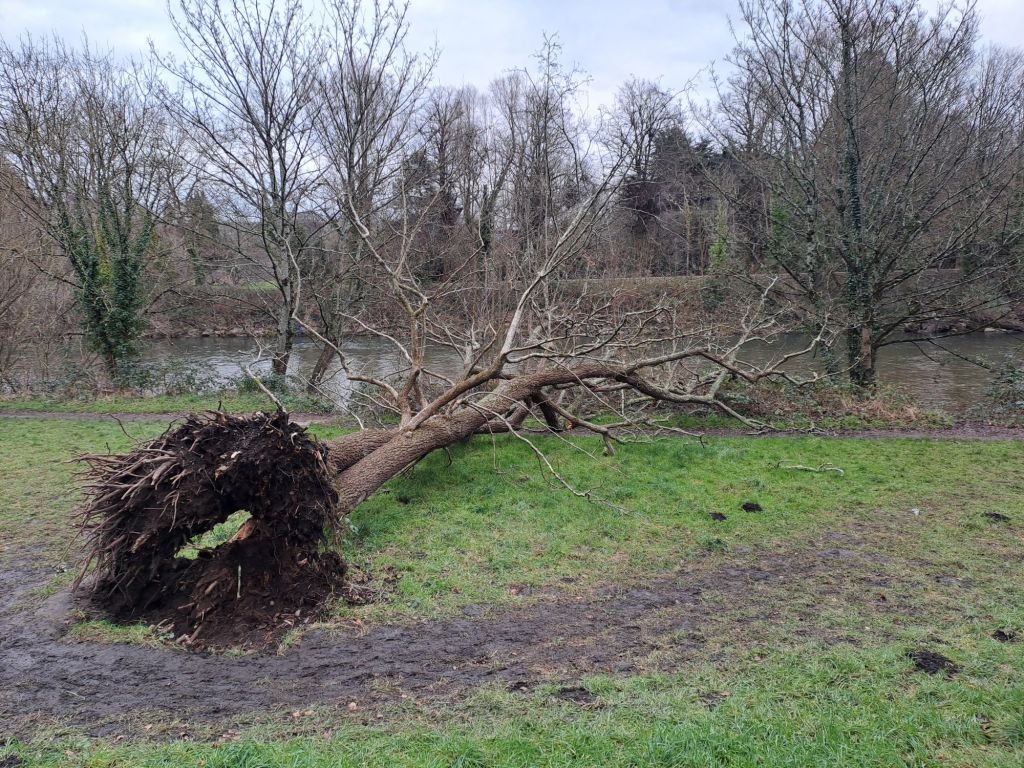
Earlier today, my perambulations took me through Bute Park, where there was quite a lot of evidence of storm damage, including this:
Fallen tree by the River Taff.
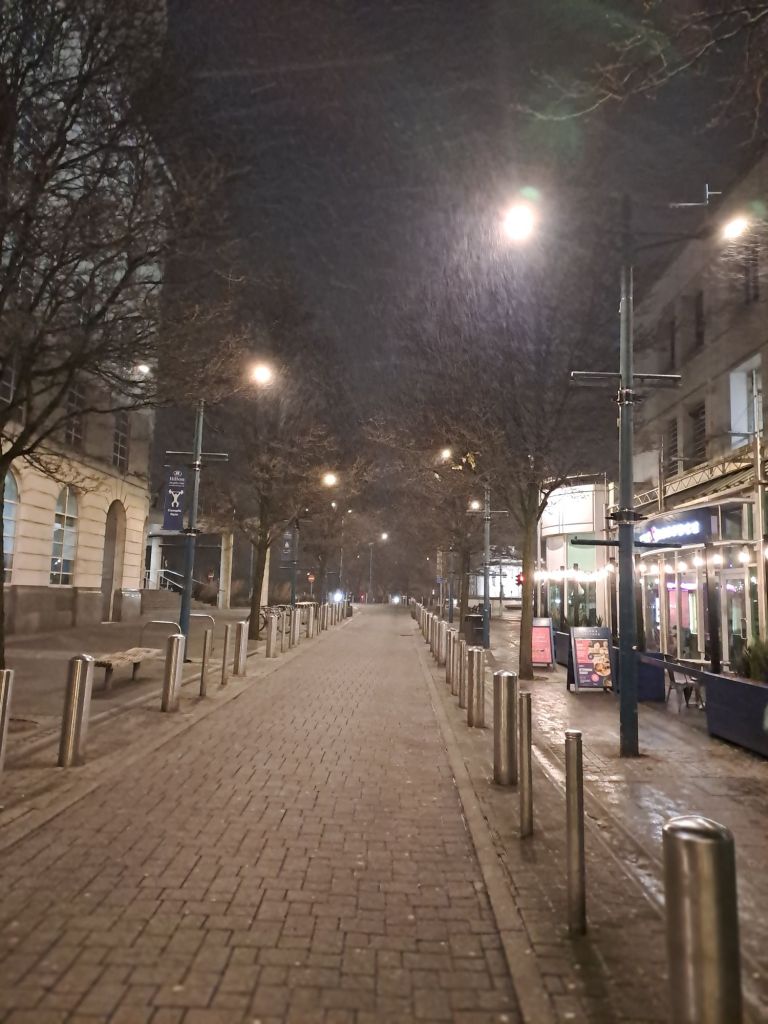
The snow is now falling steadily.
Snow on The Friary, Cardiff
I hope it doesn’t go on too long as I have to get a train later in the week, and even a light dusting seems to bring the rail network to a standstill!
With Nollaig na mBan yesterday that’s the festive season over for me, and time to resume my sabbatical. Joining the crowd of post-Christmas travellers at the airport, today I took my first flight of 2024, complete with last-minute change of gate, apart from which all went perfectly to plan. I won’t be returning to Barcelona immediately, however, as I have a things to do in various different parts of not-Barcelona.
I’m in Cardiff now, where it is fine and dry but very cold, and spending a few days in Cardiff to start with. After that I’ll be taking a train to London to attend a meeting at the Royal Astronomical Society, followed by dinner at the R.A.S Club on Friday 12th January.
Coincidentally, Friday’s dinner is rather appropriately at the Travellers Club, rather than the usual Athenaeum (which is unavailable for some reason). I couldn’t attend any of these occasions between October and December as I was in Barcelona, and for a couple of years. In fact I haven’t been able to attend much at all since the bicentennial dinner in 2020 because of the pandemic and subsequent workload issues. I’m not sure if I’ll be able to go to any others this year either, so I’m looking forward to Friday (despite having to pay the arrears on my subscription) because it is the Parish Dinner, when new members are elected. Owing to the arcane complexity of the rules, and the fact that it all happens after the consumption of a great deal of wine, this usually makes for an amusing occasion.
Meanwhile, in Maynooth, preceded by a few days of revision lectures and tutorials, the January examinations start on Friday 12th January too. Students will therefore be returning from their breaks, swapping the Christmas decorations for the austerity of the examination halls. Although I’m not involved in examinations this year, I’d like to take this opportunity to wish all students at Maynooth and elsewhere all the best for the forthcoming ordeals, and the same for all academic staff whose ordeal by marking will come in due course…
I got up at 3am this morning to take a bus to an airport, then a flight to Bristol Airport, then another bus to Bristol Temple Meads, and then a train to Cardiff in order to give a seminar. Now I’m in the middle of the reverse process, having a pint in Bristol Airport.
In case you’re thinking of using Bristol Airport at any time in the next 8 weeks, then please bear in mind that there are major roadworks on the approach road, so be sure to allow extra time. It took over an hour from Bristol Temple Meads this evening, more than double the usual time, and it’s only 8 miles…
I’m more than a little tired after all that, but it was still very nice to meet up with friends and former colleagues again. I was particularly delighted to learn that Professor Haley Gomez has been appointed Head of the School of Physics and Astronomy. Congratulations to Haley!
I’ll upload the slides from my talk when I get back to base. For the time being, however, I’m just going to chill in the departure lounge before my return flight.
Update: the return leg ran to schedule so here, as promised, are the slides for the talk I was invited to give:
Some time ago – was it really over a decade? – I wrote a piece about the optimum size of modules in physics teaching. I was still in the United Kingdom then so my ramblings were based on a framework in which undergraduate students would take 120 credits per year, usually divided into two semesters of 60 credits each. In Cardiff, for instance, most modules were (and still are) 10 credits but some core material was delivered in 20 credit modules. In the case of Sussex, to give a contrasting example, the standard “quantum” of teaching was the 15 credit module. I actually preferred the latter because that would allow the lecturer to go into greater depth, students would be only be studying four modules in a semester (instead of six if the curriculum consisted of 10 credit modules), and there would be fewer examinations. In short, the curriculum would be less “bitty”.
In Maynooth the size of modules is reckoned using the European Credit Transfer System (ECTS) which takes a full year of undergraduate teaching to be 60 credits rather than 120 in the UK, but the conversion between the two is a simple factor of two. In Maynooth the “standard” unit of teaching is 5 credits, with some 10 credit modules thrown in (usually extending over two semesters, e.g. projects). This is similar to the Cardiff system. The exception concerns first-year modules, which are 7.5 credits each because students take four modules in their first year so they have to be 30/4=7.5 credits each. The first year is therefore like the Sussex system. It changes to a five-credit quantum from Year 2 onwards because students do three subjects at that stage.
I find it interesting to compare this with the arrangements here in Barcelona (and elsewhere in Spain). Here the ECTS credit size is used, but the standard module is six credits, not five, and year-long projects here are 12 credits rather than 10. The effect of this is that students generally study five modules at a time (or four plus a project). To add to the fun there are also some 9 credit modules, so a semester could be made up of combinations of 6-credit and 9-credit chunks as long as the total adds up to 30.
Anyway, the main point of all this is to illustrate the joy of the sexagesimal system which derives from the fact that 60, being a superior composite number, has so many integer divisors: 2, 3, 4, 5, 6, 12, 15, 20, and 30. The Babylonians knew a thing or two!

It was more than four years ago that I passed on the news that the space mission LiteBIRD had been selected as the next major mission by the Japanese Space Agency JAXA and Institute for Space and Astronautical Science (ISAS).
LiteBIRD (which stands for `Lite (Light) satellite for the studies of B-mode polarization and Inflation from cosmic background Radiation Detection’) is a planned space observatory that aims to detect the footprint of the primordial gravitational waves on the cosmic microwave background (CMB) in a form of a B-mode polarization pattern. This is the signal that BICEP2 claimed to have detected nine years ago to muc excitement, but was later shown to be a caused by galactic dust.
At the time, I said that this was great news for a lot of CMB people all round the world that this mission had been selected – include some old friends from Cardiff University. Well, I’ve just seen a news item announcing a grant to Cardiff astrophysicists who will lead the UK involvement and develop the optical design.
The launch date has slipped into the 2030s (no doubt partly because of the pandemic) so I’ll be long retired before it happens, but the mission will last three years and will, like Euclid, be at Earth-Sun Lagrange point known as L2. It will be a very difficult task to extract the B-mode signal from foregrounds and instrumental artifacts but I wish LiteBIRD every success!
It’s very nice to have an opportunity, courtesy of JWST, to congratulate astronomers from my current institution (Maynooth, Ireland) and my previous one (Cardiff, UK) – as well as many others – or their involvement in stunning new observations of the Ring Nebula (aka M57 and NGC 6720), a planetary nebula. There is a full story on the Maynooth University website here detailing the involvement of Dr Patrick Kavanagh in the processing of the images and another on the Cardiff University website here about Dr Roger Wesson, who led the programme. Not surprisingly there has been a lot of news coverage about these wonderful images obtained with the NIRCam and MIRI instruments on JWST here in Ireland and in Wales and elsewhere.
A particular excuse for reproducing the pictures here is to try out the fancy “image comparison” tool on WordPress, which allows the reader – that’s you – to slide one picture over the other. Have a go!
This groovy visual shows two images side by side of the Ring Nebula. The image on the left shows the NIRCam view and the image on the right shows the MIRI image. The left image shows the planetary nebula as a distorted doughnut with a rainbow of colours with a blue/green inner cavity and clear filamentary structure in the inner region. The right image shows the nebula with a red/orange central cavity with a ring structure that transitions from colours of yellow to purple/blue. Picture credits ESA/Webb, NASA, CSA, M. Barlow, N. Cox, R. Wesson
The full paper describing these observations can be found on the arXiv here.
I made it back to Maynooth from Cardiff last night after a relatively uneventful journey, although sitting next to a hen party on a RyanAir flight en route to Dublin wasn’t exactly the most peaceful experience and I was quite tired when I got home.
Among the many things that have changed over the last few years is how much quieter Cardiff Airport is. When I arrived there at about 6pm yesterday there were only two flights on the departure screen. One of them (a KLM flight to Amsterdam) was then cancelled, so all the intending passengers had to leave the departure lounge and collect their checked luggage. My flight was on time, however, and was very full.
In a previous pre-pandemic existence I spent half my time in Cardiff and half in Maynooth so had to cross the Irish Sea twice a week. The airline I used in those days, FlyBe, went bust just before the pandemic. RyanAir has taken the Cardiff-Dublin route, deploying a Boeing which is much bigger than the Embraer used by FlyBe, but there is only one flight a day. The other routes previously operated by FlyBe from Cardiff (e.g. to Edinburgh) no longer exist. Bristol is relatively easy to get to from Cardiff so I suppose people go that way nowadays if they have to fly.
A consequence of the small number of flights from Cardiff Airport is that the shuttle bus to Cardiff City Centre no longer runs. That was the method I used to get to and from the airport in my previous existence when I had to cross the Irish Sea twice a week. That no longer being available, I travelled to the airport by train and bus transfer. It’s a lot less convenient than the old bus, and a bit more expensive, but went off without any hitches.
Anyway, it’s nice to be home. I plan to spend the day chilling and watching the hurling semi-final between Limerick and Galway. UPDATE: Defending Champions Limerick beat Galway by 2-24 to 1-18 and thus get to the final yet again. The other semi-final, between Clare and Kilkenny, is tomorrow.
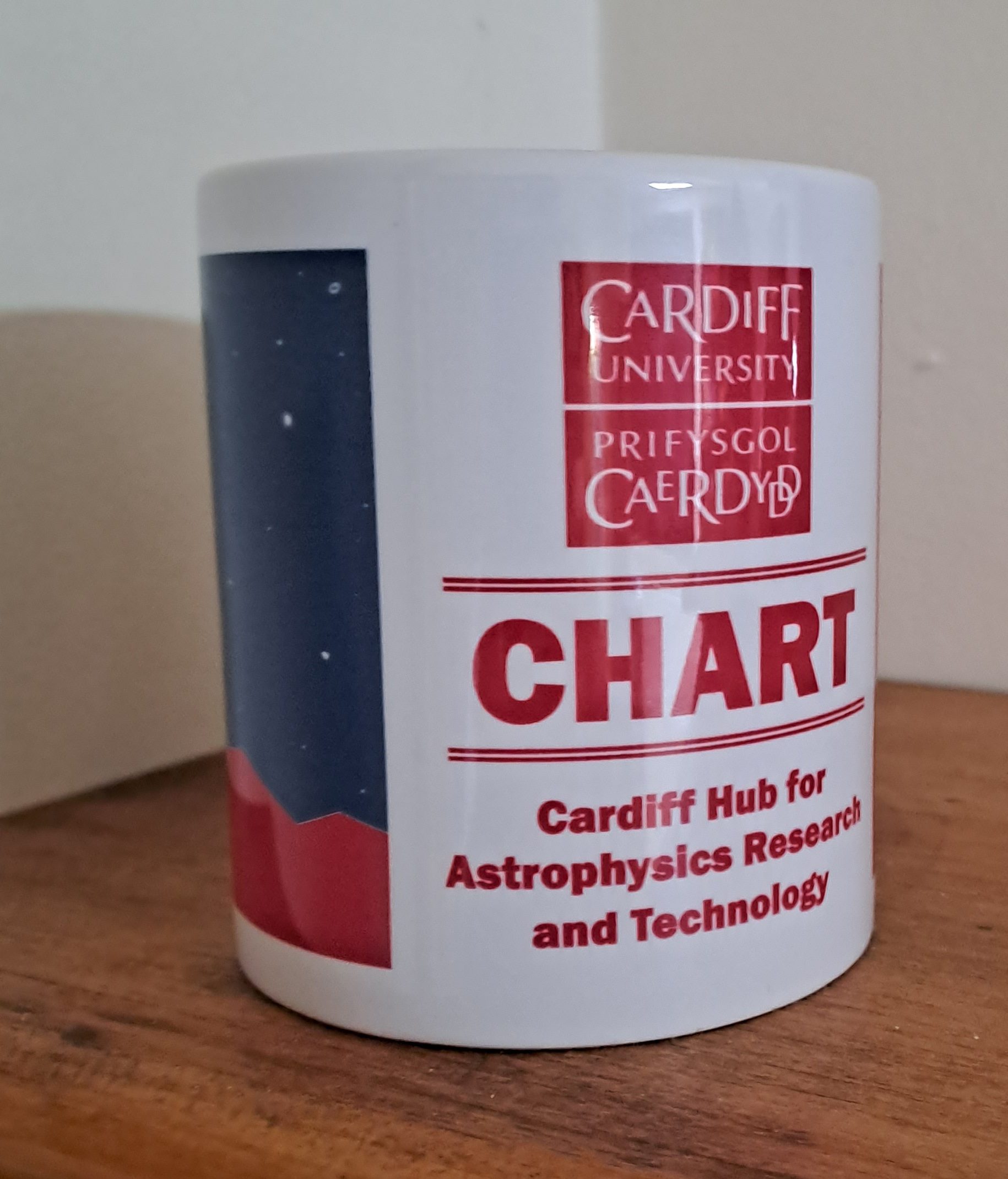
P.S. I forgot to mention that the good folk of Cardiff gave me a mug advertising CHART – Cardiff Hub for Astrophysics Research and Technology – which is new since my day.
The views presented here are personal and not necessarily those of my employer (or anyone else for that matter).
Feel free to comment on any of the posts on this blog but comments may be moderated; anonymous comments and any considered by me to be vexatious and/or abusive and/or defamatory will not be accepted. I do not necessarily endorse, support, sanction, encourage, verify or agree with the opinions or statements of any information or other content in the comments on this site and do not in any way guarantee their accuracy or reliability.