Archive for the Covid-19 Category

Thoughts on Lá Bealtaine

Posted in Biographical, Covid-19, Education, Maynooth with tags , , on May 1, 2021 by telescoper

Today, 1st May, Beltane (Bealtaine in Irish) is an old Celtic festival that marks the mid-point between the Spring Equinox and the Summer Solstice. It’s one of the so-called Cross-Quarter Days that lie exactly halfway between the equinoxes and solstices. These ancient festivals have been moved so that they take place earlier in the modern calendar than the astronomical events that represent their origin: the halfway point between the Spring Equinox and Summer Solstice is actually next week.

Anyway, any excuse is good for a Bank Holiday long weekend, so let me offer a hearty Lá Bealtaine shona daoibh!
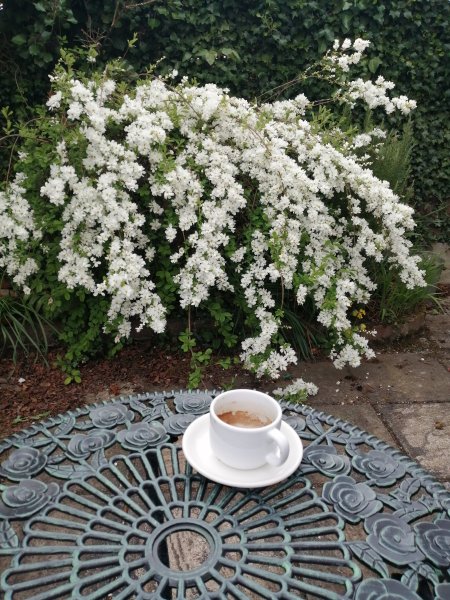
While not excessively warm, the weather is at least pleasant enough for me to have had my breakfast outside in the garden. As I was sipping my coffee I thought how much nicer it is to be in my own home during all this. The one really big positive about last year was that I managed to buy a house and move in during a few-month window when that was possible.

I put up a post last year on May Day that was dominated by Covid-19. I didn’t really imagine that we would still be under restrictions a whole year later, but I didn’t imagine that vaccines would be available so quickly either. Now it seems I will have the chance to register for my shot(s) next week with the view to getting a first dose sometime in June. Possibly.

The precise timing of my vaccination shot isn’t particularly important to me at this point, as it looks like I’ll be stuck at work all summer with no possibility of a holiday (as was the case last year). On the bright side, my three-year term as Head of Department ends after next academic year so there is some light at the end of the tunnel.

Despite the slow progress with vaccination – currently only about 28.5% of the adult population have received a first dose – and the very high case numbers – about 450 per day on average, and not decreasing – Ireland is now entering a phase of modest relaxation. I think this is far too early and that there’s a real risk of another surge here before any kind of herd immunity is achieved. I hope I’m proved wrong. At least it doesn’t look likely to get as bad as India, where the pandemic is truly out of control.

Workwise we have just completed the penultimate teaching week of Semester 2. Monday is a Bank Holiday so we have four days of teaching left, before a Study Week and the start of examinations. The last week will be busy with assessments and other things, though I imagine most lecturers will be doing revision rather than presenting a lot of new material. In the last few classes. That’s what I plan to do anyway.

Examinations Online Timed Assessment start on 14th May. I have three to supervise and then mark so much of the rest of May will be taken up with that, which has to be done before the Examination Boards in June. After that I suppose we’ll find out what our Lords and Masters have in mind for the start of next academic year…
Vaccination Machinations

Posted in Biographical, Covid-19 on April 30, 2021 by telescoper

As Ireland’s Covid-19 vaccination programme stumbles along, well behind schedule, the Irish Government keeps saying – despite all the evidence – that it will meet its target of 82% of the adult population have received a first dose by the end of June. Actually they say that “will either have received or been offered a dose” by then. This may end up with people registering for their shot and being counted if they are given a date to receive it some time later in the year.

As of Wednesday 28th April, 1,067,378 people have received their first dose in Ireland. That will have to increase to to over 3 million to reach the 82% target by the end of June. There is also the fact that only 419,655 have had their second dose so not all the shots delivered in the next two months will be first doses. Looking at the current rate of vaccination, which is around 35,000 per day – it does not seem at all likely to me that it will be possible to hit the target. The Government is claiming 450,000 doses per week in June, which seems not just optimistic but delusional. I hope I’m proved wrong.

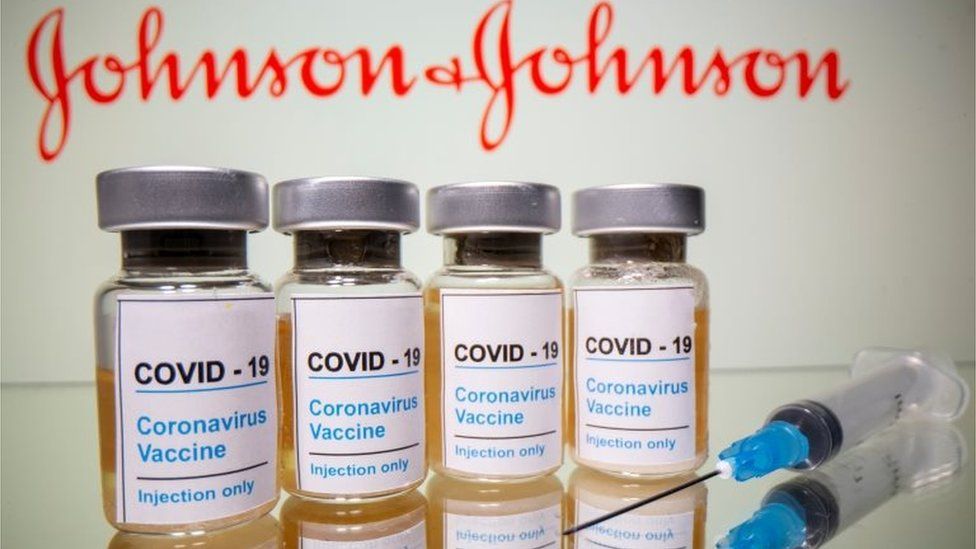
Recently the HSE recommended that two of the available vaccines – AstraZeneca and Johnson & Johnson – can only be given to the over-50s, which is the next cohort due to be allowed to register for vaccination (starting next week) and to which I happen to belong. If the Government is to reach its target it will have to use almost all the shots it receives in the next two months, including AZ and J&J. The problem this poses is: (1) the over 50s are next in line, according to the age-based priority system being implemented; and (2) most of the 600,000 J&J doses coming to Ireland won’t arrive until late June.  The number of people currently unvaccinated in the 50-59 age group is about 550,000. The obvious suggestion would therefore to be to make the over-50s wait for the J&J to arrive.

(Of course the over-50s also qualify for the AstraZeneca vaccine, but I won’t discuss that because the supply of that has been so unreliable that it would seem to me to be unwise to count on it for anything. There’s a strong case for just forgetting about AZ and giving the surplus doses to countries that need them more, e.g. India. I also wish the EU well in its legal case against AstraZeneca for multiple and egregious breaches of contract.)

Anyway, unless the advice on use of J&J is changed, the only way to use most of the J&J doses is on the fifty-somethings whose will have to be delayed in order to wait for the doses to arrive. If the decision is made to do this then I won’t be vaccinated until the end of June or later, even if the promised deliveries arrive on schedule. If J&J are as unreliable as AstraZeneca then I may not be vaccinated until much later. The upshot of this shot is that it is a single-shot, so recipients would count as fully vaccinated immediately.

This would also mean  Pfizer/BioNTech and Moderna doses sitting around unused, so there is a case for moving on to younger cohorts to use up these doses until the J&J doses arrive for us oldies. I expect to be able to register for my vaccine next week but it’s anyone’s guess when I’ll actually be able to get my jab. I have even toyed with the idea of going back to Cardiff to get my vaccination there…

I’m pretty much resigned at this stage to having to wait at least another two months to receive my jab, and for that to probably be the J&J vaccine, but the vaccination programme has changed umpteen times during the course of April and it could change again in May. We’ll see. We live in interesting times.


R.I.P. Cousin Itt

Posted in Covid-19, Television with tags , , on April 19, 2021 by telescoper

I was sorry to hear of the recent death at the age of 84 of actor Felix Silla, best known for his role as Cousin Itt in the 1964 TV series The Addams Family in which he pioneered the lockdown hairstyle that is proving so popular these days.

Will we return to on-campus teaching next academic year?

Posted in Biographical, Covid-19, Education, Maynooth on April 17, 2021 by telescoper

As we approach the end of the 20/21 academic year during which most of our teaching has been online rather than face-to-face, a number of students have been asking me whether we will “get back to normal” next September for the start of next teaching year.

The answer I give to this is that I don’t know. It depends entirely on the progress of the battle against the Covid-19 pandemic and that has so far proved to be difficult to predict.

Over the last week, however, the news has made me lean very strongly towards a negative answer. I am now quite confident that there will be no (or at most minimal) in-person teaching at Irish universities in September 2021.

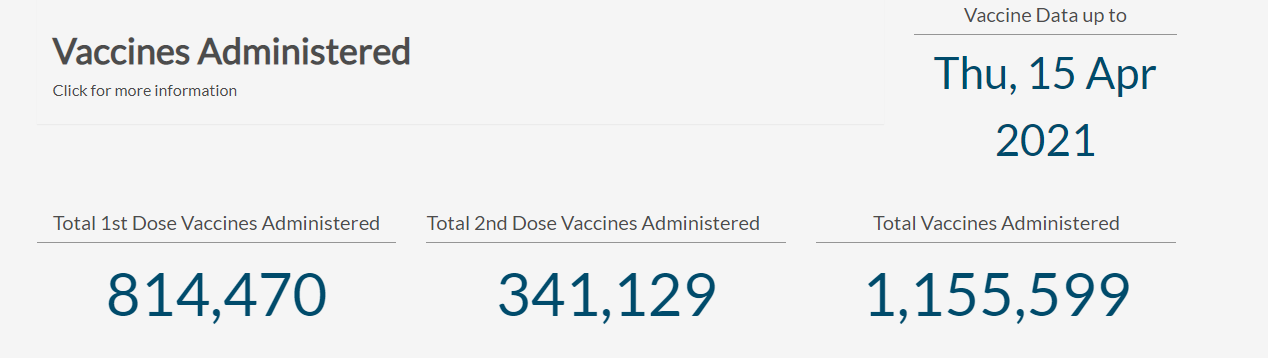
The reason I feel this is the shambolic state of Ireland’s vaccination programme. According to the updates page, as of 15th April, Ireland has administered 1,155,599 vaccine doses, including 814,470 first doses and 341,129 second doses. The figure for total doses on 1st April was 893,375. That means in the first two weeks of April just 262,224 doses have been given. The HSE’s target for April is 800,000 doses; to reach that the daily rate of dishing out vaccinations has to more than double in the second half of the month.

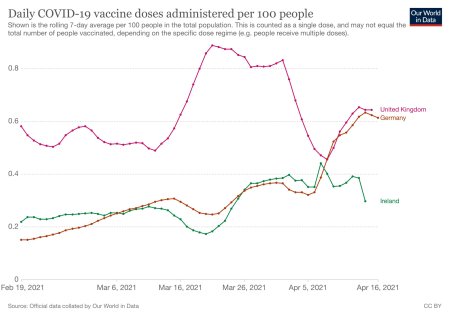
The slowness of the rollout is partly due to a pause in use of the AstraZeneca vaccine because of concerns about blood clots and a decision by Johnson & Johnson not to deliver its promised doses for similar reasons, leaving a shortfall in supply. But that’s not the only reason. If it were then the vaccination programme in Ireland would not be stalling at the same time as Germany’s has been accelerating.

There has been an absurd amount of dithering and disorganization in the Health Service Executive and at Ministerial level which, together with incoherent messaging, has led to administrative chaos.

The AstraZeneca vaccine will in future only be offered to those over the age of 60, with an impact on the timetable for other age cohorts. Last week the HSE announced that Irish people in the general population under the age of 60 will not get their first jab (presumably either Pfizer or Moderna) until June “at the earliest”. It seems – to say the least – unlikely that 80% of the population will receive a vaccine dose by the end of June (the official target) if they’re not going to start on the under-60s until the beginning of that month.

More recently it has been announced that the HSE is also considering changing the correct rollout programme yet again, this time moving people aged 18-30 up the batting order. (Currently the scheme for the general population is organized by age; those in the 65-69 cohort are currently registering.)

I can see the argument for doing that. Younger people tend to have a bigger cross-section for interaction, as it were, and therefore contribute more to the spread of the virus. Prioritizing them would therefore lower the rate of community transmission. On the other hand, moving younger people to a higher priority will have the effect of moving older people down it. But surely this should have been considered long before now?

If the decision is taken to do this people aged 30-50 will not get even their first dose until much later than they would under the current programme, possibly not until the autumn. The vaccination programme plays two roles: one is to protect individuals from serious illness and the other is to slow the transmission of the virus. The former approach means to prioritize the older cohorts while the second pushes in the opposite direction. It’s a difficult question and I think it’s sensible to consider moving younger adults up, though it’s not obvious to me that on balance it would be advantageous.

All of which brings me to the reason I think we won’t be doing on-campus teaching next year, at least for the first Semester. If students (who are mainly aged 18-30) are vaccinated first then most academic staff will probably not be vaccinated by September. If most academic staff are vaccinated by September then probably most students won’t be. Either way it doesn’t look good for a return to campus. I know for a fact that some Irish Universities are already planning for online teaching at the start of the 21/22 academic year. I don’t know what the plans are at my own institution.

I can’t speak for anyone other than myself, but there is I am not going to support a return to face-to-face teaching on campus unless and until a majority of staff and students have been vaccinated. And I am certainly not going to return to campus until I have had both jabs. I am in the 55-60 cohort and may therefore get my first shot in June and second doses by September (although, to be honest, I wouldn’t bet on either of those possibilities).

Of course there are much wider issues to be taken into consideration than what happens in third-level institutions so I’m not saying that this should be a main policy driver, but it’s important to be aware of the ramifications. In previous manifestations of the rollout programme, those involved in delivering education where in a high priority group, but they are no longer. In lowering the priority for vaccination teaching staff, the Government has to accept that it is lowering the priority for a return to campus in September.

A New Horizon

Posted in Covid-19, Maynooth on April 14, 2021 by telescoper

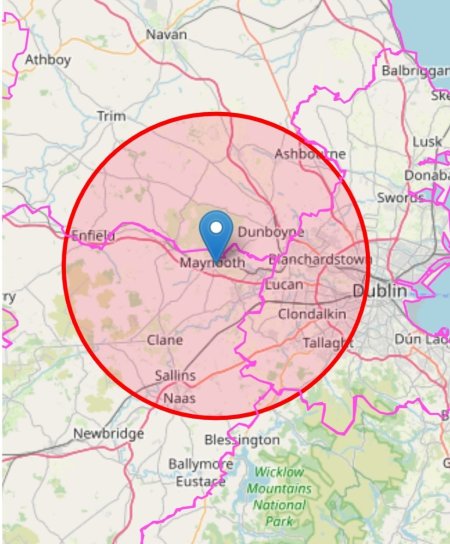
With the (very slight) relaxation in Covid-19 restrictions in Ireland starting this week my horizon had increased from the previous 5km to a new 20km radius:

In fact the new rule says “You can travel within your county or up to 20 km from your home”. I could therefore travel even beyond Naas* remaining within County Kildare, and almost to Dublin City Centre or up to Ashbourne in County Dublin and County Meath respectively. The excitement of it all!

*Naas is the location of the hospital where I get my knee treatment, but they’re not doing routine procedures right now so I’ve got no reason to go there.

Spring Return

Posted in Biographical, Covid-19, Education, Maynooth on April 12, 2021 by telescoper

After a few days off last week following the Easter Bank Holiday weekend it’s time to get back into the swing of things for the four weeks of teaching term that remain. It’s back to school today for all school students in Ireland too, so good luck to them on their first day in the classroom since Christmas!

As well as (remote) lectures the next four weeks will involve us getting our papers ready for the examination period which starts on 14th May this year. All our examinations will be remote online timed assessments (as indeed they were last year). I’ve been teaching three modules this Semester so have no fewer than six examinations to write: three main exams plus three repeat papers for the resit period in August. The decision has already been made to make all the repeat exams online so at least these will be of similar style to the original May versions.

Then it will be marking and Exam Boards and various other things heading into the summer break. Hopefully I will get some holiday this summer as I didn’t get any at all last year. On the other hand there’s a strong likelihood that Senior Management will think of something else for Heads of Department to do that will make this impossible.

What happens at the end of summer all depends on Covid-19 of course, and specifically how Ireland’s vaccination programme goes. My personal opinion is that we should continue with remote teaching until all staff and students have had their jabs, which is unlikely to be the case before September at the current rate, but you never know. The speed of vaccination shows signs of increasing though, so we might be able to do it.

Despite the more rapid progress with immunisation over the other side of the Irish Sea, UK university bosses are apparently complaining that they haven’t got a date for returning to campus. This surprises me as they run on roughly the same calendar as here in Ireland so there are only a few weeks of teaching left there too. Why bother to go back at such a late stage? Unless of course it’s so they can charge students for a full term’s accommodation…


On Vaccination in Ireland

Posted in Covid-19 with tags , , , on March 31, 2021 by telescoper

Following from my weekend post about issues with Covid19 vaccination, which seems to have ruffled a few feathers, I thought I’d just mention a couple of recent developments.

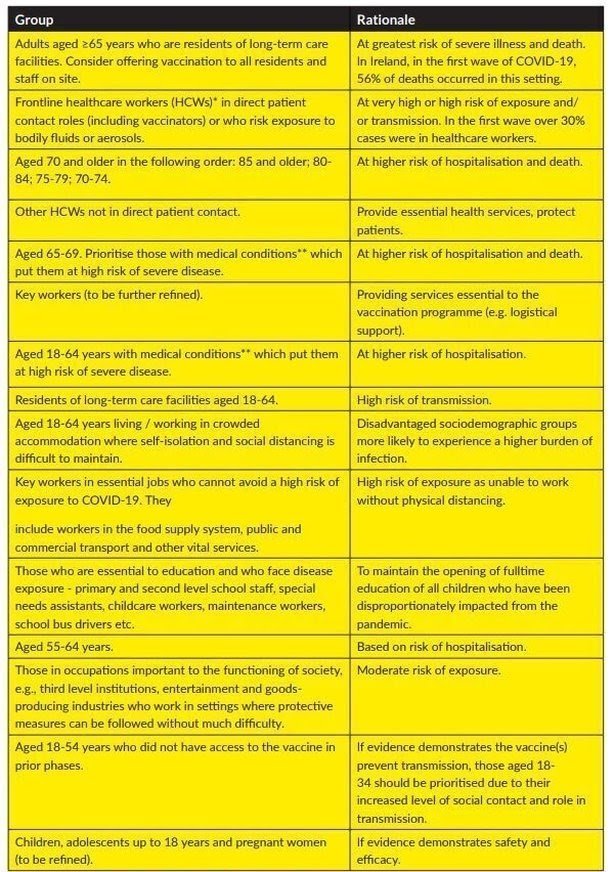
The first is that on Tuesday (yesterday) the Irish Government decided to change the way it vaccinates the rest of the population. The previous plan was rather complicated with a number of groups to be vaccinated in order of priority:

That plan has now been scrapped and after the current groups 1-3 are completed it will revert to a simpler scheme with priority determined only by age. As an oldie I will benefit from this, moving up several steps in the pecking order as a consequence of the decision.

Frontline workers such as teachers and Gardaí are dismayed by this decision. On the news just now various folk were trying to argue that the change is for health policy reasons, stating that the prime factor in risk for Covid-19 is age. Actually, it isn’t. The prime factor is exposure to the virus.

What I mean is that the probability of dying from Covid-19 if you haven’t been infected is zero: 100% of those suffering death or serious illness from Covid-19 have been in contact with the virus. Someone who is 60 years old but able to work effectively at home at far lower risk of exposure than a 35 year old schoolteacher.

The real reason for the change is that Ireland does not possess a system that can be used identify groups by occupation in an efficient way. Doing it by age is far simpler and would lead to a much more rapid rise in the fraction of the population immunized. Sometimes decisions have to be made for such practical reasons, but I do wish certain people were more honest.

The slow rollout of the vaccine in Ireland should have provided the Government to work out how to implement their original strategy. Obviously they decided that they couldn’t.

Anyway, for myself, I am pleased that it now looks quite likely that I’ll get at least one jab by May. Assuming the vaccine supply holds up, of course.

I thought I’d end with a thought following on from my earlier post. Some people will ask whether I would have the AstraZeneca vaccine given my views about the company’s behaviour and the lower efficacy of the vaccine as compared to others available.

I think there are two motivations for getting vaccinated. One is self-preservation. I want to protect myself as much as possible. If I had the choice of vaccine for this reason I would pick Moderna or Pfizer-BioNtech but would accept AZ if that was the only one available. As things stand, over 75% of doses administered in Ireland have been Pfizer-BioNtech,

The other motivation is to help reduce the transmission of the disease. For that even a low efficacy vaccine would play a part. If the only shot available offered just 50% protection I would still take it, as if everyone did so the population dynamics would still be significantly slowed.

It’s a similar thing with face masks, actually. Their role is only partly to protect the wearer. The other part is to protect everyone else.

So on both grounds, yes I would take the AZ vaccine if that was the only one on offer, but if I had the choice I would pick a better one. I feel the same way about the Johnson & Johnson vaccine, which will start to become available in Ireland very soon.

Per Ardua ad AstraZeneca

Posted in Covid-19 with tags , , on March 28, 2021 by telescoper

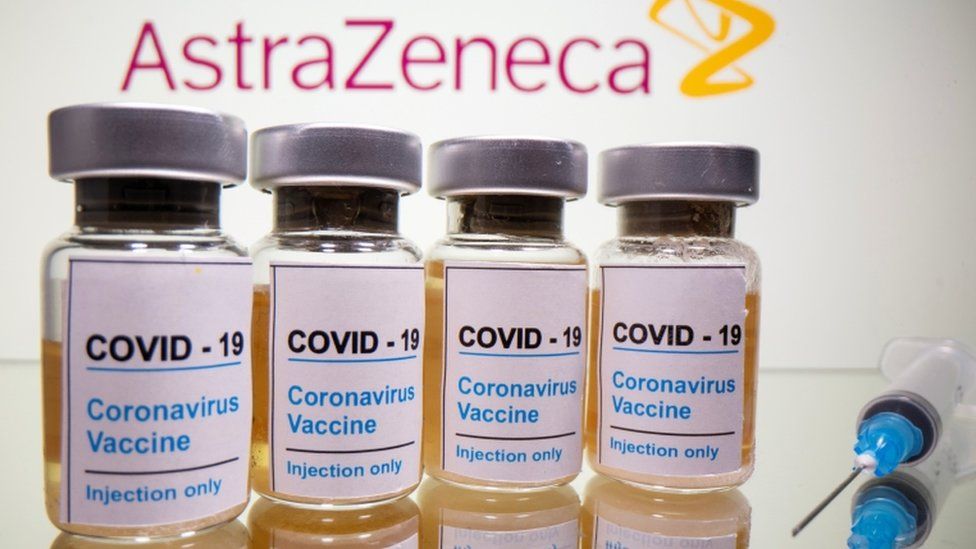
The extent to which AstraZeneca’s dishonesty concerning its purchasing agreement with the EU is becoming clearer, and the company is increasingly engulfed by a PR disaster resulting from this and misleading claims about the efficacy of its Covid-19 vaccine (see here, here, here, etc). Perhaps they will now get their finger out and actually honour their contract?

Here in Ireland there is expected to be a delivery of “large volume” of doses of the Astra Zeneca vaccine next week, though I doubt it will be as large as their contractual obligations specify. We’ll see what actually happens. There isn’t much confidence in AstraZeneca around these parts I can tell you.

This morning the Covid-19 tracker app for Ireland was updated with the latest vaccination figures for Ireland (25th March) which are as follows:

  • First doses: 548,945
  • Second doses: 211,223
  • Total: 760,168

That is definitely speeding up, which is welcome. Not as fast as the UK, of course, who have been the beneficiaries of 21 million doses exported by the EU. That’s about 2/3 of the total shots administered there. The number exported from the UK to the EU is zero. Nada. Zilch. The same is true of the USA. There’s no doubt in my mind who the bad guys are.

Anyway, not to dwell on that issue I was wondering when I might get around to having a jab myself. I am not particularly high in the pecking order, but from April onwards Ireland is supposed to receive about a million doses per month. Assuming that this actually happens, and AstraZeneca doesn’t crap out yet again, I estimate they should get to me in May (2021).

Another question that occurred to me, given that under-18s are not given the current vaccines – is how many doses are needed to vaccinate the adult population of Ireland. The total population of Ireland is about 5 million but that includes quite a large number of children. Looking at the 2016 census I see that the number of people living in Ireland who are under the age of 18 is about 1.25 million. That means to fully vaccinate the entire adult population will take about 7.5 million doses. Currently about 14.6% of the adult population have received one dose, and about 5.6% have received two. We probably won’t get to anything like full vaccination of the adult population until the autumn.

Let me just correct yet another misunderstanding often presented in the UK press concerning unused vaccines. The number of doses imported to Ireland currently exceeds the number administered by over 100,000, but that does not mean that these vaccines have been refused or wasted. Because the vaccination programme here follows the manufacturers’ guidelines, and because the supplies have been unreliable (especially from AstraZeneca), there is a buffer to ensure that a second dose will always be available on the necessary timescale for anyone who has been given the first. That means that at any time there will always be some doses in storage. It wouldn’t be necessary to do this if we could trust the delivery schedule, but there you go.

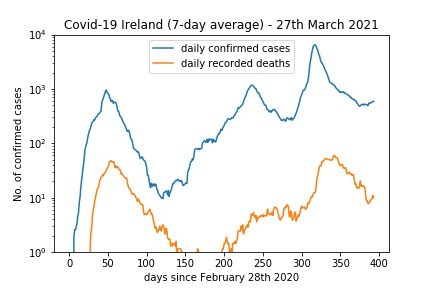
I wouldn’t be too worried about the slowish pace of vaccination were it not for the fact that new Covid-19 cases in the Republic are on the way up again:

The demographic for these new cases is quite young (a median age of 32 yesterday) and the increase almost certainly arises from lax adherence to the restrictions by a subset of the population. The relatively young age distribution and the fact that those at greatest risk of death or serious illness are being vaccinated should mean that the mortality figures remain low even as cases rise. Although the increase in new cases is worrying it is nowhere near as bad in Ireland as on the Continent of Europe and elsewhere around the world (especially Brazil). More worrying still is the likelihood of vaccine-resistant strains arising through mutation. Indeed there is already some evidence that the AstraZeneca vaccine is not as effective against the B.1.351 South African variant, although this has been disputed. Let’s hope that all the AstraZeneca doses administered so far don’t turn out to be useless.

It seems to me that it’s very likely that in order to deal with variants we’ll be having regular (perhaps annual) updated vaccine shots for the foreseeable future, as the only way to stop mutations happening is to immunize a large fraction of the world’s population and that will take a considerable time.

A Year of Closure

Posted in Covid-19, Education, Maynooth, Mental Health with tags , on March 12, 2021 by telescoper

Today is 12th March 2021, which means it is exactly one year since Maynooth University campus closed because of Covid-19. Last year 12th March was on a Thursday and I remember doing my Computational Physics lecture in the morning and a computer lab in the afternoon and then hearing we couldn’t go back to teaching the following day. After that, as it is this year, it was the Study Week break (which includes the St Patrick’s Day holiday). Last year we all trued to use the opportunity to move all our teaching online.

I certainly didn’t imagine that a full year later we would still be working from home. Although the current lockdown isn’t as strict as that of last Spring we’re still told not to come on campus unless it is strictly necessary, and all teaching remains online.

When the campus closed last year I was living in a small flat with no internet connection, so the only way I could do my teaching was using my mobile phone data. It wasn’t great but I did the best I could.

At least I was able to use the semi-unlocking of the lockdown in late summer to complete the purchase of a house. I’ve been much more comfortable doing teaching from here for the last six months or so, although not leaving the house except to do shopping has led to an extreme sense of isolation which is not all ameliorated by endless online meetings via Zoom and Teams. That, together with the heavy workload, is all very wearying. It further annoys me how many people think “working from home” means not “working very much” or not “working at all”. What it does mean is never getting away from your work, except when you’re asleep.

I’ve noticed over the last few months that the agoraphobia from which I’ve suffered sporadically over the years has very definitely returned. Agoraphobia can be defined as:

…an anxiety disorder characterized by symptoms of anxiety in situations where the person perceives their environment to be unsafe with no easy way to escape. These situations can include open spaces, public transit, shopping centers, or simply being outside their home.

My long-term agoraphobia has been about the threat of physical violence caused by a traumatic event in the past, but now it is more general. I see too many people not taking proper precautions (face masks, social distancing, etc) that it gets me very anxious for a new reason. Supermarkets are bad enough, but it’s more general. I’m now starting to realize that I’m going to find it difficult ever to return to a “normal” life of crowded lecture theatres and campus buildings after this pandemic ends, whenever that happens.

This morning I did a tutorial (via Teams) which was my last teaching session before the mid-term break. I was exhausted even before term started so it has been a very difficult six weeks. It’s not just the teaching, it’s also the relentless stream of demands from upstairs for other things to be done. There seems very little understanding from that direction of what life is like on the front line, to be honest.

My appointment as Head of Department for Theoretical Physics was nominally three years. I am now about halfway through that term and can’t wait for it to end.

Unfortunately there isn’t much light at the end of the Covid-19 tunnel. Case numbers in Ireland remain high, and are falling slowly at best; they have actually been increasing for the last few days. Vaccination rollout is also very slow, thanks to supply issues (chiefly with AstraZeneca).

I am now fairly confident that teaching at least for the Autumn Semester of 2021/22 will again be online, as there is little chance of staff being vaccinated by the end of the summer. I know colleagues in other Irish universities who are planning for this eventuality too.

A Year of Covid-19 in Ireland

Posted in Biographical, Covid-19, Maynooth, Politics with tags , , on February 28, 2021 by telescoper

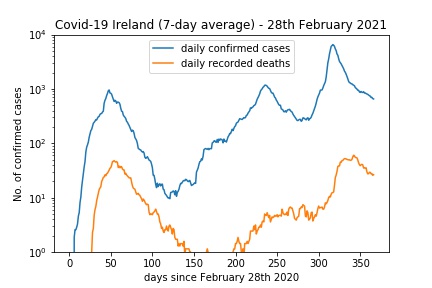
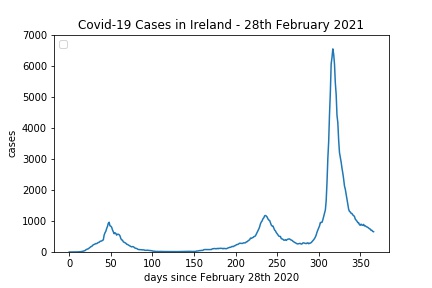
Last night I was updating my Covid-19 statistics and plotting new graphs (which I do every day – the results are here) when I noticed that I now have 365 data points. The first officially recorded case of Covid-19 in Ireland was dated 29th February 2020 (although there is evidence of cases in Ireland before that, including one of community transmission). I can’t actually mark the anniversary of that date exactly – for obvious reasons – but it seems a good point to look at what has happened. I didn’t actually start doing a daily update until 22nd March when we were all in the first lockdown but there were relatively few cases in the intervening time and it was possible quite easily to fill in the earlier data.

Little did I know that I would be doing an update every day for a year!

Anyway, here are today’s plots:


On a linear y-axis the cases look like this:


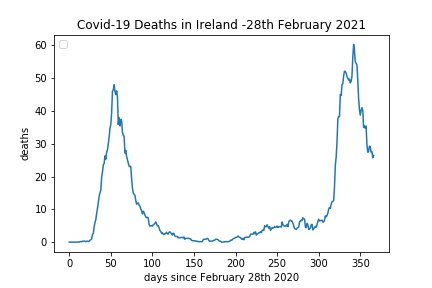
The numbers for deaths on a linear scale look like this:


The recent trend is for a slow decline in new cases, hospitalizations, ICU referrals and testing positivity rates which is all good news. The rate of vaccination- severely limited by supply issues – is starting to increase and from April to June is expected to reach a million a month and then two million a month thereafter. There is therefore some grounds for optimism that a significant fraction of the population will be immunized by the end of the summer, assuming the supply ramps up as expected and there are no more dirty tricks from certain pharmaceutical companies.

Comparing with the situations elsewhere I’d say that Ireland has in broad terms handled the pandemic quite well: worse than some (especially Scandinavian countries) but better than many. It does seem to me that there have been three serious errors:

  1. There has never been – and still isn’t – any sensible plan for imposing quarantine on arrivals into Ireland. A year on one is being put in place but it is simply ridiculous that an island like Ireland failed to do this earlier.
  2. Those lockdown measures that have been imposed have been very weakly enforced, and have often been accompanied by confused messaging from the Government, with the result that a significant minority of people have simply ignored the restrictions. The majority of the population has complied but the others that haven’t have kept the virus in circulation at a high level: the current daily rate of new cases is 650-700, which is far too high, and is declining only slowly.
  3. Finally, and probably the biggest mistake of all, was to relax restriction for the Christmas holiday. The huge spike in infections and deaths in January and February is a direct result of this catastrophic decision for which the Government is entirely culpable.

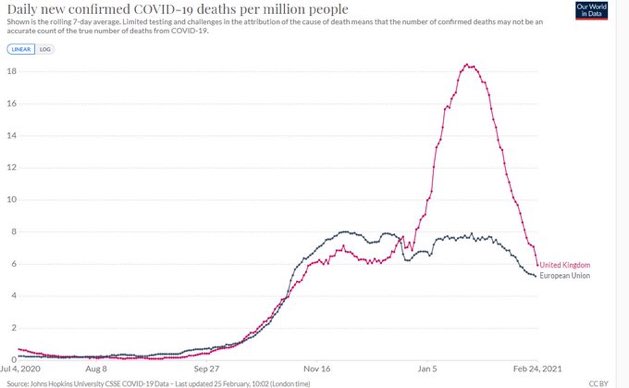
The situation in the United Kingdom with regard to 3 was even worse:

The excess mortality from January is a direct consequence of Boris Johnson “saving Christmas”. The difference in area under the two curves tells you precisely how many people he killed. I hope politicians on both sides of the Irish Sea are one day held to account for their negligence.

As for myself, I am reasonably optimistic for the future, and not just because Spring appears to have arrived. I have found the Covid-19 restrictions very irksome but I am fortunate to be in a position to cope with them reasonably well, especially now that I have my own house with a garden in a nice quiet neighbourhood.

It has been very hard work doing everything online, and it’s essential to take a break from the screen from time to time, but the upside of that is that by keeping busy you avoid becoming bored and frustrated. One thing that does annoy me though is the number of people who thinking that “working from home” means “not working at all”. I’m sure there are many others, especially in the education sector, who will agree with me!

Although I have coped reasonably well in a personal sense I still very much want to get back to campus to resume face-to-face teaching. I like talking to students and find teaching much more rewarding when there is a response. Moreover, since we’re now going to be off campus until the end of this academic year, that means that a second cohort of students will complete their degrees and graduate this summer without their lecturers being there to congratulate them in person and give them a proper sendoff into the big wide world. I find that very sad.

Anyway, tomorrow we start week 5 of the Semester, which means 4 weeks have passed. That means there are two weeks before the Study Break, the halfway point of teaching term, and we are one-third of the way through the semester. Life goes on.