The following graphic was recently used by a television programme to show the parts of England in which special Covid-19 restrictions are imposed:

Can any of you spot the deliberate mistake?
See below for the answer..
The following graphic was recently used by a television programme to show the parts of England in which special Covid-19 restrictions are imposed:
Can any of you spot the deliberate mistake?
See below for the answer..
Yesterday the UK Government reported that there were 119 Covid-19 related deaths in the United Kingdom:

In other news, it was also announced yesterday that Stuart Broad and I have now taken 500 Test wickets between us…
Follow @telescoperThere was a welcome announcement last week of a package of supports for further and higher education institutions and students in Ireland to cover costs incurred by third level institutions during the Covid-19 pandemic and enable further and higher education students to return to college this September.
There wasn’t much sign of any help at all coming under the previous Government, so this is perhaps a sign that the new Department of Further and Higher Education, Research, Innovation and Science might be a force to be reckoned with in the new administration.
If this funding is to achieve its aim, however, it will have to reach its targets very quickly. The new academic year is to commence at the end of September, which is just two months away. The slice that is intended to go directly to students to help them buy laptops or tablets can probably be spent quite quickly, but the money intended for colleges and universities to buy equipment will take much longer to filter through.
Speaking for myself, as Head of a Department of Theoretical Physics I’d say we desperately need better video equipment for both live and recorded material. At present we have no lecture capture facilities at all in any lecture theatres. We also need graphics tablets to help lecturers show mathematical working via remote means. There is likely to be a big rush for this sort of thing between now and September, and no guarantee we will have it in time for the start of lectures.
You might well ask `why don’t you buy this stuff now?’. The answer is simple: I haven’t got the money!
Things are even tougher for schools. Here there is another big support package on the way, this time of €350 million to allow them to open at the end of August. Getting kids back to school is obviously important not only for their education but also to allow their parents to return to work. However, the time available to prepare all the things necessary is just a month, even shorter than it is at third level.
Among the funds being made available is €75 million for `building works’. I’m sure that investment is very welcome, but can it do anything between now and the end of August? It’s actually rather difficult to spend money that quickly if due process is followed. Just look at how the UK government has squandered tens of millions on phony contracts, such as the £12 million it blew on a Covid-19 tracing app that never worked.
On top of that 1000 new schoolteachers are going to be provided. Will they be recruited in time?
Another announcement to appear last week contained guidance for further and higher education on returning to on-site activity in 2020. This guidance has been interpreted in the media in a rather unhelpful way, causing many of my colleagues to go into a panic. This, for example, from the Irish Times:
Physical distancing rules of two metres will apply on college campuses from September in a move which will severely limit the ability of universities to hold lectures and graduation ceremonies.
A strict requirement of 2 metre distancing at all times would indeed severely reduce the capacity of lecture theatres, but if you look at the guidance it is considerably more nuanced than this. The real problem with this guidance is that it is so vague. We can only hope we get something a bit more concrete soon so we can plan for September. Alternatively we could just wing it. All of it. At the moment this seems the only viable strategy.
The time of Covid-19 was already an “interesting” time to be an academic in Ireland but yesterday it got more interesting still, as news emerged that this year’s (estimated) Leaving Certificate results will not be published until 7th September, which is three weeks later than usual. The first round of CAO offers will be made on 11th September. All this is about three weeks later than the usual cycle of examinations and results.
Here at Maynooth University the start of the academic year has been delayed by one week to September 28th, so the three week delay in Leaving Cert means we have to speed the processes up of getting everything in place for new students to start by two weeks. That is going to be a challenge, and even if we manage it we will only find out very late in the day how many students we have to accommodate in first-year lectures.
The current plan for teaching next semester at Maynooth University is that all modules will be allocated the same timetable slots and rooms as last year. However, most lecture rooms have had their capacity reduced by more than half. Lecturers need to know how many students they have in order to decide how to use the available lecture slots and how to strike a balance between live and online delivery.
To give an example, I had about 90 students in my first-year module last year for which I had three lectures per week in Physics Hall, which has a normal capacity of 90. Next year the capacity of this room is likely to be around 30 with social distancing so. if I have the same numbers as last year, I will have to split the class into three groups and have one weekly session with each group. The material not covered live will be put online. I’m planning on that basis now, but if I find we have more students in Year 1 than last year I’ll have to have a Plan B. I won’t know that until just before teaching starts.
And then there is the possibility that teaching will actually start later for first-year students, requiring the lecture content to be revised. That’s not the current plan at Maynooth University, but a lot can happen between now and September…
We do indeed live in interesting times.
Of course I’m not the only one to be facing such challenges. Mine is a relatively small class by first-year standards and other bigger courses will experience far more serious difficulties.
If any prospective student is getting worried reading this, I can promise you that we will be doing the best we can to provide the best education we can in whatever circumstances we find ourselves in this September. Please bear in mind that workloads on academic staff (including Heads of Department!) are going to be very heavy after a summer in which very few will have been able to take any holidays at all. So please bear with us. We didn’t want any of this any more than you did, but we just have to make the best of it.
Follow @telescoperI was playing about with different ways of presenting the Covid-19 data I’ve been collecting here to make the trends clearer. This is what the daily confirmed cases and reported deaths look like if smoothed with a simple 7-day moving average and plotted on a log-linear scale:

This confirms something I’ve suspected over the last couple of weeks: that the number of confirmed cases has been edging upwards. This is not so clear in the raw counts, but is suggested: the smoothing makes this easier to see by reducing the noise and removing any weekend reporting artefacts:

This recent upward trend is consistent with the latest estimates of the basic reproduction number R that suggest it has crept up to around unity.
The number of cases per day remains low and confined to particular clusters. Hopefully contact tracing and isolation will prevent the increase getting out of hand.
It seems about two thirds (15 out of 23) of the new cases are associated with travel, though, so any loosening of restrictions on overseas travel would be very unwise.
The maximum age of any of the new cases reported yesterday is 44 and 77% are under 25. Perhaps its younger people who are less likely to observe social distancing.
I worry a bit that Ireland may be unlocking too quickly and people may be getting a bit complacent about the situation.
This is not over.
Follow @telescoper
I was interested to see in the news this week that Ireland’s Covid-19 contact tracing app has been released and is now available for download. According to the HSE it has been downloaded over a million times in the last few days. I haven’t downloaded it myself (yet) but I probably will.
One of the interesting things about this app is that it cost €850,000 (which is about £760K at today’s exchange rate). The UK’s attempt to produce a similar bit of software has so far cost over £11M for an app that doesn’t exist. It seems a rather similar situation to the £50M paid for ferries that didn’t exist.
“Where has that money gone?”, I hear you ask. The answer is “I don’t know”, but it’s probably been pocketed by friends of Mr Cummings.
But UK residents needn’t fear. Not only is the Irish Covid-19 tracker app free to download and I’m told it also works on the other side of the Irish Sea. Not only that, but the source code is also freely available on Github.
This app does of course raise genuine concerns about data protection, though perhaps not as great as it would if the data was being handed to friends of Mr Cummings. I was amused yesterday however to see usual conspiracy theorists expressing their fears about what would happen to their data if they downloaded the app on – of all places – Facebook.
Follow @telescoper
It’s Consultation Day here in Maynooth, which is when students can get some feedback on the exam results released last week and also discuss what they may need to do in terms of repeating assessments next month.
A few minutes ago I took a short break from dealing with such things to make a cup of coffee and I thought I’d provide an update on the processes going on to allow people to return to work. Signs went up on the outside doors to the Science Building last week.

The furniture in the Foyer area has been rearranged to facilitate social distancing…

The Department of Theoretical Physics will be operating a two-way system, with people sticking to the left of the corridors. People came to yesterday to stick the signs on the floor.
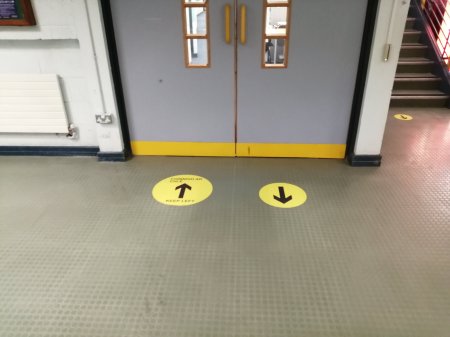
Fortunately the corridors in the Department are just about wide enough to maintain social distancing. If people pass each other coming in different directions their encounter will only be transient anyway, which is of low risk.
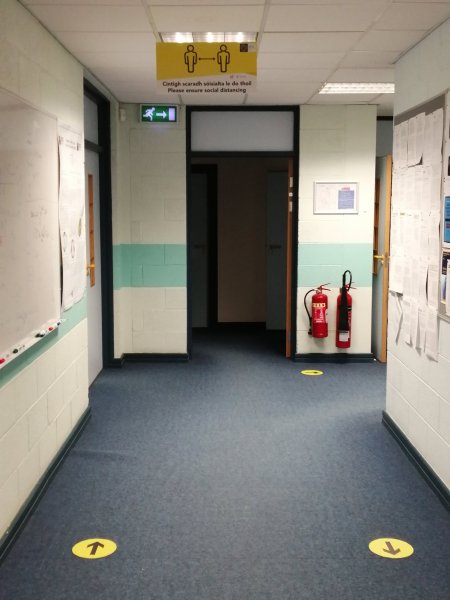
The computer room (not shown) will have a one-way system so students and staff will enter through one door and leave through the other. We will also have to take half the machines out of use for social distancing purposes, but that should be manageable.
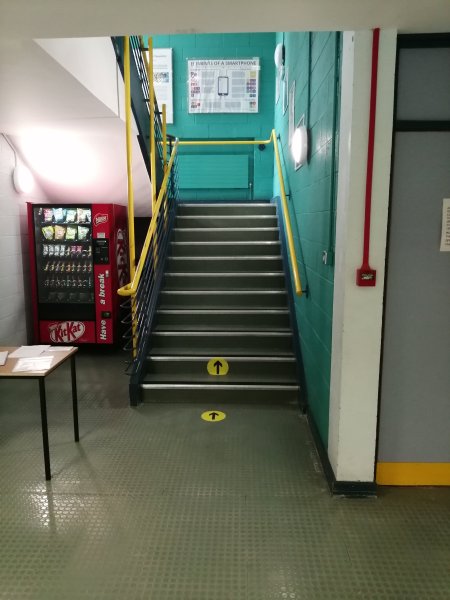
Elsewhere in the Science building in order to avoid people passing each other on the (rather narrow) stairs there is one set for up and another for down.

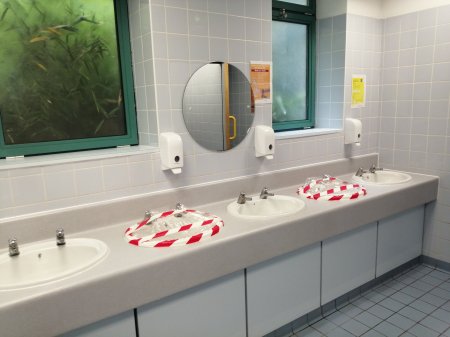
Social distancing is being enforced in the other facilities too…

That’ll do for now. Time to get back to work.
Follow @telescoperI saw an interesting news item this morning about excess deaths registered in Ireland between 11th March and 16th June, the period that brackets the peak of the Covid-19 pandemic.
According to the official numbers, 1709 deaths occurred during that time of people who had tested positive for the Coronavirus. During the same period, however, about about 1100-1200 deaths were registered in excess of the average mortality figures.
One interpretation of this discrepancy is that many of those counted as Covid-19 cases actually died of other causes. Consistent with that interpretation is the fact that over 60% of those deaths were people in care homes, many of whom may have had chronic illness.
Taking 1150 as an estimate of the excess deaths caused by Covid-19 the mortality per million in Ireland drops from 352 to about 237. It must be noted that this figure is still much higher than similar-sized countries such as Denmark and Norway.
The contrast with the United Kingdom is stark. A recent analysis of excess deaths there suggests about 69,000 people have lost their lives directly or indirectly due to Covid-19, which is about 57% higher than the official figure of around 44,000. Taking 69,000 instead of 44,000, the United Kingdom’s mortality rate increases from 647 per million to over a thousand.
I haven’t really been following the reporting in the United Kingdom very closely, because I don’t live there anymore, but the data on new cases found by testing is hopelessly confusing. This, together, with the apparent under-reporting of deaths, may be the reason behind the lax adherence to public health measures over the other side of the Irish Sea.
There is also the fact that daily Covid-19 briefings here in Ireland are led by medical experts, with the politicians taking a back seat (and often not involved at all). These are much more likely to be trusted than politicians, especially those involved in the current Tory government.
Follow @telescoper
As Ireland’s Chief Medical Officer, Dr Tony Holohan has been constantly in the public eye during the Covid-19 outbreak. At the daily press briefings he has impressed with his authoritative and frank delivery. During this time he has come across not only as a leading health expert, but as a good honest man and a dedicated public servant. His personal qualities have done much to win the confidence of the public in the battle against the Coronavirus.
Today I learnt that throughout this period Dr Holohan had also been caring for his wife, who is very ill with cancer, and their two young children. I have no idea how he managed to carry out his public role, which must have been onerous in itself, so professionally while carrying such a heavy additional burden in private.
Now his wife has gone into palliative care, and he has taken the decision to stand down from his job in order to be with her and their family.
All I can do is add a small voice to the many others saying a heartfelt “thank you” to Dr Tony Holohan for service far beyond the call of duty, and send my best wishes for the challenges ahead.
Follow @telescoperWell, Phase Three of the Great Reopening happened has started on schedule. As I walked to campus this morning I saw long queues in the street outside every barber’s shop in Maynooth. I decided to wait a few days before trying to get my long overdue haircut. It’s been over three months now.
Maynooth has quite a lot of barber’s shops for a town of its size. It also has quite a lot of nice restaurants. I noticed this evening that quite a few will be opening this week for sit-down meals rather than takeaway. I wish them well, but I think I’ll be sticking with the takeaways for a while longer.
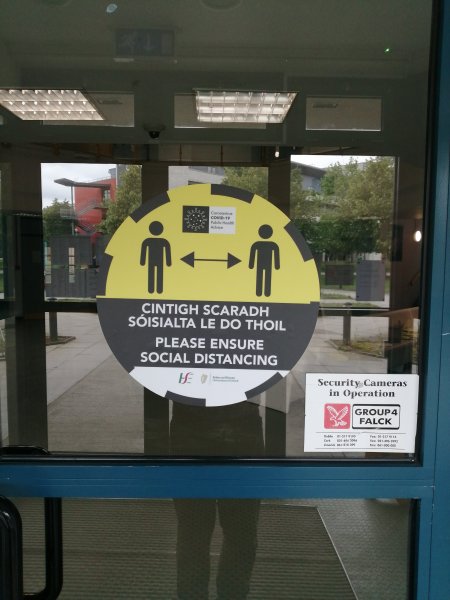
When I got into the office to start work on the risk assessment I’m supposed to complete so staff can return to work, there was quite a lot of activity in the Science Building, including signs of various kinds being put up.
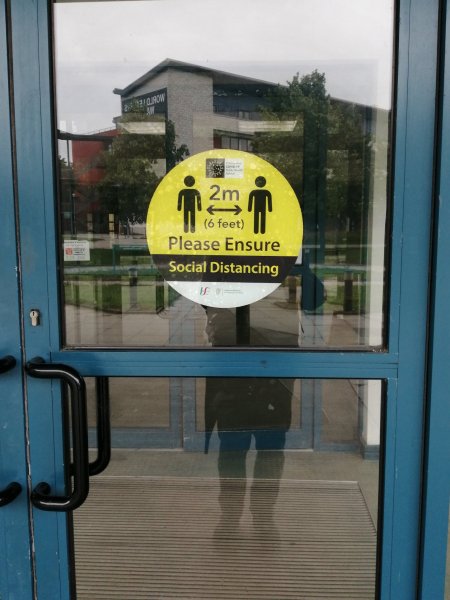

Some of the signs are bisexual bilingual:
All this reminded me of some lines from the Leonard Cohen song Anthem:
We asked for signs. The signs were sent
……
Signs for all to see.
The arrows will be put on the floor at regular intervals to enforce a one-way system around the building to allow people to circulate without bumping into each other.
I’m also expecting to be issued with tape to be used to mark some of the machines in our computer laboratory out of use, to keep users from sitting too close. I was going to remove the chairs but I don’t have anywhere to out them and we’ll probably – hopefully – need them back sometime!
I started work on the risk assessment but didn’t get it finished. I should be able to complete it tomorrow. Then it needs to be approved. Only after that will staff be able to begin routinely working in the Department. Until then, working from home continues.
Follow @telescoper
 In the Dark