Archive for the Covid-19 Category

The vaccine effect

Posted in Covid-19 with tags , , , on July 28, 2021 by telescoper

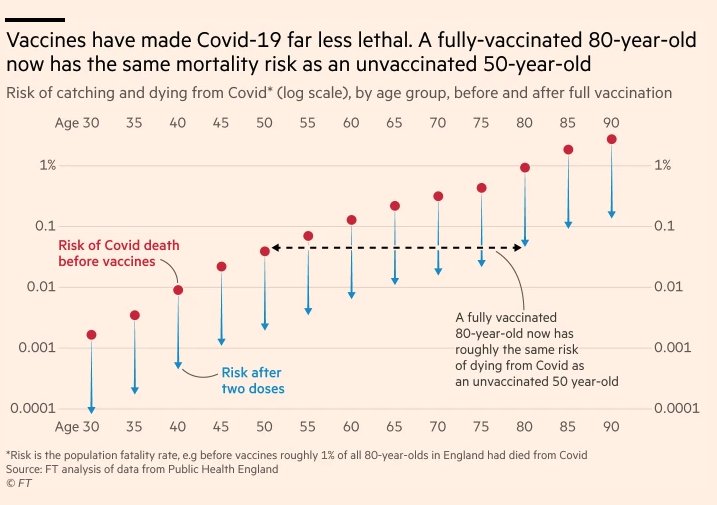
I saw this nifty graphic from the Financial Times floating around on social media and thought I would share it here. It’s a nice demonstration of the way the use of vaccines has impacted mortality rates from Covid-19. Basically the vaccines reduce the probability of a death by a factor greater than 10 (i.e. are more than 90% effective in doing this). On the logarithmic plot this appears as a downward shift in the “risk of death” that is more or less independent of age.

This behaviour is generally consistent with the observation that while infections in the UK are quite high the mortality rate is still rather low. Low is not zero, however, and there will still be some deaths if infection levels are high: a small fraction of a large number can still be significant.

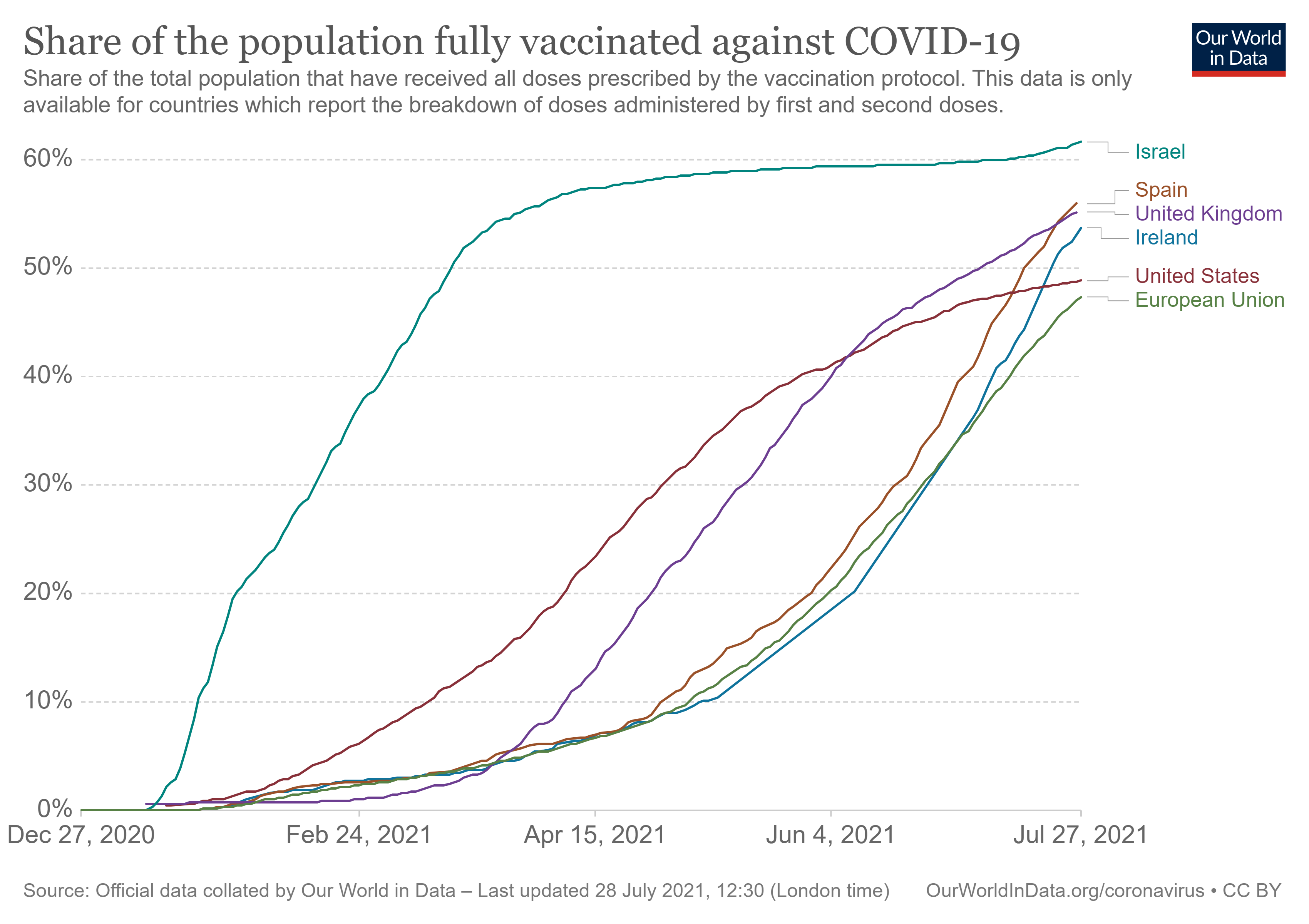
Incidentally, about 70% of the adult population of Ireland has now been vaccinated with about 80% having received partial vaccination. The fraction of the total population fully vaccinated is about 54%. On this measure Spain has just overtaken the UK in vaccinations; Ireland is well above average for the EU. The USA and Israel have both flattened out considerably.

When I got back from my break I tried my best to update the statistics relating to Ireland here. Doing so reminded me that when I first decided to plot the data on a log y-axis I got a slew of comments on Twitter complaining that I was “manipulating the data”! The backlash against anything even simple mathematics is quite extraordinary sometimes.

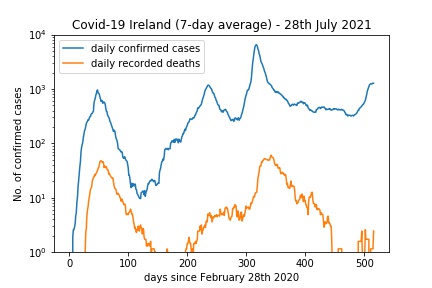
Anyway, the latest logarithmic plot looks like this:

The death figures are unreliable because of the lingering effects on the ransomware attack on the Health Service Executive IT system but do seem to be much lower relative to infections than they were at earlier stages of the pandemic, even allowing for the fact that the first peak in the case curve should be higher as testing was not so extensive at this early stage. The 7-day average of new cases is currently around 1200-1300 per day.

It still fascinates me how the case numbers managed to stay roughly constant for such a long time at such a high level earlier this year…

New Term Ahead!

Posted in Biographical, Covid-19, Education, Maynooth with tags , , on July 28, 2021 by telescoper

I know that there are quite a few people out there who think the summer is one long holiday for academic staff. Well, it may still be July but after my 10 days away that’s the holidays over as far as I’m concerned. Still, ten days’ summer holiday is ten days more holiday than I got last summer.

Next week the Repeat Examination period begins; it lasts from 4th August to 14th August. Once again these examinations are online and once again they have to be supervised by a member of academic staff. I have five paper scheduled and have to be at the screen for all of them. Then there’s the marking, checking, collation and uploading of the marks which must be done by 18th August. After that there’s an Examination Board before the final submission of all the repeat exams by August 23rd.

Incidentally, I was just checking over my Semester 1 repeat examinations and it seems like decades since I taught those modules last Autumn! The pandemic has played havoc with the perception of time!

After the Repeat Examinations are done, I have the unenviable task of preparing teaching for the next academic year. Although I’m stepping down as Head of Department of Theoretical Physics at the end of September I am still in that position until then so that task falls to me. Quite apart from the continuing uncertainty about what the Covid-19 situation will be like at the start of term (20th September), I have to deal with the fact that three out of our six full-time permanent lecturers are not available for next year. One is retiring this summer, one is departing for a position in Germany and another is on sabbatical.

The appointment of a temporary lecturer to provide sabbatical cover is normal, but the two other departures have not been replaced with permanent staff but by two one-year temporary lecturers. None of these new staff will be in post until 1st September but will have to teach a full complement of modules from 20th September onwards. Half our modules will therefore have to be reassigned, which means that the organization of teaching for the new academic year is not just the usual slight rearrangement of the previous year’s assignments but a major overhaul.

Losing two of our permanent staff to be replaced by temporary staff will of course have a negative impact on our research but that doesn’t seem to be important.

On top of al this the University is pressing ahead with a complete reorganization in the form of a merger of the Departments of Theoretical Physics and Experimental Physics which it intends to force through by 1st October 2021…

While glad that we may at last be emerging from the pandemic I’m dreading the next two months, not only because of the huge amount that has to be done by the end of September, but also because I think that period is going to set the scene for the longer-term future. I know I’m not the only academic who fears the massively increased workload dumped on us during the pandemic is going to become, to use a hackneyed phrase, “the new normal”.

Back to Civilisation

Posted in Biographical, Cardiff, Covid-19, Cricket, GAA, Maynooth with tags , , , on July 24, 2021 by telescoper

So last night I returned safely from Cardiff to Ireland via Birmingham. Travel both ways was relatively uneventful. There can’t have been more than 30 people on the flight in either direction. I did however almost screw up the return flight by omitting to fill in the obligatory Covid-19 passenger locator form which I hadn’t realised is now online-only. I only found out that I had to do it before they would let me on the plane, resulting in a mad scramble with a poor phone connection to get it done. After a few goes and quite a bit of stress I succeeded and was allowed to board, conspicuously the last passenger to do so. We still managed to leave early though, and the short flight to Dublin – passing directly over Ynys Môn was relaxing and arrived on schedule; the immigration officer scanned my new-fangled Covid-19 vaccination certificate but wasn’t interested in the passenger locator form that caused me so much stress on departure.

I returned to Cardiff to take a bit of a break, to check up on my house and also prepare to move the rest of my belongings to Ireland. I was relieved when I got there last week that everything was basically in order, although there were lots of cobwebs and a very musty smell, which was hardly surprising since I hadn’t been there for 15 months. The inside of the fridge wasn’t a pretty sight either.

One night last week after meeting some friends for a beer in Cardiff I walked back via Pontcanna Fields and saw, much to my surprise, Camogie practice in progress in the twilight:

Camogie Practice, Pontcanna Fields, Cardiff.

The logistics of my planned removal proved a bit more complicated than I expected but eventually I cracked it and all the arrangements are now in place. I should receive delivery here in Maynooth next month. I’m doing it on the cheap as a part-load, which is why it will take a bit longer than usual.

Cleaning and packing was very hard work owing to the intense heat over the last week or so – it was regularly over 30° C – during the day, so I took quite a few siestas. My neighbours tell me it’s been much the same here in Maynooth, although it is a bit cooler today, around 20° with a very pleasant breeze.

Despite the hard work it was nice to have a change of scenery for a bit and also to meet up with some old friends from Cardiff days. Everyone has been in a state of limbo for the last 18 months or so, and although we’re not out of the woods yet there are signs of things coming back to life. When I went to Bubs in Cardiff for a drink last week it was the first time I’d been inside a pub since February 2020!

Incidentally, most people I saw observed social distancing, wore masks, etc. The rules in Wales are still fairly strict. Although open for indoor service, bars and restaurants seem to have few customers. Some people on trains to and from Birmingham didn’t wear masks. One group of unmasked and obnoxious English passengers on my return journey were loudly boasting how backwards Wales was compared to England, where the rules have relaxed despite a huge surge in cases. I moved to another carriage.

The only other thing I managed to do was attend a Royal London One-Day Cup match at Sophia Gardens between Glamorgan and Warwickshire in the baking heat of Sophia Gardens. It turned out to be a good tight game, with Glamorgan winning by 2 wickets courtesy of two consecutive boundaries. Most of the time I was sitting there in the shade I was thinking how glad I was not to be fielding in such conditions.

One thing that was very noticeable during my stay in Wales was that it was very hard to get fresh salad vegetables and the like. That may be partly due to weather-related demand or it may be due to a shortage of lorry drivers or other staff owing to Covid-19 isolation requirements and may be a consequence of Brexit. Who knows? I’ll just say that there’s been hot weather in Ireland, where the Covid-19 pandemic is also happening but there are no reports of shortages of fresh food here. I’m very much looking forward to having a nice salad with my dinner this evening.

Anyway, I suppose that’s enough rambling. At some point I’ll have to open up my email box to see what horrors lurk therein. Still can’t be worse than the fridge I opened last week. Can it?

Reasons for Optimism

Posted in Biographical, Covid-19, Education with tags , , , , , , on July 6, 2021 by telescoper

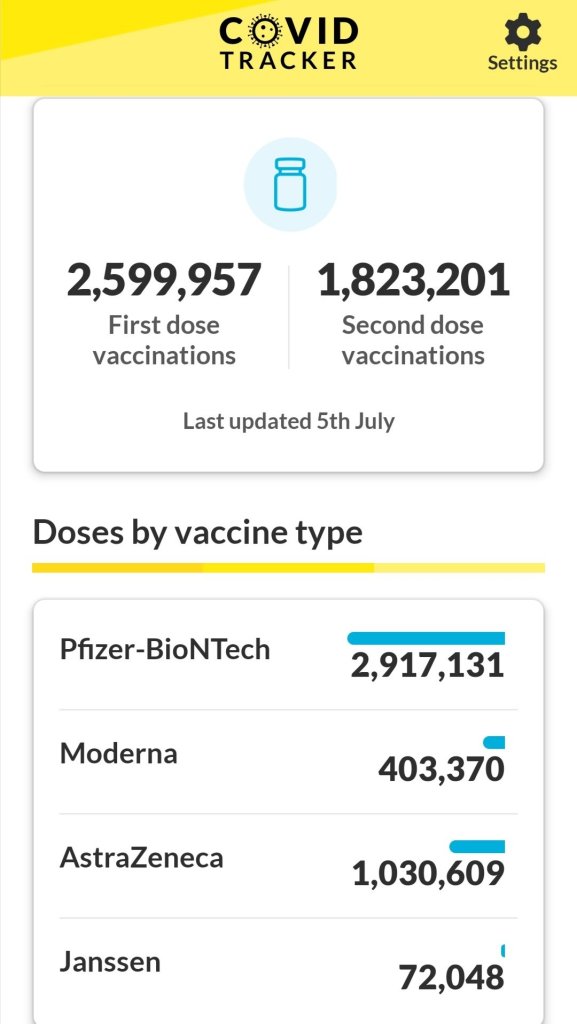
After an interruption of almost two months because of a Cyberattack on the Health Service Executive’s computer system, daily updates of Ireland’s vaccination statistics have at last resumed, including via the Covid-19 app (which has been moribund since 11th May).

You might think it strange but I find the restoration of daily updates reassuring. I suppose it’s because I work in a quantitative discipline but I like having things expressed in figures, though I am of course aware of their uncertainties and other problems involved in interpreting them.

The latest figures above show that about 70% of the adult population has received at least one dose while about 50% have had two doses; the latter are regarded as “fully” vaccinated as are the smaller number who have received the one-shot Janssen vaccine produced by Johnson & Johnson. Although the Government missed by some margin its target of giving one dose to 82% of the adult population by the end of June, I find myself much more optimistic than in past few weeks about how things are going.

Two developments in particular have helped.

First the Government is set to purchase about a million doses of Pfizer/BioNTech from Romania. That would be enough to fully vaccinated about 10% of the population. These doses have become available because take-up in Romania is very poor and the shots would go to waste if not disposed of elsewhere. What’s bad news for Romania is, however, good news for Ireland.

The second change is that the Government has decided to allow the AstraZeneca and Janssen vaccines to be used on adults in the age range 18-34 and that vaccinations of this group are now being carried out by pharmacists. Previously these vaccines were only to be given to persons aged 50 and over. Indications are that there is some reluctance among the younger cohort, which is hardly surprising since it was only a few weeks ago that they were being told these vaccines were too risky, but I suspect this change will go a long way towards fully vaccinating the adult population, which may be possible by the end of August.

I regard the immunization of students next year’s intake to third level education institutions as a necessary condition for opening up campuses to something like “normal” teaching. Just a couple of months ago I didn’t think this would be possible, but now it might be. It’s still possible that there will be disruptions in supply but it’s looking reasonably good at the moment based on the arithmetic of how many doses are available.

The fly in the ointment is of course the so-called Delta Variant, which has already gained a foothold in Ireland and is set to cause case numbers to rise substantially. We will soon see whether this causes an increase in hospitalizations and deaths. The most vulnerable should be protected so the probability of a case turning into serious illness or death should be much lower, but we don’t know by how much. Unfortunately the statistics of Covid-19 are still not being reported publicly. Some people seem to think this means they’re not happening. It doesn’t. It just means the system for reporting them is not working. I expect the forthcoming announcement of the backlog will cause some alarm.

The Irish Government recently decided to pause the gradual reopening of the economy to allow vaccinations to proceed further. There is still a race between the Delta variant and the vaccination programme. The number of people vaccinated increases approximately linearly with time, while the number of Covid-19 cases grows exponentially in the growth phase of the pandemic. I think the pause was sensible.

Across the Irish Sea there is a different situation. The English Government has decided to abandon all attempts to control the spread of Covid-19 at precisely the point when the pandemic is in another exponential phase. The number of cases is now likely to increase dramatically. The number of resulting deaths may be fewer than in previous waves but won’t be zero. Perhaps more importantly, allowing a huge pool of virus to develop increases the chance of yet another variant evolving, perhaps one that can evade the defences afforded by vaccination even more effectively than the Delta variant. I shudder to think of the consequences if that does happen. Perhaps it already has.

Ireland’s Covid-19 Models

Posted in Covid-19, mathematics, Maynooth with tags , , , , , on July 1, 2021 by telescoper

Yesterday the Chair of the National Public Health Emergency Team (NPHET), who also happens to be the President of Maynooth University, Professor Philip Nolan published a lengthy but interesting Twitter thread (which you can find unrolled here). In these tweets he explained the reason behind NPHET’s recommendation to pause the process of relaxing Covid-19 restrictions, postponing the next phase which was due to begin on 5th July with indoor dining.

The basic reason for this is obvious. When restrictions were lifted last summer the reproduction number increased to a value in the range 1.4 to 1.6 but the infection rate was then just a handful per day (on July 1st 2020 the number of new cases reported was 6). Now the figures are orders of magnitude higher (yesterday saw 452 new cases). A period of exponential growth starting from such a high base would be catastrophic. It was bad enough last year starting from much lower levels and the Delta variant currently in circulation is more transmissable. Vaccination obviously helps, but only about 40% of the Irish population is fully immunized.

Incidentally the target earlier this year was that 82% of the adult population should have received one jab. We are missing detailed numbers because of the recent ransomware attack on the HSE system, but it is clear that number has been missed by a considerable margin. The correct figure is more like 67%. Moreover, one dose does not provide adequate protection against the Delta variant so we’re really not in a good position this summer. In fact I think there’s a strong possibility that we’ll be starting the 2021/22 academic year in worse shape than we did last year.

In general think the Government’s decision was entirely reasonable, though it obviously didn’t go down well with the hospitality sector and others. What does not seem reasonable to me is the suggestion that restaurants should be open for indoor dining only for people who are fully vaccinated. This would not only be very difficult to police, but also ignores the fact that the vast majority of people serving food in such environments would not be vaccinated and are therefore at high risk.

As things stand, I think it highly unlikely that campuses will be open in September. Rapidly growing pockets of Delta variant have already been seeded in Ireland (and elsewhere in Europe). It seems much more likely to me that September will see us yet again in a hard lockdown with all teaching online.

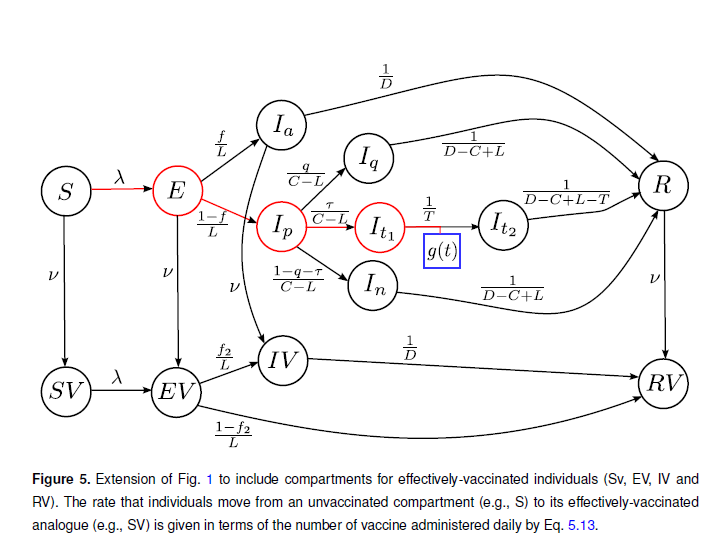
But the main reason for writing this post is that the thread I mentioned above includes a link to a paper on the arXiv (by Gleeson et al.) that describes the model used to describe the pandemic here in Ireland. Here is the abstract:

We describe the population-based SEIR (susceptible, exposed, infected, removed) model developed by the Irish Epidemiological Modelling Advisory Group (IEMAG), which advises the Irish government on COVID-19 responses. The model assumes a time-varying effective contact rate (equivalently, a time-varying reproduction number) to model the effect of non-pharmaceutical interventions. A crucial technical challenge in applying such models is their accurate calibration to observed data, e.g., to the daily number of confirmed new cases, as the past history of the disease strongly affects predictions of future scenarios. We demonstrate an approach based on inversion of the SEIR equations in conjunction with statistical modelling and spline-fitting of the data, to produce a robust methodology for calibration of a wide class of models of this type.

You can download a PDF of the paper here.

This model is a more complicated variation of the standard compartment-based models described here. Here’s a schematic of the structure:

This model that makes a number of simplifying assumptions but it does capture the main features of the growth of the pandemic reasonably well.

Coincidentally I set a Computational Physics project this year that involved developing a Python code that does numerical solutions of this model. It’s not physics of course, but the network of equations is similar to what you mind find in physical systems – it’s basically just a set of coupled ODEs- and I thought it would be interesting because it was topical. The main point is that if you study Theoretical Physics you can apply the knowledge and skills you obtain in a huge range of fields and disciplines. Developing the model does of course require domain-specific epidemiological knowledge but the general task of modelling complex time-evolving systems is definitely something physicists should be adept at doing. Transferable skills is the name of the game!

P.S. It came as no surprise to learn that the first author of the modelling paper, Prof. James Gleeson of the University of Limerick, has an MSc in Mathematical Physics.

A Vaccination Fallacy

Posted in Bad Statistics, Covid-19 with tags , , , , on June 27, 2021 by telescoper

I have been struck by the number of people upset by the latest analysis of SARS-Cov-2 “variants of concern” byPublic Health England. In particular it is in the report that over 40% of those dying from the so-called Delta Variant have had both vaccine jabs. I even saw some comments on social media from people saying that this proves that the vaccines are useless against this variant and as a consequence they weren’t going to bother getting their second jab.

This is dangerous nonsense and I think it stems – as much dangerous nonsense does – from a misunderstanding of basic probability which comes up in a number of situations, including the Prosecutor’s Fallacy. I’ll try to clarify it here with a bit of probability theory. The same logic as the following applies if you specify serious illness or mortality, but I’ll keep it simple by just talking about contracting Covid-19. When I write about probabilities you can think of these as proportions within the population so I’ll use the terms probability and proportion interchangeably in the following.

Denote by P[C|V] the conditional probability that a fully vaccinated person becomes ill from Covid-19. That is considerably smaller than P[C| not V] (by a factor of ten or so given the efficacy of the vaccines). Vaccines do not however deliver perfect immunity so P[C|V]≠0.

Let P[V|C] be the conditional probability of a person with Covid-19 having been fully vaccinated. Or, if you prefer, the proportion of people with Covid-19 who are fully vaccinated..

Now the first thing to point out is that these conditional probability are emphatically not equal. The probability of a female person being pregnant is not the same as the probability of a pregnant person being female.

We can find the relationship between P[C|V] and P[V|C] using the joint probability P[V,C]=P[V,C] of a person having been fully vaccinated and contracting Covid-19. This can be decomposed in two ways: P[V,C]=P[V]P[C|V]=P[C]P[V|C]=P[V,C], where P[V] is the proportion of people fully vaccinated and P[C] is the proportion of people who have contracted Covid-19. This gives P[V|C]=P[V]P[C|V]/P[C].

This result is nothing more than the famous Bayes Theorem.

Now P[C] is difficult to know exactly because of variable testing rates and other selection effects but is presumably quite small. The total number of positive tests since the pandemic began in the UK is about 5M which is less than 10% of the population. The proportion of the population fully vaccinated on the other hand is known to be about 50% in the UK. We can be pretty sure therefore that P[V]»P[C]. This in turn means that P[V|C]»P[C|V].

In words this means that there is nothing to be surprised about in the fact that the proportion of people being infected with Covid-19 is significantly larger than the probability of a vaccinated person catching Covid-19. It is expected that the majority of people catching Covid-19 in the current phase of the pandemic will have been fully vaccinated.

(As a commenter below points out, in the limit when everyone has been vaccinated 100% of the people who catch Covid-19 will have been vaccinated. The point is that the number of people getting ill and dying will be lower than in an unvaccinated population.)

The proportion of those dying of Covid-19 who have been fully vaccinated will also be high, a point also made here.

It’s difficult to be quantitatively accurate here because there are other factors involved in the risk of becoming ill with Covid-19, chiefly age. The reason this poses a problem is that in my countries vaccinations have been given preferentially to those deemed to be at high risk. Younger people are at relatively low risk of serious illness or death from Covid-19 whether or not they are vaccinated compared to older people, but the latter are also more likely to have been vaccinated. To factor this into the calculation above requires an additional piece of conditioning information. We could express this crudely in terms of a binary condition High Risk (H) or Low Risk (L) and construct P(V|L,H) etc but I don’t have the time or information to do this.

So please don’t be taken in by this fallacy. Vaccines do work. Get your second jab (or your first if you haven’t done it yet). It might save your life.
Opening Up Again

Posted in Biographical, Covid-19, Maynooth, The Universe and Stuff on June 15, 2021 by telescoper

The Irish Government has just produced its plan for A Safe Return to on-site further and higher education and research that outlines what is basically a full return to on-campus activity from September 2021.
I quote from the preamble to the document linked to above:

It is expected that the majority of the people over 18 in Ireland will have been vaccinated by September 2021, and so planning is proceeding on the basis that full resumption of on-site activity is possible, while ensuring that overall numbers attending on-site are monitored and controlled.

In the absence of regular updates about the progress of Ireland’s vaccination programme it is difficult to know whether the first sentence is accurate or not, especially since it appears that two vaccine doses are needed to protect against the Delta-variant. I think most teaching staff will have been immunized by September, but am not so sure about the student population.

I’m also mindful that we were optimistic in advance of the start of last academic year and things didn’t exactly go to plan then. Nevertheless there do seem to be reasonable grounds for believing that we can return to on-campus teaching in September and we will be planning on that basis until there is evidence to the contrary. I just hope we don’t have to do a rapid about-turn like we did last year.

The first step in this process for us here in Maynooth is that from 5th July staff and research students can return to their offices on campus – following the existing protocols on social distancing, sanitation and ventilation – without having to make a special case. Only a few people have been working inside the Department since the start of the year and I’d expect most to begin making their way back.

In fact some members of the Department of Theoretical Physics joined us only this academic year and have never actually been the building (or on campus) at all. I suppose I’ll now have to find office space for them, something that hasn’t been necessary while we have all been working from home!

As a matter of fact, since it’s a nice day and I’ve been on Teams all morning, I might take a walk onto campus myself this afternoon and visit my office in the Department for the first time in a month…

The Euclid Consortium Conference Photo!

Posted in Covid-19, The Universe and Stuff on June 11, 2021 by telescoper

The Coronavirus pandemic has not only changed the nature of conferences but also changed the nature of conference photographs. Here’s the group picture of the Euclid Consortium Conference that took place via Zoom at the end of May. I’m actually in it, though I wasn’t paying attention at the time and am therefore not looking at the camera. Moreover, there are some other people who are in it several times!

Full of Pfizz

Posted in Biographical, Covid-19 on June 8, 2021 by telescoper

Well, this morning I took my second trip to City West Convention Centre for my second dose of the Pfizer-BioNTech vaccine. It all went off smoothly, except the queues were very much longer than last time so it took me about 90 minutes from start to finish. Most of the extra time was spent queuing outside which wasn’t too bad because it wasn’t raining. Chatting to one of the volunteers on the way I learned that they are doing about 4,500 a day at this centre, which is getting on for 500 an hour.

When I left after my jab I noticed the outdoor queue was much longer than it had been when I joined this morning, so those just starting to wait were probably in for at least two hours before they got jabbed. Still, after everything that we’ve been missing out on for the past year and a bit, what’s a couple of hours?

Other than the increased numbers the experience was similar to my first dose: well-run, efficient and friendly. Thanks again to all concerned!

So that’s me fully vaccinated although disappointingly I don’t seem to be able to receive 5G signals and haven’t received my instructions from Bill Gates yet.

Anyway, now I’m back home about an hour later and have so far no ill-effects. We have an examination board meeting this afternoon so let’s hope I don’t flake out during it.

UPDATE: 8 hours on and I’m definitely feeling a bit tired…zzzz

UPDATE: 24 hours on, I was more-than-usually tired last night and that continues but I experienced no fevers or anything like that. Slight discomfort in the arm where the injection was given.

Birthday Treats

Posted in Art, Biographical, Covid-19 on June 5, 2021 by telescoper

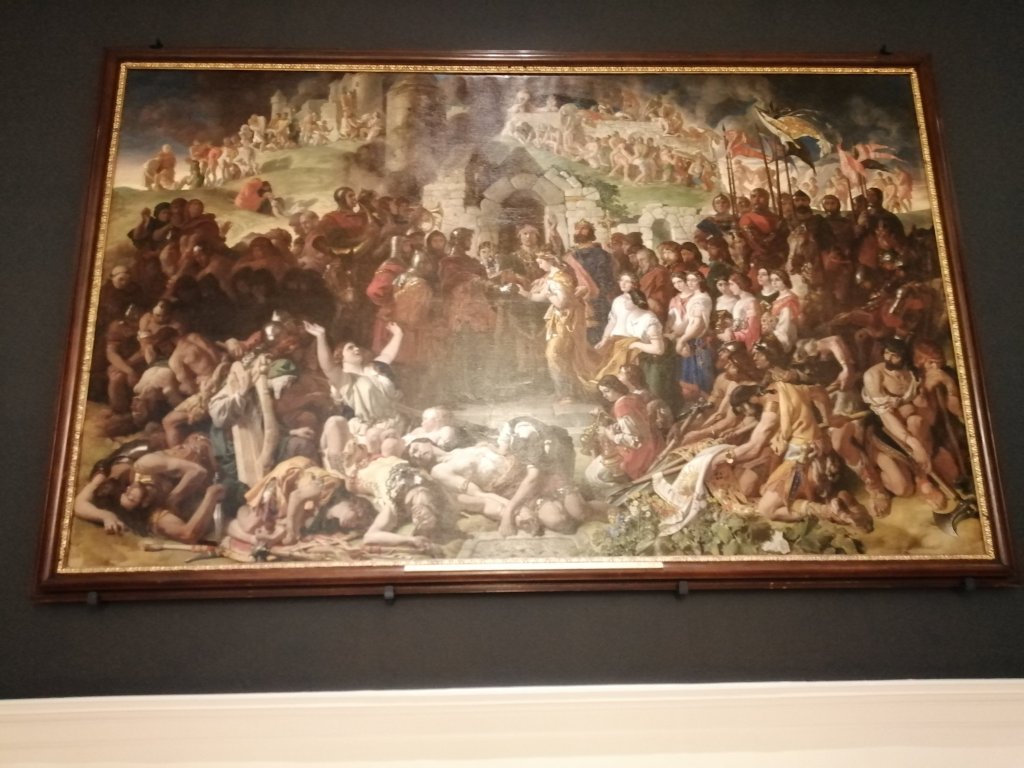
As planned I took some time out yesterday, hopped on a train for the first time in 15 months and went into Dublin. I was shocked by some of the scenes I saw when I reached my destination: large crowds with no masks and no social distancing and all kinds of rowdy behaviour. Here’s an example:

I was at the National Gallery of course. I wandered around for a couple of hours and then returned to Maynooth. The gallery is still free for visitors but these days you have to register online beforehand so they can control numbers. I have been there before but didn’t realize until yesterday that there’s an entrance on Clare Street, which is even closer to Pearse Station than the main entrance of Merrion Square, so I’ll be using that from now on. There’s a lot to see in the National Gallery and I hope to spend more time there in future.

After getting home I had Zoom drinks with some old friends from Cardiff, which was very pleasant indeed, and then cooked myself a self-indulgent dinner which I ate with a nice Barolo.

Earlier in the day, I was able to publish another paper in the Open Journal of Astrophysics (of which more anon).

Then, as a lovely present, I received a text telling me of the appointment for my second Pfizer/BioNTech Jab: Tuesday 8th June, exactly 4 weeks after the first. People (and the leaflets I was given on the occasion of Jab Number 1) say that the second dose is more likely to produce side effects than the first but I’m glad that in a few days I’ll be fully vaccinated and can start thinking about the possibility of travelling at some point this summer, regulations permitting.

Anyway, the relaxation isn’t over yet. This is a Bank Holiday Weekend in Ireland so I’ll be doing as little as possible until I return to work on Tuesday for Examination Matters, etc.

P.S. My birthday fundraiser has almost reached its target but is still going so if you feel like contributing you can still do so here.

P.P.S. There were some rowdy scenes in Dublin yesterday evening but not where I was (and I was home before they started).