Archive for the Crosswords Category

Dingbats, surface readings, and literally what it says

Posted in Crosswords with tags , , , , , , , on August 22, 2010 by telescoper

It’s been a long time since I posted anything in the box marked crosswords, so I thought I’d remedy that today.

As I’ve explained before, I’m a regular entrant in the monthly Azed competition in the Observer. There’s actually an Azed cryptic crossword every week, but every four weeks there’s a special one  in which contestants have not only to complete the (usually quite tricky) puzzle, but also to supply a clue for a word for which only a definition was given. There are prizes for the best clues each time, as judged by Azed himself, and a league table is built up over the year.

I don’t mind admitting that I much prefer solving the puzzles to setting clues of my own. Perhaps that’s consistent with the fact that I don’t enjoy setting examination questions much! However, I do enter the clue-writing competition every time it comes up. I’ve never won it, but I’ve had several VHC (Very Highly Commended) which count in the honours table. I’ve gradually improved my ranking year on year, and perhaps one day I’ll actually win the  coveted Azed bookplate. However, I’ve got a long way to go before I can produce clues of the ingenuity and subtlety of the regular winners.

Last year, I started brightly and was for a long time neck-and-neck with the novelist Colin Dexter in the league table. However, over the last few months my clues didn’t find favour with Mr Azed while his were much better. He finished in 8th place, while I languished in joint 40th; the complete table is here.

My best clue last year (I think) was in Azed 1967 for the word SUBORDINATELY:

In the manner of an inferior sandwich, prepared ‘to a New York deli recipe’ (13)

It’s a fairly straightforward one, as these things go, consisting of two parts, a definition and a cryptic allusion to the word being clued.  “In the manner of an inferior..” is the definition, meaning “subordinately”. The cryptic allusion in this case is the word “SUB” (meaning an American-style sandwich) followed by an anagram of the collection of letters indicated by what’s inside the quotes, i.e. to+a+NY+deli+r, the NY and r being standard abbreviations. “Prepared” is an anagram indicator.

The clue also has a nice surface reading, I think, which is an aspect many setters don’t seem to bother with. The surface reading is just how the clue reads when you don’t try to interpret it as a cryptic clue. I much prefer clues that read like something that  as could be written or said in a different context to a crossword, as well as making grammatical and syntactical sense.

The winning clue for this word was by D.F. Manley, who is one of the setters for the Times, with an &lit clue:

As in ‘B-role’ duty possibly (13)

This type of clue is regarded by many setters as the cleverest kind, but I have to admit that I have a love-hate relationship with them. Here the definition and cryptic allusions are supplied not by two different parts of the clue, but by two different readings of the whole thing. The cryptic allusion in this case is an anagram indicated by the word “possibly”, i.e. SUBORDINATELY is an anagram of AS IN B ROLE DUTY. The definition is “&lit”, i.e. “and literally what it says”. This is where I think setters push the boundaries a bit too far. I don’t think “As in B-role duty possibly” is really a very fair definition of SUBORDINATELY, and this clue has a very clumsy surface reading too. It’s undoubtedly clever, but I don’t like it as much as some of the others. In general I think these kind of clues are more appreciated by setters, who know how hard they are to concoct, than by solvers.

Anyway, today saw the announcement of the results of the first round of the current Azed competition, and I got another VHC for the slightly obscure word FOULARD (a kind of scarf or handkerchief). My clue was

A square covering La Dame’s head? (7)

This is an “&lit” too, but the cryptic allusion isn’t an anagram. FOUR is a perfect square so “A square covering La” is FOU(LA)R, and Dame’s Head is D (first letter of “Dame”), hence FOULARD. The whole clue also serves as a fair definition, I think, because a “square” can be a scarf (the wikipedia example of a foulard shows the typical way of wearing it, around the head); it also suggests a French word. Anyway, I’m off quickly out of the blocks again with a VHC, and am currently in 4th place in the table! That might be the highest I’ve ever been. I doubt it will last, though.

I also do the Guardian Prize crossword puzzle every week, which has many potential setters some of whom seem to bend the rules beyond breaking point. Last week’s Guardian competition puzzle (No. 25089) by Paul contained a number of clues that I didn’t like at all. They weren’t particularly difficult but had neither a  fair definition nor a good surface reading. Take, for example,

Dr Castier? (5,2,3,5)

and

M – give it ten? (5,2,5)

The question marks are a conventional way of indicating that something funny is going on, but they’re not sufficient to give   fair indications of the solutions in this case. These are, in fact, reverse clues of a form sometimes known as a dingbat or a rebus. The first one gives THROW IN THE TOWEL, which is clued thus: DR(CAST)IER,  with DRIER defining TOWEL and CAST defining THROW. In similar vein the second one is HAND IN GLOVE, via M(GIVE)ITTEN, with GIVE=HAND and MITTEN=GLOVE. Clever, but neither clue has any definition whatsoever of the answer phrase nor any surface reading other than gibberish. I might have forgiven Dr Castier? were it a familiar name from history or literature, but it isn’t. It was just made up for this puzzle. A very poor show, in my view. Anyone can make a clue by flinging random letters together.

There were several other clues of this type in the puzzle, so once you have one of them the others are quite easy.  However, in my opinion, they’re all pretty dismal clues on their own. I only ever buy the Guardian these days on Saturdays, largely for the weekend Prize crossword. If they carry on using puzzles as feeble as that one I’ll ditch it altogther. However, this week we were back to good old Araucaria, which restored my faith. My favourite  clue was

The wrong way to be (4)

The solution is left as an exercise.

Playfair

Posted in Crosswords with tags , , , , on February 12, 2010 by telescoper

It’s been a while since I’ve blogged about my passion for crosswords, but this Sunday’s Azed puzzle in the Observer was one of my favourite kind so I thought I’d mention it briefly here.

Azed is the pseudonym used by Jonathan Crowther who has been setting the Observer crossword since 1972; this week’s was number 1967. His  puzzles are usually standard cryptic crosswords which, though quite difficult as such things go, are nevertheless set in a fairly straightforward style. Every now and again, however,  he puts together a different type of puzzle that makes a different set of demands on the solver.  To be honest, I don’t always like these “funny” ones as they sometimes seem to me to be contrived and inelegant, but this last one was a type I really like as it combines the normal cryptic crossword style with another interest of mine, which is  codes and codebreaking.

The interesting aspect of this particular puzzle, which is laid out on a normal crossword grid, is that it involves a type of code called a Playfair cipher. In fact, this particular scheme was invented by the scientist Charles Wheatstone whom most physicists will have heard of through “Wheatstone Bridge“. It was, however, subsequently popularized by Lord Playfair, whose name stuck rather than its inventor’s.

The Playfair scheme is built around the choice of a code word, which must have the special property that no letter occurs twice within it.  Other than that, and the fact that the more letters in the codeword the better the code, there aren’t any real constraints on the choice. The particular example used by Azed to illustrate how it works is ORANGESTICK.

The codeword is used to construct a Playfair square which is a 5×5 arrangement of letters involving the codeword first and then afterwards the rest of the alphabet not used in the codeword,  in alphabetical order. Obviously, there are 26 letters altogether and the square only holds 25 characters,  so we need to ditch one: the usual choice is to make I stand for both I and J, doing double duty, which rarely causes ambiguity in the deciphering process. The Playfair square formed from ORANGESTICK is thus

This square is then used as the basis of a literal digraph substitution cipher, as follows. To encode a word it must first be split into pairs of letters e.g. CR IT IC AL. Each pair is then seen as forming the diagonally opposite corners of a rectangle within the word square, the other two corner letters being the encoded form. Thus, in the example shown, CR gives SG (not GS, which RC would give).

Where a pair of letters appears in the same row or column in the word square, its encoded form is produced from the letters immediately to the right of or below each respectively. For the last letters in a row or column the first letters in the same row or column become the encoded forms. Thus IC is encoded as CE. When all the pairs are encoded, the word is joined up again, thus CRITICAL is encoded as SGCICEOP.

The advantage of this over simpler methods of encipherment is that a given letter in the plain text is not always rendered as the same letter in the encrypted form: that depends on what other letter is next to it in the digraph.

Obviously, to decipher encrypted text into plain one simply inverts the process.

Now, what does this have to do with a crossword? Well, in a Playfair puzzle like the one I’m talking about a certain number of answers – in this case four – have to be encrypted before they will fit in the diagram. These “special” clues, however, are to the unencrypted form of the answer words. The codeword is not given, but must be deduced. We are, however, told that the answers to these special clues and the codeword are “semantically linked”.

What one has to do, therefore, is to solve the clues for the unencrypted words, then solve all the other clues that intersect with them on the grid. Given a sufficient number of digraphs in both plain text and encrypted form one can infer the codeword and hence encrypt the remaining (unchecked) letters for the special answers.

It probably sounds very convoluted, but in this puzzle it isn’t so bad because the four special clues weren’t so difficult. These are the following “across” clues:

1.  Footman having to plough yard (6)

which gives “FLUNKY” – “plough” in university slang, meaning “fail” or “flunk” + y (standard abbreviation for yard).

18. Wallaby No. 2 in penalty infringement, right? (8)

has to be “OFFSIDER”, Australian slang for a deputy and hence Wallaby No. 2,  with the cryptic allusion “OFFSIDE” for “penalty infringement” and R for “right”.

19. Staff inadequately blunder – many will conceal this (8)

this is the easiest – straightforward hidden word “UNDERMAN”, meaning “staff inadequately”.

32. Younger mussels one goes for in jar (6)

I think this is the best of this quartet of clues. The answer is “JUNIOR”, with “UNIO” (the genus of mussels) replacing the “a” (i.e. one) in JAR.

This set of answers clearly suggests the common theme that links them to the codeword. Moreover, the geometry of the grid along with the answers to the rest of the clues gives us ten digraphs in plain and encrypted form.

What has to be done then is to try to work out the Playfair square from the letter pairs, work out the codeword and then complete the unchecked letters in the specials in their encrypted form. It isn’t actually all that difficult to find the codeword in this example, by a mixture of induction and deduction. It turns out to be “SUBORDINATELY”, a fine candidate for a Playfair codeword as it is thirteen letters long and doesn’t feature any letter twice.

To enter the monthly Azed competition, however, one generally has to supply a clue as well as solving the puzzle. I’m really not very good at this aspect of crosswords- I much prefer solving the puzzles to setting ones of my own – which is why I’m quite a long way down the annual Azed Honours Table, in 29th place as of this month.

In the “Plain” competition puzzles, one has to supply a clue to replace one which is given as a straight definition.  In this case a clue was requested to the codeword, but I think  I’ll keep my attempt at  “SUBORDINATELY” to myself unless and until I win at least an honourable mention!


Dublin Back

Posted in Art, Books, Talks and Reviews, Crosswords, The Universe and Stuff with tags , , , , on March 28, 2009 by telescoper

I’m just back from a flying visit to Dublin, where I gave a talk yesterday at a meeting of the Astronomical Science Group of Ireland (ASGI), an organization which promotes scientific collaborations between individuals and institutions on both sides of the border between Northern Ireland and the Republic of Eire. The venue for the twice-yearly meetings moves around both countries, but this time it was held in the splendid environment of Trinity College, Dublin.

It turned out to be an easy trip from Cardiff to Dublin and my first opportunity to try out Cardiff’s fine little airport. A small airline called Air Arann operates the route to Dublin from there, and it all went to schedule despite the plane having to struggle against a 70 mph head wind across the Irish sea. For our small propeller-driven plane, that made a signficant difference to the flying time.

Arriving in Dublin on Thursday I had time to have a nice dinner before settling in to my hotel in the Temple Bar region of the city. There’s a huge concentration of bars and nightclubs there and it’s a traditional area for Stag and Hen Parties. There was plenty of evidence of drunken debauchery going on into the early hours of the morning, which remind me of the way the Irish rugby fans carried on last weekend in Cardiff.

Anyway, the meeting itself was interesting with a wide range of talks most of which were given by PhD students. I enjoy meetings where the younger scientists are encouraged to speak; too many conferences involve the same people giving the same talk time after time. Solar Physics was particularly  well represented, and I learned quite a bit about about things that are far from my own province. 

There isn’t much actual cosmology done in Ireland (North or South) so my brief as invited speaker was to give an overview of the current state of the field for astronomers who are not  experts in cosmological matters. I therefore gave a summary of the concordance model which I’ve blogged about before and then made some comments about things that might point to a more complete theory of the Universe. I also mentioned some of the anomalies in the cosmic microwave background that I’ve also blogged about on here.

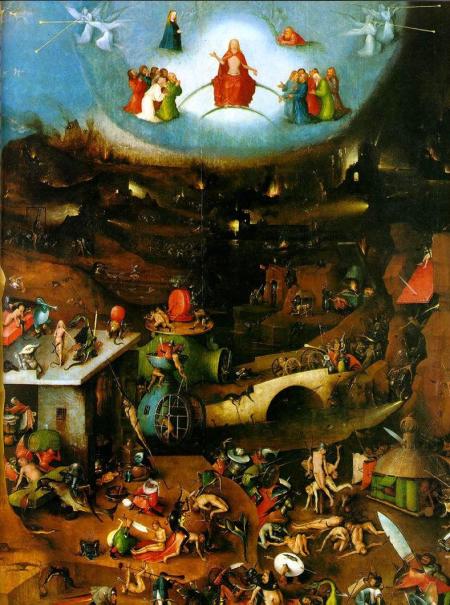
I usually use this piece of Hieronymus Bosch The Last Judgement to illustrate my feelings about the concordance model:

das_letzte_gericht


The top part represents the concordance cosmology. It clearly features an eminent cosmologist surrounded by postdoctoral researchers. Everything appears to be in heavenly harmony, surrounded by a radiant glow of self-satisfaction. The trumpets represent various forms of exaggerated press coverage.

But if you step back from it, and get the whole thing in a proper perspective, you realise that there’s an awful lot going on underneath that’s not so pleasant or easy to interptet. I don’t know what’s going down below there although the unfortunate figures slaving away in miserable conditions and suffering unimaginable torments are obviously supposed to represent graduate students.

The main point is that the concordance model is based on rather strange foundations: nobody understands what the dark matter and dark energy are, for example. Even more fundamentally, the whole thing is based on a shotgun marriage between general relativity and quantum field theory which is doomed to fail somewhere along the line.

Far from being a final theory of the Universe I think we should treat our standard model as a working hypothesis and actively look for departures from it. I’m not at all against the model. As models go, it’s very successful. It’s a good one, but it’s still just a model.

That reminds me of the school report I got after my first year at the Royal Grammar School. The summary at the bottom described me as a “model student”. I was so thrilled I went and looked up the word model in a dictionary and found it said “a small imitation of the real thing.”

Anyway, the talk went down pretty well (I think) and after a quick glass of Guinness (which definitely went down well) I was back to Dublin airport and home to Cardiff soon after that: Cardiff airport to my house was less than twenty minutes. I greatly enjoyed my short visit and was delighted to be asked to do a couple of seminars back there in the near future.

I was in a  good mood when I got home, which got even better when I found out that I won the latest Crossword competition in the Times Literary Supplement. And the prize isn’t even a dictionary. It’s cash!

The Eightsome Reels

Posted in Crosswords, Literature with tags , on March 24, 2009 by telescoper

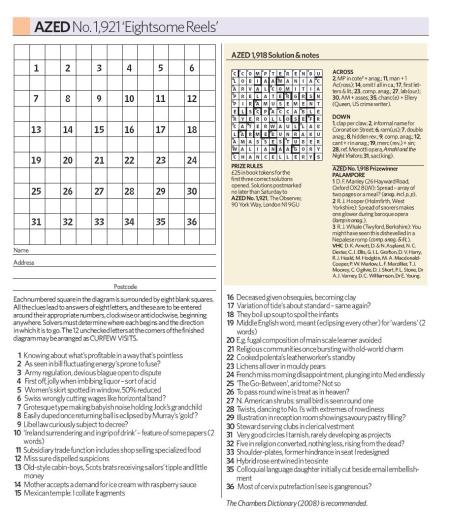
As an ardent cruciverbalist, I couldn’t resist posting this week’s Observer Crossword just to show you one of the interesting variations that Azed comes up with from time to time:

azed

It’s probably a bit small to read  the clues, or even the instructions, but the point to grasp is that the answers are all 8 letters long and they have to be fitted in the squares surrounding the corresponding number. The trouble is that you’re not told which square to start from, or whether the letters are to be entered clockwise or anticlockwise.

Hmmm.

The only way I know to start one of these puzzles is to solve several adjacent clues before entering them in the diagram and then see if I can find a way to fit them together on a bit of scrap paper. The structure of the diagram guarantees many checked letters (i.e. overlaps) between neighbouring answers so once you have a few then the subsequent ones get easier to fit in. These puzzles are usually difficult to start though.

Fortunately, however, in this one  I managed to get four  answers quite quickly:

2. As seen in bill fluctuating energy’s prone to fuse?

This is “liquable”, from “qua” meaning “as” in anagram of “bill”+e for energy, meaning able to melt.

3. Army regulation, devious blague open to dispute

Is clearly “arguable” (army regulation=ar+anagram of blague, “open to dispute” is the definition).

8. Easily duped once returning ball is eclipsed by Murray’s `gold’?

A little harder, but the word “once” suggests an obsolete spelling so the answer is “gullable” (“ball” backwards in “gule”, a Scottish form of “gold”, hence the reference to Murray).

9. Libel law curiously subject to decree?

Is “willable” (anagram of “libel law”; “subject to decree” being the definition).

With those four answers to fit in the squares around 2,  3, 8 and 9 I had plenty of checked letters and could find only one way to make it work. The remaining clues fell into place eventually, although it took me well over an hour to finish it on Sunday afternoon.

Nice puzzle though.

In the ongoing Azed competition for budding crossword cluers, I’m not doing so well. I did pick up a “highly commended” for my last clue, in competition No. 1918,  for the word PALAMPORE (a kind of Nepalese bedcover, don’t you know), but From the dizzying heights of 28th place, I’ve slipped down the table to 33rd.  Still, the winning clue for PALAMPORE was a real beauty:

Spread – array of two pages or a meal?

This involves an anagram of “pp+or a meal” with two different definitions of spread in the cryptic part. Very ingenious, and certainly better than my attempt (which I’m ashamed to include). Esteem to D.F. Manley, who wrote this clue and who is heading the Azed Honours Table for this year after 9 competitions.

Crucial Verbalism

Posted in Crosswords, Literature with tags , , , , , on December 13, 2008 by telescoper

It’s a cold and rainy day and I’m lacking the inspiration to do anything energetic before making dinner, so I thought I’d pick something to blog about. Looking back over the past three months or so, I realise I’ve at least mentioned most things that I’m interested in, at least those that I’m willing to write about on here. But there is one other thing I haven’t covered yet and which I spend a lot of my spare time doing (especially during seminars) and that is solving cryptic crossword puzzles. In fact I simply can’t put a crossword down until I’ve solved all the clues, behaviour which I admit is bordering on the pathological. Still, I think of it as a kind of mental jogging, forcing your brain to work in unaccustomed ways is probably good for its fitness for other more useful things.

I can’t remember when I first started doing these, or even how I learned to do them. But then people can learn languages simply by picking them up as they go along so that’s probably how I learned to do crosswords.

If you’ve never done one of these puzzles before, you probably won’t understand the clues at all even if you know the answer and I can’t possibly explain them in a single post. In a nutshell, however, they involve clues that usually give two routes to the word to be entered in the crossword grid. One is a definition of the solution word and the other is a subsidiary cryptic allusion to it. Usually the main problem to be solved involves the identification of the primary definition and secondary cryptic part, which are usually heavily disguised.

The secondary clue can be of many different types. The most straightforward just exploits multiple meanings. For example, take

Fleeces, things often ordered by men of rank [6]

The answer to this is RIFLES which is defined by “fleeces” in one sense, but “men of rank” (soldiers) also order their arms hence giving a different meaning. Other types include puns, riddles, anagrams, hidden words, and so on. Many of these involve an operative word or phrase instructing the solver to do something with the letters in the clue, e.g.

Port’s apt to make you steer it erratically [7]

has the solution TRIESTE, which is an anagram of STEER+IT, port being the definition.

Most compilers agree however that the very best type of clue is of the style known as “&lit” (short for “and literally what it says”). Such clues are very difficult to construct and really beautiful when they work because both the definition and cryptic parts comprise the same words read in different ways. Here’s a simple example

The ultimate of turpitide in Lent [5]

which is FEAST. Here we have “e” as the last letter of turpitude in “fast” (lent) giving “feast” but a feast is exactly what the clue says too. Nice.

Some clues involve more than one element of this type and some defy further explanation altogether, but I hope this at least gives you a clue as to what is involved.

Cryptic crosswords like the ones you find in British newspapers were definitely invented in the United Kingdom, although the crossword itself was probably born in the USA. The first great compiler of the cryptic type used the pseudonym Torquemada in the Observer. During the 1930s such puzzles became increasingly popular with many newspapers, including famously The Times, developing their own distinctive style. People tend to assume that The Times crossword is the most difficult, but I’m not sure. I don’t actually buy that paper but whenever I’ve found one lying around I’ve never found the crossword particularly hard or, more importantly, particularly interesting.

As a Guardian reader, I have to say I enjoy their crosswords best, primarily because each day brings a different setter each of which has a different style to the others. Unlike some other newspapers they are not anonymous, but identified by a weird and wonderful collection of pseudonyms (Janus, Rufus, Shed, Logodaedalus, Gordius, Chifonie, Paul, Quantum, Brummie, etc). The best of them is the great Araucaria (whose name comes from the Monkey-Puzzle tree) and who is revered by crossword fans the length and breadth of the country for the brilliance of his clues. Araucaria is such a witty compiler that his clues often have you laughing out loud when you see how they fall into place. He is, in fact, a retired clergyman called John Graham who has been setting clues for the Guardian and other newspapers and magazines for over forty years. In fact, the Financial Times has a compiler called Cinephile who is the same person. (CINEPHILE is an an anagram of CHILE PINE, which is another word for the Monkey-Puzzle tree).

As it happens, today’s Guardian prize crossword was by Araucaria and, as usual, it was fun although it wasn’t as difficult as many of his. He followed a common tactic of connecting several clues together but as soon as you realise that

Writers’ relation to 10, maybe [6]

is BRONTE (note the position of the apostrophe indicating several writers with the same name, cryptic part is “bro” for relation and an anagram of “ten”) then the various references to the Brontes were straightforward. The only really difficult other clue is

Picture rhyme for MC in MND [10]

the answer to which is ILLUSTRATE (MND is Midsummer Night’s Dream, which explains the rhyme reference to PHILOSTRATE, a character in that play).

I also like to do the bi-weekly crossword set by Cyclops in Private Eye which has clues which are not only clever but also laced with a liberal helping of lavatorial humour and topical commentary which is right up my street. Many of the answers (“lights” in crossword parlance) are quite rude, such as

Local energy source of stress for Bush [5]

which is PUBES (“pub” from “local”+ E for energy +S for “source of stress”; Bush is the definition).

On Saturdays the Guardian crossword involves a prize so I religiously send my completed grid in the post. There are many hundreds of correct entries per week so it’s quite unlikely to win – the winner is drawn “at random” from all the correct entries. I’ve won the prize nine times over the years, an average of once every two years or so, with the result that I now have more dictionaries than I know what to do with. I don’t actually think a dictionary is a very good prize for a crossword puzzle, as surely every solver has one already! A few years ago The Guardian used to offer fancy fountain pens and watches, which are more like it. I also won a digital radio from the Financial Times puzzle, but I’ve got out of the habit of doing that one nowadays. The same is true for Salamanca in the New Statesman, which I won a couple of times years ago but have stopped doing since I lost interest in the rest of the magazine. I send off the answers to the Eye crossword every time but have never won it yet. That one has a cash prize of £100.

Anyway, Torquemada, who I mentioned above, was eventually followed as the Observer’s crossword compiler by the great Ximenes (real name D.S. Macnutt) who wrote a brilliant book called the Art of the Crossword which I heartily recommend if you want to learn more about the subject.

One of the nice stories in his book concerns the fact that crossword puzzles of the cryptic type were actually used to select recruits for British Intelligence during the Second World War, but this had a flip side. In late May 1944 the chief crossword setter for the Daily Telegraph was paid a visit by some heavies from MI5. It turned out that in a recent puzzle he had used (quite innocently and by sheer coincidence) the words MULBERRY, PLUTO, NEPTUNE and OVERLORD all of which were highly confidential code words to be used for the forthcoming D-Day invasion…

The current Observer crossword setter is the estimable Azed (real name Jonathan Crowther) who follows in the footsteps of his predecessor Ximenes. On balance I think this is consistently the best crossword I have ever done, although it is often a source of total frustration because it is quite convoluted and idiosyncratic. It is a bit different from other puzzles because it doesn’t involve any black squares like you would find in the standard `Everyman’ type of grid. This makes a very dense and intricate task for the solver, but does have the advantage that clues intersect more frequently than in the usual type. The problem with solving Azed is usually getting started as the clues are quite difficult and the words often very obscure. The one concession is that all answers are usually in the Chambers dictionary, and if they aren’t the compiler gives another hint. I’ve been tackling Azed for so long now that the Chambers has become in my mind a much more definitive dictionary than the OED. I also have several copies at home in different rooms, and one in my office at work.

Solving the Azed puzzle is hard enough, but for the special competition puzzles every four weeks one also has to supply a clue of one’s own. The winners of this competition are selected by Azed himself and there is an archive on the web of successful clues. As well as the winner of each competition, there is an annual prizewinner who produces the most good clues over the set of 13 competitions each year, and a roll of honour of all contributed clues that are deemed worthy. I’ve gradually clawed my way up this league table from 118th in 2006-7 to 46th in 2007-8 and, after four of the thirteen rounds this year, I’m currently in 28th place. I have to admit though that I am envious of the talents of many of the other competitors who routinely produce brilliant clues that even my best ones can’t compete with. For the same reasons that I don’t really enjoy setting examination questions, I don’t really like writing clues as much as solving them. My position in the roll of honour belies the fact that I’ve never produced a single clue that has won any of the individual competitions. I’m always the bridesmaid. You can find some of my more successful clues on the archive here.

Among those who have done exceedingly well in this competition over the years are the novelist Colin Dexter (in the form of N.C. Dexter) and a chap called C.J. Morse who is in fact the man that provided the name Dexter used for the crossword-loving chief Inspector in his famous detective novels. In turns out that C.J. Morse recently had his eightieth birthday and, as a special present, last Sunday’s Azed puzzle included some of his competition clues, which are real crackers. I won’t repeat them here though as you can find them all on the archive. However, solvers were invited to submit a clue to the word MORSE for the purposes of the competition, so at least I can tell you what my attempt was. Here we go:

His signal art no astronomer can comprehend [5]

By way of explanation, anagram of “astronomer” can give “morse” plus “art no”; comprehend is used in the slightly unusual sense of “comprise”; signal in the sense of “remarkable” plus reference to Morse system of signals. In the context of this puzzle, to celebrate the skills of Mr Morse, I also think this overall qualifies as an “&lit”.

I doubt if it competes with the best of the entries but I’m still quite proud of it.