Archive for the Cute Problems Category

An Integral Appendix

Posted in Biographical, Cute Problems, The Universe and Stuff with tags , , , , , , on August 7, 2013 by telescoper

After the conference dinner at the Ripples in the Cosmos meeting in Durham I attended recently, a group of us adjourned to the Castle bar for a drink or several. I ended up chatting to one of the locals, Richard Bower, mainly on the subject of beards. I suppose you could call it a chinwag. Only later on did  we get onto the subject of a paper we had both worked on a while ago. It was with some alarm that I later realized that the paper concerned was actually published twenty years ago. Sigh. Where did all that time go?

Anyway, Richard and I both remembered having a great time working on that paper which turned out to be a nice one, although it didn’t exactly set the world on fire in terms of citations. This paper was written before the standard “concordance” (LCDM) cosmology was firmly established and theorists were groping around for ways of reconciling observations of the CMB from the COBE satellite with large-scale structure in the galaxy distribution as well as the properties of individual galaxies. The (then) standard model (CDM with no Lambda) struggled to satisfy the observational constraints, so in typical theorists fashion we tried to think of a way to rescue it. The idea we came up with was “cooperative galaxy formation”, as explained in the abstract:

We consider a model in which galaxy formation occurs at high peaks of the mass density field, as in the standard picture for biased galaxy formation, but is further enhanced by the presence of nearby galaxies. This modification is accomplished by assuming the threshold for galaxy formation to be modulated by large-scale density fluctuations rather than to be spatially invariant. We show that even a weak modulation can produce significant large-scale clustering. In a universe dominated by cold dark matter, a 2 percent – 3 percent modulation on a scale exceeding 10/h Mpc produces enough additional clustering to fit the angular correlation function of the APM galaxy survey. We discuss several astrophysical mechanisms for which there are observational indications that cooperative effects could occur on the scale required.

I have to say that Richard did most of the actual work on this paper, though all four authors did spend a lot of time discussing whether the idea was viable in principle and, if so, how we should implement it mathematically. In the end, my contribution was pretty much limited to the Appendix, which you can click to make it larger if you’re interested.
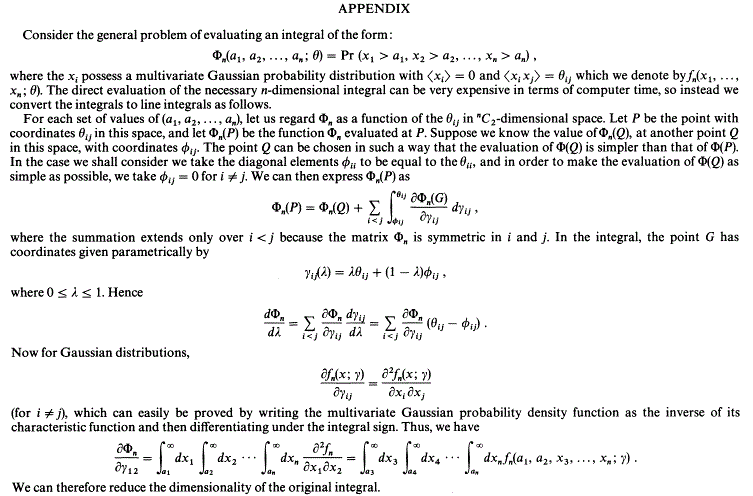
t2png

As is often the case in work of this kind, everything boiled down to evaluating numerically a rather nasty integral. Coincidentally, I’d come across a similar problem in a totally different context a few years previously when I was working on my thesis and therefore just happened to know the neat trick described in the paper.

Two things struck me looking back on this after being reminded of it over that beer. One is that a typical modern laptop is powerful enough to evaluate the original integral without undue difficulty, so if this paper had been written nowadays we wouldn’t have bothered trying anything clever; my Appendix would probably not have been written. The other thing is that I sometimes hear colleagues bemoaning physics students’ lack of mathematical “problem-solving” ability, claiming that if students haven’t seen the problem before they don’t know what to do. The problem with that complaint is that it ignores the fact that many problems are the same as things you’ve solved before, if only you look at them in the right way. Problem solving is never going to be entirely about “pattern-matching” – some imagination and/or initiative is going to required sometimes- but you’d be surprised how many apparently intractable problems can be teased into a form to which standard methods can be applied. Don’t take this advice too far, though. There’s an old saying that goes “To a man who’s only got a hammer, everything looks like a nail”. But the first rule for solving “unseen” problems has to be to check whether you might in fact already have seen them…

Tuesday’s Child

Posted in Bad Statistics, Cute Problems with tags on July 5, 2013 by telescoper

I came across this little teaser this morning and thought I’d share it here.

I have two children, one of whom is a son born on a Tuesday. What is the probability that I have two boys?

Please select an answer from the possibilities listed in the poll below.

This is not a new problem and you can probably find the answer on the internet very quickly, but please try to work it out yourself before doing so. In other words, try thinking before you google! I’ll add a link to a discussion of this puzzle in due course..

UPDATE: Here’s the discussion that triggered this post. As you can see from the poll, most of you got it wrong!

A Question of Bores

Posted in Cute Problems, The Universe and Stuff with tags , , , on June 7, 2013 by telescoper

I was at a lengthy meeting this morning so naturally there popped into my mind the subject of bores. The most prominent of these that will be familiar to British folk is the Severn Bore, but they happen in a variety of locations, including Morecambe Bay (which is in the Midlands):

Tidal_Bore_-_geograph.org.uk_-_324581

As you can see, a bore consists of a steep wavefront that travels a long distance without disruption, and is one manifestation of a more general phenomenon called a hydraulic jump; in a coordinate frame that moves with the wavefront, a bore is basically identical to a stationary hydraulic jump.

Anyway, I while ago I decided to set an examination question about this, which I reproduce here in severely edited form for your amusement and edification; you can click on it to make it larger if you have difficulty reading the question. With the examination season over I’m sure there are many people out there missing the opportunity to grapple with physics problems! Or perhaps not…

Bore

If you need hints, I suggest first working out how the pressure P varies with depth and then using the result to work out to work out the balance of forces either side of the discontinuity. Then deploy Bernoulli’s theorem and Bob’s your uncle!

P.S. For another hint, try the yellow pages:

Boring

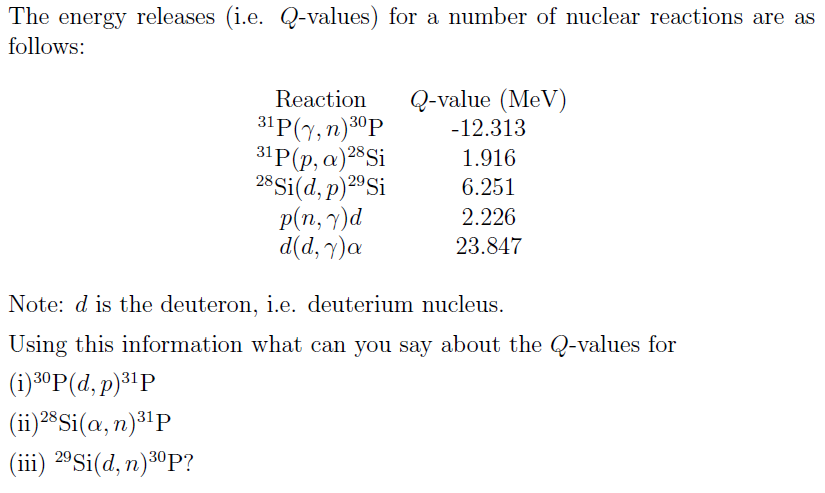
Cute Nuclear Physics Problem

Posted in Cute Problems, The Universe and Stuff with tags , , on May 2, 2013 by telescoper

It’s been quite a while since I posted anything in the cute physics problems folder – mostly because the problems I’m generally dealing with these days are neither cute nor related to physics – but here’s one from an old course I used to teach on Nuclear and Particle Physics.

In the following the notation A(a,b)B means the reaction a+A→b+B and the you might want to look here for a definition of what a Q-value is. The Atomic Number of Phosphorus (P) is 15, and that of Silicon (Si) is 14. The question doesn’t require any complicated mathematics, or any knowledge of physics beyond A-level; the rest is up to your little grey cells!

nuclear

A Small Problemette related to Cosmological non-Gaussianity

Posted in Cute Problems, The Universe and Stuff with tags , , , on April 8, 2013 by telescoper

Writing yesterday’s post I remembered doing a calculation a while ago which I filed away and never used again. Now that it has come back to my mind I thought I’d try it out on my readers (Sid and Doris Bonkers). I think the answer might be quite well known, as it is in a closed form, but it might be worth a shot if you’re bored.

The variable x has a normal distribution with zero mean and variance \sigma^{2}. Consider the variable

y = x + \alpha \left( x^2 - \sigma^2 \right),

where \alpha is a constant. What is the probability density of y?

Answers on a postcard through the comments box please..

The Problem of the Dangling Magnet

Posted in Cute Problems with tags , , , , on February 20, 2013 by telescoper

Here’s a variation on a physics problem we discussed in my first-ever Skills in Physics Tutorial at the University of Sussex. I hadn’t realized that solutions were provided for Tutors so had to exercise my enfeebled brain in finding a solution. You’ll probably find it a lot easier…

A rectangular bar magnet hangs vertically from a pivot at one of its ends. When gently displaced the magnet undergoes small oscillations either side of the vertical with a period of one second.  A horizontal magnetic field is then applied so that the equilibrium orientation of the magnet is  45° to the vertical. If the magnet is gently displaced from this new position, what is the new period of oscillation?

Comment: you do not need any further information about the size, shape or mass of the magnet in order to solve this problem.

The Problem of the Eiffel Tower

Posted in Cute Problems with tags , , , , on November 27, 2012 by telescoper

Too busy today (again) for anything else so I’m going to resort (again) to the Cavendish Problems in Classical Physics. I think I’ll eschew the multiple-choice format for this one, but will say that there is a small hint in the fact that the question is split into two parts:

The Eiffel Tower is 300m high and is situated at a latitude 49° N. What are the magnitude and direction of the deflection caused by the Earth’s rotation to:

  1. the bob of a plumb-line hung from the top of the Tower;
  2. the point of impact of a body dropped from the top?

Please give your answers, with reasons, through the comments box below. For legal reasons I should make it clear that you are not expected to perform either experiment.

The Problem of the Charged Bubble

Posted in Cute Problems with tags , , , on November 21, 2012 by telescoper

Fun physics problem time. I like problems that combine different concepts, so here’s one such from Ye Olde Booke of Cavendish Problems, in a multiple-choice format. It’s not particularly hard, but I like it anyway…

A soap bubble – the film may be taken to be a conductor – of radius 10 mm and surface tension 0.02 N/m is charged by momentarily connecting it to an electrode at 6 kV. How does the radius of the bubble change?

PS. Americans, please note the correct usage of “momentarily”…

Three Tips for Solving Physics Problems

Posted in Cute Problems, Education with tags , , , , , on November 2, 2012 by telescoper

I spent quite some time this morning going over some coursework problems with my second-year Physics class. It’s quite a big course – about 100 students take it – but I mark all the coursework myself so as to get a picture of what  the students are finding easy and what difficult. After returning the marked scripts I then go through general matters arising with them, as well as making the solutions available on our on-line system called Learning Central.

Anyway, this morning I decided to devote quite a bit of time to some tips about how to tackle physics problems, not only in terms of how to solve them but also how to present the answer in an appropriate way.

I began with the Feynman algorithm for solving physics problems:

  1. Write down the problem.
  2. Think very hard.
  3. Write down the answer.

That may seem either arrogant or facetious, or just a bit of a joke, but that’s really just the middle bit. Feynman’s advice on points 1 and 3 is absolutely spot on and worth repeating many times to an audience of physics students.

I’m a throwback to an older style of school education when the approach to solving unseen mathematical or scientific problems was emphasized much more than it is now. Nowadays much more detailed instructions are given in School examinations than in my day, often to the extent that students  are only required to fill in blanks in a solution that has already been mapped out.

I find that many, particularly first-year, students struggle when confronted with a problem with nothing but a blank sheet of paper to write the solution on. The biggest problem we face in physics education, in my view, is not the lack of mathematical skill or background scientific knowledge needed to perform calculations, but a lack of experience of how to set the problem up in the first place and a consequent uncertainty about, or even fear of, how to start. I call this “blank paper syndrome”.

In this context, Feynman’s advice is the key to the first step of solving a problem. When I give tips to students I usually make the first step a bit more general, however. It’s important to read the question too.

The middle step is more difficult and often relies on flair or the ability to engage in lateral thinking, which some people do more easily than others, but that does not mean it can’t be nurtured.  The key part is to look at what you wrote down in the first step, and then apply your little grey cells to teasing out – with the aid of your physics knowledge – things that can lead you to the answer, perhaps via some intermediate quantities not given directly in the question. This is the part where some students get stuck and what one often finds is an impenetrable jumble of mathematical symbols  swirling around randomly on the page.

Everyone gets stuck sometimes, but you can do yourself a big favour by at least putting some words in amongst the algebra to explain what it is you were attempting to do. That way, even if you get it wrong, you can be given some credit for having an idea of what direction you were thinking of travelling.

The last of Feynman’s steps  is also important. I lost count of the coursework attempts I marked this week in which the student got almost to the end, but didn’t finish with a clear statement of the answer to the question posed and just left a formula dangling.  Perhaps it’s because the students might have forgotten what they started out trying to do, but it seems very curious to me to get so far into a solution without making absolutely sure you score the points.  IHaving done all the hard work, you should learn to savour the finale in which you write “Therefore the answer is…” or “This proves the required result”. Scripts that don’t do this are like detective stories missing the last few pages in which the name of the murderer is finally revealed.

So, putting all these together, here are the three tips I gave to my undergraduate students this morning.

  1. Read the question! Some solutions were to problems other than that which was posed. Make sure you read the question carefully. A good habit to get into is first to translate everything given in the question into mathematical form and define any variables you need right at the outset. Also drawing a diagram helps a lot in visualizing the situation, especially helping to elucidate any relevant symmetries.
  2. Remember to explain your reasoning when doing a mathematical solution. Sometimes it is very difficult to understand what you’re trying to do from the maths alone, which makes it difficult to give partial credit if you are trying to the right thing but just make, e.g., a sign error.
  3.  Finish your solution appropriately by stating the answer clearly (and, where relevant, in correct units). Do not let your solution fizzle out – make sure the marker knows you have reached the end and that you have done what was requested.

There are other tips I might add – such as checking answers by doing the numerical parts at least twice on your calculator and thinking about whether the order-of-magnitude of the answer is physically reasonable – but these are minor compared to the overall strategy.

And another thing is not to be discouraged if you find physics problems difficult. Never give up without a fight. It’s only by trying difficult things that you can improve your ability by learning from your mistakes. It’s not the job of a physics lecturer to make physics seem easy but to encourage you to believe that you can do things that are difficult.

So anyway that’s my bit of “reflective practice” for the day. I’m sure there’ll be other folk reading this who have other tips for solving mathematical and scientific problems, in which case feel free to add them through the comments box.

A (Physics) Problem from the Past

Posted in Cute Problems, Education, The Universe and Stuff with tags , , , , , on September 25, 2012 by telescoper

I’ve been preparing material for my new 2nd year lecture course module The Physics of Fields and Flows, which starts next week. The idea of this is to put together some material on electromagnetism and fluid mechanics in a way that illustrates the connections between them as well as developing proficiency in the mathematics that underpins them, namely vector calculus. Anyway, in the course of putting together the notes and exercises it occurred to me to have a look at the stuff I was given when I was in the 2nd year at university, way back in 1983-4. When I opened the file I found this problem which caused me a great deal of trouble when I tried to do it all those years ago. It’s from an old Cambridge Part IB Advanced Physics paper. See what you can make of it..

(You can click on the image to make it larger…)