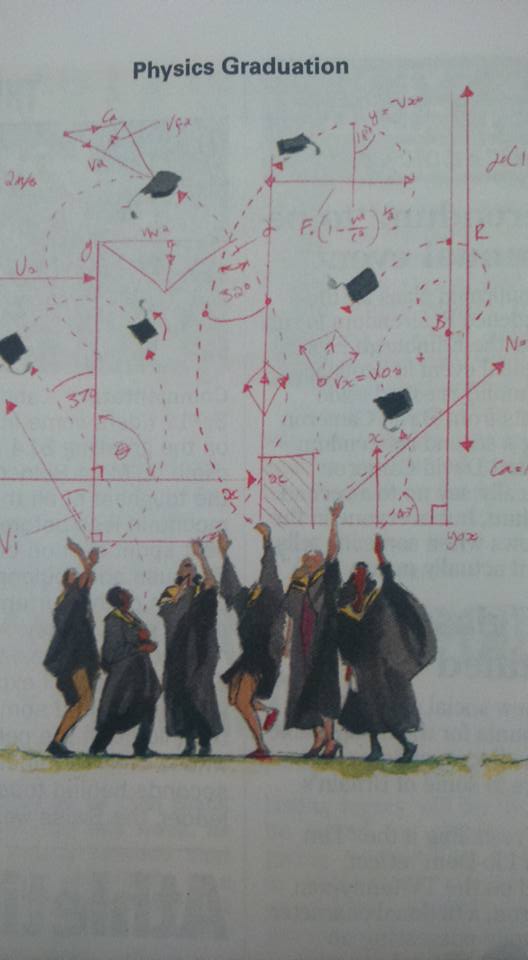
After almost a whole week of conferring ceremonies at Maynooth University, today was the day that this year’s Theoretical Physics students graduated. We all know that theoretical physicists are la crème de la crème so they were obviously keeping the best until last. Anyway, congratulations all!
Here’s a suitable image from Private Eye years ago:
I was away yesterday dealing with some personal matters and on the way home I was so bored that I took a rare glance at my LinkedIn feed and found this, which unfortunately refuses to be embedded properly.
Anyway, it reminded me that it was 50 years ago this week that I went through a similar induction process at the Royal Grammar School Newcastle and was about to begin my Secondary Education along with my classmates in 1E, one of whom I wrote about here. We didn’t have “Year 3”, “Year 7” and “Year 11” in those days; we were just called “First Years”, which I guess is Year 7 in today’s currency. The Hall hasn’t changed much since my day. Although it looked enormous then, to a little boy, to an adult it looks very small to accommodate over a thousand pupils. At the morning School Assemblies many of us had to stand around the edges.
Meanwhile, back in the present week, Maynooth University is hosting events at which degrees are conferred. The cohort of undergraduate students graduating at this week’s ceremonies are those that took their final examinations in May/June this year (while I was away on sabbatical) so I didn’t teach any of them this year. I will, however, be seeing some again as they return for postgraduate degrees.
In a couple of weeks we will be having induction events for the new intake of students at Maynooth University. Most of our students are on 4-year programmes, so it well be September 2028 that the latest crop have their conferring ceremonies. If all goes to plan I shall have retired by then.
My first official day back at work after a year-long sabbatical coincides with the first official day of a new Department of Physics at Maynooth University:
I knew this was happening, of course, and it should have happened years ago. Having two separate Physics Departments at Maynooth was not just an oddity. It required the relatively small number of academic staff across the Departments to undertake a huge amount of duplication in teaching thereby wasting resources and increasing workloads. Even combined together, the total complement of 15 academic staff means that we’re still a very small Department.
There are, therefore, potential benefits in this merger but they will take time to accrue. At the moment it only exists on paper, and staff in the two ex-Departments will have to work out what to do next in terms of coordinating teaching and research. In my opinion this all should have been planned and agreed before going ahead, but here we are. We just have to make the best of the situation presented to us by The Management.
For the time being the New Department is just the two Old Departments in a single wrapper. We were already located side-by-side in the same building, the Science Building so there are no large-scale relocations of staff, at least not yet. All existing courses remain the same as before, too. That’s just as well, really, as we start teaching in three weeks!
That’s not to say that nothing has changed. The number of postgraduate and postdoctoral researchers in the Department of Theoretical Physics has been growing and there was consequently a drastic shortage of office space. My return from sabbatical has involved me being granted an elevated status in the new Department: I’ve been moved upstairs out of the old Theoretical Physics Department to an office in the old Experimental Physics Department.
Here’s a question, though. My contract of employment says that I am employed in the Department of Theoretical Physics. Since that Department no longer exists, do I need a new contract or have I been made redundant?
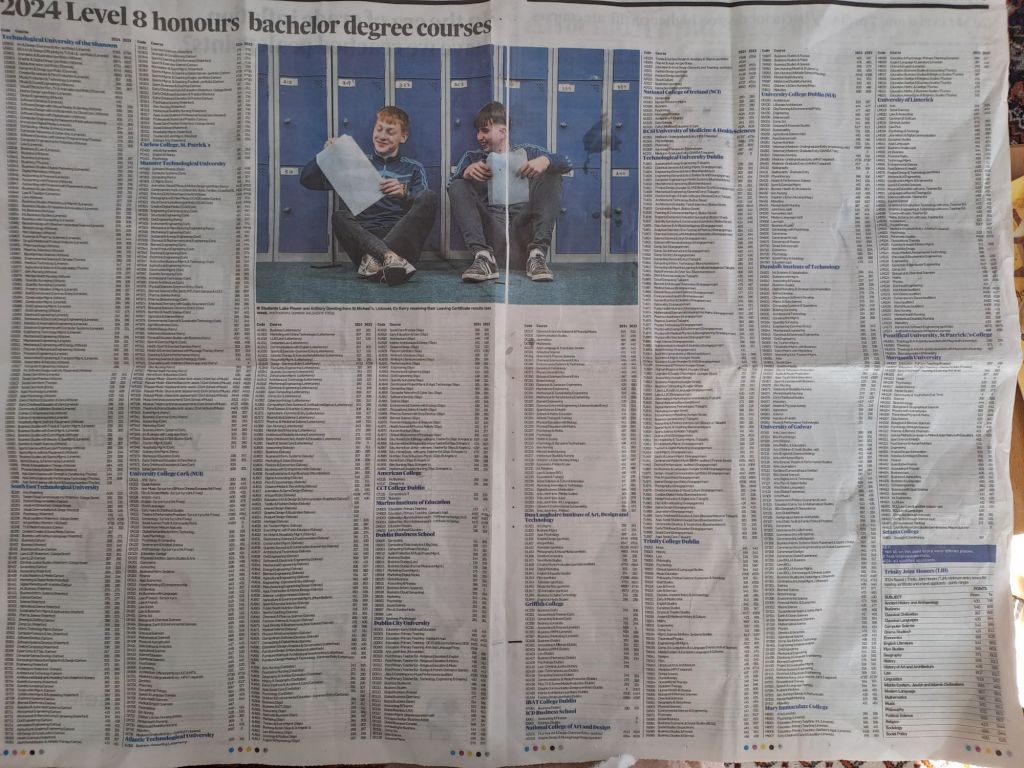
Today is the day that students across Ireland receive offers of places at Third-Level Institutions to start next month; the full set of CAO points required for different courses in different institutions are available in searchable form here and in a more user-friendly interface here. I have been away on sabbatical for a year so have been out of the loop for admissions. In past years I got an idea of how things were going from Open Days, etc, but not this time round.
This is of course just the first round of offers so things may change significantly over the next week or two. Students now have to decide whether to accept their first-round offer or try to change course. They have until next Tuesday to do this. Departments won’t know how many new students they have for a while yet.
The official low-tech results for Maynooth (in the lower right of the page shown above) are here. Minimum points required for Maynooth’s – and indeed Ireland’s – most important course, MH206 Theoretical Physics and Mathematics, are 513 this year, up a from 493 last year. Here’s a graph of how the CAO points for this course have varied over the years since 2010:
The entry level has been rather steady but note that Leaving Certificate grades have been adjusted upwards for the past few years so 500 points in 2024 is not equivalent to the same number in (say) 2016. The above graph doesn’t show how many students were recruited each year either.
MH201 General Science is 350 this year (same as last year); MH204 Physics with Astrophysics is 383 this year, up slightly from 376 last year. MH101 General Arts – the most popular course at Maynooth and indeed in all Ireland – has a first round offer of 307 this year, down from 310 last year. Most courses I have looked at in Maynooth have first-round offers this year similar to or lower than last year. Across all institutions, required points have fallen or remained unchanged for about 57% of courses.
This is interesting because it contrasts with news stories about grade inflation on the Leaving Certificate; I blogged about this here. It is perhaps worth pointing out that the CAO points needed for a course is largely a matter of demand versus capacity rather than academic performance. For the last few years Maynooth University has been recruiting more and more students, putting pressure on accommodation, teaching loads and campus space. It seems likely that the desire to keep this trend going is at least part of the reason for the continued falls in CAO points here. This is probably happening to some extent across the sector, though Maynooth has a more urgent need for more students: to pay for the legions of new managers it has appointed. The race to the bottom will really accelerate when the Covid-era Leaving Certificate adjustment is removed.
Update: here is the traditional supplement from Thursday’s Irish Times:
Today’s the day that over 60,000 school students across Ireland are receiving their Leaving Certificate Results. As always there will be joy for some, and disappointment for others. The headline news relating to these results is that a majority (68%) of grades have been scaled up to that the distribution matches last year’s outcomes. This has meant an uplift of marks by about 7.5% on average, with the biggest changes happening at the lower levels of grade.
This artificial boost is a consequence of the generous adjustments made during the pandemic and apparent wish by the Education Minister, Norma Foley, to ensure that this year’s students are treated “fairly” compared to last year’s. Of course this argument could be made for continuing to inflate grades next year too, and the year after that. Perhaps the Minister’s plan seems to be to keep the grades high until after the next General Election, after which it will be someone else’s job to treat students “unfairly”. Anyway, you might say that marks have been scaled to maintain a Norma Distribution…
One can’t blame the students, of course, but one of the effects of this scaling is that students will be coming into third-level education with grades that imply a greater level of achievement than they actually have reached. This is a particular problem with a subject like physics where we really need students to be comfortable with certain aspects of mathematics before they start their course. It has been clear that even students with very good grades at Higher level have considerable gaps in their knowledge. This looks set to continue, and we will just have to deal with it. This issue was compounded for a while because Leaving Certificate grades were produced so late that first-year students had to start university a week late, giving less time for the remedial teaching that many of them needed. At least this year we won’t have that problem, so can plan some activities early on in the new Semester.
Anyway, out of interest – probably mine rather than yours – I delved into the statistics of Leaving Certificate results going back six years for Mathematics (at Higher A and Ordinary B) level, Physics and Applied Mathematics which I fished out of the general numbers given here.
Here are the results in a table, with the columns denoting the grade (1=high) and the numbers are percentages:
You can seen that the percentage of students getting H1 in Mathematics has increased a bit to 12.6% after falling considerably from 18.1% in 2022 to 11.2% last year (2023); note the huge increase in H1 from 2020 to 2021 (8.6% to 15.1%). Another thing worth noting is that both Physics and Applied Mathematics have declined significantly in popularity since 2019 from 7210.
Now that the results are out there will be a busy time until next Wednesday (28th) when the CAO first round offers go out. That is when those students wanting to go to university find out if they made the grades and university departments find out how many new students (if any) they will have to teach in September.
P.S. When I was a little kid we used to call a “Certificate” a “Stiff Ticket”. I just thought you would like to know that.
Yesterday was the day that students in United Kingdom received this year’s A-level results. It seems the number of students getting the highest grades went up in England but down in Wales and Northern Ireland. That difference could be because of the timing of the transition from Covid-19 adjustments, with marks in Wales and Northern Ireland only returning to pre-pandemic levels this year; this may disadvantage applicants to universities this year, of course.
Another thing worth mentioning is that the number of students taking Physics A-level has increased by 12% this year, reversing a recent downward trend. In Physics, 31.5 per cent of students achieved the top grades. This was an increase from last year when 30.8 per cent were awarded an A or A*. That probably means that most students who applied to do Physics at university will get a place in their first-choice institution.
As always my advice to students who got disappointing results is
There’s always the clearing system and there’s every chance you can find a place somewhere good. If you’re reading this blog you might be interested in Physics and/or Astronomy so I’ll just mention that both Cardiff and Sussex have places in clearing and both are excellent choices.
At least you’ve got your results; students here in Ireland will have to wait next Friday (23rd August) to get to get theirs – not in the form of GCE A-levels, of course, but the School Leaving Certificate. I have been away all year so don’t know how admissions have been going for Maynooth but the intention seems to be to increase student numbers in any way possible despite the already huge student-staff ratio (the highest in Ireland) and lack of student accommodation. Anyway, Covid-19 adjustments are still in place in Ireland so the artificial inflation of Leaving Certificate grades will continue. It seems the Government doesn’t know how to get out of the system it has locked itself into and is intent on leaving it for the next Government to sort out.
Today, Monday 5th August 2024, being the first Monday in August, is a Bank Holiday in Ireland. This holiday was created by the Bank Holiday Act of 1871 when Ireland was under British rule. While the August Bank holiday was subsequently moved to the end of August in England and Wales, it has remained at the start of August in Ireland. Today is also a Bank Holiday in Scotland, though the Scots have the best of both worlds and have a holiday at the end of August too.
The first day of August marks the old pagan festival of Lughnasadh, named after the God Lugh, on which is celebrated the beginning of the harvest season. This coincides with the English Lammas Day one of many Christian festivals with pagan origins. Traditionally this marks the start of the harvest season and is celebrated accordingly, with rites involving the first fruit and bread baked from flour obtained from the first corn. It is also one of the cross-quarter days, lying roughly half-way between the Summer Solstice and the Autumnal Equinox (in the Northern Hemisphere).
It seems to be a tradition in Maynooth that the Bank Holidays in May and August are are adjacent to examinations. This year they start on Wednesday (7th August). I am, however, still on sabbatical so I don’t have any correcting duties. That doesn’t mean I can’t wish all the students taking repeat examinations all the best in their endeavours.
This month is the last of my sabbatical. I officially return to normal duties on 1st September, but that is a Sunday so I won’t return to the office until Monday 2nd September. That is if I have an office. There’s a lot of reorganization going on and currently I don’t know where I’ll be based. At least I know what I’ll be teaching in Semester 1 though: a fourth-year Mathematical physics course on Differential Equations and Complex Analysis and a second-year Engineering Mathematics course. These are not what I would have chosen if I had a free hand (I’d rather teach physics than mathematical methods) but I’ve had it excessively easy for the last year so can’t complain. With a bit of luck I might get a project student or two as well, if the students haven’t forgotten who I am!
The full paper can be found here (Open Access). In case you weren’t aware the word anomie according to Durkheim, being a state of “normlessness”, in general means the lack of social cohesion and solidarity that often accompanies rapid social change. I’d say there’s a lot of that about these days.
The study relates directly to UK universities, many of which are struggling and some of which are on the verge of collapse as a result of several factors, not just those stemming from the Covid-19 pandemic. One of the surprising (and depressing) things about Ireland is that the people in charge of third level education here seem to be determined to repeat here the terrible decisions being taken across the Irish sea despite all the evidence of the damage they have done in the UK. Many of the comments made by individuals mentioned in the paper will definitely resonate with colleagues in Maynooth.
This bit particularly caught my eye:
All too often dangerous managers simply skip from one university to the next causing havoc wherever they go. (RS2 – Male, former Senior Lecturer, pre-1992 institution)
I just passed by some poppies growing on a rather scruffy piece of verge near my house. They reminded me of this poem by Sylvia Plath, which I have posted before.
Last night I arrived back in a very rainy Barcelona. Although I got a bit damp on the way back to my flat from the bus stop, the journey was otherwise uneventful. The one thing worthy of note is that although the approach to Barcelona Airport was a little bumpy owing to bad weather, the pilot managed to perform one of the softest of soft landings I’ve ever experienced. It was so well done that there was a spontaneous round of applause from the passengers. Clapping when the plane lands used to be fairly common, but nowadays is a rarity reserved for occasions such as this.
The end of my stint in Barcelona is now in sight so I plan to see the sights I haven’t yet seen, or at least as many of them as I can manage. Next week I have to travel to Rome for the 2024 Euclid Consortium Meeting, at which I’m doing a plenary talk on the first morning. The week after that I have to travel to Valencia to give a seminar, so it will be a busy second half of the month.
Talking of the Euclid Consortium, my term as Chair of the Euclid Consortium Diversity Committee (ECDC) closes at the end of June 2024, at which point I will also be leaving the Committee after 4 years on it. Hopefully I will find a bit more time to do research in the last two months of my sabbatical; I’ve spent about 50% of it so far on ECDC matters, and progress on writing papers has consequently been slower than I’d have liked. I hadn’t anticipated such a big increase in papers submitted to the Open Journal of Astrophysics, either but fortunately I’ve managed to get the most time-consuming aspects of that automated and since that it hasn’t taken up that much of my time.
As it happens, yesterday was the day of the Departmental Examination Board for the Department of Theoretical Physics at Maynooth. I haven’t been teaching this year, so wasn’t involved. I do know quite a few students who will be graduating this summer, though, and am a little sad I won’t be around to congratulate them. I might see some of them at their conferring ceremonies in September though.
And then there’s next academic year to look forward to. What will I be teaching, I wonder? I’m not going to think about that until I have to…
The views presented here are personal and not necessarily those of my employer (or anyone else for that matter).
Feel free to comment on any of the posts on this blog but comments may be moderated; anonymous comments and any considered by me to be vexatious and/or abusive and/or defamatory will not be accepted. I do not necessarily endorse, support, sanction, encourage, verify or agree with the opinions or statements of any information or other content in the comments on this site and do not in any way guarantee their accuracy or reliability.




 In the Dark