Archive for the Education Category

The Land of Inadequate Research Stipends

Posted in Education with tags , , , on October 13, 2023 by telescoper

I noticed yesterday that the Irish Government has announced that the stipend for PhD research supported by Science Foundation Ireland (SFI) and the Irish Research Coucil (IRC) will increase by €3,000 a year. The increase will bring the rate of stipend to €22,000 a year for doctoral researchers from January 2024. While this is €3,000 less than the €25,000 recommended by a report published earlier this year, and the Government itself has already tacitly admitted that a level of €28,000 is needed to attract the best students, this is at least a step in the right direction.

Current levels of funding for research students are simply exploitative, forcing research students to take on extra work – often low-paid teaching duties – in order to make enough money to make ends meet. That is, unless they are students from affluent backgrounds. The discriminatory aspect of this policy is plain for all to see: should a career in research only be possible for the wealthy?

Of course this applies only to PhD students funded by SFI and IRC. It remains to be seen whether other funders – particularly Universities themselves – will match this increase. If they don’t, it will create an unhealthy division between students doing similar work but receiving vastly different levels of remuneration.

In related news I notice the Irish Universities Association has proudly announced a new agreement to fund Chilean students undertaking PhD and Research Masters courses in Ireland. Sounds great, I thought when I saw the announcement, astronomy being a likely area for research projects involving Chilean students.

Strangely (?) the website advertising this scheme doesn’t mention the level of stipend offered, but I found out independently that it is $15,000 per annum. That’s about €14,250, completely inadequate for a research student in Ireland, especially in the Dublin area, and especially for one who has travelled halfway round the world to get to Ireland. I certainly won’t be encouraging any students to apply for this scheme unless and until the miserly bursary is increased to the same level as SFI/IRC.

The IUA, of course, knows full well that this stipend is insupportable, so it is reprehensible for it to have agreed to these terms, the only possible outcome of them being to create an underclass within an underclass.

I had my university education for free, without tuition fees and with a full maintenance grant. The stipend I received for my PhD, although by no means luxurious, was adequate too. At times like this I wonder yet again why my generation spends so much time shitting on the young?

On Budgets

Posted in Education, Finance, Maynooth, Politics with tags on October 11, 2023 by telescoper

Yesterday was Budget Day in Ireland, when the Irish Government had to decide how to deal with an unprecedented fiscal surplus. Would it use the available funds to help the homeless and those in poverty? Would it provide much-needed investment in public services and infrastructure? Or would it use the funds to buy the next General Election? As far as I see it, the decision was mainly to go with the third option, paying only lip service to the other two. That’s not surprising, as it’s the sort of thing the sort of people in the current Government have tended to do over the years. Short-termism is the order of the day.

When it comes to third level education, there was some good news for students. Tuition fees currently €3K will be cut by €1K but, disappointingly, the reduction is for one year only. As far as I can understand the news, extra Government funding to universities will replace the loss of fee income, but not provide the general uplift that was hoped for.

A couple of weeks ago, the Leaderene President of Maynooth University sent around a letter written by the Irish Universities Association (IUA) to the Taoiseach. You can find the PDF here. The Government must have been unconvinced by the arguments presented therein, because despite having more than enough dosh to pay for the requested increase in funding, no such largesse was forthcoming.

Despite this setback, Maynooth University’s Management hiring frenzy continues unabated. The latest new position to be advertised is a Director of International Recruitment and Conversion. No, I have no idea what it means either. Perhaps someone in Government looked at how much money Maynooth has burned recently on so many new positions and decided that third level institutions must have plenty of cash already?

In reality of course, the horde of new managers have been funded by diverting funds away from teaching and research. Maynooth already has the highest student-staff ratio of the eight comparable universities, a situation which will only get worse. As funding for teaching gets squeezed to pay for ballooning bureaucracy, departments have no alternative but to employ casual staff instead of permanent academics. As a report produced by the union IFUT makes clear, precarity is endemic in the Irish third level system,as it overwork and job-related stress.

I hope this interpretation is wrong but, the way I see it, none of this is accidental. During the pandemic, University bosses saw teaching staff take on greatly increased workloads that enabled their institutions to generate large surpluses. Having established just how much they could exploit their workforce, the way ahead will be more of the same. The deliberate policy of understaffing, overwork, and casualization will only accelerate. The Irish University system is heading for a crisis on the same scale as that in the United Kingdom, and lack of public funding is only part of the reason…

The Meaningless University Rankings

Posted in Education with tags , , , on September 29, 2023 by telescoper
Photo by Pixabay on Pexels.com

I see that the Times Higher has now released this year’s outcomes of its annual exercise in numerology called the World University Rankings. The announcement is accompanied by narratives such as this:

China is edging closer to the top 10 and now has two institutions in the top 15 for the first time. Tsinghua and Peking universities both overtake the University of PennsylvaniaJohns Hopkins University and Columbia University to rank 12th and 14th respectively in this year’s 20th edition of the ranking. Meanwhile, Japan’s University of Tokyo now outperforms the University of EdinburghKing’s College London and the London School of Economics and Political Science, after rising 10 places to 29th.

Blah Blah Blah.

Such statements are rendered even more meaningless than they usually are by the fact that this year’s (2024) rankings are constructed using a very different methodology from previous years. How do we know, then, that the changes in rank described above are due simply to a change in methodology?

The answer is that we don’t.

As I pointed out last week, it would be a very simple task to answer that question. All the Rankers need to do is run last year’s methodology using this year’s data and/or last year’s methodology with this year’s data, and compare the result with this year’s rankings. Any differences so produced would demonstrate whether or not the methodology is more important that the data. This is the sort of test that anyone with a basic knowledge of the scientific method would perform. Over the years I’ve asked the Times Higher many times to do this exercise and they have always refused.

My theory is that actual institutional changes take place much more slowly, over a much longer timescale than a year. These rankings would be much harder to sell, and to construct commentaries that sell, if the rankers if nothing much happened between, say 2023 and 2024. That’s why they shake up the methodology every few years, to make it look like something is happening with which their “journalists” can fill column inches.

It seems to me a reasonable inference that the Times Higher doesn’t really care whether the results of its annual Rankfest actually mean anything or not. They just want to peddle the results to the world’s bureaucrats and politicians who lap it all up unquestioningly. Unfortunately the people in and around universities who make strategic decisions often believe this sort of nonsense and hold quite a lot of power, so the league tables aren’t merely irrelevant garbage – they’re potentially dangerous garbage.

Hats off, then, to Utrecht University in the Netherlands who have refused to participate in this year’s rankings. I quote:

UU has chosen not to submit data. A conscious choice:

  • Rankings put too much stress on scoring and competition, while we want to focus on collaboration and open science.
  • In addition, it is almost impossible to capture the quality of an entire university with all the different courses and disciplines in one number.
  • Also, the makers of the rankings use data and methods that are highly questionable, research shows.

Quite so. More of this please!

Physical Differences

Posted in Barcelona, Biographical, Education with tags , , on September 26, 2023 by telescoper

Today was my first day in the ICCUB

I spent quite a lot of this morning trying to get my internet connections to work and trying to sort out an office key, not with 100% success. I am currently in the office of a member of staff who happens to be away today instead of the office I was allocated, and my email address here is not yet activated – probably because I did something wrong in the registration process. I’m hopeful that these minor issues will be resolved tomorrow. Even Eduroam acted up for a while before finally letting me connect. Such is life.

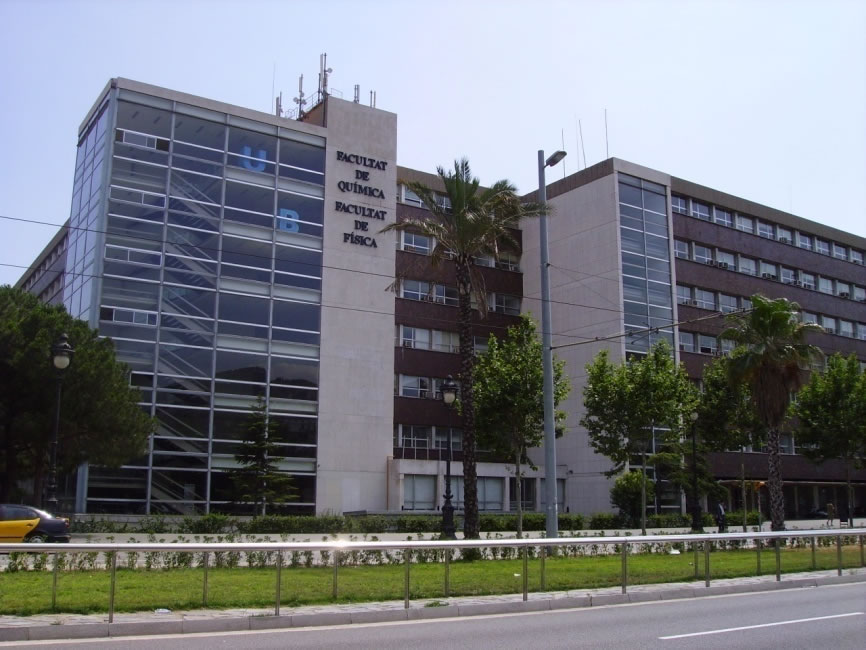
Anyway, my first impression on arriving in the building was of a huge difference in scale in Physics activity here at the University of Barcelona (UB) as compared to Maynooth (and indeed the UK Physics departments I have worked in). That’s not just the size of the building, which the Faculty of Physics shares with the Faculty of Chemistry. Physics and Chemistry also share a building in Maynooth, in fact, so the sharing was not in itself a surprise. The Science Building in Maynooth is very small, however, and it was a bit of a shock seeing how much space there is here compared with Maynooth, and also finding out how easy it is to get lost among the 7 floors. The sense of space is very refreshing, actually, as cramped accommodation is a constant reminder of financial and other constraints.

That’s not the only difference, though. There is enough activity in Physics in the University of Barcelona for it to be an entire Faculty. The UB Faculty of Physics contains Departments, covering the following areas: Electronic & Biomedical Engineering; Quantum Physics & Astrophysics; Condensed Matter Physics, and Applied Physics. It is also home to ICCUB, an interdisciplinary research institute that sits outside the Department structure and some of whose staff are paid from external agencies rather than the University itself.

In Maynooth there is a Faculty of Science and Engineering that covers all disciplines represented in the list above, and more besides. It would amuse my colleagues back in Ireland to see that Electronic Engineering is considered a small subset of Physics in Barcelona, whereas in Maynooth it is a free-standing department which is larger than Physics.

P.S. I just thought I’d mention another difference: that it is very warm here (26° C) so I may need to stop for a beer on the way home…

An Open Letter to the Times Higher World University Rankers

Posted in Bad Statistics, Education with tags , , , , , , on September 20, 2023 by telescoper

Dear Rankers,

I note with interest that you have announced significant changes to the methodology deployed in the construction of this years forthcoming league tables. I would like to ask what steps you will take to make it clear to that any changes in institutional “performance” (whatever that is supposed to mean) could well be explained simply by changes in the metrics and how they are combined?,

I assume, as intelligent and responsible people, that you did the obvious test for this effect, i.e. to construct and publish a parallel set of league tables, with this year’s input data but last year’s methodology, which would make it easy to isolate changes in methodology from changes in the performance indicators.  This is a simple test that anyone with any scientific training would perform.

You have not done this on any of the previous occasions on which you have introduced changes in methodology. Perhaps this lamentable failure of process was the result of multiple oversights. Had you deliberately withheld evidence of the unreliability of your conclusions you would have left yourselves open to an accusation of gross dishonesty, which I am sure would be unfair.

Happily, however, there is a very easy way to allay the fears of the global university community that the world rankings are being manipulated. All you need to do is publish a set of league tables using the 2022 methodology and the 2023 data. Any difference between this table and the one you published would then simply be an artefact and the new ranking can be ignored.

I’m sure you are as anxious as anyone else to prove that the changes this year are not simply artificially-induced “churn”, and I look forward to seeing the results of this straightforward calculation published in the Times Higher as soon as possible, preferably next week when you announce this years league tables.

I look forward to seeing your response to the above through the comments box, or elsewhere. As long as you fail to provide a calibration of the sort I have described, this year’s league tables will be even more meaningless than usual. Still, at least the Times Higher provides you with a platform from which you can apologize to the global academic community for wasting their time and that of others.

Welcome (and Goodbye) Week

Posted in Biographical, Education, Maynooth on September 18, 2023 by telescoper

So Welcome Week has started in Maynooth, although I’m keeping a low profile ahead of my departure to foreign climes and haven’t seen any of the new students, who I’m assured definitely exist. I will be on campus tomorrow though as I have various things to do in my office before handing over the keys until next year. I think pint or two may well be drunk at some point this week to celebrate my departure too.

Although I’m not involved in Welcome Week activities, this week is nevertheless going to be extremely busy, and not just because of preparations for my trip to Barcelona. After a short hiatus in December, Euclid developments are well and truly back and I’ve got a stack of telecons to deal with. I had three today, and that’s just the start. I won’t get away from those while on sabbatical, of course, but at least I don’t have to organize them around teaching and other departmental activities.

I was chatting with my PhD student online this afternoon and it struck me that this will be the first time since 2020 that the Autumn Semester will start properly at Maynooth and students will get a full twelve weeks of in-person teaching with a study week. For the three previous years, teaching started late for new students because of a knock-on effect of the Leaving Certificate results being delayed by Covid-19 reasons. That meant that there was a truncated orientation process and term was a week shorter, i.e. 11 weeks instead of 12. I have been teaching first year physics students during that period, and it was quite a headache figuring out how to tweak things to make everything fit without rushing too much. Now all that is behind us, and a more relaxed start of term is possible, but it’s my successor in the role of first-year lecturer who will reap the benefit.

Teaching term starts later in Maynooth than in many other Irish universities. This year lectures commence on 25th September, a week today, by which time I’ll be in Barcelona. This has its advantages, but the disadvantage is that teaching is supposed to carry on until Friday December 22nd, just three days before Christmas…

Physics as Fun

Posted in Biographical, Education, Maynooth on September 13, 2023 by telescoper

To add to all the excitement I’ve just had a visit from a representative of ESB Networks who installed a new “smart” meter at my house in Maynooth. That process involved cutting off the electricity for about 15 minutes, which was long enough to set off my burglar alarm. Now that’s sorted, I have to go round resetting the clocks. All of that after I wasted half an hour this morning watching my laptop do compulsory Windows updates which involved two restarts.

Anyway, despite the distractions I’ve been working busily at home and getting ready for my departure abroad. This is the first year for a while that I haven’t been involved in Welcome Week or the Student Orientation process, which are ongoing. I have, however, looked at the online registrations so far and confirmed that there will indeed be some students in Theoretical Physics for the forthcoming academic year.

Yesterday I saw this cartoon by Gary Larson so thought I’d share it here.

It reminded me of this picture I have in the past shown at Open Days

I think there are many people out there who think physics, especially theoretical physics, isn’t something to be enjoyed. I think it is, or at least that it can be. I also think the best way to succeed at physics is by enjoying it, and I hope the new and returning students at Maynooth enjoy their theoretical physics over the next year while I am slaving away on sabbatical in Barcelona…

ITP 2023

Posted in Biographical, Education, Maynooth, The Universe and Stuff on September 6, 2023 by telescoper

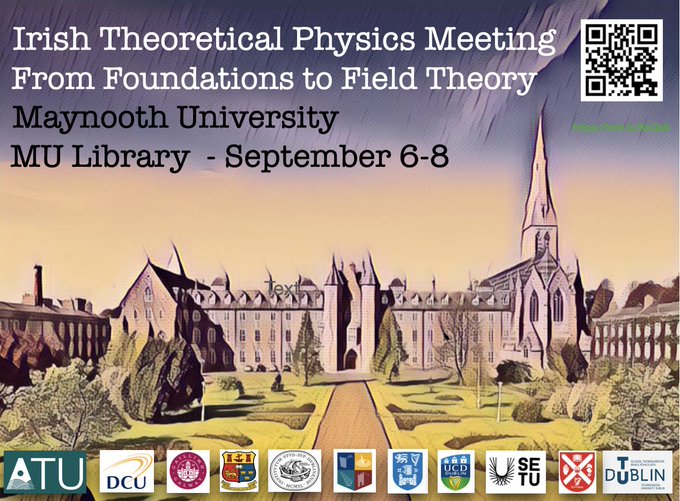
So here we are then, first day of the 2023 Irish Theoretical Physics meeting here in Maynooth. It’s a busy schedule for the three days, followed by a little meeting on Saturday to mark the retirement of Brian Dolan

It’s been a busy day for reasons other than the ITP2023 and I’ve left it a bit late to write my talk for this evening’s public lecture so I’d better get on with that this afternoon.

Updates to follow.

The Higher Education Market

Posted in Education, Maynooth with tags , , , on September 3, 2023 by telescoper
Iontas Lecture Theatre, Maynooth University

Last week I was talking to a current undergraduate student who has been working in the Department of Theoretical Physics over the summer. After a while the conversation turned to the possibilities for postgraduate education. I’ve had that sort of discussion many times over the years with many different students, but the curious thing is that I always find it quite difficult because I’m torn between competing motivations.

On the one hand, there is the wish to have the best undergraduates stay on for further study in the Department. That of course helps our research, but it is also good for our finances as postgraduate students bring income. I think we offer good opportunities at both Masters and Doctoral levels, so it’s not too difficult to point these out to students in a way that at least some find persuasive.

On the other hand, there is the fact that I am an academic not a salesman and I feel that it is my responsibility to give honest guidance. The fact is that a good undergraduate degree from the National University of Ireland will open a lot of doors elsewhere, and these should be considered. At Masters level in particular, there are excellent courses available in the EU which have the advantage of not charging fees at the level they are charged in Ireland. Add to that the cost of living and accommodation crises. It’s no surprise that many of our graduates seize opportunities to go to postgraduate study in Germany, Denmark or The Netherlands (to name just a few). I have no problem with explaining the advantages of options outside my own Department and no doubt some students find these points persuasive too.

There’s a wider context for this type of dichotomy, namely the progressive marketisation of higher education. When it comes to recruiting undergraduate students we academics are increasingly required to act as reps for the University, hawking our wares at Open Days, Recruitment Fairs, and a variety of online events. I’m reasonably happy to participate in these when asked to do so, but I always take the approach of describing what we do in our Department rather than trying to do down what happens elsewhere. I’m an academic not a salesman. And I work in a public university, not a private business. I see my job as giving advice in as objective a way as possible. If I feel that our courses would not be the right choice for a student, I’ll explain why. In the end, of course, the decision is up to the student, but I feel obliged to give them enough information to make an informed choice.

A couple of years ago, the (then) new President of Maynooth University walked up to the Theoretical Physics stand at a Maynooth Open Day when I was on duty. The first thing she said was “Sell your course to me”. I described what we had on offer, but I don’t think what I said impressed her at all. We can only hope to succeed in recruiting students who have some interest in science. An Open Day is a bit late to cultivate that: interest has to be nurtured from an early age.

Another problem I find, speaking as a physicist (though this is probably also true for people in many other disciplines), is that we see physicists in other institutions as colleagues rather than business rivals. This is particularly true for those of us working in large consortia that spread over many departments (and indeed many countries). I therefore see myself as a physicist who happens to work at Maynooth University rather than as an employee of Maynooth University who happens to do physics. It’s not that I am disloyal to my employer, it’s just that I have a greater loyalty to a larger community.

I do understand that the reality of the funding system here means that we have to be able to recruit students in order to pay our way, but I feel that the way to achieve that is by establishing a strong reputation in our core academic mission of teaching and research rather than through marketing gimmicks, corporate branding, or other forms of commercial flummery. No amount of propaganda will disguise a higher education institution that neglects those things that higher education is about.

Times of Offers

Posted in Education, Maynooth with tags , , , , on August 31, 2023 by telescoper

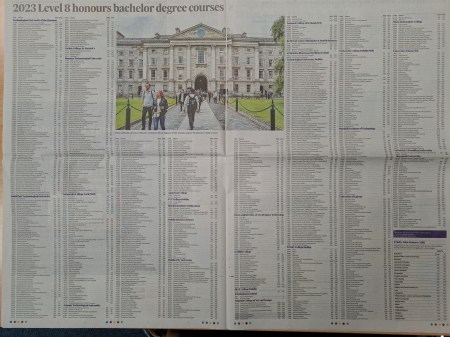
It’s that time of year again when I break with the self-imposed tradition of not buying a newspaper during the week. I don’t usually buy a newspaper during the week but today is the day the full set of CAO points required for different courses across the land are published in the print edition of the Irish Times, about ten days earlier than last year. This is of course just the first round of offers so things may change over the next week or two.

Students now have to decide whether to accept their first-round offer or try to change course. Departments won’t know how many new students they have for a while yet.

The official low-tech results for Maynooth (in the lower right of the page shown above) are here. Minimum points required for Maynooth’s most important course, MH206 Theoretical Physics and Mathematics, are 494 this year, down a little from 510 last year. MH201 General Science is 350 this year compared to 400 last year; MH204 Physics with Astrophysics is 376 this year, down from 423 last year. MH101 General Arts – the most popular course at Maynooth and indeed in all Ireland – has a first round offer of 310 this year, down from 338 last year.

In fact, most courses I have looked at, not only at Maynooth, have lower first-round offers this year than last year. This is confirmed by this news item which says:

In more good news for this year’s applicants, there has been a fall in the points requirement for more than 60% of Level 8 courses.

This is interesting because it contrasts with news stories about grade inflation at the Leaving Certificate. How does one reconcile the fact that a majority of courses are asking for lower points, when the average points are going up? I think part of the answer lies in the fact that the CAO points needed for a course is largely about demand versus capacity rather than academic performance. For the last few years Maynooth University has been recruiting more and more students, putting pressure on accommodation, teaching loads and campus space. It seems likely that the desire to keep this trend going is at least part of the reason for the large falls in CAO points here. This is probably happening to some extent across the sector, though Maynooth has a more urgent need for more students – to pay for the legions of new managers it has appointed.

Another part of the answer is that one subject in which grades have fallen this year is Mathematics, specifically Higher Mathematics. Mathematics is a core subject for the Leaving Certificate and it therefore has the potential to have an effect across the board. A fall in the top grades at Higher Maths will propagate downwards through many subjects.