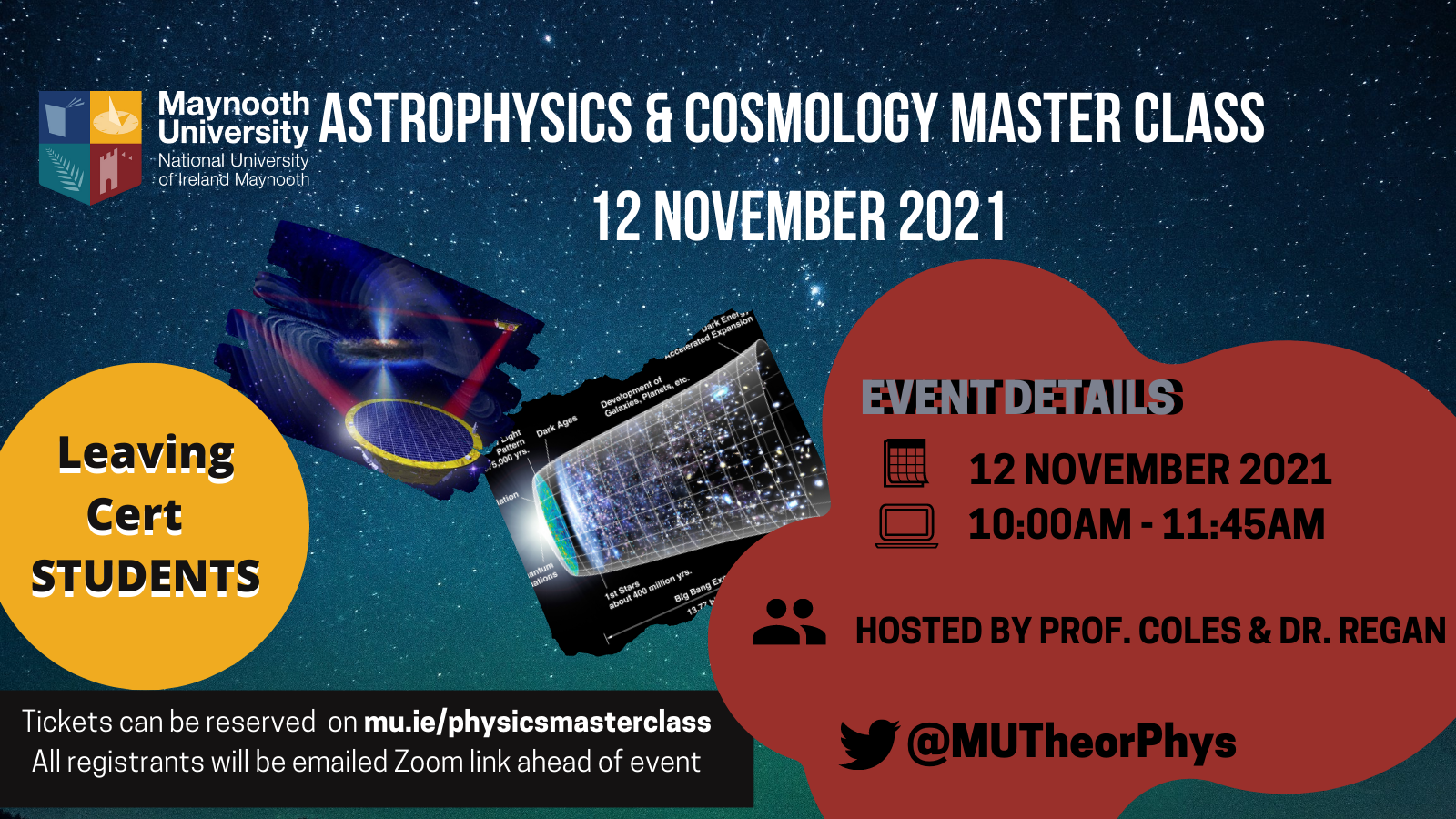
Regular readers of the blog – both of them – may remember that, after a couple of postponements due to Covid-19, we presented a Masterclass in Astrophysics & Cosmology in Maynooth on March 25th 2021. Well, owing to popular demand, we’ve decided to do a re-run of the event on Friday 12th November 2021 ahead of the forthcoming CAO cycle. That’s a week tomorrow!
This will be a half-day virtual event via Zoom. It’s meant for school students in their 5th or 6th year of the Irish system. There might be a few of them or their teachers who see this blog so I thought I’d share the news here. You can find more information, including instructions on how to book a place, here.
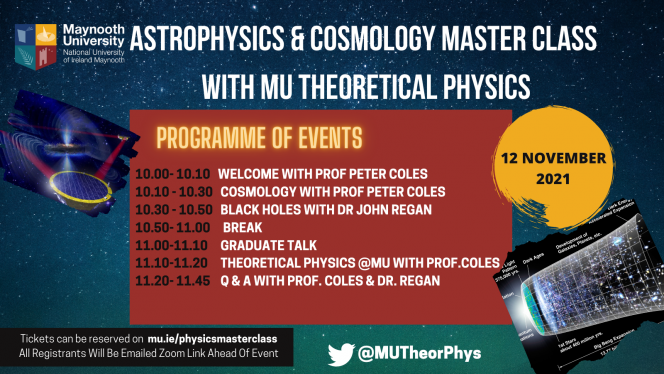
Here is the updated official poster and the programme:
I’ll be talking about cosmology early on, while John Regan will talk about black holes. After the coffee break one of our PhD students will talk about why they wanted to study astrophysics. Then I’ll say something about our degree programmes for those students who might be interested in studying astrophysics and/or cosmology as part of a science course. We’ll finish with questions either about the science or the study!
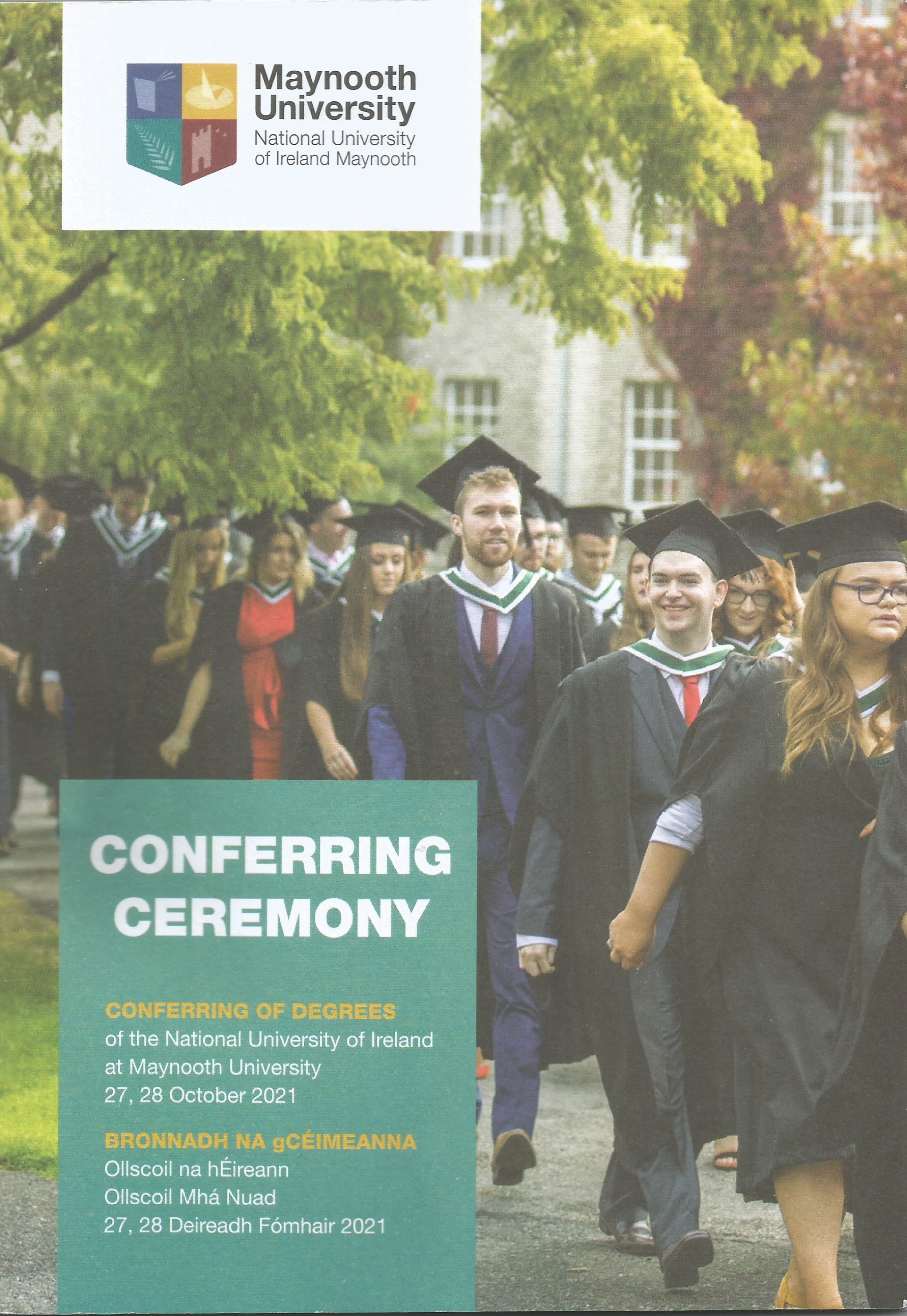
I’m told that with a week still to go we already have over 750 science students based in schools from An Daingean to Arranmore Island, from Monaghan to Mayo and many counties in-between. Fortunately it is online so no travelling is involved. Unfortunately the participants don’t get to see the wonderful campus so here’s a gratuitous picture!
(And at 12 noon I don’t turn into a pumpkin but do have to run off to give a lecture on vector calculus..)
This morning I braved the inclement weather to attend a Conferring Ceremony at Maynooth University. This was the first Conferring Ceremony to be held in person since for about two years and the first ever featuring the new President of Maynooth University, Prof. Eeva Leinonen, presiding.
There were only four students from Theoretical Physics graduating this morning, and two of them graduated in absentia but I did get to see two students get their Master of Science by Research awards. If you’re interested their theses are available online here and here.
I wouldn’t say the ceremony went off without any hitches. There were quite a few late arrivals among the graduands. I think the bad weather elsewhere in Ireland caused some delays which led to some people being late for the ceremony (which was due to start at 10am, but didn’t get going until about 10.30). Then there were some last minute changes of order which led to one or two students initially getting the wrong scroll. I remember how nerve-wracking it was when that sort of reshuffling happened when I was involved in similar ceremonies at Sussex. It’s bad enough stressing over the correct pronunciation of the names! Anyway I was glad that these days all I have to do is sit there.
The last conferring ceremony I attended in person was on October 31st 2019. It was while I was en route to give a talk at DIAS that evening after the ceremony that I heard that my Mam had passed away. So much has happened between then and now that it is hard to accept that was only two years ago…
After a welcome break for yesterday’s traditional Hallowe’en Bank Holiday it’s time today to embark on the tradition of the Writing of the First Semester Examinations. I have to come up with four papers (two main exams for January and two repeat exams for next August) by next week, complete with solutions. I always find it very difficult writing examinations, perhaps for the same reason that I find devising clues for crosswords much harder than solving the puzzles. In this world there are setters and solvers and I definitely count myself among the latter.
Anyway, it has been decided that the exams in January will be of the traditional type, sat in person in an Examination Hall, as opposed to the online version we have been using since May 2020. I feel I should point out that was the plan this time last year too, but it didn’t work out that way in the end because of climbing Covid-19 cases. I wouldn’t rule out an abrupt volte-face this year either. The situation is not looking good at all. In fact it looks very much like last year…
I think the “open-book” style of our online examinations had much to recommend it, with an emphasis on problem solving. The one flaw is that we can’t really do anything about collusion when students are sitting remotely and can exchange messages with each other in the absence of an invigilator. I never saw any evidence of significant collusion in the exams I graded, but there’s no denying it was a possibility that we couldn’t negate.
Interestingly, the student representatives present at our Department Meeting a couple of weeks ago indicated that their discussions with other students came out heavily in favour of on-campus examinations. As a result only one of our examinations – for an advanced postgraduate module with very few students taking it – will be of the online “open-book” style. The rest, including my own, will be written and marked on paper. That’s the plan, anyway…
Making use of this Bank Holiday Monday morning to tidy up some things on my computer I realized I had bookmarked this short clip of Richard Feynman answering a question about teaching. I clearly intended to blog about it at some point but forgot to do so, so I’m correcting that now.
Feynman was of course a renowned lecturer both for university students and for public audiences. I think one of the things that made him so successful is that he liked talking about his subject and liked being the centre of attention; people who like neither of those things are unlikely to make good lecturers!
But the thing that really struck me about what he says in this clip is near the beginning where he says he thinks the way to approach teaching is “be chaotic” to “use every possible way of doing it”. Now some of us are occasionally chaotic by accident, but I think there is a great deal of truth in what he says. I also agree with him when he says “I really don’t know how to do it..” I don’t either
If you start from the premise that every student is different, and will consequently learn in a different way, then you have to accept that there is no one unique style of teaching that will suit everyone. It makes sense therefore to try different kinds of things: worked examples, derivations, historical asides, question-and-answer sessions, and so on. And we shouldn’t rely exclusively on lectures: there must be a range of activities: problems classes, tutorials, supplementary reading, etc. With a bit of luck the majority of your class will find something that stimulates and/or enlightens them.
The point about using every possible method at your disposal has become especially relevant now that we have had about 18 months’ experience of online teaching. I feel very strongly that we should make recordings of lectures routinely available to all students, not as a replacement for the “live” experience but to add to the set of resources a student can draw on. The same goes for other things which came into regular use doing our online period, such as printed lecture notes (again, not as a replacement for a student’s own notes but as a supplement).
I think it also helps to acknowledge that what you can actually achieve in a lecture is very limited: you shouldn’t be simply trying to “deliver” material for later regurgitation. You should be pointing out the particularly interesting aspects, explaining why they are particularly interesting, and what things students should follow up in private study where in textbooks and on the net they will find yet more different ways of approaching the subject.
After over thirty years of teaching have come to the conclusion that the main purpose of university education is to convince students that their brain is more than simply a memory device, i.e. that it can also be used for figuring things out. I’m not saying that a good memory is worthless. It can be extremely useful and memory skills are important. I’m just saying that the brain can do other things too. Likewise, examinations should not be simple memory tests. Sadly school education systems seem to be focussed on coaching students passing exams by rote learning.
We see particular evidence of this in physics, with many students afraid to even attempt to solve problems they haven’t seen before. One infers that they passed exams by simply memorizing answers to questions very similar to those on the paper. Our job is to remove that fear, not by pretending that physics is easy, but by giving students the confidence to start believing that they can do things that they previously thought were too difficult. In other words, university education is often about undoing some of the limitations imposed on students by their school education.
Back to lecturing, there are some obvious basics which lecturers need to do in order to teach competently, including being prepared, talking sufficiently loudly, writing clearly (if relevant), and so on. And of course turning up at the right theatre at the right time. But there are also those things that turn mere competence into excellence. Of course there are many ways to lecture, and you have to put your own personality into what you do, but the main tips I’d pass on to make your lectures really popular can be boiled down into the Three Es. I add that these are things that struck me while watching others lecture, rather than me claiming to be brilliant myself (which I know I’m not). Anyway, here we go:
Enthusiasm. The single most obvious response on student questionnaires about lecturing refers to enthusiasm. My take on this is that we’re all professional physicists, earning our keep by doing physics. If we can’t be enthusiastic about it then it’s clearly unreasonable to expect the students to get fired up. So convey the excitement of the subject! I don’t mean by descending into vacuous gee-whizz stuff, but by explaining how interesting things are when you look at them properly as a physicist, mathematics and all.
Engagement. This one cuts both ways. First it is essential to look at your audience, ask questions, and make them feel that they are part of a shared experience not just listening to a monologue. The latter might be fine for a public lecture, but if a teaching session is to be successful as a pedagogical exercise it can’t be passive. And if you ask a question of the audience, make your body language tell them that it’s not just rhetorical: if you don’t look like you want an answer, you won’t get one. More importantly, try to cultivate an atmosphere wherein the students feel they can contribute. You know you’ve succeeded in this when students point out mistakes you have made. On the other hand, you can’t take this too far. The lecturer is the person who is supposed to know the stuff so fundamentally there’s no symmetry between you and the audience. You have to be authoritative, though that doesn’t mean you have to behave like a pompous schoolmaster. Know your subject, explain it well and you’ll earn respect without needing to bluster.
Entertainment. As I said above, lecturing is very limited as a way of teaching physics. That is not to say that lectures don’t have a role, which I think is to highlight key concepts and demonstrate their applicability; the rest, the details, the nuts and bolts are best done by problem-based learning. I therefore think it does no harm at all if you make your lectures fairly light on detail and (with reason) enjoyable as pieces of entertainment. By all means introduce the odd joke, refer to surprising examples, amusing analogies, and so on. As long as you don’t overdo it, you’ll find that a bit of light relief will keep the attention levels up. A key element of this is spontaneity. A lecture should appear as if it develops naturally, in an almost improvised fashion. Of course your spontaneity will probably have to be very carefully rehearsed, but the sense of a live performance always adds value. A lecture should be a happening, not just a presentation. Lecture demonstrations also play this role, although they seem to be deployed less frequently nowadays than in the past. Being a showman doesn’t come naturally to everyone, and the audience will know if you’re forcing it so don’t act unnaturally, but at the very least try to move about. Believe me, watching a lecturer drone on for an hour while rooted to the spot is a very tedious experience (especially on a video recording). You’d be surprised how much difference it makes if you can convey at least the impression of being alive.
On this last point, I’ll offer a few quotes from a physicist who definitely knew a thing or two about lecturing, Michael Faraday. First, his opinion was that the lecturer should not be
…glued to the table or screwed to the floor. He must by all means appear as a body distinct and separate from the things around, and must have some motion apart from that which they possess.
Conventional wisdom nowadays suggests that one should take breaks in lectures to stop students losing concentration. I’m not sure I agree with this, actually. It’s certainly the case that attention will flag if you persist with a dreary monotone for an hour, but I think a lecture can have a natural dynamic to it which keeps the students interested by variation rather than interruption. Faraday also thought this.
A flame should be lighted at the commencement and kept alive with unremitting splendour to the end…I very much disapprove of breaks in the lecture.
Finally, here is one of my all-time favourite physics quotes, Faraday’s take on the need for lectures to be entertaining:
..for though to all true philosophers science and nature will have charms innumerable in every dress, yet I am sorry to say that the generality of mankind cannot accompany us one short hour unless the path is strewn with flowers.
Today is the last day of teaching ahead of next week’s mid-term break. As it happens I did two consecutive lectures from 11-1 today instead of the usual one from 12-1 because of a rearrangement necessitated by a staff absence. I don’t mind admitting that I’m looking forward to a bit of a pause during Study Week, before embarking on the remaining 7 teaching weeks of the Semester.
The room I give my 12-1 lecture in has a chalkboard but the one for the 11-12 slot only has a whiteboard. The downside of the whiteboard is that it is almost impossible to make a lecture recording because the contrast is too low. I was happy to move to the usual room for the second one, which isn’t great either but at least has a decent blackboard.
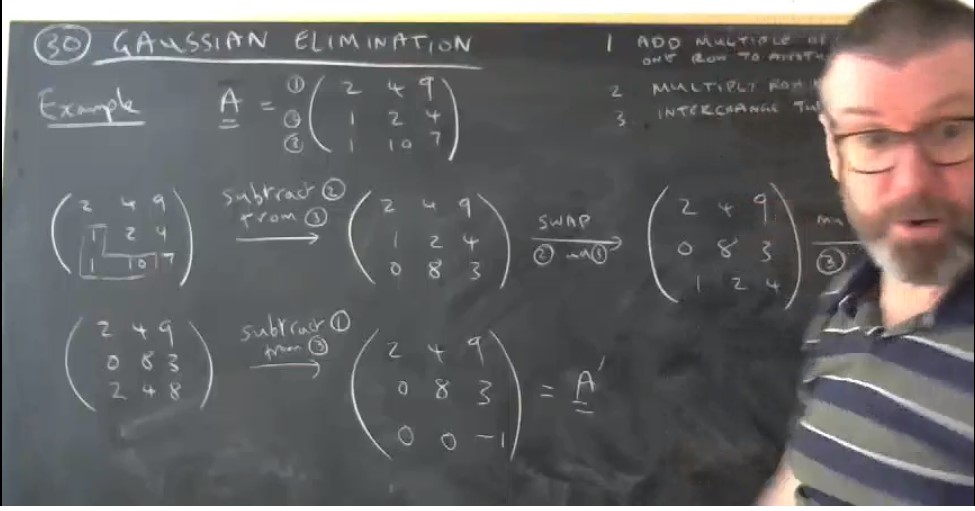
A still from one of last year’s Engineering Maths lectures from home…
I know people think I am very old fashioned in persistently using a chalkboard. They also find it quite amusing that I bought one especially so I could do lectures from home using it. It’s far easier to get a decent contrast than using a whiteboard and I find that standing up and walking around allows me to communicate more effectively, at a decent pace and with a reasonable amount of energy. Most importantly of all I think it’s important for the students to see a process unfolding.
It’s proving much more difficult to provide decent quality lecture recordings on campus than at home because of the lack of decent camera facilities, but I’m doing the best I can.
Yesterday was the end of Week 4 of the Autumn Semester. Because Hallowe’en is on Sunday this year, the mid-term study break is a bit earlier than usual, meaning that Week 5 is the last week before that. That’s not to say we have a holiday of course, apart from the October Bank Holiday on 25th October, the first day of that week. There is, however no teaching in that week. Although the break is welcome, it does mean a rather long run-in of seven uninterrupted weeks of teaching until the Christmas break.
Anyway, yesterday we had our first in-person Departmental Meeting since I don’t know when. It wasn’t quite “normal” as some members of the Department joined via Teams, everyone wore masks and we held the meeting in a large-ish lecture theatre to enable physical distancing. We still have one lecturer who is not able to be in Ireland because of visa delays, so he joined remotely. At least there is a sign of movement on that issue, and we think he’ll be in Ireland and ready to teach after the study break, on November 1st. We did have student representatives present, which was very welcome, as it was difficult to arrange during the lockdown.
Although I’ve had about 18 months of practice to get used to virtual meetings I still dislike them so intensely that my heart sinks whenever anyone calls one that I have to attend, which is depressingly often. Meetings in person are so much better in my view. I don’t know why that is. Just call me old-fashioned. I think yesterday’s meeting went rather well, all things considered, with contributions from just about everyone present.
The October study break is traditionally when we prepare our examinations for the January period. One of the most important items on the agenda was what to do for this January. The official line is that we’re supposed to return to normal, with traditional examinations on campus. I think most lecturers will do their exams like that unless the public health situation deteriorates even more rapidly and we are forced to switch online again. With Covid-19 cases rising significantly, that is a distinct possibility.
I think most staff agree that there are positives to the online style of examinations and I’ve left it up to individuals to decide what they think is best for their particular modules. The important thing however is to inform the students as quickly as possible so they know what’s going to hit them. Students in Year 2 have never had a “traditional” examination at Maynooth and those in Year 3 only had one set, way back in January 2020. They will need to readjust to not having an “open book” style of examination. On the other hand, in theoretical physics we try to test problem-solving rather than memory so I think we’re in a better position than many disciplines to manage this.
First-year students this year are in a different but also tricky situation, in that they are facing their first set of University examinations having had their school education significantly disrupted by the pandemic. We have to help them cope with the fact that they may not be as well prepared as students in previous years. Since I’m teaching the first-years this Semester, this means doing more revision classes and tips on examination technique.
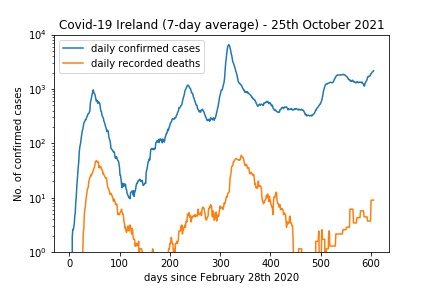
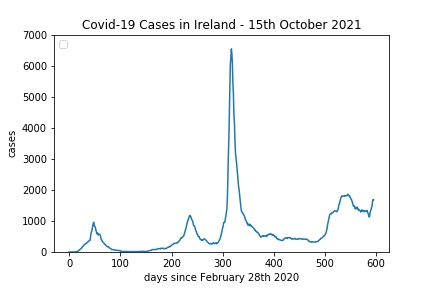
I’ve alluded to the backdrop of rising Covid-19 cases already, and this is causing considerable uncertainty. Some time ago the Irish Government announced that most remaining public health restrictions would be scrapped from 22nd October, i.e. on Friday but case numbers are alarmingly high:
There has been a steep rise recently, not only in positive tests as shown on the graph, but also in positivity rate and hospitalizations. I think this is not surprising. The Coronavirus is circulating like wildfire in the UK right now and it is very difficult for Ireland to insulate itself from that given the open border. In addition it is still the case that about 10% of the adult population is not vaccinated and those who refuse the vaccine are also most likely not to observe social distancing, wear masks, etc. Only 1-in-10 are not vaccinated, but it only takes one to give you the virus.
At least I can say that students in my classes have observed the rules on mask-wearing diligently once in the classroom. The one-way systems in place in campus and staggered lecture start times have been less somewhat successful. I’ve arrived for classes several times only to find the previous lecturer over-running with the consequence that the students in my class are in close proximity to those in the previous class on the way in and out respectively.
I doubt if these infringements are causing significant problems, however. I think it’s far more likely that the virus is spreading in social events and on public transport. The basic problem is that in the minds of some people the pandemic is already over, though in my experience of everyday life outside the University people in shops etc are masking up and behaving sensibly.
We await the announcements due on Friday with interest. If I had to guess I would say that the Government will once again cave in to pressure from the hospitality industry and remove restrictions on bars, restaurants and nightclubs and then feign surprise that infections rise yet again. That won’t have an immediate effect on universities and colleges but it will probably prolong the pandemic well into next year, and necessitate a programme of booster shots for the whole population.
Two weeks into the Autumn Semester, we’ve now had a week of teaching first-year students and two-weeks for all other years. I won’t say there have been no challenges but I think it has gone as well as can be expected. In particular the students (at least in my lectures) have impeccably observed the protocols. Although I’ve had to improvise with the equipment they do seem to appreciate my attempts to record my classes too.
The biggest problem Irish universities seem to be facing as we emerge from the pandemic is student accommodation. The media are full of stories about this issue, pointing the social cost as well as the difficulty posed to students’ education; see, e.g. here. There is a chronic housing shortage in Ireland anyway and this is a specific manifestation of that general problem.
The situation here in Maynooth is particularly acute, with some students having to make 220km round trips by bus to and from Co Wexford. I saw that bus the other day, actually. It’s always been an issue with my Tuesday MP110 lecture (which starts at 5pm) that some students have had to leave early in order to get a bus home. Even more students are doing that this year. I’m definitely glad I decided to record my lectures for the benefit of these students who have to miss part of the class for no fault of their own.
So why is there a student accommodation crisis? One factor is that Maynooth has had a bumper year for recruitment. There is only room on campus for 1,170 students out of a total enrolment approaching 14,000 and those rooms were all snapped up weeks ago. It’s a similar situation elsewhere. Universities have not been able to construct sufficient numbers of sufficiently affordable student rooms to keep up with demand. This is partly because of high building costs and planning bureaucracy, but also because Irish third-level institutions are strapped for cash thanks to decades of underfunding.
But there’s another issue, caused by the lingering effect of Covid-19. A significant number of students at Maynooth usually rent rooms locally in a family home on a four or five days a week basis, sometimes with meals included. This sort of arrangement is highly unusual in the UK, so it surprised me when I first moved here that so many students live that way. On the weekends they go back to their families, often travelling a considerable distance to do so. Typically these students arrive in Maynooth on Sunday evening or Monday morning and leave on Friday afternoon or evening; we see lots of students waiting for buses on the Kilcock Road on Friday afternoons.
Because we’re not fully out of Covid-19 restrictions, the supply of rooms available on this kind of letting arrangement is greatly diminished because of the perceived risk of a tenant being infectious (especially for elderly landlords). I know personally quite a few people who used to offer this kind of accommodation but are not doing so this year, hence the particular difficulty. I hope this situation improves soon, but for the time being it leaves many students having to commute great distances. I hope this doesn’t lead to some with difficult journeys dropping out.
I actually feel a bit guilty about this myself. I have a spare room in my house in Maynooth. It’s not huge but it has a single bed and a small desk in it so would work quite well for a student. I don’t really need the money, though it would be useful, but given the crisis I’ve thought of offering it as a weekday let. I do think, however, that it would be very awkward for a member of University staff to be landlord to one of their own students (both for me and for the student). On top of that, after such a long time as a bachelor I’ve just got used to living on my own! It’s a bit selfish, I know, but I therefore decided not to do it, though if there is an emergency (such as if people get snowed in as happened a few years ago) I would obviously offer my spare room as temporary accommodation.
With the departure of Professor Philip Nolan (whose last day at Maynooth is today) there will soon be a new regime in place at the University. Nobody knows what changes will take place, but there will undoubtedly be some and there are reasons for being nervous about what they will bring to STEM disciplines.
On a more personal note some things will change less than I originally planned. Back in July, exhausted after a difficult academic year, I wrote this:
I was appointed as Head of Department for three years, but last week I asked the University to let me step down from my role as Head of Department of Theoretical Physics from the end of September 2021, a year early. I’ll carry on as a Professor, hopefully with some time to do research, although my teaching duties will undoubtedly remain heavy.
Part of the thinking behind that decision was that a major reorganization of Physics at Maynooth University was on the cards and I thought the position of Head of Department would no longer really exist from the end of September. It is now clear, however, that the reorganization is not imminent. Don’t ask me whether or when it will happen now. That will be up to the new President. It certainly won’t be in effect from 1st October, though. We also have serious staffing issues this year due to the retirement of one colleague, the departure of another to a position in Germany, and another taking a sabbatical for the year. These positions are currently replaced by temporary lectureships, the holder of one of which is still yet to arrive in Ireland and is doing his lectures remotely from abroad.
The current state of the Department is not such as to make the position of Head attractive so, after discussions with my colleagues in the Department earlier this month I agreed to carry on for another year, until the end of my original term. Hopefully by this time next year we will be back to a full complement of permanent staff and the position concerning the reorganization will be clearer – or indeed the reorganization might have actually happened – so that would be a far better time for someone to take over if the position still exists.
I do therefore have another year of heavy teaching and administration in front of me, except that my colleagues have agreed to help me out considerably by taking some of the administrative burden on their own shoulders and teaching will hopefully be in person for the whole year and not online, which makes it far less onerous.
On the other hand, there are two silver linings. One is that after three years as Head of Department I get an automatic sabbatical – if I can find another institution who wants to host me! The other is that this Semester I have no teaching on Thursdays. That is more by luck than good judgement but I decided to seize the opportunity to make it my “research day”. For the rest of the Semester I will be working from home on Thursdays, as I am indeed doing now (although actually not working at the moment but taking a tea break and writing this post).
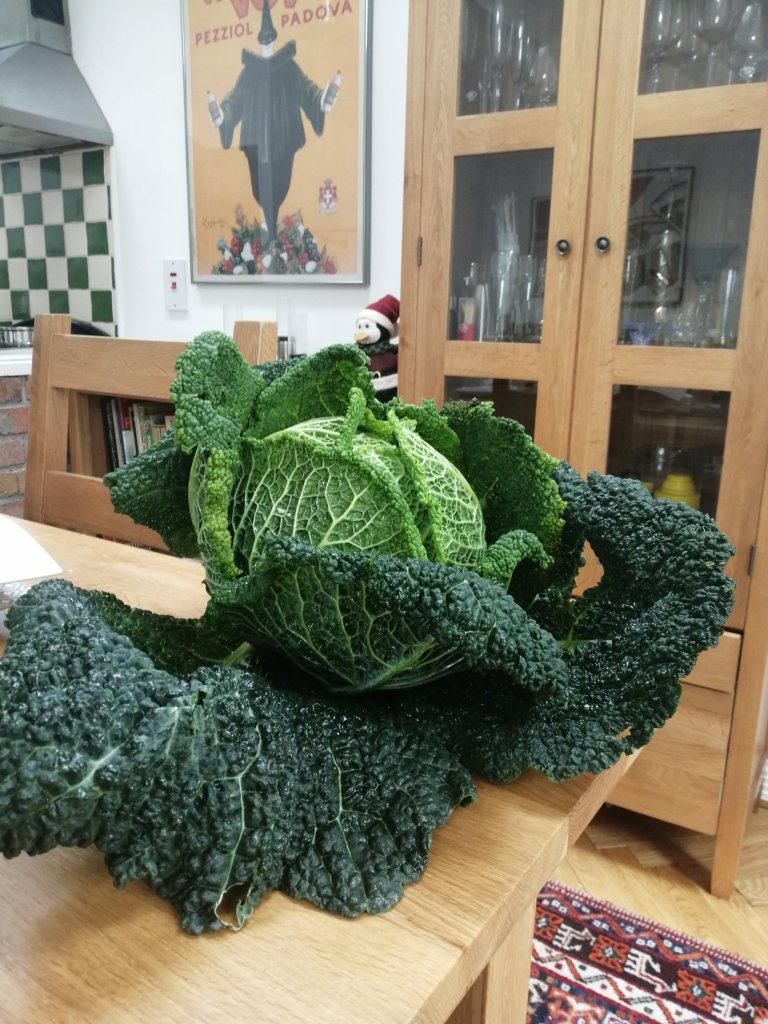
As it happens Thursday is also the day of my newly organized veggie box delivery, so here’s a picture of the enormous Savoy cabbage that arrived this morning (along with various other items such as leeks, rainbow chard and beetroot):
One final aspect of the new regime is that being at home today I’ve finally surrendered to the colder weather and put the central heating on…
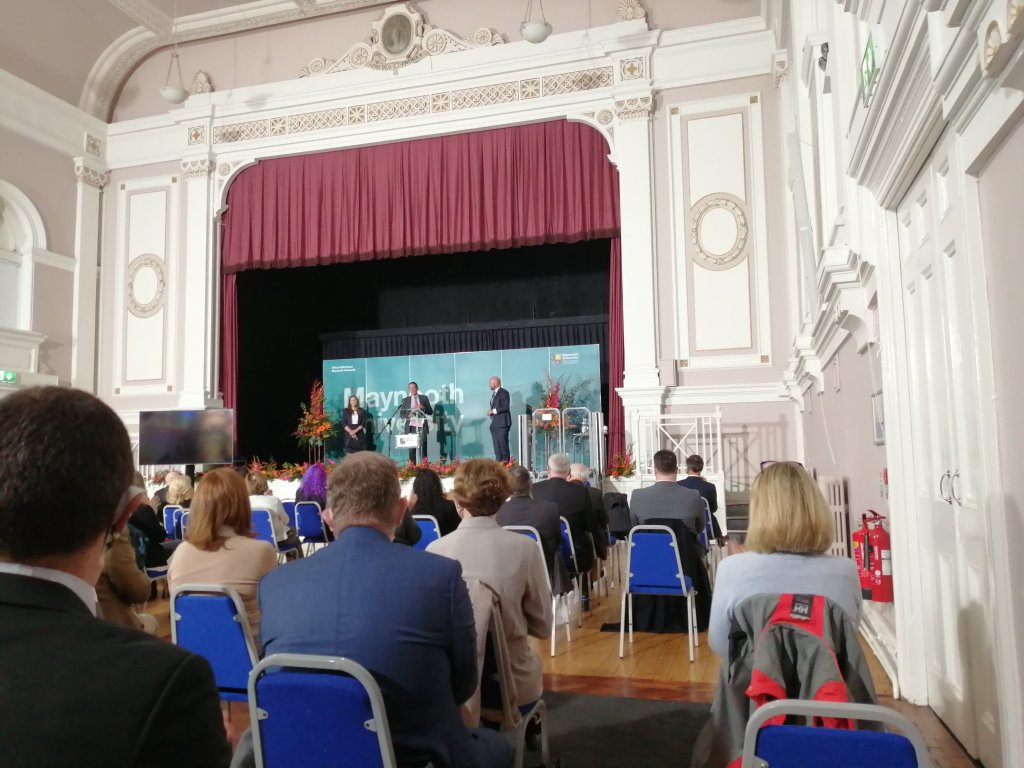
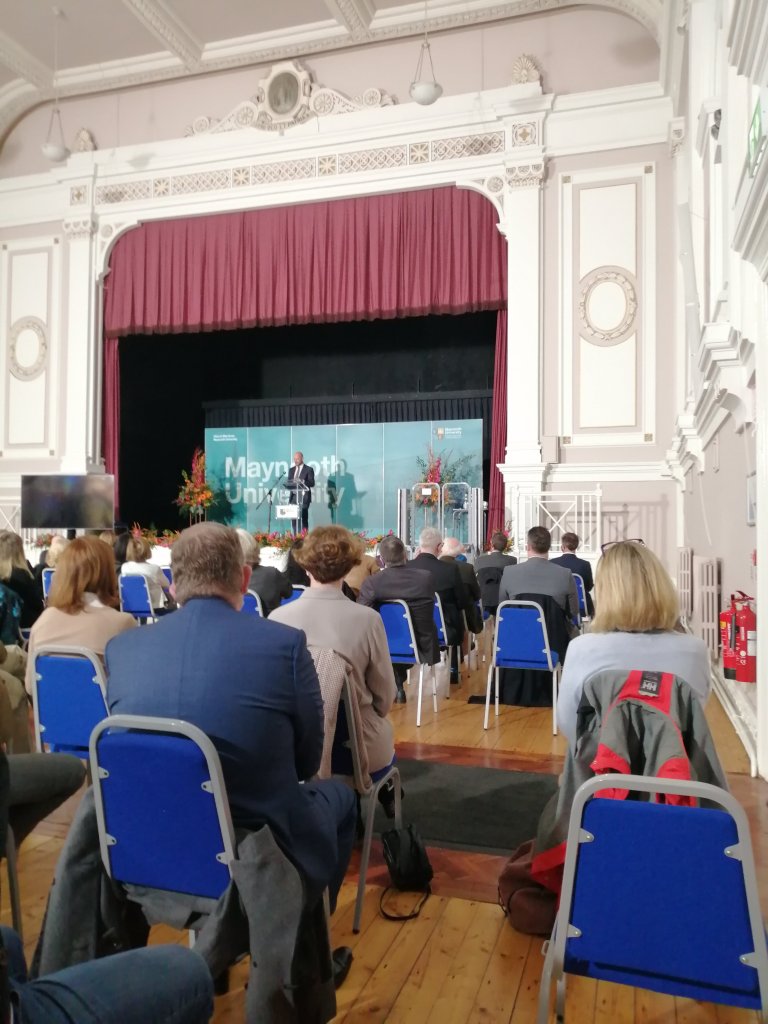
This afternoon I attended an event in the Aula Maxima on Maynooth University Campus to bid farewell to the President of Maynooth University, Professor Philip Nolan who has been in that position for 10 years and who steps down at the end of September (i.e tomorrow). For the last 18 months he has been chairing the Epidemiological Modelling effort as part of National Public Health Emergency Team dealing with Covid-19.
Here are two views of the ceremony taken from my position next to a radiator (it was quite cold today) :
Presentation of Gifts
Farewell Speech
After the formal indoor bit of the event in which the number in the audience was strictly limited and masks were worn, we adjourned outside for a reception which was especially nice because it’s the first social event I’ve attended in person for a very long time. In fact I haven’t been in the Aula Maxima for a couple of years either!
It was a pleasant occasion with many warm and well-delivered contributions, and I think was a fitting tribute to a President who has held his office with great distinction. I had the opportunity to wish Professor Nolan all the best in person over a glass of wine at the reception but I’d like to repeat it publicly here. After all, it was on his watch that I got my position here. Farewell, Prof. Nolan, and please accept my very best wishes for the future.
The only disappointment for me is that among the speeches by academics and other staff there was no time for personal appearance by Maynooth University Library Cat…
Regular readers of the blog – both of them – may remember that, after a couple of postponements due to Covid-19, we presented a Masterclass in Astrophysics & Cosmology in Maynooth on March 25th 2021. Well, owing to popular demand we’ve decided to do a re-run of the event on Friday 12th November 2021 ahead of next year’s CAO cycle.
This will be a half-day virtual event via Zoom. It’s meant for school students in their 5th or 6th year of the Irish system. There might be a few of them or their teachers who see this blog so I thought I’d share the news here. You can find more information, including instructions on how to book a place, here.
Here is the updated official poster and the programme:
I’ll be talking about cosmology early on, while John Regan will talk about black holes. After the coffee break one of our PhD students will talk about why they wanted to study astrophysics. Then I’ll say something about our degree programmes for those students who might be interested in studying astrophysics and/or cosmology as part of a science course. We’ll finish with questions either about the science or the study!
(And at 12 noon I don’t turn into a pumpkin but do have to run off to give a lecture on vector calculus..)
The views presented here are personal and not necessarily those of my employer (or anyone else for that matter).
Feel free to comment on any of the posts on this blog but comments may be moderated; anonymous comments and any considered by me to be vexatious and/or abusive and/or defamatory will not be accepted. I do not necessarily endorse, support, sanction, encourage, verify or agree with the opinions or statements of any information or other content in the comments on this site and do not in any way guarantee their accuracy or reliability.



 In the Dark