Archive for the Education Category

Asynchronous and Public Lectures

Posted in Education, Maynooth with tags , , , , , on September 11, 2020 by telescoper

This morning I came across a very interesting blogpost by Philip Moriarty which is mainly about teaching quantum mechanics but also includes some discussion of his ideas of how he plans to conduct teaching for the forthcoming semester at the University of Nottingham.

We are in a rather different situation here at Maynooth University with Covid-19 different rules, different numbers of students and different levels of resource in terms of teaching software and equipment, but I think the primary constraints are similar.

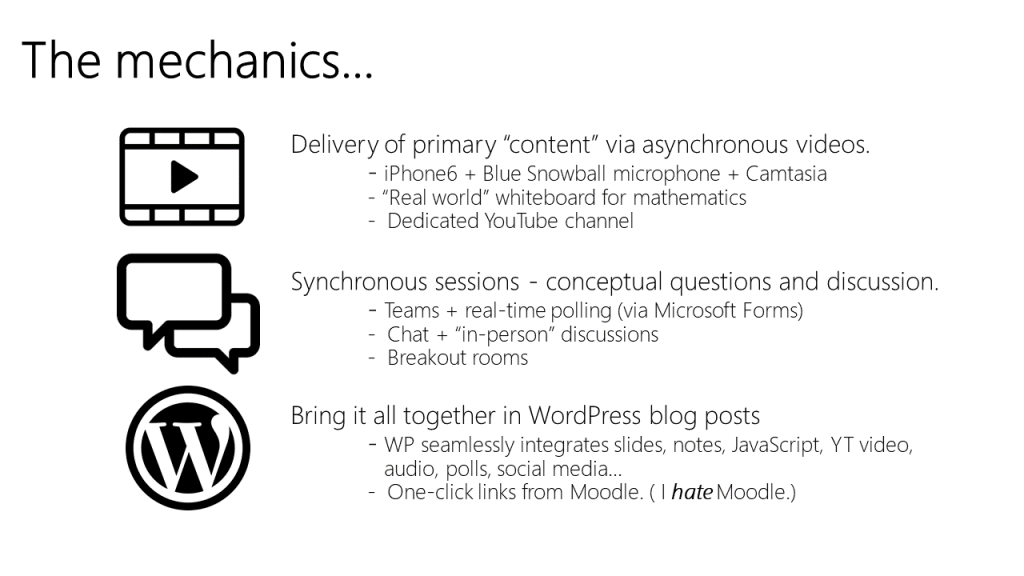
Here is is graphic Philip uses to outline the major elements of teaching he plans to adopt (copied without permission):
I think the University of Nottingham has, in common with many other UK universities, moved all its large lecture classes online. Here in Maynooth we’re restricted by physical distancing to have an absolutely maximum of 50 people in any lecture theatre at one time, so effectively the big classes will be online too. However, many of our smaller classes and tutorials will be on campus `face-to-face’ sessions. Since Theoretical Physics is a relatively small Department many of our modules will run pretty much as normal.

This are a bit different for the first year Mathematical Physics module which I teach (MP110) where the class last year was about 90 students. This class will have to be split, but I am still planning to deliver face-to-face lectures for all students in some form. There are three lectures a week in this class and I’ll probably have to have about one third of the students in each session: the other sessions will be streamed and recorded – assuming our newly-installed Panopto system works (!) – and made available to students not at the class. In addition students will get a tutorial per week, also in person.

I have thought a lot about this over the last few months and I’ve decided that the main `lectures’ (which will be with fewer than 30 students) will not be lectures but more like `workshops’ where I illustrate the main results that I would have given in a “normal” lecture using examples as well as getting students to work on problems in class.

Like Philip I plan to record videos of the “primary content” offline, probably in my office, so the students can view them at their leisure. I decided to record these primarily because I think the production quality of such lectures would be better. I’ve used Panopto before and it’s OK, but it has its limitations. I don’t have access to all the equipment Philip talks about, but at least in my office I can re-take and edit the video whenever I mess up (which will be quite frequently, I’m sure). These won’t be 50-minute lectures as I find that not having the interaction with the audience, going back over things when it’s clear they haven’t understood, giving them problems to try in class, etc, the time taken to cover the material in a video is far shorter.

Making these `asynchronous’ is, I think, extremely important. Timetabling teaching sessions looks likely to be extremely complicated for the forthcoming semester so I think it’s far better to make the content available for students to study wherever and whenever they want.

So my plan is that students will get each week:

  • A set of pre-recorded videos covering the material for that week
  • One interactive workshop on campus
  • Access to recordings of two other workshops
  • A full set of lecture notes
  • Coursework examples (assessed)
  • One tutorial on campus
  • A virtual office hour with the lecturer (me) for Q&A

It’s not the same “as normal” but I think it provides the best blend of learning approaches possible under the constraints we will have to operate. Note also that some students may be “at very high risk” for health reasons and consequently unable to come onto campus. The approach I have outlined here means that such students will miss as little as possible.

Unlike Philip, I don’t hate Moodle, so this will be where all the course materials will be made available. It will also be the principal channel of communication with the class.

Like Philip, though, I am in favour of putting all the primary content on Youtube so that anyone who wants to access it can do so. I have suggested this before and it received mixed reactions, but for me it’s more a point of principle. As my teaching is funded by the public purse, it seems reasonable to me that what I produce should all be in the public domain wherever possible. That obviously excludes some teaching activities (e.g. labs and tutorials) but I don’t see why I shouldn’t do it with lectures or other video content. I won’t make the workshop videos public, because they may accidentally identify students who do not wish to appear on a video.

I know many of my colleagues disagree with this, so here’s the unscientific poll I’ve been running to see what people think. Not that the voting will change my mind….


Leaving Out

Posted in Covid-19, Education, Maynooth with tags , , on September 7, 2020 by telescoper

This morning students across Ireland have been receiving their Leaving Certificate grades. First of all let me congratulate the 2020 Leaving Certificate Class for their success in what has been a very difficult year!

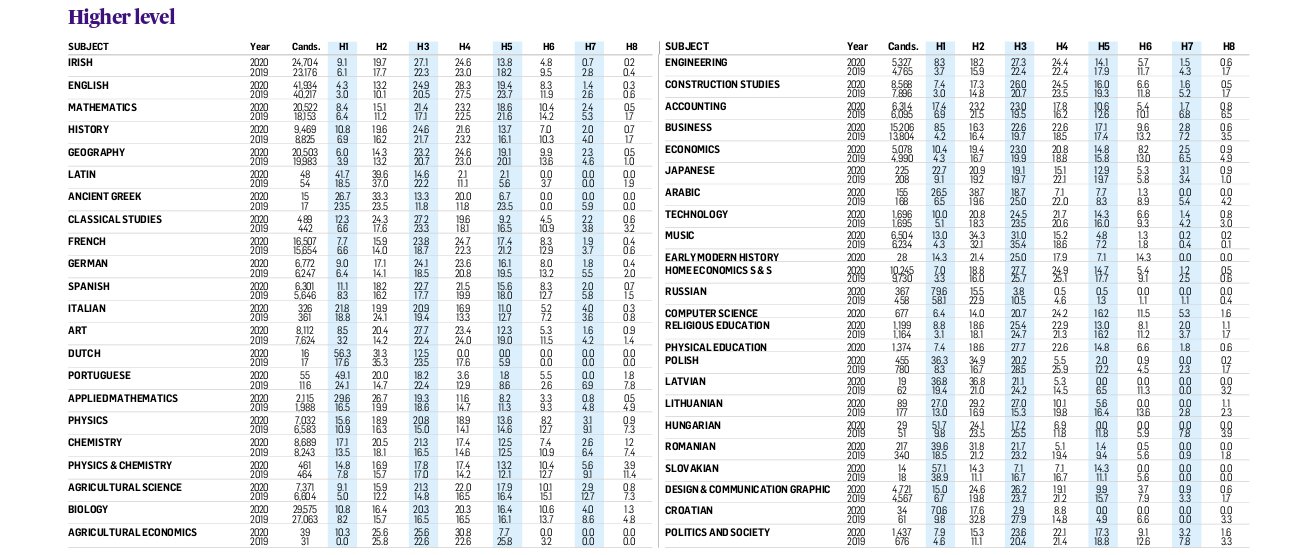
The release of Leaving Certificate results will trigger even more of a scramble than usual for university places through the CAO process. This year things are likely to be very different from previous years as (a) the process is much shorter in duration (students who get into university will be having their first lectures just three weeks from today) and (b) the distribution of grades is unlike previous years because they are based on “calculated grades” rather than examination results. This has led to an increase in top grades across many subjects. Here is a useful summary from the Irish Times:

(I know it looks small but you can click on it to make it legible…)

Note the number of top grades in Mathematics, Applied Mathematics and Physics has gone up because of the general grade inflation and because the number of students taking them has gone up. This is potentially good news for our recruitment here in Maynooth but it’s probably not so simple. For example, it may be that bigger departments elsewhere try to offset the lack of international students this year by recruiting more home students. We’ll just have to wait and see. By the start of next week the picture will probably be clearer.

At any rate, a certain local celebrity is looking forward to welcoming the new students onto campus shortly…

The Year Ahead

Posted in Biographical, Covid-19, Education, Maynooth with tags , , on September 6, 2020 by telescoper

Tomorrow sees the release of the 2020 Leaving Certificate results which this year are based on “calculated grades” rather than examination results. It seems that for about 79% of students these grades will be the same as the teacher’s assessment, about 17% will be lower than the teacher assessment and in about 4% of cases it will be higher. It remains to be seen whether the results will create the sort of stir that this year’s A-level results did.

That seems to imply that CAO points will be a bit higher on average than previous years so more students will make the grade for their first choice of course, which may have a significant impact on recruitment.

We’ll find out all about that next week when the details come in. Teaching term starts on Monday 28th September so there’s very little time to get things organised for the new cohort, especially on the Omnibus Science course on which students have a wide range of alternatives from which to pick their first-year subjects.

Next week at Maynooth University we also have our repeat Examination Board (a week later than usual). After that we will have a good idea of how many students will be returning for Years 2, 3 and 4 and how many will not progress.

So soon we will have enough information to fine-tune our teaching plans. These are challenging this year because of the reduced capacity of the rooms we use for lectures and tutorials due to physical distancing. Some rooms are affected more than others – it’s far worse for large lecture theatres than for tutorial rooms – so we have to look at each module separately.

We had a (virtual) meeting of teaching staff in the Department of Theoretical Physics to coordinate the approaches to different modules. Among other things, that showed how very sensitive everything is to numbers of students taking. If a room can take N students then if the actual number taking the class is less than or equal to N then the class can proceed as usual but if it exceeds N, even by just one, then we have to split the class somehow.

Having detailed numbers is essential to sorting all this out but students can change modules during the first few weeks of teaching, we’re likely to be reorganising as we go along.

All this causes multiple headaches but, despite the extra complications this year, I’m looking forward to seeing the students on campus again. I haven’t given a ‘proper’ lecture since March 12th.

I was so busy last week, grappling with these and other matters, that I missed the fact that I took over as Head of Department on 1st September 2019, a year ago last Tuesday. Little did I know what I was letting myself in for…

Littlewood on `the real point’ of lectures

Posted in Education, mathematics, The Universe and Stuff with tags , , , on September 3, 2020 by telescoper

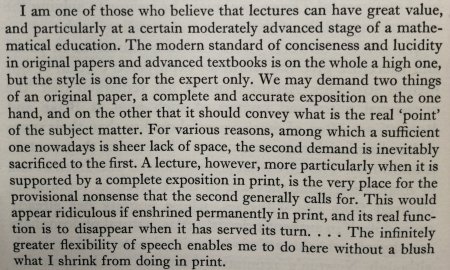
We’re often challenged these days to defend the educational value of the lecture as opposed to other forms of delivery, especially with the restrictions on large lectures imposed by Covid-19. But this is not a new debate. The mathematician J.E. Littlewood felt necessary to defend the lecture as a medium of instruction (in the context of advanced mathematics) way back in 1926 in the Introduction to his book The Elements of the Theory of Real Functions.

(as quoted by G. Temple in his Inaugural Lecture as Sedleian Professor of Natural Philosophy at the University of Oxford in 1954 “The Classic and Romantic in Natural Philosophy”.)

Temple concluded his lecture with:

Classic perfection should be reserved for the monograph: the successful lecture is almost inevitably a romantic adventure. It is at once the grandeur and misery of a scientific classic that it says the last word: it is the charm of a scientific romance that it utters the first word, and thus opens the windows on a new world.

Modern textbooks do try to be more user-friendly than perhaps they were in Littlewood’s day, and they aren’t always “complete and accurate” either, but I think Littlewood is right in pointing out that they do often hide `the real point’ so students sometimes can’t see the wood for the trees. The value of lectures is not in trying to deliver masses of detail but to point out the important bits.

It seems apt to mention that the things I remember best from my undergraduate lectures at Cambridge are not what’s in my lecture notes – most of which I still have, incidentally – but some of the asides made by the lectures. In particular I remember Peter Scheuer who taught Electrodynamics & Relativity talking about his first experience of radio astronomy. He didn’t like electronics at all and wasn’t sure radio astronomy was for him, but someone – possibly Martin Ryle – reassured him by saying “All you need to know in order to do this is Ohm’s Law. But you need to know it bloody well.”

The Virtue of Signalling

Posted in Covid-19, Education, Maynooth, Politics with tags , , on September 3, 2020 by telescoper
I was in a supermarket in Maynooth yesterday morning when a bloke was refused entry for not wearing a mask. That’s the first time I’ve seen that happen, though I’ve heard various people mentioning similar stories elsewhere. There is a big sign near the entrance to the store saying that face masks are mandatory, which they have been for some time in Ireland, so he could not make the excuse that he didn’t know. I rather think he was trying to make a point.
The person concerned didn’t get violent, but was extremely loud and abusive to the staff, who shouldn’t have to put up with that sort of behaviour. He stood there for a while shouting expletive in between which his message was that he didn’t care whether he got Covid-19 as it was “just the flu”. I did wonder whether someone might call that Gardaí but after a few minutes, afer which he either felt he had done what he wanted to do or that he was wasting his time, he left.
I have to admit I completely fail to see why certain people find wearing a face mask such an ordeal. It’s really nothing. I understand that some people, with e.g. asthma, might have good reasons for finding it difficult but I’m talking here about people without such reasons who seem to think they’re being asked to bear some intolerable burden, rather than just wearing a piece of light material over their nose and mouth. I’ve got quite used to it and think nothing of it. As winter comes on I even think wearing a mask might help keep my face warm and, more importantly, protect my beard from inclement weather.
The only thing that bothers me slightly is that I have very boring face masks when others seem to have invested in colourful stylish affairs. It makes me feel a bit drab. Perhaps I should invest in some more glamorous masks.
But back to our friend in the supermarket. He of course may not care whether or not he gets Covid-19, but that’s not the main point of wearing a mask. Face masks are far more effective at protecting other people from your germs than protect you from other people’s germs. I suspect, however, that trying to explain this to the person concerned would simply make matters worse. To be happy wearing a face mask you have to be the sort of person who cares about what happens to other people and there are some – regrettably many these days – who just don’t. I’m sure that extreme selfishness translates into their political attitudes too.
When we return to on-campus teaching at the end of this month, students will be asked to wear face coverings in lectures. I’m not sure how that will work out. In particular I don’t know who is supposed to police it. Supermarkets have people on the door to turn away the unmasked. Are we to have that at the entrance to lecture theatres?
Lecturing with a face mask on will be difficult, but in a big theatre the lecturer is sufficiently far from the front of the audience that won’t be necessary.
I’m not sure how effective face masks will be at slowing the spread of Covid-19 – we’ll have to wait and see – but my attitude is that they are just a part of a bundle of measures, including frequent washing of hands, wiping surfaces regularly, maintaining social distancing, etc that all contribute. The great value of a face mask in all this is that it is visible. Wearing a mask is a signal to others that they should remember the danger of the situation and act accordingly. It’s a way of showing leadership.
It has become fashionable (at least among those who possess no virtues) to use the phrase virtue signalling as pejorative term for doing or saying something good in a way that is conspicuous. To the person ejected from the supermarket, the wearing of a face mask is probably an example of virtue signalling. I think it is too, literally, and I’m all in favour of it.

Back to Returning to Campus Again

Posted in Covid-19, Education, Maynooth with tags , , , , on September 1, 2020 by telescoper

Three weeks ago I was writing about our plans for returning to campus at Maynooth University only to be rudely interrupted the very next day by new restrictions that forced us to put those plans on ice. Now we have about four weeks to get everything in place so we have to crack on.

Today the University wrote to all students outlining the general approach we are taking at Maynooth, but the details vary enormously from subject to subject. That is because the capacity of lecture theatres and laboratories and seminar rooms is reduced considerably to maintain the proper distancing between students. Classes will inevitably be smaller but we haven’t got any more rooms, so the number of face-to-face sessions will have to decrease. This affects every subject but hits very large courses much harder than smaller ones.

I will be in at the deep end on September 28th as I am teaching our first-year Mathematical Physics module, MP110. That is in Physical Hall, which has a normal capacity of 90 reduced to 27 by physical distancing requirements. Last year I had about 85 students in the class so it was full every time. This term I can fit only about one-third of that number in any session. There are three lectures per week in that module which means that if I have up to 81 students then each will be able to attend one lecture. Those unable to attend a lecture will be able to view recordings. Over the summer the University has been installing Panopto, a lecture-capture system we used to have when I was in Cardiff, so recordings of each session can be made. I also intend to record offline supplementary material for the class.

In addition to lectures each student on MP110 previously had a weekly tutorial. For the tutorials the students were split into 4 groups, but this year the reduced room capacities will probably require us to have more, smaller groups or to move to bi-weekly tutorials.

All of this is very sensitive to numbers, and we won’t know those until very close to the start of term. If we get more students than last year we will to revise the plans. The start of term is likely require quite a lot of last-minute adjustment.

For returning students on more specialist modules the classes are smaller and the impact less severe. I will also be teaching a second-year module MP201 Vector Calculus and Fourier Series next term. Not everyone who does Mathematical Physics in Year 1 continues with it to the second year so we expect roughly 50 on MP201. With that number we may be able to run lectures as normal (which means two a week) but may have to switch to bi-weekly tutorials. We expect third and fourth year classes to run quite close to normal. At least we will know the numbers of returning students fairly soon and can lock those plans in, leaving the 1st year to be dealt with last.

On top of all this we do have to have contingency plans in case the local or national Covid-19 situation deteriorates so far that we have to close the campus again. We will be in a better position to deal with that than we were back in March, as we have learned a lot very quickly and now have better equipment.

This afternoon the President of Maynooth University, Professor Philip Nolan, sent a message to all students that included the following:

Most of the large modules will use streaming of lectures so that you will receive some of the lectures on-line, and will be invited to attend less frequently than usual. Tutorials and practicals will also have reduced capacity, and in some cases the frequency will be reduced. The content of each module will remain largely unchanged, so you will be introduced to the same ideas, concepts and challenges. What will change is the format of delivery, and you will learn through a combination of live classes and on-screen material. We will publish more information, and details of the contact time in sample modules on the COVID page of the university website.

This reduced time on campus will mean that you will need to take more responsibility for your own learning, and ensure that you keep up with both the on-campus and on-line teaching.

Some of you are wondering if you need to attend at all, and whether you could complete your studies remotely. We are not a distance teaching university, and most of our courses are designed for on-campus delivery. So there will be times when you need to be on campus, and you will need to make sure that you can get to the campus when you need to.

I’ve seen some of the draft plans for other departments and it seems that the Department of Theoretical Physics is probably going to be one of the departments whose students will spend the most time on campus, with about 50% of the normal contact time. That’s primarily because we are small(ish) so can be a little more flexible. I also think that mathematical physics is a subject that needs students to take responsibility for their own learning anyway because much of it is problem-based. You can do physics problems at home or on the bus just as well as sitting in a room on campus.

I know some students are questioning the need to come on campus at all if they have so few contact hours and material is made available via recordings anyway. I can only speak for my own Department when I say that we think there is a huge value attached to in-person teaching, which is why we are trying so hard to maximize the on-campus experience for our students. It won’t quite be business as usual but will be the very best we can do under the constraints we have imposed on us. We’re doing the best we can but we do need students to play their part too!

P.S. I note that, for example, Waterford Institute of Technology is taking a quite different approach, with all lectures and tutorials going online for the whole academic year 2020/21.

Back to School

Posted in Biographical, Covid-19, Education, Maynooth with tags , , , , on August 26, 2020 by telescoper

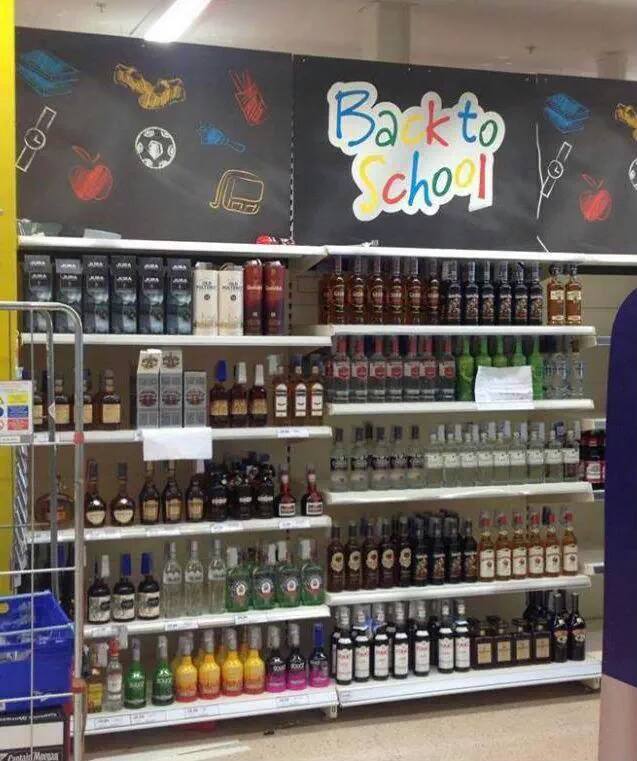
News that primary and secondary schools in Ireland are re-opening this week reminded me of this picture I saw a year ago:

I suppose the items on display there provide one way of dealing with the stress of worrying whether re-opening will result in a large increase in Covid-19 cases!

Meanwhile the Third Level sector is also preparing to re-open. Although we have another month to go before teaching is supposed to restart at Maynooth University, I’m already getting quite a few emails from students asking what things are going to be like when it resumes in September. All I can answer is what our plans are, but whether or not we can put those plans into practice depends crucially on things outside my control, including local factors (such as the number of students taking each module) and national factors (especially the restrictions intended to prevent the spread of Covid-19).

On the first matter we’ll have to wait until students register which, for first years will be very late in the day because of the delayed leaving certificate results this year. We will know a bit sooner about returning students, but even for them it will be a couple of weeks or so.

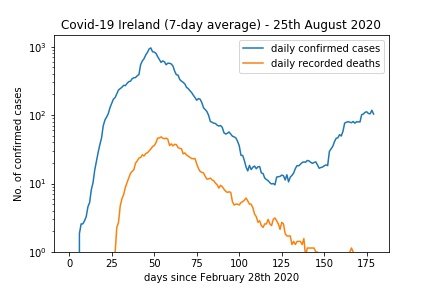
The national picture is even more uncertain. As of yesterday, the average number of new Covid-19 cases per day over the last 7 days was an uncomfortably high 103.6:

Over the next month will the local lockdown in Kildare carry on? What will be the impact of schools’ reopening? Will the national Covid-19 picture improve or deteriorate? Although at this stage we plan to resume (partly) campus-based teaching on September 28th, but we have to accept that if things take a turn for the worse we might not be able to do that and will instead have to go online. We’ll just have to wait and see.

That doesn’t help students, of course, because they have to make decisions about accommodation and travel. It’s a very awkward and stressful situation for them but I think the only way to approach the queries I’m getting is to tell the truth. Sometimes “I don’t know” is the only honest answer.

At least my own preparations are proceeding. I’ve just had my own tensor barrier put in. This is intended to deter people from wandering into my office and spreading their germs. I don’t think the installation is finished yet, however, as it doesn’t seem to be connected to the mains electricity.

The Week Ahead

Posted in Biographical, Covid-19, Education, Maynooth with tags , on August 23, 2020 by telescoper

On Friday I finished correcting the batch of Repeat examinations that were within my remit. I think the other staff have done likewise. All the marks now get uploaded and cross-checked and before another meeting of the Exam Board the year’s examination process to an end.

There’s no time to pause, however, as we go straight into the preparations for next academic year. Nobody knows quite how things are going to go, and no doubt we’ll have to adapt quickly to changes in the national situation. County Kildare, wherein Maynooth is located, remains in a sort of mini-lockdown for the next two weeks. It is not a very welcome distinction to be in the only County under “special measures” – Laois and Offaly – were stood down on Friday – but I’m optimistic that local Covid-19 outbreaks will be sufficiently well controlled to let us relax fully well before term starts.

At least after the Repeats we will know how many returning students we have on which modules so can start firming up the arrangements for Years 2 to 4.

Year 1 will have to wait for the Leaving Certificate results which won’t be out until after September 7th. Teaching starts on 28th September so final arrangements for new students will have to be made at the last minute. As it happens I’m teaching the first module for Mathematical Physics. I have a basic a plan of what I want to do but the details are dependent on precisely how many students we have.

For new students there is an Orientation Week before teaching starts which this year will be virtual, so in preparation for that I’ll be recording video presentations for the new students on different courses. They all have to be done by Wednesday.

There’s also sorting out contracts for tutors, training on new software and hardware for teaching, and writing lecture notes to be getting on with.

On top of all that, if there are no last minute hitches, I should be getting the keys to my new home on Wednesday so will be moving in later in the week. I have paid this month’s rent on the flat so have until the end of the month to move out. I can therefore do a relatively gradual transition over a few days, working around work commitments. Not that I have much to move: a lot of my personal effects are still in Wales and there’s no way I can get back retrieve them at the moment. Although the timing could have been better, I’m looking forward to living in a home of my own once more.

O-Level Latin Examinations, Vintage 1979

Posted in Biographical, Education with tags , , , , , , on August 20, 2020 by telescoper

Since I’ve just finished marking all my repeat examinations, and examinations are in the news for other reasons, I thought I’d fish out one of the GCE O-level examinations that I took way back in 1979 when I was 16. I have from time to time posted examinations in Mathematics and Science subjects at both O-level and A-level, but I thought it would be fun to share something quite different. In fact my best mark at O-level was in Latin. Latin was a compulsory subject at my (old-fashioned) Grammar School, by the way.

The first of the two Latin exams was basically about the language, and involved unseen translation and comprehension tests. The second involved parts of two set books. We did Book II of Virgil’s Aeneid, a verse epic in strict hexameter, and Book V of Caesar’s Gallic Wars De Bello Gallico. These formed Sections A and B of the same examination although they appear as separate papers. The bit of the Aeneid we did included the Trojan Horse (actually Greek Horse, obviously) and the famous line `Timeo Danaos et dona ferentes’…

The GCE O-levels were replaced by GCSEs a few years after I did mine and I’m not sure how many people do Latin at GCSE these days (or indeed at Leaving Certificate) but I’d be interested in any comments on how these exams compare with modern ones!

The U-turn and After …

Posted in Education, Politics with tags , , , on August 18, 2020 by telescoper

One of the many things that Winston Churchill never said (referring to Americans) is that they “…will always do the right thing – after exhausting all the alternatives”. Yesterday the UK Government performed a U-turn on its approach to A-level results but only after extensive protests and after causing immense stress to a great many students. All of this could have been avoided had the Secretary of State for Education bothered to look at the results of the downgrading algorithm. This morning he said that he “wasn’t aware” of what the outcomes would be and tried to put the blame on OfQual. Well, it’s actually his job to be aware of these things and that statement shows he’s not doing his job.

While many students will be mighty relieved that their official A-level grades will go up, that won’t be the end of this fiasco. Many students will find that their places have been already been filled through last week’s clearing process. The Government has lifted the number cap on places in imposed earlier this year, but that won’t help many departments, especially those in the sciences, who have severe constraints on, e.g., laboratory capacity (more so with social distancing in place).

I feel very sorry for friends and former colleagues in UK universities having to deal with this shambles. The Government will be quite happy that it has managed to throw this particularly hot potato into the hands of admissions tutors across the land. Ministers will be hoping that whatever blame now accrues will be attributed to universities being “inflexible” when it is entirely down to incompetence elsewhere. As always it’s the front-line staff who will have to deal with it, as if their job was not stressful enough having to deal with Covid-19.

Meanwhile, here in Ireland, the Government’s plan for “standardisation” of this year’s Leaving Certificate results looks alarmingly similar to the failed approach tried – and subsequently abandoned – in the United Kingdom. Minister for Education Norma Foley has been making statements about the accuracy and reliability of her Department’s plans that sound eerily similar to those issued by officials across the Irish Sea. I hope that I’m wrong about this – and that there’s some frantic activity going on behind the scenes to change the approach ahead of the release of this year’s Leaving Certificate grades (due on September 7th) – but I have a feeling that we’re going to see yet another slow-motion car crash. It wouldn’t be the first time that, having observed something truly shambolic happening in the UK Education system, an Irish Government then proceeds to do exactly the same thing…