Archive for the Education Category

What’s the Point of the Prospectus?

Posted in Education, Maynooth with tags , , on June 30, 2019 by telescoper

Visitors to last weekend’s Summer Open Day at Maynooth University were all given a `goodie bag’ containing this:

The Undergraduate Handbook (as it’s called) is an example of a Prospectus, which Wikipedia helpfully defines as:

A university or school prospectus is a document sent to potential (prospective) students to attract them to apply for admissions. It usually contains information about the institution and the available courses, including advice on how to apply and the benefits of accepting a place. Many universities have an individual prospectus for each course or group of courses that they offer. Most universities have both online and paper versions of their prospectus, and they are divided into an Undergraduate Prospectus and a Postgraduate Prospectus.

I’ve worked at quite a few Universities in my career: (Sussex, Queen Mary, Nottingham, Cardiff and, now, Maynooth) and they have all produced something similar. The Maynooth one shown above is a fairly hefty document, in A4 format, and over 200 pages in length. It is nicely laid out and well produced so what follows is not to be interpreted as a criticism of it as a piece of literature!

Last week I was thinking about why universities continue to produce prospectuses in paper form when nowadays all the information is available online in a form that is much easier to search than the cumbersome hard copy.
Of the 200+ pages in the Maynooth version, only a few will be of any interest to any one student and we found on our stall last weekend that a much smaller pamphlet outlining just the science courses was far more popular and, one infers, useful for prospective students. The big handbook must be quite expensive to produce and distribute – and a new one is required every year – so is it really worth the effort?

I know from time at Sussex that the annual printing of the prospectus imposed a number of constraints on the process of developing new courses. The deadline for getting things ready was over a year ahead of the time a new course would start, which dramatically slowed down the process. That’s not a particular criticism of Sussex, by the way, I think that’s a fairly ubiquitous issue. Why not just have the material available online, where it can be updated with new courses and modules at any time?

There may be good reasons for continuing with the old-style university prospectus, but the only reason I’ve heard articulated is that `everyone else has one so we have to too’. Maybe the prospectus is an effective marketing tool, I don’t know. If so it’s probably more for the benefit of parents than students.

I’d be interested in hearing views from prospective students, parents thereof, academics and or university
admissions specialists on this issue, especially from those who want to change my mind as I have to say that I think we should scrap the paper and just deliver the material via the internet (either via webpages or an app).

[twitter-follow

The Senior Academic Leadership Initiative

Posted in Education, Maynooth, Politics with tags , , , , , on June 27, 2019 by telescoper

I’ve been so busy over the last week or so that I forgot to mention that on Friday (21st June) the Minister of State for Higher Education Mary Mitchell O’Connor announced a new scheme to improve the gender balance in senior academic roles in Irish universities.

While women make up more than half of university lecturers here in Ireland, just 24% are professors, and the new scheme plans to tackle that under-representation at senior levels by creating up to 45 academic leadership positions specifically for women over the next three years.

The Senior Academic Leadership Initiative (SALI) is funded by the Department of Education and Skills and managed by the Higher Education Authority. More details of the scheme can be found here and the call for applications can be found here.

In summary: new and additional senior academic leadership posts will be funded in areas where

  • there is clear evidence of significant gender under-representation
  • where this appointment will have significant impact within the HEI and the relevant faculty/department/functional unit
  • where they would be a proportionate and effective means to achieve accelerated and sustainable change within an institution

Predictably there has been a bit of a backlash to this announcement from some quarters, but I think it’s an excellent idea and it has my full support. Note further that Legal advice from the Attorney General has confirmed that this policy approach is consistent with EU and national employment and equality law.

I hope a significant number of these positions go to outstanding female academics in STEM disciplines, where the under-representation is indeed significant – and hope we can also attract some here to Maynooth! We don’t have any female academics in the Department of Theoretical Physics….

It’s important, however, to bear in mind that this scheme addresses only one of the issues relating to gender discrimination in Irish higher education and there are many others, especially in STEM disciplines (such as recruitment of early-career level) which will require separate actions.


Institutes, Acronyms and the Letter H

Posted in Education, Maynooth with tags , , , , , on June 25, 2019 by telescoper

Here’s a rambling and inconsequential post emanating from a coffee-room discussion yesterday.

The latest round of guff about University Rankings, in which Massachusetts Institute of Technology (MIT) came top and Irish universities didn’t  prompted a strange letter to the Irish Times about the status of the Irish Institutes of Technology some of which have merged, or are planning to merge, to form Technological Universities.

Among the list of Irish Institutes of Technology, I found that sadly there isn’t an MIT in Ireland (Mullingar would be a good place for it!) but there are, for example:

Cork Institute of Technology (CIT)

Waterford Institute of Technology (WIT)

Limerick Institute of Technology (LIT)

Athlone Institute of Technology (AIT)

and so on, as well as..

Institute of Technology Tralee….(:-)

I wondered whether there might be some other potentially unfortunate acronyms  to be had, I hoped for example for a South Howth Institute of Technology but sadly there isn’t one; nor is there a Sligo Higher Institute of Technology. There’s no Galway Institute of Technology either.

In the course of that exercise in silliness I discovered how few towns and villages there are in Ireland whose names begin with the letter H. Moreover all of those listed on the Wikipedia page are in the Sacs-Bhéarla (English language) rather than genuinely Irish names.

I’m sure Irish speakers will correct me on this, but I guess this lack of Irish proper names beginning with H may be connected with the use of h in denoting lenition. When used in this way the `h’ always appears after the consonant being modified and so never forms the initial letter. There are plenty of words in Irish beginning with H, though, so this is either a red herring or something specific to place names.

Comments and corrections are welcome through the box below!


UPDATE: I’m reliably informed (via Twitter) that all words in modern Irish beginning with H are borrowings from other languages, and the h was only introduced into Irish words for the reason mentioned above,

Summer Open Day

Posted in Biographical, Education, Maynooth with tags , on June 22, 2019 by telescoper


This morning I made my way onto campus to  represent the Department of Theoretical Physics at Maynooth University’s Summer Open Day which took place today. Naturally I encountered Maynooth Library Cat on the way. I’ve never seen him in that location amid the shrubs before, and when I saw him heading for that place I thought he might be about to do a poo in the mulch (which looks a bit like a litter tray). Instead of that he just flopped into the position shown in the photo. It was quite sunny early on today and I think he was happy to have found a spot in the shade.

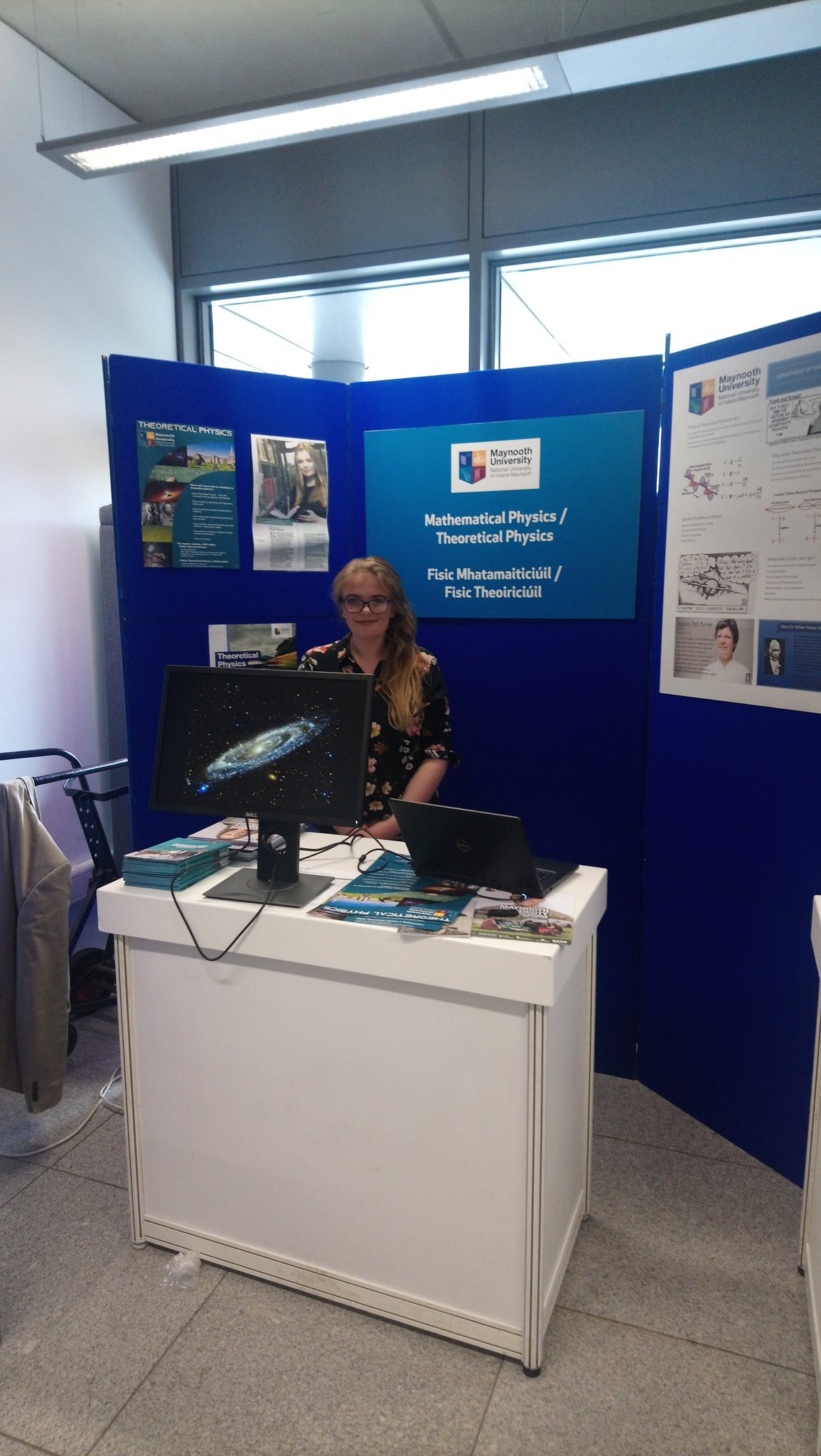
Despite the good weather, the Open Day wasn’t as busy as the last couple I’ve been involved with, probably because this year’s Leaving Certificate examinations haven’t quite finished. Nevertheless we had a reasonable number of prospective students visit the stall in Iontas, shown here with Rebekah (a current student in the Department on a summer research project):

Later on I gave a talk. The audience was fairly small but quite a few people took the opportunity to ask questions at the end, so I think it was useful for those who attended.

At least today the weather was nice, even if the occurrence of the solstice yesterday means that the nights are now drawing in…

I find these occasions always bring a bit of a flashback to Sussex days, actually, when I used to have to do this sort of thing quite regularly on Saturdays throughout the year. It’s almost three years since I left there. Can it really be so long already?


Investigating Sexual Harassment in Universities

Posted in Education with tags , on June 12, 2019 by telescoper

This morning I came across a piece in the Guardian about a report from the UK Office for Students about hate crime and sexual harassment in Universities.

One of the recommendations of the report is that that Universities should hire specialist staff to investigate sexual harassment.

I’ve thought a lot about this issue since I blogged about the Bode versus Mundell case a few years ago (here and here). I hope we can all agree that we need to strive to create working environments wherein harassment and bullying simply do not happen, but sadly they do happen and until that changes we need to find ways of dealing with the perpetrators fairly but firmly and promptly.

In another post I made two suggestions.

The first was that organizations of a sufficient size to bear the cost should have independent misconduct investigators rather than relying on staff from the same workplace. This role could even be fulfilled by someone from a different organization altogether. Universities, for example, could set up a shared resource to deal with this kind of thing. I’ve now come to the conclusion that such investigators should not be employees of the university in question, as they would come under pressure to hush things up – which clearly happens now. It seems to me that far too many institutions prioritize limiting reputational damage over doing the right thing for their staff and students.

Having independent investigators would avoid any real or perceived conflict of interest but, perhaps more importantly, a dedicated investigator could carry out the work much more quickly than a senior academic who is busy with many other things and who would probably have had only cursory training.

The other suggestion I made is that confidentiality agreements covering related disciplinary matters should become void if an employee leaves the institution, whether that is as a result of dismissal or because they leave before investigations are completed. That would put an end to the game of “pass the harasser”.

I am not saying that these will solve the problem completely. To mind they are necessary but not sufficient. Any further suggestions through the comments box are welcome.

Boards and Consultations

Posted in Education, Maynooth with tags , , , on June 10, 2019 by telescoper

Back from Helsinki, I’m now in the midst of Examination Board business. That’s two Boards for me, one for the Department of Theoretical Physics and the other for the Department of Engineering (as I’ve been teaching Engineering Mathematics).  We’ve already Preliminary meetings for both and this afternoon had the `Final’ Board for Engineering in the presence of the external examiners. The Final ‘Board’ for Theoretical Physics with the external is on Thursday. But that’s not the end of it – there is an overall University Examination Board that covers all courses in the University to formally bring an end to the examination process.

That’s quite a lot of Boards.

It is not until after all the Boards have done their business that the students get their marks and not long after that we have a Consultation Day, where

Staff will be available in all Departments to discuss results with students. Students are entitled to see their examination scripts if they wish, these will be generally available on this day or at another mutually convenient time.

When I was Head of the School of Mathematical and Physical Sciences at Sussex University I tried to introduce such a system there, but it was met with some resistance from staff who thought this would not only cause a big increase in workload and but also lead to  difficulties with students demanding their marks be increased. That has never been my experience elsewhere: only a handful take up the opportunity and those that do are told quite clearly that the mark cannot be changed.  Last year I had only one student who asked to go through their script. I was happy to oblige and we had a friendly and (I think) productive meeting.

If I had my way we would actually give all students their marked examination scripts back as a matter of routine. The fact that we don’t is no doubt one reason for relatively poor performance in student satisfaction surveys about assessment and feedback. Obviously examination scripts have to go through a pretty strict quality assurance process involving the whole paraphernalia of examination boards (including external examiners), so the scripts can’t be given back immediately but once that process is complete there doesn’t seem to me any reason why we shouldn’t give their work, together with any feedback written on it,  back to the students in its entirety.

I have heard some people argue that under the provisions of the Data Protection Act students have a legal right to see what’s written on the scripts – as that constitutes part of their student record – but that’s not my point here. My point is purely educational, based on the benefit to the student’s learning experience.

Anyway, I don’t know how widespread the practice is of giving examination scripts back to students so let me conduct a totally unscientific poll. Obviously most of my readers are in physics and astronomy, but I invite anyone in any academic discipline to vote:

And, of course, if you have any further comments to make please feel free to make them through the box below!

The English Higher Education Funding Mess

Posted in Biographical, Education, Politics with tags , , , , on June 2, 2019 by telescoper

One of the items that sneaked out in the news last week was the Augar report on the future of post-18 education and funding in England. A review led by a former equities broker was never likely to be friendly to the higher education sector, and so it seems to have turned out.

The headline recommendation that the level of tuition fee should be reduced from £9250 to £7500 seems to me rather silly: it’s enough of a reduction to cause serious financial problems to universities if the shortfall is not replaced by increased teaching grants  but not enough to make a qualitative difference to students. In fact, since the report also recommends reducing the threshold for repaying student loans, and increasing the term over which they will be repaid, many graduates will end up paying significantly more in the long run.

To be fair the Augar report does recommend:

Government should replace in full the lost fee income by increasing the teaching grant, leaving the average unit of funding unchanged at sector level in cash terms.

Unfortunately, I can easily see a Conservative government implementing the cut in tuition fees but not making up the difference with grants.

As I have blogged about before (many times e.g here) the current level of resource is insufficient to fund teaching STEM disciplines properly. This graphic is from a few years ago, but the situation has not changed significantly:

The annual cost per student in Arts and Humanities disciplines is typically around £6K whereas for STEM disciplines the figure is typically over £10K. The former are effectively subsidizing the latter in the current system. If the maximum fee chargeable is £7.5K then this subsidy will be impossible. Bear in mind also that a slice of the fee is used to fund bursaries and other schemes for widening participation, so only a fraction of that funding is available to be redistributed. It’s a system that is stacked against STEM disciplines already, and that will only get worse if the Augar proposals are implemented.

Another problem with the stance taken by the `independent panel’ is that it seems to regard the only useful courses to be those that lead to high earnings upon graduation. There is even a call to cut funding for course that do not produce `outputs’ that are paid high wages.  I find it profoundly depressing that the purpose of a university is reduced to such an empty utilitarian level. Is this what the education system is to become?

Increasing their future earning potential may indeed be why some people go to university, and good luck to them if it is, but others are driven by quite different goals. Anyone who wants to be a research scientist, for example, faces years of low salaries and insecure contracts until, if they’re lucky, they get a secure job with a decent wage. In this case and no doubt in countless others, students go to university because learning is and end in itself.

While I am critical about the Augar review’s narrow-minded view of higher education, I will give credit where it is due and point out that it does recommend the re-introduction of maintenance grants which, if implemented, would be a positive.

When I went to University (in 1982) I was the first in my family ever to go to university. I’m also, at least as far as my immediate family goes, the last. However, in those days there was no need for a First Generation Scholars scheme: there were no tuition fees and, because I don’t come from a wealthy background, I qualified for a full maintenance grant. Life (in Cambridge) as an undergraduate student on a grant was fairly comfortable. Times have changed a lot. Many more people go to university nowadays, but the price is that support for those who don’t have access to family funds is now spread very thinly. There are no full maintenance grants, and the fees are very high. Looking back, though, I don’t think it would have been the tuition fees that might have deterred me from going to university. After all, they don’t have to be paid back until after graduation, and when one’s income exceeds a certain level. What would have made a difference would have been the withdrawal of maintenance. Without the grant, I simply wouldn’t have been able to study without getting a job. Apart from the amount of work involved in doing my degree, the recession of the early 1980s meant that jobs were very hard to come by.

In summary, then, I think UK universities are right to be worried about, especially as it comes on top of the damage already being done by Brexit. But Brexit has also induced a paralysis in Westminster that means the legislation needed to enact the Augar recommendations is unlikely to be forthcoming any time soon. Although that means that cuts – and let’s face it, that’s what this review is about – are likely to be delayed, the uncertainty will make it difficult for universities to plan their finances.

To summarize the summary: it’s a mess and I’m glad I’m out of it. As I wrote a in 2018, after I’d decided to move to my current position in Ireland:

Oh, and there’s neither a Research Excellence Framework nor a Teaching Excellence Framework nor a Knowledge Exchange Framework nor punitive levels of student tuition fees nor any of the many other idiocies that have been inflicted on UK* universities in recent years. It will be a relief to be able to teach and do research in environment which, at least for the time being, regards these as things of value in themselves rather than as means of serving the empty cycle of production and consumption that defines the modern neoliberal state. Above all, it’s a good old-fashioned professorship. You know, teaching and research?

*To clarify, these idiocies are mainly of English origin, but the devolved systems of Scotland, Wales and Northern Ireland have had to deal with the consequences so they have been inflicted on the entire United Kingdom.

I just hope Ireland resists the temptation to destroy its own education system. Recent history does reveal a remarkable willingness to implement stupid ideas from across the Irish Sea but perhaps Brexit will put a stop to that.


Suddenly the End of Term

Posted in Biographical, Education, Maynooth with tags , , , on June 1, 2019 by telescoper

Yesterday I finished the last of my marking duties, and put away the exam scripts and other assessments. I had to rush to get them all done in time for this weekend because I will not be here for most of next week. That’s been quite difficult because of all the other things going on and has led to quite a few late nights!

The marks will of course need to be validated and uploaded to a database in advance of the meetings of the Examination Boards which take place the week after next in the presence of the External Examiner. It will be some time, therefore, before everything is finalised and the students get their marks. (In case you didn’t realise, that was a hint to any students reading this not to pester us for their marks…)

The last examinations took place this week and all of a sudden the campus is deserted. Most of the students at Maynooth University don’t actually live here so many of them depart as soon as their last examination is over. The effect is dramatic. There’s been a particularly noticeable change in the vicinity of the Library, which was crammed full of students during the examination period but yesterday morning was deserted. Our friendly feline celebrity will have a lot less company for the next few months but I’m sure he’ll still be well looked after..

Not everyone has disappeared for the summer, of course. The postgraduate will still be around, and we have quite a few students in Theoretical Physics staying for (paid) internships: I have two working with me and I’m looking forward to starting them off on their projects.

This is actually a Bank Holiday Weekend, so everyone will be off on Monday and the campus is closed, which makes  for a nice end-of-term break for some of us. Not all staff had exams early enough to finish in time like I did, however, and no doubt some will have to spend the weekend marking scripts. The June Bank Holiday (Lá Saoire i mí Mheitheamh) in Ireland is actually the equivalent of last week’s late May Bank Holiday in the UK, in that both have their origin in the old festival of Whitsuntide (or Pentecost) which falls on the 7th Sunday after Easter. Because the date of Easter moves around in the calendar so does Whit Sunday, but it is usually in late May or early June. Here in Ireland the Bank Holiday is always on the first Monday in June whereas on the other side of the Irish Sea it is on the last Monday in May.

Finally I noticed last night that the season of concerts from the National Concert Hall in Dublin is now over. The new season will start in September. I’ve been too busy this term to get to many of these but I’ll try to plan things a bit better for the new season.

Should students be (financially) compensated for strike action by lecturers?

Posted in Cardiff, Education, Politics with tags , , , , on May 22, 2019 by telescoper

Regular readers of this blog will know that last year I was still employed part of the time at Cardiff University and during that period I was participating in strike action called by the Universities and Colleges Union (UCU) over pensions. As a result of that action students on my module on Physics of the Early Universe missed quite a lot of lectures (and I was docked a large fraction of my pay).

I refused to do extra lectures after the strike was over to make up for those lost, as it seemed to me that defeated the point of the strike action, but I did make notes available for the students (which I do anyway). Students were also given access to recordings of the previous year’s lectures on the same module. I know some lecturers also adjusted their examinations and/or other assessments to exclude material that had not been covered.

It seems practice for dealing with this (admittedly difficult) situation has varied from institution to institution, and some students who feel that they missed out as a result of the strike have apparently asked to be compensated by their University. Institutions could of course pay compensation to students out of the money saved by not paying lecturers, but that wouldn’t go very far because only a small part of the £9000+ students pay in fees goes to the salaries of teaching staff. Another issue is that I recall one or two students didn’t come to lectures even before the strike started. Should they be compensated too?

Anyway I thought this might be an interesting topic for a poll, so here goes:

As always views are welcome through the comments box too!

English SATs Questions for Year 6 – Could you answer them?

Posted in Education, Pedantry with tags , , on May 16, 2019 by telescoper

Regular readers of this blog will know that I’m not averse to a bit of pedantry now and again and, in contrast to many of my colleagues, I actually find grammar quite interesting. I was however quite shocked to see these questions (shared on Facebook by a concerned parent). They appear on the Standard Attainment Test (SAT) for taken by her son, who is in Year 6.

I think they’re ridiculous. I wonder how many of you could answer these five sample questions correctly without looking things up on the web? I certainly wouldn’t have been able to do them all at age 11! More to the point, who* decided that the names of grammatical structures should be deemed so important?

Far better, in my opinion, to concentrate on cultivating a love of reading.

*It was Michael Gove.

QUESTION 1:

Circle the relative pronoun in the sentence below.

“It’s too rainy for the picnic today, which is a shame.”

QUESTION 2:

Circle all the determiners in the sentence below.

“The man’s hair was very long, so my uncle cut it using a pair of the clippers he owns.”

QUESTION 3:

Underline the subordinate clause in this sentence.

“I don’t need a school dinner today because I have brought sandwiches.”

QUESTION 4:

Circle the modal verb in this sentence:

“If I can leave early, I would like to meet Anna at the park, as she said she might be there.”

QUESTION 5:

Tick one box to show whether the word ‘before’ is used as a preposition or a subordinating conjunction:

“We left the cinema before the film had ended.”

“Simon finished before Paul in the race.”

“Train tickets are often cheaper before 9am.”