Archive for the Education Category

“No Erasmus please, we’re British..”

Posted in Education, Maynooth with tags , , , on February 28, 2019 by telescoper

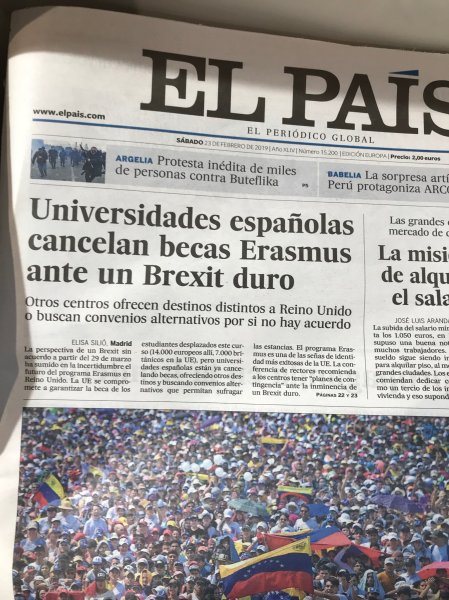
As the ongoing Brexit fiasco systematically trashes Britain’s international reputation, the consequences for the UK University sector are becoming increasingly obvious. In particular, the realization that Britain now defines itself exclusively by its xenophobia has led to a decision by Spain to remove the UK from the list of potential destinations for students under the Erasmus scheme. I’m sure other nations will soon make the same decision.

The European Union has agreed to honour Erasmus grants this year to UK students wish to study at European universities under Erasmus regardless of whether there is a Withdrawal Agreement between the UK and EU, but this is unlikely to be anything other than a stop-gap. It’s very sad to think that British students will be denied access to the Erasmus scheme in future, along with losing all the other benefits of Freedom of Movement.

Every cloud has a silver lining, though. Irish universities are more than happy to accept Erasmus students, and the one I work in (Maynooth) has a very active involvement in the scheme. So if you’re a student based in the EU, and want to study at an English-speaking university, why not apply to study in Ireland?

Cardiff Blues: Sustainability and UK Universities

Posted in Cardiff, Education with tags , , , on February 20, 2019 by telescoper

Just before I left on my travels last week I saw a rather depressing news item about Cardiff University. It seems that, after posting a deficit of £22.8 M last year, the University is planning to cut about 380 staff positions. According to the news item:

“The university plans to reduce current staff levels by 7%, or 380 full-time equivalent over five years,” said vice chancellor Colin Riordan in an email to staff.

Since I left Cardiff University in the summer I didn’t get the email from which this is quoted and I don’t know the wider picture. (If anyone would like to forward the V-C’s email to me I’d be very interested.)

The news item also says

Its aim is to get back into surplus by 2019-20 and it wants to cut staffing costs from 59.6% of total income to no more than 56% of income by 2022-23.

Between you and me I was quite surprised that a University can be spending less than 60% of its income on staff, since staff are by far its most valuable resource. Bear in mind also that academic staff will be responsible for only a fraction of this expenditure. In some universities this fraction is only about half. Cutting this still further seems a very retrograde step to me, as it means that student-staff ratios will inevitably rise, making the institution less attractive to prospective students, as well as increasing the workload on existing staff to intolerable levels.

I sincerely hope none of my former colleagues in the School of Physics & Astronomy is affected by the deterioration of the University’s finances. At least the news item I referred to does mention new investments in Data Science, so that is presumably a positive development for the Data Innovation Research Institute with which I was formerly associated.

Incidentally, best wishes to anyone at Cardiff who is reading this, and good luck against England in the Six Nations on Saturday!

I’ve mentioned Cardiff here just because I noticed a specific news item (and I used to work there) but it seems a number of other universities are suffering financial problems. There are cold winds blowing through the sector. Many institutions (including Cardiff) have committed to ambitious building programs funded by a combination of borrowing and on optimistic assumptions about growth in student numbers and consequent increases in fee income. Although I no longer work in the UK Higher Education system, I do worry greatly about its sustainability. Even from across the Irish Sea the situation looks extremely precarious: the recent boom could easily end in some institutions going bust. I don’t think that will include Cardiff, by the way. I don’t think the Welsh Government would ever allow that to happen. But I think the English Government wouldn’t act if an English university went bankrupt.

Lecture Demonstration

Posted in Education, The Universe and Stuff with tags , , , , on February 18, 2019 by telescoper

I am very proud to be at the forefront of teaching innovation, frequently deploying sophisticated new technology in the classroom for the benefit of the student learning experience.

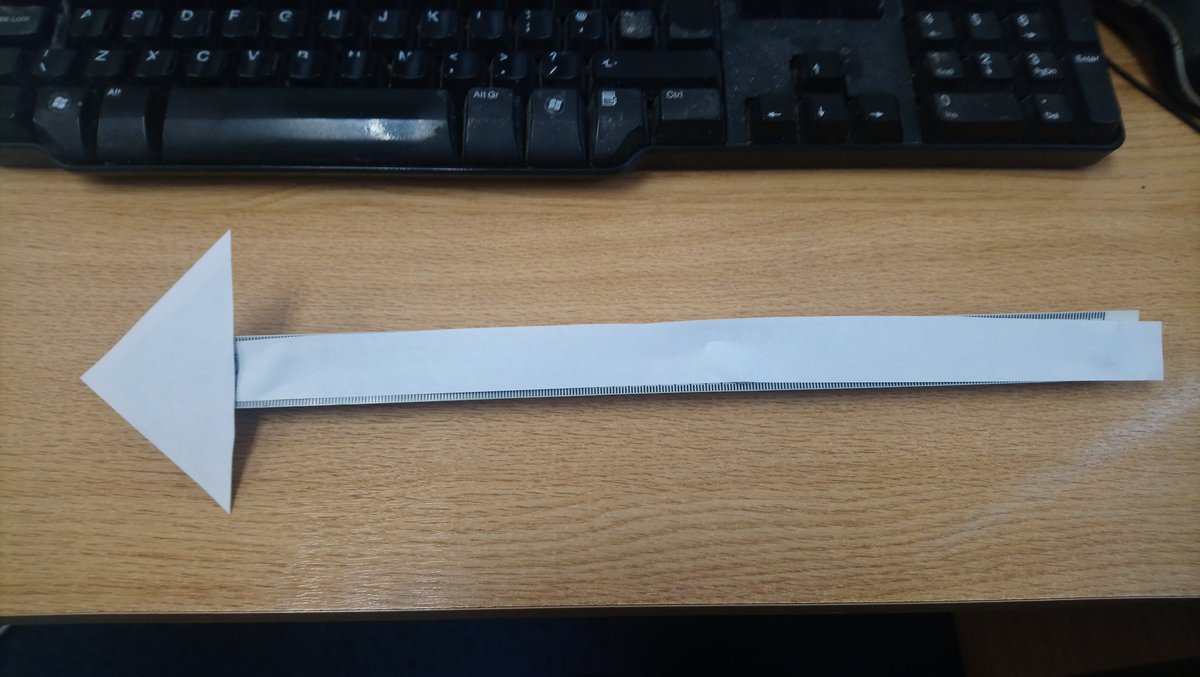
I thought I’d share one of the latest devices I have developed for the Linear Algebra part of my module on Engineering Mathematics as I am all too aware that not all lecturers have such a firm grasp of the range pf possibilities offered by novel educational appliances.

This sophisticated yet lightweight tool utilizes a pressure-sensitive adhesive (`blu tack’) to attach shapes cut from a flexible sheet of a substance derived from cellulose pulp (`paper’) to a rigid plastic geometric measuring device (`ruler’) in order to represent the magnitude and direction of a vector. Illustrated here is the version designed for use with a chalkboard; an alternative version in black is available for use with a whiteboard. The head can be detached in order to separate the concept of magnitude from that of direction.

Made from lightweight materials this device is easily carried to and from the lecture theatre and can be deployed in all weather conditions (apart from rain, wind, snow, etc).

This simple yet effective hi-tech teaching tool is available for purchase throughout the European Union for just €19.99 and in the United Kingdom for £599.50.


Copenhagen Yet Again

Posted in Biographical, Education with tags , , on February 14, 2019 by telescoper

Once again I find myself in the wonderful city of Copenhagen. As far as I’m concerned, at least, my wavefunction has collapsed (along with the rest of me into a definite location: Ibsen’s Hotel, in fact. Henrik Ibsen isn’t here: he checked out many years ago.

The hotel management, being Danes, are refreshingly honest in their description of my room:

Usually hotel rooms this size are described as `standard’…

After a very enjoyable but rather tiring day yesterday I was up early this morning to get from Loughborough to Luton Airport. What I thought would be the reasonable way of making the trip – train from Loughborough to Luton Airport Parkway and shuttle bus from there – turned out to be inconvenient in terms of timing and cost, so the kind people of Loughborough University just booked me a cab all the way there. I had to leave at 7am, though, so missed the hotel breakfast but I got to the airport in good time to have something there.

My second flight with Ryanair this week was also on time and Copenhagen’s excellent public transport system got me to this hotel very quickly. It’s a good few degrees colder here than in England.

When I checked in the receptionist asked me if I had stayed here before. I said yes, but couldn’t remember when. She said it was 2012, as I was still on their system. I did actually post about it then. The hotel hasn’t changed at all from what I remember last time. I must remember to get to breakfast in good time.

The flight from Luton Airport carried a large contingent of Chelsea supporters. Their team is playing  Malmö this evening in the UEFA Europa League. Malmö is easily reachable from Copenhagen by train over the Øresund Bridge. Fortunately I was heading into Copenhagen on the Metro so parted company with the supporters as soon as I left the airport.

Anyway, I’m in Copenhagen again as one of the External Examiners for a thesis defence at the Niels Bohr Institute tomorrow morning and then I’ll be returning directly to Dublin on Saturday afternoon. I’m missing today’s Computational Physics lecture and laboratory in Maynooth, but the students are being well looked after in my absence by John and Aaron who have all the notes and lab scripts.


Mumps and Mumpsimusses

Posted in Education, Maynooth with tags , , , , on February 12, 2019 by telescoper

I noticed that there has been an outbreak of mumps among students in the Dublin area (including a case in Maynooth). I had mumps when I was a kid and I can tell you it was no fun at all. I had thought mumps had been virtually eradicated by vaccination; the MMR vaccine was brought into use in the UK in 1988, and I had mumps long before that. I suppose one can lay the blame for the current outbreak at the door of the anti-vaxxers.

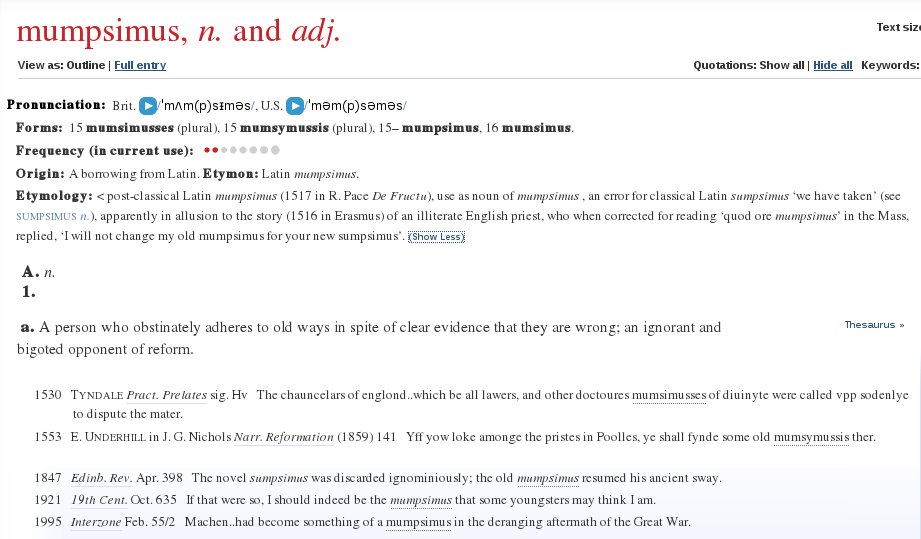
That brings me to one of my favourite words – yet another that I found out while doing a crossword – mumpsimus. Here is (part of) the OED entry:

Wikipedia gives “traditional custom obstinately adhered to however unreasonable it may be”, which is in the OED further down the page.

It seems to me that belief in idea that one’s children should not be protected against mumps is a mumpsimus, and people who cling to that belief are mumpsimusses.


Hyperbolic sine, shine or sinsh (or sinch)?

Posted in Education, mathematics with tags , , , on February 6, 2019 by telescoper

An important coffee-time discussion just revealed a significant cultural difference between members of staff here in the Department of Theoretical Physics at Maynooth University, which I wish to explore further via a completely scientific poll.

The hyperbolic sine, usually written sinh, is well known to be defined in thuswise fashion:

But the question is how do you pronounce it? Since my schooldays I have always pronounced it like `shine’ whereas I’m told others have pronounced it more like `sinch’. Yet others simply call it hyperbolic sine. What is your pronunciation?

This also gives me the excuse to tell a little story of when I was at school. One morning, which happened to be April 1st, our maths teacher started on the subject of hyperbolic functions, talking about `shine’ and `cosh’ and `tanch’. We all assumed it was an April Fool’s joke and although it was very clever it wasn’t all that funny, particularly as it went on for the whole class. We only realised it wasn’t a joke when he carried on in the same vein the following day…

And another thing, for bonus marks. In all European languages with which I am familiar (which is by no means all), the trigonometric function sin is pronounced `sinus’ not `sine’. Is English the only language to depart from sinus?

Answers through the comments box!

Ahead of Teaching

Posted in Biographical, Education, mathematics, Maynooth, Music with tags , , , , on February 3, 2019 by telescoper

It’s 3rd February 2019, which means that today is two days after Imbolc, a Gaelic festival marking the point halfway between the winter solstice and vernal equinox. This either happens 1st or 2nd February, and this year it was former, i.e. last Friday In Ireland this day is sometimes regarded as the first day of spring, as it is roughly the time when the first spring lambs are born. It corresponds to the Welsh Gŵyl Fair y Canhwyllau and is also known as the `Cross Quarter Day’ or (my favourite) `The Quickening of the Year’.

I wrote a post about this time last year, on the day I gave my first ever lecture in Maynooth University, on Computational Physics, in a theatre called Physics Hall. That was on Thursday February 1st 2018. It’s hard to believe that was a full year ago. Time certainly has gone quickly this year.

Owing to the vagaries of the academic calendar we’re a week later getting back to teaching this year than last year so my first Computational Physics lecture won’t be until this Thursday (7th February) at 9am, but sadly it won’t be in Physics Hall, which I rather liked, but in Hall C – a much less atmospheric venue, but one rather closer to my office, which will be handy if I forget anything (which I am prone to do). There are about 25 students taking this module, a few down on last year, which means they should fit comfortably into our computer lab. I’m not surprised they moved the lecture, really. The capacity of Physics Hall is 90, and even last year I only had about 30 students. Still, it did have a piano (which Hall C does not):

Computational Physics doesn’t start until Thursday. Before that I have to start my other module: Engineering Mathematics II. This (what you would probably call a `service course’) covers a mixture of things, mainly Linear Algebra but with some other bits thrown in for fun, such as Laplace transforms. Interestingly I find the Mathematical Physics students do not encounter Laplace Transforms in the first year, but perhaps engineers use them more often than physicists do? I think I’ve written only one paper that made use of a Laplace transform. Anyway, I have to start with this topic as the students need some knowledge of it for some other module they’re taking this semester. I reckon six lectures will be enough to give them what they need. That’s two weeks of lectures, there being three lectures a week for this module.

By coincidence rather than good planning, the timetable for this module is quite nice. I have lectures on Monday, Tuesday and Wednesday and then the students have a choice of tutorial (on either Thursday or Friday). That means I can get through a decent amount of material each week before each tutorial. I don’t do the tutorials, by the way: that’s left to one of our PhD students, who gets paid for doing that and correcting the weekly coursework. There are about 50 students on this module, divided into two courses: Electronic Engineering and Robotics and Intelligent Devices. We don’t have Civil or Mechanical or Chemical Engineering, etc at Maynooth.

Campus has been very quiet for the last week or so. The exam period finished in late January but lectures don’t start until tomorrow morning (Monday 4th February) so there have been few students around. No doubt it will be a different story tomorrow. I’ve done my first week’s notes and compiled my first problem set so I’m more-or-less ready to go. First lecture at 2pm tomorrow in Hall H, which is one of the rooms I taught in last term so at least I know where it is!


Maynooth Library Cat Update

Posted in Education, Maynooth with tags on January 18, 2019 by telescoper

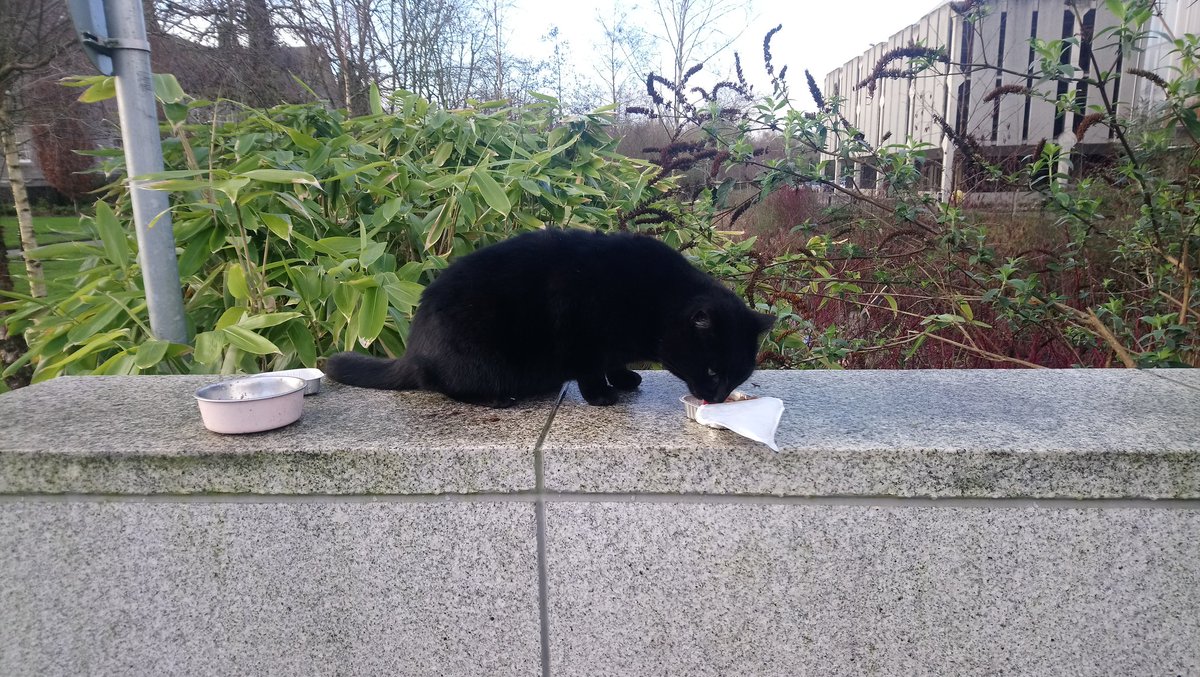
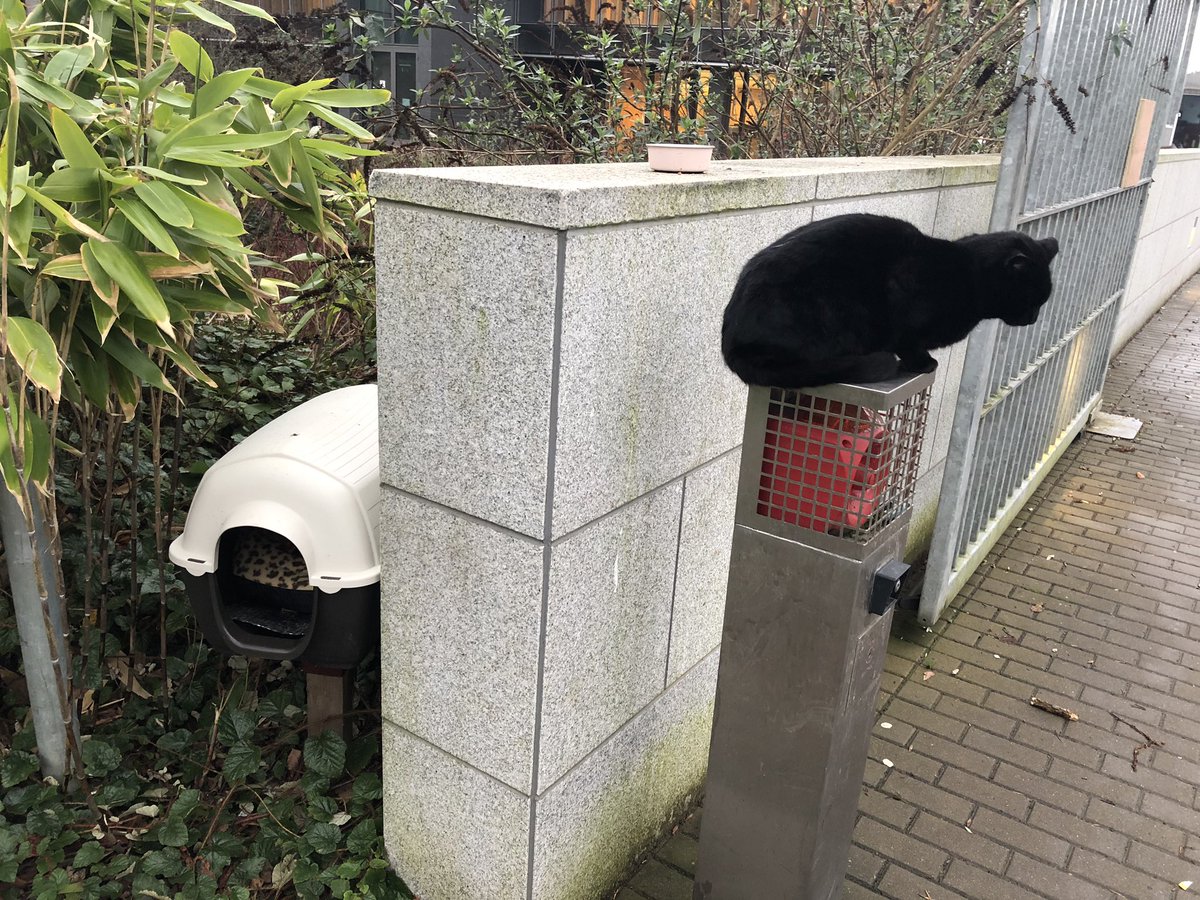
As I went for a quick coffee break this morning, I passed the local feline celebrity known as Maynooth Library Cat. That reminded me that quite a few people have asked me how said moggy is getting on. Well, here’s a picture I took this morning:

Since we’re in the middle of the examination period, the library is very busy with students using the space in there to prepare. I think the cat is doing a sterling job as a stress release mechanism as he is very friendly and quite vocal. He likes to be stroked and petted, but isn’t keen on being picked up. In return for affection he is regularly plied with food, as this morning. I actually carry some Dreamies in my bag in case he fancies a snack when I go past, but he was busy scoffing a whole portion of food when I took the picture above so I didn’t give him anything this morning. All in all, I think he’s got a very cushy number going.

Some kind soul supplied him with a box, which is placed near his favourite lookout position.

It’s pretty cold these days so I’m sure he appreciates having somewhere warm to take his naps, but he also finds other cosy places around the campus.

There’s a rumour going around that Maynooth Library Cat’s real name is Trevor. I’m not sure that is really the case, and it is possible I was told it as a joke. These days the Irish tend (not unreasonably) to assume that English people are gullible fools who will believe anything…

Self Assessments

Posted in Biographical, Education, Finance, Maynooth with tags , , on January 17, 2019 by telescoper

My first batch of examination marking having been completed satisfactorily and my next paper not taking place until the weekend (Saturday morning, to be precise), I naively hoped that I could devote myself to research for a few days this week as I am behind schedule in completing a couple of papers. Unfortunately this has not been as straightforward as I’d hoped. I’ve spent all of today doing various administrative things (expenses claims, examination reports, and a part of the Department’s Quality Review Self-Assessment document which is due in near the end of the month.

In case you are unfamiliar with such things, a Quality Review is an exercise that takes place from time to time for every Department or Administrative Unit in the University (and indeed for every university in Ireland). For the Department of Theoretical Physics at Maynooth University, the last one took place in 2009). The process begins with the aforementioned Self-Assessment document which basically lays out what the Department is trying to do, the processes by which it uses to do it, reflects on the effectiveness of those processes, and outlines ideas for how they can be improved. All the staff in the Department have been engaged in writing bits of this document, which is now gradually coming into shape.I’ve had a relatively light involvement in this because I haven’t been here for very long, but it has consumed quite a lot of staff effort.

When complete, the Self Assessment report is sent to a range of people both inside and outside the University and there is then a visitation during which the panel talks to staff and students and has a look around the Department. We’re expecting our `inspection’ to take place in March. After that the panel gives feedback to the Department in a report. The panel’s comments are made publicly available, as is appropriate for a publicly-funded body. The report emerging from the last Quality Review of the Department of Mathematical Physics (as it was then called ) can be found here (pdf). It’s all quite a lot of work – the latest Departmental meeting devoted to this yesterday lasted three and a half hours, and we’ve had several meetings like that! fortunately, it  will all be finished by next week. Better is the end of a thing than the beginning thereof.


Talking of Self Assessment, I realized last night with a panic that I hadn’t yet done my UK income tax return for 2017/18, also due in by the end of January. I spent this lunchtime getting all the bits of paper in order, and completed the task online fairly quickly as I’ve done it many times before. It turns out that yet again HMRC owes me a substantial refund. They haven’t handled my income tax properly since I left Sussex in 2016 as a matter of fact. Despite repeated attempts to get them to apply the rules correctly they have basically taxed all my income at source at the higher rate (40%) only to pay it back when I submitted my return. Fortunately, I am now domiciled in Ireland so won’t have to deal with HMRC much again.

Anyway, I should complete most of the outstanding administrative stuff this evening and if I do that I can clear a day for research, or at least writing up papers…


Reflections on the Examination Period

Posted in Biographical, Education, Maynooth with tags , , on January 10, 2019 by telescoper

Tomorrow (11th January)  is the start of our mid-year examination period here at Maynooth University. It’s therefore a good opportunity to send a hearty “good luck” message to all students about to take examinations, especially those who are further on in their courses for whom these papers have greater importance. In particular I’d like to send my best wishes to students on my fourth-year module on Astrology Astrophysics and Cosmetics Cosmology, whose paper is at 9.30 tomorrow morning.

I’m a bit too busy for anything particularly profound today, as I’m off to the airport after lunch to get a flight to London for an event at the IOP tomorrow, so I thought I’d just rehash an excerpt from something I posted a while ago on the subject of examinations.

My feelings about examinations agree pretty much with William Wordsworth, who studied at the same University as me, as expressed in this quotation from The Prelude:

Of College labours, of the Lecturer’s room
All studded round, as thick as chairs could stand,
With loyal students, faithful to their books,
Half-and-half idlers, hardy recusants,
And honest dunces–of important days,
Examinations, when the man was weighed
As in a balance! of excessive hopes,
Tremblings withal and commendable fears,
Small jealousies, and triumphs good or bad–
Let others that know more speak as they know.
Such glory was but little sought by me,
And little won.

It seems to me a great a pity that our system of education – both at School and University – places such a great emphasis on examination and assessment to the detriment of real learning. In particular, the biggest problem  with physics education in many institutions is the way modular degrees have been implemented.

I’m not at all opposed to modularization in principle. I just think the way we teach modules often fails to develop any understanding of the interconnection between different aspects of the subject. That’s an educational disaster because what is most exciting and compelling about physics is its essential unity. Splitting it into little boxes, taught on their own with no relationship to the other boxes, provides us with no scope to nurture the kind of lateral thinking that is key to the way physicists attempt to solve problems. The small size of each module makes the syllabus very “bitty” and fragmented. No sooner have you started to explore something at a proper level than the module is over. More advanced modules, following perhaps the following year, have to recap a large fraction of the earlier modules so there isn’t time to go as deep as one would like even over the whole curriculum.

Students in Maynooth take 60 “credits” in a year, split into two semesters. These are usually split into 5-credit modules with an examination at the end of each semester. Projects, and other continuously-assessed work do not involve a written examination, but the system means that a typical  student will have at least 5 written examination papers in January and at least another 5 in May. Each paper is usually of two hours’ duration.

Incidentally, one big difference between our examinations in Theoretical Physics in Maynooth and those at other institutions I’ve taught at in the UK is that the papers offer no choice of questions to be answered. A typical format for a two-hour paper is that there are two long questions (broken up into bits), each of which counts for 50 marks.  Elsewhere one normally finds students have a choice of two or three questions from four. The advantage of our system is that it makes it much harder for students to question-spot in the hope that they can get a good grade by only revising a fraction of the syllabus.


But I digress.

One consequence of the way modularization has been implemented throughout the sector is that the ratio of assessment to education has risen sharply over the last decades with a negative effect on real understanding. The system encourages students to think of modules as little bite-sized bits of education to be consumed and then forgotten. Instead of learning to rely on their brains to solve problems, students tend to approach learning by memorizing chunks of their notes and regurgitating them in the exam. I find it very sad when students ask me what derivations they should memorize to prepare for examinations. A brain is so much more than a memory device. What we should be doing is giving students the confidence to think for themselves and use their intellect to its full potential rather than encouraging rote learning.

You can contrast this diet of examinations with the regime when I was an undergraduate. My entire degree result was based on six three-hour written examinations taken at the end of my final year, rather than something like 30 examinations taken over 3 years. Moreover, my finals were all in a three-day period: morning and afternoon exams for three consecutive days is an ordeal I wouldn’t wish on anyone, so I’m not saying the old days were better, but I do think we’ve gone far too far to the opposite extreme. The one good thing about the system I went through was that there was no possibility of passing examinations on memory alone. Since they were so close together there was no way of mugging up anything in between them. I only got through  by figuring things out in the exam room.

I don’t want to denigrate the achievements of students who are successful under the current system.  What I’m saying is that I don’t think the education we provide does justice to their talents. That’s our fault, not theirs…