Archive for the Education Category

Back to Exams

Posted in Education on January 4, 2019 by telescoper

Well here I am, back in my office at Maynooth University, although I wish I could say the same about the heating. The Christmas closure officially ended yesterday (3rd January) but there are very few people about today and no heating in my office. I doubt there will be anywhere open to get lunch later, either. And did I mention there’s no heating?

We have a short hiatus between now and Friday 11th January in advance of the start of the examination period, during which I plan to try to finish off a few papers that I failed to complete over the holiday. As it happens, my examination on Astrology Astrophysics & Cosmetics Cosmology is one of the first, next Friday morning. No doubt I’ll get more than a few inquiries from students between now and then.

I’ll actually be in London next Friday when the examination takes place, as I’m giving the closing keynote talk at the annual LGBT Steminar which this year takes place at the brand new IOP Building in King’s Cross. I’m looking forward to that, but have no idea what I’m going to talk about.

Anyway, back to the topic of examinations, I noticed a piece in the Irish Times a few days ago concerning the fact that the proportion of First and Upper-Second Class degrees awarded by Irish universities has increased. The same thing has happened in the UK recently too.

Responses to this from most media pundits have generally been to accuse universities of `dumbing down’ their examinations. Responses from university staff, on the other hand, have included complaints that they are being forced by senior management to inflate grades awarded to students. All I can say to the latter is that I’ve never experienced, at any University I’ve ever worked in, even as a Head of School, any pressure whatsoever to increase the grades for any category of student in any course. That’s not to say that it doesn’t happen anywwhere. I just don’t know. I just say I’ve no experience of it happening.

I would like to say to those who jump to conclusion that universities are making it easier for students to get high grades by lowering standards is to set aside your prior prejudice and imagine, for the sake of argument, that universities are actually getting better at teaching students. How would that improvement manifest itself in the proportion of students awarded 1st and 2.1 degrees?

The answer to that question is that the proportion of good degrees would increase. One can’t therefore argue on that evidence alone whether examinations are being made easier or teaching is getting better (or indeed that students find examinations easier because they are better taught). In other words, the assumption that it’s all about dumbing down, is based on something other than the grade award data. If you have other evidence, that’s fine. Let’s hear it.

What I have seen is better training for teaching staff, better facilities for studying, and (yes) more motivated students. Given all that, why would you not expect students to get better results?

Are lectures dying out?

Posted in Education on November 29, 2018 by telescoper

Here’s a blog post from an academic (in Engineering) at Dublin City University.

I have thought similar things from time to time. I enjoy lecturing – mainly because I like talking about physics and astrophysics – but I am unsure of how much they add to the students’ education. In fact, when I was a student, I think I learned relatively little from attending lectures (although I still have most of my undergraduate notes). For me the real learning came from working through problems. For that reason I tend to keep the content of my lectures relatively light on detail, but use tutorials and worked examples a lot.

As it happens, I’m about to do this term’s teaching evaluations. I’m giving the two modules I’m teaching this semester for the first time. I’m looking forward to finding out what the students think so I can improve things next year. Even if the response is positive there are always things you can do better.

Greg Foley's avatarTales from Academia

There’s a small lecture theatre beside my office that holds about 40 students. I regularly pass it and peep in to see what’s going on. Originally I did it out of nosiness but these days I’m interested in attendance rates.

Most of the time when I look in there is a handful of students looking bored or knackered, with quite a few looking at their phones. In fairness, the lectures seem a bit dull and often involve a scientist or mathematician writing on the blackboard with his/her back to the students.

I’ve also noticed that it’s much easier this year to find a car parking space. I’m usually in before 8am but even on days when I’m not in until 10am or so, I rarely have trouble finding a place. This was not true just a few years ago.

And now, when I have a 9am lecture, I tell the…

View original post 212 more words

Physics: Mathematical or Theoretical or Experimental?

Posted in Education, Maynooth, The Universe and Stuff with tags , , , on November 26, 2018 by telescoper

Fresh from doing two Open Day talks last week I thought I’d write a few words here about something that cropped up in the question-and-answer session.

For a start, I should explain that here at Maynooth University there are two Physics departments, one the Department of Theoretical Physics (of which I am a Faculty member) and the other the Department of Experimental Physics. These two units are in the same building but are largely separate in terms of teaching and research.

For instance, when students enter on our General Science degree programme they have to choose four subjects in the first year, including Mathematics (much as I did when I did my Natural Sciences degree at Cambridge back in the day). Picking `double physics’ (i.e. Experimental Physics and Theoretical Physics) uses up two of those choices, whereas Physics was a single choice in the first year of my degree.

To confuse matters still further, the Department of Theoretical Physics only recently changed its name from the Department of Mathematical Physics and some of our documentation still carries that title. I got asked several times at the weekend what’s the difference between Theoretical Physics and Mathematical Physics?

As far as Maynooth is concerned we basically use those terms interchangeably and, although it might appear a little confusing at first, having both terms scattered around our webpages means that Google searches for both `Mathematical Physics’ and `Theoretical Physics’ will find us.

It’s interesting though that Wikipedia has different pages for Mathematical Physics and Theoretical Physics. The former begins

Mathematical physics refers to the development of mathematical methods for application to problems in physics. The Journal of Mathematical Physics defines the field as “the application of mathematics to problems in physics and the development of mathematical methods suitable for such applications and for the formulation of physical theories”. It is a branch of applied mathematics, but deals with physical problems.

while the latter starts

Theoretical physics is a branch of physics that employs mathematical models and abstractions of physical objects and systems to rationalize, explain and predict natural phenomena. This is in contrast to experimental physics, which uses experimental tools to probe these phenomena.

The difference is subtle,and there is obviously a huge amount in common between these two definitions, but it is perhaps that Theoretical Physics is more focused on the use of mathematics to account for the results of experiment and observations whereas Mathematical Physics concerns itself more with the development of the necessary mathematical techniques, but I’m sure there will be readers of this blog who disagree with this interpretation.

For the record here is what Wikipedia says about Experimental Physics:

Experimental physics is the category of disciplines and sub-disciplines in the field of physics that are concerned with the observation of physical phenomena and experiments. Methods vary from discipline to discipline, from simple experiments and observations, such as the Cavendish experiment, to more complicated ones, such as the Large Hadron Collider.

I’d say that theoretical physicists are more likely than mathematical physicists to be working closely with experimentalists. I count myself as a theoretical physicist (that’s what I did in Part II at Cambridge, anyway) though I do work a lot with data.

Anyway, as an experiment, I asked the audience at my Open Day talks if they could name a famous physicist. Most popular among the responses were the names you would have guessed: Einstein, Hawking, Feynman, Dirac, Newton, Schrodinger, and some less familiar names such as Leonard Susskind and Brian Greene. Every single one of these is (or was) a theorist of some kind. This is confirmed by the fact that many potential students mention similar names in the personal statements they write in support of their university applications. For better or worse, it seems that to many potential students Physics largely means Theoretical (or Mathematical) Physics.

Although it is probably good for our recruitment that there are so many high-profile theoretical physicists, it probably says more about how little the general public knows about what physics actually is and how it really works. For me the important thing is the interplay between theory and experiment (or observation), as it is in that aspect where the whole exceeds the sum of the parts.

It might seem a bit strange to have two Physics departments in one University – though it seems to work alright in Cambridge! – but I think it works pretty well. The one problem is that there isn’t a clear entry point for `Physics’ without an adjective. Students can carry Theoretical Physics and Experimental Physics through all the way to final year and get a joint honours degree (50% theory and 50% experiment) or they can pick one to do single honours, but we might attract a few more students if the former possibility were just called `Physics’. Perhaps.

On the Second (Open) Day..

Posted in Education, Maynooth with tags , on November 24, 2018 by telescoper

I’ve been back on campus all morning today (Saturday 24th November) at Maynooth University for the second Open Day. I’m just taking a short break to have a sandwich and a cup of tea before rejoining the fray and giving the Subject Talk at 2.10pm on behalf of the Department of Theoretical Physics.

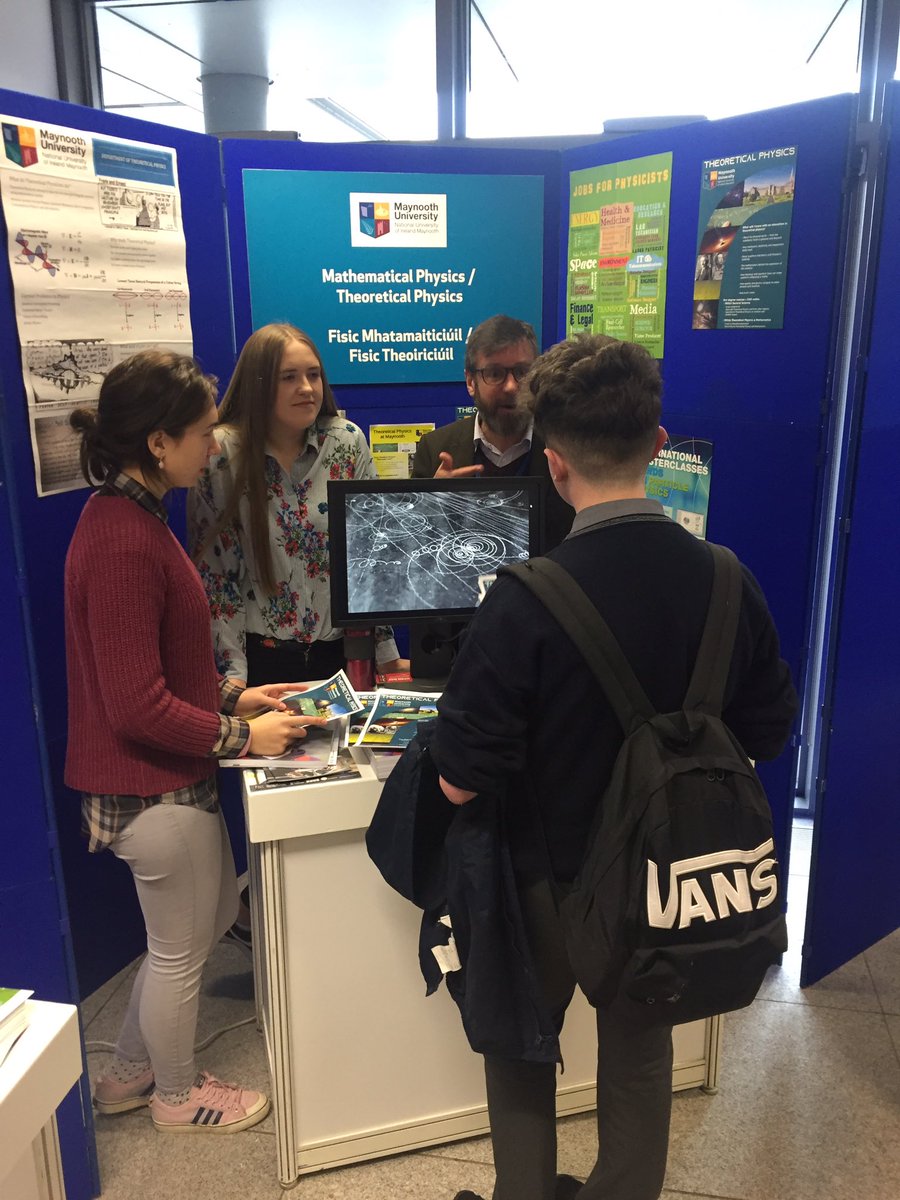
Yesterday’s Open Day was a very busy day. I’m given to understand that there was a record crowd  of over 3000 visitors. We were certainly not short of people to talk to at our stand in Iontas.

I think being a number of school trips contributed to the high attendance. Today has been more individual prospective students and parents. Also it’s been a bit rainy this morning so numbers might be down a bit compared to yesterday, but we’ve been busy again on the stall.

Anyway the main reason for writing this post is to thank all our student helpers including Rebekah, Eibhlin, Philip, Cai, Tigernach and Ryan for contributing over the two days and staff members Paul and Jiri for doing their stint. Their only material reward for helping has been a lunch voucher for one of the campus refectories.

UPDATE: The talk was very well attended and ended with lots and lots of questions, so I think I’ll call it a success. Now home to put my feet up and have a nice cup of tea!

Theoretical Physics at Maynooth University Open Days!

Posted in Education, Maynooth with tags , on November 22, 2018 by telescoper

Well, tomorrow (Friday 23rd November) and Saturday 24th November are both open days at Maynooth University. If you want to find out more about them you can look here where you will find this video which has some nice views of the campus:

I used to give Open Day talks quite frequently in a previous existence as Head of School of Mathematical and Physical Sciences at the University of Sussex and now I’m at it again, giving talks on behalf of the Department of Theoretical Physics on each Open Day. If you come along, please say hello either at the lectures (1.10pm on Friday and 2.10 on Saturday)! We also have a stall in the Iontas Building from 9.30 each day where you can meet staff and students and talk to them about the course, or anything else vaguely related to Theoretical Physics. There are other stalls, of course, but the Theoretical Physics one is obviously em>way more interesting than the others!

Looking for fun pictures to put in my talk I stumbled across this:

I think that’s the only one I need, really!

Women-only Professorships in Ireland

Posted in Education, Politics with tags , , , , on November 16, 2018 by telescoper

Earlier this week the Irish Government made an announcement that has ruffled a few feathers: it aims to create a number of new senior positions at Professor level in Irish Universities that are open only to female candidates. I don’t know the details of how this scheme will work, but I understand that the positions will be targeted at subject (and perhaps geographical) areas in which there is a demonstrable gender imbalance and the scheme will cost about €6M.

Reactions to this among people I know have been very varied, so it seems a good topic on which to have a  simplistically binary poll:

For the record, I should state that I am broadly in favour of the idea, but I’d like to know more about how these positions will be allocated to institutions, how they will be advertised and how the recruitment will be done. I’ll also add that my main worry about this initiative is that it might distract attention away from the need for Irish higher education institutions to have much better promotion procedures; see, e.g. here. There are plenty of female lecturers in Irish universities, but they seem to face ridiculous difficulties getting promoted to Professorships.


Lectures and Lava Lamps

Posted in Education, Maynooth, The Universe and Stuff with tags , , , on November 7, 2018 by telescoper

Teaching at Maynooth University has resumed after the Study Break, and yesterday I gave my first lecture on Astrophysics & Cosmology after a gap of a week. I still haven’t got onto the Cosmology bit yet, but am most of the way through a set of half-a-dozen lectures or so on stellar structure and evolution.

In past incarnations I’ve deployed a lava lamp as a prop to illustrate convection, one of the ways that heat can be transported from the core of a star (where it is generated by nuclear fusion) to its surface (whence it is radiated). The simple demonstration of how a temperature gradient can lead to convective motion always proved popular with students. In fact, more-or-less the only complimentary comments I ever got about my lectures on this topic were about how nice the lava lamp was.

Anyway, no longer having access to the official Cardiff University School of Physics & Astronomy Lava Lamp, I thought I’d just show a video chosen from the many available on youtube. They seem quite popular, perhaps because they are rather restful:

Unfortunately, however, the fates had it in for me yesterday. The Powers That Be decided to update the version of Windows on all the PCs in all the teaching rooms on campus during the study break. When I tried to show the video the computer crashed and would not restart. I had to run back to the office to get my laptop, which I eventually got to work, but I had lost so much time that I skipped the video. Hopefully I’ll get to show it properly at some point in the future.


Union Matters

Posted in Education, Politics with tags , , , , , on October 14, 2018 by telescoper

The above collection of goodies arrived last week in a Welcome Pack from the Irish Federation of University Teachers (IFUT), my new trade union. I sent in an application to join some time ago, and was getting a bit worried that it might have been lost, but then confirmation arrived in the form of my membership card along with a pen, a badge, a lanyard, an application form for a Credit Union and various other bits and bobs. It’s only by standing together that academics in Irish universities have any hope of exerting enough pressure on the Government to get it to reverse the persistent underfunding of Higher Education in this country. Even then it won’t be easy – last week’s budget had nothing whatsoever in it for universities or students.

Incidentally, according to the online budget calculator, I’ll be a princely €28 per month better off next year as a result of small changes in taxation, but it seems to me that the priority should have been to help the less well off and it failed to do that. No doubt, however, the cautious approach to public finances shown by the Government is largely down to the uncertain effects of Brexit.

While I am on about unions, some of the readers of this blog will recall that I was participating in industrial action by UCU (the Universities and Colleges Union) in the UK earlier this year in relation to proposed cuts to pensions in the Universities Superannuation Scheme (USS). I have since left that scheme, deferring my benefits from it until I retire, but I couldn’t resist passing on a link to an article I read yesterday, which argues that USS’s valuation (which resulted in a deficit) rests on a large and demonstrable mistake and, when this is corrected there is no deficit as at 31 March 2018 and no need for detrimental changes to benefits or contributions.

Could it be that all that pain was caused by an accounting error? If so, then heads should roll!

From Phase Walks to Undergraduate Research

Posted in Education, The Universe and Stuff with tags , , , , , on September 28, 2018 by telescoper

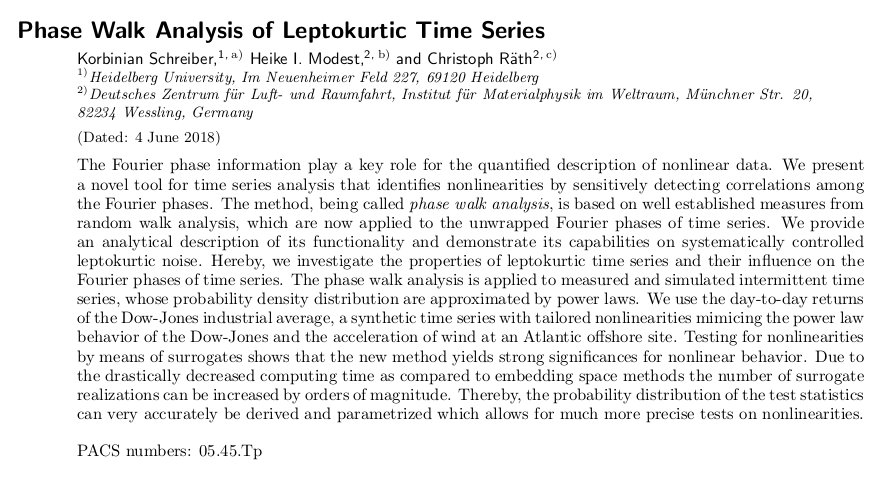
This week I put together a couple of brief descriptions for possible research projects for final-year undergraduate and/or Masters students in the Department of Theoretical Physics at Maynooth University, and I was reminded of the value of projects like this when I found this paper on the arXiv:

In fact the `Phase Walk Analysis’ developed here is based on an original idea I had for an undergraduate summer research project when I was at Nottingham University and have mentioned before on this blog. The student who did the project with me was Andrew Stannard (who is now at King’s College, London) and the work led to a paper that was published in a refereed journal in 2005 and has now been cited 21 times by various authors including the Planck Team.

Although Andrew is now working in a completely different area (Condensed Matter Physics), I like to think this taste of research was of at least some assistance in developing his career. Above all, though, it relates to something I read in the Times Higher by astronomer, Nobel Prize winner, and Vice-Chancellor of the Australian National University, namely that the idea that many politicians seem to have of separating teaching from research in universities is at best misguided and at worst threatens the very idea of a university.

The One True Ranking Narrative

Posted in Education, Maynooth with tags , , , on September 27, 2018 by telescoper

Yesterday saw the release of the 2019 Times Higher World University Rankings. The main table of rankings can be found here and the methodology used to concoct it here.

It seems that there’s little point in doing so, but I’ll try to reiterate the objections I made last year and the year before that and the year before that to the completely unscientific nature of these tables. My main point is that when changes to the methodology used to compile these tables are introduced no attempt is ever made to distinguish their effect from changes in the input data. This would be quite easy to do, by simply running the old methodology alongside the new on the metrics. The compilers of these tables steadfastly refuse to do this straightforward exercise, I suspect this is because they know what the result would be: that many of the changes in these tables year-on-year are the result of artificially introduced `churn’.

And then there’s the questions of whether you think the metrics used are meaningful anyway, and whether any changes not due to methodological tweaks are simply statistical noise, but I have neither the time nor the energy to go into that one now…

Notwithstanding the reasonable objections to these tables, the newspapers are full of stories constructed to explain why some universities went up, some went down and others stayed roughly the same. Most of these articles were obviously written by that well-known journalist, Phil Space.

However, not all these narratives are meaningless. The latest Times Higher World University Rankings have revealed that here in Ireland, while more famous higher education establishments such as Trinity College Dublin have fallen three places due to *insert spurious narrative here*, my own institution (Maynooth University) is one of only two to have risen in the tables. It simply cannot be a coincidence that I moved here this year. Clearly my arrival from Cardiff has had an immediate and positive impact. There is no other credible explanation.