Archive for the Education Category

Student access to marked examination scripts

Posted in Cardiff, Education, Maynooth with tags , , , on May 25, 2018 by telescoper

I’m currently waiting for the last couple of scripts from my Physics of the Early Universe examination to arrive so I can begin the task of marking them. The examination was yesterday morning, and it’s now Friday afternoon, so I don’t know why it takes so long for the scripts to find their way to the examiner, especially when marking is on such a tight schedule. I’m away next week (in Ireland) so if I don’t get papers by this afternoon they won’t be marked until I return. The missing two are from students sitting in alternative venues, but I don’t see why that means they take over 24 hours  to get to the marker.

(By the way,  `script’ refers to what the student writes (usually in a special answer book), as opposed to the `paper’ which is the list of questions to be answered or problems to be solved in the script.)

Anyway, while I’m waiting for the missing scripts to arrive I thought I’d mention that here in the School of Physics & Astronomy at Cardiff University we have a system whereby students can get access to their marked examination scripts.  This access is limited, and for the purpose of getting feedback on where they went wrong, not for trying to argue for extra marks. The students can’t take the scripts away, nor can they make a copy, but the can take notes which will hopefully help them in future assessments. There’s a similar provision in place in the Department of Theoretical Physics at Maynooth University, where I will be relocating full-time in July, based around a so-called `Consultation Day’.

When I was Head of the School of Mathematical and Physical Sciences at Sussex University I tried to introduce such a system there, but it was met with some resistance from staff who thought this would not only cause a big increase in workload and but also lead to  difficulties with students demanding their marks be increased. That has never been the experience here at Cardiff: only a handful take up the opportunity and those that do are told quite clearly that the mark cannot be changed.  Last year I had only one student who asked to go through their script. I was happy to oblige and we had a friendly and (I think) productive meeting.

If I had my way we would actually give all students their marked examination scripts back as a matter of routine. The fact that we don’t is no doubt one reason for relatively poor performance in student satisfaction surveys about assessment and feedback. Obviously examination scripts have to go through a pretty strict quality assurance process involving the whole paraphernalia of examination boards (including external examiners), so the scripts can’t be given back immediately but once that process is complete there doesn’t seem to me any reason why we shouldn’t give their work, together with any feedback written on it,  back to the students in its entirety.

I have heard some people argue that under the provisions of the Data Protection Act students have a legal right to see what’s written on the scripts – as that constitutes part of their student record – but that’s not my point here. My point is purely educational, based on the benefit to the student’s learning experience.

Anyway, I don’t know how widespread the practice is of giving examination scripts back to students so let me conduct a totally unscientific poll. Obviously most of my readers are in physics and astronomy, but I invite anyone in any academic discipline to vote:

And, of course, if you have any further comments to make please feel free to make them through the box below!


When Log Tables aren’t Log Tables

Posted in Education, mathematics, Maynooth with tags , , , , , on May 17, 2018 by telescoper

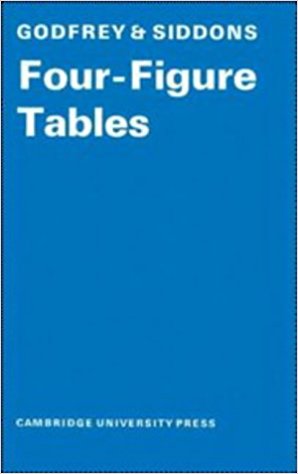
Every now and then – actually more frequently than that – I reveal myself in Ireland as an ignorant foreigner. The other day some students were going through a past examination paper (from 2014) and I was surprised to see that the front cover (above) mentioned  `log tables’.

Now I’m old enough to remember using tables of logarithms (and other mathematical tables  of such things as square roots and trigonometric functions, in the form of lists of numbers) extensively at school. These were provided in this book of four-figure tables (which can now buy for 1p on Amazon, plus p&p).

As a historical note I’ll point out that I was in the first year at my school that progressed to calculators rather than slide rules (in the third year) so I was never taught how to use the former. My set of four-figure tables which was so heavily used that it was falling to bits anyway, never got much use after that and I threw it out when I went to university despite the fact that I’m a notorious hoarder.

Anyway, assuming that the mention of `log tables’ was a relic of many years past, I said to the group of students going through the old examination paper that it seemed somewhat anachronistic. I was promptly corrected, and told that `log tables’ are in regular use in schools and colleges throughout Ireland, but that the term is a shorthand for a booklet containing a general collection of mathematical formulae, scientific data and other bits of stuff that might come in useful to students; for an example appropriate to the Irish Leaving Certificate, see here. One thing that they don’t contain is a table of logarithms…

Students in Physics & Astronomy at Cardiff University are also given a formula booklet for use during examinations. I don’t remember having access to such a thing as an undergraduate, but I don’t object to it. It seems to me that an examination shouldn’t be a memory test, and giving students the basic formulae as a starting point if anything allows the examiner to concentrate on testing what matters much more, i.e. the ability to formulate and solve a problem. The greatest challenge of science education at University level is, in my opinion, convincing students that their brain is much more than a memory device…

100 Years of Feynman

Posted in Cute Problems, Education with tags , , , , , , on May 11, 2018 by telescoper

Today marks the centenary of the birth of Noble Prize-winning physicist, science communicator and bongo player Richard Feyman. It’s great to see so many articles about him today, so I was wondering how to do my own quick tribute before I head to London for the Royal Astronomical Society Annual General Meeting this afternoon.

With university exams coming up it seemed a good idea to celebrate Richard Feynman’s legacy by combining todays 100th anniversary with some tips (inspired by Feynman) about how to tackle physics problems, not only in terms of how to solve them but also how to present the answer in an appropriate way.

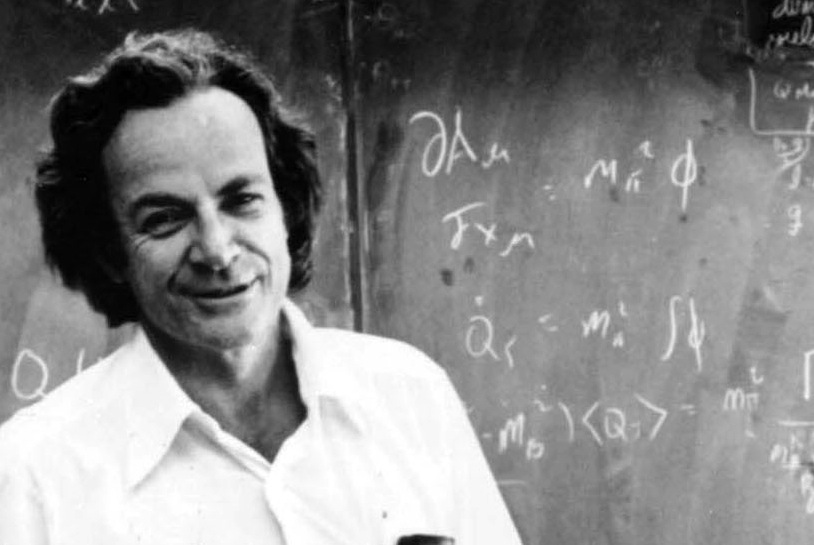
Richard-Feynman-cornellI began with Richard Feynman’s formula (the geezer in the above picture) for solving physics problems:

  1. Write down the problem.
  2. Think very hard.
  3. Write down the answer.

That may seem either arrogant or facetious, or just a bit of a joke, but that’s really just the middle bit. Feynman’s advice on points 1 and 3 is absolutely spot on and worth repeating many times to an audience of physics students.

I’m a throwback to an older style of school education when the approach to solving unseen mathematical or scientific problems was emphasized much more than it is now. Nowadays much more detailed instructions are given in School examinations than in my day, often to the extent that students  are only required to fill in blanks in a solution that has already been mapped out.

I find that many, particularly first-year, students struggle when confronted with a problem with nothing but a blank sheet of paper to write the solution on. The biggest problem we face in physics education, in my view, is not the lack of mathematical skill or background scientific knowledge needed to perform calculations, but a lack of experience of how to set the problem up in the first place and a consequent uncertainty about, or even fear of, how to start. I call this “blank paper syndrome”.

In this context, Feynman’s advice is the key to the first step of solving a problem. When I give tips to students I usually make the first step a bit more general, however. It’s important to read the question too. The key point is to write down the information given in the question and then try to think how it might be connected to the answer. To start with, define appropriate symbols and draw relevant diagrams. Also write down what you’re expected to prove or calculate and what physics might relate that to the information given.

The middle step is more difficult and often relies on flair or the ability to engage in lateral thinking, which some people do more easily than others, but that does not mean it can’t be nurtured.  The key part is to look at what you wrote down in the first step, and then apply your little grey cells to teasing out – with the aid of your physics knowledge – things that can lead you to the answer, perhaps via some intermediate quantities not given directly in the question. This is the part where some students get stuck and what one often finds is an impenetrable jumble of mathematical symbols  swirling around randomly on the page. The process of problem solving is not always linear. Sometimes it helps to work back a little from the answer you are expected to prove before you can return to the beginning and find a way forward.

Everyone gets stuck sometimes, but you can do yourself a big favour by at least putting some words in amongst the algebra to explain what it is you were attempting to do. That way, even if you get it wrong, you can be given some credit for having an idea of what direction you were thinking of travelling.

The last of Feynman’s steps  is also important. I lost count of the coursework attempts I marked this week in which the student got almost to the end, but didn’t finish with a clear statement of the answer to the question posed and just left a formula dangling.  Perhaps it’s because the students might have forgotten what they started out trying to do, but it seems very curious to me to get so far into a solution without making absolutely sure you score the points.  IHaving done all the hard work, you should learn to savour the finale in which you write “Therefore the answer is…” or “This proves the required result”. Scripts that don’t do this are like detective stories missing the last few pages in which the name of the murderer is finally revealed.

So, putting all these together, here are the three tips I gave to my undergraduate students this morning.

  1. Read the question! Some students give solutions to problems other than that which is posed. Make sure you read the question carefully. A good habit to get into is first to translate everything given in the question into mathematical form and define any variables you need right at the outset. Also drawing a diagram helps a lot in visualizing the situation, especially helping to elucidate any relevant symmetries.
  2. Remember to explain your reasoning when doing a mathematical solution. Sometimes it is very difficult to understand what students are trying to do from the maths alone, which makes it difficult to give partial credit if they are trying to the right thing but just make, e.g., a sign error.
  3.  Finish your solution appropriately by stating the answer clearly (and, where relevant, in correct units). Do not let your solution fizzle out – make sure the marker knows you have reached the end and that you have done what was requested. In other words, finish with a flourish!

There are other tips I might add – such as checking answers by doing the numerical parts at least twice on your calculator and thinking about whether the order-of-magnitude of the answer is physically reasonable – but these are minor compared to the overall strategy.

And another thing is not to be discouraged if you find physics problems difficult. Never give up without a fight. It’s only by trying difficult things that you can improve your ability by learning from your mistakes. It’s not the job of a physics lecturer to make physics seem easy but to encourage you to believe that you can do things that are difficult!


Revisionist (Thermal) History of the Universe

Posted in Biographical, Cardiff, Education, The Universe and Stuff with tags , , on May 10, 2018 by telescoper

Well, today saw my last teaching session on my Cardiff University module Physics of the Early Universe. It was actually an optional revision lecture, during which I went through questions on last year’s examination paper, some matters arising therefrom and some general tips on `examination technique’. The latter included advice that seems obvious – such as `read the question carefully’ and `check your numerical answers’ – but that surprisingly many students seem not to have heard before or, if they have, choose not to follow!

Anyway, I hope the students who came today found it useful and I hope that they (and indeed everyone else taking examinations over the next few weeks) do themselves proper justice and get the results they need for whatever comes next in their plans.

The Physics of the Early Universe paper is a couple of weeks ago so no doubt I’ll get a few more queries to deal with before then.

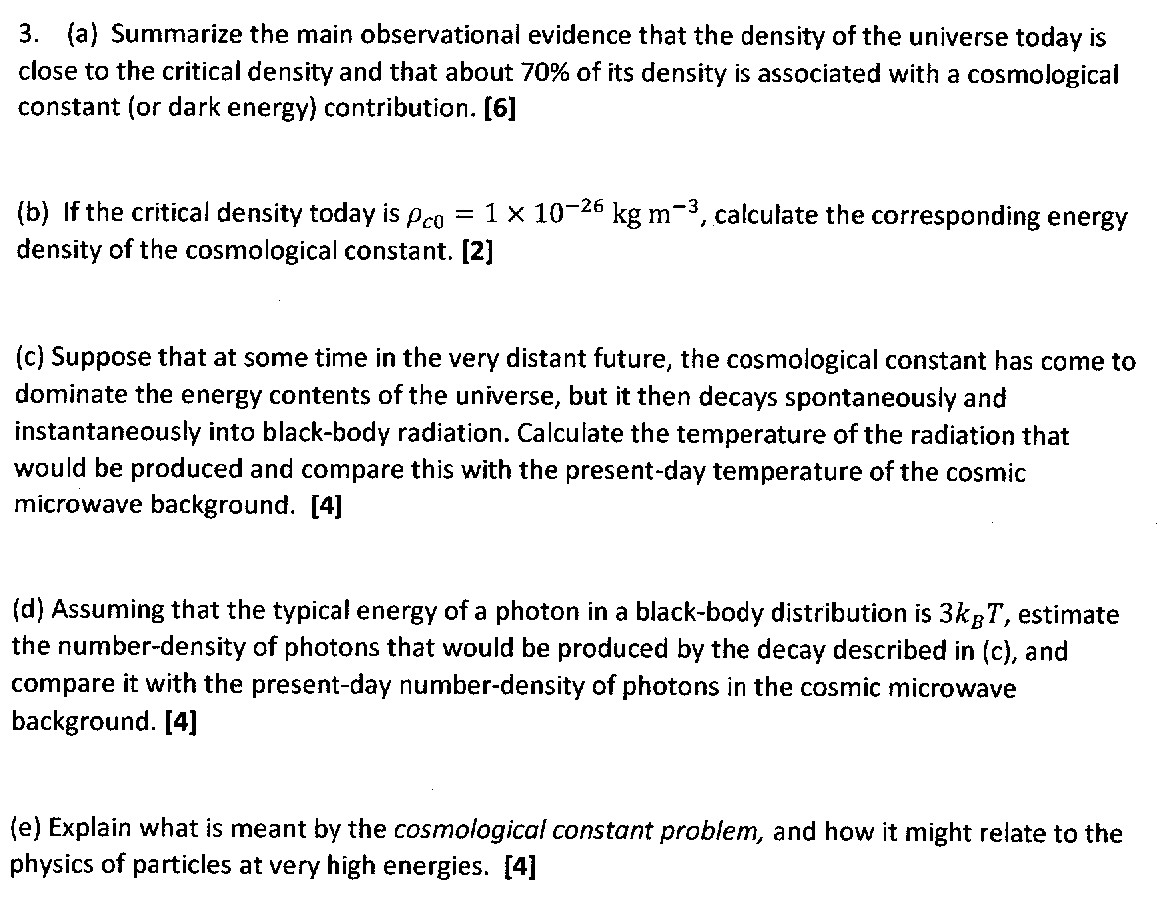
I thought I’d give an idea of the stuff I’ve been teaching here by including one of the questions from last year’s paper. I thought this was quite an easy one, actually, but the students seemed to find it tricky while they mostly coped well with the other questions, which I thought were harder. One of the challenges of teaching is that it’s often hard to see what other people find difficult! See what you think. You don’t really need to know much cosmology to do this:

Anyway, today was not only the last teaching session for this particular module – it’s also the last teaching session I’ll ever conduct in the UK university system. Best wishes to whoever it is that teaches this module next year when I’m in Ireland.

Project Work

Posted in Biographical, Education, mathematics with tags , , , , , on April 23, 2018 by telescoper

I’m progressively clearing out stuff from my office prior to the big move to Ireland. This lunchtime I opened one old box file and found my undergraduate project. This was quite an unusual thing at the time as I did Theoretical Physics in Part II (my final year) of Natural Sciences at Cambridge, which normally meant no project but an extra examination paper called Paper 5. As a member of a small minority of Theoretical Physics students who wanted to do theory projects, I was allowed to submit this in place of half of Paper 5…

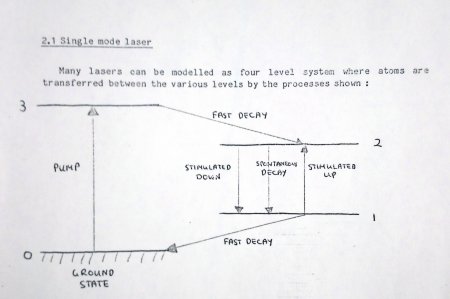
The problem was to write a computer program that could solve the equations describing the action of a laser, starting with the case of a single-mode laser as shown in the diagram below that I constructed using a sophisticated computer graphics package:

The above system is described by a set of six simultaneous first-order ordinary differential equations, which are of relatively simple form to look at but not so easy to solve numerically because the equations are stiff (i.e. they involve exponential decays or growths with very different time constants). I got around this by using a technique called Gear’s method. There wasn’t an internet in those days so I had to find out about the numerical approach by trawling through books in the library.

The code I wrote – in Fortran 77 – was run on a mainframe, and the terminal had no graphics capability so I had to check the results as a list of numbers before sending the results to a printer and wait for the output to be delivered some time later. Anyway, I got the code to work and ended up with a good mark that helped me get a place to do a PhD.

The sobering thought, though, is that I reckon a decent undergraduate physics student nowadays could probably do all the work I did for my project in a few hours using Python….

An O-Level History Examination from 1979

Posted in Biographical, Education, History with tags , , , , on April 18, 2018 by telescoper

I have in the past posted a few examples of the O- and A-level examinations I took when I was at school. These have been mainly science and mathematics papers as those are relevant to the area of higher education in which I work, and I thought they might be of interest to students past and present.

A few people have emailed me recently to ask if I could share any other examinations, so here are the two History papers I took for O-level in June/July 1979. Can that really have been almost 40 years ago?

These were Papers 5 and 12 out of an unknown number of possible papers chosen by schools. My school taught us exclusively about British and European history from the mid-19th to early 20th centuries; you will observe that in both cases `history’ was deemed to have ended in 1914. It’s possible that some of the other papers paid more attention to the wider world.

I have no idea what modern GCSE history examinations look like, but I’d be interested in any comments from people who do about the style and content!

Fun with the Airy Equation

Posted in Education, mathematics with tags , , , , , , on April 12, 2018 by telescoper

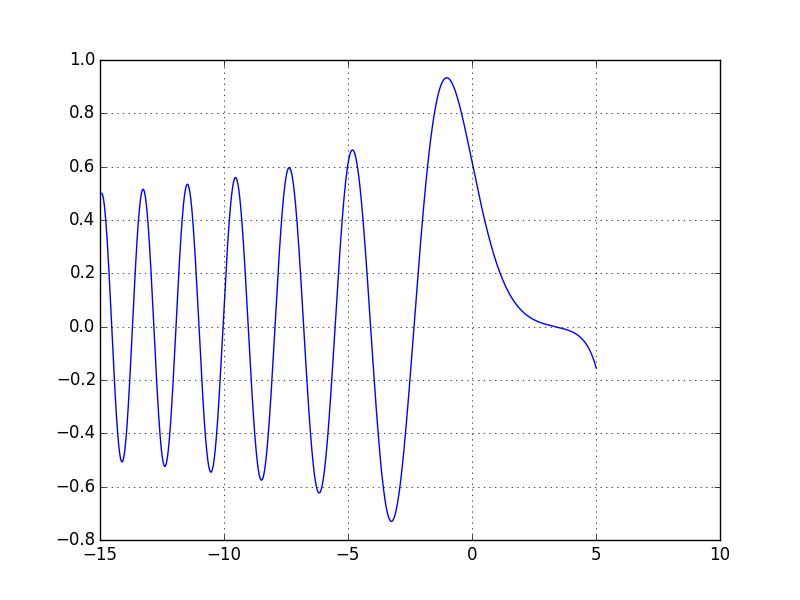
Today being a Maynooth Thursday, it has, as usual, has been dominated by computational physics teaching. We’re currently doing methods for solving ordinary differential equations. At the last minute before this afternoon’s lab session I decided to include an exercise that involved solving the following harmless-looking equation: y'' = xy.

This is usually known as Airy’s equation and it comes up quite frequently in problems connected with optics. It was first investigated by a former Astronomer Royal George Airy, after whom the function is named; incidentally, he was born in Alnwick (Northumberland, i.e. not the Midlands).

Despite its apparent simplicity, the Airy equation describes some very interesting phenomena. Indeed it is the simplest ODE (that I know of) that has the property that there’s a point at which the behaviour of the solution turns from oscillatory to exponential. Here’s a result of a numerical integration of the equation: obtained using a simple Python script:

(I stopped the integration at x=5 as the magnitude of the solution grows very quickly beyond that value for the particular initial conditions chosen).

One of the reasons for including this example (apart from the fact that Airy was a Geordie) is that the students were so surprised by the behaviour of the solution and most of them assumed that there was some problem with the numerical stability of their results. Some integration methods do struggle with such simple equations as the simple harmonic oscillator, but just sometimes weird numerical results are not mere numerical artifacts!

Anyway, my point is not about this particular equation or even about computational physics, but a general pedagogical one: finding interesting results for yourself is much more likely to motivate you to think about what they mean than if they’re just described to you by someone else. I think that goes for numerical experiments in a computer lab just as much as it does for any other kind of practical experiment in a science laboratory.

Public House Outreach

Posted in Education, The Universe and Stuff with tags , , , , on April 10, 2018 by telescoper

I’m told that there are pubs in which people don’t sit around discussing antimatter and time reversal by sketching Feynman diagrams on seasickness bags, but who would want to drink in one those?

Back to work in Cardiff..

Posted in Biographical, Education with tags , on March 19, 2018 by telescoper

So here I am, then. Back in the offices of the Data Innovation Research Institute in Cardiff for the first time in almost a fortnight. The four-week batch of strikes over pensions has come to an end so I have returned to work. No agreement has been reached so it seems likely there will be further industrial action, but for the time being normal services are being resumed. In fact it’s not exactly back to normal because there’s a large backlog of things to be done (including marking coursework and setting examinations), but I mean at least that lectures resume and will be delivered on the normal timetable. In my Physics of the Early Universe module I have only given four (two-hour) lectures and have missed three. I return to the fray tomorrow morning to give Lecture 8. Frustratingly, that’s the only lecture I have before the Easter break which starts on Friday and lasts for three weeks. Assuming there are no further strikes I’ll be giving lectures 9-12 (the last a revision lecture) after the holiday.

I now have to figure out how to cope with the six hours of lectures missed because of industrial action. That will be tricky, but I’ll do my level best to ensure that I cover everything needed for the examination. I spent most of this morning trying to figure out how to reorganise the remaining material, and I think I can do it as long as we don’t lose any more teaching time. At any rate I have made the decision not to give additional lectures to cover what I’ve missed. Owing to the timing of the strikes (and the fact that only work half the time here in Cardiff) I have been on strike for all the days I would have been working for three weeks. That means I will lose three full weeks pay. Even if it were logistically possible to fit in 6 hours of extra lectures after Easter, I don’t think it’s reasonable for me to do that for free.

While I was on strike a group of my students emailed the Vice-Chancellor of Cardiff University (copying me in) to point out how much teaching they were missing and request some form of compensation. I have a lot of sympathy for their situation and in no way do I want to damage their education. I will do what I can to mitigate the effect of the strike but won’t take any action that reduces the effectiveness of the industrial action. It remains to be seen if any compensation will be offered by the University management, but I think their best policy would be pressure Universities UK to stop pratting about and find a speedy settlement of the dispute.

Anyway, today is a bank holiday in Maynooth – St Patrick’s Day fell on a Saturday this year – and the rest of the week is `Study Week’, so there are no lectures or laboratory sessions. I’ll therefore be staying in Cardiff all week, which gives me the chance to go to a concert on Friday at St David’s Hall – the first for quite a while.

Now, time to get back to writing tomorrow’s lecture…

Other People’s Code

Posted in Education, mathematics with tags , , , on March 16, 2018 by telescoper

I don’t know if this is just me being useless, but one of the things I’ve always found difficult is debugging or rewriting computer programs written by other people. This is not a complaint about people who fail to document their code sufficiently to see what’s going on, it’s that even when the code is documented it seems much more difficult to spot errors in code written by other people than it is when you’ve written the program yourself.

I’ve been thinking a lot since I’ve been teaching Computational Physics here in Maynooth University. One of the standard elements of the assessment for this module is a task wherein the students are given a Python script intended to perform a given task (e.g. a numerical integral) but which contains a number of errors and asked to identify and correct the errors. This is actually a pretty tough challenge, though it is likely to be one that a graduate might have to meet if they get a job in any environment that involves programming.

Another context in which this arises is our twice-weekly computing laboratory sessions. Twice in the last couple of weeks I’ve been asked for a bit of help by students with code that wasn’t working, only to stare at the offending script for ages and fiddling with a number of things that made no difference, without seeing what turned out to be an obvious mistake. Last week it was an incorrect indent in Python (always a hazard if you’ve been brought up on Fortran). This week it was even simpler, a sign error in a line that was just supposed to calculate the mid-point of an interval. I should have been able to spot these very quickly, but I couldn’t.

What makes this so difficult? When given a mathematical calculation to mark I can usually spot errors reasonably easily (unless the working is illegible), but with code it’s different (at least for me). If I’d been given it on a piece of paper as part of a formula, I reckon I would have spotted that minus sign almost immediately.

One possibility is just that I’m getting old. While that may well be true, it doesn’t explain why I found debugging other people’s code difficult even when I was working on software at British Gas when I was 18. In that context I quite often gave up trying to edit and correct software, and instead just deleted it all and wrote my own version from scratch. That’s fine if the task is quite small, but not practicable for large suites written by teams of programmers.

I think one problem is that other people rarely approach a programming task exactly the same way as one would oneself. I have written programs myself to do the tasks given to students in the computing lab, and I’m always conscious of the method I’ve used. That may make it harder to follow what others have tried to do. Perhaps I’d be better off not prejudicing my mind doing the exercises myself?

Anyway, I’d be interested to know if anyone else has the same with other people’s code and if they have any tips that might improve my ability to deal with it. The comments box is at your disposal…