Archive for the Education Category

The Renewed Threat to STEM

Posted in Education, Finance, Science Politics with tags , , , , , , on July 26, 2015 by telescoper

A couple of years ago, soon after taking over as Head of the School of Mathematical and Physical Sciences (MPS) at the University of Sussex, I wrote a blog post called The Threat to STEM from HEFCE’s Funding Policies about how the funding policies of the Higher Education Funding Council for England (HEFCE) were extremely biased against STEM disciplines. The main complaint I raised then was that the income per student for science subjects does not adequately reflect the huge expense of teaching these subjects compared to disciplines in the arts and humanities. The point is that universities now charge the same tuition fee for all subjects (usually £9K per annum) while the cost varies hugely across disciplines: science disciplines can cost as much as £16K per annum per student whereas arts subjects can cost as little as £6K. HEFCE makes a small gesture towards addressing this imbalance by providing an additional grant for “high cost” subjects, but that is only just over £1K per annum per student, not enough to make such courses financially viable on their own. And even that paltry contribution has been steadily dwindling.  In effect, fees paid by arts students are heavily subsidising the sciences across the Higher Education sector.

The situation was bad enough before last week’s announcement of an immediate £150M cut in HEFCE’s budget. Once again the axe has fallen hardest on STEM disciplines. Worst of all, a large part of the savings will be made retrospectively, i.e. by clawing back money that had already been allocated and which institutions had assumed in order to plan their budgets. To be fair, HEFCE had warned institutions that cuts were coming in 2015/16:

This means that any subsequent changes to the funding available to us from Government for 2015-16, or that we have assumed for 2016-17, are likely to affect the funding we are able to distribute to institutions in the 2015-16 academic year. This may include revising allocations after they have already been announced. Accordingly, institutions should plan their budgets prudently.

However, this warning does not mention the possibility of cuts to the current year (i.e. 2014-15). No amount of prudent planning of budgets will help when funding is taken away retrospectively, as it is now to the case. I should perhaps explain that funding allocations are made by HEFCE in a lagged fashion, based on actual student numbers, so that income for the academic year 2014-15 is received by institutions during 15/16. In fact my institution, in common with most others, operates a financial year that runs from August 1st to July 31st and I’ve just been through a lengthy process of setting the budget from August 1st 2015 onward; budgets are what I do most of the time these days, if I’m honest. I thought I had finished that job for the time being, but look:

In October 2015, we will notify institutions of changes to the adjusted 2014-15 teaching grants we announced in March 20158. These revised grant tables will incorporate the pro rata reduction of 2.4 per cent. This reduction, and any other changes for individual institutions to 2014-15 grant, will be implemented through our grant payments from November 2015. We do not intend to reissue 2014-15 grant tables to institutions before October 2015, but institutions will need to reflect any changes relating to 2014-15 in their accounts for that year (i.e. the current academic year). Any cash repayments due will be confirmed as part of the October announcements.

On top of this, any extra students recruited as as  result of the government scrapping student number controls won’t attract any support at all from HEFCE, so we wll only get the tuition fee.And the government says it wants the number of STEM students to increase? Someone tell me how that makes sense.

What a mess! It’s going to be back to the drawing board for me and my budget. And if a 2.4 per cent cut doesn’t sound much to you then you need to understand it in terms of how University budgets work. It is my job – as the budget holder for MPS – to ensure that the funding that comes in to my School is spent as efficiently and effectively on what the School is meant to do, i.e. teaching and research. To that end I have to match income and expenditure as closely as possible. It is emphatically not the job of the School to make a profit: the target I am given is to return a small surplus (actually 4 per cent of our turnover) to contribute to longer-term investments. I’ve set a budget that does this, but now I’ll have to wait until October to find out how much I have to find in terms of savings to absorb the grant cut. It’s exasperating when people keep moving the goalposts like this. One would almost think the government doesn’t care about the consequences of its decisions, as long as it satisfies its fixation with cuts.

And it’s not only teaching that is going to suffer. Another big slice of savings (£52M) is coming from scrapping the so-called “transitional relief” for STEM departments who lost out as a result of the last Research Excellence Framework. This again is a policy that singles out STEM disciplines for cuts. You can find the previous allocations of transitional relief in an excel spreadsheet here. The cash cuts are largest in large universities with big activities in STEM disciplines – e.g. Imperial College will lose £10.9M previous allocated, UCL about £4.3M, and Cambridge about £4M. These are quite wealthy institutions of course, and they will no doubt cope, but that doesn’t make it any more acceptable for HEFCE to break a promise.

This cut in fact won’t alter my School’s budget either. Although we were disappointed with the REF outcome in terms of league table position, we actually increased our QR income. As an institution the University of Sussex only attracted £237,174 in transitional relief so this cut is small potatoes for us, but that doesn’t make this clawback any more palatable from the point of view of the general state of health of STEM disciplines in the United Kingdom.

These cuts are also directly contrary to the claim that the UK research budget is “ring-fenced”. It clearly isn’t, and with a Comprehensive Spending Review coming up many of us are nervous that these cuts are just a foretaste of much worse things to come. Research Councils are being asked to come up with plans based on a 40% cut in cash.

Be afraid. Be very afraid.

Exciting Opportunity in Experimental Physics at the University of Sussex!

Posted in Education, The Universe and Stuff with tags , , , , on July 23, 2015 by telescoper

Just a quick update on the news that Department of Physics & Astronomy at the University of Sussex has an exciting opportunity in the form of a brand new Chair position in Experimental Physics. The advertisement appeared on the University of Sussex website somedays ago. But it has now appeared on Nature Jobs and the Times Higher websites. It is also in today’s print edition of the Times Higher. At least I think it is. I couldn’t find a copy in W.H. Smith’s when I went there today. Obviously it has sold out because word has got out about this job!

I’m taking the liberty of reposting a description of the new position here, but for fuller details please visit the formal advertisement.

–0–

The School of Mathematical and Physical Sciences seeks to appoint a Professor in Experimental Physics in the Department of Physics & Astronomy to lead the next phase of expansion and diversification of the research portfolio within the School by establishing an entirely new research activity in laboratory-based physics.

Sufficient resources will be made available to the selected candidate to establish a new group at Sussex in their field of experimental physics including, for example, condensed matter (interpreted widely), materials science, nanophysics or biophysics. Applicants in research areas with scope for interdisciplinary collaborations with other Schools at the University of Sussex (e.g. Life Sciences, Engineering & Informatics or Brighton and Sussex Medical School) are encouraged, especially  those in areas with potential for generating research impact, as defined in the context of the UK Research Excellence Framework.

The successful applicant will have a proven track-record of success in obtaining substantial external funding through research grants and/or industrial sponsorship.

The appointee will be supported with substantial (seven-figure) sum for start-up funding and an extensive newly-refurbished laboratory space. The financial package on offer will also support the appointment of at least two further experimental lectureships; the appointed professor is expected to be strongly involved in recruitment to these positions.

Informal (and confidential) enquiries may be addressed in the first instance to the Head of School, Professor Peter Coles (P.Coles@sussex.ac.uk).

Software Use in Astronomy

Posted in Education, The Universe and Stuff with tags , , , , on July 21, 2015 by telescoper

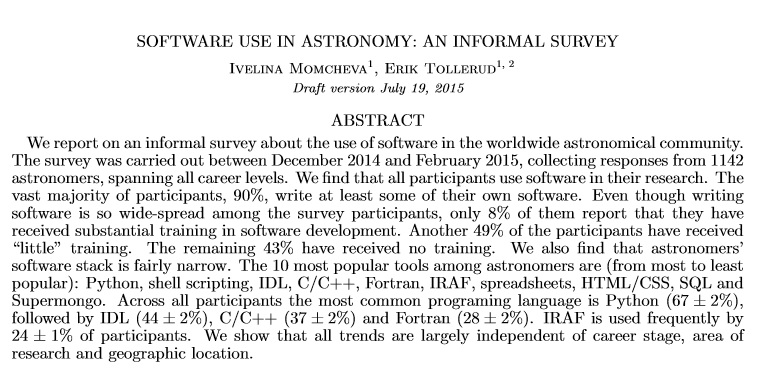
I just saw an interesting paper which hit the arXiv last week and thought I would share it here. It’s called Software Use in Astronomy: An Informal Survey and the abstract is here:

softwareA couple of things are worth remarking upon. One concerns Python. Although I’m not surprised that Python is Top of the Pops amongst astronomers – like many Physics & Astronomy departments we actually teach it to undergraduates here at the University of Sussex – it is notable that its popularity is a relatively recent phenomenon and it’s quite impressive how rapidly it has caught on.

Another interesting thingis the continuing quite heavy use of Fortran. Most computer scientists would consider this to be an obsolete language, and is presumably mainly used because of inertia: some important and well established codes are written in it and presumably it’s too much effort to rewrite them from scratch in something more modern. I would have thought that Fortran would have been used primarily by older academics, i.e. old dogs who can’t learn new programming tricks. However, that doesn’t really seem to be the case based on the last sentence of the abstract.

Finally, it’s quite surprising that over 40% of astronomers claim to have had no training in software development. We do try to embed that particular skill in graduate programmes nowadays, but it seems that doesn’t always work!

Anyway, do read the paper yourself. It’s very interesting. Any further comments through the box below please, but please ensure they compile before submitting them…


Astronomy: One of the Seven Liberal Arts

Posted in Art, Education, History, The Universe and Stuff with tags , , , on July 20, 2015 by telescoper

This morning I came across this picture (via @hist_astro on Twitter):

Seven Liberal ArtsIt is by Giovanni dal Ponte and was painted in or around 1435; the original is in the Museo Nacional del Prado in Madrid. It depicts the Seven Liberal Arts which, in antiquity were considered the essential elements of the education system. The Arts concerned are: Grammar, Rhetoric, Dialectic, Astronomy, Arithmetic, Geometry and Music. Appropriately enough, Astronomy is in the middle.

I suspect some of you may have noticed that there are more than seven figures in the painting. That’s because each of the Liberal Arts is itself represented by a (female) figure, presumably a Goddess, and also a famous character associated with the particular discipline. Second from the right, for example, you can see Arithmetic accompanied by Pythagoras, who seems to be trying to copy from her notebook. Astronomy. In the centre, kneeling at the feet of Urania (the muse of Astronomy) is Ptolemy..

It’s quite interesting to look at the structure of a Liberal Arts education as it would be in classical antiquity. The first three subjects (Grammar, Rhetoric and Dialectics) formed the Trivium (from which we get the English word “trivial”). “Grammar” means the science of the correct usage of language, knowledge and understanding of which helps a person to speak and write correctly; “Dialectic” basically means “logic”, the science of rational thinking as a means of arriving at the truth; and “Rhetoric” the science of expression, especially persuasion, which includes ways of organizing and presenting an argument so that people will understand and hopefully believe it. These may have been considered trivial in ancient times, but I can’t help thinking that we could do with a lot more emphasis on such fundamental skills in the modern curriculum.

After the Trivium came the Quadrivium: Arithmetic, Geometry, Astronomy and Music all of which were considered to be disciplines connected with Mathematics. Presumably these are the non-trivial subjects. We might nowadays consider Astronomy to be a mathematical subject – indeed in the United Kingdom astronomy was until relatively recently generally taught in mathematics departments, even after the rise of astrophysics in the 19th Century. On the other hand, fewer would nowadays would recognize music as being essentially mathematical in nature. Historically, however the connections between music, mathematics and natural philosophy were many and profound.

Of course there are now many other disciplines and it would be impossible for any education to encompass all fields of study, but I do think that it’s a shame that modern education systems are so lacking in breadth, as they tend to emphasize the differences between subjects rather than what they all have in common.

Physics is more than applied mathematics

Posted in Education, The Universe and Stuff with tags , , , on July 15, 2015 by telescoper

I thought rather hard before reblogging this, as I do not wish to cause any conflict between the different parts of my School – the Department of Mathematics and the Department of Physics and Astronomy!

I don’t think I really agree that Physics is “more” than Applied Mathematics, or at least I would put it rather differently. Physics and Mathematics intersect, but there are parts of mathematics that are not physical and parts of physics that are not mathematical.

Discuss.

Michael de Podesta's avatarProtons for Breakfast

A problem set for potential applicants in the foyer of the Cavendish Laboratory. Despite appearances - this is not physics! A problem set for potential applicants in the foyer of the Physics department of a premier UK university. It looks like physics, but it is in fact maths. The reason is that in the context of this problem, the string cannot pull a particle along at all unless it stretches slightly. Click the image for a larger diagram.

While accompanying my son on an Open Day in the Physics Department of a premier UK university, I was surprised and appalled to be told that Physics ‘was applied mathematics‘.

I would just like to state here for the record that Physics is notapplied mathematics.

So what’s the difference exactly?

I think there are two linked, but subtly distinct, differences.

1. Physics is a science and mathematics is not.

This means that physics has an experimental aspect. In physics, it is possible to disprove a hypothesis by experiment: this cannot be done in maths.

2. Physics is about…

View original post 256 more words

An Exciting Opportunity in Experimental Physics at the University of Sussex!

Posted in Education, The Universe and Stuff with tags , , , , on July 14, 2015 by telescoper

After much planning and preparatory work, I’m pleased that I am now in a position to announce that the Department of Physics & Astronomy at the University of Sussex has an exciting opportunity in the form of a brand new Chair position in Experimental Physics. The advertisement will shortly appear in both Nature and the Times Higher but it has already appeared on the University of Sussex website. I’m taking the liberty of posting a description of the new position here, but for fuller details please visit the formal advertisement.

–0–

The School of Mathematical and Physical Sciences seeks to appoint a Professor in Experimental Physics in the Department of Physics & Astronomy to lead the next phase of expansion and diversification of the research portfolio within the School by establishing an entirely new research activity in laboratory-based physics.

Sufficient resources will be made available to the selected candidate to establish a new group at Sussex in their field of experimental physics including, for example, condensed matter (interpreted widely), materials science, nanophysics or biophysics. Applicants in research areas with scope for interdisciplinary collaborations with other Schools at the University of Sussex (e.g. Life Sciences, Engineering & Informatics or Brighton and Sussex Medical School) are encouraged, especially  those in areas with potential for generating research impact, as defined in the context of the UK Research Excellence Framework.

The successful applicant will have a proven track-record of success in obtaining substantial external funding through research grants and/or industrial sponsorship.

The appointee will be supported with substantial (seven-figure) sum for start-up funding and an extensive newly-refurbished laboratory space. The financial package on offer will also support the appointment of at least two further experimental lectureships; the appointed professor is expected to be strongly involved in recruitment to these positions.

Informal (and confidential) enquiries may be addressed in the first instance to the Head of School, Professor Peter Coles (P.Coles@sussex.ac.uk).


Should Academics be (Facebook) Friends with Students?

Posted in Biographical, Education with tags , , , , on June 30, 2015 by telescoper

I noticed a short article in the Times Higher last week about a small survey that concluded that more than half academics count students among their Facebook friends. It’s actually a very small survey – of 308 academics, all based in America – of whom 54.4% admitted being “friends” with students.

For those of you who don’t use Facebook, a “Facebook friend” isn’t necessarily an actual real-life friend, it’s just someone else on Facebook with whom  you agree to share information, photographs, music and other stuff. Different people have different policies with regard to whether to accept or decline a friend request (or indeed initiate one). I only ever accept requests from people I know in another context, for example, which restricts the number of people who get to see my Facebook scribblings. Others are less selective and have many many more Facebook friends.

One of the things about Facebook is that people do sometimes share quite personal things, and sometimes things that might be quite compromising in a work context, e.g. pictures of themselves ina  state of inebriation. I suppose that’s why it’s a rather  contentious whether a member of academic staff in a University should or not be “friends” with their undergraduate students. I know many of my friends and colleagues  in academia flatly refuse to befriend undergraduate students (in the Facebook sense) and indeed this is the advice given by some institutions to staff. Most wouldn’t have a problem with having social media interactions with their graduate students, though. The nature of the relationship between a PhD student and supervisor is very different from that between an undergraduate and a lecturer.

There is a point on social media where professionalism might be compromised just as there is in other social interactions. The trouble is knowing precisely where that boundary lies, which is easy to misjudge. I’ve never felt that it was in any way improper to be friendly to students. Indeed I think that could well improve the students’ experience of education. If the relationship with staff is too distant students may not  feel comfortable asking for help with their work, or advice about wider things. Why should being “professional” mean not treating students as human beings?

One can take friendliness too far, however. There have to be some boundaries, and intrusive or demanding behaviour that makes students uncomfortable should be avoided.

I’ve thought about this quite a lot since I joined Facebook, which was in 2007. What I decided to do is simple. If a student initiates a friend request, I usually accept it (as long as I actually know who it is). Not many make such requests, but some do. More often, in fact, students send friend requests after they’ve graduated, when they perhaps feel liberated from the student-teacher relationship. On the other hand, I never initiate friend requests with students, for fear that they might feel pressured to accept it. It’s much the same as with other interactions.  For example, I rarely visit the extensive Student Spaces in the School without being invited there for a specific reason. If I did I’d just feel I was intruding. Many universities don’t bother to provide study space for their undergraduates, so this is probably only relevant here in Sussex.

Anyway, that’s my response. I know it’s a sort of compromise, but there you are. I am however interested in how other academics approach this issue. Plus, I haven’t done a poll for a while. So here we go:


It is important that the DfE publish correct science content in their GCSE subject content

Posted in Education with tags , , on June 28, 2015 by telescoper

You would think that the people in the Department for Education who draft the subject content for GCSE science would know stuff about science…

Sadly, it seems not…

Sadly, it seems this is not the case…

mrweatherallscience's avatarTeaching science in all weather

Yesterday I posted this reaction to the publication by the DfE of the GCSE_combined_science_content (copy taken – original link here). Others, including @alby and @hrogerson have written and commented about this as well.

[Another update: in the comments Richard Needham from the ASE has reminded me that over the next few weeks QfQual will be using these documents to ratify the Exam Boards’ science GCSE specifications. Not a good situation.]

[An update: the DfE released the GCSE_single_science_content in another document (original link here). Some of the errors below including the kinetic energy formula have not made it into this document and the space physics is obviously only considered interesting enough for the triple scientists. I will check the rest.]

I thought it relevant to post some specific points (just from the physics section – which didn’t even appear correctly in the table of contents). Now…

View original post 935 more words

Religion is a Diversity Issue

Posted in Education with tags , , on June 22, 2015 by telescoper

Equality and Diversity issues in Higher Education  have been very prominent in the media recently, though usually in the context of gender. A recent article in the Times Higher urges academics to include religion as a diversity issue, which prompted me to make a few comments here. Then my attention was drawn to the following Code of Conduct for lecturers at the forthcoming STFC Summer School for new Astronomy PhD students. I’m one of the invited speakers, actually:

Code of Conduct

I gather that there are some who find the inclusion of “religion” to be somehow inappropriate…

Before I go on I should declare that I am an atheist and a secularist. I’m a paid-up member of the National Secular Society, in fact. That means that I’m in favour of the removal of religious privilege from all aspects of the government of this country. What it does not mean is that I think I know all the answers. I may be an atheis, but I am not a fundamentalist like Richard Dawkins. In fact, I think Dawkins does more harm than good to secularism.

People far cleverer than me – including many of my colleagues in astrophysics and cosmology – are deeply religious and I don’t respect them any the less for that. I may not understand their beliefs, but I respect their right to hold them. I don’t delude myself into thinking that everything that I think do or say is perfectly rational, so I don’t judge people whose beliefs I find hard to comprehend.

Sir Isaac Newton was a great scientist, but he was also a deeply religious man who also dabbled in alchemy and other forms of magic. Science may have displaced some of the more esoteric parts of Newton’s belief-system, but it hasn’t banished the magic of our Universe. It just describes it better.

I believe in free speech. As a consequence, I do not believe that it should be illegal or unlawful to say things that insult a religion. I have myself made jokes about religion, e.g. on Twitter, that some have found offensive. I have also mocked the bigotry and hypocrisy which seems to me all too frequently associated with certain types of religious belief. And those who use religion as a pretext for racism, homophobia or gender discrimination. But that’s not the same as poking fun at someone just because they have a religious beleief.

Although I don’t think such things should ever be made unlawful – there is too much law about this already – there are circumstances in which such things should not be said. This seems to be an aspect of free speech that people get very wound up about. If you don’t say what you’re thinking then surely that’s cowardly “self-censorship”? No. In everyday life there are countless situations in which things are better left unsaid. We make such decisions all the time. That’s not about cowardice, unless you hold your tongue just because you’re frightened of making waves. There can be many reasons for discretion including, and these certainly apply in the context of the Summer School, professionalism and respect for your audience. Just because you can say something doesn’t always mean you should.

So I think it’s perfectly appropriate to have a Code of Conduct to remind speakers that they should refrain from making “offensive verbal comments” related to religion (or the other things listed). I welcome it, in fact. Religion is a diversity issue, in science as it is everywhere else.

(Almost) Fifty Years of Astronomy at Sussex

Posted in Education, History with tags , on June 19, 2015 by telescoper

I came across this booklet earlier this morning, whereupon I realised that Thirty is about to turn into Fifty…

Astronomy_30

The date on the front of the booklet is November 1996, but inside it explains that the content is based on a seminar given at Sussex about a year earlier. In fact the first MSc students in Astronomy started in October 1965. However, they were all part-time students (they were all staff at the Royal Greenwich Observatory which at that time was in Herstmonceux, Sussex) and none graduated until 1967. The 40th anniversary of that graduation was recognized with an event in 2007. The first full-time staff astronomer arrived in 1966, along with the first full-time MSc students. The first MSc students to graduate did so in 1967.

In fact I joined the Astronomy Centre at Sussex as a DPhil student in October 1985, 20 years after the arrival of the first cohort.

It’s interesting to note that originally astronomy existed at Sussex only as a postgraduate course. The attitude in most Universities in those days was that students should learn all the necessary physics before applying it to astronomy. Over the years this has changed, and most departments offer some astronomy right from Year 1. I think this change has been for the better because I think the astronomical setting provides a very exciting context to learn physics. If you want to understand, say, the structure of the Sun you have to include atomic physics, nuclear physics, gravity, thermodynamics, radiative transfer and hydrostatics all at the same time. This sort of thing makes astrophysics a good subject for developing synthetic skills while more traditional physics teaching focusses almost exclusively on analytical skills.

Anyway, I’m now left with a quandary. Should Fifty Years of Astronomy at Sussex be celebrated in 2015, 2016 or 2017?

Answers on a postcard please….