Following on from a provocative post I wrote a couple of weeks ago on this blog (which was subsequently reblogged by the Times Higher), I was contacted by Paul Crowther who sent me a copy of the slides used by Peter Main of the Institute of Physics in a talk in May 2015 on the subject of Widening Participation in Physics. With Peter Main’s permission I’m sharing those slides here as a service to the Physics community. There’s a lot of interesting information in these slides, which I think many UK physicists would be interested in.
Follow @telescoperArchive for the Education Category
Widening Participation in Physics
Posted in Education with tags education, Institute of Physics, Peter Main, Physics, widening participation on September 9, 2015 by telescoperResearch Funding – A Modest Proposal
Posted in Education, Science Politics with tags HEFCE, Higher Education, REF, research, Research Excellence Framework, Universities on September 9, 2015 by telescoperThis morning, the Minister for Universities, Jo Johnson, made a speech in which, among other things, he called for research funding to be made simpler. Under the current “dual funding” system, university researchers receive money through two main routes: one is the Research Excellence Framework (REF) which leads to so-called “QR” funding allocations made via the Higher Education Funding Council for England (HEFCE); and the other is through research grants which have to be applied for competitively from various sources, including the Seven Research Councils.
Part of the argument why this system needs to be simplified is the enormous expense and administrative burden of the Research Excellence Framework. Many people have commented to me that although they hate the REF and accept that it’s ridiculously expensive and time-consuming, they didn’t see any alternative. I’ve been thinking about it and thought I’d make a suggestion. Feel free to shoot it down in flames through the box at the end, but I’ll begin with a short introduction.
Those of you old enough to remember will know that before 1992 (when the old `polytechnics’ were given the go-ahead to call themselves `universities’) the University Funding Council – the forerunner of HEFCE – allocated research funding to universities by a simple formula related to the number of undergraduate students. When the number of universities suddenly increased this was no longer sustainable, so the funding agency began a series of Research Assessment Exercises to assign research funds (now called QR funding) based on the outcome. This prevented research money going to departments that weren’t active in research, most (but not all) of which were in the ex-Polytechnics. Over the years the apparatus of research assessment has become larger, more burdensome, and incomprehensibly obsessed with short-term impact of the research. Like most bureaucracies it has lost sight of its original purpose and has now become something that exists purely for its own sake.
It is especially indefensible at this time of deep cuts to university core funding that we are being forced to waste an increasingly large fraction of our decreasing budgets on staff-time that accomplishes nothing useful except pandering to the bean counters.
My proposal is to abandon the latest manifestation of research assessment mania, i.e. the REF, and return to a simple formula, much like the pre-1992 system, except that QR funding should be based on research student (i.e. PhD student) rather than undergraduate numbers. There’s an obvious risk of game-playing, and this idea would only stand a chance of working at all if the formula involved the number of successfully completed research degrees over a given period .
I can also see an argument that four-year undergraduate students (e.g. MPhys or MSci students) also be included in the formula, as most of these involve a project that requires a strong research environment.
Among the advantages of this scheme are that it’s simple, easy to administer, would not spread QR funding in non-research departments, and would not waste hundreds of millions of pounds on bureaucracy that would be better spent actually doing research. It would also maintain the current “dual support” system for research, if that’s a benefit.
I’m sure you’ll point out disadvantages through the comments box!
Walky Talky
Posted in Education, Politics with tags Benny Hill, Gordon Brown on August 19, 2015 by telescoperOne of the regular indignities we university teachers have to face is the “Peer Review of Lectures”, during which another member of teaching staff sits in on a lecture in order to give, hopefully constructive, criticism. I first went through this many years ago and among the negative comments made by my reviewer – who shall remain nameless – concerned my tendency to pace around while lecturing. I wasn’t aware that I did it until it was mentioned in that context but try as I might I haven’t really been able to stop doing it. It’s probably just nerves, but the excuse I usually give is that I like to present a moving target. Anyway, it’s not such a bad thing to move around when you’re lecturing, is it? A little animation isn’t necessarily a bad thing. Or is it?
On the other hand, one can obviously take this too far. Anyone who saw Gordon Brown’s speech about the Labour leadership contest a few days ago will have seen this taken to an extreme. He moved backwards and forwards so regularly that it was almost hypnotic, like those ducks you see at a fairground shooting gallery. It was inevitable that someone would give him this treatment..
Jeremy Corbyn is 66.
Follow @telescoperHave we reached Peak Physics?
Posted in Education, The Universe and Stuff with tags A-level, bias, gender, Physics, sexism on August 17, 2015 by telescoperOne of the interesting bits of news I picked up concerning last week’s A-level results is a piece from the Institute of Physics about the number of students taking A-level physics. The opening paragraph reads:
Although there was an overall rise of 2% in the number of A-level entries, the number taking physics fell to 36,287 compared with 36,701 last year – the first time numbers have fallen since 2006. The number of girls taking physics rose by 0.5%, however.
The decline is slight, of course, and it’s obviously too early to decide whether we’ve reached Peak Physics or not. It remains the case however that Physics departments in UK universities are competing for a very small pool of students with A-levels in that discipline. With some universities, e.g. Newcastle, opening up physics programmes that they had previously closed, competition is going to be intense to recruit students across the sector unless the pool of qualified applicants increases substantially.
The article goes on to speculate that students may be put off doing physics by the perception that it is harder than other subjects. It may even be that some schools – mindful of the dreaded league tables – are deliberately discouraging all but the brightest pupils from studying physics in case their precious league table position is affected.
That’s not a line I wish to pursue here, but I will take the opportunity to rehearse an argument that I have made on this blog before. The idea is one that joins two threads of discussion that have appeared on a number of occasions on this blog. The first is that, despite strenuous efforts by many parties, the fraction of female students taking A-level Physics has flat-lined at 20% for over a decade. This is the reason why the proportion of female physics students at university is the same, i.e. 20%. In short, the problem lies within our school system. This year’s modest increase doesn’t change the picture significantly.
The second line of argument is that A-level Physics is simply not a useful preparation for a Physics degree anyway because it does not develop the sort of problem-solving skills, or the ability to express physical concepts in mathematical language, on both of abilities which university physics depends. Most physics admissions tutors that I know care much more about the performance of students at A-level Mathematics than Physics when it comes to selecting “near misses” during clearing, for example.
Hitherto, most of the effort that has been expended on the first problem has been directed at persuading more girls to do Physics A-level. Since all universities require a Physics A-level for entry into a degree programme, this makes sense but it has not been successful.
I now believe that the only practical way to improve the gender balance on university physics course is to drop the requirement that applicants have A-level Physics entirely and only insist on Mathematics (which has a much more even gender mix at entry). I do not believe that this would require many changes to course content but I do believe it would circumvent the barriers that our current school system places in the way of aspiring female physicists. Not all UK universities seem very interested in widening participation, but those that are should seriously consider this approach.
I am grateful to fellow astronomer Jonathan Pritchard for pointing out to me that a similar point has been made to drop A-level Physics as an entry requirement to Civil Engineering degrees, which have a similar problem with gender bias.
Follow @telescoperSussex Physics – Among The World’s Best Again!
Posted in Education on August 15, 2015 by telescoperAfter a hectic week, filled with loads of other Head of School type things besides UCAS Clearing, I’ve decided to take a rare Saturday off. I did however see some good news about the Department of Physics and Astronomy at the University of Sussex, so I thought I would share it here.
The latest (2015) Academic Rankings of World Universities (often called the “Shanghai Rankings”) have just come out so, as I suspect many of my colleagues also did, I drilled down to look at the rankings of Physics departments.
Not surprisingly the top six (Berkeley, Princeton, MIT, Harvard, Caltech, & Stanford) are all based in the USA, as are many others in the Top 100.
The top British university is, also not surprisingly, Cambridge in 9th place. That’s the only UK university in the top ten for Physics. The other leading UK physics departments are: Manchester (13th), Imperial (15th), Edinburgh (20th), Durham (27th), Oxford (35th). I don’t think there will be any surprise that these all made it into the top 50 departments worldwide.
Just outside the top 50 in the world is the Department of Physics & Astronomy at the University of Sussex. For a relatively small department in a relatively small university it is a truly remarkable result to be in the Top 100. These rankings place the Department in joint 8th place in the UK, just behind UCL, level with Bristol, and ahead of Birmingham, Lancaster, Leicester, Queen Mary, Nottingham, St Andrews, and Warwick all of whom also made the top 200 in Physics.
Although I have deep reservations about the usefulness of league tables, I’m not at all averse to using them as an excuse for a celebration and to help raise the profile of Physics and Astronomy at Sussex generally. I’d therefore like to take the opportunity to offer hearty congratulations to the wonderful staff of the Department of Physics & Astronomy on their achievement.
With the recent investments we’ve had and further plans for growth I hope over the next few years we can move even further up the rankings. Unless of course the methodology changes or we’re subect to a “random” (i.e. “downward”) fluctuation…
Follow @telescoperClearing Advice for Mathematics, Physics and Astronomy Applicants!
Posted in Education with tags Clearing, Department of Mathematics, Department of Physics & Astronomy, education, University of Sussex on August 12, 2015 by telescoperWell, tomorrow is the big day. This year’s A-level results are out on Thursday 13th August, with the consequent scramble across the country to confirm places at university. Good luck to all students everywhere waiting for your results. I hope they are what you expected!
For those of you who didn’t get the grades they needed, I have one piece of very clear advice:

The clearing system is very efficient and effective, as well as being quite straightforward to use, and there’s still every chance that you will find a place somewhere good. So keep a cool head tomorrow and follow the instructions. You won’t have to make a decision until 5pm tomorrow, so there’s plenty of time to explore all the options.
As a matter of fact we will have places in the School of Mathematical & Physical Sciences at the University of Sussex. Whether you’re interested in Physics, Astrophysics, Astronomy or Mathematics (or even a combination of those subjects), why not just take a look at the University’s Clearing Page and give us a ring? I’ll be helping out on the phone lines tomorrow myself, so I might get to talk to you in person.
Anyway, here’s a video featuring our excellent admissions team, led by the inestimable Rob Evans, to explain the process:
The 2015 National Student Survey results are just out and they show that the Department of Mathematics has a 94% rating for overall satisfaction; the Department of Physics & Astronomy has 91%. Click the relevant link for more information on our courses in Physics & Astronomy or for Mathematics!
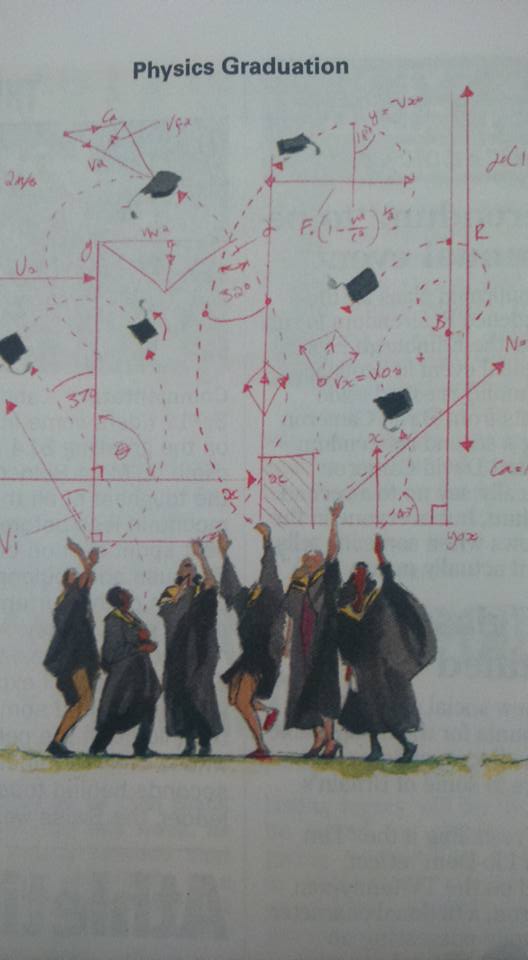
Follow @telescoperPhysics Graduation, according to Private Eye
Posted in Education, The Universe and Stuff with tags Graduation, Physics, Private Eye on August 11, 2015 by telescoperVery busy day today, what with one thing and another (and another, and another…) so in lieu of a proper post I thought I’d just post this rather excellent cartoon I saw in last week’s Private Eye…
Why Research Loans Should Replace Grants For Commercially-Driven Research
Posted in Education, Politics, Science Politics with tags research grants, student loans, Treasury, Universities on August 4, 2015 by telescoperTwo recent items in the Times Higher about UK Higher education – concerning the abolition of maintenance grants for less well-off students and whether business should contribute more to the cost of research reminded me of a post I wrote almost exactly five years ago. Was it really so long ago? Anyway, I am old so I am allowed to repeat myself even if people aren’t listening, so here’s the gist of the argument I made way back then….
Universities essentially do two things, teaching and research. However, when you think about it, there’s a fundamental inconsistency in the way these are funded. It seems to me that correcting this anomaly could significantly improve both the main benefits universities contribute to the UK economy.
First, research. If research is going to pay off in the short term it should be funded by private investors, interested businesses or venture capitalists of some sort. Dragon’s Den, even. When the public purse is so heavily constrained, it should only be asked to fund those things that can’t in practice be funded any other way. This is pretty much the opposite of what the Treasury thinks. It wants to concentrate public funds in projects that can demonstrate immediate commercial potential. Taxpayer’s money used in this way either ends up in the pockets of entrepreneurs if the research succeeds or, if it doesn’t, the grant has effectively been wasted. It’s yet another example of the taxpayer bearing the risk that an investment might fail, but not sharing in the benefits if it succeeds. This is analogous to the way the taxpayer bailed out the banking sector in the aftermath of the Credit Crunch in 2008, only to see the profits subsequently transferred back into private hands. This is happening to an increasing extent elsewhere in the United Kingdom, as public services built up through state investment are being transferred to for-profit organizations. Even our beloved National Health Service seems to be on an irreversible path to privatization.
My proposal for research funding would involve phasing out research grants for groups that want to concentrate on commercially-motivated research and replace them with research loans. If the claims the researchers make to secure the advance are justified, they should have no problem repaying it from the profits they make from patent income, commercial sales, or other forms of exploitation. If not, then they will have to pay back the loan from their own funds (as well as being exposed for having made over-optimistic claims). In the current economic situation the loans could be made at very low interest rates and still save a huge amount of the current research budget for higher education. Indeed after a few years – I suggest the loans should be repayable in 3-5 years – it would be self-financing. I think a large fraction of research in the Applied Sciences and Engineering should be funded in this way.
The money saved by replacing grants to commercially driven research with loans could be re-invested in those areas where public investment is really needed, such as pure science and medicine. Here grants are needed because the motivation for the research is different. Much of it does, in fact, lead to commercial spin-offs, but that is accidental and likely to appear only in the very long term. The real motivation of doing this kind of research is to enrich the knowledge base of the UK and the world in general. In other words, it’s for the public good. Remember that?
Most of you probably think that this is a crazy idea, but if you do I’ll ask you to now think about how the government funds teaching in universities and ask yourself why research is handled in such a different way.
Way back in the mists of time when I was a student, I didn’t have to pay fees and even got a maintenance grant from the government that was more-or-less sufficient to live on. That system changed so that students don’t get grants any more, but may qualify for loans. They also have to pay fees. The government only pays an amount directly to the university on their behalf if they are studying an “expensive” subject, i.e. a laboratory-based science, and that amount is very small (and decreasing with time). This change of policy happened because the (then) Labour government wanted to boost the rate of participation in universities, but didn’t think the taxpayer should pay the whole cost. The logic goes that the students benefit from their education, e.g. in terms of increased earnings over their working lifetime, so they should pay a contribution to it. The policy has changed since then into one in which many students bear the full cost of their tuition.
I don’t come from a wealthy family background so it’s not clear whether I would have been able to go to University under the current system. I would have been prepared to borrow to fund tuition fees, but without a maintenance grant for day-to-day living I don’t think I could have afforded it as my parents could not have supported me financially. In my opinion the removal of maintenance grants is far more likely to deter students from poorer backgrounds from going to University than the introduction of fees.
Anyway, the problem with all these changes is that they have led to a huge increase in enrolment on degree courses in “vocational” areas such as Leisure & Tourism, Media Studies, and Business while traditional courses, such as those in STEM disciplines, providing the sort of rigorous intellectual training that is essential for many sectors of the economy, have struggled to keep up. This is partly because subjects like Mathematics and Physics are difficult, partly because they are expensive, and partly because the UK school system has ceased to provide adequate preparation for such courses. I’m by no means against universities supplying training in vocational subjects, but because these are the areas where the primary beneficiary is indeed the student, I don’t think the government should subsidise them as much as the more rigorous courses that we really need to encourage the brightest students to take up. Universities are not just for training. They have a much deeper purpose.
If it’s fair to ask students to contribute to their teaching, it’s fair to ask commercial companies to pay for the research that they exploit. Just as student grants should be re-introduced for certain disciplines, so should research loans be introduced for others. You know it makes sense.
However, if you want to tell me why it doesn’t, via the comments box, please feel free!
Follow @telescoperPlanning for the Future
Posted in Brighton, Education with tags Brighton and Hove City Council, Campus Masterplan, University of Brighton on July 30, 2015 by telescoperSome great news arrived this morning. The Planning Inspectorate has given approval to the University of Sussex’s Campus Masterplan, which paves the way for some much-needed new developments on the Falmer Campus and a potential £500 million investment in the local economy. As a scientist working at the University I’m particularly delighted with this decision as it will involve much-needed new science buildings which should ease the pressure on our existing estate. The planned developments include new state-of-the-art academic and research facilities, the creation of an estimated 2400 new jobs in the local community and 2500 new student rooms on the campus, while still preserving the famous listed buildings designed by architect Sir Basil Spence when the University was founded back in the 1960s. We’re in for an exciting few years as these new developments take shape, especially a new building for Life Sciences and redevelopment of the East Slope site. The expansion of residential accommodation on campus will take some of the pressure off the housing stock in central Brighton while the other new buildings will provide much-needed replacements and extensions for some older ones that are at the end of their useful life.
Here’s a video fly-through that illustrates the general scale of the development – although the individual buildings shown are just indicative, as detailed designs are still being drawn up and each new building will need further planning permission.
But it is not just as an employee of the University that I am delighted by this news. I also live in Brighton and I honestly believe that the expansion of the University is an extremely good thing for the City, which is already turning into a thriving high-tech economy owing to the presence of so many skilled graduates and spin-out enterprises. There’s a huge amount of work to do in order to turn these plans into reality, but within a couple of years I think we’ll start to see the dividend.
Follow @telescoperMathematics at Sussex – The Video!
Posted in Education with tags Department of Mathematics, University of Sussex on July 29, 2015 by telescoperHere’s a nice little promotional video about the Department of Mathematics at the University of Sussex, featuring some of our lovely staff and students along with some nice views of the campus and the city of Brighton. Above all, I think it captures what a friendly place this is to work and study. Enjoy!
Follow @telescoper

