Once again I find myself too busy to do a substantial post this lunchtime. However, I’ve been rescued by Prof. Philip Moriarty who tipped me off about the following video from the series “Sixty Symbols” which features this blog in a supporting a role as a source of old examination papers. The theme is the dire state of mathematics education in British schools, something I’ve moaned about on many occasions myself, so I thought I’d post it here. You’ll get a flash of my organ about 6 minutes and 15 seconds into the clip, so if you don’t want to see it please watch with your eyes closed.
Follow @telescoperArchive for the Education Category
In the Dark on Youtube
Posted in Education with tags education, mathematics, Philip Moriarity, Sixty Symbols on November 12, 2012 by telescoperDond’escono quei vortici?
Posted in Education, Opera, The Universe and Stuff with tags Don Giovanni, Mozart, Navier-Stokes equations, Reynold's Number, Turbulence on November 10, 2012 by telescoperJust time for a quickie today. I seem to be writing that virtualy every day at this time, in fact. Anyway, yesterday I gave the last of a series of lectures on Fluid Dynamics during which I talked a little bit about the Navier-Stokes equation, and introduced the concept of turbulence, topic that Richard Feynman described as “the most important unsolved problem in classical physics”. Given that the origin of turbulence is so poorly understood, I had to cover it all fairly qualitatively but did at least explain that its onset is associated with high values of the Reynold’s Number, an interesting dimensionless number that characterizes the properties of viscous fluid flow in such a way as to bring out the dynamical similarity inherent in the equations. The difficulty is that there is no exact theory that allows one to calculate the critical value of the Reynold’s number and in any particular situation; that has to be determined by experiments, such as this one which shows turbulent vortices (or “eddies”) forming downstream of a cylindrical obstacle placed in flowing fluid. The (laminar) flow upstream, and in regions far from the cylinder, has no vorticity.
What happens is obviously extremely complicated because it involves a huge range of physical scales – the vorticity is generated by very small-scale interactions between the fluid elements and the boundary of the object past which they flow. It’s a very frustrating thing for a physicist, actually, because one’s gut feeling is that it should be possible to figure it out. After all, it’s “just” classical physics. It’s also of great practical importance in a huge range of fields. Nevertheless, despite all the progress in “exotic” field such as particle physics and cosmology, it remains an open question in many respects.
That’s why it’s important to teach undergraduates about it. Physics isn’t just about solved problems. It’s a living subject, and it’s important for students to know those fields where we don’t really know that much about what is going on…
PS. The title is a quotation from the libretto of Mozart’s opera, Don Giovanni, uttered by the eponymous Count as he is dragged down to hell. It translates as “Whence come these vortices?” Pretentious, moi?
Follow @telescoperThe Council for the Defence of British Universities
Posted in Education, Politics with tags Higher Education, The Council for the Defence of British Universities, Universities on November 8, 2012 by telescoperNo time for a proper post today, but time to pass on news of the launch of a new independent campaigning body called The Council for the Defence of British Universities.
Here is the CDBU manifesto:
The Council for the Defence of British Universities is independent of any political party, for although we oppose many of the present government’s proposals, the assumptions to which we object were equally evident under its predecessor.
Our core principle is that the Council for the Defence of British Universities exists to advance university education for the public benefit. This is underpinned by nine supporting aims:
• To defend and enhance the character of British universities as places where students can develop their capacities to the full, where research and scholarship are pursued at the highest level, and where intellectual activity can be freely conducted without regard to its immediate economic benefit
• To urge that university education, both undergraduate and postgraduate, be accessible to all students who can benefit from it
• To maintain the principle that teaching and research are indispensable activities for a university, and that one is not pursued at the expense of the other
• To ensure that universities, while responding to the needs of students and society in general, should retain ultimate control of the content of the courses taught and the methods of instruction employed. As well as often providing vocational training, university education should equip graduates with the mental skills and intellectual flexibility necessary to meet the demands of a rapidly changing economy. It should develop the powers of the mind, enlarge knowledge and understanding, and enable graduates to lead fuller and more rewarding lives
• To emphasise that, as well as often having vital social and economic applications and being subject to accountability, academic research seeks to enhance our knowledge and understanding of the physical world, of human nature and of all forms of human activity
• To ensure that methods employed to assess the quality of university research do not encourage premature or unnecessary publication or inhibit the production of major works that require a long period of gestation
• To safeguard the freedom of academics to teach and to pursue research and enquiry in the directions appropriate to the needs of their subject
• To maintain the principle of institutional autonomy, to encourage academic self-government and to ensure that the function of managerial and administrative staff is to facilitate teaching and research
• To ensure that British universities continue to transmit and reinterpret the world’s cultural and intellectual inheritance, to encourage global exchange and to engage in the independent thought and criticism necessary for the flourishing of any democratic society.
For more information about the CDBU, including details on joining, you can visit their website.
Follow @telescoperTaking Notes…
Posted in Education with tags lecture notes, lectures, Physics, Science, teaching on November 6, 2012 by telescoperAs if this week wasn’t busy enough, I’ve just received back the student questionnaires for my second-year module The Physics of Fields and Flows (which includes some theoretical physics techniques, such as vector calculus and Fourier methods, together with applications to fluid flow, electromagnetism and a few other things). I’ve only just taken up this module this year and was planning to prepare it over the summer, but circumstances rather intervened and I’ve had to put together more-or-less on the fly. I was, therefore, not inconsiderably apprehensive about the reaction I’d get from the students.
Fortunately most of the comments were fairly positive, although there were some very useful constructive criticisms, which I’ll definitely take into account for the rest of the term.
However, one recurring comment was that I write too fast on the whiteboard. In fact I go far more slowly than the lecturers I had at University. That brings me back to an old post I did some time ago about lecture notes.
I won’t repeat the entire content of my earlier discussion, but one of the main points I made in that was about how inefficient many students are at taking notes during lectures, so much so that the effort of copying things onto paper must surely prevent them absorbing the intellectual content of the lecture.
I dealt with this problem when I was an undergraduate by learning to write very quickly without looking at the paper as I did so. That way I didn’t waste time moving my head to and fro between paper and screen or blackboard. Of course, the notes I produced using this method weren’t exactly aesthetically pleasing, but my handwriting is awful at the best of times so that didn’t make much difference to me. I always wrote my notes up more neatly after the lecture anyway. But the great advantage was that I could write down everything in real time without this interfering with my ability to listen to what the lecturer was saying.
An alternative to this approach is to learn shorthand, or invent your own form of abbreviated language. This approach is, however, unlikely to help you take down mathematical equations quickly.
My experience nowadays is that students simply aren’t used to taking notes like this – I suppose because they get given so many powerpoint presentations or other kinds of handout – so they struggle to cope with the old-fashioned chalk-and-talk style of teaching that some lecturers still prefer. That’s probably because they get much less practice at school than my generation. Most of my school education was done via the blackboard..
Nowadays, most lecturers use more “modern” methods than this. Many lecturers using powerpoint, and often they give copies of the slides to students. Others give out complete sets of printed notes before, during, or after lectures. That’s all very well, I think, but what are the students supposed to be doing during the lecture if you do that? Listen, of course, but if there is to be a long-term benefit they should take notes too.
Even if I hand out copies of slides or other notes, I always encourage my students to make their own independent set of notes, as complete as possible. I don’t mean copying down what they see on the screen and what they may have on paper already, but trying to write down what I say as I say it. I don’t think many take that advice, which means much of the spoken illustrations and explanations I give don’t find their way into any long term record of the lecture.
And if the lecturer just reads out the printed notes, adding nothing by way of illustration or explanation, then the audience is bound to get bored very quickly.
My argument, then, is that regardless of what technology the lecturer uses, whether he/she gives out printed notes or not, then if the students can’t take notes accurately and efficiently then lecturing is a complete waste of time. In fact for the module I’m doing now I don’t hand out lecture notes at all during the lectures, although I do post lecture summaries and answers to the exercises online after they’ve been done.
I like lecturing, because I like talking about physics and astronomy, but as I’ve got older I’ve become less convinced that lectures play a useful role in actually teaching anything. I think we should use lectures more sparingly, relying more on problem-based learning to instil proper understanding. When we do give lectures, they should focus much more on stimulating interest by being entertaining and thought-provoking. They should not be for the routine transmission of information, which is far too often the default.
I’m not saying we should scrap lectures altogether. At the very least they have the advantage of giving the students a shared experience, which is good for networking and building a group identity. Some students probably get a lot out of lectures anyway, perhaps more than I did when I was their age. But different people benefit from different styles of teaching, so we need to move away from lecturing as the default option.
I don’t think I ever learned very much about physics from lectures, but I’m nevertheless glad I learned out how to take notes the way I did because I find it useful in all kinds of situations. Effective note-taking is definitely a transferable skill, but it’s also a dying art.
Follow @telescoperFun with Vortex Rings
Posted in Education, The Universe and Stuff with tags Fluid Dynamics, magnetism, Vortex Rings on November 5, 2012 by telescoperI decided to squeeze in a little bit about vortex rings into this morning’s lecture, partly because they illustrate the connections between fluid vorticity and magnetism, and partly because they’re fun…
Here’s an animation of a vortex ring showing how the fluid elements move around it (you might need to click on it to make it animate):
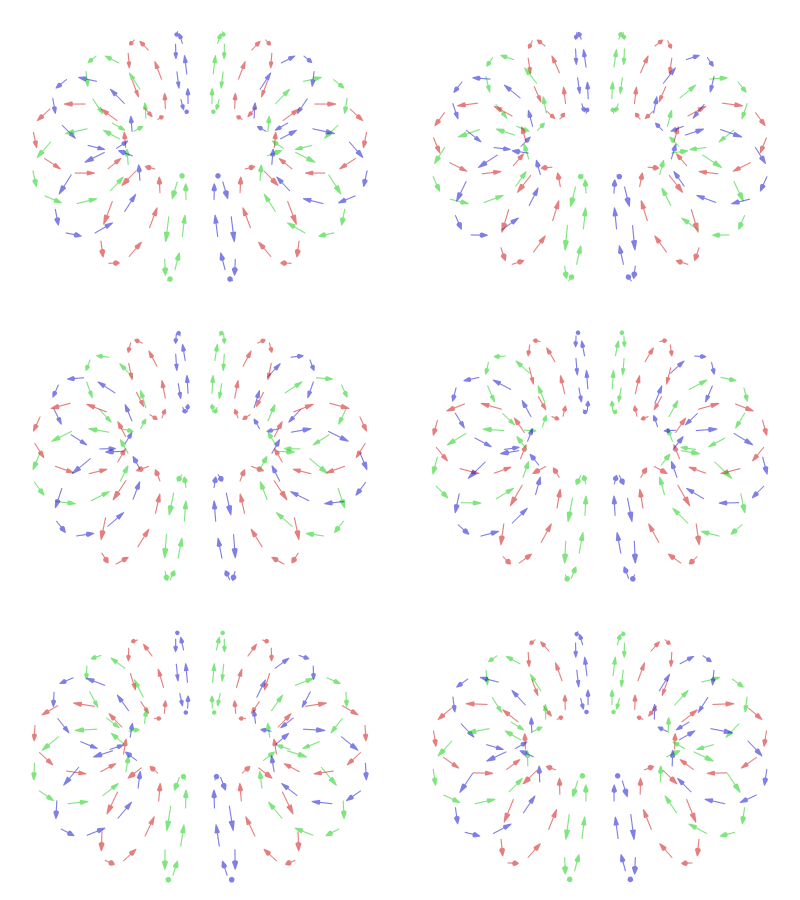
It’s quite easy to generate vortex rings in everyday situations, the simplest way being when a mass of fluid is impulsively pushed from an enclosed space through a narrow opening. In this case the poloidal flow is set in motion, at least in part, by interaction between the outer parts of the fluid mass and the edges of the opening. This results in fluid elements travelling in little circles, like those above, around a “core”; the direction of the vorticity is at right angles to these circles, i.e. in the toroidal direction. A vortex line can be formed from by joining together the vorticity vectors from each little circle to form a circle defining the core of the vortex ring. The behaviour of vortex lines in flows like this is entirely analogous to that of magnetic field lines. In this case, the vortex line follows the motion of the fluid, which is at right angles to it, so it propagates more-or-less without disruption. This is how most vortex ring toys work, such as shown in the two examples here; the second is far more dramatic!
The last video features some naturally-occurring vortex rings (as well as some distinctly man-made examples). What I didn’t realise until I found this video last night is that whales and dolphins know how to make vortex rings too, only underwater. Why do they do this? Is there an evolutionary explanation? I doubt it! I think they’re just having fun.
Follow @telescoper
Three Tips for Solving Physics Problems
Posted in Cute Problems, Education with tags blank paper syndrome, education, Physics, problem solving, Richard Feynman, teaching on November 2, 2012 by telescoperI spent quite some time this morning going over some coursework problems with my second-year Physics class. It’s quite a big course – about 100 students take it – but I mark all the coursework myself so as to get a picture of what the students are finding easy and what difficult. After returning the marked scripts I then go through general matters arising with them, as well as making the solutions available on our on-line system called Learning Central.
Anyway, this morning I decided to devote quite a bit of time to some tips about how to tackle physics problems, not only in terms of how to solve them but also how to present the answer in an appropriate way.
I began with the Feynman algorithm for solving physics problems:
- Write down the problem.
- Think very hard.
- Write down the answer.
That may seem either arrogant or facetious, or just a bit of a joke, but that’s really just the middle bit. Feynman’s advice on points 1 and 3 is absolutely spot on and worth repeating many times to an audience of physics students.
I’m a throwback to an older style of school education when the approach to solving unseen mathematical or scientific problems was emphasized much more than it is now. Nowadays much more detailed instructions are given in School examinations than in my day, often to the extent that students are only required to fill in blanks in a solution that has already been mapped out.
I find that many, particularly first-year, students struggle when confronted with a problem with nothing but a blank sheet of paper to write the solution on. The biggest problem we face in physics education, in my view, is not the lack of mathematical skill or background scientific knowledge needed to perform calculations, but a lack of experience of how to set the problem up in the first place and a consequent uncertainty about, or even fear of, how to start. I call this “blank paper syndrome”.
In this context, Feynman’s advice is the key to the first step of solving a problem. When I give tips to students I usually make the first step a bit more general, however. It’s important to read the question too.
The middle step is more difficult and often relies on flair or the ability to engage in lateral thinking, which some people do more easily than others, but that does not mean it can’t be nurtured. The key part is to look at what you wrote down in the first step, and then apply your little grey cells to teasing out – with the aid of your physics knowledge – things that can lead you to the answer, perhaps via some intermediate quantities not given directly in the question. This is the part where some students get stuck and what one often finds is an impenetrable jumble of mathematical symbols swirling around randomly on the page.
Everyone gets stuck sometimes, but you can do yourself a big favour by at least putting some words in amongst the algebra to explain what it is you were attempting to do. That way, even if you get it wrong, you can be given some credit for having an idea of what direction you were thinking of travelling.
The last of Feynman’s steps is also important. I lost count of the coursework attempts I marked this week in which the student got almost to the end, but didn’t finish with a clear statement of the answer to the question posed and just left a formula dangling. Perhaps it’s because the students might have forgotten what they started out trying to do, but it seems very curious to me to get so far into a solution without making absolutely sure you score the points. IHaving done all the hard work, you should learn to savour the finale in which you write “Therefore the answer is…” or “This proves the required result”. Scripts that don’t do this are like detective stories missing the last few pages in which the name of the murderer is finally revealed.
So, putting all these together, here are the three tips I gave to my undergraduate students this morning.
- Read the question! Some solutions were to problems other than that which was posed. Make sure you read the question carefully. A good habit to get into is first to translate everything given in the question into mathematical form and define any variables you need right at the outset. Also drawing a diagram helps a lot in visualizing the situation, especially helping to elucidate any relevant symmetries.
- Remember to explain your reasoning when doing a mathematical solution. Sometimes it is very difficult to understand what you’re trying to do from the maths alone, which makes it difficult to give partial credit if you are trying to the right thing but just make, e.g., a sign error.
- Finish your solution appropriately by stating the answer clearly (and, where relevant, in correct units). Do not let your solution fizzle out – make sure the marker knows you have reached the end and that you have done what was requested.
There are other tips I might add – such as checking answers by doing the numerical parts at least twice on your calculator and thinking about whether the order-of-magnitude of the answer is physically reasonable – but these are minor compared to the overall strategy.
And another thing is not to be discouraged if you find physics problems difficult. Never give up without a fight. It’s only by trying difficult things that you can improve your ability by learning from your mistakes. It’s not the job of a physics lecturer to make physics seem easy but to encourage you to believe that you can do things that are difficult.
So anyway that’s my bit of “reflective practice” for the day. I’m sure there’ll be other folk reading this who have other tips for solving mathematical and scientific problems, in which case feel free to add them through the comments box.
Follow @telescoperValue Added?
Posted in Bad Statistics, Education with tags A-levels, Cardiff University, Higher Education, Oxford University, UCAS Tariff, University of Sussex on October 22, 2012 by telescoperBusy busy busy. Only a few minutes for a lunchtime post today. I’ve a feeling I’m going to be writing that rather a lot over the next few weeks. Anyway, I thought I’d use the opportunity to enlist the help of the blogosphere to try to solve a problem for me.
Yesterday I drew attention to the Guardian University league tables for Physics (purely for the purposes of pointing out that excellent departments exist outside the Russell Group). One thing I’ve never understood about these legal tables is the column marked “value added”. Here is the (brief) explanation offered:
The value-added score compares students’ individual degree results with their entry qualifications, to show how effective the teaching is. It is given as a rating out of 10.
If you look at the scores you will find the top department, Oxford, has a score of 6 for “value added”; in deference to my alma matter, I’ll note that Cambridge doesn’t appear in these tables. Sussex scores 9 on value-added, while Cardiff only scores 2. What seems peculiar is that the “typical UCAS scores” for students in these departments are 621, 409 and 420 respectively. To convert these into A-level scores, see here. These should represent the typical entry qualifications of students at the respective institutions.
The point is that Oxford only takes students with very high A-level grades, yet still manages to score a creditable 6/10 on “value added”. Sussex and Cardiff have very similar scores for entry tariff, significantly lower than Oxford, but differ enormously in “value added” (9 versus 2).
The only interpretation of the latter two points that makes sense to me would be if Sussex turned out many more first-class degrees given its entry qualifications than Cardiff (since their tariff levels are similar, 409 versus 420). But this doesn’t seem to be the case; the fraction of first-class degrees awarded by Cardiff Physics & Astronomy is broadly in line with the rest of the sector and certainly doesn’t differ by a factor of several compared to Sussex!
These aren’t the only anomalous cases. Elsewhere in the table you can find Exeter and Leeds, which have identical UCAS tariffs (435) but value added scores that differ by a wide margin (9 versus 4, respectively).
And if Oxford only accepts students with the highest A-level scores, how can it score higher on “value added” than a department like Cardiff which takes in many students with lower A-levels and turns at least some of them into first-class graduates? Shouldn’t the Oxford “value added” score be very low indeed, if any Oxford students at all fail to get first class degrees?
I think there’s a rabbit off. Can anyone explain the paradox to me?
Answers on a postcard please. Or, better, through the comments box.
Follow @telescoperWill University Swapping Work?
Posted in Education with tags A-levels, Cardiff University, Higher Education, Lord Rees, Russell Group, University of Sussex on October 21, 2012 by telescoperYesterday’s crossword having been more straightforward than usual, I found myself with time to peruse the Independent newspaper at my leisure. While doing so I came across a little item describing a plan suggested by Lord Rees that students from “disadvantaged backgrounds” should be allowed to swap universities after two years of a three-year degree and transfer to a Russell group institution. Apparently this idea is based on a scheme that runs “successfully” in the University of California.
The purported aim of this is to give “a second chance” to students who didn’t do well enough at A-level to get into an “elite” university – which is laudable – but it doesn’t deal with the underlying problem, namely that our pre-university education system is a mess, for two reasons. First, students can have the misfortune to attend a school where certain subjects are taught badly or not at all. This is a particular problem in my own field, physics. Second, the A-level examinations on which most institutions base their entry criteria do not provide a reasonable assessment of a candidate’s suitability for university study.
Because of these problems many students either don’t apply to top universities or fail to make the grades required. Such universities are reluctant to drop their grades to make special allowance because they would then get penalised in the league tables – a high entry requirement at A-level is perceived to be a mark of quality. I’m convinced that this is a major flaw in the system. Some of the very best students I’ve had the pleasure to work with at Cardiff, for example, came in at a time when our recruitment team was struggling to meet its quota, with modest A-level scores that would not normally have been high enough to get in. I worry a great deal about how many more talented young people there are out there who lacked that bit of luck and missed out entirely.
Lord Rees is correct in saying that it will take a very long time to fix the pre-university education system, and his proposal is an attempt to provide a sticking-plaster solution later on. If you like, it’s an admission of defeat. Elite universities will be allowed to carry on using inappropriate criteria to reject talented students applying to join the first year of a degree, but will be allowed to cherry-pick the best performers from other institutions into Year 3.
Although I think this proposal contains some good ingredients, there are several things about it that worry me. I don’t know how many students will want to move after two years in the first place. They will have made friends, formed relationships, and generally settled in at their original university and to up sticks in order to travel to another university for their final year would be very disruptive. Steps would have to be taken to ensure continuity of curriculum too. And what about the financial and other implications for the original institution, which would have to be prepared to lose an indeterminate number of its best students at the end of Year 2, with consequent impact on the quality of its graduating class?
I don’t think it’s fair for the so-called “elite” to exploit the hard work put in by other departments and institutions in order to mask its own failure to recruit appropriately. The only fair solution is to fix the university admission system, which means fixing our broken A-levels.
And another thing. I’m shortly moving from Cardiff (which is a member of the Russell group) to Sussex (which isn’t). Look at the league tables for Physics and tell me which one should be regarded as “elite”. Should students choose their University on the basis of which one provides the best education, or on the basis that it provides membership of a prestigious club?
On balance, I don’t think this scheme is workable in the way suggested. There is a variant, however, which I think is more promising. I think we should scrap the current confused system of 4-year undergraduate degrees (MPhys, MSci, etc) and adopt a standard system of 3-year Bachelors degrees. The next level of degree should be standalone postgraduate Masters. I’d prefer these to be two years, actually, but that’s not essential to this argument. Students could then transfer after their Bachelors’ degree into an “elite” university for their Masters if they so wish.
Follow @telescoperPastures New
Posted in Biographical, Education with tags MPS, School of Mathematical and Physical Sciences, Sussex, University of Sussex on October 17, 2012 by telescoperWell, after what seems like ages the news is now official. I’ve been appointed Head of the School of Mathematical and Physical Sciences at the University of Sussex. I’ll be taking up my new job on 1st February 2013. I was actually offered the job back in September and decided pretty quickly to accept it, but there have been quite a few things to sort out before the news could be made public. Anyway, yesterday the University of Sussex decided it was time to make a formal announcement, and there we are.
As I am quoted as saying in the press release it will definitely be a wrench to leave Cardiff. I’ve really enjoyed living and working here for the last five years or so, and will miss the staff and the students of the School of Physics and Astronomy at Cardiff University. I’m especially grateful for the help and support I received during the difficulties I experienced this summer. However, I felt the position at Sussex represented an exciting opportunity to make a fresh start which would offer new and exciting challenges and which I couldn’t afford to turn down. It means a lot that my Cardiff colleagues – particularly the Head of School, Walter Gear – have accepted my decision in such good spirit, and are doing everything possible to smooth the transition.
As it also explains in the official news item, I’m not exactly a stranger to Sussex. I did my DPhil there (from 1985-88) and stayed on for a couple of years as a PDRA (1988-90). That was a long time ago, of course. In fact, in those days I was a member of a School called “MAPS” (Mathematics and Physics). I’ve been back to Sussex on numerous occasions over the past twenty-odd years, usually discovering that some reorganisation had happened – Maths separated from Physics, changes of building, and so on. Now, ironically, I’ll return to a School that, on paper at any rate, looks very similar to the old MAPS and is even back in the same building! Plus ça change.
I won’t be leaving Cardiff immediately, of course. I’m still an employee of Cardiff University and will do my best to carry out my duties until the end of January. That means I’ll carry on lecturing as normal, and will be around to mark the examinations after Christmas. I also have two PhD students and three final-year projects students, and will be travelling back to Cardiff regularly to ensure they continue get as much supervision as they need even after the (formal) end of my employment here. I’ll also be continuing to collaborate with folks in Cardiff (and elsewhere) on, e.g., the Herschel ATLAS survey.
The position of Head of MPS at Sussex only became available because of the untimely death of the previous Head of School, David Axon, in April this year, so I’m fully aware that the circumstances that have given me such a wonderful opportunity have also brought much sadness to David’s colleagues and loved ones. I only hope that I can build on the many excellent things he did during his time at Sussex, and so eventually earn the respect and acceptance of the School.
Many of my colleagues at Cardiff have expressed sadness that I’ll be leaving. But just as there are exciting developments in the pipeline at Sussex, so are there different but equally exciting things in store at Cardiff. In no way will my departure have a negative impact on the School of Physics and Astronomy at Cardiff University. Quite the contrary, in fact. There will now be a bit more headroom in the budget that I’m sure will help bring at least some of the School’s plans to fruition.
And anyway, as I said previously, I’m not going just yet. I’ll probably keep the house in Cardiff until the spring (at the earliest) so I’ll be back here regularly, especially when it’s Opera season. And having branches in both Brighton and Cardiff for a while might even give me an excuse to have two 50th birthday celebrations next year!
Follow @telescoper
 In the Dark