Archive for the Education Category

The End of the Viva

Posted in Biographical, Education with tags , , , , , on June 13, 2012 by telescoper

I’m stuck at home today, waiting for UPS to come and collect a defective printer. Any time between 9am and 7pm, they said. Very helpful. Anyway, I’ve got plenty to do while I’m here, catching up on STFC Astronomy Grant Panel business that I’ve been too busy to attend to. Also, this week’s Private Eye has just arrived in the post, so I’ll take a break at some point to do the crossword by Cyclops. It’s a lovely day. Pity I can’t sit in the garden. I’d miss the doorbell when the carrier arrives.

Anyway, the past two days have been largely given over to the business of examinations in the School of Physics & Astronomy at Cardiff University. The External Examiners spent a big slice of Monday doing viva voce examinations of selected candidates; not just those on borderlines, but also some others for “calibration”. I wasn’t involved in them this year, but have taken part in the past as External in various places. Obviously these examinations are very stressful for the students, and also quite difficult to conduct fairly, but sometimes provide useful insights in the cases where a student’s marks put them on a knife-edge between two degree classifications (or even between pass and fail).

Anyway, in its infinite wisdom Cardiff University has decided to scrap the viva voce examination after next year. From 2014 onwards we’ll just have to apply a formula to deal with borderline cases; the algorithm involves counting how many modules were passed at the higher level, etc. Actually, I probably agree with this for the purposes of classifying degrees. Twenty minutes’ questioning under stress can hardly be expected to yield much objective  information about a candidate’s knowledge of the subject that dozens of written papers and other assessments. Often, in my experience, students (especially the shy ones) are so nervous that the shutters come down almost straight away.  I would  prefer a system which is algorithmic as possible, so everyone knows what the rules are, rather than relying on subjective judgements.

As external, I always found the viva examinations a useful way of getting feedback from the students on their course which can be fed back – either usefully or not – to the department. In losing the viva  for drawing up the classification lists, I hope that we can find another way for the externals to talk to students in some other context to get some feedback about the course. Perhaps they could attend for project talks, or something like that?

Yesterday, the entire Board of Examiners (including Externals) gathered to go through all the individual cases and draw up the Honours List. I was delighted when I saw all the consolidated marks in advance of the meeting, to see how well how many of our students had done. There were one or two difficult cases, but in the end we produce the lists. As I went back to my office, students were already gathering in the corridor by the noticeboard where it is always placed as soon as the definitive final version has been prepared, shortly after the meeting closed.

Soon I heard whoops of joy and laughter and had a quick look to see the students congratulating one another. As always on such occasions, I was tempted to go along and chat to a few of them but, as always, I resisted doing so. It’s a time for them, the students, not us, the staff.

Anyway, congratulations to all those who had good news yesterday!

I hope your hangovers aren’t too bad…

Teaching (about) Physics

Posted in Education with tags , , , on June 10, 2012 by telescoper

So the academic year nears its end. This week we have the dreaded meetings of the Examination Boards, complete with External Examiners, ordeal by viva voce for selected students, and finally the lists go up announcing success (or otherwise) for this year’s finalists. It’s all a lot of work – and I’m sure also extremely stressful for the students waiting for their results.

If it’s any consolation for any students reading this post, I can assure you that there’s no lack of stress on this side of the fence either. I always feel a sense of dread opening the packets of examination scripts, and this year was no different. Have I set the exam too hard? Will the marks be a fair reflection of the students’ ability? Have they learned anything at all from the hours I spent droning on? These questions are all the more apt for a third-year class, since these are the papers that really count in determining the final outcome of their course. When the lists go up later this week, one’s delight at the sight of happy (or relieved) faces is always tempered by sadness when things have obviously gone wrong.

Coincidentally, I noticed the other day that a former student from the School of Physics and Astronomy at Cardiff University posted an item on her blog giving her view of her degree. It’s a very frank assessment of her own opinion of the course she took, including a list of her  three favourite courses. None of the ones I lectured are amongst them, by the way, in case you think I’m mentioning it for egocentric reasons. Indeed, I’m pretty confident that I’m one of the lecturers she didn’t like at all!

The main thing is that, for better or worse, our course involves an enormous amount of contact time with academic staff.  In the new fee regime students will pay the same £9K for a science course as they would for the Arts and Humanities:

See, doing a Physics and Astronomy degree, I had about 20 contact hours. With lab time. so in one month I had out stripped the BA people for an entire academic year. So in the 12 weeks of one semester, I have had more contact time than they will get in their entire degree. Worth it?

As for whether we make the best use of the time we devote to teaching, that’s a different matter. We have in fact recently overhauled the entire curriculum so we’ll see whether that has the desired effect. One can’t please all of the people all of the time, so we’ve tried to introduce new teaching methods – e.g. fewer lectures, more problems classes – to try to engage better with more students. Only time will tell whether it works.

Anyway, although it’s not one of the topics of her post, Harriet’s blog brought something from the back of my mind where it usually lurks ready to trouble me when I start to think about teaching physics. The point is that most of us involved in teaching physics at University level think that what we should be doing is training people to be professional physicists. That means teaching them to do physics the way it is actually done by people who do research. That means that, especially in Astronomy, students have to grapple with strange unit systems, peculiar terminology and quite a lot of maths. Those aren’t put into our courses in order to torment students – they’re there in the curriculum because they’re there in the world of (astro)physics research. It would be dishonest for us to pretend we were training physicists if we made out that it was all easier than it actually is.

What I mean to say is that I don’t think it should be our job to present physics in a way that’s different from (specifically easier than) the way it is  done at the coalface, in the world of scientific research.  What we should be doing is giving students the skills and confidence to solve the difficult problems a scientist can expect to confront in that situation. To be honest I don’t think we do that particularly well either, but that’s the aim. And that’s why our courses are mainly taught by people who actually do physics and why we claim our teaching is research-led.

That’s an oversimplification, of course. Especially in earlier years, much of the undergraduate curriculum – Newtonian Mechanics, Electromagnetism, Quantum Mechanics, etc  – is not “frontier” stuff so probably doesn’t require an active researcher to teach it. On the other hand, none of that is exactly easy so anyone who is going to teach it competently needs to have mastered it themselves. And in later years, the more specialist material and projects certainly require an active research environment.

Anyway, the point is that  in the new fee regime science courses will attract the same level of funding as courses in, e.g. English Literature. But a course in Physics requires physicists to teach it, while a course in literature does not require a team of successful novelists. Given the fact that the way we teach physics is more expensive by a very large margin, should we be rethinking our approach to the basic physics degree, and leave all the fancy research-led stuff to Masters courses?

Should we really be trying to teach all our students how to do physics? Or should we just be teaching them about physics?

You want a visa to do a PhD? Show me the money!

Posted in Education with tags , , on May 21, 2012 by telescoper

David McGloin gives an example of the idiocy of the UK’s policy of restricting access to our universities for fully-funded overseas research students.

SydneyPhysics's avatarShowing Ambition

Last year I had an enquiry from a prospective PhD canidate, from Libya. He seems like a decent enough bet: he had a MSc from Cardiff, and his references from there were fine – so there were no major concerns with his English or his general background knowledge. His MSc project was in an area relevant to my own work. So, it looked like his could make a go of a PhD. The basic paperwork was in place for him to come, he just needed to acquire a visa. Then the revolution started. Communications went down, and there was no way to know what was really happening. Thankfully, sometime after things had settled down I got an email to say my applicant was OK, and was the offer for the PhD still open? So we sorted the paperwork out again and an application was made for a visa. Note that…

View original post 297 more words

By Gove, I agree!

Posted in Education with tags , , , on April 4, 2012 by telescoper

I never thought the day would come, but I have to admit it. I agree with Michael Gove. There. I said it.

Not with everything he says, of course. But I do think that universities should take over responsibility for the examinations required for University Entrance, currently known as A-levels. Here is an excerpt from an old post on this, and I’ve said much the same thing on several other occasions:

So what’s the solution? I think it is to scrap A-levels entirely, and give the system of pre-university qualifications over to the people who actually know what students need to know to cope with their courses, i.e. the universities. There should be a single national system of University Entrance Examinations, set and moderated by an Examination Board constituted by university teachers. This will provide the level playing field that we need. No system can ever be perfect of course, but this is the best way I can think of to solve the biggest problem with the current one. Not that it will ever happen. There are just too many vested interests happy with the status quo despite the fact that it is failing so many of our young people.

But lest you all think I’ve turned into a Conservative, let me point out that the fault with the current system is precisely that market forces have operated to the detriment of educational standards. The GCE examination boards compete for customers by offering easier and easier examinations each year, regardless of what students need to know to cope with University courses. What I advocate is renationalisation.  I bet Mr Gove doesn’t like it put that way…

Oh and another thing. I think universities should be given this task, but should also be paid for doing it just as the examination boards now are. That way it will not be treated as yet another imposition from the top, but an important task that has a similar status within a university as teaching and research.

End of Term

Posted in Biographical, Education with tags , , , on March 30, 2012 by telescoper

So here we are, then. The last day of term has finally arrived.  Many of our students will be out partying tonight before they start a three-week break with little to disturb their relaxation but project reports, assignments and examination revision. Probably not all that relaxing at all then, especially for the final-year students.

For various reasons I’ve found this term very heavy going and am  looking forward to spending some time away over the next couple of weeks.  More about that in due course, assuming I have internet access…

The curious thing about the academic year is that since most UK universities switched to a semester system we’ve had to cope with the fact that Easter isn’t on a fixed calendar date. Last year, Easter was rather late so we managed to squeeze in a full 11 weeks teaching in before the vacation started. This year we’ve only got time for 9 weeks, so we resume teaching in three weeks’ time for another two weeks, followed by a revision week and the examination period. I think most students probably agree with me that this hiatus is extremely annoying.

This year Good Friday is on 6th April (a week today) and Easter Monday on 9th April; both are statutory (“bank”) holidays in the UK. Most universities have felt obliged to move their recess so that these two holidays occur outside term-time.

If I had my way we would have fixed semester dates so this nonsense of a 9+2 week teaching semester wouldn’t happen. Last year’s 11-week uninterrupted run was a slog, but I much prefer it over the stop-start affair we’re having this year.

I was a visiting professor at an American university over one Easter period many years ago. Given the fact that the Christian lobby is far more powerful over there than it is here I was quite surprised by the fact that there’s no real interruption for Easter. Lectures were held on Good Friday and there’s no Easter Monday holiday. Easter Sunday was definitely observed, but that had no effect on teaching.

The two Bank Holidays are a bit of a problem, of course, especially because they are followed by two more in May. However, when I was an undergraduate at Cambridge, we had lectures as normal on bank holidays.  I’m not sure whether that practice was restricted to Oxbridge colleges – where term dates are different to elsewhere anyway – or some other Universities did the same. I don’t even know if Oxbridge still carries on over bank holidays today…

A better solution would be to distribute the statutory holidays more evenly through the year so they weren’t concentrated so inconveniently in Spring. There would be  nothing to stop Christians taking a day’s leave in order to observe Good Friday, of course.

But since only a minority of British people are practising Christians, why are the rest of us forced to arrange our calendars according to archaic and irrelevant rituals?  Far better, in my opinion,  to give us all a day off for the start of the cricket season…

Grumble over, it just remains for me to wish my loyal readers (Sid and Doris Bonkers) all the best for the recess, and I hope it’s a good night at the Student Ball tonight!

Is this the “Squeezed Middle”?

Posted in Education, Finance with tags , , on March 29, 2012 by telescoper

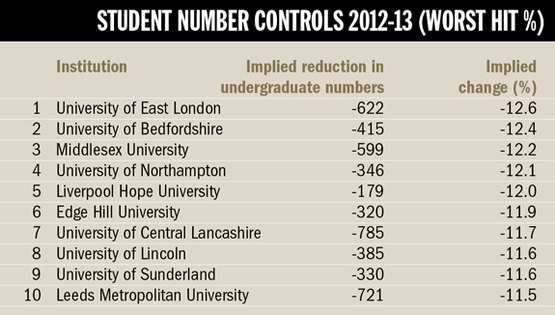
As reported in the Times Higher , the Higher Education Funding Council for England (HEFCE) has announced its allocations to English Higher Education Institutions for 2012/13. As expected, many universities are receiving substantial cuts next year. Here is a table of the biggest losers:

The Times Higher article describes this as the “Squeezed Middle”. It looks more like the “Squeezed Bottom” to me, but then I suppose that would have made an inappropriate headline.

Is there really a University of Sunderland?

Anyways, this allows me the chance to congratulate the former Director of Learning and Teaching in the School of Physics & Astronomy at Cardiff University on his move to the University of Central Lancashire, currently riding high at Number 7 in the above table…


Last Week of Term

Posted in Biographical, Education, The Universe and Stuff with tags , , , , , on March 26, 2012 by telescoper

So the glorious weather continues. Unfortunately, unlike most UK universities, we’re not finished for Easter yet; at Cardiff University we only get three weeks for the Easter recess instead of the four that colleagues over the border seem to enjoy.

One of the consequences of this is that the annual National Astronomy Meeting (NAM) often falls in Cardiff term time. This year NAM is taking place in the fine city of Manchester (which, for those of you unfamiliar with British geography, is in the Midlands). Many colleagues in the School of Physics & Astronomy are attending NAM, and most of my research group are either there already or travelling up today. I particularly wish Jo and Ian well when they give their talks; one of the excellent things about NAM is the opportunity it offers for younger researchers to talk about their work to a large audience. Nerve-wracking, no doubt, but invaluable experience.

I’m not going to NAM this year because I have too much to do back here at the ranch, including filling in a few lectures for staff who are away.  I’m always reluctant to cancel lectures during term-time, but in the current spell of good weather I doubt if any students would complain too much! I did a cosmology lecture this morning – only the second I’ve done here – and it the room was uncomfortably stuffy. A few of the students failed to fall asleep, however, so I regard that as a major success.

It’s strange how often good weather coincides with times of great stress for students. I recall that most of my undergraduate examinations took place in glorious sunshine, which seemed to have been laid on by some malevolent being to make us suffer. This week our students have project reports and presentations to worry about and other coursework to finish before term ends, as well as revision for the exams that take place in May; being couped up inside is no fun on days like this and I’m sure they’d prefer it to be raining outside so as not to distract them from the tasks in hand…

It’s so quiet around here today that it occurred to me now would be a good time to stage a Coup d’Etat. Come to thank of it, there’s a Staff Meeting  been called on Wednesday which may well amount to something pretty similar…

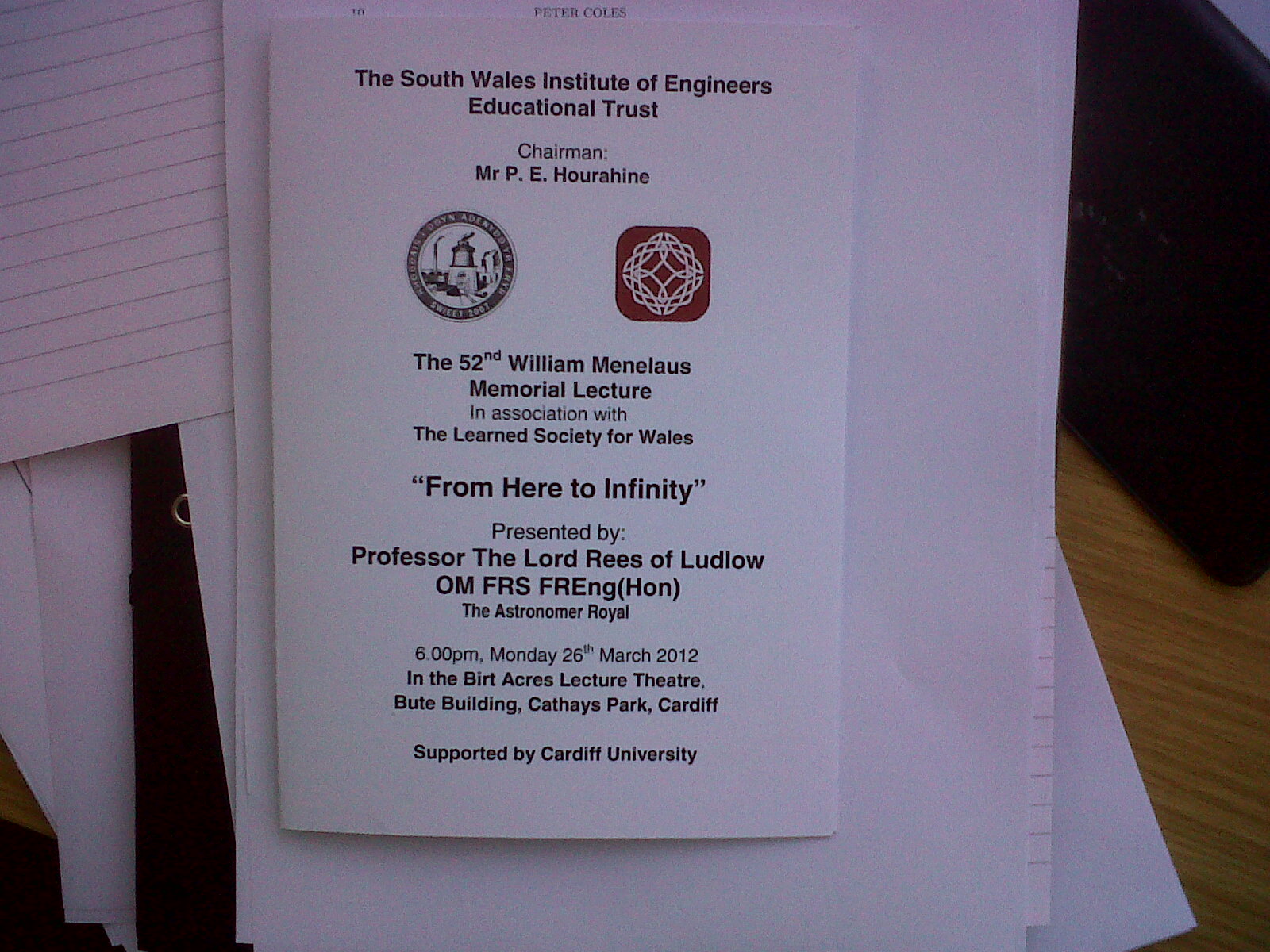
Anyway, those of us around today have a nice event this evening to look forward to, a lecture by Lord Rees followed by a nice dinner in Aberdare Hall. Here’s the invitation:

You’ll see that this is organized “in association with The Learned Society for Wales“, which I only just learned about when I saw it on the invitation!

Anyway, the prospect of a slap-up dinner persuaded me to just have a sandwich for lunch. Now that’s eaten methinks I’ll get back to work!

UPDATE: It was indeed a very interesting and entertaining lecture by Lord Rees; here he is, in action, watched by Prof. Disney…

Teaching Physics

Posted in Education, The Universe and Stuff with tags , , on March 22, 2012 by telescoper

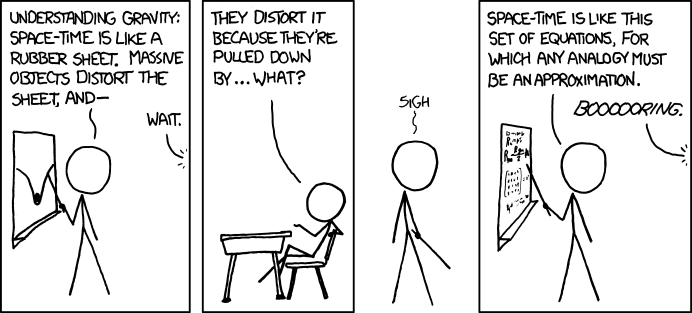
More on this weeks’ theme, from the inestimable xkcd

Cosmology, Escher and the Field of Screams

Posted in Art, Education, The Universe and Stuff with tags , , , , , on March 20, 2012 by telescoper

Up early this morning for yet another busy day I thought I’d post a quick follow-up to my recent item about analogies for teaching physics (especially cosmology).

Another concept related to the cosmic microwave background that people sometimes have problems understanding is that of last scattering surface.

Various analogies are useful for this. For example, when you find yourself in thick fog you may have the impression that you are surrounded by an impenetrable wall at some specific distance around you. It’s not a physical barrier, of course, it’s just the distance at which there sufficient water droplets in the air to prevent light from penetrating further. In more technical terms the optical depth of the fog exceeds unity at the distance at which this wall is seen.

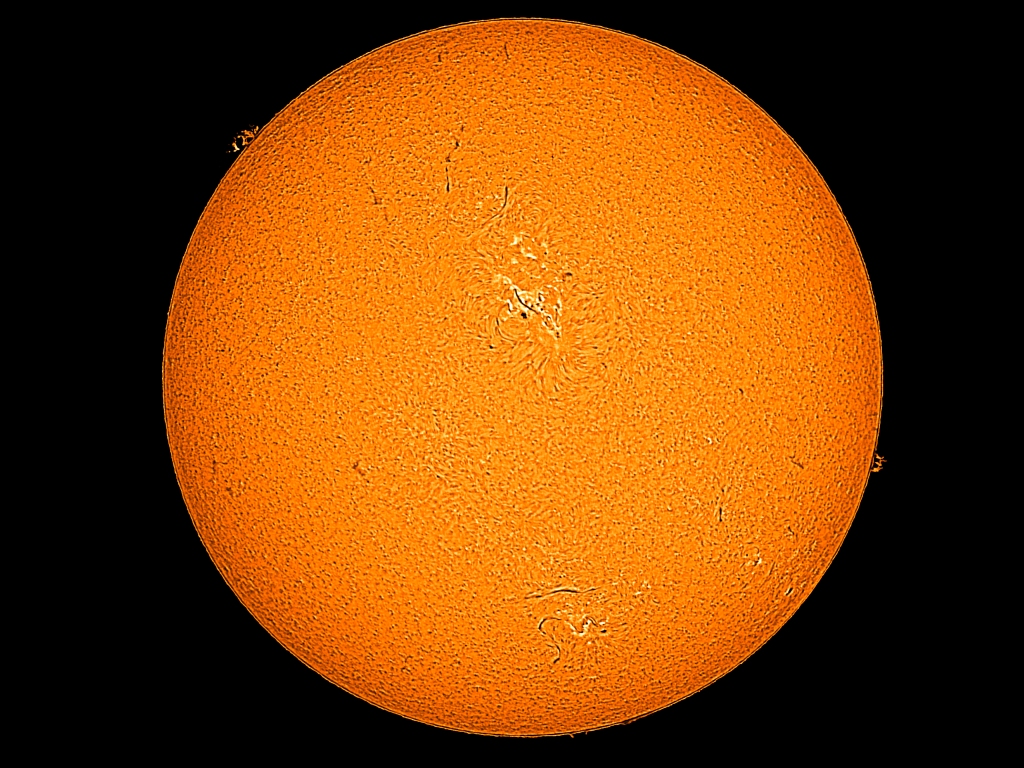
Another more direct analogy is provided by the Sun. Here’s a picture of said object, taken through an H-α filter..

What’s surprising to the uninitiated about an image such as this is that the Sun appears to have a distinct edge, like a solid object. The Sun, however, is far from solid. It’s just a ball of hot gas whose density and temperature fall off with distance from its centre. In the inner parts the Sun is basically opaque, and photons of light diffuse outwards extremely slowly because they are efficiently scattered by the plasma. At a certain radius, however, the material becomes transparent and photons travel without hindrance. What you see is the photosphere which is a sharp edge defined by this transition from opaque to transparent.

The physics defining the Sun’s photosphere is much the same as in the Big Bang, except that in the case of the Sun we are outside looking in whereas we are inside the Universe trying to look out. Take a look at this image from M.C. Escher:

The universe isn’t actually made of Angels and Demons – at least not in the standard model – but if you imagine you are in the centre of the picture  it nicely represents what it is like looking out through an expanding cosmology. Since light travels with finite speed, the further you look out the further you look back into the past when things were denser (and hotter). Eventually you reach a point where the whole Universe was as hot as the surface of a star, this is the cosmic photosphere or the last scattering surface, which is a spherical surface centred on the observer. We can’t see any further than this because what’s beyond is hidden from us by an impenetrable curtain,  but if we could just a little bit further we’d see the Big Bang itself where the density is infinite, not as a point in space but all around us.

Although it looks like we’re in a special place (in the middle) of the image, in the Big Bang theory everywhere is equivalent; any observer would see a cosmic photosphere forming a sphere around them.

And while I’m on about last scattering, here’s another analogy which might be useful if the others aren’t. I call this one the Field of Screams.

Imagine you’re in the middle of a very large, perhaps infinite, field crammed full of people, furnished with synchronised watches, each of whom is screaming at the top of their voice. At a certain instant, say time T, everyone everywhere stops screaming.

What do you hear?

Well , you’ll obviously  notice that it gets quieter straight away as the people closest to you have stopped screaming.  But you will still hear a sound because some of the sound entering your ear set out at a time before t=T. The speed of sound is 300 m/s or so, so after 1 second you will still hear the sound arriving from people further than 300 metres away. It might be faint, but it would be there. After two seconds you’d still be hearing from people further than 600 metres away,. and so on. At any time there’ll be circle around you, defined by the distance sound can have travelled since the screaming stopped – the Circle of Last Screaming. It would appear that you are in the centre of this circle, but anyone anywhere in the field would form the same impression about what’s happening around them.

Change sound to light, and move from two dimensions to three, and you can see how last scattering produces a spherical surface around you. Simples.


Failed Physics Teaching Analogies

Posted in Education, The Universe and Stuff with tags , , , , , , , on March 18, 2012 by telescoper

Last week I deputized for a colleague who was skiving off away at an important meeting so, for the first time ever in my current job, I actually got to give a proper lecture on cosmology. As the only out-and-out specialist in cosmology research in the School of Physics and Astronomy at Cardiff, I’ve always thought it a bit strange that I’ve never been asked to teach this subject to undergraduates, but there you are. Ours not to reason why, etc. Anyway, the lecture I gave was about the cosmic microwave background, and since I have taught cosmology elsewhere in the past it was quite easy to cobble something together.

As a lecturer you find, over the years, that various analogies come to mind that you think will help students understand the physical concepts underpinning what’s going on, and that you hope will complement the way they are developed in a more mathematical language. Sometimes these seem to work well during the lecture, but only afterwards do you find out they didn’t really serve their intended purpose. Sadly it also  sometimes turns out that they can also confuse rather than enlighten…

For instance, the two key ideas behind the production of the cosmic microwave background are recombination and the consequent decoupling of matter and radiation. In the early stages of the Big Bang there was a hot plasma consisting mainly of protons and electrons in an intense radiation field. Since it  was extremely hot back then  the plasma was more-or-less  fully ionized, which is to say that the equilibrium for the formation of neutral hydrogen atoms via

p+e^{-} \rightarrow H+ \gamma

lay firmly to the left hand side. The free electrons scatter radiation very efficiently via Compton  scattering

\gamma +e^{-} \rightarrow \gamma + e^{-}

thus establishing thermal equilibrium between the matter and the radiation field. In effect, the plasma is opaque so that the radiation field acquires an accurate black-body spectrum (as observed). As long as the rate of collisions between electrons and photons remains large the radiation temperature adjusts to that of the matter and equilibrium is preserved because matter and radiation are in good thermal contact.

Eventually, however, the temperature falls to a point at which electrons begin to bind with protons to form hydrogen atoms. When this happens the efficiency of scattering falls dramatically and as a consequence the matter and radiation temperatures are no longer coupled together, i.e. decoupling occurs; collisions can longer keep everything in thermal equilibrium. The matter in the Universe then becomes transparent, and the radiation field propagates freely as a kind of relic of the time that it was last in thermal equilibrium. We see that radiation now, heavily redshifted, as the cosmic microwave background.

So far, so good, but I’ve always thought that everyday analogies are useful to explain physics like this so I thought of the following. When people are young and energetic, they interact very effectively with everyone around them and that process allows them to keep in touch with all the latest trends in clothing, music, books, and so on. As you get older you don’t get about so much , and may even get married (which is just like recombination, in that it dramatically  reduces your cross-section for interaction with the outside world). Changing trends begin to pass you buy and eventually you become a relic, surrounded by records and books you acquired in the past when you were less introverted, and wearing clothes that went out of fashion years ago.

I’ve used this analogy in the past and students generally find it quite amusing even if it has modest explanatory value. I wasn’t best pleased, however, when a few years ago I set an examination question which asked the students to explain the processes of recombination and decoupling. One answer said “Decoupling explains Prof. Coles’ terrible fashion sense”. Grrr.

An even worse example happened when I was teaching particle physics some time ago. I had to explain neutrino oscillations, a process in which neutrinos (which have three distinct flavour states, associated with the electron, mu and tau leptons) can change flavour as they propagate. It’s quite a weird thing to spring on students who previously thought that lepton number was always conserved so I decided to start with an analogy based on more familiar physics.

A charged fermion such as an electron (or in fact anything that has a magnetic moment, which would include, e.g. the neutron)  has spin and, according to standard quantum mechanics, the component of this in any direction can  can be described in terms of two basis states, say |\uparrow> and |\downarrow> for spin in the z direction. In general, however, the spin state will be a superposition of these, e.g.

\frac{1}{\sqrt{2}} \left( |\uparrow> + |\downarrow>\right)

In this example, as long as the particle is travelling through empty space, the probability of finding it with spin “up” is  50%, as is the probability of finding it in the spin “down” state. Once a measurement is made, the state collapses into a definite “up” or “down” wherein it remains until something else is done to it.

If, on the other hand, the particle  is travelling through a region where there is a  magnetic field the “spin-up” and “spin-down” states can acquire different energies owing to the interaction between the spin and the magnetic field. This is important because it means the bits of the wave function describing the up and down states evolve at different rates, and this  has measurable consequences: measurements made at different positions yield different probabilities of finding the spin pointing in different directions. In effect, the spin vector of the  particle performs  a sort of oscillation, similar to the classical phenomenon called  precession.

The mathematical description of neutrino oscillations is very similar to this, except it’s not the spin part of the wavefunction being affected by an external field that breaks the symmetry between “up” and “down”. Instead the flavour part of the wavefunction is “precessing” because the flavour states don’t coincide with the eigenstates of the Hamiltonian that describes the neutrinos’ evolution. However, it does require that different neutrino types have intrinsically different energies  (which, in turn, means that the neutrinos must have different masses), in quite  a similar way similar to the spin-precession example.

Although this isn’t a perfect analogy I thought it was a good way of getting across the basic idea. Unfortunately, however, when I subsequently asked an examination question about neutrino oscillations I got a significant number of answers that said “neutrino oscillations happen when a neutrino travels through a magnetic field….”. Sigh. Neutrinos don’t interact with  magnetic fields, you see…

Anyhow, I’m sure there’s more than one reader out there who has had a similar experience with an analogy that wasn’t perhaps as instructive as hoped. Feel free to share through the comments box…