Archive for the Education Category

University Admissions in Uncharted Territory

Posted in Education, Politics with tags , , , , , , on October 26, 2011 by telescoper

It turns out I have a few minutes spare before going to our staff Away (half) Day this afternoon, so I thought I’d pass on another interesting bit of news that came out this week.

The Universities and Colleges Admissions Services, known to all and sundry as UCAS, has released some interesting statistical information on numbers of applicants to UK universities and how this compares with the corresponding stage in the admissions timetable last year.

We’re still very early on in the process so it would be unwise to read too much into the figures available so far. The big question, however, is whether the ConDem government’s decision to raise fees for university students to £9K per annum has had any effect on the number of students applying. In fact the headline figure is that after several years of growth in overall applicant numbers, the figures for 2012 entry are down 9% on last year. Still early days, of course, but it does look like the new fee levels may be having the deterrent effect we all expected.

Another interesting thing that struck me, from Table 6 of the UCAS analysis, is that the number of students applying to study courses in the physical sciences (including Physics & Astronomy) is down by just 1.6% on the same stage last year, compared to an average of 7.9% across all subjects. (Note that this is not the same as the 9% mentioned above, because students get more than one choice of course..).

Of particular interest to us in Wales is the breakdown of applicants by domicile and choice of institution.  From Table 4 we see that the number of English students applying to Welsh Universities is down 13.4%, while the number of Welsh-domiciled students applying to study in England is down by only 4.3%. If this differential persists then it will have a big impact on the Welsh Higher Education sector, because of the Welsh Assembly Government’s decision to cut funding for Welsh Universities in order to pay for its  subsidy for  Welsh students wanting to study in England.

It’s too early to predict what will happen to overall student numbers for 2012/13, but I’m sure planning officers in universities all around the UK will be looking at the interim figures with a considerable degree of anxiety.

A-Level Further Mathematics Examination, 1981

Posted in Education with tags , , on October 24, 2011 by telescoper

I’ve been forcibly evicted from my office this afternoon while a highly-trained operative of Cardiff University’s esteemed Estates Department replaces a broken window. It’s been broken since I moved into the office, about four years ago, by the way, but you can’t rush these things. Anyway, having been forced to change location I took the opportunity to decamp to the upstairs computer room wherein our departmental scanner resides and occupied myself with the task of scanning in yet another of the old examinations I took when I was in school. This one is the Further Mathematics examination, consisting of two papers each of three hours’ duration: Paper 1 is entirely Pure Mathematics; Paper 2 contains a mixture of Pure and Applied Mathematics, and Statistics.

Looking back on the paper now, thirty years after I first saw it, it seems to me that the Applied Mathematics questions (6-11 on Paper 2) actually look quite tough by the standard of 1st year undergraduate examinations in mechanics. However, I’ll leave it to you to comment on whether you think it’s harder, or easier, or about the same, compared to current A-levels in Further Mathematics. I’d also be interested in knowing whether there’s anything on these papers that isn’t on the syllabus nowadays.

The comments box awaits…

The Physics of the Pole Vault

Posted in Education, The Universe and Stuff with tags , , , , , on October 17, 2011 by telescoper

At the RAS Club Dinner last Friday I chatted for a while with my former DPhil supervisor, John Barrow. I’m not sure how, but the topic came up about how helpful it is to use sports to teach physics. By coincidence he chose the same example as I have used in the past during first-year tutorials,  the pole vault.

Years ago I went to watch an athletics meeting at Gateshead Stadium and sat right next to the pole vault area. I can tell you that the height the vaulters reach is truly spectacular, especially when you’re close to the action. The current world record for the pole vault is 6.14m, in fact, set by the legendary Sergey Bubka in 1994, so the record hasn’t been broken for 17 years. Here’s a clip of him a few years earlier clearing a mere 6.10 metres (pretty comfortably, by the look of it)…

One might infer, from the fact that the record has not been broken for such a long time, that pole vaulters are working pretty much at the limit of what the human body can achieve. And a bit of physics will convince you of the same.

Basically, the pole is a device that converts the horizontal kinetic energy of the vaulter \frac{1}{2} m v^2,  as he/she runs in, to the gravitational potential energy m g h acquired at the apex of his/her  vertical motion, i.e. at the top of the vault.

Now assume that the approach is at the speed of a sprinter, i.e. about 10 ms^{-1}, and work out the height h = v^2/2g that the vaulter can gain if the kinetic energy is converted with 100% efficiency. Since g = 9.8 ms^{-2} the answer turns out to be about 5 metres.

This suggests that  6.15 metres should not just be at, but beyond, the limit of a human vaulter,  unless the pole were super-elastic. However, there are two things that help. The first is that the centre of mass of the combined vaulter-plus-pole does not start at ground level; it is at a height of a bit less than 1m for an an average-sized person.  Nor does the centre of mass of the vaulter-pole combination reach 6.15 metres. The pole does not go over the bar, but it’s pretty light so that probably doesn’t make much difference. However, it’s not  obvious that the centre of mass of the vaulter actually passes over the bar.  That certainly doesn’t happen in the high jump – owing to the flexibility of the jumper’s back the arc is such that the centre of mass remains under the bar while the different parts of the jumper’s body go over it.

Moreover, it’s not just the kinetic energy of the vaulter that’s involved. A human can in fact jump vertically from a standing position, using elastic energy stored in muscles. One can’t jump very high like that, but it seems likely to me that this accounts for a few tens of centimetres.

Anyway, it is clear that pole vaulters are remarkably efficient athletes. And not a little brave either – as someone who is scared of heights I can tell you that I’d be absolutely terrifed being shot up to 6.15 metres on the end of  a bendy stick, even with something soft to land on!

Another day, another tutorial…

Posted in Education, The Universe and Stuff with tags , , , , on October 13, 2011 by telescoper

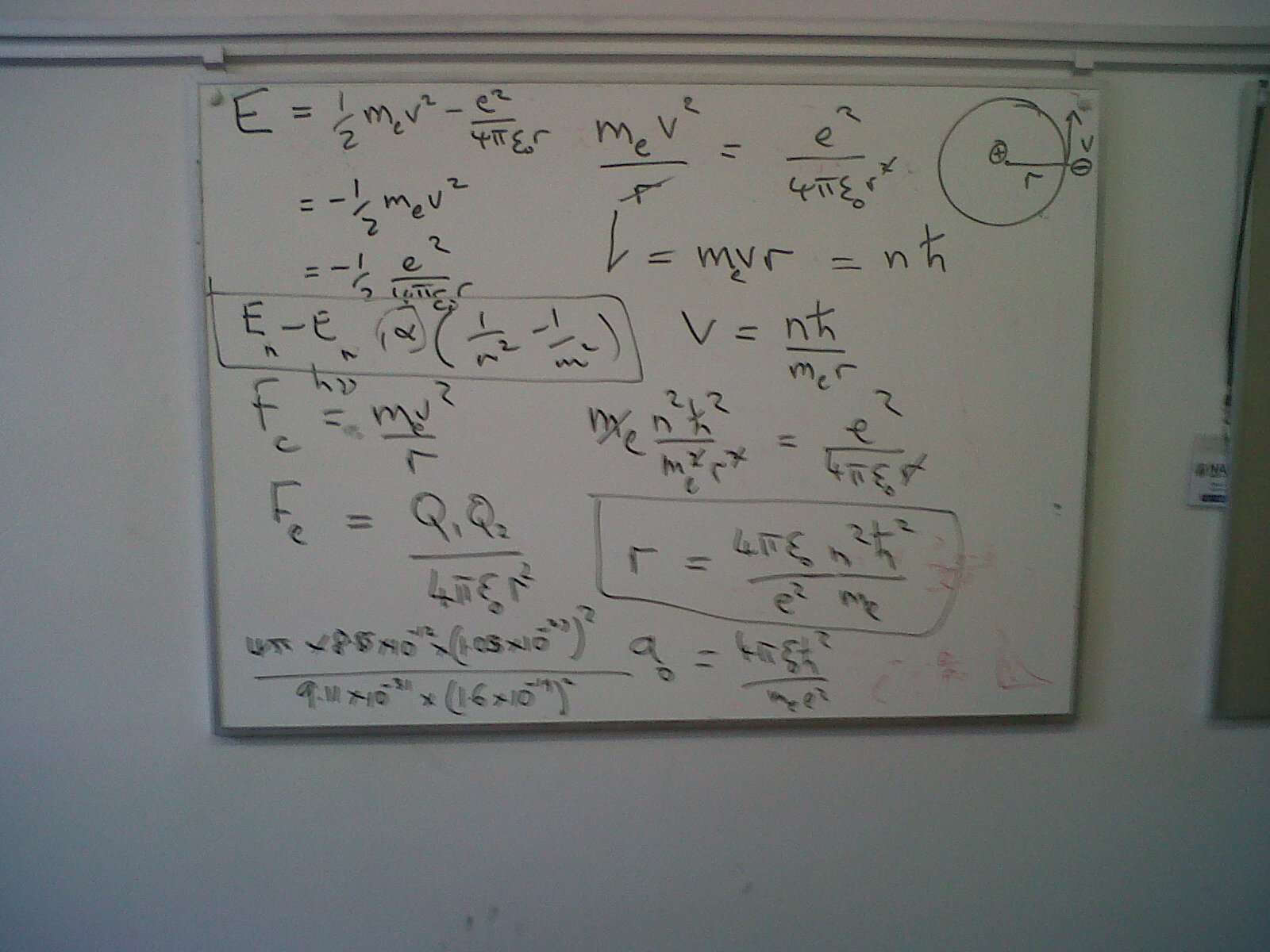
Oh what fun it is to derive the Bohr radius. At least the camera on my Blackberry works!

Who needs the University of Wales?

Posted in Education, Politics with tags , , , , , , on October 12, 2011 by telescoper

I couldn’t resist a quick  and possibly inflammatory, comment about the University of Wales affair.

I’m not sure how much this story has spread outside Wales, but it’s relatively easy to summarise quickly.  The University of Wales has had a complicated history which I won’t go into details about, but in essence it used to be the only University in Wales; my current employer, Cardiff University, for example, was for a long time a College of the University of Wales.  In 1992 the special status of the University of Wales changed when the former Polytechnic of Wales became the University of Glamorgan. In subsequent years a number of institutions within the University of Wales, including the College of  Cardiff in 2004, sought and were granted the ability to award their own degrees rather than degrees accredited by the University of Wales and so effectively became independent. As  a consequence, the importance of the University of Wales in the landscape of Welsh Higher Education rapidly dwindled to the point where it was a “rump” of an institution accrediting degrees for just a few relatively small institutes.

Having spent some time in my career working in London, it seems to me that there’s at least superficially a  striking parallel between the situation in Wales and that surrounding the former colleges of the University of London, most of which now award their own degrees rather than University of London degrees. The University of London nevertheless still exists, though I’ve never really understood why.

It tends to be the case that administrative structures refuse to die a natural death but instead try to find new things to administer. In order to justify itself, the University of Wales diversified into accrediting degrees from a host of smaller institutions both at home and abroad.  To cut several long stories very short, much of its business in recent years has been dodgy to say the least.  The University of Wales’ involvement in visa scams and  the selling of bogus degrees are just two of the revelations that have led to many calling for the organisation to be scrapped altogether, prominent among them being the Welsh Assembly Minister responsible for higher education, Leighton Andrews.

The University of Wales “brand” has now become so tarnished that some of   Welsh Higher Education institutions whose degrees it accredits now seem anxious to sever their ties altogether. The University of Wales, Institute of Cardiff (UWIC) wishes to change its name to Cardiff Metropolitan University and award its own degrees.

I think it’s quite clear that the University of Wales is now damaged beyond repair and should be dissolved, although the mechanism by which this can be achieved is unclear as universities are  independent charitable institutions, not run directly from government.  So egregious has been the conduct of the senior management of this organisation, however, that I’m sure a way can be found to wind it up. I just can’t see how it can possibly survive these scandals.

Unfortunately, dissolution  in itself will not repair the damage already done; some institutions under the University of Wales umbrella will surely find that, through no fault of their own, a great deal of mud will stick.

Leighton Andrews has already called – rightly, in my view – for a reduction in the number of universities in Wales, most of which are small. In my neck of the woods, South-east Wales, for example, a game of musical mergers has been going on for months already between UWIC, Glamorgan and the University of Wales, Newport but no concrete plans have emerged. In my opinion the region can only sustain one world-class, research intensive university and one teaching led “new” university. Will  the  chaos generated by the public disintegration of the University of Wales make it easier or harder to achieve this?

But I can’t help feel sad about the inevitable demise of the University of Wales, which seems to me to be more of a tragedy than a farce. Its problems can all be traced back to the terrible decision,  taken by the Conservative government in 1992, to allow the polytechnics to call themselves universities. Wales was much better off when it had one University and one Polytechnic, and neither had to prostitute itself to make ends meet.

The Three Es for Lecturing

Posted in Education with tags , , , , on October 5, 2011 by telescoper

Yet another very busy day looms in front of me. I’m off to the smoky bigness of London for an examiners’ meeting at Queen Mary this afternoon, but before that I have to squeeze in my first tutorial of the year, with a group of fresh-faced freshers. Actually I don’t know if they’re fresh faced or not because I haven’t met them yet. I had my first teaching encounter with the first years yesterday morning during an exercise class on mechanics, which I enjoyed despite some teething troubles with the facilities in the room we were using. I was very happy with the way the students chipped freely in with answers whenever I asked questions, which is a good sign.

A while ago I attended a session on teaching for our new lecturers. Actually I didn’t attend most of it, I just dropped in at the end to deliver a few tips I’ve picked up from observing other lecturers. Here in Cardiff we have “peer observation” of lectures in which one member of teaching staff sits in on a lecture by another, followed by a feedback and discussion session. While I was at Nottingham it was a different system; two nominated staff members (myself and another Professor) sat in on  lectures by each of the other staff. It was a lot of work, but gave me the chance to see quite a lot of different approaches to teaching and was consequently very interesting.

Anyway, over the years it became obvious that there are some obvious basics which lecturers need to do in order to teach competently, including being prepared, talking sufficiently loudly, writing clearly (if relevant), and so on. And of course turning up at the right theatre at the right time. But there are also those things that turn mere competence into excellence. Of course there are many ways to lecture, and you have to put your own personality into what you do, but the main tips I’d pass on to make your lecturers really popular can be boiled down into the Three Es. I add that these are things that struck me while watching others lecture, rather than me claiming to be brilliant myself (which I know I’m not). Anyway, here we go:

Enthusiasm. The single most obvious response on student questionnaires about lecturing refers to enthusiasm. My take on this is that we’re all professional physicists, earning our keep by doing physics. If we can’t be enthusiastic about it then it’s clearly unreasonable to expect the students to get fired up. So convey the excitement of the subject! I don’t mean by descending into vacuous gee-whizz stuff, but by explaining how interesting things are when you look at them properly as a physicist, mathematics and all.

Engagement. This one cuts both ways. First it is essential to look at your audience, ask questions, and make them feel that they are part of a shared experience not just listening to a monologue. The latter might be fine for a public lecture, but if a teaching session is to be successful as a pedagogical exercise it can’t be passive. And if you ask a question of the audience, make your body language tell them that it’s not just rhetorical; if you don’t look like you want an answer, you won’t get one. More importantly, try to cultivate an atmosphere wherein the students feel they can contribute. You know you’ve succeeded in this when students point out mistakes you have made. On the other hand, you can’t take this too far. The lecturer is the person who is supposed to know the stuff so fundamentally there’s no symmetry between you and the audience. You have to be authoritative, though that doesn’t mean you have to behave like a schoolmaster. Know your subject, explain it well and you’ll earn respect without needing to bluster.

Entertainment. To be absolutely honest, I think lectures  are a  fairly useless as a way of teaching physics. That is not to say that they don’t have a role, which I think is to highlight key concepts and demonstrate their applicability;  the rest, the details, the nuts and bolts are best done by problem-based learning. I therefore think it does no harm at all if you make your lectures enjoyable as pieces of entertainment. By all means introduce the odd joke, refer to surprising examples, amusing analogies, and so on.  As long as you don’t overdo it, you’ll find that a bit of light relief will keep the attention levels up. A key element of this is spontaneity. A lecture should appear as if it develops naturally, in an almost improvised fashion. Of course your spontaneity will probably have to  be very carefully rehearsed, but the sense of a live performance always adds value. A lecture should be a happening, not just a presentation. Lecture demonstrations also play this role, although they seem to be deployed less frequently  nowadays than in the past. Being a showman doesn’t come naturally to everyone, and the audience will know if you’re forcing it so don’t act unnaturally, but at the very least try to move about. Believe me, watching a lecturer drone on for an hour while rooted to the spot is a very tedious experience. You’d be surprised how much difference it makes if you can convey at least the impression of being alive.

On this last point, I’ll offer a few quotes from a physicist who definitely knew a thing or two about lecturing, Michael Faraday. First his opinion was that the lecturer should not be

…glued to the table or screwed to the floor. He must by all means appear as a body distinct and separate from the things around, and must have some motion apart from that which they possess.

Conventional wisdom nowadays suggests that one should take breaks in lectures to stop students losing concentration. I’m not sure I agree with this, actually. It’s certainly the case that attention will flag if you persist with a dreary monotone for an hour, but  I think a lecture can have a natural dynamic to it which keeps the students interested by variation rather than interruption. Faraday also thought this.

A flame should be lighted at the commencement and kept alive with unremitting splendour to the end…I very much disapprove of breaks in the lecture.

Finally, here is one of my all-time  favourite physics quotes, Faraday’s take on the need for lectures to be entertaining:

..for though to all true philosophers science and nature will have charms innumerable in every dress, yet I am sorry to say that the generality of mankind cannot accompany us one short hour unless the path is strewn with flowers.

Well, that’s all I have time for, but please offer your own tips through the comments box if you feel so motivated!

Why go to University?

Posted in Education with tags , , on September 29, 2011 by telescoper

I’ve just got time this morning before the Astronomy Grants Panel reconvenes for another day of deliberations to put up a quick postette. I thought of this quote the other day when we were inducing inducting inductifying enrolling the new undergraduates. I think it encapsulates what I think a university actually is, specifically why it’s essential for a University education to be part of an environment that also encompasses research, and why even in the digital age (and beyond),  personal interaction between student and teacher will always be essential. Call me old-fashioned.

The general principles of any study you may learn by books at home; but the detail, the colour, the tone, the air, the life which makes it live in us, you must catch all these from those in whom it lives already.

From The Idea of a University, by Cardinal John H. Newman, Chapter 2.

The Autumn Collection

Posted in Biographical, Education on September 28, 2011 by telescoper

Up bright and early again this morning, ready for the return leg (and possible extra time/penalties) of the STFC Astronomy Grants Panel deliberations in Swindon. While I slurp my coffee and crunch my toast I thought I’d try to get my brain into gear by posting a brief something.

Yesterday was the first day of our induction period for new students. Lectures proper don’t start until next week but this week we have preliminary sessions with all the freshers to show them round the laboratories, tell them how the library learning resources unit works, sort out their access to computer facilities and so on. As I’ve blogged about before, this is a bumper year for us in terms of undergraduate intake so these sessions were busier than usual. Somewhat remarkably, however, at close of play we had managed to process nearly all the students we were expecting. Usually a few  turn up late, or don’t turn up at all, but this time there seems to be only one “no show”. That must be some kind of record.

At coffee time this morning, all staff were invited to a “meet and greet” session with the new students. I’m not really involved with the undergraduate induction process but went along anyway to show moral support (and help myself to free coffee). When I arrived at the session I immediately noticed the crowd of baffled and bewildered people struggling to figure out what was going on. But that was just the members of stafff;  the students  seemed fine with it all.

Over coffee I chatted with a few students who were very friendly and relaxed, raring to get started with their studies. Let’s see how long that lasts! One student asked me “What are physicists really like?”. All I could think of to say was “some of them resemble normal people”…

I doubt if any of the new students is a reader of this blog – especially during Fresher’s Week, in which there are many distractions on offer – but in any case I’d like to welcome them all to Cardiff. If any are reading this, I wish you well in your  studies, and hope you find your time here both fruitful and enjoyable!

Just as some students start on their course others are about to complete theirs. Such is the cycle of academic life. My main administrative role in the School of Physics & Astronomy actually concerns postgraduate students. The end of this week (September 30th) is the PhD thesis deadline for several of these, so there’s been a rush of paperwork relating to arrangements for examinations for me to deal with. I’m sure there’ll be more than a few people having a relaxing tipple on Friday evening after they’ve submitted their thesis.

All in all it was a very busy but actually quite pleasant day made all the more pleasant by an unexpected outbreak of nice sunshine. Now. To Swindon.

Advanced Level Mathematics Examination, Vintage 1981

Posted in Education with tags , , , , , , on September 26, 2011 by telescoper

It’s been a while since I posted any of my old examination papers, but I wanted to put this one up before term starts in earnest. In the following you can find both papers (Paper I and Paper 2) of the Advanced Level Mathematics Examination that I sat in 1981.

Each paper is divided into two Sections: A covers pure mathematics while B encompasses applied mathematics (i.e. mechanics) and statistics. Students were generally taught only one of the two parts of Section B and in my case it was the mechanics bit that I answered in the examination. Paper I contains slightly shorter questions than Paper 2 and more of them..

Note that slide rules were allowed, but calculators had crept in by then. In fact I used my wonderful HP32-E, complete with Reverse Polish Notation. I loved it, not least because nobody ever asked to borrow it as they didn’t understand how it worked…

I also did Further Mathematics, and will post those papers in due course, but in the meantime I stress that this is just plain Mathematics.

If it looks a bit small you can use the viewer to zoom in.

I’ll be interested in comments from anyone who sat A-Level Mathematics more recently than 1981. Do you think these papers are harder than the ones you took? Is the subject matter significantly different?

Reflective Practice

Posted in Education with tags , , on September 9, 2011 by telescoper

I’ve just taken a short break from reading grant applications and filling in forms to read through the stack of teaching questionnaires that arrived yesterday, along with a complicated statistical analysis which I won’t even try to explain – because I  don’t understand it.

These questionnaires are handed out during a lecture, filled in by the students (anonymously), and then sent off to be analysed by a team of elves.  Doing this during a lecture ensures a reasonable rate of return; in my case about 2/3 of the students returned completed questionnaires. The results are condensed into a “Figure of Merit” (FOM) using a mystic formula of some sort. If my FOM turned out badly I would probably try to work out what it means, but since it’s quite good I’ll just assume the algorithm is excellent.

Questions on the questionnaire are divided into questions about the module (we don’t have courses, we have modules),  e.g. is it easy, hard, interesting etc, and questions about the lecturer(s), e.g. was he/she audible, legible. Generally speaking, students seemed to enjoy this particular first-year module, Astrophysical Concepts, but also thought it was difficult. In fact it’s a generic outcome of this sort of analysis that modules that are considered to be easy don’t get the best student feedback – they don’t seem to  mind so much if the material is difficult, as long as it is interesting. I think that’s where astrophysics is a lot easier to score well than, say, solid state physics.

The only thing I was disappointed with was the score for the responses to the prompt “The lecturer wrote helpful comments on the marked homework“. In fact, I didn’t write anything at all on the marked homework because I didn’t mark it – that’s usually done by PhD students,  according to a mark scheme I provide. Nevertheless, I do post full worked solutions (on a system called Learning Central) along with the mark scheme after  the scripts have been returned to students so they can easily find out where they went wrong and how they lost marks. I though that, supplemented by the comments written by the markers on the scripts,  would be sufficient feedback. Obviously not. Heigh-ho.

More interesting than the statistical analysis (to me) are the individual comments written on the reverse of the questionnaire. Most don’t write anything at all here, but there’s an opportunity to massage one’s ego by reading things like “Best lecturer this term by a long, long way”. Actually, come to think of it, that was the only one that said that.

Occasionally, however, one comes across a disgruntled response. An example was

I think the homeworks should be on Blackboard. They never are. If you misplace a homework you can never get another!

Sigh. Actually, all the homeworks were put on Blackboard (the older name for Learning Central) at the same time that I handed them out. As a matter of fact, they’re all still there…along with the solutions in a folder marked Assignments.

Anyway, Astrophysical Concepts was fun to teach and popular with the students, so obviously it had to go. It’s now been discontinued and replaced in the first year by a module about Planets. But I think some of it will make a return in a new problem-solving class for 2nd year students…

PS. In case you’re not up with the jargon, “reflective practice” is “the capacity to reflect on action so as to engage in a process of continuous learning” and is “one of the defining characteristics of professional practice” that involves “paying critical attention to the practical values and theories which inform everyday actions, by examining practice reflectively and reflexively. This leads to developmental insight.”

In other words, thinking about the stuff you do in order to do it better.