Archive for the Education Category

Nerth gwlad ei gwybodaeth

Posted in Education, Opera, Politics with tags , , , , , , on July 15, 2010 by telescoper

Once again the wheel of academic life has turned full circle. A year to the day since I blogged about the last graduation ceremony for the School of Physics & Astronomy at Cardiff University, here I am doing it again. Last night Cardiff experienced some of the heaviest rainfall I’ve seen for ages and I got a bit soggy on the way to St David’s Hall for this morning’s ceremony. Given that today is St Swithin’s Day this doesn’t bode well for the rest of the summer…

I confess it didn’t feel too comfortable sitting there on stage under the lights in a slightly damp suit, wearing a tie, and sporting mortarboard and gown but it went pretty well. Three Schools went through during the ceremony I attended: Earth & Ocean Sciences and Psychology as well as Physics & Astronomy.

We had by far the smallest group of graduands; the School of Psychology is particularly huge and is also notable for having such a small percentage of male graduates. In Physics & Astronomy we have about 20% female students whereas Psychology must be >95%. We often sit around at tea-time discussing how to persuade more girls to study Physics, but I wonder if anyone frets about how to get more boys to do Psychology?

It’s a very proud moment when the students you know receive their degrees. This year, in fact, produced the first set of BSc graduates that have completed their entire study period while I’ve been here since I only arrived three years ago.

It must be a nerve-wracking experience crossing the stage at St David’s Hall in front of your family and friends, especially in high heels as most of the girls did. I would have thought sensible shoes were a wiser option, but then what do I know?

If you want to see the ceremony you can do so by following this link. I’m in the front row on stage, to the right hand side, dressed in a blue gown and mortarboard but not visible on the cross-stage view.

The Honorary Fellowship presented during our ceremony was received by Professor Paul Harris, a distinguished psychologist. It’s worth mentioning that another such event earlier in the week saw the award of an Honorary Fellowship to Stephen Fry who has been involved in studies of bipolar disorder at the University. He tweeted regularly during his short visit to Cardiff, e.g.

Must say Cardiff is looking spankingly good in the late afternoon sunshine. Castle is gleaming, Town Hall glowing. Much to like here.

I’m sure the university press machine will make as much as they can of his comments. And why not? Cardiff does indeed have much to like. Even in the rain.

The ceremony ended on a high note or, in fact, on several.  Mary-Jean O’Doherty, a wonderful young Soprano from the Cardiff International Academy of Voice, gave us a fine rendition of the Queen of the Night’s  Act II aria from Mozart’s The Magic Flute. Die Hölle Rache kocht in meinem Herzen is a tremendously difficult coloratura piece featuring a barrage of stratospheric high notes. I thought it was tremendously brave to take that on, coming into it completely cold, but she did it fantastically well and it fair brought the house down. I note that the opera from which this aria was taken is featured in Welsh National Opera’s forthcoming autumn season, where it is sure to prove popular.

I’m pretty sure not many people in the audience knew the Opera or could understand German, however, because although the music is wonderful the lyrics aren’t entirely appropriate. The first line translates as “The Rage of Hell is boiling in my heart….”. Perhaps that was a subliminal response to the fact that the  Cardiff International Academy of Voice is closing later this year.

Anyway it was then back to the School for a lunch party – which was very nicely done, I think – and a speech of farewell from the Head of School ending with the award of prizes for students who had performed exceptionally well in their studies. I’m fortunate that the prize-winning student of the MPhys (4-year) cohort is staying on in Cardiff to do a PhD under my supervision.

Just in case any of the new graduates are reading this, let me add my congratulations to those of the Head of School and also repeat his encouragement to you to stay in touch. It’s always a delight when former students drop in for a chat, but if you can’t do that please do keep in touch on Facebook or the like.

I know the graduate job market is tough at the moment, but don’t be discouraged if you haven’t got anything sorted out yet. In the long run what you’ve learned will benefit you.  I’m sure I speak on behalf of everyone who has had the pleasure of teaching you over the last three or four years when I say that we wish you all the very best in your future careers.

PS. The title of this post in in Welsh. It translates as “A nation’s strength is in its learning”.

Hymn to Science

Posted in Biographical, Education, Poetry with tags , , , on July 7, 2010 by telescoper

Mark Akenside was born on 9th November 1721 in the city of Newcastle upon Tyne, which was also my birthplace. He attended the same school that I did too, the  Royal Grammar School, although I went about 250 years later. Akenside was a physician and political activist as well as a poet. I remembered his name when I was tidying up yesterday and found an old school magazine which mentioned him. This is called Hymn to Science. I hope you like it. I doubt if Simon Jenkins will.

Science! thou fair effusive ray
From the great source of mental day,
Free, generous, and refin’d!
Descend with all thy treasures fraught,
Illumine each bewilder’d thought,
And bless my lab’ring mind.

But first with thy resistless light,
Disperse those phantoms from my sight,
Those mimic shades of thee;
The scholiast’s learning, sophist’s cant,
The visionary bigot’s rant,
The monk’s philosophy.

O! let thy powerful charms impart
The patient head, the candid heart,
Devoted to thy sway;
Which no weak passions e’er mislead,
Which still with dauntless steps proceed
Where Reason points the way.

Give me to learn each secret cause;
Let number’s, figure’s, motion’s laws
Reveal’d before me stand;
These to great Nature’s scenes apply,
And round the globe, and thro’ the sky,
Disclose her working hand.

Next, to thy nobler search resign’d,
The busy, restless, human mind
Thro’ ev’ry maze pursue;
Detect Perception where it lies,
Catch the ideas as they rise,
And all their changes view.

Say from what simple springs began
The vast, ambitious thoughts of man,
Which range beyond control;
Which seek Eternity to trace,
Dive thro’ th’ infinity of space,
And strain to grasp the whole.

Her secret stores let Memory tell,
Bid Fancy quit her fairy cell,
In all her colours drest;
While prompt her sallies to control,
Reason, the judge, recalls the soul
To Truth’s severest test.

Let the fair scale, with just ascent,
And cautious steps, be trod;
And from the dead, corporeal mass,
Thro’ each progressive order pass
To Instinct, Reason, God.

Nor dive too deep, nor soar too high,
In that divine abyss;
To Faith content thy beams to lend,
Her hopes t’ assure, her steps befriend,
And light her way to bliss.

Then downwards take thy flight agen;
Mix with the policies of men,
And social nature’s ties:
The plan, the genius of each state,
Its interest and its pow’rs relate,
Its fortunes and its rise.

Thro’ private life pursue thy course,
Trace every action to its source,
And means and motives weigh:
Put tempers, passions in the scale,
Mark what degrees in each prevail,
And fix the doubtful sway.

That last, best effort of thy skill,
To form the life, and rule the will,
Propitious pow’r! impart:
Teach me to cool my passion’s fires,
Make me the judge of my desires,
The master of my heart.

Raise me above the vulgar’s breath,
Pursuit of fortune, fear of death,
And all in life that’s mean.
Still true to reason be my plan,
Still let my action speak the man,
Thro’ every various scene.

Hail! queen of manners, light of truth;
Hail! charm of age, and guide of youth;
Sweet refuge of distress:
In business, thou! exact, polite;
Thou giv’st Retirement its delight,
Prosperity its grace.

Of wealth, pow’r, freedom, thou! the cause;
Foundress of order, cities, laws,
Of arts inventress, thou!
Without thee what were human kind?
How vast their wants, their thoughts how blind!
Their joys how mean! how few!

Sun of the soul! thy beams unveil!
Let others spread the daring sail,
On Fortune’s faithless sea;
While undeluded, happier I
From the vain tumult timely fly,
And sit in peace with thee.

All in a day’s work

Posted in Art, Biographical, Education, Science Politics, The Universe and Stuff with tags , , , , , on June 30, 2010 by telescoper

I got back from yesterday’s trip to a very muggy London with a raging sore throat and a brain as sluggish as an England defender on an action replay. Come to think of it, I must be as sick as a parrot. I’m sweating like a pig too, although I don’t know whether that’s a symptom of anything nasty or just because it’s still so warm and humid. Anyway, in view of my likely incoherence I thought I’d keep it brief (again) and just mention a few salient points from the last day or two.

I went to London as part of my duties as External Examiner for the MSc Course in Astrophysics at Queen Mary, University of London. Of course all the proceedings are confidential so I’m not going to comment on anything in detail, except that I spent a bit of time going through the exam scripts before the Examiners’ Meeting in a room that did a very passable impersonation of a heat bath. When I was later joined by the rest of the Exam Board the temperature soared still further. Fortunately the business went relatively smoothly so nobody got too hot under the collar and after concluding the formal business, a few of us cooled off with a beer or two in the Senior Common Room.The students spend the next couple of months writing their dissertations now that the written exams are over, so we have to reconvene in October to determine the final results. I hope it’s a bit cooler by then.

I couldn’t stay long at Queen Mary, however, as I had a working dinner to get to. Regular readers of this blog (both of them) may remember that I’m involved in project called Beyond Entropy which is organized by the Architectural Association School of Architecture. I’ve been working on this occasionally over the months that have passed since I first blogged about it, but deadlines are now looming and we need to accelerate our activity. Last night I met with the ever-enthusiastic Stefano Rabolli Pansera at the house of Eyal Weizman by Victoria Park in the East End, handily close to Queen Mary’s Mile End campus. Assisted by food and wine we managed to crystallise our ideas into something much more tangible than we had managed to do before on our theme of Gravitational Energy. The School has offered us expert practical assistance in making prototypes and  I’m now much more optimistic about our exhibit coming together, not to mention excited at the prospect of seeing it on display at the Venice Architecture Biennale. I won’t say what we’re planning just yet, though. I’d rather wait until it’s done before unveiling it.

Incidentally, here’s a link to a  lecture by Eyal Weizman where he gives some interesting perspectives on architectural history.

Finally, and nothing to do with my trip to the Big Smoke, I noticed today on the Research Fortnight Blog that the Higher Education Funding Council for Wales (HEFCW) is planning to reduce the number of universities in Wales “significantly” from its current level of 12. This is an interesting development and one that I’ve actually argued for here. Quoting Leighton Andrews, Welsh Assembly Minister responsible for higher education, the piece says

“This target does not mean fewer students,” he said in a statement. “But it is likely to mean fewer vice chancellors. We will have significantly fewer HE institutions in Wales but they will be larger and stronger.”

How these reductions will be achieved remains to be seen, but it seems obvious that quite a few  feathers will be ruffled among the management’s plumage in some institutions and it looks like some vice chancellors will be totally plucked!

Progress

Posted in Education, Football with tags , , on June 23, 2010 by telescoper

My agenda for today was dominated by three events, each involving a different form of progression. The timing was a coincidence, I think.

First, this morning, a bunch of interviews with our first-year postgraduate research students. Like most universities, the first year of a PhD at Cardiff University is a probationary period so we get the students to write a report on what they’ve been doing and also get input from their supervisor. This is then followed up by a panel interview, with 3-4 members of staff, at which a judgement is made as to whether to allow them continue. This used to be a relatively informal thing involving supervisor and one other member of staff, but I’ve recently taken over as Director of Postgraduate Studies in the School of Physics & Astronomy and made the process a bit more rigorous, having the same panel talk to all the students. It all passed off pretty well apart from the fact that a couple of students are away and I’ll have to put them through the process later on in the summer when they get back from their observing trips and whatnot.

After a spot of form-filling and a quick lunch we went straight into another examiners’ meeting, this time for undergraduate students. We already went through the marks for graduating students a couple of weeks ago, but today we had to look at the results for our Prelim candidates, and Years 1 and 2. Here the focus for most staff is on their personal tutees, usually 4 in each year, checking they all progress as intended to the following year and presenting any special circumstances.  This meeting can be quite fraught, but this year went smoothly.

Which brought us to the last issue of progression, and the one I was less optimistic about  prior to the event. However, England did manage to win their game against Slovenia in the FIFA World Cup by the not entirely convincing scoreline of 1-0. That means they too progress to the next round, although how much further than that they can go is not very clear. Well done to the USA too, who beat Algeria to win the group and take their place in the last 16.

All in all, a busy but productive and satisfying day. Now I’m going to watch one more game of football and have a glass or two of wine before having an early night.

Stay of Execution

Posted in Education, Finance, Politics, Science Politics with tags , , , , on June 22, 2010 by telescoper

Another beautiful summer’s day here in Cardiff just happened to be the day when the new ConDem government unleashed its much-feared budget. I suppose we were all expecting some combination of  tax rises and spending cuts but nodody I know had managed to predict the details. A big rise in VAT (to 20%) is the headline figure most of the newspapers seem to be running with, but the other side is the one that caught my eye;  average cuts of 25% in “unprotected” Whitehall departments. That means basically everything outside Health and Education, and “Education” doesn’t include Higher Education which falls within the remit of the Department of Business Innovation and Skills.  Universities (in England; Scotland, Wales and Northern Ireland run their own budgets for HE) and the Research Councils are therefore bracing themselves for cuts of 25% or even more; if some departments are cut less than this average, then some will be cut more…

For informed comment, see here and here.

However, the details of how these cuts will be implemented – and, of particular relevance to me, how much the Science and Technology Facilities Council will be chopped – will have to wait until the Comprehensive Spending Review to be announced in October 2010. No doubt the STFC Executive will be using all their political skills and powers of persuasion to argue for a positive settlement. Like they did last time. In other words, we’re doomed.

Incidentally, you can hear Lord Rees’ scathing comments about the inept management of STFC here, although to so involves shaking hands with the devil that is iTunes.

There’s also a two-year freeze on public sector salaries – again, not entirely unexpected – but obviously that will only apply to those who keep their jobs after the departmental budgets are cut by a quarter.

Anyway, no point in griping. We all knew this was coming. The big question now is whether the increases in unemployment and tax rises will stop our feeble economic recovery in its tracks, and how badly the cuts in investment will jeoparside future growth. I’m not sufficiently knowledgeable about economics to comment sensibly on this.

Coincidentally today was also the day that STFC Council met here in Cardiff. Of course they did so behind closed doors, but they also had a quick tour of the buildings and a briefing by our Head of School, Swiss Tony Walter Gear. I’m told one of the Council members asked “Excuse me, but what is Planck?”. Apparently the question was posed by one of the non-scientists on STFC Council. So that’s alright then.

Still, there’s always the elimination of France from the World Cup to gladden the heart of an Englishman. Like STFC, the England  football team will learn its fate soon eough …

Sexism, of course…

Posted in Education with tags , , on June 21, 2010 by telescoper

I’ve only just recovered from the shock  of seeing the sheer hopelessness of British science education laid bare last week. Indeed, I was so staggered to discover how poorly conceived the current GCSE science examinations are that I forgot that I’d already blogged about the lamentable tendency of the modern education system to concentrate on getting kids to swallow and regurgitate little bite-sized factoids, rather than actually learning to think for themselves.  Leaving aside the issue that quite a few of the things that are being taught seem to be wrong anyway, my point there was that teaching science isn’t about teaching facts at all, it’s about trying to develop critical thinking and problem-solving skills. At least that’s what it should be, if only the dumbers-down would stop meddling.

Well, I’d almost come to terms with my despair when I saw another article (from Friday’s Guardian) which tells a tale that’s not just idiotic, but also sinister and offensive. Here’s the full text

One of the country’s biggest exam boards is developing different GCSE courses for boys and girls, it emerged today.

The Assessment and Qualifications Alliance (AQA) said it was looking into creating a science GCSE with more coursework in it for girls, and one which gave more weighting to exam marks for boys.

Studies have shown that girls perform better in coursework than boys, while boys do better in exams.

AQA said it would not prevent boys from taking the girls’ course and vice versa.

The courses in English, maths and science could be available from September next year.

Bill Alexander, the exam board’s director of curriculum and assessment, told the Times Educational Supplement: “We could offer a route for boys that is very different to a route for girls.

John Bangs, head of education at the National Union of Teachers, said it was “extremely dangerous” to get into gender stereotyping. “There are lots of boys who like the investigative element of coursework as well,” he said.

John Dunford, general secretary of the Association of School and College Leaders, said it was a “wild generalisation” to state that boys did better in exams, while girls performed better in coursework, but that it had “more than a grain of truth” to it.

However, he suggested that as well as sitting the gender-specific exams, pupils’ work should be marked in part by professional assessors.

Experts believe that this year could end a 20-year trend for girls to outperform boys in GCSEs because many new courses have no coursework. Instead, pupils complete work over a prolonged period, but under exam conditions.

There’s also a longer piece on the same topic in the Times Education Supplement.

Different courses for boys and girls? Are they serious? This is gender stereotyping of the worst possible kind. I find it absolutely abhorrent that anyone in any position of authority in the education system could even have contemplated doing something so offensively patronising. What’s next, different courses for different racial groups?

I sincerely hope that the new government intervenes and stops the AQA from going along this road. Better still, it should scrap these worthless examination factories and sack the profiteering dunderheads in charge who are responsible for turning the education system into a national disgrace.

Science Examination Blues

Posted in Education, The Universe and Stuff with tags , , , , , on June 16, 2010 by telescoper

I woke up this morning …

.. to the 7am news on BBC Radio 3, including a story about how GCSE science examinations are not “sufficiently rigorous”. Then, on Twitter, I saw an example of an Edexcel GCSE (Multiple-choice) Physics paper.  It’s enough to make any practising physicist weep.

Most of the questions are very easy, but there’s just as many that are so sloppily put together that they  don’t make any sense at all. Take Question 1:

I suppose the answer is meant to be C, but since it doesn’t say that A is the orbit of a planet, as far as I’m concerned, it might just as well be D. Are we meant to eliminate D simply because it doesn’t have another orbit going through it?

On the other hand, the orbit of a moon around the Sun is in fact similar to the orbit of its planet around the Sun, since the orbital speed and radius of the moon around its planet are smaller than those of the planet around the Sun. At a push, therefore you could argue that A is the closest choice to a moon’s orbit around the Sun. The real thing would be something close to a circle with a 4-week wobble variation superposed.

You might say I’m being pedantic, but the whole point of exam questions is that they shouldn’t be open to ambiguities like this, at least if they’re science exams. I can imagine bright and knowledgeable students getting thoroughly confused by this question, and many of the others on the paper.

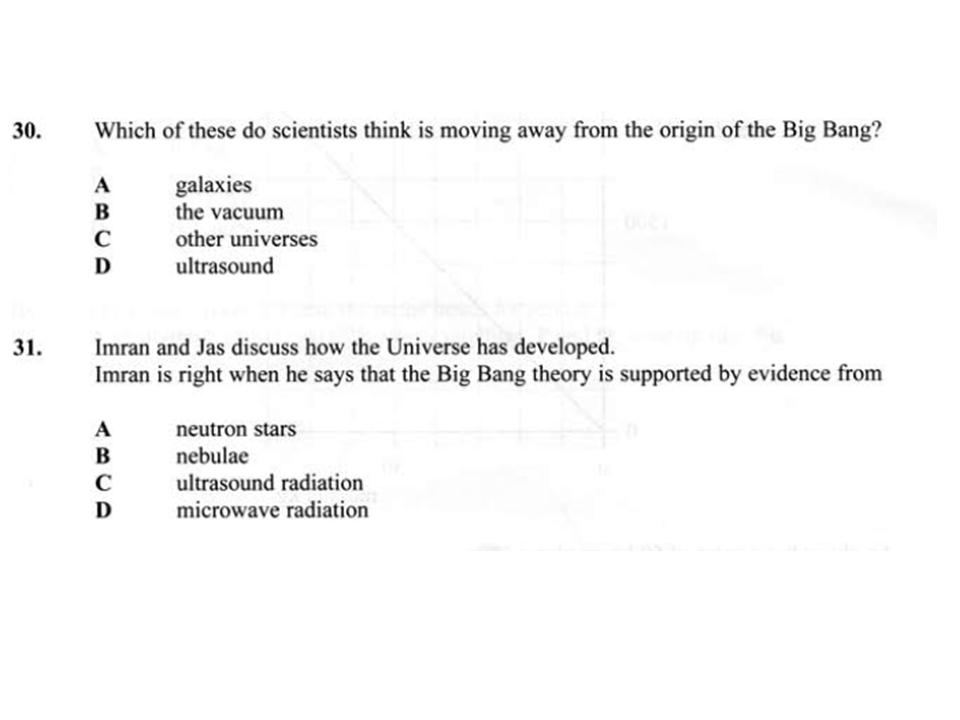
Here’s a couple more, from the “Advanced” section:

The answer to Q30 is, presumably, A. But do any scientists really think that galaxies are “moving away from the origin of the Big Bang”?  I’m worried that this implies that the Big Bang was located at a specific point. Is that what they’re teaching?

Bearing in mind that only one answer is supposed to be right, the answer to Q31 is presumably D. But is there really no evidence from “nebulae” that supports the Big Bang theory? The expansion of the Universe was discovered by observing things Hubble called “nebulae”..

I’m all in favour of school students being introduced to fundamental things such as cosmology and particle physics, but my deep worry is that this is being done at the expense of learning any real physics at all and is in any case done in a garbled and nonsensical way.

Lest I be accused of an astronomy-related bias, anyone care to try finding a correct answer to this question?

The more of this kind of stuff I see, the more admiration I have for the students coming to study physics and astronomy at University. How they managed to learn anything at all given the dire state of science education in the UK is really quite remarkable.

Announcement of Opportunities

Posted in Education, The Universe and Stuff with tags , , , , on June 16, 2010 by telescoper

I mentioned this a while ago, but I thought it wouldn’t do any harm to repeat the official advertisement here. Cardiff is going large (or at least larger) in experimental physics, and the first deadline is approaching..

..so get cracking with your applications now!

Chair in Experimental Physics

Reader/Senior Lecturer/Lecturer in Experimental Physics

School of Physics and Astronomy

As the first stage of a major initiative to broaden its research activity the School of Physics and Astronomy at Cardiff University has some immediate vacancies for permanent faculty positions at either full Professor/Reader/Senior Lecturer/Lecturer level in any area of Experimental Physics, other than Astrophysics.

Applications are welcome in fields new to the School as well as those complementary to the existing strengths. Candidates working in interdisciplinary areas with a firm Physics base are also welcomed. You will be expected to have demonstrated an established programme of research, and will also be expected to teach Physics at undergraduate and postgraduate level.

The School of Physics and Astronomy at Cardiff University has strong research groups in Photons & Matter (theory and experimental), Gravitational Physics and Nanophysics, as well as a large Astrophysics programme.

You should have a PhD in Physics, Mathematics or closely-related subject.

Salary:
A point on the Cardiff Professorial Salary Scale (Chair)
£45155 – £55535 per annum (Reader)
£37839 – £43840 per annum (Senior Lecturer)
£29853 – £35646 per annum (Lecturer)

Further information about the School may be found at http://www.astro.cardiff.ac.uk/

Informal enquiries regarding these positions may be made to Professor Walter Gear, Head of School, email Walter.Gear@astro.cardiff.ac.uk

To work for an employer that values and promotes equality of opportunity, visit www.cardiff.ac.uk/jobs telephone + 44 (0) 29 2087 4017 or email vacancies@cardiff.ac.uk for an application form quoting vacancy number 186 for the Chair position and 188 for the Reader/Senior Lecturer/Lecturer position.

Closing date: Friday, 23 July 2010.

Please note vacancies are for one Chair and three Senior Lecturer/Lecturer positions.

www.cardiff.ac.uk/jobs


Alternative Galaxy Dynamics Examination

Posted in Education, The Universe and Stuff with tags , , , , on June 12, 2010 by telescoper

Time Allowed: ~1/H0

Study the following video and answer the questions below it. Or else.

1. Use the information provided about the Earth’s orbital speed to estimate the mass of the Sun. (Assume a circular orbit; 1 AU is 1.5 × 10¹¹ m.)

2. Use the information provided about the Sun’s motion around the Galactic Centre to estimate the total mass interior to the Sun’s orbit. (Assume a circular orbit and that the mass distribution is spherically symmetric; you may quote Newton’s shell theorem without proof.)

3. Use the answer to Q2, and other information provided in the video, to estimate the mean matter density in the Milky Way.

4. Use the information provided about the size, shape and stellar content of the Milky Way to estimate the mean number-density of stars interior to the Sun’s orbit.

5. Use the answers to Q3 & Q4 to estimate the mean mass-to-light ratio of the Galaxy.

Universities Challenged

Posted in Education, Politics with tags , , , , , on June 10, 2010 by telescoper

The news headlines over the last couple of days have been dominated by remarks made by David Willetts, Minister for Universities and Science, who has called for a radical overhaul of the way UK universities are organized and funded. Predictably, his comments set alarm bells ringing about the savage cuts likely to be coming our way, but I hope it’s not just about slash-and-burn and that some imagination is applied to the problem of sorting out the mess the system has become. We’ll see.

According to a piece in the Guardian, for example, Willetts suggested that some students could study at smaller local colleges instead of going to a big university, but these colleges would teach courses designed and administered by the larger “elite” institutions, such as the University of London. This suggestion isn’t  exactly new because it’s actually how things used to work many years ago. In fact, Nottingham University, where I used to work used to be Nottingham University College and its degrees, along with those of a number of similar provincial universities, were University of London degrees. Nottingham University only got the power to award its own degrees in 1948. Of course, there wasn’t really such a thing as distance learning in those days, so there’s a possibility that a 21st Century revival of this basic idea could turn out very differently in terms of how things are actually taught.

On the up side of this suggestion is the fact that it would be a lot easier to maintain standards, if examinations were set by a common body. On the down side is the fact that the distinctive flavour of speciality courses taught in different colleges, which is a strength of research-led teaching, would be lost. In between these positives and negatives there is a huge grey area of questions, such as where the funding would go, precisely which universities should administer the changes and so on. A lot of thinking and planning will be  needed before anything like this could be implemented.

Let me add two more specific comments to this. First, I think Willetts’ suggestion would make a lot of sense here in Wales where it could be easily implemented by returning to the old University of Wales.  As I’ve mentioned before, as well as suffering from many of the problems besetting the English university system, the Principality has a few extra ones all its own. Among the most pressing is the proliferation of small colleges and the consequent duplication of administrative systems. I think a great deal of money could be saved and teaching quality improved by cutting out the unnecessary bureaucracy and having the smaller places administered by a larger central University (as Willetts imagined with the University of London).

My other comment is specific to my own subject, physics (and astronomy). The problem with this – and other laboratory based STEM subjects – is that it’s very difficult to imagine how they can actually be taught at all at degree level without access to research laboratories for, e.g., project work. This is why physics is only taught in 40-0dd of the 131 universities and colleges around the UK. You can call me old-fashioned, but I just don’t think it’s either possible or desirable to separate teaching from research in science subjects in the way this plan seems to suggest. I know some colleagues of mine disagree strongly with this, but there you go.

Behind this proposal is the issue of student funding, as it is at least partly motivated by the suggestion that students could stay at home and study at a local college instead of moving to a university further away, which would necessitate them taking out student loans which the Treasury has to pay out. 

There’s also the issue of fees. At the moment students in England are expected to pay a flat-rate annual fee of £3225. In addition to this the government pays to the University concerned an amount called the “Unit of Resource”. Last year, in England, the basic amount was around £4K but there is multiplier for more expensive courses. Clinical medicine, for example, attracts four times the basic rate. Subjects like physics and chemistry get a multiplier of 1.7 (so each student comes with around £6.7K of funding). Subjects with no laboratory component, i.e. most Arts and Humanities courses,  just get the bog-standard amount.

I think there’s an obvious problem with this system, namely that physics (and other science subjects) are  much more expensive to teach than the formula allows for. The total income per student for an arts subject would be about £7.2K, while that for physics is about £10K. Why bother with all that expensive laboratory space and shiny new kit when the funding differential is so small. That’s another reason why so many universities have scrapped their physics departments in favour of cheaper disciplines that generate a profit much more easily.

Coincidentally I attended a lunch yesterday with some of our soon-to-be-graduating students. I’ve been a member of a committee working on updating our Physics courses and we wanted to discuss the proposed changes with them. One of the group was a mature student who had already done an English degree (at another university). She said that a physics drgee was much harder work, but was impressed at how much more contact she had with staff. Like most physics department, virtually all our teaching is done by permanent academic staff. Students doing  Physics at Cardiff get about three times as many contact hours with staff as students doing English. It’s unfair to compare apples with oranges, but I’m convinced the funding model is stacked against STEM subjects.

The awful financial climate we’re in has led to a general sense of resignation that the government contribution to university education (the Unit of Resource) is going to decrease and the student contribution go up to compensate. However, there’s a Catch-22 here for the Treasury. If the tuition fee goes up students will have to borrow more, and the Treasury doesn’t want to take on more  subsidised student loans. It seems much more likely to me that the cuts will be achieved by simply reducing the number of funded places. However, in the light of what I argued above, I think this is a great opportunity to think about what is the correct Unit of Resource for different subjects. If we all agree the country needs more scientists and engineers, not less, I’d argue that funded places elsewhere should be cut, and that the difference between arts and science units of resource also be substantially increased.

I’d even go so far as to suggest that there should be zero-rated courses, i.e. those which students are welcome to take if they pay the full cost but to which the government will not contribute at all. That should put an end to the Mickey Mouse end of Higher Education provision once and for all.

PS. A review of the tuition fee system is currently taking place but isn’t due to report until the autumn. It is led by Lord Browne who was formerly the boss of BP. I wonder if there’ll be any leaks?