Archive for the Education Category

The Dissolution of the Assembly

Posted in Education, Finance, Politics with tags , , , on March 27, 2011 by telescoper

Yesterday’s mail included a polling card for the forthcoming elections to the Welsh Assembly. Coincidentally, I found out this morning that the Welsh Assembly will be dissolved on 31st March, to be re-convened on or after 5th May when the elections are finished.

Until Thursday the Welsh Assembly Government comprises a coalition of New Labour and Plaid Cymru and, although I don’t know enough about Welsh politics to predict what’s going to happen with any real confidence, it seems reasonably likely that not much will change. I can’t see the Tories or LibDems making any gains, at any rate.

I’m not sure of the extent to which Higher Education will be important in the forthcoming election campaign. It sure be, of course, as the relevant issues are those over which the Assembly has direct responsibility, education being one. The WAG’s hands are tied to a large extent by the funding it receives from Westminster, and it also has many other calls on its purse, but I do hope the new WAG, whatever its complexion is, will do the right thing by Welsh universities when it re-forms in May.

I have to admit, though, that I’m very worried for the future. As I predicted when the new funding arrangements for English universities were announced, the vast majority – and certainly all the research intensive ones – will be charging the full £9K fee level from 2012. That means the current WAG’s commitment to pay fees for Welsh-domiciled students wanting to study in England will be much more expensive than the WAG’s estimates, which were based on an average fee level of £7.5K. English students wanting to study in Wales will have to pay whatever fee Welsh universities charge, which isn’t known yet.

Currently about 25,000 English students study in Wales, compared with the 16,000 Welsh students who study in England. If numbers remain the same, in order for the funds coming in from England to exceed the money going to England, the fee level charged in Wales must  be at least 64% of that charged in England, i.e. £5760 if all English universities charge £9K. That’s way above the putative mininum fee level of £4K announced by the WAG; if Welsh universities charge fees at that level then the WAG will be providing a large net subsidy to English universities.

And breaking even isn’t anywhere near enough. The WAG has signalled an intention to top-slice teaching budgets by about 40%. We don’t yet know how that will be implemented, university-by-university and department-by-department,  but unless there are to be wholesale closures of “expensive” subjects (i.e. science and engineering) fee levels will have to rise substantially above the level calculated above. My own employer, Cardiff University, a member of the Russell Group of research-led universities, will probably want to brand itself alongside the English universities belonging  to this club by charging a high fee. I hope it doesn’t do this, but  the WAG’s policies are pushing it in that direction. As one of Wales’ biggest recruiters of English students, Cardiff will have to charge high fees in order to be seen as being of the same quality as leading English universities as well as to make up for funding lost in the latest round of deep cuts to recurrent grants.

The recent rhetoric of the WAG is all about achieving greater control of the HE sector in Wales to align it with strategic priorities within the Principality. This is certainly justifiable in principle as Wales has a university system which is far too fragmented and chaotic. Paradoxically, however,  the WAG’s own policies seem to be forcing Welsh universities to look to England for income to make up for the big cuts recently announced.

So what’s the alternative?

I think it would be much more rational to ditch the commitment to fund Welsh-domiciled students for studying in England. If a student wants to go to England then they should experience the same fee regime as students domiciled there. After all, you wouldn’t expect the WAG to pay fees for a Welsh student to go to America, would you? The cash thus saved should be reinvested in Welsh Higher Education, in accordance with the WAG’s strategic priorities, and in keeping tuition fee levels as low as possible within the Principality. The best way to avoid tuition fee levels of £9K is to maintain core grants at a level that makes it unnecessary to charge so much.

It seems to me that this plan is a better deal for Welsh students, for English students wanting to study in Wales,  for Welsh universities, and for the Welsh Assembly Government, but then I’m used to being in a minority of one.

Let’s just say I’ll be reading the party manifesto statements with great interest over the next few weeks…


Share/Bookmark

A Tale of Two Balls

Posted in Biographical, Education with tags , , , , on March 26, 2011 by telescoper

This morning was definitely the one after the night before, as Friday was the occasion of the Annual Chaos Society Physics Ball. The Chaos Society organises a number of social events for both staff and students from the School of Physics & Astronomy at Cardiff University. This year’s ball was nearly a whole month earlier than last year’s, because we’re not having a term break before Easter this year as Easter is so late. There’s still another three weeks of teaching, in fact, whereas in most years we would stop now and resume after Easter.

Anyway, the do last night started off with a champagne reception at the Parc Thistle Hotel in central Cardiff, followed by dinner and dancing in the function room there. There was a fine band playing a sort of funky soul jazz mix at the start and end of dinner. There were a bit loud to make conversation possible at the beginning, but once the food arrived they took a break and resumed when coffee was served. Instead of attempting to make ourselves heard over the music, I decided to try to set the ball rolling by getting up and dancing with a lady called Tanys, who was a guest of the Head of School Walter Gear. Nobody else joined us, but it was fun anyway.

We then went “informal” so to speak. The DJ got going, but I didn’t reckon much to the music so went and mixed in the bar. Some final-year students celebrating having secured PhD places here and there, so congratulations to them, and there was a beautiful moment when Michael proposed to Matthew. They’re not allowed to be properly married here in the UK, and a proposal of “civil partnership” doesn’t quite have the same ring to it, but it was one of the highlights of the evening. Matthew accepted, of course.

After that we adjourned to a boutique nightclub called Crystal, an exotic place with peculiar soft furnishings and a bevy of bare chested muscle men in attendance. Around 3am I was poured into a taxi and got home quarter of an hour or so later, reasonably intact. Bad hangover this morning, though.

I’d like to add my personal thanks to the organisers of what was a hugely enjoyable evening, the Chaos Society generally and especially Natasha who did sterling work persuading so many people to come along. This was the third of these bashes I’ve been to, and it was definitely the best.

I’ve worked in a number of universities so far in my career as a jobbing astrophysicist, but the students at Cardiff are by far the friendliest and the most fun of all the groups I’ve had the pleasure to teach. And, yes, it does mean an awful lot to me when people tell me to my face that they enjoy my lectures. Even if they are drunk when they do so!

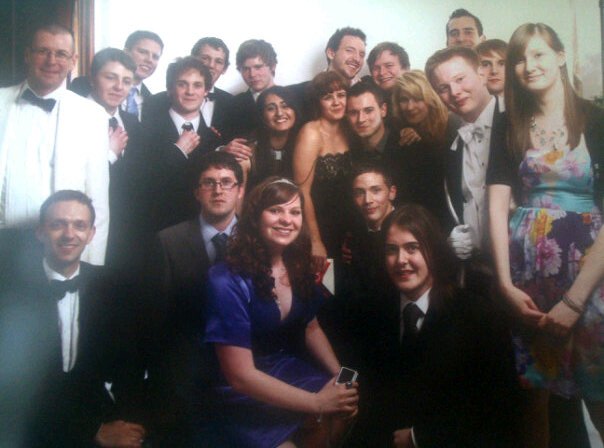
Anyway, some pictures are floating around on facebook. Here’s a couple, and I may add some more as they emerge from various cameras and phones. Of course it must be some kind of optical defect that makes me look so old in these, or perhaps it’s just because I’m surrounded by people less than half my age?

You’ll notice that I got the old white DJ out. Strictly speaking, UK tradition dictates that these should only be worn when abroad but I like wearing one when the weather is nice as it was yesterday whether it’s consistent with etiquette or not. There were plenty more serious breaches going on last night anyway, chiefly involving gentlemen removing their jackets at the dining table which is extremely poor manners.

You’re probably wondering what the second ball  refers to in the title of this post. Well, it’s just to remark that today in Cardiff  Wales played England at Football  (the “Association” variety, with a round ball, which I believe in some backward countries is called “soccer”). It was good to have an excuse for avoiding the city centre, and I was in a sufficiently vegetative state not to venture out of the house at all until the match was over. England beat Wales comfortably, 2-0.

UPDATE: Here’s a few more pictures, starting with one of me and the lovely Matthew. Well, at least one of us is photogenic…

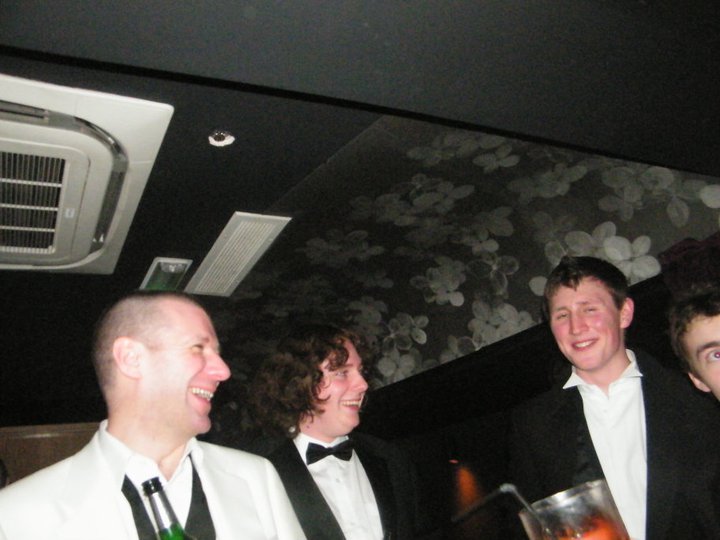
These two were snapped at the club later on…

Here’s a couple more, one of me and the gorgeous Flo…

..and one last one, which I suspect was taken very late in the proceedings


Share/Bookmark

Local News

Posted in Education, Finance, Politics with tags , , , , , , , on March 25, 2011 by telescoper

I’m looking forward to tonight’s Annual Chaos Society Physics Ball, in advance of which I’ll have to go home to get my glad rags sorted out.

This posh night out should provide some welcome fun at the end of a week in which various items of news concerning Welsh universities have generated considerable anxiety around these parts.

For a start the Welsh Assembly Government has announced funding levels for HEFCW, the body that distributes funding to Welsh universities. According to a newspaper article

The Higher Education Funding Council for Wales (Hefcw) has seen its core budget slashed by 8.5% from £453m in 2010-11 to £388m in 2011-12.

Well, pardon my numeracy but a cut from £453m  to £388m is actually a drop of 14.3% not 8.5%. This is much worse than the cuts already announced by HEFCE for English universities, although it remains to be seen how HEFCW will pass on this cut to the institutions it funds. Whatever it does will cause considerable pain, as this cut is being imposed a full year before universities will be allowed to recoup any losses by charging increased tuition fees.

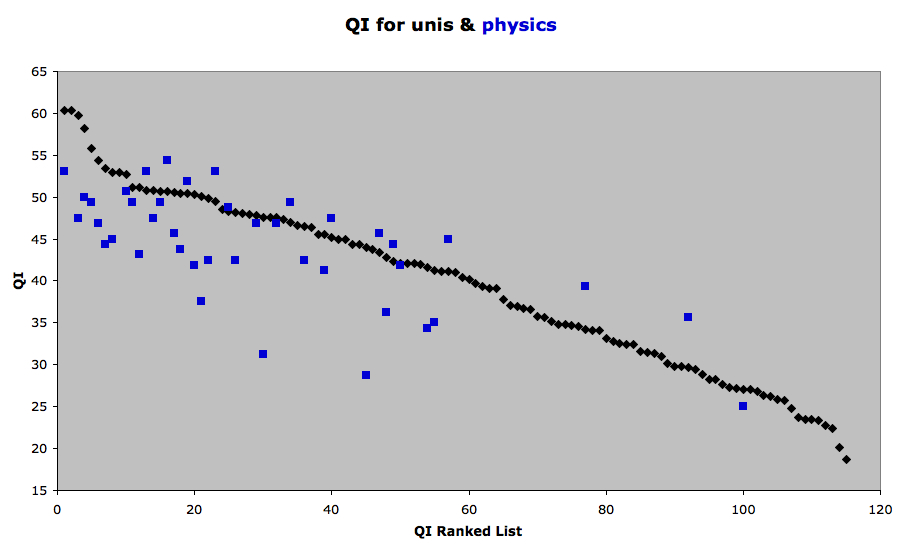
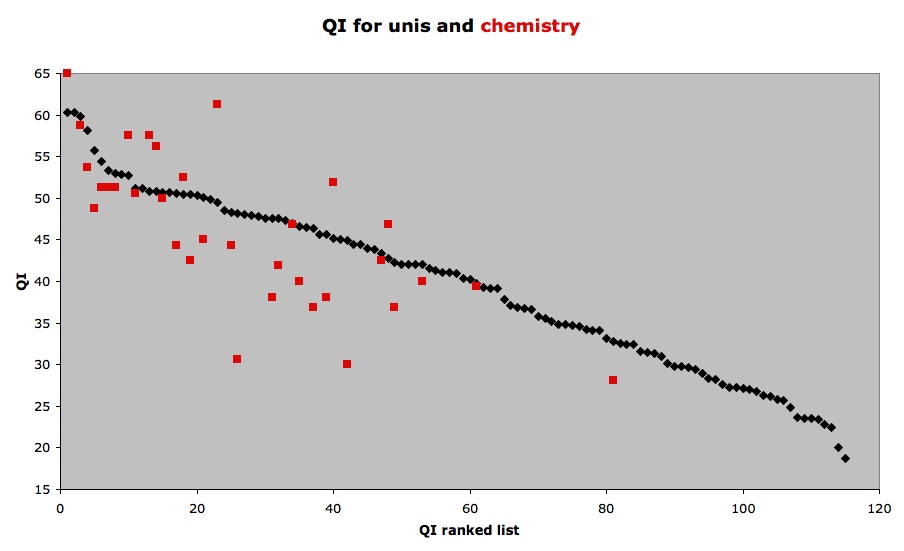
There was also some even more local and even more disappointing news this week concerning HEFCW. Over the past year or so, the three remaining physics departments in Wales (at Cardiff, Swansea and Aberystwyth) have developed a proposal to form a strategic alliance along the lines of similar initiatives in Scotland, the Midlands, and South-East of England which resulted in the injection of large amounts of cash into physics research in those areas. The bid went into HEFCW in January and this week we received the decision. No.

I suppose the decision wasn’t surprising given the current funding climate, but it’s nevertheless extremely disappointing to realise we’ve  missed a very important boat. If  Welsh physics had gone down this road a decade ago – which I believe it should – then we would be in much better shape to face the very uncertain future that hangs over us. Still, I suppose it spares us the effort of trying to think up an acronym.

What’s especially worrying about this is that it seems to me that it makes it  inevitable that Welsh physics will do as poorly in the forthcoming Research Excercise Framework as it did in the 2008 Research Assessment Exercise.
I think it’s worth quoting the observations made by Sub-panel 19 (physics) after the 2008 Research Assessment Exercise:

Sub-panel 19 regards the Scottish Universities Physics Alliance collaboration between Scottish departments as a highly positive development enhancing the quality of research in Scotland. South of the border other collaborations have also been formed with similar objectives. On the other hand we note with concern the performance of three Welsh departments where strategic management did not seem to have been as effective as elsewhere.

Ouch! The final sentence is completely out of order, of course, as it exceeds the remit of HEFCE (which administered the RAE) to try to dictate how Higher Education is run in Wales, as this responsibility is devolved to the Welsh Assembly Government. It is, however, to some extent a valid criticism. England and Scotland have pumped money into physics in order the develop strategic alliances. Wales hasn’t. And it isn’t going to either.

Given Wales’ relative autonomy when it comes to Higher Education I still don’t understand why its universities forced to participate in the REF anyway, but since it looks like we are stuck with it, I worry what the outcome will be, especially since Welsh physicists have been systematically excluded from the physics panel.

The last item of news concerns HEFCW itself. A report produced by John McCormick has recommended that it be scrapped and replaced with a new body called Universities Wales.

There are many reasons why scrapping HEFCW could turn out to be a good thing. For one thing, a new body might realise that continuing involvement in the REF is wasting a huge amount of time and money in the Welsh HE sector on an exercise that takes no account of Welsh strategic objectives. Nevertheless, I’m  a bit worried by some of the rhetoric coming out of the Welsh Assembly about this issue.

Universities are not the property of the Welsh Assembly (which in fact only funds part of their activity). Universities are independent charitable institutions. Their autonomy is essential in allowing them to do what they do best, free from the short-term expediency that dominates the thinking of the political establishment.

But that’s not to say that the Welsh Assembly is wrong to expect universities to respond to the changing socio-economic landscape. It’s all a matter of balance. If Universities Wales is sufficiently “hands-off” to allow universities to do what they do best – teaching and research – but sufficiently “hands-on” that it can help the HE sector to reorganize in the ways it clearly must, then this could be a very good move.

And if HEFCW does die, I’m afraid there will be few around these parts that mourn its passing.


Share/Bookmark

That Old “Two Cultures” Thing…

Posted in Art, Biographical, Education with tags , , , , , on March 20, 2011 by telescoper

Just a very brief follow-up to a post earlier this week about the 2nd Bright Club Wales. First, for all of you who refuse to believe I actually did stand-up, here is a picture of me doing it, i.e. standing up. It’s a bit blurred, I’m afraid. The person taking the picture must either have been drunk or was laughing so hysterically that he couldn’t hold the camera still. You can also find a review of the evening here, which is where I got the picture from.

I mentioned in the comments on the earlier posts that one of the other “acts” that evening was a lecturer in Film Studies. In fact that was a chap called Daryl Perrins who works at the University of Glamorgan.

He started his 8 minutes with the comment “I hate science” and followed it up with a number of unfunny remarks that relied on crude stereotypes of what a scientist is. None of that endeared him very much to me, nor, judging by the stony silence did the rest of the audience appreciate it much. I wouldn’t have minded him taking the piss out of scientists at all had it been funny. After all, I do a fair bit of that on here..

Anti-science attitudes are far from unusual amongst the Arts & Humanities fraternity, which I think is a real shame. After all, you’ll have to work very hard to find a scientist who would be prepared to stand up in front of audience and proudly announce “I hate art”. Many of my scientific colleagues have deep passions for the performing arts (especially music and drama) as well as being very well read across a wide range of subjects.  Many also hold strong  (and often idiosyncratic) political opinions and are involved in a huge range of activities outside science.

In short, scientists don’t just sit in their labs and offices torturing small animals. We live in the real world and have as much contact with wider society as anyone else. Imagination, creativity and free thinking can be found in scientists, just as they can in the arts.  Scientists both contribute to and participate in our society’s cultural heritage.Scientists are human beings. Culture belongs to us too.

Coincidentally this week there was an article in the Times Higher with the title “Life depends on science but the arts make it worth living“. I agree with a lot of what is written in the piece, in fact, although it does seem also to contain numerous examples of non sequitur and I think it’s both poorly argued and highly exaggerated. The arts are undoubtedly among the things that make  life worth living, but there are others, such as “ordinary” human relationships and the “simple” enjoyment of the natural world, which academics of all persuasions all too frequently neglect. I am a scientist, however, and I do think that the government should be spending more on science, but I certainly don’t think it should be robbing the arts and humanities which is what its current policies are doing.

You probably think I’m going to go off on a rant about the famous Two Cultures thesis advanced  by C.P. Snow, but I’m not. I think Snow’s analysis is only marginally relevant. I do think that there are “two cultures”, but these are not “science” and “the arts”. One is a creative, thinking culture that encompasses arts, the humanities and science. The other is its antithesis, a “culture” that sees the sole function of education as being to train people  to take their place on the never-ending treadmill of production and consumption.

The way we are heading, it’s not “two cultures” that we should be worried about. It’s no culture at all.


Share/Bookmark

Sentimental Education

Posted in Education, The Universe and Stuff with tags , , , on March 10, 2011 by telescoper

We’ve now reached the half-way point of the Spring Semester, which means that my teaching load has just doubled; I do the “Particle” bit of a third-year module on “Nuclear and Particle Physics”, which means I have 11 lectures from now until the end of the Semester to tell the students everything I know about particle physics. More than enough time.

Anyway, the first lecture today, as it was last year, was all about Natural Units. I always find it fun doing this, partly because the students stare at me as if I’ve taken leave of my senses. Come to think of it, they do that anyway.

The other night I was having a drink with some colleagues after work. Various topics came up, but we spent a bit of time talking about teaching. It appears that I’m in a small minority of my physics colleagues in that I actually like teaching. In fact, the older I’ve got the more I enjoy it. There’s always a limit, of course, and I wouldn’t like to do so much teaching that I couldn’t do other things, especially research, but I wouldn’t like to be in a job that didn’t involve teaching at all. I think most of my colleagues would jump at the chance to abandon teaching altogether. I can’t understand that attitude, mainly because I find it so rewarding myself, but I’m in a minority of one about so many things nowadays that I’ve ceased worrying about it.

I do sometimes wonder why I find teaching so rewarding. Perhaps it’s because I’m already middle-aged and don’t have any kids of my own. Teaching at least gives me a chance to play some sort of a role in someone else’s development as a person. I can’t guarantee that it’s necessarily a positive role, but there you are.  Another thing is that sometimes when I travel about at conferences and whatnot I get to meet people I taught years ago. It means a lot when they say they remember the lectures, especially if they’ve now embarked on scientific careers of their own.

One of the problems of the government’s push for greater concentration of research funds and the simultaneous slashing of teaching budgets is that the quality of University teaching is bound to suffer. If research funding is allocated only to self-styled research  “superstars” then Universities will obviously spare them from other duties. Teaching loads for ordinary foot soldiers will increase, with obvious consequences in decreasing enthusiasm among lecturing staff.

It’s already the case that teaching is grossly undervalued, and it’s probably worse in physics departments than anywhere else because, without research funding, most would simply go bust. Teaching funding is nowhere near sufficient to cover the real cost of a physics degree and in any case we can’t deliver advanced physics training without access to the research labs.

On top of this there’s the way teaching is entirely disregarded in promotion cases. On paper, promotion to Professor requires demonstrated commitment to teaching. In reality, all that committees care about is how much research income the candidate brings in. Excellence in teaching counts very little, if anything at all, in the assessment of a promotion case. I think this situation must change, especially with tuition fees set to rise to unprecedented levels, but all the forces currently at play are acting in precisely the wrong direction.

If we concentrate physics research funding any further then we’ll have a small number of rich institutions stuffed full of research professors whom the undergraduates never see. The less successful academics in these departments will be put on teaching-only contracts, not because they like teaching but because their alternative is Her Majesty’s Dole. Meanwhile, less favoured research labs – i.e. those who don’t get lucky in the REF – won’t be able to sustain world-class research or teaching activities and will be forced to shut up shop. Further research concentration is bad news all round for the higher education system.

But I digress.

One of the other things we talked about in the pub was the National Lottery. As regular readers of this blog might know, I put the princely sum of £1 on the lottery every Saturday. Some think this is strange, but I see it partly as one of those little rituals we all invent for ourselves and partly as a small price to pay for a little frisson of excitement when the numbers are drawn.

But I do sometimes wonder what on Earth I would do if I won a multi-million pound jackpot prize. Would I quit my job? Would I quit teaching? Actually, I’m not sure I would do either of those. If I could ditch the admin stuff, I would of course do so. I don’t have a car and have no interest in getting one, especially a fancy one. I don’t need a bigger house, or a yacht.  In fact, frankly, there’s nothing that I would really want to buy that I couldn’t buy already. It’s not that I have a huge salary, just that I’m not exactly very materialistic.

So even if I were rich I’d probably carry on doing pretty much what I do now. And that thought brings home just how lucky we are, those of us working in academia. For all the frustrations, the fact remains that we are fortunate to be getting paid for things that we enjoy doing.

Or am I just a sentimental old fool?

Anyway, I feel a poll coming on…


Share/Bookmark

A Modest Proposal

Posted in Education, Science Politics with tags , , , , on March 7, 2011 by telescoper

Last week I posted a short item about the looming Kafka-esque nightmare that is the Research Excellence Framework. A few people commented to me in private that although they hate the REF and accept that it’s ridiculously expensive and time-consuming, they didn’t see any alternative. I’ve been thinking about it and thought I’d make a suggestion. Feel free to shoot it down in flames through the box at the end, but I’ll begin with a short introduction.

Those of you old enough to remember will know that before 1992 (when the old `polytechnics’ were given the go-ahead to call themselves `universities’) the University Funding Council – the forerunner of HEFCE – allocated research funding to universities by a simple formula related to the number of undergraduate students. When the number of universities suddenly increased this was no longer sustainable, so the funding agency began a series of Research Assessment Exercises to assign research funds (now called QR funding) based on the outcome. This prevented research money going to departments that weren’t active in research, most (but not all) of which were in the ex-Polys. Over the years the apparatus of research assessment has become larger, more burdensome, and incomprehensibly obsessed with “research concentration”. Like most bureaucracies it has lost sight of its original purpose and has now become something that exists purely for its own sake.

It’s especially indefensible at this time of deep cuts to university budgets that we are being forced to waste an increasingly large fraction of our decreasing budgets on staff-time that accomplishes nothing useful except pandering to the bean counters.

My proposal is to abandon the latest manifestation of research assessment mania, i.e. the REF, and return to a simple formula, much like the pre-1992 system,  except that QR funding should be based on research student rather than undergraduate numbers.

There’s an obvious risk of game-playing, and this idea would only stand a chance of working at all if the formula involved the number of successfully completed research degrees over a given period .

I can also see an argument  that four-year undergraduate students (e.g. MPhys or MSci students) also be included in the formula, as most of these involve a project that requires a strong research environment.

Among the advantages of this scheme are that it’s simple, easy to administer, would not spread QR funding in non-research departments, and would not waste hundreds of millions of pounds on bureaucracy that would be better spent on research. It would also maintain the current “dual support” system for research.

I’m sure you’ll point out disadvantages through the comments box!


Share/Bookmark

`Difficult to Defend’

Posted in Education, Finance with tags , , on February 26, 2011 by telescoper

My copy of the Times Higher arrived a little late this week, so I’ve only just seen the latest evidence that the Westminster government’s plans for English Higher Education are degenerating into farce.

For a start it seems that the government made a serious error in believing that the Office For Fair Access (known to its few friends as OFFA) actually doesn’t have the legal authority to impose fee levels on universities. The government had assumed that they would be able to prevent all universities charging the maximum £9K allowed under the new rules. But they can’t.

Since the increased tuition fee is being offset by cuts of up to 80% in teaching budgets it’s no surprise that universities want to maximise the income from fees. Oxford, Cambridge, Imperial College and UCL have all already indicated that they will go for the maximum, which isn’t surprising since these are among the leading universities in the country. It may be that some universities, perhaps from the ex-Poly sector, might try to go for the `pack ’em high and sell ’em cheap’ approach to undergraduate degrees, but a more challenging issue is what the middle-grade universities will do. Will they try to compete on price, or will they fear that charging less than £9K will get them branded as second-rate?

However, if all universities charge £9K – which has always seemed to me to be the most likely outcome – then this costs the government much more than it anticipated, because it has to provide a much higher amount in loans. David Willetts has argued that the £9K limit is `difficult to defend’, claiming that despite the cuts a fee of this size would lead to a 40% increase in teaching resource. This isn’t actually true because universities will have to devote a large slice of the fee income to supporting less-well-off students and they are also being hit by huge cuts in capital funding, which will have to be made up some way. Methinks Willett’s famous two brains might have got their wires crossed.

Whether the £9k level is defensible or not, the government appears powerless to stop universities charging it, so is threatening to penalise research grants or to cut the number of student places if too many try it. This looks like panic to me.

The current state of British Higher Education policy is difficult to defend in other ways too. In among the figures spun out by Willetts is one that reveals that 80% of UK students are in subjects outside the area of Science, Technology, Engineering and Mathematics (STEM), which attract a lower level of central funding than STEM disciplines. However, the differential is not as large as you might think: there’s only a factor two between the lowest band (D, including Sociology, Economics, Business Studies, Law and Education) and the STEM band B (including my own subject, Physics). The real difference in cost is much larger than that, and not just because science subjects need laboratories and the like.

To give an example, I was talking last week to a student from a Humanities department at a leading University (not my employer). Each week she gets 3 lectures and one two-hour seminar, usually run by a research student. That’s it for her contact with the department. In my School, a typical student can expect around 20 contact hours per week including lectures, exercise class, laboratory sessions, and a tutorial (usually in a group of four). The vast majority of these sessions are done by full-time academic staff, not PDRAs or PhD students, although we do employ such folks in laboratory sessions and for a very small number of lectures. It doesn’t take Albert Einstein to work out that 20 hours of staff time costs a lot more than 3, and that’s even before you include the cost of the laboratories and equipment needed to teach physics. In the current system, however, students pay the same fee for STEM and non-STEM subjects.

This situation not only works as a powerful disincentive for a university to invest in expensive subjects, such as physics, but also rips off arts students who are given very little teaching in return for their fee. It is fortunate for this country that scientists working in its universities show such dedication to teaching as well as research that they don’t try to do what our cousins in the arts do. I sense a growing consensus, however, that we’re being ripped off too.

I suppose it could be argued that the big cuts in teaching grant in England do something to redress this anomaly, as the central funding element for Arts & Humanities subjects is cut to zero in the new funding regime. On the other hand, however, if universities do charge £9K for all subjects then the differential between arts and sciences will turn out to be lower than 2:1, as the central funding element for STEM subjects is far less than £9K. On the other other hand, if STEM subjects were to charge a higher fee than the others then demand would probably collapse.

To get another angle on this argument, consider the comments made by senior members of the legal profession who are concerned about the drastic overproduction of law graduates. Only about half those doing the Bar Professional Training Course after a law degree stand any chance of getting a job as a lawyer in the UK. Contrast this with the situation in science subjects, where we don’t even produce enough graduates to ensure that schools have an adequate supply of science teachers. The system is completely out of balance.

I don’t see anything in the post-Browne era that will alter this ridiculous situation. STEM subjects will continue to be strangled and universities will continue to overproduce graduates in other areas. Somebody has to get a grip. I doubt the Westminster government is capable of doing this. It has already delayed its planned White Paper on Higher Education, providing yet another indication that it has completely lost the plot.

Or maybe it’s making a complete botch of the situation deliberately, as part of a cunning plan to encourage universities to go private?


Share/Bookmark

A First Problem in Astrophysics

Posted in Education, The Universe and Stuff with tags , , , , on February 25, 2011 by telescoper

When I first arrived at Cambridge University (nearly 30 years ago) to begin my course in Natural Sciences, eventually leading to a specialism in Physics, one of the books we were all asked to buy was the Cavendish Problems in Physics. One of the first problems I had to solve for tutorial work was from that collection, and I have been setting it (in a slightly amended form) for my own students ever since I started lecturing. I thought I’d put it up here because I think there might be a few budding theoretical astrophysicists who’ll find it interesting and because it provides a simple refutation of a crazy theory that has been doing the rounds on Twitter all morning.

I like this problem because it involves a little bit of lateral thinking, because not all the information given seems immediately relevant to the question being asked, but you can get a long way by just writing down the pieces of information given and thinking about how you might use simple physical ideas to connect them to the answer.

If you haven’t seen this problem before, why not have a go?

Using only the information given in this Question, estimate the ratio of the mean densities of the Earth and Sun:

i) the angular diameter of the Sun as seen from Earth is half a degree

ii) the length of 1° of latitude on the Earth’s surface is 100km

iii) the length of a year is 3×10⁷ seconds

iv) the acceleration due to gravity at the Earth’s surface is 10 m s-2.

HINT: You do not need to look up anything else, not even G!

The answer you should get is that the mean density of the Earth is something like 3.5 times that of the Sun, although the information given in the question isn’t all that accurate.

In fact the mean density of the Earth is about 5500 kg per cubic metre, and that of the Sun is about 1400 kg per cubic metre; the average density of the Sun is just 40% higher than water, which is perhaps surprising to the uninitiated….

The density of solid iron on the other hand is about 7900  kg per cubic  metre, and even higher than that if it is compressed…

UPDATE: I’ve added my Solution.

Share/Bookmark

Meet the Panel …

Posted in Education, Science Politics with tags , , , , , , , on February 21, 2011 by telescoper

Just a quick post to pass on the news that the Higher Education Funding Council for England (HEFCE) has announced the list of panel members for the forthcoming Research Excellence Framework (REF), a massive exercise in bean counting which will drag on until 2014.

Much as I enjoy ploughing through HEFCE’s fascinating documents, in this case I went straight to the Physics (& Astronomy) sub-panel, which is:

All estimable folk and a good selection of different expertise. There’s also a good geographical spread with members from the English regions, Scotland, Northern Ireland, and of course Wales. Oh, wait a minute. Not Wales. Apparently Wales doesn’t merit any representation on the Physics REF panel. Nor did it last time. Why am I thinking to myself “here we go again”?

To be perfectly honest, I don’t really understand why Welsh universities are being forced to take part in the REF anyway. Or those from Scotland and Northern Ireland for that matter. The REF is driven by an English agenda which is certainly at variance with Welsh priorities. Whereas in England, HEFCE is allocating funding using a formula involving an exceedingly steep weighting towards “internationally leading” research, here in Wales the equivalent body HEFCW is resisting the urge to concentrate research cash so heavily according to such a doubtful measure of research quality.

And don’t get me started on the so-called “impact” measures. All I can say about them is that Kafka would have been proud.

The Welsh Assembly Government has recently taken steps to protect Welsh students against the effects of Higher Education cuts imposed by Westminster. However, there will be substantial cuts in resource to Welsh universities in order to pay for this. At the same time as making “efficiency savings”, as is appropriate for the age of austerity, we’re also being forced to participate in a monstrously wasteful bureaucratic exercise of little relevance to the needs or aspirations of Welsh universities.

I think there’s a strong case for HEFCW to show a bit of real independence and withdraw from the REF altogether.


Share/Bookmark

Harriet Presents…

Posted in Education with tags , on February 18, 2011 by telescoper

Now here’s a short video called a (presented by the legendary Harriet Parfitt) explaining the joys of studying  in the School of Physics & Astronomy at Cardiff University. It’s somewhat spoiled by the appearance of yours truly (filmed during a recent first-year  Astrophysical Concepts lecture) but apart from that it’s really rather good!


Share/Bookmark