Archive for the Education Category

A Gloom of Uninspired Research

Posted in Education, Poetry, Politics, Science Politics with tags , , , , , , , on November 26, 2010 by telescoper

I don’t mind admitting that I’m a bit down today. Being stuck at home with a fever and sore throat, and with mounting backlog of things to do isn’t helping my mood. On top of that I’ve got a general sense of depression about the future.

On the one hand there’s the prospect of huge increases in tuition fees for students, the motivation for many demonstrations all around the country (including an occupation here at Cardiff). I have to admit I’m firmly on the side of the students. It seems to me that what is happening is that whereas we used to finance our national gluttony by borrowing on over-valued property prices, we’ve now decided to borrow instead from the young, forcing them to pay for what we got for free instead of paying for it ourselves; it’s no wonder they’re angry. Call me old-fashioned, but I think universities should be funded out of general taxation. How many universities, and what courses, are different questions and I suspect I differ from the younger generation on the answers.

The other depressing thing relates to the other side of academic life, research. The tide of managerialism looks like sweeping away every last vestige of true originality in scientific research, in a drive for greater “efficiency”. I’ve already blogged about how the Science & Technology Facilities Council (STFC) is introducing a new system for grants which will make it impossible for individual researchers with good ideas to get money to start new research projects. Now it seems the Engineering and Physical Sciences Research Council (EPSRC) is going to go down the same road. It looks likely that in future only large-scale, low-risk research done in big consortia will be funded. Bandwagons are in; creativity is out.

Improving “efficiency” sounds like a good idea, but efficiency of what? These plans may reduce the cost of administering research grants, but they won’t do anything to increase the rate of scientific progress. Still, scientific progress can’t be entered easily on a spreadsheet so I suppose in this day and age that means it doesn’t matter.

I found the following in a story in this weeks Times Higher,

A spokeswoman for the Science and Technology Facilities Council also cited stability and flexibility as the main rationales for merging its grants programmes into one “consolidated grant”, a move announced earlier this month.

It looks like STFC has seconded someone from the  Ministry of Truth. The change to STFC’s grant system is in fact driven by two factors. One is to save money, which is what they’ve been told to do so no criticism there. The other is that the costly fiasco that is the new RCUK Shared Services Centre was so badly conceived that it has a grant system that is unable to adminster 5-year rolling grants of the type we have been used to having in astronomy. On top of that, research grants will last only 3 years (as opposed to the previous 5-year duration). There’s a typically Orwellian inversion  going on in our spokesperson’s comment: for “stability and flexibility”, read “instability and inflexibility”.

We’re not children. We all know that times are tough, but we could do with a bit less spin and a bit more honesty from the people ruining running British science. Still, I’m sure the resident spin doctors at STFC are “efficient”, and these days that’s all that matters.

The following excerpt from Wordsworth’s The Excursion pretty much sums it up.

Life’s autumn past, I stand on winter’s verge;
And daily lose what I desire to keep:
Yet rather would I instantly decline
To the traditionary sympathies
Of a most rustic ignorance, and take
A fearful apprehension from the owl
Or death-watch: and as readily rejoice,
If two auspicious magpies crossed my way;–
To this would rather bend than see and hear
The repetitions wearisome of sense,
Where soul is dead, and feeling hath no place;
Where knowledge, ill begun in cold remark
On outward things, with formal inference ends;
Or, if the mind turn inward, she recoils
At once–or, not recoiling, is perplexed–
Lost in a gloom of uninspired research;
Meanwhile, the heart within the heart, the seat
Where peace and happy consciousness should dwell,
On its own axis restlessly revolving,
Seeks, yet can nowhere find, the light of truth.


Share/Bookmark

Uncertain Universities…

Posted in Education, Politics with tags , , , , on November 24, 2010 by telescoper

Interesting snippets of Higher Education news today from the BBC website.

It seems that the Higher Education Funding Council for Wales (HECFW) has voiced concerns about the sustainability of no less than five Welsh universities. Although it hasn’t named them, I think it’s likely to be those most dependent on state funding which is pretty certain to shrink drastically over the next few years. I’ll leave it as an exercise for the reader to identify the five most likely to fold. This news has emerged as a result of a request by the BBC under the Freedom of Information Act.

This comes as no surprise to me, actually. It’s clear that, for its size and population,  Wales has too many separate institutions currently regarded as “universities”. A sustainable system would have less than half the number than we have now, but managing the change to a more rational structure is bound to be a difficult process, especially if it is allowed to happen by organized neglect (which seems to be the plan). Wales drastically underfunds its Higher Education sector compared to England anyway and, with what jam there is spread over far too many institutions, there’s very little by way of resources to devote to any real sort of strategic development.

Another interesting bit of information in the BBC report is that the Welsh Assembly is expected to outline its response to the Browne Review before Christmas. I was expecting the WAG to but  the introduction of any new fee system will probably have to wait until after the Welsh Assembly elections next May.

Meanwhile Cardiff University students are holding a protest against the possible introduction of fees at the very moment I am writing this, as part of a day of action across the UK. Although there are no definite plans to increase fees in Wales at the moment because the WAG has not announced its policy, I think most of us working in academia think a big increase in fees is imminent in Wales, just as it is in England (provided the necessary legislation gets through the House of Commons). It remains to be seen, however, whether Welsh universities will be allowed to charge as much as English ones, i.e. up to £9000 per annum.


Share/Bookmark

A Sign of the Times

Posted in Education, Finance with tags , , on November 18, 2010 by telescoper

Given yesterday’s announcement of cuts to the Higher Education budget in Wales, and the likely outcome in terms of increased costs to students, this picture of a sign I found the other day at the entrance to Bute Park seems particularly apt…


Share/Bookmark

Higher Education Spending in Wales

Posted in Education, Politics with tags , , , on November 17, 2010 by telescoper

Just a quick post to pass on the news that the Welsh Assembly has now published its draft budget for 2011/12 (and following years). You can find the documents related to this here, the most useful one of which is this.

I haven’t got time to comment in detail but, being a university employee, I skipped directly to the section about Higher Education and found the following:

In order to direct funding to schools and skills, the majority of budget reductions have been focused on specific budgets. Higher Education will receive a reduction over the next 3 years of £51m. This amounts to some 11.8%, compared to the severe reductions proposed in England. The planned reductions will facilitate the statutory commitment to provide financial support for Higher Education students, numbers of which have increased significantly over the past two years. This does not predetermine the Welsh Assembly Government’s response to the Browne Review. The reductions include the efficiency savings we expect to be delivered through the implementation of our Higher Education strategy, For our Future. The commitment to the development of the University of the Heads of The Valleys (UHoVI) and Coleg Cymraeg Cenedlaethol (formerly Coleg Federal) will, however, remain a priority to
be funded from this budget.

In other words, Higher Education is to bear the brunt of protecting the budgets for Schools (which remains roughly level in cash terms) and  Further Education (which is cut by about 2%). Clearly the WAG must either think that  maintaining funding for Higher Education  is a low priority or that money saved from HE can be recouped some other way (i.e. through increasing fees or cutting student support).

An 12% cut in cash terms is much worse in real terms, of course, but the draft budget doesn’t give any details of how this is going to be broken down in terms of research and teaching allocations. Moreover, the Welsh Assembly has yet to formulate a response to the Browne Review which has resulted in proposals for tuition fees up to £9000 per annum in England. Since the Welsh Assembly elections are to be held next May, it is highly unlikely that a new tuition fee system for Wales  will be in place before then. Moreover, the fact that funding is being diverted into the new institutions described above suggests that even less money than this will be available for established universities.

We also don’t know the extent to which research will be protected. In England, a cut of 40% has been applied to teaching budgets from next year, with research funding largely preserved. It appears something similar is going to happen in Scotland, but with a much smaller overall cut to the universities budget there. Will Wales follow the same pattern, or will it sacrifice any chance of having high quality research-led universities by single-mindedly pursuing its “regional agenda”?


Share/Bookmark

After Piero

Posted in Art, Education, Politics, The Universe and Stuff with tags , , , on October 31, 2010 by telescoper

I don’t often blog about things inspired from TV programmes. I don’t watch that many, and those I do see are rarely inspirational. However, last night, I caught the last of the series Renaissance Revolution, presented by Matthew Collings. It was on the subject of a major obsession of mine, the art of Piero della Francesca, and I thought it was wonderful. I regret having missed the previous programmes in the series, but I’m sure I’ll get a chance to see them sometime.

Collings focused on one particular painting by Piero, The Baptism of Christ, which hangs in the National Gallery in London, and which is illustrated below:

The political and religious backround to this painting are almost as fascinating as its composition, based on the offset superposition of a circle (representing heaven) and a square (representing the Earth). The use of perspective was very new around 1450 when this painting was finished, but that’s not the only geometrical aspect to note. There’s a striking use of symmetry (e.g. in the angles of John the Baptist’s arm and leg), and the central vertical axis defined by the dove, John’s hand and Christ’s hands.

Given the mathematical rigour of his compositional techniques, it should come as no surprise to learn that in his lifetime Piero was just as famous as a mathematician as he was as an artist. In other words he was the archetypal renaissance man. Unfortunately, most of his art doesn’t survive; the vast majority of his works were frescoes in various churches, few of which have withstood the test of time. Regrettably, little also is known about Piero the man, except that he lived into his 80s.

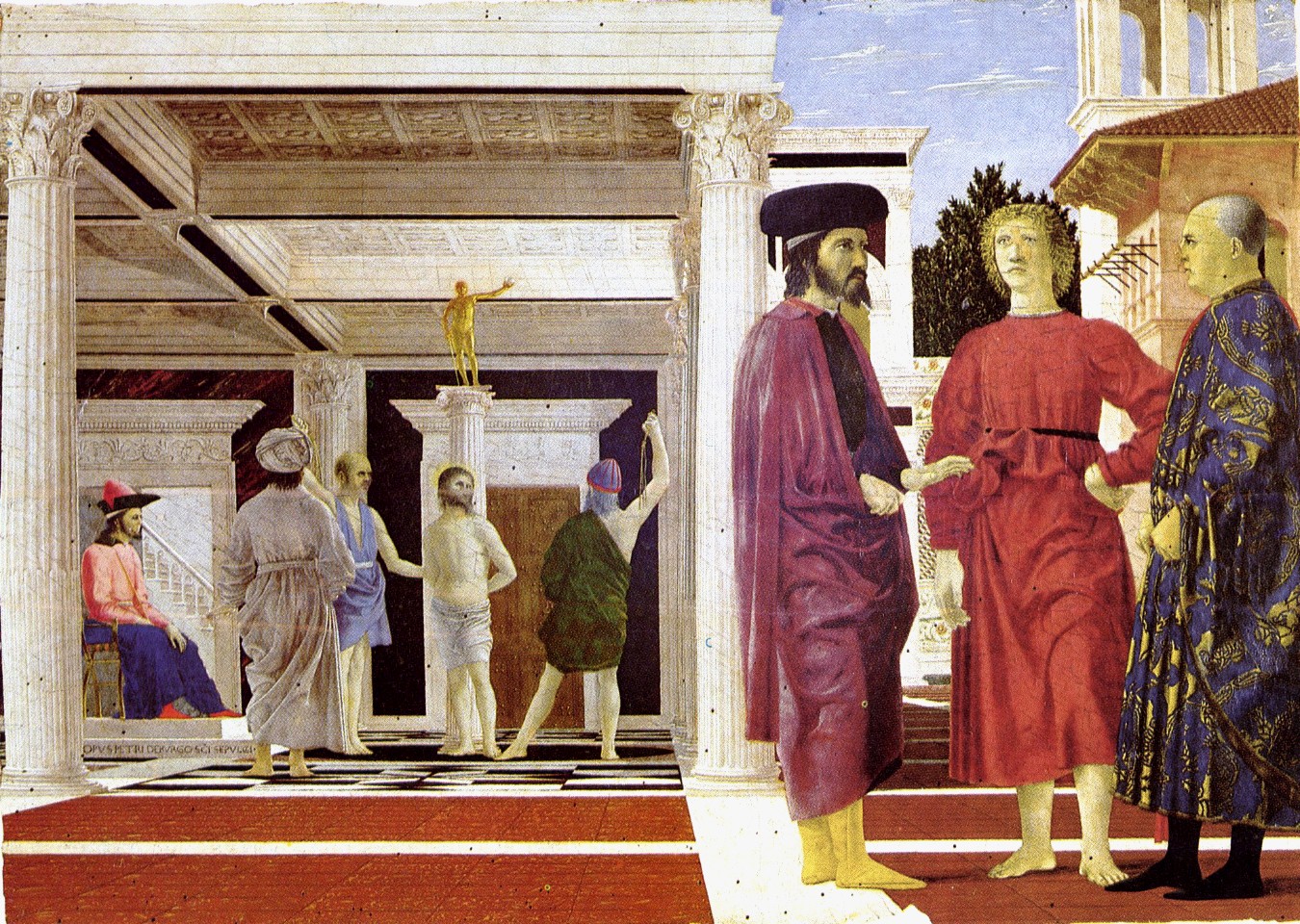
A while ago I mentioned another work by Piero which is the origin of my obsession with his paintings. The Flagellation of Christ is a work that has burrowed so far into my psyche that I quite often dream that I’m in the strange building depicted therein:

In fact I also use this painting in talks about science – I did so in my talk on Wednesday, in fact. The reason I use it in that context is that it is a bit like the standard model of cosmology. On one level it makes sense: the flat Euclidean geometry mapped out by the precise linear perspective allows us to understand the properties of the space extremely well, including the scale (the vanishing point indicates a front-to-back distance of about 250 ft). This is what our standard cosmology says too:- the universe also has a flat geometry. On the other hand, the more you think about the contents, the more confusing the picture gets. The main subject matter of the painting is to the left, in the background, playing an apparently minor part in the whole thing. Who are the characters surrounding the Christ figure? And who are the three figures in the foreground, dominating the whole composition, but seemingly indifferent to what is going on behind? Do they represent dark energy? Do the other characters represent the dark matter?

That’s not meant to be taken seriously, of course, and nobody actually knows what is really going on in this painting. It’s undoubtedly beautiful, but also an enigma, and that combination is what makes it a great work of art. It’s not easy to understand. It makes you wonder.That’s what science is like too. We have our theories, we have data, but there always remains a great deal we don’t understand. And sometimes the more we think about it, the more confused we get. Just as it is with that painting.

As Mark Collings put it brilliantly in the programme last night

When you’re looking at the picture, analysis isn’t exactly what is going on. You’re seeing and you’re getting pleasure from seeing. Partly the picture is telling you how pleasure is constructed, how it’s created, and partly you’re just lost in it. So when you’re lost in the light of Piero, you’re experiencing when you’ve forgotten how to experience. And you’re suddenly curious when you’ve forgotten how to be curious. And what you’re experiencing and being curious about is .. the world.

It doesn’t matter whether you’re a scientist or an artist (or a poet or a philosopher or a historian or whatever). The need to be curious about the world – or some aspect of it – is surely what it’s all about. During the Renaissance it wasn’t unusual for great minds to embrace science, mathematics and art – just think of Leonardo da Vinci. However, over the centuries we’ve become increasingly specialised and compartmentalised and more focused on making money than on making ideas. We’re losing what above all else is what makes us human, our curiosity.

Our society increasingly sees education simply as a means to develop skilled workers, smart enough to do technically complicated jobs, but not clever enough to ask too many questions about the materialistic treadmill they will spend their life upon. The UK government’s plan to withdraw funding for arts and humanities departments in universities is just another step along this path.

It shouldn’t be like this. Universities should be about learning for learning’s sake; not about teaching facts or skills, but about teaching people to ask questions and figure out their own answers. In other words, they should be about curiosity.


Share/Bookmark

Did HE fall, or was it pushed?

Posted in Education, Politics with tags , , , , , , on October 30, 2010 by telescoper

One of the other scary bits of news to emerge last week concerns proposed changes to the arrangements for tuition fees in English universities. According to the Times Higher, the Minister responsible for universities, David Willetts, has admitted that the cuts to university budgets announced in the Comprehensive Spending Review, will occur before any new money flows into universities from whatever new fee arrangements emerge from the government’s deliberations following the Browne Report.

One of the recommendations of the Browne Report was that central government funding for arts, humanities and social sciences be scrapped entirely. Although I’m a scientist and I do think Science is Vital this is a very bad move, as I think other forms of scholarship and learning are vital too, for a wide range of reasons including cultural ones. It was never clear whether arts & humanities departments would be able to recoup the money lost as a result of cuts to central funding, but now it appears they will have to survive for an indeterminate time without any prospect of extra income to offset the shortfall.

The upshot of all this will be a huge and immediate cut in the budgets of many university departments, a  state of affairs about which Willetts commented only thus:

You have to expect that there will be pressure on universities to save money, and we don’t think they should be exempt from the pursuit of efficiencies.

Can an immediate 40% cut in teaching income be made by efficiency savings? I don’t think so, Mr Willetts. Even making large-scale redundancies won’t help there, as that costs a lot of money up front.

So why is the government pushing through cuts to university funding before ensuring that the new fee arrangements are in place? A variety of answers are possible. One would be incompetence, always a possibility when politicians are involved. However, although this government has tried to rush things through very quickly, I do not believe that this is something that hasn’t been considered very carefully. I think it’s deliberate.  I believe that this government wants some universities to fail, and has found an opportunity to push them over the edge.

It’s not about efficiency savings, it’s about survival of the fattest. Only those places able to dig into their reserves for several years will be able to weather the storm. Some will cope, some won’t. That’s the point.

It’s well known that several universities, most of them post-1992 institutions, have been struggling financially for a considerable time. In the past, special procedures have always been implemented to protect organizations of this type that have been close to insolvency. This government has said that will do things differently, and that universities that go bust will now be allowed to fail. This may involve them closing altogether, or being taken over by private companies. If I were working in a university heavily dependent on income from arts, humanities and social science teaching, I would be extremely nervous about the future. I mean, more nervous than I am anyway, working as a scientist in an institution which is financially sound. And that  is already very nervous indeed.

The other side of this particularly nasty coin, is that more “prestigious” institutions specialising in non-STEM areas, such as the London School of Economics, are already considering the option of going private. If the government gives them no support directly, yet insists – as seems likely – in capping the fee students pay at a figure around £7K per annum as well as strangling them with yards of red tape as HEFCE is wont to do, then why not just withdraw from the system and set fees at whatever level they like? It’s unlikely that an institution with a strong science base will go down this road, as the taxpayer is going to continue supporting STEM subjects, but it seems to me that it would make sense for the LSE to opt out of a system whether the costs of membership exceed the benefits received.

In the longer term, the squeeze is set of continue. According again to the Times Higher, the net revenue from fees will only replace part of the funding withdrawn over the CSR period. It looks like five years of struggle during which many departments may go under. The more you think about it, the worse it looks.

However, perhaps a better question than the one I asked a couple of paragraphs ago is the following. Why is the government intent on slashing the budgets of HE institutions, when it appears to have  let Vodafone off without paying a bill for £6 billion tax?

That amount would have been more than enough to tide the HE sector over until the new fee stream came online…


Share/Bookmark

The Day After: A Welsh Perspective

Posted in Education, Politics, Science Politics with tags , , , , , , , on October 21, 2010 by telescoper

It’s well after 11am and I’m still at home. Came down last night with some sort of bug that kept me awake nearly all night with frequent visits to the smallest room in the house. Whatever it is is still rumbling on so I’ve decided to stay at home until I give myself the all clear.

This sudden attack of lurgy is probably not connected with yesterday’s dramatic announcements of the results of the comprehensive spending review, which are now being dissected and analysed all over the mainstream press, the blogosphere, and countless common rooms around the country.

I haven’t got the energy right now to go over the ramifications in detail, but encourage you to read the whole thing, which is available in a nifty online reader for your perusal. I will, however, make a few brief comments, with particular emphasis on the situation here in Wales.

First, the announcement of large cuts to the teaching budget administered by HEFCE has clearly sent shockwaves through academia. It appears that only STEM subjects will continue to receive the state contribution and in future students will have to bear the full cost of tuition (but only after they’ve graduated and started to earn over the threshold of £21K). As a supporter of the Science is Vital campaign I was relieved that we seem to won a victory, although the war is far from over. However, I feel great sadness at the cost that our success seems likely to inflict on other disciplines. If you think these are nervous times for scientists, imagine what it must be like working in the Arts and Humanities.

Of course this all applies directly only to English universities: the budgets for Higher Education in Scotland, Wales and Northern Ireland are administered separately, so in principle things could work out very differently for Higher Education here in Wales.

However, the total amount of money available for the Welsh Assembly Government (WAG) to spend is fixed by the Westminster government through the Barnett Formula. This determines the overall cash for the devolved governments by allocating a proportion of what England spends on those things that are devolved., i.e. Wales is notionally allocated an amount for Higher Education which is proportional to HEFCE’s allocation and similar for other areas of spending such as Health. Once the size of the overall pot is fixed, however, the WAG is not obliged to spend its money in the same way that England does.

Buried in the pages of the CSR document is Wales’ allocation over the CSR period, which shows real terms cut of about 7.5% over the term. However, the Welsh Assembly Government’s reaction puts it rather differently:

In real terms, our total Budget is set to fall by around 3.1% per year on average, or 12% in total over the coming four years. This means that our Budget in 2014/15 will be £1.8bn lower in real terms than it is this year. Overall, in cash terms the reductions to our Budget will be 3% over the period.

Our capital Budget has been hit particularly hard, and will be cut by 40% in real terms – 34% in cash terms – over the next four years. This substantial reduction, particularly next year, where the cut is more than 25% in real terms, will clearly have a major impact on the private as well as the public sectors.

These figures seem different from those in the CSR document, which might be because of some nuance such as the way capital expenditure is accounted. If anyone can explain the discrepancy through the comments box I’d be grateful.

The main point is, though, that if Wales is going to keep current levels of investment in Higher Education (or even cut less than the English are doing) then it will have to take the money from elsewhere, which is not going to be easy to get through the Welsh Assembly. The picture, therefore, may not be any better here in Wales than it is in England, and could well turn out even worse, depending on how the WAG sets its own spending priorities. To complicate matters further, there’s an election next year for the Welsh Assembly, so there’s a wider political perspective to consider.

Within the overall issue of Higher Education spending is the question of whether Wales will decide to protect funding for STEM disciplines at the expense of all others. The WAG has already produced a document that suggests a strong focus on the so-called regional agenda, which may mean more money going into Further Education, vocational training, and part-time studies rather than, say, research-led science. I know what I would prefer, but whatever I say, it’s the WAG’s decisions that really count. And so it should be. After all, unlike me, they were elected!

Of course, if STEM subjects aren’t protected in Wales, those of us working in those areas are likely to lose even more ground to English universities, which already out-perform us in many respects. We have to make our case as best we can and see what happens.

However, I will end with some more local news which is extremely promising. Yesterday we had a staff meeting in the School of Physics & Astronomy at Cardiff University during which two extremely positive items came to light. One is that we will shortly be interviewing for the extra physics posts we advertised some time ago. Hopefully there will be a new Professor and three new Lecturers joining the staff in the very near future. I’m told we had a huge number of applicants for these positions, and the shortlists for these positions are very strong indeed. This is all very encouraging.

On top of this there is another exciting development on the horizon. After the disappointing outcome of the last RAE for physics in Wales, we have been thinking very hard at working closer with colleagues at Swansea with a view to building a sort of South Wales Physics Alliance. The departments are complementary in many ways: Swansea does particle physics, but Cardiff doesn’t; Cardiff does astronomy, but Swansea doesn’t. Where we are both relatively weak is in so-called “mainstream” physics, which is in the minority in both departments. With a bit of help, I think these two small(ish) departments could form a research institute that really challenges our competitors abroad (especially in England). I’m strongly in favour of this plan, and hope it goes ahead with full HEFCW support (including extra cash), but in this as in some many things, it’s a case of “fingers crossed”.


Share/Bookmark

The Browne Stuff

Posted in Education, Finance, Politics with tags , , on October 13, 2010 by telescoper

I’m basically in purdah this week, shuttling to and fro between Cardiff and Swindon on the business of the STFC Astronomy Grants Panel. However, I couldn’t resist a brief early morning post about yesterday’s news about the report on higher education funding by Lord Browne. I haven’t had time to read the report in full, so won’t comment in detail on it, but a few things did strike me from what I’ve picked up from the media. Perhaps others will add their views through the comments box.

  • For a start it’s quite amusing how far wide of the mark most of the rumour-mongering about the report’s recommendations has been. In fact the proposals are far more radical than had been touted.
  • The suggestion of lifting the cap on fees entirely, and allowing universities to decide how much to charge for tuition, will delight the so-called “elite” universities, but will alarm those (like me) who worry about the impact on students from poorer backgrounds. Most difficult, however, as far as I’m concerned will be the impact on middle-grade universities who won’t know where to pitch themselves in the free market that such a move would create. We know that Oxbridge will be able to get away with charging pretty much whatever they like, and many of the former polytechnics will clearly go for the budget end of the market, but in between there will be tricky decisions to make.
  • The increased fee is to be offset by a cut of a whopping 80% (from £3.5bn to £0.8bn) in the teaching grant to English universities. A cut of this scale may well mean that some courses do not receive any direct contribution from the taxpayer at all (the so-called “unit of resouce”). If this goes ahead it will undoubtedly lead to course closures across the country. Although I would oppose a blanket cut of this scale, I’m not against the idea of withdrawing support from Mickey Mouse courses and concentrating it on important subjects.
  • It seems likely, and indeed there are already signs, that full implementation of the Browne proposals will be politically difficult for the ConDem coalition.  In fact, unless some of the recommendations are diluted, this may well lead to a full-scale revolt. We’ll have to wait and see.
  • Vince Cable has endorsed the report, despite his own party’s previous opposition to raising tuition fees. Any resisual respect I had for him is going down the plughole very rapidly indeed.
  • Finally, I’ll just point out that, even if they are fully implemented, the draconian cuts to English higher education funding are not necessarily going to be replicated here in Wales (or in Scotland or Northern Ireland). The Welsh Assembly has issued a statement on the Browne report, but clearly doesn’t know what to do about it. If they make good decisions now, Welsh universities could prosper by bucking the English trend, but if they get it wrong….

Anyway, that’s all for this am. Got a train to catch!


Share/Bookmark

Dragons and Unicorns

Posted in Education, The Universe and Stuff with tags , , , , , , , on August 30, 2010 by telescoper

When I was an undergraduate I was often told by lecturers that I should find quantum mechanics very difficult, because it is unlike the classical physics I had learned about up to that point. The difference – or so I was informed – was that classical systems were predictable, but quantum systems were not. For that reason the microscopic world could only be described in terms of probabilities. I was a bit confused by this, because I already knew that many classical systems were predictable in principle, but not really in practice. I blogged about this some time ago, in fact. It was only when I had studied theory for a long time – almost three years – that I realised what was the correct way to be confused about it. In short, quantum probability is a very strange kind of probability that displays many peculiarities and subtleties  that one doesn’t see in the kind of systems we normally think of as “random”, such as coin-tossing or roulette wheels.

To illustrate how curious the quantum universe is we have to look no further than the very basic level of quantum theory, as formulated by the founder of wave mechanics, Erwin Schrödinger. Schrödinger was born in 1887 into an affluent Austrian family made rich by a successful oilcloth business run by his father. He was educated at home by a private tutor before going to the University of Vienna where he obtained his doctorate in 1910. During the First World War he served in the artillery, but was posted to an isolated fort where he found lots of time to read about physics. After the end of hostilities he travelled around Europe and started a series of inspired papers on the subject now known as wave mechanics; his first work on this topic appeared in 1926. He succeeded Planck as Professor of Theoretical Physics in Berlin, but left for Oxford when Hitler took control of Germany in 1933. He left Oxford in 1936 to return to Austria but fled when the Nazis seized the country and he ended up in Dublin, at the Institute for Advanced Studies which was created especially for him by the Irish Taoiseach, Eamon de Valera. He remained there happily for 17 years before returning to his native land at the University of Vienna. Sadly, he became ill shortly after arriving there and died in 1961.

Schrödinger was a friendly and informal man who got on extremely well with colleagues and students alike. He was also a bit scruffy even to the extent that he sometimes had trouble getting into major scientific conferences, such as the Solvay conferences which are exclusively arranged for winners of the Nobel Prize. Physicists have never been noted for their sartorial elegance, but Schrödinger must have been an extreme case.

The theory of wave mechanics arose from work published in 1924 by de Broglie who had suggested that every particle has a wave somehow associated with it, and the overall behaviour of a system resulted from some combination of its particle-like and wave-like properties. What Schrödinger did was to write down an equation, involving a Hamiltonian describing particle motion of the form I have discussed before, but written in such a way as to resemble the equation used to describe wave phenomena throughout physics. The resulting mathematical form for a single particle is

i\hbar\frac{\partial \Psi}{\partial t} = \hat{H}\Psi = -\frac{\hbar^2}{2m}\nabla^2 \Psi + V\Psi,

in which the term \Psi  is called the wave-function of the particle. As usual, the Hamiltonian H consists of two parts: one describes the kinetic energy (the first term on the right hand side) and the second its potential energy represented by V. This equation – the Schrödinger equation – is one of the most important in all physics.

At the time Schrödinger was developing his theory of wave mechanics it had a rival, called matrix mechanics, developed by Werner Heisenberg and others. Paul Dirac later proved that wave mechanics and matrix mechanics were mathematically equivalent; these days physicists generally use whichever of these two approaches is most convenient for particular problems.

Schrödinger’s equation is important historically because it brought together lots of bits and pieces of ideas connected with quantum theory into a single coherent descriptive framework. For example, in 1911 Niels Bohr had begun looking at a simple theory for the hydrogen atom which involved a nucleus consisting of a positively charged proton with a negatively charged electron moving around it in a circular orbit. According to standard electromagnetic theory this picture has a flaw in it: the electron is accelerating and consequently should radiate energy. The orbit of the electron should therefore decay rather quickly.

Bohr hypothesized that special states of this system were actually stable; these states were ones in which the orbital angular momentum of the electron was an integer multiple of Planck’s constant. This simple idea endows the hydrogen atom with a discrete set of energy levels which, as Bohr showed in 1913, were consistent with the appearance of sharp lines in the spectrum of light emitted by hydrogen gas when it is excited by, for example, an electrical discharge. The calculated positions of these lines were in good agreement with measurements made by Rydberg so the Bohr theory was in good shape. But where did the quantised angular momentum come from?

The Schrödinger equation describes some form of wave; its solutions \Psi(\vec{x},t) are generally oscillating functions of position and time. If we want it to describe a stable state then we need to have something which does not vary with time, so we proceed by setting the left-hand-side of the equation to zero. The hydrogen atom is a bit like a solar system with only one planet going around a star so we have circular symmetry which simplifies things a lot. The solutions we get are waves, and the mathematical task is to find waves that fit along a circular orbit just like standing waves on a circular string. Immediately we see why the solution must be quantized. To exist on a circle the wave can’t just have any wavelength; it has to fit into the circumference of the circle in such a way that it winds up at the same value after a round trip. In Schrödinger’s theory the quantisation of orbits is not just an ad hoc assumption, it emerges naturally from the wave-like nature of the solutions to his equation.

The Schrödinger equation can be applied successfully to systems which are much more complicated than the hydrogen atom, such as complex atoms with many electrons orbiting the nucleus and interacting with each other. In this context, this description is the basis of most work in theoretical chemistry. But it also poses very deep conceptual challenges, chiefly about how the notion of a “particle” relates to the “wave” that somehow accompanies it.

To illustrate the riddle, consider a very simple experiment where particles of some type (say electrons, but it doesn’t really matter; similar experiments can be done with photons or other particles) emerge from the source on the left, pass through the slits in the middle and are detected in the screen at the right.

In a purely “particle” description we would think of the electrons as little billiard balls being fired from the source. Each one then travels along a well-defined path, somehow interacts with the screen and ends up in some position on the detector. On the other hand, in a “wave” description we would imagine a wave front emerging from the source, being diffracted by the screen and ending up as some kind of interference pattern at the detector. This is what we see with light, for example, in the phenomenon known as Young’s fringes.

In quantum theory we have to think of the system as being in some sense both a wave and a particle. This is forced on us by the fact that we actually observe a pattern of “fringes” at the detector, indicating wave-like interference, but we also can detect the arrival of individual electrons as little dots. Somehow the propensity of electrons to arrive in positions on the screen is controlled by an element of waviness, but they manage to retain some aspect of their particleness. Moreover, one can turn the source intensity down to a level where there is only every one electron in the experiment at any time. One sees the dots arrive one by one on the detector, but adding them up over a long time still yields a pattern of fringes.

Curiouser and curiouser, said Alice.

Eventually the community of physicists settled on a party line that most still stick to: that the wave-function controls the probability of finding an electron at some position when a measurement is made. In fact the mathematical description of wave phenomena favoured by physicists involves complex numbers, so at each point in space at time \Psi is a complex number of the form \Psi= a+ib, where i =\sqrt{-1}; the corresponding probability is given by |\Psi^2|=a^2+b^2. This protocol, however, forbids one to say anything about the state of the particle before it measured. It is delocalized, not being definitely located anywhere, but only possessing a probability to be any particular place within the apparatus. One can’t even say which of the two slits it passes through. Somehow, it manages to pass through both slits. Or at least some of its wave-function does.

I’m not going to into the various philosophical arguments about the interpretation of quantum probabilities here, but I will pass on an analogy that helped me come to grips with the idea that an electron can behave in some respects like a wave and in others like a particle. At first thought, this seems a troubling paradox but it only appears so if you insist that our theoretical ideas are literal representations of what happens in reality. I think it’s much more sensible to treat the mathematics as a kind of map or sketch that is useful for us to do find our way around nature rather than confusing it with nature itself. Neither particles nor waves really exist in the quantum world – they’re just abstractions we use to try to describe as much as we can of what is going on. The fact that it doesn’t work perfectly shouldn’t surprise us, as there are are undoubtedly more things in Heaven and Earth than are dreamt of in our philosophy.

Imagine a mediaeval traveller, the first from your town to go to Africa. On his journeys he sees a rhinoceros, a bizarre creature that is unlike anything he’s ever seen before. Later on, when he gets back, he tries to describe the animal to those at home who haven’t seen it.  He thinks very hard. Well, he says, it’s got a long horn on its head, like a unicorn, and it’s got thick leathery skin, like a dragon. Neither dragons nor unicorns exist in nature, but they’re abstractions that are quite useful in conveying something about what a rhinoceros is like.

It’s the same with electrons. Except they don’t have horns and leathery skin. Obviously.


Share/Bookmark

No Science Please, We’re British

Posted in Education, Politics, Science Politics with tags , , , , , , , , , on August 27, 2010 by telescoper

The time is getting closer when the Condem government’s hatchet men announce the detailed plans for spending cuts over the next few years. Those of us scientists working in British universities face an anxious few weeks waiting to see how hard the axe is going to fall. Funds for both teaching and research seem likely to be slashed and there’s fear of widespread laboratory closures across the sector, particularly in “pure” science that doesn’t satisfy the current desire for a rapid return on investment.

The mood is pretty accurately summarised by an article in the Guardian, in which John Womersley (who is the Director of Science Programmes at the Science and Technology Facilities Council) pointed out the very real possibility that the UK might be forced to mothball expensive national facilities such the recently built Diamond Light Source and/or withdraw from international collaborations such as CERN (which would also entail pulling out of the Large Hadron Collider). Astronomers also fear that cuts to STFC might force us to withdraw from the European Southern Observatory, which would basically destroy our international competitiveness in a field which for so long we have been world-leading. Withdrawal from CERN would similarly ensure the end of particle physics in Britain.

As well as the loss of facilities and involvement in ongoing international research programmes, big cuts in science funding – especially at STFC – will also lead to a “lost generation” of young scientists having little or no opportunity to carry out their research here in Britain. In fact the process of throwing away the UK’s future as a scientific nation has already begun and is likely to accelerate even without further cuts this year.

The STFC budgets for training young scientists at both postgraduate and postdoctoral levels were slashed even before the General Election because STFC was formed in 2007 with insufficient funds to meet its commitments. The total funding for research grants in astronomy – which is how many postdoctoral researchers are trained has been squeezed by an unsustainable level of 40% already. Many young scientists, whose contracts have been terminated with virtually no notice, have not unreasonably decided that the UK can offer them nothing but a kick in the teeth and gone abroad, taking their expertise (which was developed thanks to funding provided by the UK taxpayer) to one of our competitors in the global economy.

Some say the previous funding crisis was due to downright incompetence on behalf of the STFC Executive, some say it was part of a deliberate policy at the RCUK level to steer funding away from pure science towards technology-related areas. Either way the result is clear. Opportunities for young British scientists to do scientific research have been severely curtailed. Another round of cuts to STFC of the 25% being talked about by the new government will certainly lead to wholesale closures of labs and observatories, the withdrawal from international commitments such as CERN and ESO, and the loss of irreplaceable expertise to other countries.

On top of this, it seems not only STFC but also other research councils (such as EPSRC) are talking about clawing back funds they have already granted, by reneging on contracts they have already signed with Universities to fund research by scientists carried out there. If this does happen, there will be a catastrophic breakdown of trust between University-based scientists and the government government that will probably never be healed.

This government risks destroying the foundations of scientific excellence that have taken over 300 years to build, and all for what level of saving? The annual subscription the UK pays to CERN is about £70 million, a couple of pounds per British taxpayer per year, and a figure that most bankers would regard as small change. It would be madness to throw away so much long-term benefit to save so little in terms of short-term cost.

In the Guardian article, John Womersley is quoted as saying

Our competitor nations such as Germany and the US are investing in science and engineering right now because they recognise that they stimulate economic growth and can help to rebalance the economy. It is pretty obvious that if the UK does the exact opposite, those companies will look elsewhere. That would deepen the deficit – in a recession you need to invest in science and engineering to reap the benefits, not cut back.

Of course we don’t know how the Comprehensive Spending Review will turn out and there may be still time to influence the deliberations going on in Whitehall. I hope the government can be persuaded to see sense.

I’m trying very hard to be optimistic but, given what happened to STFC in 2007, I have to say I’m very worried indeed for the future of British science especially those areas covered by STFC’s remit. The reason for this is that STFC’s expenditure is dominated by the large facilities needed to do Big Science, many of which are international collaborations.

In order to be active in particle physics, for example, we have to be in CERN and that is both expensive and out of STFC’s control. The cost of paying the scientists to do the science is a relatively small add-on to that fixed cost, and that’s the only bit that can be cut easily. If we cut the science spend there’s no point in being in CERN, but we can’t do the science without being in CERN. The decision to be made therefore rapidly resolves itself into whether we do particle physics or not, a choice which once made would be irreversible (and catastrophic). It’s the same logic for ESO and ground-based astronomy. There’s a real possibility in a few years time that the UK will have killed off at least one of these immensely important areas of science (and possibly others too).

A decade ago such decisions would have been unthinkable, but now apparently they’re most definitely on the cards. I don’t know where it all went wrong, but given the (relatively) meagre sums involved and the fact that it started before the Credit Crunch anyway, it’s difficult to escape the conclusion that it’s a deliberate stitch-up by senior mandarins. All I can say is that the future looks so grim I’m glad I’m no longer young.


Share/Bookmark