Archive for the Finance Category

When will the AI Bubble burst?

Posted in Artificial Intelligence, Finance, mathematics with tags , , , , on October 12, 2025 by telescoper

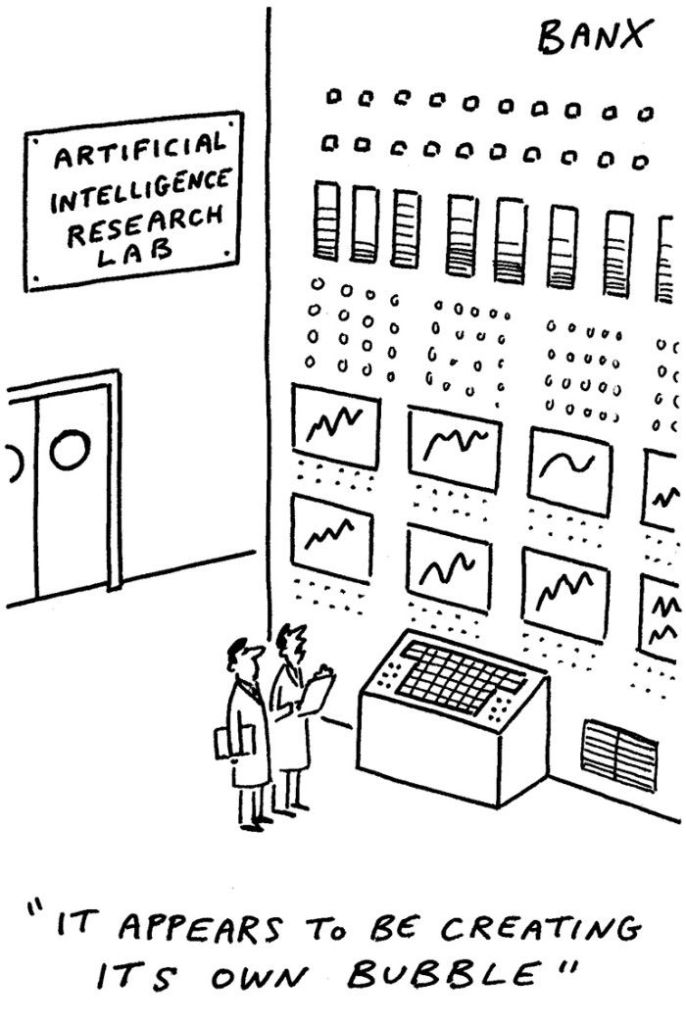
I’m not a financial expert, but I have noticed a significant number of articles in the media suggesting that the Generative AI industry is a bubble waiting to burst. There are recent pieces here on the BBC website, here in the Financial Times (from which I stole the cartoon), and here in the Irish Times, to name but a few.

These stories are based on reports by the Bank of England and the International Monetary Fund, warning of a stock market crash far worse than the dotcom boom-and-bust of 2000 and even the banking crisis of 2008. Over 30% of the valuation of the US stock market, for example, lies in five big technology companies that are investing heavily in the enormous infrastructure required for AI. Their extravagant capital expenditure is underpinned by a complex series of financial arrangements which could unravel very quickly if the investors get cold feet and consider it unlikely they will see a return on their money. It does look very much like a bubble to me.

My own view is that the claims made about the capabilities of AI by tech gurus are grossly overstated. Only the irredeemably gullible could think otherwise. I think a correction is inevitable. It’s not a question of “if” but “when” and “how much”. I am not competent to answer those questions.

P.S. Now there’s an RTÉ Brainstorm piece along the same lines…

Trump’s Tariff Tirade

Posted in Finance, mathematics, Politics with tags , , , , , , on April 3, 2025 by telescoper

I didn’t watch the speech tirade by “US President” Donald Trump* last night in which he unveiled his new tariff plan, but people have been talking about this all day so I couldn’t resist a quick comment. There’s a lot I don’t know about economics and trade policy but one thing I do know is that the trad-weighted average tariff on goods from the USA entering the EU is about 3%, not the 39% that Trump alleged. I did therefore wonder where he got this number and all his other “reciprocal tariffs” from. Fortunately a little digging around revealed the answer.

On the left you see part of the chart showing tariffs country-by-country and the second is an extract from the published methodology which would be hilarious were the consequences not so serious.

You will see that the second column on the chart is headed “Tariffs charged on the USA”, with 39% listed for the European Union. This number is calculated using the “formula” on the right which has absolutely nothing to do with tariffs charged. Moreover, the denominator contains the product εφ with the values ε=4 and φ=0.25 given in the text so εφ = 1. The expert mathematician who derived this formulae seems to have missed the fact that ε is not less than zero (first sentence) if it is equal to 4, but we’ll let that pass. In fact I can’t be bothered to point out the other errors because no matter how egregious they are, there is no chance of Trumpty Dumpty reversing his decisions anyway.

To sum up, the notional tariff in column 2 is just the difference between imports and exports (the country’s trade surplus) divided by imports. The numbers in the third column of the chart on the left are just half those in the second column (give or take rounding errors). There is also a minimum of 10%, which applies even to countries with which the USA has a trade surplus. China faces huge tariffs because it has a large trade surplus with the USA. The EU’s 20% tariff is nothing to do with the tariffs it charges but is due to the fact that it has a trade surplus with the USA; the UK has a lower tariff rate than the EU because it has a smaller trade surplus  with the USA. That’s it.

I heard a Trump-supporting numpty attempting to justify the calculation shown in the chart on the grounds that it is really an “unfairness index”, it apparently being unfair and worthy of punishment if a country sells more to the USA than the USA sells to it. Following this line of reasoning, I have decided that all shops are unfair because I always buy more from them than they buy from me.

P.S. I was thinking that in future retaliation I should boycott goods from the USA but this would be an empty gesture because I don’t really buy any anyway. Looking up top imports from the USA to Ireland I find, for example, Bourbon (which I never buy because it is undrinkable) and confectionery (which I don’t buy because I don’t have a sweet tooth). Then I found peanuts, which I do buy occasionally, and will not buy in future. However in the grand scheme of world trade, peanuts are small potatoes.

*I apologize for forgetting to mention that Donald Trump is a convicted felon.

The University of Edinburgh in Crisis

Posted in Education, Finance with tags , , , , on February 26, 2025 by telescoper

It seems that financial emergencies are spreading around the United Kingdom like a contagion. About a month ago I posted about the crisis at Cardiff University, but now there’s a bombshell about the University of Edinburgh which, according to the Times Higher is planning to make cuts of around £140 million in recurrent expenditure, about 10% of its annual operating budget. This level of cuts is greater than those previously listed at other universities, including Cardiff, the largest of which are measured in tens of millions. The piece goes on to explain that target can’t be reached by voluntary redundancies, which presumably means compulsory redundancies are looming.

I don’t know which particular academic units are under threat, but I’m sure this episode is causing a great deal of stress to a great many people. The only advice I can offer to anyone at Edinburgh worrying about the future is, if they haven’t done so already, to JOIN A UNION!

Talking of which, the University of Edinburgh UCU has pointed out that the University revealed a budget surplus last year and has huge reserves measured in the billions. It accuses managers of manufacturing a crisis in order to cut staff and bring about even more centralisation – thus achieving an even greater level of corporate control over teaching and research activities. The subordination of academia to management is the aim. I don’t doubt that university managers around the world believe that teaching will be largely done by AI anyway which will allow even more lecturing staff to be cut.

I believe that universities need less centralisation not more. The Principal of the University of Edinburgh, Peter Mathieson, is quoted in the Times Higher piece as saying:

We can no longer afford to run duplicative services across the university, often with inconsistent practices which create inefficiencies, increase staff workload and impact our student experience..

This is fair enough, but it is quite wrong to assume that greater centralisation is the solution. In my experience it is “The Centre” that creates inefficiencies, increases staff workload and impacts student experience. That is because it knows far less than Schools and Departments about what is needed to achieve their academic objectives. Universities need a flatter and more responsive structure, not the ever-increasing management bloat that has been imposed on them for decades and which is now causing them to capsize.

On Budgets

Posted in Education, Finance, Maynooth, Politics with tags on October 11, 2023 by telescoper

Yesterday was Budget Day in Ireland, when the Irish Government had to decide how to deal with an unprecedented fiscal surplus. Would it use the available funds to help the homeless and those in poverty? Would it provide much-needed investment in public services and infrastructure? Or would it use the funds to buy the next General Election? As far as I see it, the decision was mainly to go with the third option, paying only lip service to the other two. That’s not surprising, as it’s the sort of thing the sort of people in the current Government have tended to do over the years. Short-termism is the order of the day.

When it comes to third level education, there was some good news for students. Tuition fees currently €3K will be cut by €1K but, disappointingly, the reduction is for one year only. As far as I can understand the news, extra Government funding to universities will replace the loss of fee income, but not provide the general uplift that was hoped for.

A couple of weeks ago, the Leaderene President of Maynooth University sent around a letter written by the Irish Universities Association (IUA) to the Taoiseach. You can find the PDF here. The Government must have been unconvinced by the arguments presented therein, because despite having more than enough dosh to pay for the requested increase in funding, no such largesse was forthcoming.

Despite this setback, Maynooth University’s Management hiring frenzy continues unabated. The latest new position to be advertised is a Director of International Recruitment and Conversion. No, I have no idea what it means either. Perhaps someone in Government looked at how much money Maynooth has burned recently on so many new positions and decided that third level institutions must have plenty of cash already?

In reality of course, the horde of new managers have been funded by diverting funds away from teaching and research. Maynooth already has the highest student-staff ratio of the eight comparable universities, a situation which will only get worse. As funding for teaching gets squeezed to pay for ballooning bureaucracy, departments have no alternative but to employ casual staff instead of permanent academics. As a report produced by the union IFUT makes clear, precarity is endemic in the Irish third level system,as it overwork and job-related stress.

I hope this interpretation is wrong but, the way I see it, none of this is accidental. During the pandemic, University bosses saw teaching staff take on greatly increased workloads that enabled their institutions to generate large surpluses. Having established just how much they could exploit their workforce, the way ahead will be more of the same. The deliberate policy of understaffing, overwork, and casualization will only accelerate. The Irish University system is heading for a crisis on the same scale as that in the United Kingdom, and lack of public funding is only part of the reason…

Holding your ground

Posted in Biographical, Brighton, Finance with tags , , , on February 26, 2022 by telescoper

Thinking about the brave defenders of Ukraine, especially in Kyiv, who include numerous civilians I suddenly remembered an old post about a friend I met in Brighton many years ago, a Jewish man of Austrian extraction who went by the name of Solly. He had been sent by his parents to live in England a few years before the start of World War 2 when he was still a teenager.

To cut a long story short, in 1940 Solly ended up joining the Local Defence Volunteers (the Home Guard) in Brighton. This is something he told me reminiscing abut those times. over dinner many years ago.

On 7th September 1940 the War Office issued the following communique:

Message to all UK units: codeword CROMWELL. Home Defence forces to highest degree of readiness. Invasion of mainland UK expected at any time.

After being informed of this signal Solly and his comrades turned up to be issued with the equipment with which they were expected to stop the imminent invasion. In his case it was an ancient pre-WW1 rifle, three rounds of ammunition, and two improvised grenades. With these meagre supplies, they were supposed to hold their positions until reinforced, possibly for up to 7 days.

As they walked to their posts, all the volunteers were certain that they had no chance and that none of them would survive the night. In such a grim situation they were understandably quiet, but what talk there was exclusively concerned the need to make all their shots count. If each of them could kill at least one invader before he himself was killed then the invasion might be thwarted.

After an agonizing wait, and several false alarms, dawn broke. The Germans never came.

Solly clearly found this recollection difficult. Few of us are ever faced with such a stark prospect of death. But I remember one thing he did say, which at the time I didn’t really understand, which is that it was in a way quite liberating – accepting that you are certain to die means that you no longer feel afraid. He had previously worried that he might lack the courage to fight if called upon to do so, but that doubt disappeared on 7th September 1940.

I think we’re already seeing this attitude in Ukrainian President Volodymyr Zelensky, who has emerged as a heroic figure . He must know that he is a marked man, and that his days are probably numbered, but he has refused offers to get him out to safety. The contrast between his courage and another so-called leader, who ran away from reporters to hid in a fridge, could not be greater.

Anyway, as the Russians enter the city of Kyiv, many civilians will be trying to summon up their courage right now. Received wisdom is that in urban fighting, the attacking force needs a numerical advantage of at least five to one and even more if the attackers are poorly trained conscripts, as seems to be the case in some parts of Ukraine. The defenders hold many cards, not least that it’s their land on which they’re fighting.

I fear that there is a bloodbath coming, but it seems to me very likely that the Russians will suffer worse. Not that Putin will be bothered. To him, his soldiers are mere cannon fodder.

Hope Springs Eternal…

Posted in Finance, Politics on October 28, 2021 by telescoper

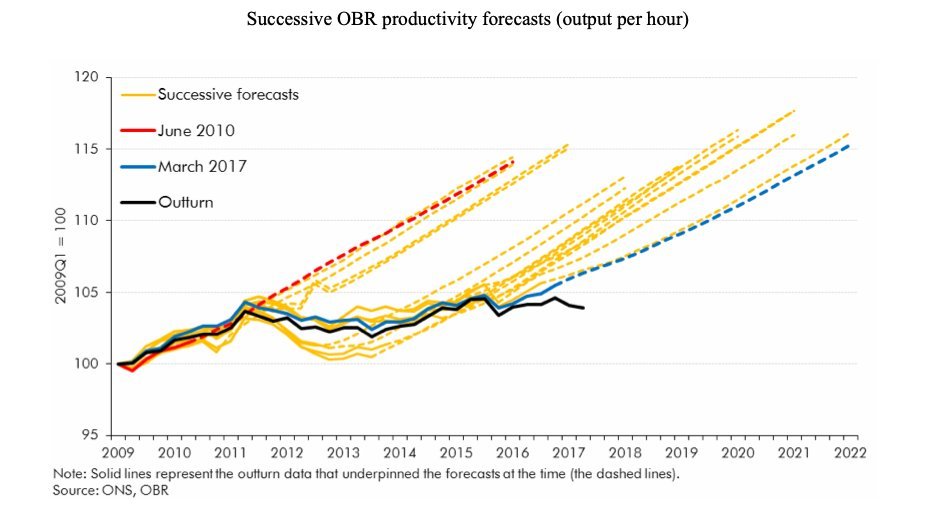
… in the “Office for Budget Responsibility

A decade of ludicrously over-optimistic forecasts.

“Man never is but always to be blest.”

Farewell to Flybe

Posted in Biographical, Covid-19, Finance on March 20, 2020 by telescoper

Just for the record, I today received a full refund for the cost of my Flybe tickets via the Chargeback scheme. Thanks to AIB for processing this so quickly!

The collapse of Flybe happened on 5th March 2020, just over two weeks ago. Can it really have been so recent? It seems like ages ago.

telescoper's avatarIn the Dark

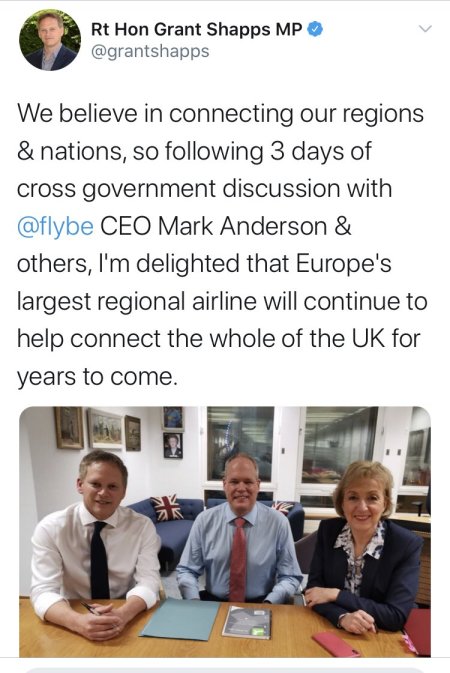
It had been on the cards for some time, but last night the airline Flybe collapsed and has now gone into administration. Let me just leave this Twitter announcement made in January by Transport Secretary Grant Shapps here:

It seems that Flybe has gone the inevitable way of every Tory promise.

I had bought a ticket to fly from Dublin to Cardiff at the end of next week as the following week is a study break that includes the St Patrick’s Day holiday. As a result I got this email this morning.

Obviously it’s an inconvenience for me as I’ll have to find another way to get to Cardiff, but I’ll probably get my money refunded by the Chargeback scheme so it’s not such a big deal. The same can’t be said of the 2000 people who worked for Flybe who have now lost their jobs, nor the many…

View original post 181 more words

The Myths of UK-Ireland Trade

Posted in Finance, Politics with tags , , , , on August 20, 2019 by telescoper

It is clear now that the UK Government’s strategy on Brexit is one of economic aggression towards Ireland.  Senior Brexiters seem to think that threatening to put up barriers to trade with the Republic will frighten it and the European Union into abandoning the rules of the single market and customs union.

As well as being morally repellent this strategy is also extremely stupid, as is based on a complete misconception of the state of trade between these two countries. For example, one prominent Leave campaigner and former Minister of State recently claimed that 90% of Ireland’s trade is with the UK. That may have been the case in the 1950s but it is certainly not the case now.

In fact, according to the latest figures, only about 11% of Ireland’s exports in goods go to the UK and this figure is falling rapidly. The largest export destination for Ireland within the EU is actually not the UK, but Belgium (11.65%) with Germany just behind on 8.56%. Overall the EU accounts for about 49% of Ireland’s exports; the largest other contribution is the United States on about 29%.

Contrary to popular myth, Ireland’s exports are not dominated by agriculture and food. By far the largest contribution is from chemicals and pharmaceutical products many of which go to Antwerp for onward distribution and/or further processing. This accounts for the large trade figure with Belgium.

Another fact worth mentioning is that while Ireland overall has a healthy trade surplus overall (it exports more than it imports; see above Figure), its trade balance with the United Kingdom is actually negative (i.e. the UK exports more to Ireland than it imports). In 2018, UK exports to Ireland were worth £38.3 billion; imports from Ireland were £21.9 billion, resulting in a trade surplus of £16.4 billion with Ireland. Ireland accounted for 6.0% of UK exports and 3.3% of all UK imports. Ireland was the UK’s 5th largest export market and the 9th largest source of imports. The UK has recorded a trade surplus with Ireland every year between 1999 and 2018.

Brexiters have frequently used the argument that, since the UK has a negative trade balance with the EU, the EU needs the UK more than the UK needs the EU. It’s a wrong argument, of course, but it’s interesting that the Brexiters don’t apply it to Ireland.

There’s no question that the `No Deal’ Brexit which I’ve regarded as inevitable from the outset will disrupt the Irish economy, or at least parts of it, and in the short term, but I agree with the Irish Times analysis from some time ago and a more recent article from the FT that it will cause far greater damage to the UK.

In the longer term, when the UK is out of the European Union I’m sure its trade surplus with Ireland will quickly disappear as Ireland finds alternative (and more trustworthy) trading partners. Irish businesses are already eliminating British companies out of their supply chains and it seems likely that if and when the hard Brexit arrives, Irish customers will be increasingly disinclined to buy British products.

The UK seems to be hoping that some sort of deal with Trump’s America will help it out of the economic hole it has dug for itself, but remember that the UK currently has a trade surplus with the USA. The Americans will be keen to eliminate that during any future trade negotiations.

The really important thing however is not the overall effect on the economy but on the problems it will cause for communities either side of the British border in Ireland. The recently-leaked documents from Operation Yellowhammer make it clear that the UK government `expects a return to a hard border in Ireland’. The implication of this is stark: the UK government is planning to renege on its obligations under the Good Friday Agreement, which is an international treaty.

If it goes ahead and does that, then it may be that the economic effects of leaving the single market and customs union are small potatoes compared to the price that will pay for becoming a rogue state. I can’t see the United States, with its approximately 40 million citizens of Irish descent, being keen to support a British government that is so obviously seeking to bully Ireland especially, as seems sadly likely, British actions spark a return to violence in the North.

Self Assessments

Posted in Biographical, Education, Finance, Maynooth with tags , , on January 17, 2019 by telescoper

My first batch of examination marking having been completed satisfactorily and my next paper not taking place until the weekend (Saturday morning, to be precise), I naively hoped that I could devote myself to research for a few days this week as I am behind schedule in completing a couple of papers. Unfortunately this has not been as straightforward as I’d hoped. I’ve spent all of today doing various administrative things (expenses claims, examination reports, and a part of the Department’s Quality Review Self-Assessment document which is due in near the end of the month.

In case you are unfamiliar with such things, a Quality Review is an exercise that takes place from time to time for every Department or Administrative Unit in the University (and indeed for every university in Ireland). For the Department of Theoretical Physics at Maynooth University, the last one took place in 2009). The process begins with the aforementioned Self-Assessment document which basically lays out what the Department is trying to do, the processes by which it uses to do it, reflects on the effectiveness of those processes, and outlines ideas for how they can be improved. All the staff in the Department have been engaged in writing bits of this document, which is now gradually coming into shape.I’ve had a relatively light involvement in this because I haven’t been here for very long, but it has consumed quite a lot of staff effort.

When complete, the Self Assessment report is sent to a range of people both inside and outside the University and there is then a visitation during which the panel talks to staff and students and has a look around the Department. We’re expecting our `inspection’ to take place in March. After that the panel gives feedback to the Department in a report. The panel’s comments are made publicly available, as is appropriate for a publicly-funded body. The report emerging from the last Quality Review of the Department of Mathematical Physics (as it was then called ) can be found here (pdf). It’s all quite a lot of work – the latest Departmental meeting devoted to this yesterday lasted three and a half hours, and we’ve had several meetings like that! fortunately, it  will all be finished by next week. Better is the end of a thing than the beginning thereof.


Talking of Self Assessment, I realized last night with a panic that I hadn’t yet done my UK income tax return for 2017/18, also due in by the end of January. I spent this lunchtime getting all the bits of paper in order, and completed the task online fairly quickly as I’ve done it many times before. It turns out that yet again HMRC owes me a substantial refund. They haven’t handled my income tax properly since I left Sussex in 2016 as a matter of fact. Despite repeated attempts to get them to apply the rules correctly they have basically taxed all my income at source at the higher rate (40%) only to pay it back when I submitted my return. Fortunately, I am now domiciled in Ireland so won’t have to deal with HMRC much again.

Anyway, I should complete most of the outstanding administrative stuff this evening and if I do that I can clear a day for research, or at least writing up papers…


End of Term Thoughts

Posted in Biographical, Finance with tags , , , on May 4, 2018 by telescoper

Today is the last day of teaching term at Maynooth University. My last lecture, a revision lecture, was yesterday morning and I spent most of the afternoon helping students put the finishing touches on their project work, which is due in on Tuesday next week. Next Monday is a bank holiday in Ireland (as it is in the UK), then there’s a short period of private study before the examinations start next Friday. As it happens, the theory paper for the module I’ve been teaching on Computational Physics is on the first day of the examination period.

It’s `Study Week’ in Cardiff next week too, and I have a revision lecture there. Owing to the Monday holiday we’ve juggled the schedule a bit to ensure all modules have a revision lecture so I’m doing my revision lecture on Thursday rather than the usual Tuesday. I have a meeting at the Institute of Physics in London on Tuesday and it’s the Annual General Meeting of the Royal Astronomical Society (also in London) on Friday so I’ll be spending all of next week in the UK, in between Cardiff and London. Since teaching is over I’m not planning any more midweek travel (unless it’s absolutely necessary) and intend to spend one week in the UK and one week in Ireland, and so on, apart from conferences and the like, until I fully relocate in July.

I thought I’d mention another thing, which represents a fortuitous bit of timing. Twenty-five years ago, while I was living in London, I took out a savings policy of the sort that involves making a regular monthly payment into a mixture of investment funds. The term of this policy was 25 years, and the maturity date was 23rd April 2018. On a couple of occasions I have been tempted to cash it in early but decided to let it run until maturity. The performance of my chosen funds has fluctuated over the last two and a half decades, but when the price of units drops and you invest a fixed cash amount you end up buying more units than when they’re expensive so if they do recover in value you do well. This is called Pound Cost Averaging.

However, when a policy like this reaches the end of its term the amount you get back depends on the value of the units on the day that it matures. Although my policy wasn’t doing at all well a decade ago, it seems my portfolio (more by luck than judgement) has done well over the last ten years, but with the stock market being rather volatile in the early part of this year it’s been a bit of a white knuckle ride recently. Thankfully the last few weeks seem to have been more stable, and although the units are not at an all-time high in terms of value they were not far off that when they were cashed in. aturity value turned out to be about three times the total amount I’ve invested. I received the money on 30th April, and the proceeds will make a significant contribution to the cost of purchasing a house here in Ireland.

The downside of pound cost averaging is that the final sum is paid in pounds to a UK bank account, and with the pound languishing against the euro there’s now a decision to be made about when to transfer it to Ireland..