Archive for the Finance Category

R.I.P. Ray Bradbury (1920-2012)

Posted in Finance, Literature with tags , , on June 7, 2012 by telescoper

I was deeply saddened yesterday to hear news of the death at the age of 91 of writer Ray Bradbury. The resulting wave of comments on twitter and facebook from friends and colleagues and the wider world testifies to the joy and wonder he brought into so many lives. Bradbury was so much more than a science fiction writer (although he did write great science fiction). He was a rare example of an author whose work transcended genre. His limitless imagination and fluid writing style also allowed him to make light work of that most difficult form, the short story.

One of my  very first blog posts – way back in October 2008 – was inspired by a collection of Ray Bradbury stories called The October Country.  To mark his passing I thought I’d recycle it here. World news hasn’t changed much, so it’s still relevant. Except  it’s not October. Yet.

–0–

I don’t know why I stopped reading science fiction and fantasy stories. I don’t know exactly when either. Perhaps it was a gradual thing to do with getting older. But when I was a teenager that’s the sort of thing I read all the time. I was a big fan of Michael Moorcock and read book after book of his stories, from the swords and sorcery novellas to the amazing End of Time series, and even the trippy psychedelic 1960s adventures of Jerry Cornelius. I enjoyed Tolkien, Mervyn Peake, Isaac Asimov,  Arthur C. Clarke and many others which I usually binge-read by buying everything I could find by a given author and ploughing through them one after the other.

One of the authors whose work I devoured in this way was Ray Bradbury, and his books are among the few that I still like to re-read from time to time. To be honest, I wasn’t all that keen on the pure science fiction books like The Martian Chronicles, but I loved his collections of macabre short stories. Perhaps it’s because I now know how difficult it is to write in that genre that my appreciation of his story-telling skill has if anything grown with time.

I was watching the news last night about the continuing tailspin in the world’s stock markets and it reminded me of one of my favourite collections of Ray Bradbury stories, The October Country. I rummaged around in the stacks of old paperbacks I still haven’t got around to putting on shelves – mainly because I haven’t got around to buying enough shelves – and finally located my copy. It’s a weirdly eclectic mixture of the whimsical and the frightening.

The October Country of the title isn’t a specific place. It is many places:

..a picturesque Mexican village where death is a tourist attraction; a city beneath the city where drowned lovers are silently reunited; a carnival midway where a tiny man’s most cherished fantasy can be fulfilled night after night. The October Country’s inhabitants live, dream, work, die–and sometimes live again–discovering, often too late, the high price of citizenship. Here a glass jar can hold memories and nightmares; a woman’s newborn child can plot murder; and a man’s skeleton can wage war against him. Here there is no escaping the dark stranger who lives upstairs…or the reaper who wields the world.

What binds the separate tales together is the way Bradbury conjures up an atmosphere that is both autumnal and alien, both familiar and unnerving, like that of a long-forgotten room where dust gathers on lost artefacts of the past.

But what does this have to do with Stock Markets?

The baffling thing is that the greatest episodes of spine-chilling terror that grip the stock market from time to time also always seem to happen in October. The great Wall Street Crash of 1929 happened in October. More recently, the 1987 crash known Black Monday happened in the same month. Now, in 2008, although the credit crunch has been with us for a significant time, the most dramatic drops in share prices have also been in October.

In order to find the answer to why this is the case I went to Wikianswers and discovered somebody has already posted the question, but so far there have been no answers.

Whatever it is, something about October seems to give investors the jitters.

I blame Ray Bradbury.

49 not out

Posted in Biographical, Finance, Politics with tags , , on June 5, 2012 by telescoper

Yesterday having been my birthday – which Her Majesty The Queen kindly declared to be a national holiday – I am now just a year short of a half-century. HMQ has decreed that today is also a national holiday, thus giving me the chance to get rid of my hangover before returning to work a year older on Wednesday.

Fortunately I didn’t have to endure the Queen’s Official party at Buckingham Palace on TV  last night, and instead went to see the fabulous Lady Boys of Bangkok who are in Cardiff all week as part of their UK Tour. They perform in the purpose-built mobile Sabai Pavilion which for this week is situated in Cardiff Bay. Not only did I enjoy the show, I also escaped being hauled up on stage and turned into part of the act. Other members of the audience weren’t so fortunate…

I suspect most of the audience there were also celebrating birthdays or other special occasions, but some were probably just trying to escape from the all-encompassing Jubilee celebrations, of which I’m sure I’m not alone in being completely bored.  So bored, in fact, that I can’t even be bothered to go into the whole Monarchist versus Republican thing.

Still, at least I wasn’t forced to work as an unpaid steward at the stupid river pageant on Sunday, and required to sleep rough under London Bridge, under threat of losing my benefits. Slavery is another fine British tradition.

I think the people who focus on getting rid of the  Monarchy are misguided. Of course it’s an undemocratic and anachronistic institution, but it only has a symbolic status; it doesn’t have any actual power. The real threat to democracy is not the Royal Family, but the rampant capitalism that taken the world’s financial systems to the brink of chaos. Only when we’ve come up with a sensible plan for the world economy in the post-capitalist era – which, in my view, is approaching rapidly – will it be worth making the effort to remove some of the tattered decorations left behind by the old system.

The ongoing financial crisis gripping the world’s economy only exists because governments were persuaded of the need to use taxpayers’ money to underwrite losses in the banking sector. Bankers like capitalism when it comes to making profits, but are happy to fall back on socialism when they make a mess. Now the bankers’ losses have turned into a crippling burden of sovereign debt that could take decades to pay off. And who profits from this? The people who made the mess in the first place.

There is an obvious solution to this problem. A one-off tax of 20% of the accumulated wealth  of the top 10% of the population would raise a staggering £800 billion for the Treasury. This option isn’t even discussed in Parliament because our politicians know their masters wouldn’t like it. And so we go on squeezing ordinary folk and letting the rich off the hook. I don’t think this can go on forever without someone figuring out that we’ve been royally had.

Is this the “Squeezed Middle”?

Posted in Education, Finance with tags , , on March 29, 2012 by telescoper

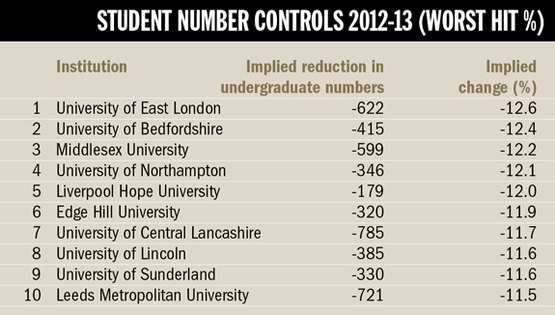
As reported in the Times Higher , the Higher Education Funding Council for England (HEFCE) has announced its allocations to English Higher Education Institutions for 2012/13. As expected, many universities are receiving substantial cuts next year. Here is a table of the biggest losers:

The Times Higher article describes this as the “Squeezed Middle”. It looks more like the “Squeezed Bottom” to me, but then I suppose that would have made an inappropriate headline.

Is there really a University of Sunderland?

Anyways, this allows me the chance to congratulate the former Director of Learning and Teaching in the School of Physics & Astronomy at Cardiff University on his move to the University of Central Lancashire, currently riding high at Number 7 in the above table…


The Budget – a Pictorial Guide

Posted in Finance, Politics with tags , , on March 21, 2012 by telescoper

Courtesy of the BBC Webshite.

Worries for Science in Spain

Posted in Finance, Politics, Science Politics with tags , on March 10, 2012 by telescoper

I recently received the following email letter, concerning the state of science funding in Spain.  As well as passing it on to colleagues I thought I would post it on this blog where it might have wider impact:

Dear colleague,

You probably know very well how the global crisis is affecting southern Europe, and in particular Spain. Some of us are promoting a campaign among the worlwide scientific community to prevent our conservative government from straining even more the science system in Spain, that so many successes has obtained in the last decade, but whose future is now at stake.

In the next few weeks, and contravening recommendation from the European Commission stating that public deficit control measures should not affect Research and Development (R&D) and innovation, the Spanish Government and Parliament could approve a State Budget for 2012 that would cause considerable long-term damage to the already weakened Spanish research system, contributing to its collapse.

There is an open letter that we are sending to distinguished scientists all over the world, including many Nobel Prize Winners and Members of Academies of Science, asking them to sign, support the motion and spread the word:

http://www.investigaciondigna.es/wordpress/sign

Please do help us by signing the letter and passing it on to your colleagues.

Kind regards,

Alexander Knebe

The “open letter” you can read by clicking on the link contains some interesting – and alarming – information that has serious implications for our colleagues not only in Spain but elsewhere in Europe. Take a look, for example, at the following picture that shows the fraction of GDP being invested in science:

This isn’t just about Spain, although the situation is clearly especially serious for Spanish Science. It’s a timely reminder that the UK is also well below the EU average in terms of science spend. Is it a coincidence that the EU’s worst-performing economies are all on the right of this figure? Is that where we want the UK to be too?

UCAS Update: Worrying for Wales?

Posted in Education, Finance with tags , , , , , on January 5, 2012 by telescoper

Just time for a quick post today, to comment on the latest batch of application figures released by the Universities and Colleges Admissions Service (UCAS). A late rush of applications has changed the situation since I last posted about the topic of university admissions, and there is a mixture of good and bad news.

Overall, applications to UK universities are down 6.4% on last year. That’s not surprising, given the introduction of much higher fees this year and the fact that applications were up last year on the previous year. In fact, it’s a much smaller decrease than many predicted.

It also appears that the Physical Sciences are bucking the national trend. Applications in these subjects are actually up 0.5% on last year. It’s a very slight increase, of course, but better than a drop.

However, there does seem to be some bad news for those of us in  Welsh Higher Education. As I’ve blogged about before, the Welsh Assembly Government has decided to subsidise Welsh domiciled students wherever in the UK they decide to go to University. Funding the  required bursaries means that  money has to be clawed back from Welsh Higher Education Institutions.

Leighton Andrews, the Minister responsible for administering this policy,  has argued that the resulting shortfall will be more than offset by funds brought into Wales by English students electing to study here and bringing their own money with them. That argument can only be sustained if the number of English students wanting to study in Wales is greater than the number of Welsh students wanting to study in England, which has been the case in previous years. Currently about 25,000 English students study in Wales whereas about 16,000 Welsh students study in England.

The latest application figures, however, reveal a potentially worrying trend. Applications from English students to Wales are down a massive 11.1%, while applications from Welsh students to English universities are up 2.9%. These are application figures, of course, and it’s by no means clear how they will translate into actual numbers of students next year. However, any drop in income from English students and/or increase in expenditure on Welsh students will squeeze the Welsh Higher Education budget.

In fact Welsh universities expecting a massive shortfall next year anyway, because HEFCW will be forced to slash the core support for existing students at Welsh universities in order to pay for those going to England.The School of Physics & Astronomy at Cardiff University, for example, is currently running a comfortable surplus. Next year, however, we are planning on the basis that we be losing all of our core teaching support for students in Years 2, 3 and 4, money which has been allocated to support existing students in Wales but which instead will be clawed back and given to new students wanting to study at English HEIs. Only the first year students will be bringing in the new £9K fee, so this policy will plunge us into deficit and we’ll have to rely on the goodwill of the University administration to tide us over with a subsidy until we have a full complement of fee-paying students. It will only after be several years of the new fee-paying regime , if at all, that the deficit situation is reversed. Meanwhile it might just provide University administrators with an excuse for closing expensive departments….

Happy New Year.

Advice for the REF Panels

Posted in Finance, Science Politics with tags , , , , , on October 30, 2011 by telescoper

I thought I’d post a quick follow-up to last week’s item about the Research Excellence Framework (REF). You will recall that in that post I expressed serious doubts about the ability of the REF panel members to carry out a reliable assessment of the “ouputs” being submitted to this exercise, primarily because of the scale of the task in front of them. Each will have to read hundreds of papers, many of them far outside their own area of expertise. In the hope that it’s not too late to influence their approach, I thought I’d offer a few concrete suggestions as to how things might be improved. Most of my comments refer specifically to the Physics panel, but I have a feeling the themes I’ve addressed may apply in other disciplines.

The first area of  concern relates to citations, which we are told will be used during the assesment, although we’re not told precisely how this will be done. I’ve spent a few hours over the last few days looking at the accuracy and reliability various bibliometric databases and have come to the firm conclusion that Google Scholar is by far the best, certainly better than SCOPUS or Web of Knowledge. It’s also completely free. NASA/ADS is also free, and good for astronomy, but probably less complete for the rest of physics. I therefore urge the panel to ditch its commitment to use SCOPUS and adopt Google Scholar instead.

But choosing a sensible database is only part of the solution. Can citations be used sensibly at all for recently published papers? REF submissions must have been published no earlier than 2008 and the deadline is in 2013, so the longest time any paper can have had to garner citations will be five years. I think that’s OK for papers published early in the REF window, but obviously citations for those published in 2012 or 2013 won’t be as numerous.

However, the good thing about Google Scholar (and ADS) is that they include citations from the arXiv as well as from papers already published. Important papers get cited pretty much as soon as they appear on the arXiv, so including these citations will improve the process. That’s another strong argument for using Google Scholar.

The big problem with citation information is that citation rates vary significantly from field to field sit will be very difficult to use bibliometric data in a formulaic sense, but frankly it’s the only way the panel has to assess papers that lie far from their own expertise. Unless anyone else has a suggestion?

I suspect that what some panel members will do is to look beyond the four publications to guide their assessment. They might, for example, be tempted to look up the H-index of the author if they don’t know the area very well. “I don’t really understand the paper by Professor Poindexter but he has an H-index of 95 so is obviously a good chap and his work is probably therefore world-leading”. That sort of thing.

I think this approach would be very wrong indeed. For a start, it seriously disadvantages early career researchers who haven’t had time to build up a back catalogue of high-impact papers. Secondly, and more fundamentally still, it is contrary to the stated aim of the REF, which is to assess only the research carried out in the assessment period, i.e. 2008 to 2013. The H-index would include papers going back far further than 2008.

But as I pointed out in my previous post, it’s going to be impossible for the panel to perform accurate assessments of all the papers they are given: there will just be far too many and too diverse in content. They will obviously therefore have to do something other than what the rest of the community has been told they will do. It’s a sorry state of affairs that dishonesty is built into the system, but there you go. Given that the panel will be forced to cheat, let me suggest that they at least do so fairly. Better than using the H-index of each individual, use the H-index calculated over the REF period only. That will at least ensure that only research done in the REF period will count towards the REF assessment.

Another bone of contention is the assessment of the level of contribution authors have made to each paper, in other words the question of attribution. In astronomy and particle physics, many important papers have very long author lists and may be submitted to the REF by many different authors in different institutions. We are told that what the panel will do is judge whether a given individual has made a “significant” contribution to the paper. If so, that author will be accredited with the score given to the paper. If not, the grade assigned will be the lowest and that author will get no credit at all. Under this scheme one could be an author on a 4* paper but be graded “U”.

This is fair enough, in that it will penalise the “lurkers” who have made a career by attaching their names to papers on which they have made negligible contributions. We know that such people exist. But how will the panel decide what contribution is significant and what isn’t? What is the criterion?

Take the following example. Suppose the Higgs Boson is discovered at the LHC duringthe REF period. Just about every particle physics group in the UK will have authors on the ensuing paper, but the list is likely to be immensely long and include people who performed many different roles. Who decides where to draw the line on “significance”. I really don’t know the answer to this one, but a possibility might be to found in the use of the textual commentary that accompanies the submission of a research output. At present we are told that this should be used to explain what the author’s contribution to the paper was, but as far as I’m aware there is no mechanism to stop individuals hyping up their involvement.What I mean is I don’t think the panel will check for consistency between commentaries submitted by different people for the same institution.

I’d suggest that consortia  should be required to produce a standard form of words for the textual commentary, which will be used by every individual submitting the given paper and which lists all the other individuals in the UK submitting that paper as one of their four outputs. This will require co-authors to come to an agreement about their relative contributions in advance, which will no doubt lead to a lot of argument, but it seems to me the fairest way to do it. If the collaboration does not produce such an agreement then I suggest that paper be graded “U” throughout the exercise. This idea doesn’t answer the question “what does significant mean?”, but will at least put a stop to the worst of the game-playing that plagued the previous Research Assessment Exercise.

Another aspect of this relates to a question I asked several members of the Physics panel for the 2008 Research Assessment Exercise. Suppose Professor A at Oxbridge University and Dr B from The University of Neasden are co-authors on a paper and both choose to submit it as part of the REF return. Is there a mechanism to check that the grade given to the same piece of work is the same for both institutions? I never got a satisfactory answer in advance of the RAE but afterwards it became clear that the answer was “no”. I think that’s indefensible. I’d advise the panel to identify cases where the same paper is submitted by more than one institution and ensure that the grades they give are consistent.

Finally there’s the biggest problem. What on Earth does a grade like “4* (World Leading)” mean in the first place? This is clearly crucial because almost all the QR funding (in England at any rate) will be allocated to this grade. The percentage of outputs placed in this category varied enormously from field to field in the 2008 RAE and there is very strong evidence that the Physics panel judged much more harshly than the others. I don’t know what went on behind closed doors last time but whatever it was, it turned out to be very detrimental to the health of Physics as a discipline and the low fraction of 4* grades certainly did not present a fair reflection of the UK’s international standing in this area.

Ideally the REF panel could look at papers that were awarded 4* grades last time to see how the scoring went. Unfortunately, however, the previous panel shredded all this information, in order, one suspects, to avoid legal challenges. This more than any other individual act has led to deep suspicions amongs the Physics and Astronomy community about how the exercise was run. If I were in a position of influence I would urge the panel not to destroy the evidence. Most of us are mature enough to take disappointments in good grace as long as we trust the system.  After all, we’re used to unsuccessful grant applications nowadays.

That’s about twice as much as I was planning to write so I’ll end on that, but if anyone else has concrete suggestions on how to repair the REF  please file them through the comments box. They’ll probably be ignored, but you never know. Some members of the panel might take them on board.

Acting and Clearing

Posted in Education, Finance, Politics, Science Politics with tags , , , , , , on August 14, 2011 by telescoper

Now that I’m back from my trip to Copenhagen, it’s going to be back to work with a vengeance. To those of you who think academics have massively long summer breaks, I can tell you that mine ends on Monday when I will be doing a stint as Acting Head of School. That’s not usually a particularly onerous task during the summer months, but next week happens to be the week that A-level results come out and it promises to be a hectic and critical period. It’s obviously a sheer coincidence that all the other senior professors have decided to take their leave at this time…

There are several reasons for this being a particularly stressful time. First the  number of potential students applying to study Physics (and related subjects) this forthcoming academic year (2011/12) in the School of Physics & Astronomy at Cardiff University was up by a whopping 53% on last year. I blogged about this a few months ago when it became obvious that we were having a bumper year.

The second reason is that Cardiff’s  School of Physics & Astronomy has been given a big increase in funded student numbers  from HEFCW. In fact we’ve been given an extra 60 funded places (over two years), which is a significant uplift in our quota and a much-needed financial boost for the School. This has happened basically because of HECFW‘s desire to bolster STEM subjects as part of a range of measures related to the Welsh Assembly Government’s plans for the regions. Preparations have been made to accommodate the extra students in tutorial groups and we’re even modifying one of our larger lecture rooms to increase capacity.

Unfortunately the extra places were announced after the normal applications cycle was more-or-less completed, so the admissions team had been proceeding on the basis that demand would exceed supply for this year so has set our undergraduate offers rather high. In order to fill the extra places that have been given to us late in the day, even with our vastly increased application numbers, we will  almost certainly have to go into the clearing system to recruit some of the extra students.

In case you didn’t realise,  universities actually get a sneak preview of the A-level results a couple of days before the applicants receive them. This helps us plan our strategy, whether to accept “near-misses”, whether to go into clearing, etc.

On top of these local factors there is the sweeping change in tuition fees coming in next year (2012-13). Anxious to avoid the vastly increased cost of future university education many fewer students will be opting to defer entry than in previous years. Moreover, some English universities have had cuts in funded student places making entry highly competitive. As an article in today’s Observer makes clear, this all means that clearing is likely to be extremely frantic this year.

And once that’s out of the way I’ll be working more-or-less full time until late September on business connected with the STFC Astronomy Grants Panel, a task likely to be just as stressful as UCAS admissions for both panel members and applicants.

Ho hum.

Keep the home fires burning

Posted in Biographical, Finance, Politics with tags , , , , on August 9, 2011 by telescoper

I’m in Copenhagen, yet again, for the third time in as many months, this time for a  workshop arranged by the Dark Cosmology Centre at the Niels Bohr Institute. It’s my talk this morning, in fact, so although I’m up early I haven’t got much time to post. I have to work on my talk to see if there’s a way I can make it all fit in 30 minutes!

Copenhagen is a pretty familiar place to me, but this has to be the most unsettling trip I’ve ever made here. I’m not talking about the long delay at Heathrow airport before we took off; I’ve come to expect that. The airport clearly can’t cope with the level of traffic it is supposed to handle during the summer months, so you have to reckon on at least an hour delay inbound and outbound. Sitting on the tarmac for an hour while being told over and over again that it will be “just a few minutes” really does bring out the grumpy old man in me. Still,  at least I didn’t lose any luggage.

No, the reason this is such an unsettling trip is that back home in Blighty all hell seems to have broken lose, with riots in the streets of, first, London and now apparently Birmingham, Liverpool and Bristol. I was also on the march in 1990 that turned into the Poll Tax riot. I was appalled by the violence that day and got myself and my friends away from trouble as soon as it flared, but it has to be said that it did lead to a change in the law, something Parliament had failed to achieve.

Back to the present, I note that the Tesco at Bethnal Green, where I used to live, has apparently been looted. I hope all my friends in London are keeping themselves safe.

I don’t think there’s anything I can say about these riots that wouldn’t be ill-informed, unhelpful, or even downright stupid. I am however old enough to remember that such things have happened before, in deprived inner-city areas, including Liverpool and Bristol. The circumstances were similar too.  Given the public spending cuts that have hit community programmes extremely hard,  it doesn’t surprise me that some have decided to lash out, especially at the Police,  whose criminal collusion with the media over phone-tapping and draconian tactics in dealing with lawful protests has turned many others against them .

I find it hard to separate these signs of social disintegration from the large-scale economic landscape. The huge level of debt accumulated by banks during the Credit Crunch of 2008 has now been absorbed by governments across the globe, who are attempting to deal with it by cutting public spending rather than raising taxes. Meanwhile the bankers have accepted their bailouts with glee, paying themselves bonuses by the bucketful and no doubt squirreling away the dosh in the Cayman Islands. If the state sanctions greed on that scale, is it surprising that people at the bottom of the heap decide to join in by looting the local supermarket?

The young  have the right to feel particularly disillusioned. The current generation has lived beyond its means for too long and, realising it too late, is trying to pay for it by mortgaging the future. The opportunities our young people, especially those from less affluent  backgrounds, can look forward to, in terms of education and jobs, will be much poorer than my generation.

I’m not usually one to endorse the view of the Daily Telegraph, but I think this piece hits the nail pretty much on the head. As Karl Marx would have said, it’s all about alienation, and I can tell you it’s not just the “underclass” that’s feeling it at the moment.

None of which is to condone the violence: you can be angry with the looters and the arsonists and those engaged in wanton destruction, but that doesn’t mean you shouldn’t try to understand why it’s happening.

But I’m very afraid that there’s going to be a lot more of this. The sovereign debt crisis is far from over. In many ways it has only just begun. There will be deeper cuts in public spending, greater inequality, greater social divisions and more upheavals like this. I think we’re in for a rough ride. I’m just glad I’m no longer young.

People vs projects in science funding (via Responsible Innovation)

Posted in Finance, Science Politics with tags , on July 19, 2011 by telescoper

Interesting article about whether funding should go to scientists with reputations, or to excellent projects…

Prompted by a question from Times science correspondent Hannah Devlin on Twitter, some thoughts on whether science funders should concentrate on funding people or funding projects… There appears to be growing interest in the idea of channeling funding through individuals. In the last few years, we’ve seen the Wellcome Trust redirect money towards people. EPSRC and other research councils are interested too. Paul Nurse and other senior scientist … Read More

via Responsible Innovation