Archive for the Finance Category

Acting and Clearing

Posted in Education, Finance, Politics, Science Politics with tags , , , , , , on August 14, 2011 by telescoper

Now that I’m back from my trip to Copenhagen, it’s going to be back to work with a vengeance. To those of you who think academics have massively long summer breaks, I can tell you that mine ends on Monday when I will be doing a stint as Acting Head of School. That’s not usually a particularly onerous task during the summer months, but next week happens to be the week that A-level results come out and it promises to be a hectic and critical period. It’s obviously a sheer coincidence that all the other senior professors have decided to take their leave at this time…

There are several reasons for this being a particularly stressful time. First the  number of potential students applying to study Physics (and related subjects) this forthcoming academic year (2011/12) in the School of Physics & Astronomy at Cardiff University was up by a whopping 53% on last year. I blogged about this a few months ago when it became obvious that we were having a bumper year.

The second reason is that Cardiff’s  School of Physics & Astronomy has been given a big increase in funded student numbers  from HEFCW. In fact we’ve been given an extra 60 funded places (over two years), which is a significant uplift in our quota and a much-needed financial boost for the School. This has happened basically because of HECFW‘s desire to bolster STEM subjects as part of a range of measures related to the Welsh Assembly Government’s plans for the regions. Preparations have been made to accommodate the extra students in tutorial groups and we’re even modifying one of our larger lecture rooms to increase capacity.

Unfortunately the extra places were announced after the normal applications cycle was more-or-less completed, so the admissions team had been proceeding on the basis that demand would exceed supply for this year so has set our undergraduate offers rather high. In order to fill the extra places that have been given to us late in the day, even with our vastly increased application numbers, we will  almost certainly have to go into the clearing system to recruit some of the extra students.

In case you didn’t realise,  universities actually get a sneak preview of the A-level results a couple of days before the applicants receive them. This helps us plan our strategy, whether to accept “near-misses”, whether to go into clearing, etc.

On top of these local factors there is the sweeping change in tuition fees coming in next year (2012-13). Anxious to avoid the vastly increased cost of future university education many fewer students will be opting to defer entry than in previous years. Moreover, some English universities have had cuts in funded student places making entry highly competitive. As an article in today’s Observer makes clear, this all means that clearing is likely to be extremely frantic this year.

And once that’s out of the way I’ll be working more-or-less full time until late September on business connected with the STFC Astronomy Grants Panel, a task likely to be just as stressful as UCAS admissions for both panel members and applicants.

Ho hum.

Keep the home fires burning

Posted in Biographical, Finance, Politics with tags , , , , on August 9, 2011 by telescoper

I’m in Copenhagen, yet again, for the third time in as many months, this time for a  workshop arranged by the Dark Cosmology Centre at the Niels Bohr Institute. It’s my talk this morning, in fact, so although I’m up early I haven’t got much time to post. I have to work on my talk to see if there’s a way I can make it all fit in 30 minutes!

Copenhagen is a pretty familiar place to me, but this has to be the most unsettling trip I’ve ever made here. I’m not talking about the long delay at Heathrow airport before we took off; I’ve come to expect that. The airport clearly can’t cope with the level of traffic it is supposed to handle during the summer months, so you have to reckon on at least an hour delay inbound and outbound. Sitting on the tarmac for an hour while being told over and over again that it will be “just a few minutes” really does bring out the grumpy old man in me. Still,  at least I didn’t lose any luggage.

No, the reason this is such an unsettling trip is that back home in Blighty all hell seems to have broken lose, with riots in the streets of, first, London and now apparently Birmingham, Liverpool and Bristol. I was also on the march in 1990 that turned into the Poll Tax riot. I was appalled by the violence that day and got myself and my friends away from trouble as soon as it flared, but it has to be said that it did lead to a change in the law, something Parliament had failed to achieve.

Back to the present, I note that the Tesco at Bethnal Green, where I used to live, has apparently been looted. I hope all my friends in London are keeping themselves safe.

I don’t think there’s anything I can say about these riots that wouldn’t be ill-informed, unhelpful, or even downright stupid. I am however old enough to remember that such things have happened before, in deprived inner-city areas, including Liverpool and Bristol. The circumstances were similar too.  Given the public spending cuts that have hit community programmes extremely hard,  it doesn’t surprise me that some have decided to lash out, especially at the Police,  whose criminal collusion with the media over phone-tapping and draconian tactics in dealing with lawful protests has turned many others against them .

I find it hard to separate these signs of social disintegration from the large-scale economic landscape. The huge level of debt accumulated by banks during the Credit Crunch of 2008 has now been absorbed by governments across the globe, who are attempting to deal with it by cutting public spending rather than raising taxes. Meanwhile the bankers have accepted their bailouts with glee, paying themselves bonuses by the bucketful and no doubt squirreling away the dosh in the Cayman Islands. If the state sanctions greed on that scale, is it surprising that people at the bottom of the heap decide to join in by looting the local supermarket?

The young  have the right to feel particularly disillusioned. The current generation has lived beyond its means for too long and, realising it too late, is trying to pay for it by mortgaging the future. The opportunities our young people, especially those from less affluent  backgrounds, can look forward to, in terms of education and jobs, will be much poorer than my generation.

I’m not usually one to endorse the view of the Daily Telegraph, but I think this piece hits the nail pretty much on the head. As Karl Marx would have said, it’s all about alienation, and I can tell you it’s not just the “underclass” that’s feeling it at the moment.

None of which is to condone the violence: you can be angry with the looters and the arsonists and those engaged in wanton destruction, but that doesn’t mean you shouldn’t try to understand why it’s happening.

But I’m very afraid that there’s going to be a lot more of this. The sovereign debt crisis is far from over. In many ways it has only just begun. There will be deeper cuts in public spending, greater inequality, greater social divisions and more upheavals like this. I think we’re in for a rough ride. I’m just glad I’m no longer young.

People vs projects in science funding (via Responsible Innovation)

Posted in Finance, Science Politics with tags , on July 19, 2011 by telescoper

Interesting article about whether funding should go to scientists with reputations, or to excellent projects…

Prompted by a question from Times science correspondent Hannah Devlin on Twitter, some thoughts on whether science funders should concentrate on funding people or funding projects… There appears to be growing interest in the idea of channeling funding through individuals. In the last few years, we’ve seen the Wellcome Trust redirect money towards people. EPSRC and other research councils are interested too. Paul Nurse and other senior scientist … Read More

via Responsible Innovation

JWST: Too Big to Fail?

Posted in Finance, Science Politics, The Universe and Stuff with tags , , , , , on July 7, 2011 by telescoper

News emerged last night that the US Government may be about to cancel the  James Webb Space Telescope, which is intended to be the successor to the Hubble Space Telescope. I’m slow out of the blocks on this one, as I had an early night last night, but there’s already extensive reaction to the JWST crisis around the blogosphere: see, for example, Andy Lawrence, Sarah Kendrew, and Amanda Bauer; I’m sure there are many more articles elsewhere.

The US House Appropriations Committee has released its Science Appropriations Bill for the Fiscal Year 2012, which will be voted on tomorrow. Among other announcements (of big cuts to NASA’s budget) listed in the accompanying press release we find

The bill also terminates funding for the James Webb Space Telescope, which is billions of dollars over budget and plagued by poor management.

It is undoubtedly the case that JWST is way over budget and very late. Initial estimates put the cost of the at $1.6 billion and that it would be launched this year (2011). Now it can’t launch until at least 2018,  and probably won’t fly until as late as 2020, with an estimated final price tag of $6.8 billion. I couldn’t possibly comment on whether that is due to poor management or just that it’s an incredibly challenging project.

There’s a very informative piece on the Nature News Blog that explains that this is an early stage of the passage of the bill and that there’s a long way to go before JWST is definitely axed, but it is a worrying time for all those involved in it. There are serious implications for the European Space Agency, which is also involved in JWST, to STFC, which supports UK activity in related projects, and indeed for many groups of astronomers around the world who are currently engaged in building and testing instruments.

One of the arguments against cancelling JWST now is that all the money that has been spent on it so far would have been wasted, in other words that it’s “too big to fail”, which is an argument that obviously can’t be sustained indefinitely. It may be now it’s so far over budget that it’s become a political liability to NASA, i.e. it’s too big to succeed. It’s too early to say that JWST is doomed – this draft budget is partly a political shot across the bows of the President by the Republicans in the House – but it does that the politicians are prepared to think what has previously been unthinkable.

UPDATE: A statement has been issued by the American Astronomical Association.


Ex Officio

Posted in Education, Finance on June 23, 2011 by telescoper

I’ve been remarkably subdued and rant-free these days – partly because I’ve been too engaged with other things. However, I just came across a story in the Times Higher which put me in the mood for a short diatribe.

It seems that the Higher Education Council for England (HEFCE) has published a report entitled “Performance in Higher Education” which looks into university estates management. Among other things, this report states that in English universities academics are assigned an average of 13.2 sq m of office space per person, Scottish institutions offer 14.5 sq m, and Welsh universities a “whopping” 15.7 sq m. By contrast the average office space per person across all sectors in the UK 10-12 sq m.

The conclusion is that

The enduring perception of an office as a status symbol has contributed to the higher education sector lagging behind nearly all others in the efficient use of space.

An interesting inference, this, especially as it gives no definition of what is meant by “efficient”. Note also that it resorts to the pure cliché of the office as status symbol without a shred of evidence to support this as an explanation of alleged inefficiency. I have quite a large office – it seems Welsh universities are generous in this regard – but I don’t see it as a status symbol at all. It just means I use it for more things.

For one thing, I use my office for research. I can’t speak for anyone else but for me that means having a space to myself, free from distractions, for thinking. My room also contains many books and research papers that I use for both teaching and research. I also hold tutorials and discussion group meetings for which the large whiteboard is essential (although I would have preferred an old-fashioned blackboard). On occasion I also have private meetings with students and other staff at which confidential matters can be discussed in private.

Given the variety of activities carried out in a space which is only fractionally larger than the national norm, I would be quite confident of making a case that universities -or at least those that do both research and teaching –  already use their space more efficiently than other sectors.

And another thing. Many of us work in old buildings. Mine is a hundred years old. Converting it to an open plan environment would cost a fortune. Perhaps in order to effect the “cultural change” HEFCE desires universities should knock down the old buildings and put up brand new, smaller ones, with open plan offices? Pity in that case that capital funding has been slashed.

The HEFCE report states that “other sectors have … embraced a more open-plan scenario”. That may be the case, but other sectors are not universities and they don’t do the range of things we do. How am I supposed to hold tutorials in an open-plan office? And how would I be expected to do research with chit-chat going on all around?

Managers will probably argue that we could have dedicated rooms that could be booked for tutorials, etc. Fine. So we would have to decamp from our (small) offices to a bare cell with a group of students. If something comes up that makes me want to refer to a book or paper, I couldn’t pop over to my bookshelf and get it, I’d have to come back to my office. Or just not bother. There’d also be no space for impromptu meetings. No room for books either, but who needs them? Most university libraries don’t bother with them any more so why should staff?

I know exactly what would happen if these measures were introduced. First, academics would have to do their research at home. Opportunities for interaction between staff members, and between staff and students, would be greatly diminished. Students would no longer feel that the staff were accessible for advice and discussions, greatly diminishing the student experience. The impact on research would be extremely negative, as would be the effect on staff morale.

But who cares about teaching or research? It would be more efficient.


Cutting Remarks

Posted in Finance, Politics, Science Politics with tags , , , , , on May 13, 2011 by telescoper

I know you’ve all been waiting with baited breath for news of the outcome of the House of Commons Science and Technology Committee‘s report into Astronomy and Particle Physics in the UK.

Well, it’s out now. You can find the web version of the report here and it’s also available as a PDF file there. There’s also a press release with the headline

MPs warn astronomy and particle physics budgets cuts will hit UK science hard

Journalists have obviously been busy overnight – the report was released at midnight, I believe – and there are stories all over the press this morning, including The Guardian, and the journal Science as well as the BBC. The Royal Astronomical Society and the Institute of Physics have also been quick to respond.

Apart from the savage cuts themselves – which the committee correctly suggest will reduce astronomy and particle physics spending by 2014/15 to about 50% of the level it was at in 2005 – the great tragedy of this story is that it has taken so long to recognize the scale of the disaster. Most of the damage was done way back in 2007 when the Science and Technology Facilities Council (STFC) was first set up. I’d suggest there is an error in the tense of the verb “to hit” in the headline above. It would be more accurate as

MPs warn astronomy and particle physics budgets cuts HAVE ALREADY hit UK science hard, and are getting worse all the time..

Last year’s Comprehensive Spending Review had relatively good news for STFC, with a settlement corresponding to level funding in cash terms. However, the Bank of England has recently stated that it expects inflation to reach 5% this year, which means that science will actually be getting 5% year-on-year real terms cuts on top of what it received in 2007. It’s a pretty dire situation.

The report also raises a doubt over whether the current Chief Executive, Keith Mason, has the “ability to command the confidence of the scientific community”. No shit.

I don’t have time to write much more on this right now as I have lectures to do, but perhaps others out there might feel the urge to start a discussion through the comments box…

Share/Bookmark

Local Matters

Posted in Education, Finance, Politics, Science Politics with tags , , , , , on May 12, 2011 by telescoper

I think I’ve caught up with most of the signficant things that happened during my travels, so I thought I’d end this series of updates with some local news from Cardiff (and Wales generally).

First, I can pass on some information relating to the  number of potential students applying to study Physics (and related subjects) this forthcoming academic year (2011/12) in the School of Physics & Astronomy at Cardiff University.  I blogged about this a few months ago when it became obvious that we were having a bumper year. As it turns out, we finished with applications up by a whopping 53% on last year.

Second, and related to the first item, the detailed allocations of university funding in Wales have finally filtered down all the way from HEFCW, through the Cardiff University management, and onto individual schools.  As it happens, this has also turned out not too badly for us here in Physics & Astronomy. For various reasons we’ve finally been given the increase in student numbers that we have been requesting for some time without success. In fact we’ve been given an extra 60 funded places, which is a significant uplift in our quota and a much-needed financial boost for the School. This has happened basically because of HECFW‘s desire to bolster STEM subjects as part of a range of measures related to the Welsh Assembly Government’s plans for the regions.

Unfortunately the admissions team have so far been proceeding on the basis that demand would exceed supply for this year so has set our undergraduate offers rather high. In order to fill the extra places that have been given to us late in the day, even with our vastly increased application numbers we may have to go into the clearing system to recruit some of the extra bodies. We’ll have to wait until the A-level results come out in August, however, before we know what the situation really is.

It would have been a lot easier if we’d known the rules at the start of the game, rather than near the end, but that’s the way it goes when politicians start tinkering with things…

We will have to lay on extra tutorials and laboratory sessions to cope with the anticipated increase in student numbers, which will be a bit of a struggle, but the extra money they bring in should keep the wolf from the door for a while.

Another thing worth mentioning concerns research in Wales. In the run-up to the Welsh Assembly elections, the Campaign for Science and Engineering (CASE) produced a couple of interesting documents. One was about science policy in the devolved nations and the other was a comparison of STEM subjects across the UK.

These documents make it clear that Wales lags far beyond England and (particularly) Scotland in terms of investment in, and productivity of, its scientific research.  In its  recommendations for Wales, CASE included

    • The Higher Education Funding Council for Wales must increase its investment in research – as well as improving the research base directly, this investment should bring more success in winning competitive, UK-wide funding. The indirect costs of charitably funded research should continue to be covered.
    • Policies should continue to build up the critical mass of research through collaboration, including with overseas researchers or businesses.

As I reported recently, we (Cardiff, Swansea and Aberystwyth) have tried to persuade HECFW to fund a Welsh physics initiative, intended to achieve precisely what CASE suggests. Unfortunately HECFW turned our bid down. At least for the short term, additional investment in physics research is clearly not on the agenda for HEFCW.  There’s not much sign of it happening in the future either, but we will have to wait and see…

Share/Bookmark

(Guest Post) Physics and Binary Creep

Posted in Education, Finance, Science Politics with tags , , , , , , on April 15, 2011 by telescoper

His Excel-lence (geddit?) Paul Crowther has been at it again, using his favourite packages sophisticated graph-plotting facilities to produce the interesting figures that go with another guest post….

–0–

Last week’s Times Higher Ed included a news item headlined ‘binary creep’, in which HEFCE were considering restricting support for PhD research students to universities of the highest research quality. Concerns were expressed in the article about a two stream future for universities – research intensives in the fast lane and ‘the rest’ in the slow lane. This reminded me of a recent Times Higher Ed interview with the former Commons’ Science and Technology Committee chairman, Lord (Phil) Willis. Lord Willis argued that the UK could probably sustain “no more than 30” universities with the capacity to attract the best global researchers and carry out world-class research, a view no doubt shared by ministers and civil servants within BIS. I should qualify the following line of thought by emphasising that this is not Government policy, although both stories reflect moves by funding agencies to further concentrate increasingly scarce resources on the highest ranked research universities. For example, in England HEFCE is expected to withdraw all quality-related (QR) support from 2* RAE research from 2012 onwards.

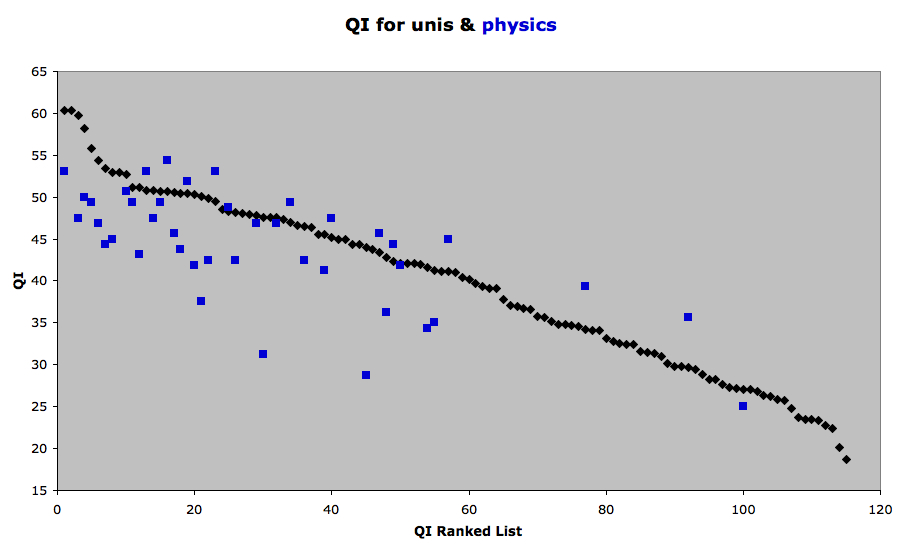
Mindful of the fact that in such a vision for the future, there would be a comparatively few, research intensive universities (`winners’) where would that leave the remainder (‘losers’), especially for physics? Research quality can be quantified in all manner of ways, but for simplicity I have adopted the Quality Index (QI) from Research Fortnight which provides a single mark out of 100 based on RAE quality profiles (4*:3*:2*:1* weighted 8:4:2:1). The chart below shows the  QI-ranked list of more-or-less all 120 UK universities who were rated in RAE 2008. It will come as no surprise to anyone that Oxbridge, LSE and Imperial top the rankings, closely followed by UCL and a few other high flyers, but beyond the top 10 perhaps more surprising there are no natural breaks in quality from Durham and QMUL in joint 11th place, to Bolton at 107th.

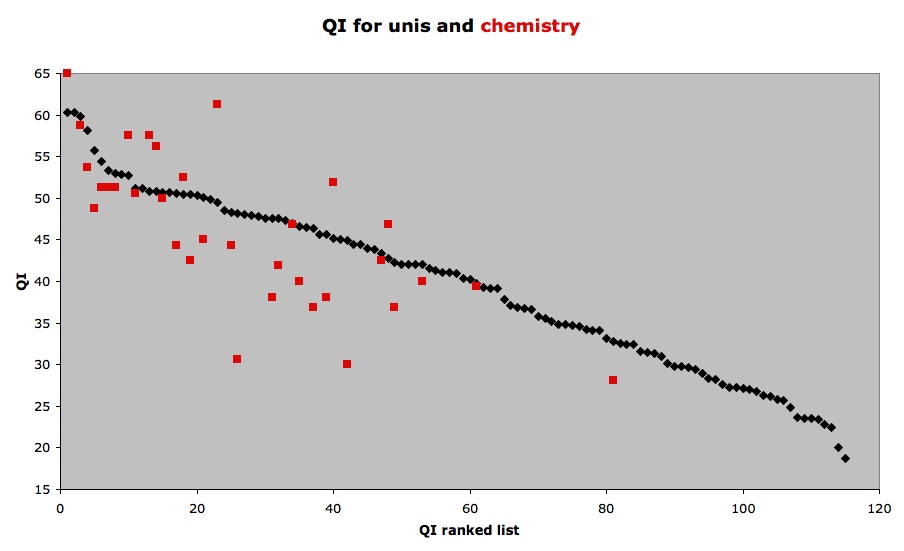
Thinking out loud about Willis’ assertion that the UK should not be spreading the jam more thinly than, say, the leading 30 universities, there would obviously be individual physics departments currently outside the top 30 which are ranked significantly higher than those within the top 30. To illustrate this, the chart also includes (in blue) physics QI scores for all teaching institutions that were assessed under the UOA 19 in RAE 2008. To blindly follow Lord Willis’ suggestion, 16 out of 42 institutions involved with physics research – comprising 37 per cent of all academic staff – would be clear losers. These would include one physics department raked within the top 10 (scoring 49) because its host institution is ranked 34th overall, while winners would include a department scoring 31, i.e. ranked 40th (out of 42) for physics, as a result of its university squeezing into the top 30. Chemistry – within the same RAE sub-panel as physics – reveals a broadly similar distribution, although there is perhaps a greater concentration of the highest research quality in the overall top 20, as the chart below illustrates.

Alternatively, if there is to be further concentration, one could argue that research funding should focus on, say, the top 20 physics departments regardless of the performance of their host institution. Indeed, already 80 percent of STFC spending goes to only 16 universities. Still, as RAE grades indicate, a strength of UK physics is the breadth of high quality research, with no natural break points until beyond 30th place in the rankings, as the final chart shows. Of course, RAE scores aren’t the sole criterion being discussed, with “critical mass” the other main driver. Due in large part to the big four, 70 per cent of physics academic staff submitted for RAE 2008 are in departments that are currently ranked in the top 20. Chemistry has a similar story to tell in the chart, albeit displaying a somewhat steeper QI gradient.

What might be the long-term consequences of a divergence between a small number of “research-facing” universities and the rest? It is apparent that if the number of physics departments involved in research were reduced by a third, some high quality research groups would be lost, regardless of precisely where the cleaver ultimately fell. Let’s too not forget that astrophysics represents the largest sub-field of physics from the last IOP survey, as measured in numbers of academics.

If policy makers don’t see anything fundamentally wrong with A-level physics being taught by teachers qualified, say, in biology, then they might too wonder whether physics degrees could be taught by academics lacking a physics research background? This might work for first year undergraduate courses, but thereafter isn’t more specialist knowledge needed that a research background most readily provides? How would the third of physics academics outside the top 30 universities react to the prospects of a teaching-only future? Many surely would consider jumping ship either to one of the chosen few or overseas, further decreasing the pool of those with research experience in the remaining physics departments. This is further complicated by the expected political desire that physics departments should be appropriately distributed geographically across England, Scotland, Wales and Northern Ireland.

As a final thought experiment, the fate of physics departments facing the prospect of a teaching-only future might also be binary in nature, either (a) whither and die, decreasing the range of institutions offering degrees in physics (or physical sciences, natural sciences etc.); perversely at a time when the Government are anxious to maintain the number of students studying Science, Technology, Engineering and Mathematics (STEM) subjects, or (b) thriving – free from the distractions of chasing dwinding research grants – by adapting to offer shorter duration physics degrees, described as “cheap and cheerful” by Dr David Starkey during the discussion on student fees on last Thursday’s Newsnight. To reiterate, it is not explicit Government policy to actively reduce the number of physics departments that receive research allocations, but this seems to be the general “direction of travel” in policy-makers speak, so I fear a rocky path ahead..


Share/Bookmark

Loose Ends

Posted in Biographical, Education, Finance with tags , , , , , on April 2, 2011 by telescoper

Just a brief post today, I think, in order to tie up a few loose ends from this week.

For reasons that I really don’t understand my blog suddenly became very popular on Thursday (31st March), attracting nearly 5000 hits in a day. That’s nearly four times my current daily average and a couple of thousand more than my previous busiest day. So this week I had my busiest day, last week was my busiest week, and last month was my busiest month. I guess it’s all downhill from here.

I couldn’t figure out what happened to cause all this interest, as not all the hits were on any specific article and no particular search terms were used to find this blog, at least not that I could figure out. I presume that it was my sarcastic take on Wonders of the Universe that was behind it. At any rate that was the post that generated the deluge of abusive comments that my spam filter caught.

Anyway, other items of relevant news are that two new members of Staff joined the School of Physics & Astronomy yesterday (April 1st; no, seriously…) and there are a couple more expected to join soon. It’s nice to have a few new faces around the place, and I’m sure they’ll all be bringing new ideas about research and teaching to the physics side of the School.

A week or so ago I passed on some pretty disappointing news about the funding climate here in Welsh universities. More details emerged this week about what this means for individual institutions; you can find the full list of allocations here (PDF). The figures don’t tally with those in the newspaper article I referred to in the previous post which was presumably inaccurate.

The picture isn’t as bad as I feared but, with a total cut of about 5% (in cash terms) across the sector it could hardly be described as good, especially when inflation is running about 5% on top of that. My employer, Cardiff University, has done slightly better than average, with a cut of only 3% in cash.

However – and it’s really delightful to be able to pass on some good news for once – the School of Physics & Astronomy has just been awarded a pretty large increase in its quota of undergraduate students. This is excellent, as I’ve previously reported that we have had a huge surge in applications this year. We’ll have to work hard to squeeze the extra bodies into laboratories, tutorials and even lecture theatres, but the income they will generate should help us carry out the strategic plans we have developed, perhaps bringing in even more new members of staff.

I’m still a bit grumpy, though, as our teaching terms has another two weeks to run, while some lucky bastards have finished already and are now on their Easter holidays…


Share/Bookmark

The Ernest Rutherford Fellowships Scheme

Posted in Finance, Science Politics with tags , , , on April 1, 2011 by telescoper

It seems timely to use the medium of this blog to pass on some important news from the Science and Technology Facilities Council (STFC) to those who might find it useful.

This week saw the unveiling of a brand new STFC scheme to be called the Ernest Rutherford Fellowships. These will be in some respects similar to the previous Advanced Fellowships in that each Fellowship will last for five years with 12 being offered by STFC each year, and will cover the salary costs of the holder for that period. An important new element, however, is that holders of these Fellowships will be able to bid for “significant additional funds to support their research”.

The announcement of this new programme is sure to be warmly welcomed by the scientific community because the previous Advanced Fellowships have been  a stepping stone to an academic career for many a budding scientist (including myself, in fact). There will however be some restrictions on eligibility that did not apply to previous schemes.

The first new restriction is to bring the scheme into line with the attitudes of Ernest Rutherford, in whose honour the new fellowships are to be named. One of the most frequently-quoted remarks by Rutherford is the following:

Don’t let me catch anyone talking about the Universe in my department

Obviously therefore it has proved necessary to close the scheme to astronomers and cosmologists. This shouldn’t prove too much of a problem, however, as the STFC press statement by John Le Mesurier makes it clear that the only notable recipients of Advanced Fellowships in the past are actually particle physicists:

Previous recipients of Advanced Fellowships include Professor Brian Cox who has done much to popularise/demystify physics through his recent TV series, Professor Ruth Gregory who was awarded the IoP Maxwell Medal for outstanding contributions to theoretical, mathematical or computational physics in 2006; and Professor Brian Foster who was awarded the IoP Born medal (for outstanding contributions to physics) in 2003.

The second new rule is intended to control the number of applications in order to make the selection of the recipients of these Elite Fellowships more manageable. The criteria applied to the previous Advanced Fellowship programme were very flexible, with the result that each round typically generated well over a hundred applications. This made the relevant Panel’s task extremely difficult. STFC has therefore decided to impose a restriction on the age seniority of the candidates in order to streamline the process.

To be eligible for an Ernest Rutherford Fellowship,  candidates must have completed their PhD between 5 years 11 months and 30 days and 6 years of the date of application. This is in addition to the usual requirement of being a white heterosexual male. According to rigorous investigations by STFC staff, this reduces the pool of potential applicants substantially. To one, actually.

The successful candidate (Dr Jamie B’Stard of Oxbridge University) will be eligible to bid for, and be given on the nod, additional ring-fenced funding to support those things that an Elite Fellow needs, both to carry out their research and to feel generally superior to everyone else (e.g. private jet, fleet of Rolls-Royce motor cars, and gold-plated taps in their private lavatory). Never in the history of British science will a physicist have been so generously endowed. The new scheme will allow science to compete in prestige and public acclaim with other forms of employment, such as in the banking sector.

To liberate the funds needed for this initiative it has inevitably proved necessary to make savings elsewhere in the STFC programme. After minutes of arduous deliberation it was decided, as usual, to pay for it by top-slicing the budget for research grants (this time by 95%). Unfortunately this means that no grants will be available for any other research within the STFC remit. However, as a gesture of goodwill, the Chief Executive of STFC has given the instruction that the remaining 5% of the now defunct grants line will be distributed to universities to help cover the cost of making all existing PDRAs redundant.

I hope this clarifies the situation.


Share/Bookmark