Archive for the Finance Category

Into the Blue

Posted in Education, Finance, Politics, Science Politics with tags , , , on May 12, 2010 by telescoper

So there we are.  Britain has a new government. For the time being. Last night David Cameron became the Prime Minister of a coalition government involving the Conservative and Liberal Democrat parties (as I predicted). This is hardly a surprise given the arithmetic; Labour and the LibDems wouldn’t have had enough seats to command a majority anyway. It took five days from the election for the new Prime Minister to take over, much longer than the few hours it normally takes when there is a conclusive result, but nowhere near as long as it takes on the continent where coalition-building involves smaller and more diverse parties. In the UK the three main political parties are all centre-right, at least when it comes to economic policy,  and they share a great deal of common ground, so I never thought there would be much problem with the Conservatives and LibDems coming to a deal, which they have done.

Another prediction I got right was that Gordon Brown would resign as leader of the Labour Party, which he has also done. Who will lead the Labour Party now, and for how long, is anyone’s guess.

My third prediction was that the coalition government would fall within a year and there’ll be another general election. As for that, we’ll have to wait and see. It is, after all, a marriage of convenience. I think it won’t be long before a big row develops and the coalition unravels. There’s a lot of overlap between the two parties, but it’s a long way from the left of the LibDems to the right of the Tories. I give it 6 months to the first vote of confidence, assuming the Queen’s Speech passes.

Now that we have a government once more, the unreal business of electioneering is going to be set aside and all the facts that the media have kept quiet about during the election campaign will start to come out. For example, a story in the Financial Times of 11th May (yesterday), which has clearly been on the spike for the duration of the election campaign, reveals how huge cuts in university funding are set to fall hardest on science departments. Vice-chancellors have been making contingency plans for 25% cuts in recurrent funding for some time now, and there’s an obvious temptation to cut the more expensive subjects first.

I’ve already confessed my annoyance that the main parties connived to keep the details of the deep cuts they were all planning to implement out of the election campaign. Now we’re going to find out the true extent of what’s in store, and it’s too late to change.

Niels Bohr once said “Prediction is very difficult, especially about the future”, and I have no idea whether I’m being overly pessimistic here, but here are  some of  the things I think will affect my own life  as an astrophysicist working in a British university.

First, it’s now clear that there’s  no chance of a reversal in the fortunes of STFC. There never was much of a chance of that, to be honest. It’s more likely now that  STFC will now face further cuts on top of what it has endured already.  Fundamental science in the UK is in for a very lean time.

Second, university funding – the part that comes directly from central government – will be cut by at least 25%, probably more.  This could be achieved in a number of ways. The unit of resource (the payment made per student by the government to a university) could be cut. The number of students funded could be cut. Students could be charged higher fees or have less generous loan arrangements. These options are by no means exclusive, of course. They might all happen.

University V-Cs will have to make very difficult decisions  where to make savings:  some may tighten budgets across the board; others may shut entire departments to save the rest.

Another issue with university funding, however, is that it is not entirely the preserve of central government.  The Scottish Assembly runs higher education in Scotland, not the Westminster government. The Scottish Funding Council has generally funded universities more generously than HEFCE has in England. It’s also much less likely to implement higher tuition fees. More generally, with only one Scottish Tory MP in Westminster and a Scottish Nationalist-flavoured Assembly government, there’s no way of knowing what will happen in Scotland or, indeed, how much strain will be generated there by an English Tory government very few Scots voted for.

In Wales its a bit different. Here higher education is run by the Welsh Assembly government, which currently comprises a Labour-Plaid Cymru coalition. With the Westminster government consisting of an alliance between the other two major parties in Wales we have two levels of administration roughly orthogonal to each other. In principle, the WAG could decide to protect the university system in Wales against the level of cuts being imposed in England, but since we already get a lower unit of resource from HEFCW than HEFCE allocates to English universities, I doubt we’ll be any different in future.

So this is where we’re headed:  fewer science departments with fewer staff with increased teaching loads with less time to do research and with less funding to carry it out and vanishing career opportunities for the scientists they’re supposed to be training.

Still, at least the bankers will get their bonuses.

The Day After

Posted in Finance, Politics with tags on May 7, 2010 by telescoper

I wasn’t planning to stay up last night watching the General Election results come in, but in the end I stuck with it until about 3am, basically hoping to understand what was going on.  Even by that hour there didn’t seem to be a particularly clear pattern emerging, so off I went. I had a revision lecture this morning as well as a lot of other things so I didn’t fancy an all night sitting.

Whenever there’s a General Election I always pay attention to constituencies I used to live in to see how things are changing. Broxtowe (the constituency that contains Beeston, where I used to live when I worked at Nottingham University) changed hands from Labour to the Conservatives. It had been a Conservative marginal in 1997 when it was won during the New Labour landslide. It seemed fairly typical for seats like that to revert to what they were pre-Blair. Brighton – remarkably – returned Britains first ever Green Party MP. Bethnal Green returned to the Labour fold after a flirtation with George Galloway’s Respect party.

Meanwhile here in Cardiff the results were as mixed as elsewhere. My own constituency, Cardiff West, stayed Labour, as did Cardiff South (and Penarth). The Vale of Glamorgan reverted to its pre-1997 Tory hue, unsurprisingly. The Labour candidate in Cardiff North was the wife of former Welsh Assembly leader Rhodri Morgan and it was a definite surprise to see that seat turn blue too. Cardiff Central remained Liberal Democrat.

As it has turned out the exit polls got it just about right, with the Conservative Party leading the popular vote (36%) and number of  seats (306), but not enough to make an overall majority. Labour (28%, 258 seats) and Liberal Democrats (23%, 57 seats) between them have a majority of the votes cast but don’t have enough seats to form a coalition. It’s a well and truly hung Parliament and we look set for days of discussions to see what kind of agreement can be reached between which parties. Gordon Brown remains Prime Minister until some kind of resolution is reached. We live in interesting times.

Although the election results were extremely interesting by virtue of their puzzlingly inhomogeneous variation across the country,  they really amount to little more than a sideshow compared with the spreading panic on international markets. The markets fell sharply, not because of the hung parliament but as part of a worldwide panic over the knock-on effect of the Greece and Portugal sovereign debt problems. The contagion could be very dangerous if Greece can’t convince traders that it’s not going to default and in an attempt to do so its government has put together a severe austerity package. Cue violent unrest. The Greeks live in even more interesting times than us.

I’m not going to pretend that I have the slightest clue how either of these things will pan out, but I’m not very optimistic about the forthcoming months. I hope I’m wrong. We’ll see.

The other thing that struck me  was the story of people being unable to vote because of long queues at the polling stations near 10pm when they closed. At first I wasn’t at all sympathetic. Polls are open from 7am until 10pm, so there’s no need to turn up with only 5 minutes remaining. However, it then emerged that  some polling stations couldn’t cope with the large turnout and people had been queuing for hours by the time the doors closed. The turnout was 65% nationally, higher than last time but by no means ridiculously high. In fact I think it’s a shame the usual turnout  isn’t very much higher than this. However, turnout seems to have been much higher in certain wards and the staff unprepared for the demand, sometimes with insufficient ballot papers and sometimes with out-of-date copies of the electoral register. I don’t mind saying that I found this level of incompetence deeply shaming. We can’t afford to be so careless with our democratic system. It doesn’t matter if only a few hundred people were affected. It’s the principle that matters.

Over the next few days there’ll be a lot of discussion about electoral reform. Perhaps the fact that our current electoral system seems to be showing signs of neglect might generate some impetus for change, quite apart from the scandals of MPs fiddling their expenses. I’ve always been on the fence over proportional representation. Our system is absurd in some respects, delivering huge majorities in the Commons to parties with only a modest share of the popular vote. On the other hand our country is so divided that it’s not obvious what the short-term consequences of changing to PR would be. It seems likely, for one thing, that fringe parties such as the neo-fascist BNP would actually be represented in Westminster. I find that a repulsive prospect, but putting up with people you can’t abide is one of the consequences of democracy.

I have an open mind on electoral reform and I’d like to hear the arguments for and against different systems of PR aired properly. Presumably the Liberal Democrats will want a referendum on this as part of the price of their support in a coalition, so no doubt there’ll be a lot of chat about this.

House of Cards

Posted in Finance, Politics with tags , , , on April 29, 2010 by telescoper

There’s now only a week left until polling day in the General Election, and I’ve managed to avoid blogging about it as much as possible. The main reason for this is that I feel almost entirely disconnected from the whole thing, as if it’s all a bit unreal. One of the things in the news this week sparked a memory of something I wrote a few weeks ago which, in turn, made me realise why I find it difficult to take this election seriously.

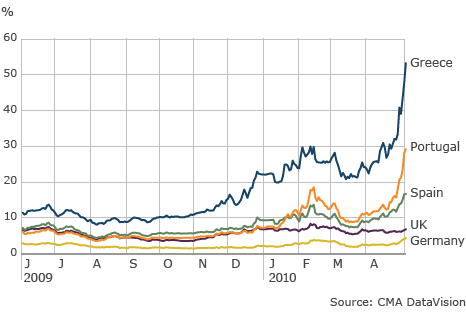
It emerged on Tuesday that the international money markets had downgraded Greece’s credit rating to “junk” status. Portugal and, more recently, Spain have since been downgraded too, but not as far as Greece. Yet. The reason for this downgrading is that analysts doubt whether these countries will be able to control their public spending sufficiently in order for them to honour huge levels of sovereign debt. The probability that Greece in particular will default in a big way has been growing steadily, according to the calculations of financial experts, and has now reached the level at which traders are adopting strategies that essentially involve betting on this actually happening.

The consequence of all this turmoil is that Greece would have to borrow money at huge levels of interest – over 15% – in order to carry on. The eurozone countries – particularly Germany – are trying to put together a package that that can be paid back at less ruinous rates, but while they continue to debate the details the panic continues.

The knock-on effect of a Greek default would be to remove money from the balance sheets of banks and financial institutions around the world. If a  bank has holdings of Greek debt, and the Greeks default, then the bonds become worthless and billions of pounds disappear off its balance sheet. Some British banks are exposed in this way, but nowhere near as much as France, Germany and Switzerland.

The baleout of Greece may work, but if it doesn’t it looks likely that Greece will be ejected from the euro and will have to take drastic measures to set its house in order. Fine, you might say. They’ve been living beyond their means for too long. That’s true. But so has Spain, which suffered even more than the UK from a housing bubble that went pop and is left with a huge budget deficit.  Spain is too large an economy to be rescued, even by Germany.  A default there, and there’s a real possibility of a chain reaction that will probably mean  curtains for the euro and possibly a real meltdown of the global financial system.  I’m just surprised that it has taken since 2007 for phase 2 of the global financial crisis to start. I think the contagion is still spreading.

 By some measures, our economy is in even worse shape than Spain’s.  However, the reason the markets haven’t downgraded us yet is that we’ve been given a stay of execution by the imminent general election. I’m sure analysts will be looking for very prompt and effective action to tackle our budget deficit if they are not going to put us through the wringer like they did with Greece. Greece, Portugal and Spain are all relatively recent democracies and it’s not obvious their governments can deliver huge public spending cuts and survive the resulting social unrest intact. They certainly haven’t managed to convince the markets they can anyway.

 What’s clear from the UK general election campaign is that none of the main political parties is willing to go public about the scale of the challenge facing whoever takes office after the election. The recent budget did a bit of trim around the edges here and there, and the party manifestos talk about the odd billion here and there in savings, but these are dwarfed by the real scale of our deficit. It seems the politicians have agreed to keep quiet about this to avoid frightening the electorate. When the votes are counted we’re going to get a rude awakening. The general election campaign is just a bizarre masquerade that’s too ridiculous to get involved in.

The scale of what could happen here is indicated by what’s happening in Ireland. Politicians here are talking about a public sector pay freeze. Ireland is actually cutting salaries in the public sector by up to 20%. I think the next UK government is going to have to do something similar or we’ll suffer the same fate as Greece. These next three years are going to be very grim for those of us working in the public sector, or at least for those who decide to stay in the UK.

We generally like to think we’re a mature democracy that’s a bit more sensible that all those mediterranean hotheads and that we’ll be able to grin and bear it for the sake of the economy. However, I’m old enough to remind the Winter of Discontent and it’s by no means obvious to me that cuts on the necessary scale will go through without sustained opposition. If – as seems likely – we end up with a coalition government with a fragile majority, this sort of thing could easily bring it down. If the markets see political instability in the UK they will certainly start downgrading our credit rating too. Public borrowing will  become more expensive, deeper spending cuts will be needed, and Britain be well and truly scuppered.

Fears for the Future

Posted in Finance, Politics, Science Politics with tags , , on April 10, 2010 by telescoper

Just came back from a lovely cycle ride to find that my polling card arrived through my letterbox while I was out. Gordon Brown announced the election earlier this week, so it’s quite impressive how efficiently the electoral system swings into action.  It’s a pity so much else is screwed up.  Anyway, Parliament now goes into limbo and we have three weeks of heightened tedium to endure while the politicians try to convince us that, despite all the mess they’ve made of things so far, they do actually know what they’re doing.

I still don’t know how I’m going to cast my vote on May 6th (polling day). I can’t see myself voting for the incumbents – for more reasons than I have time to list. My experience of Thatcher’s Britain in the 1980s convinced me that I’ll never vote Conservative either. And the Lib Dems are just, well, a bit pathetic. I will vote. I just don’t know who I’ll vote for. I’ll have to look at my constituency’s history carefully to see if tactical voting might help. Perhaps more on that in due course…

Anyway, whatever the result of the election turns out to be, I’m pretty scared about what the next three or four years has in store.  The huge budget deficit that the government has built up saving the banks from collapse is going to have to be dealt with. The recent budget didn’t really do anything to tackle it, but everybody knows that was just a holding operation until the election is over. Whoever takes power afterwards will have to take serious measures to fix things. It won’t be pretty. Tax rises and public spending cuts are both inevitable as  the international bond markets threaten to downgrade Britains AAA credit rating. If that happens we will end up with runaway debts and increasingly expensive borrowing.  Don’t think we won’t go the way of Greece.

In the meantime our economy is carrying on as if it is in a trance. House prices continue to rise, the FTSE index is climbing, interest rates are at the astonishingly low level of 0.5%. It can’t possibly go on. Houses are clearly still overvalued, at immense social cost to people wanting to start a family. The stock market is gaining because investors are not getting any return from cash deposits, and companies are boosting their profits by sacking staff and cutting costs rather than generating new demand. As soon as interest rates go up again – which they surely must – I think there’s a good chance the stock market will fall again. If you don’t hold any shares yourself you may think that’s not important. However, it directly affects the pensions of millions of people, most of whom are not wealthy, because that’s where a lot of their pension schemes’ money is invested.

The most pressing issue is not who wins the election but whether there is a winner. If the election turns out indecisively – which at the moment seems quite likely – then we’re going to see turmoil on a scale that makes the banking nightmare of 2007 look like a tea party. And even if there is an outright winner, there’s no guarantee that they will have the gumption to even begin tackling the problem.

Of course, as a scientist working in a University, I’m also concerned about what’s going to happen to my own livelihood after the election. The recent mess this government has made of science funding has blotted its record on this, which was previously not bad. However, the true scale of this country’s economic problems seems to be too much for our political leaders, both present and future, to cope with. I don’t see any of the parties having the vision to manage the current crisis as well as putting together a coherent plan to build a better future. I’m not the only person to think so, in fact, as a letter in The Times today from a group of distinguished astronomers made clear. Other nations (especially the USA and France) are all investing heavily in science as a means to secure future economic growth. We’ve already started cutting back, and don’t see any strong political voice to reverse that policy.

Of course people don’t just vote for their immediate self-interest. Science is important to me, and I think it’s important for the country too, but there are other issues. There’s more to life than economics too. This country has been in a post-Imperial sleepwalk for too long and it needs to snap out of it. We need to renew our political system, which has grown distant and unaccountable. We need to deal with a looming energy crisis. We need to develop a proper education system that is fit for the 21st century. And we need to deal with the problems of a rapidly ageing population. For these reasons, and more, I hope the next Parliament will contain politicians with the vision necessary to see this country through the tough times ahead. Unfortunately, I don’t think it will.

I’m just glad I’m no longer young.

Cut and Thrust and Nip and Tuck

Posted in Finance, Science Politics with tags , , , , , , , on March 26, 2010 by telescoper

This week we received the not-altogether-unexpected news that the budgets of Welsh universities will be cut next year. The Higher Education Funding Council for Wales (HEFCW) has announced its detailed allocations for 2010-11 and all but one institution will receive a cash cut.  Cardiff University faces a cash cut of 1.74%. Lampeter is the exception, but it gets a cash increase of only 0.32%. After taking inflation into account, even they get a real terms decrease. So it’s real cuts across the board for Welsh Higher Education, with a total of about £30 million in funding taken away.

In fact, it appears that the total amount of money available to HEFCW for next year is level in cash terms compared to last year. The total amount it has distributed in recurrent grants has, however, decreased by about 2% on last year. As far as I understand it, the discrepancy between the income and expenditure is partly explained by the diversion of some funds into a new Strategic Implementation Fund(SIF) to enable HEFCW to meet the goals outlined in the Welsh Assembly Government (WAG) document stating its vision for Higher Education, entitled For our Future. Some elements of SIF are included with the current allocation, but other’s are not, hence the  cash cuts seen here.In future, a larger proportion of the budget will move from recurrent, formula-based funding towards initiatives more closely aligned with the WAGs or, more likely, wasted on window-dressing and increased bureaucracy.

We’ll have to see what the impact of the new SIF arrangements will be in the longer term. In the short-term, however, the cuts (though obviously regrettable) are by no means a shock and will probably appear entirely insignificant after the General Election and the real cuts start, probably more like 20% than 2%…

The situation in Wales contrasts with Scotland where the Higher Education has grown by 1% for 2010/11.  Some Scottish universities, such as Edinburgh with a cash increase of 2.2%, have done pretty well. A small number of others, such as Stirling have been cut by 3.3% in cash terms.

Allocations for English universities were announced by HEFCE last week. There the situation is more mixed, partly to do with HEFCE rejigging its formula for research funding to concentrate it even more than last time (something that HEFCW – wisely, in my view – decided not to do..). It seems about half the 130 institutions in HEFCE’s remit get a cash increase, although when inflation is factored in the number with a real increase is much smaller. Among the universities with big cash cuts are Reading (-7.7%) and the London School of Economics (-6.3%).

As far as I understand the situation, these figures don’t include the fines for over-recruitment recently demanded by Lord Mandelson and may not take into account cuts in capital allowances, so things may be a lot worse than they appear at first sight.

However, to complicate things  a bit more, this week’s budget announced new funding for Science Technology Engineering and Mathematics (STEM) subjects, corresponding to an increase in numbers of about 20,000.This is only for England, as Higher Education in Wales and Scotland is not part of the remit of the Westminster government. One advantage of this for those of us in Wales is that we can’t be affected by pre-election tinkering in the same way England can.

I’m sure the news of new funding is very welcome to my colleagues across the border, but it does look to me like a bit of sticking plaster that looks likely to fall off after polling day.

Anyway, it looks to me like these results are going exactly with the form book. Scotland has always valued Higher Education more strongly than England, and Wales has usually trailed along in third place.  The real struggle hasn’t yet started, however, and we have to wait anxiously to see how hard the axe will fall once the election is over.

Results and Transfer Gossip

Posted in Finance, Football, Science Politics, Uncategorized with tags , , on February 6, 2010 by telescoper

I had to skip the usual trip to the Poet’s Corner last night and go home early because the general state of fatigue I’ve been in suddenly morphed into a fever. I went home at 5, went straight to bed, and it was only Columbo’s frantic pawing that woke me up several hours later. I had not only missed a leaving party for Kate Isaak, who is now off to work for the European Space Agency, but also slept all the way through Newcastle United’s splendid 5-1 hammering of Cardiff City in last night’s Coca Cola Championship match at St James’ Park.

Despite home advantage, and the fact that Newcastle won the corresponding away fixture here in Cardiff, I thought this tie would be pretty difficult for Newcastle so I was overjoyed to see the result when I finally roused myself from feverish slumbers. It seems that Newcastle’s recent signings in the January transfer window actually came good, especially Wayne Routledge who gives the side a much-needed injection of pace down the wing. Cardiff City, on the other hand, didn’t buy any players at all because they need all the cash they’ve got to pay off an outstanding tax bill and thwart various winding-up orders that have been served on them. The turbulence behind the scenes seems to have worked its way onto the pitch: the blues are definitely the most erratic team in the division, winning 6-0 only a week or so ago and then getting thrashed 5-1 yesterday.

And just to make  my allegiances clear, I do have a soft spot for Cardiff City and do want to see them do well – except when they’re playing Newcastle. Once a Geordie, always a Geordie…

Results of a different kind were the topic of discussion around the School of Physics & Astronomy yesterday, as it was the official day for tutors to hand the results of the 1st semester exams to their tutees. It’s always great to see students leaving their tutor’s office with a big smile on their face, which happened rather a lot yesterday.  Some, of course, got more disappointing news, but to them I’d just say that it’s only half way through the year so there’s plenty of time to recover. Stick at it, and don’t let setbacks get you down.  I hope to see even more happy faces in June than I did yesterday….

Football teams like Cardiff City aren’t the only things to be enduring financial uncertainty these days, either. Even the Premiership clubs of the university sector are feeling the pinch. Many institutions around the country are planning departmental closures and redundancies, but you know it’s serious when it hits the big colleges in London. Last week University College (UCL) and Imperial both announced plans for large-scale layoffs, and this week they were joined by King’s College which plans to sack 205 academics, including 30 in the School of Physical Sciences and Engineering.

The background to all this is that the cuts announced by Lord Mandelson in December have now been officially passed on to English universities by HEFCE, but one suspects also that in some cases this is being used as a cover for other management decisions. Imperial, for example, is going ahead with the purchase of new property in Wood Lane for a cool £28 million at the same time as cutting academic positions costing a fraction of that.

Amid all the gloom, however, it is nice to be able to report some good news. Cardiff University was almost declared bankrupt in the 1980s when it failed to get to grips with the cuts imposed by Margaret Thatcher’s Conservative  government which were similar in scale to those being implemented by New Labour. It was brought back from the brink, however, and since then has managed its finances with almost excessive caution. Other universities have scored spectacular successes in the League tables by spending money freely on fancy research initiatives and overseas campuses, but in the new reality of austerity Britain these may turn out to have been risky ventures.

By contrast, “Safe and Steady” has long been the motto in Cardiff. We might not have done brilliantly in the RAE but the insitution has an extremely sound financial base that should put it in as good position as any to withstand these difficult times. Moreover, we’ve just heard that the University management has agreed that the School of Physics & Astronomy can go ahead and make  four new academic appointments, and that these will be accompanied by substantial startup packages with which the new appointees can begin to equip their own laboratories. This involves a considerable investment in the School from the University’s central coffers and I think it’s fantastic news. I doubt if many UK universities are going to be investing so heavily in physics at this time, so this is an extremely welcome development. It’s always nice to buck the trend.

The adverts will be going out pretty soon, so the transfer window is about to open.  I look forward to meeting our new signings in due course, and I’m confident that they’ll help us climb up the League.

If only I could say the same for Cardiff City…

Value for Money?

Posted in Art, Biographical, Finance, Science Politics with tags , , , , , on February 4, 2010 by telescoper

Looking at the BBC website at lunchtime while I munched a sandwich I’d bought for £1.40, the item that really caught my eye was a story about the sale of a sculpture at Sotheby’s for £65 million. The starting price for this particular work (L’Homme qui Marche by Alberto Giacometti) was set at £12 million, but only took a few minutes for the bidding to reach its final level. An anonymous bidder now gets to keep the sculpture, which will probably now be kept in a private location, or possibly even a bank vault.

Let me make it clear at the start that I’m not going to embark on a rant about modern art in general or Giacometti in particular. A couple of years ago I went to an exhibition of his work at the Museum of Modern Art in Louisiana, just north of Copenhagen (in Denmark) and I found his strange elongated figures really fascinating. He started out making small ones that he stretched and scratched  obsessively to get the shape he wanted. Over time the figures got larger, but he didn’t make many of them. I suppose the rarity of his work has something to do with why they are so valuable, which they obviously are.

But when I say they’re fascinating, I don’t necessarily mean £65 million worth of fascinating….

The point that has always really fascinated me about this sort of thing is exactly how something can acquire such an absurdly high commercial value and what it is that makes any collector decide to pay such a huge price. A work of art obviously has some intrinsic worth, but there doesn’t seem to me to be any simple relation between aesthetic, technical or historical considerations and the market value. That’s not just the case for modern art, either. Go to the Louvre in Paris and you’ll see hordes of people clamouring around a small, drab and frankly rather uninteresting painting called the   Mona Lisa –  and ignoring the dozens of wonderful things all around them in the same room, and even in the corridor leading to it. Some process – I don’t know what – has assigned a particular status to this painting and not to others which seem to me to have at least as much value, in an artistic sense. Not that I’ve any right claim my judgement is any better than anyone else’s, of course.

A similarly mysterious process goes on with other collectible things. Take wine, for example. I like a glass of wine now and then – or rather more often than that, if truth be told. I am, however, very fortunate that I don’t have a particularly discerning palate. I can tell the difference between cheap-and-nasty stuff and pretty good stuff but, generally speaking, my taste has saturated by the time the price reaches about £25 a bottle, and often long before that. That’s great because it means I can have a perfectly enjoyable evening drinking a bottle costing £15 when if I’d been an expert I would be unsatisfied unless I spent a lot more.

Years ago I went with a friend of mine to a house clearance in rural Sussex. He was an interior designer and he liked to buy old furniture from country houses and do it up to sell on. It’s a good plan, actually – old furniture is far better made than the modern stuff. Anyway in the middle of a whole load of junk was a case of vintage wine. Not just any wine, either. It was, in fact, Chateau Petrus – one of the finest Pomerols. It wasn’t a specialist auction, however, and nobody seemed to think it had any value. Bidding was slow when it came up in front of the auctioneer so I bid for it. In the end I bought the case (12 bottles) for about £300. When I got it home I realised what I had got. It turned out £300 per bottle would have been cheap. I was scared to open any of the bottles in case the wine was off or I didn’t like it, so I put it away. I sold the case some years later for about £6500.

Having told that story though, my main point is to wonder out loud about those wines that cost thousands of pounds per bottle. There is a roaring trade in these things – even ones that are two hundred years old – but I don’t think their value has anything to do with how  they are likely to taste. In the local wine merchant – conveniently located about 20 yards from my house – price is a good indicator of taste, but the scaling doesn’t apply at the extreme end of the fine wine market. Some other process is involved.

A house also  has a value that doesn’t have anything to do with anything other than what someone will pay to buy it.  But what sets this price? The market, obviously, but that is guided and controlled by Estate Agents who influence values in strange and subtle ways.

I suppose this all just goes to show I don’t know anything about economics, a point I’m now no doubt going to reinforce.

Governments also have to decide how much to spend on different things: health, education, defence, and so on. You can argue with the way their priorities work out at any given time, but the thing that baffles me is what the process is that leads to a decision to spend X on hospitals and Y on education. How can anyone possibly decide the relative value of £1 spent on health versus £1 spent on education?

I strongly support the notion that the government should support the performing arts, such as  the Opera. But how much it should spend is an unfathomable question to me. Some will say nothing, some would say more. Who decides? Clearly someone does.

And that brings us back home to science. The ongoing ructions about the financial crisis  at the Science and Technology Facilities Council –  unfolding in front of a parliamentary select committee –  seem to me to be really about the process by which value is assigned different bits of science by the people who hold the purse strings but probably don’t know much at all about science. I place a high value on astronomical research and, within that field, on cosmology. But that’s a personal judgement. Others will disagree. We all end up working in those areas we find  more interesting than the others so we can’t really be unbiased, but I think I’m more even-handed than many when it comes to the scientific merits of other fields. Having said that, it would take a lot of doing to convince me that the scientific value for money involved in sending, say, another probe to the Moon was anything like as high as, say, exploiting the full potential of the Herschel observatory.

Worse still, all spending on  blue skies research looks like to be cut back severely at the expense of shorter-term activity that leads to immediate commercial spinoffs. Commerce clearly trumps curiosity in the value game. If the STFC debacle was – as certainly seems likely to me – the result of a deliberate high-level decision, then who was it and what were their reasons for placing so little value on the quest to understand the most fundamental properties of the Universe?

And why doesn’t science have patrons like the anonymous buyer of the Giacometti figure? £65 million would solve an awful lot of STFC’s problems, as long as we stop certain people from wasting it on silly moon missions….

Letter to Lord Drayson from George Efstathiou

Posted in Finance, Science Politics with tags , , on January 25, 2010 by telescoper

I just had a note from George Efstathiou, Director of the Kavli Institute for Cosmology at the University of Cambridge, about a letter he wrote to Lord Drayson about the STFC crisis. It’s  very much in line with what I was saying a few days ago. It’s good to see someone with some clout stepping into the ring, taking the gloves off, and not pulling his punches (That’s enough boxing metaphors, Ed.)

With George’s permission, I’m including the full text of his letter below; the added links are mine.

-0-

25 January 2010

Lord Drayson
Department for Business, Innovation and Skills
Castle View House
East Lane
Runcorn, WA72GJ

Dear Lord Drayson,

I would like to make a few comments concerning your structural review of STFC. I was a member of the Astronomy and Planetary Sciences Board of SERC (1991‐1993) and a member of PPARC Council (2001‐2004) and so I have some experience of previous funding systems.

Overall, I support the proposals put forward by the Royal Astronomical Society Forum and the Institute of Physics. It is extremely important that research grants remain in a reorganized Council rather than transferred to EPSRC. A transfer of the grants line to EPSRC, particularly at a severely reduced level following the STFC prioritization exercise, would recreate the difficulties experienced in the days of SRC/SERC that PPARC was designed to solve. (Namely, the long‐term nature of Particle Physics and Astronomy projects and their reliance on large international organizations).

In analysing the nature of a restructured Council, it is worthwhile reviewing some of the reasons for the difficulties at STFC, and the role of the Chief Executive in exacerbating those difficulties.

Firstly, Keith Mason has openly pursued a policy of transferring funds into areas with potential for short term economic impact at the expense of grant funding to Universities. STFC funds have therefore gone into facilities, innovation campuses and initiatives such as the Aurora programme. Together with a sympathetic Chairman and a Council that included three members of the Executive, this policy went (largely) unchallenged for the first two years of STFCs existence, though I know of not a single research scientist who agreed with it. Financial mismanagement of this policy finally caught up with STFC last year, leading to savage cuts of more than 35% in the grants line (the only `flexible’ part of the STFC budget). These cuts are more savage than the deepest cuts experienced during the Thatcher years. Mason’s attempt to downplay these cuts by referring to previous low points in grant funding is, frankly, risible. Government should be indignant at Mason’s attempt to write‐off the investment in science between the years 2002‐‐2007, which was intended (and succeeded) in improving the volume and quality of research in Universities.

As an example of the tension between economic impact and scientific excellence, BNSC published the Space Exploration Review recommending an increase in funding of £150m per annum and highlighting the MoonLITE bilateral mission. A few days later, the STFC prioritization exercise ranked MoonLITE `below alpha’. Any restructuring must tackle the difficulties of tensioning projects which may have economic benefits but little scientific merit against academic excellence. In my view, academic excellence should be the priority for any restructured Research Council.

Secondly, Mason has held the view (most recently expressed at the Astronomy Forum meeting earlier this month) that the UK has too many scientists involved in exploiting facilities in comparison to the number engaged in developing, building and operating facilities. Again, I know of not a single research scientist who agrees with this view. The science budget has increased significantly over the last decade. The expansion of astronomy and particle physics in UK Universities has been a rational response to the increased availability of funding. As a member of the 2008 RAE Physics panel I was able to see at first hand how this investment has translated into research of the highest international quality. The deep STFC cuts to the grants line will inevitably weaken the research base in UK Universities and may even threaten the viability of some Physics departments. The shock wave following these cuts will eventually be felt across the entire UK science base. Any restructured Research Council must sustain an acceptable balance between support of UK Universities and investment in facilities.

STFC has not given high enough priority to scientific excellence. This is the primary cause of the problems over the last three years. It is why scientific excellence will suffer following the STFC prioritization exercise. This unfortunate outcome has been achieved during a period of increased funding to STFC and despite the allocation of financial bailouts.

Any restructured Research Council must have academic excellence at its core. It must also have a Chief Executive who recognises and values academic excellence.

Yours sincerely

George Efstathiou

cc Professor Michael Sterling, Chairman STFC
Phil Willis, Chair, House of Commons Science and Technology Select Committee

The Management

Posted in Finance, Science Politics with tags , , , , , on January 24, 2010 by telescoper

After my little trip to Denmark last week, it’s now time to settle into the routine of academic life. Teaching starts tomorrow, and I’m actually quite looking forward to it. I find teaching very rewarding, in a way that’s quite different from research, to the extent that I would hate to see further separation between the two in British universities. Call me old-fashioned.

Inevitably, though, it’s been research that’s been occupying my mind for the past few days. I’ve posted a couple of times recently about the ongoing review of the way astronomy and particle physics research are funded here in the United Kingdom (see here and here). The Science Minister, Lord Drayson, seems keen to find a way to stop research grants  being massacred by overruns elsewhere in the Science and Technology Facilities Council (STFC). His aim appears to be come up with a plan before the end of February to find a way of preventing the situation from getting any worse for science. No doubt the idea of a dedicated British Space Agency will also be thrown into pot, so that the bit of STFC’s current portfolio that deals with space things will probably be hived off elsewhere.

The major question that is occupying the minds of scientists – but perhaps not those of the bureaucrats – is whether the research grants currently dispensed by STFC will continue to be held by whatever STFC morphs into or whether they should go elsewhere, probably to EPSRC.  I sense a predisposition towards the former possibility among many of my colleagues. I recognize that the EPSRC route is not without its problems, but I fear that if we remain with STFC then not only is there a very strong probability that recent history will repeat itself but that the damage done by the current STFC structure will be irreparable.

Behind all this is the issue of why STFC is in such a mess in the first place. When it came into being in 2007, it was immediately saddled with an £80 million operating deficit. Why? There are two theories. One is that it was a mistake, resulting from inept STFC management. The other is that the creation of STFC presented various grey eminences that inhabit the superstructure of British science politics represented by RCUK  with an opportunity to slash expenditure on “useless” science (i.e. particle physics and astronomy) without having to go through the tedious rigmarole of public consultation. I don’t know which of these is the truth but, given the choice, I’d put my money on the latter.

Note the behaviour of STFC’s Chief Executive after the yawning gap was discovered in his organization’s finances. If it was a result of management incompetence then he should have been fired. If he was stitched up by RCUK then the only honorable thing to do for someone with the best interests of science at heart was to resign in protest. Neither of these things happened. This leads me to the interpretation that Professor Mason was a willing participant in the game, a  point of view that is supported by his performance at the Town Meeting in December 2007 where the STFC’s delivery plan was presented to an audience of scientists. The document containing the delivery plan is notable for its upbeat and self-congratulatory tone containing no hints of the financial catastrophe engulfing the organization. It was clearly designed to say exactly what the Chief Executive’s political masters wanted it to say. The gross dishonesty of this publication was revealed by Professor Mason’s presentation, wherein he told us scientists something rather closer to the truth, that STFC was facing financial oblivion. It was an appaling performance.

After a botched and panicky initial attempt to cut science projects, and a public dressing down by the House of Commons select committee, it took another two years for its latest Programmatic Review to emerge. Once again, though, the management of STFC put an absurdly glowing light on the wreckage of UK astronomy, nuclear and particle physics; calling it “Investing in the Future” and making light of the devastating cull of research grants and projects that it is proposing. The message that I glean from all this is that STFC’s problems stem from deliberate policy at a high level, probably at the Treasury, and carried out enthusiastically by a hierarchy of yes-men who will do whatever they are told regardless of what it means for science. Some of these creatures may have started out as scientists, but they’ve definitely gone native when lured into the Whitehall jungle.

Of course the public purse is limited. We have to decide how much to spend on different bits of science. Astronomy or particle physics (or any other discipline, for that matter) has to make its case. Somehow a balance must be struck between all the competing demands for cash. Maybe Britain does have too many astronomers. Or too many particle physicists. Who knows?  My point is: who decides? This kind of thing is too important to be settled behind closed doors by  individuals who lap up whatever their masters feed them like mother’s milk.

The STFC debacle  is just one manifestation of the rampant managerialism that is strangling British civil society. Gone are the days when scientists knew best about science, doctors knew best about medicine and teachers knew best about education. Now we’re all subservient to managers who think they know best about everything. Things are no better at EPSRC, an organization notorious  for its top-down structure, mania for meaningless initiatives, and wholehearted endorsement of the ill-considered impact agenda. What I am saying is that the Haldane principle is dead and buried.

While I was in Copenhagen last week attending the inauguration of the Discovery Center I was struck by the differences between how research is funded in Denmark and in the United Kingdom. This new initiative in particle physics and cosmology is funded as a rolling programme by the Danish National Research Foundation (Danmarks Grundforskningsfond). Way back in 1991, Denmark part-privatised its pension system and a large chunk of the resulting cash was invested in scientific research. The organization funds programmes across an entire range of disciplines (including arts and humanities)  for periods of10 years (or, more precisely, 5 years with an extension to 10 after satisfactory performance; most get extended). The primary criterion for funding these programmes is scientific excellence and the vast bulk of the funds goes to funding PhD students and postdoctoral researchers at Danish universities.

A representative of the foundation (whose name I have regrettably forgotten) spoke at the official inauguration of the Discovery Center to describe the parent organization’s philosophy. In a nutshell his message was: “You’re the scientists. You know about science. We don’t. We’re here to help you hire the best people, then get out of your way. Excellence is what we want to fund, wherever it lies. That’s our only agenda.” As it happens, two out of the nine programmes funded in the last round, including the Discovery Center, were in particle physics.

Of course I was jealous. I was also struck by how similar this organization sounds to the suggestion I made in a blog post before christmas. Of course Denmark is a much smaller country than Britain and it has  a very different economic structure. I’m not saying we could simply copy what the Danes have done without any modification. But the  real reason why such an organization could never get set up in Britain, is that The Management would never allow it…

A Letter to Lord Drayson

Posted in Finance, Science Politics with tags , , on January 12, 2010 by telescoper

As reported in the Times Higher, the five chairs of the advisory panels that took part in STFC‘s recent prioritisation exercise have circulated an open letter to Lord Drayson. I’ve taken the liberty of posting the entire letter here.

-0-


UK fundamental science at a crossroads

An open letter to Lord Drayson, Minister for Science

On 16 December the Science and Technology Facilities Council announced the outcome of its “programmatic review”. The results present a dismal future for researchers in fundamental science: particle physics, nuclear physics, astronomy and space physics. In order to balance its books STFC announced cuts to these frontier science discovery areas amounting to about £28m per annum starting in 2012. Although STFC’s total annual budget is more than £450m, the cuts have been targeted at the roughly £175m annual spend on UK projects in these fundamental science areas. The cuts include:

  • an across-the-board reduction of 25 per cent for training of our brightest young scientists;
  • termination of involvement in more than 20 cutting-edge science projects in which the UK plays leading roles;
  • cancellation of support for an additional 20 projects, currently at the early R&D stage, which were planned to form the foundations of the future science programme 10-20 years from now, and in which the UK has international leadership.


Even those projects lucky enough to be continued will face cuts advertised at between 10 and 25 per cent, and this on top of cuts to STFC’s university physics grants, announced in the past 12 months, of 25 per cent across the board.

As chairs of STFC’s science advisory panels we represent the several thousand members of the UK’s particle physics, nuclear physics, astronomy and space physics communities. On 21 December we wrote to Professor Michael Sterling, chair of STFC Council, to express, on behalf of our communities, dismay at this terrible outcome. We pointed out the obvious consequences:

  • the waste of much of the significant prior investment made by the UK in forefront science;
  • the loss of hard-won UK leadership in many significant areas;
  • the lack of opportunity for developing future UK strategic opportunities for advancing the scientific frontier, with relevant knowledge exchange impact, on the 10-20 year horizon;
  • the extremely negative message to bright young people about the importance the UK places in cutting-edge, fundamental science, and the career opportunities that follow from training in these areas.


The Prime Minister has publicly stated his commitment, which we strongly agree with, to preserve funding for science, seeing it as a key part of the solution to the current economic difficulties. Given that, how could more than 40 internationally leading science projects, and hundreds of studentships, be identified for the chop?

The problem stems from the setting up of STFC in April 2007 as an agency for funding both fundamental science and large (mainly accelerator- and laser-based) facilities used by scientists in other disciplines: for example, biologists and chemists, whose research is funded by the other UK research councils. By December 2007 STFC was already in financial difficulty and announced the need to save £80m over the following three years. The House of Commons Science and Technology Select Committee investigated and concluded that STFC had been set up with a shortfall of funds needed to support both the science programme and development and operation of the facilities, and that it had managed the situation very poorly. These problems, inherent at STFC’s inception, have led inexorably to its pre-Christmas announcement to cut the science funding in order to support the operation of its facilities.

The situation has been exacerbated by the collapse of the pound against major currencies: STFC pays about £200m annually in subscriptions (in Euros and Swiss francs) for UK scientists to access major European research centres: CERN, the European Space Agency, the European Southern Observatory and others.

Unless the Government takes action, STFC’s science cuts will almost inevitably lead to:

  • irreparable damage to the high international reputation of the UK in these areas: we will be perceived as an untrustworthy partner in global projects;
  • a “brain drain” of the best UK scientists, university lecturers and professors to positions overseas;
  • a weakening of our capability to attract the best of overseas scientific talent to the UK;
  • a consequent reduction in the provision and quality of UK university physics teaching and training that are essential for the UK’s economic future.


It is obvious that STFC cannot continue to stagger between financial crises on an almost annual basis. It is structurally incapable of managing both an internationally leading fundamental science programme and domestic facilities that are used primarily by scientists funded by other research councils. Both the science programme and the facilities operations need to be properly supported by dedicated agencies, and the UK’s globally leading research in particle physics, nuclear physics, astronomy and space physics needs to be protected against exchange rate fluctuations.

Philip Burrows (University of Oxford) – Particle Physics Advisory Panel

Michele Dougherty (Imperial College London) – Near Universe Advisory Panel

Martin Freer (University of Birmingham) – Nuclear Physics Advisory Panel

Philip Mauskopf (Cardiff University) – Particle Astrophysics Advisory Panel

Bob Nichol (University of Portsmouth) – Far Universe Advisory Panel