Archive for the Finance Category

Wales set for university mergers

Posted in Education, Finance with tags , , , , , , on December 22, 2010 by telescoper

Just another quick post to pass on the news just out that the Higher Education Funding Council for Wales (HEFCW) has announced that the number of universities in Wales must reduce by a half over the next two years.

I’ve argued already on this blog that there are too many small separate higher education institutions in Wales and that’s a view which is probably held by many across the sector. Mergers and/or closures have seemed to me to be inevitable for some time given the general climate of austerity and the consequent chill winds blowing through the groves of academe. According to HEFCW, the plan is that by 2013 no “region” of Wales will have any more than two universities although I’m not sure what counts as a region.

Until recently there were four different “universities” with campuses in Cardiff: Cardiff University (where I work); the University of Glamorgan (which has a presence in Cardiff, but which has its main campus in Pontypridd); the Royal Welsh College of Music and Drama (RWCMD); and the University of Wales Institute, Cardiff (UWIC).

In fact RWCMD was absorbed by the University of Glamorgan a short time ago, but still uses its old name as part of the merged institution.
Apparently one more merger will be necessary to satisfy HEFCW’s requirement, which I guess will involve UWIC also being absorbed by the University of Glamorgan. If that does happen, I hope HEFCW will keep a close eye on matters of governance. The UoG doesn’t seem to me to have a very strong track-record with respect to resafeguarding standards of academic practice.

Depending on how “region” is interpreted, there might even be pressure to include the University of Wales, Newport in an even bigger new South East Wales institution presumably headed by the University of Glamorgan.

Elsewhere in Wales the merger process is already underway. Last week, Swansea Metropolitan and the University of Wales Trinity St David announced plans to create a united institution. Going back one stage, the University of Wales Trinity St David was itself formed through the merger earlier this year of Wales’ oldest education institutions, Trinity University College, Carmarthen and the University of Wales Lampeter. Although these have merged it appears they will carry on using their existing names, which may cause some confusion but we’ll have to see how it goes.

It’s important to note that universities are officially independent bodies, so HEFCW (through which public funding is channeled to them) can’t really just tell them to merge. However, many of the smaller institutions are so dependent on state funding that they basically have to do what HEFCW tells them or face financial oblivion. Of course it will require Vice-chancellors to agree, and since presumably half of them will cease to be VCs, there will be some reluctance. Turkeys tend not to vote for Christmas. However, HEFCW has promised that “core funding will be deployed in ways which lend force to the achievement of that target”. In other words, they’ll be calling on the odd VC to make them an offer they can’t refuse…


Share/Bookmark

Why should Wales subsidise English universities?

Posted in Education, Finance, Politics with tags , , , , on December 5, 2010 by telescoper

As the argument about increased tuition fees for English universities  intensifies in the run-up to Thursday’s debate in the House of Commons,  the Welsh Assembly Government last week announced that fees for students in Wales would rise to a basic level of £6000 per year, with a possible increase to £9000 “in certain circumstances”.

I’m a bit surprised that the WAG made this announcement in advance of the vote in Westminster, as it seems to me to be by no means certain that England will introduce the post-Browne system that Wales is copying. If the increased fee measure for England doesn’t get through Parliament then Welsh universities will find themselves out on a limb.

More generally, I find it extremely disappointing that there seems to be absolutely no independent thinking going on in Wales about Higher Education funding. The responsibility for this is devolved to the WAG, but time and time again it simply copies what the English are doing. What’s the point of having devolution if you haven’t got politicians willing and able to be different from the Westminster crowd?

One thing that Welsh Assembly Minister Leighton Andrews did announce that isn’t the case in England is that students domiciled in Wales would be protected from any tuition fee rise by a new system of grants, meaning that the Welsh Assembly will pick up the tab for Welsh students. They will still have to pay the existing fee level of £3290 per annum, but the WAG will pay the extra (between about £3K and £6K). This is good news for the students of course, but the grants will be available to Welsh students not just for Welsh universities but wherever they choose to study. Since about 16,000 Welsh students are currently at university in England, this means that the WAG is handing over a great big chunk (at least 16,000 × £3000 = £48 million) of its hard-earned budget straight back to England. It’s a very strange thing to do when the WAG is constantly complaining that the Barnett formula doesn’t give them enough money in the first place.

What’s more, the Welsh Assembly grants for Welsh students will be paid for by top-slicing the teaching grants that HECFW makes to Welsh universities. So further funding cuts for universities in Wales are going to be imposed precisely in order to subsidise English universities. This is hardly in the spirit of devolution either!

English students wanting to study in Wales will have to pay full whack, but will be paying to attend universities whose overall level of state funding is even lower than in England (at least for STEM subjects whose subsidy is protected in England). Currently about 25,000 English students study in Wales compared with the 16,000 Welsh students who study in England. If the new measures go ahead I can see fewer English students coming to Wales, and more Welsh students going to England. This will have deeply damaging consequences for the Welsh Higher Education system.

It’s very surprising that the Welsh Nationalists, Plaid Cymru, who form part of the governing coalition in the Welsh Assembly, have gone along with this strange move. It’s good for Welsh students, but not good for Welsh universities. I would have thought that the best plan for Welsh students would be to keep up the bursaries but apply them only for study in Wales. That way both students and institutions will benefit and the Welsh Assembly’s budget will actually be spent in Wales, which is surely what is supposed to happen…

POSTCRIPT: Leighton Andrews’ speech to the Welsh Assembly can be seen here.


Share/Bookmark

A Sign of the Times

Posted in Education, Finance with tags , , on November 18, 2010 by telescoper

Given yesterday’s announcement of cuts to the Higher Education budget in Wales, and the likely outcome in terms of increased costs to students, this picture of a sign I found the other day at the entrance to Bute Park seems particularly apt…


Share/Bookmark

Engineering a Conflict

Posted in Finance, Politics, Science Politics with tags , , , on October 25, 2010 by telescoper

I don’t have time to post much today so I thought I’d just put up a quick item about something that the e-astronomer (aka Andy Lawrence) has already blogged about, and generated a considerable amount of discussion about so I’ll just chip in with my two-penny-worth.

Some time ago I posted an item explaining how, in the run-up to last week’s Comprehensive Spending Review, the Royal Academy of Engineering had argued, in a letter to the Department of Business, Innovation and Skills (BIS), that government research funding should be

… concentrated on activities from which a contribution to the economy, within the short to medium term, is foreseeable. I recognise that this calls for significant changes in practice but I see no alternative in the next decade. This may mean disinvesting in some areas in order properly to invest in others.

They went on to say that

BIS should also consider the productivity of investment by discipline and then sub-discipline. Once the cost of facilities is taken into account it is evident that ‘Physics and Maths’ receive several times more expenditure per research active academic compared to those in ‘Engineering and Technology’. This ratio becomes significantly more extreme if the comparison is made between particle physics researchers and those in engineering and technology. Much of particle physics work is carried out at CERN and other overseas facilities and therefore makes a lower contribution to the intellectual infrastructure of the UK compared to other disciplines. Additionally, although particle physics research is important it makes only a modest contribution to the most important challenges facing society today, as compared with engineering and technology where almost all the research is directly or indirectly relevant to wealth creation.

I had hoped that this unseemly attack on particle physics would have been seen for what it was and would have faded into the background, but a recent article by Colin Macilwain has brought it back into the spotlight. I quote

UK engineers have started a scrap that will grow uglier as the spending cuts begin.

I should add that MacIlwain isn’t particularly supportive of the engineers’ position, but he does make some interesting remarks on the comparitively low status held by engineers in the United Kingdom compared to other countries, a point alsotaken up on Andy Lawrence’s blog. In my opinion this bare-faced attempt to feather their own nest at the expense of fundamental physics isn’t likely to generate many new admirers. Neither is the fact – and this is a point I’ve tried to make before – that the engineers’ argument simply doesn’t hold any water in the first place.

The point they are trying to make is that research in engineering is more likely to lead to rapid commercial exploitation than research in particle physics. That may be true, but it’s not a good argument for the government to increase the amount of research funding. If engineering and applied science really is “near market” in the way that the RAEng asserts, then it shouldn’t need research grants, but should instead be supported by venture capital or direct investment from industry. The financial acumen likely to be available from such investors will be much for useful for the commercial exploitation of any inventions or discoveries than a government-run research council. To be fair, as MacIlwain’s article explains, a large fraction of engineering research (perhaps 75%) is funded by commerce and industry. Moreover some engineering research is also too speculative for the market to touch and therefore does merits state support. However, that part that needs state support needs it for precisely the same reason that particle physics does, i.e. that its potential is long-term rather than short term. This means that is in the same boat as fundamental physics and shouldn’t keep pretending that it isn’t. If engineering research needs government funding then ipso facto it’s not likely to generate profits in the short term.

I think scientists and engineers would all be better off if they worked together to emphasize the amazingly successful links between fundamental physics and technology, as demonstrated by, e.g., the Large Hadron Collider at CERN and the mutual interdependence of their disciplines.

United we stand, and all that…


Share/Bookmark

The Great Escape? Not yet.

Posted in Finance, Politics, Science Politics with tags , , , , , on October 20, 2010 by telescoper

I expected to wake up this morning with the blues all round my bed, about the results of the Comprehensive Spending Review about to be announced today, but news appearing in the Guardian and the BBC websites last night suggested that the UK Science budget may, repeat may, be spared the worst of the cuts.

This news has been greeted with euphoria in the science community, as we were expecting much worse than the settlement suggested by the news. The RCUK budget, it seems, will be fixed in cash terms around £3.5 billion per annum for four years, as will the approximately £1bn distributed for research through HEFCE’s QR mechanism. This translates into a real terms cut that depends on what figure you pick for inflation over this period. The Treasury suggests it will corresponding to a 10% reduction figured that way, but inflation has defied predictions and remained higher than expected over the past three years so things could be different. Also important to note is that this budget (amounting to around £4.6 billion) is to be ring-fenced within RCUK.

So why the apparent change of heart? Well, I don’t know for sure, but I think the Science is Vital campaign played a very big part in this. Huge congratulations are due to Jenny Rohn and the rest of the team for doing such a fantastic job. The Guardian makes this clear, stating that science is usually a non-issue for the Treasury, but this time it was

high on the political radar because strong representations have been made by the scientific community about what they have described as “long term and irreversible” damage to the UK economy if there are deep cuts to research funding.

That means everyone who wrote to their MP or lobbied or went on the demo really did make a difference. Give yourselves a collective pat on the back!

BUT (and it’s a very big BUT) we’re by no means out of the woods yet, at least not those of us who work in astronomy and particle physics. As the BBC article makes clear, the level cash settlement for RCUK comes with an instruction that “wealth creation” be prioritised. The budget for RCUK covers all the research councils, who will now have to make their pitch to RCUK for a share of the pie. It’s unlikely that it will be flat cash for everyone. There will be winners and losers, and there’s no prize for guessing who the likely losers are.

The performance of the STFC Executive during the last CSR should also be born in mind. STFC did very poorly then at a time when the overall funding allocation for science was relatively generous, and precipitated a financial crisis that STFC’s management still hasn’t properly come to grips with. The track-record doesn’t inspire me with confidence. Moreover, at a town meeting in London in December 2007 at which the Chief Executive of STFC presented a so-called delivery plan to deal with the crisis he led his organisation into, he confidently predicted a similarly poor settlement in the next CSR. Talk about a self-fulfilling prophecy. Let’s hope they get their act together better this time.

Taking all this together it remains by no means improbable that the STFC budget could be squeezed until the pips squeak in order to liberate funds to spend elsewhere within RCUK on things that look more likely to generate profits quickly. The nightmare scenario I mentioned a few days ago is still on the cards.

As we all know, STFC’s budget is dominated by large fixed items so its science programme is especially vulnerable. As the BBC puts it

So any cut in [STFC’s] budget will be greatly magnified and it is expected that it will have to withdraw from a major programme. Alternatively, it would have to cutback or close one of its research institutes.

We could have to wait until December to find out the STFC budget, so the anxiety is by no means over. However, the ring-fencing of RCUK’s budget within BIS may bring that forward a bit as it would appear to suggest one level of negotations could be skipped. We might learn our fate sooner than we thought.

Overall, this is a good result in the circumstances. Although it’s a sad state of affairs when a >10% real terms cut is presented as a success, it’s far less bad than many of us had expected. But I think STFC science remains in grave danger. It’s not an escape, just a stay of execution.

But there is one important lesson to be learned from this. When the STFC crisis broke three years ago, reaction amongst scientists was muted. Fearful of rocking the boat, we sat on our hands as the crisis worsened. I hope that the success of the Science is Vital campaign has convinced you that keeping quiet and not making a fuss is exactly the wrong thing to do.

If only we’d been braver three years ago.


Share/Bookmark

Astronomy Cuts Rumour Mill

Posted in Finance, Politics, Science Politics with tags , , , , on October 18, 2010 by telescoper

Following on from my recent post of the STFC budget, and the comments thereon, I thought it might be useful to make the discussion a bit more prominent as the scale of the cuts is revealed this week and people feel the consequent need to work off nervous energy.

To get things started I’ve taken the liberty of paraphrasing some of  Paul Crowther‘s comments (in italics):

\begin{paraphrase}

More or less 20% of the total STFC budget shifts across to UKSA from April 2011. This means the STFC budget will reduce from around £570m to around £455m even if the settlement is flat-cash. Grants for space science exploitation remain the responsibility of STFC even after the transfer of the other space activity to UKSA.

George Osborne has announced that ‘infrastructure’ cash from LFCF (Capital Fund) will go towards an upgrade of the Diamond light source. This is a different pot of money from individual Research Councils, but still part of the overall RCUK budget. The Drayson plan for STFC was always to separate Harwell operations (Diamond, ISIS, CLF) from the rest of STFC programmes, so support for Diamond upgrade is likely to come with operations cash too.

Putting these two items together, the STFC allocation will shrink and some of the remaining cash is going to be ring-fenced for Diamond operations. Assuming that the overall RCUK budget falls by  20%  in near-cash terms and 50% in capital on Wednesday 20th and STFC not do worse than “average” across the RCUK portfolio, the cash+capital for the rest of the non-UKSA programme at STFC would fall by 25% or so, i.e. approx £100 million pounds less to spend per annum than at present.

In practice this might mean..

…Mothballing ISIS + CLF (£35m)  AND withdrawing from ESO (£30m) AND cancelling all PP grants (£24m) AND stopping all accelerator R& D (£8m)…

… or some other equally hideous combination of items  in the spreadsheet.

\end{paraphrase}

In other words this really would be  “game over” for large parts of STFC science. Even if the cuts are at the level of 15%, which is apparently what the word on the street is saying, then there are still going to be extremely hard choices.

One nightmare possibility is that STFC not only cuts back on new research grants – as it has already done by approximately 40% over the past three years – but actually decides to claw back grants it has already issued. If this happens at the same time as the Treasury slashes HEFCE’s support for research through the QR element then many physics departments will go under very quickly, as they will no longer be even remotely viable financially.

We’re on the brink…


Share/Bookmark

Science is Vital – the Video

Posted in Finance, Politics, Science Politics with tags on October 18, 2010 by telescoper

A comment on my earlier post about the Science is Vital rally on 9th October included this video of the occasion. Actually it’s more a series of stills than a proper video, but if you look very closely around 39 seconds in you’ll see me lurking among the ill-disciplined rabble well-behaved demonstrators seeking to overthrow the state argue the case for science and bring about the collapse of global capitalism and try to dissuade the Treasury from huge cuts to the budget for research.


Share/Bookmark

STFC Budget 2010-11

Posted in Finance, Science Politics with tags , , on October 14, 2010 by telescoper

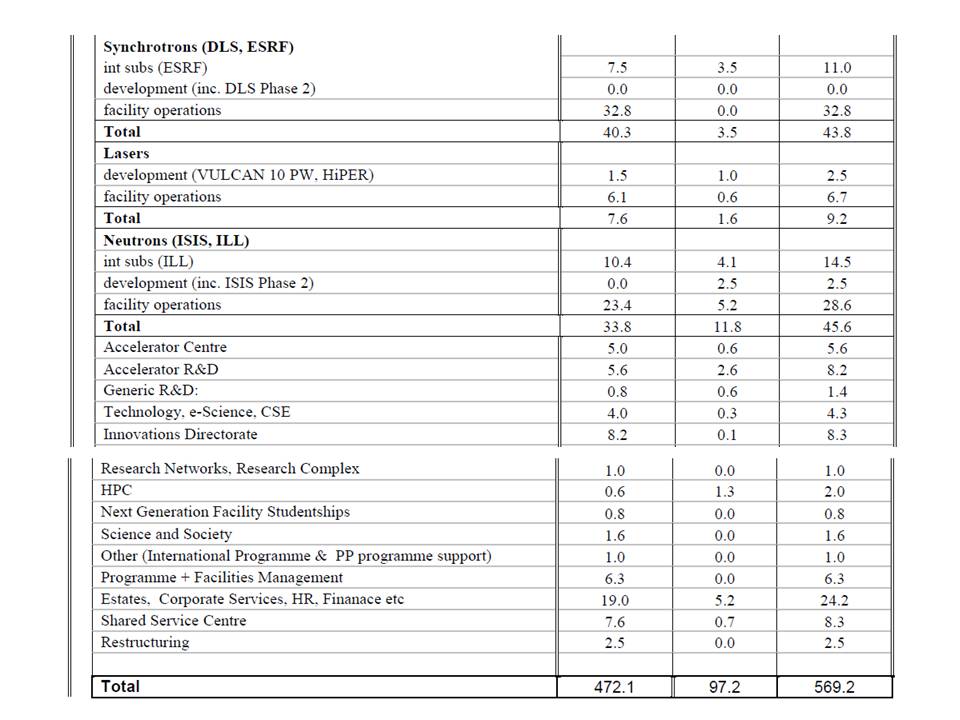
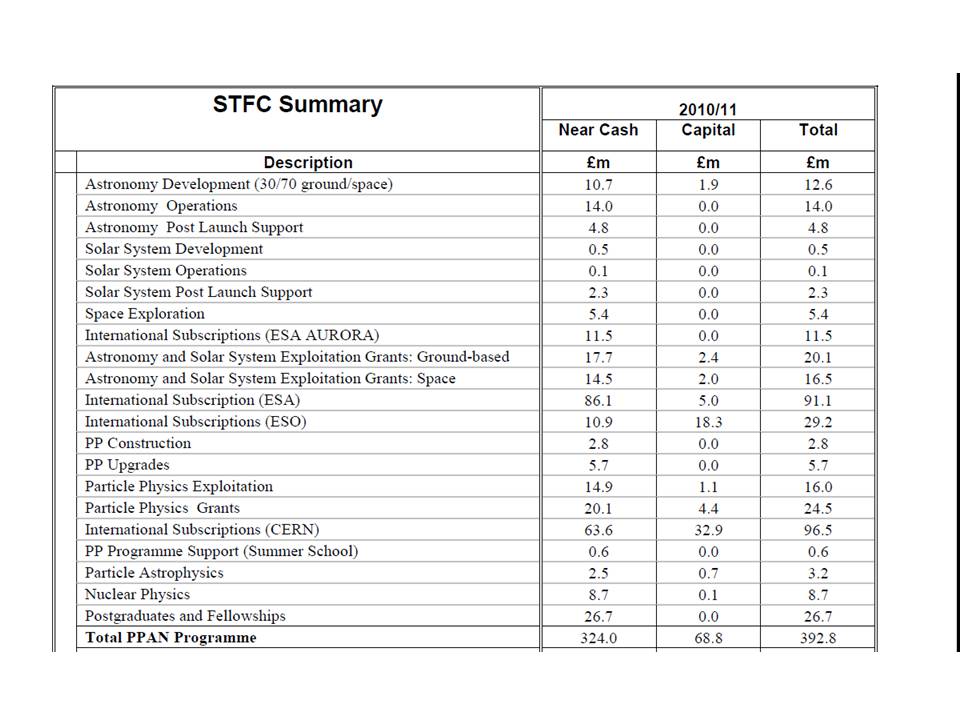
Just a quick post to point out that the Science and Technology Facilities Council have released a reasonably complete breakdown of their current budget. I’m sure many readers working in astronomy and particle physics will find it interesting reading, though others will probably find it incredibly boring.

Here it is, for easy reference, in bits, generated by a clumsy cut-and-paste-technique wholly unbefitting the hi-tech nature of STFC, starting with the PPAN Programme:

and now the rest

For those of you not up with the accounting lingo, “near cash” means assets investments and other things that could in principle be exchanged for cash in a relatively short period of time.

These are, of course, the figures before the impending cuts take place….

There’s a much more legible version of the whole thing here.


Share/Bookmark

The Browne Stuff

Posted in Education, Finance, Politics with tags , , on October 13, 2010 by telescoper

I’m basically in purdah this week, shuttling to and fro between Cardiff and Swindon on the business of the STFC Astronomy Grants Panel. However, I couldn’t resist a brief early morning post about yesterday’s news about the report on higher education funding by Lord Browne. I haven’t had time to read the report in full, so won’t comment in detail on it, but a few things did strike me from what I’ve picked up from the media. Perhaps others will add their views through the comments box.

  • For a start it’s quite amusing how far wide of the mark most of the rumour-mongering about the report’s recommendations has been. In fact the proposals are far more radical than had been touted.
  • The suggestion of lifting the cap on fees entirely, and allowing universities to decide how much to charge for tuition, will delight the so-called “elite” universities, but will alarm those (like me) who worry about the impact on students from poorer backgrounds. Most difficult, however, as far as I’m concerned will be the impact on middle-grade universities who won’t know where to pitch themselves in the free market that such a move would create. We know that Oxbridge will be able to get away with charging pretty much whatever they like, and many of the former polytechnics will clearly go for the budget end of the market, but in between there will be tricky decisions to make.
  • The increased fee is to be offset by a cut of a whopping 80% (from £3.5bn to £0.8bn) in the teaching grant to English universities. A cut of this scale may well mean that some courses do not receive any direct contribution from the taxpayer at all (the so-called “unit of resouce”). If this goes ahead it will undoubtedly lead to course closures across the country. Although I would oppose a blanket cut of this scale, I’m not against the idea of withdrawing support from Mickey Mouse courses and concentrating it on important subjects.
  • It seems likely, and indeed there are already signs, that full implementation of the Browne proposals will be politically difficult for the ConDem coalition.  In fact, unless some of the recommendations are diluted, this may well lead to a full-scale revolt. We’ll have to wait and see.
  • Vince Cable has endorsed the report, despite his own party’s previous opposition to raising tuition fees. Any resisual respect I had for him is going down the plughole very rapidly indeed.
  • Finally, I’ll just point out that, even if they are fully implemented, the draconian cuts to English higher education funding are not necessarily going to be replicated here in Wales (or in Scotland or Northern Ireland). The Welsh Assembly has issued a statement on the Browne report, but clearly doesn’t know what to do about it. If they make good decisions now, Welsh universities could prosper by bucking the English trend, but if they get it wrong….

Anyway, that’s all for this am. Got a train to catch!


Share/Bookmark

Number Crunching

Posted in Finance, Politics, Science Politics with tags , , on October 6, 2010 by telescoper

Only time for a (very) brief post this evening, as I’ve been in London all day and got back much later than expected.

In this morning’s Guardian there was a story about how the UK’s banks intend to pay out a whopping £7bn in bonuses this year. Banks. Remember them? They’re the organisations whose behaviour almost brought this country’s economy to its knees a few years ago and needed to be baled out by the taxpayer, at enormous cost to the public purse.

Meanwhile, the Science is Vital campaign is gearing up for Saturday’s rally. An article over on cosmic variance has raised the profile of this increasingly vocal campaign to stave off cuts which threaten to destroy Britain’s position as a leading scientific nation. The petition has now been signed by over 17,000 people (including the winners of this year’s Nobel Prize for Physics, announced yesterday).

It’s worth emphasizing the numbers behind this story too.  The annual UK science budget, before the next round of cuts, stands at £3.2billion. That’s everything – particle physics, astronomy, chemistry, biosciences, and countless other things.

I need hardly point out the irony. The amount we’re waging an increasingly desperate fight to protect is less than half the amount to be spent on yachts and fancy cars by the people who got us into this mess in the first place. Some of us hoped the financial sector would show some contrition after the disaster of 2007. Fat chance!  Their rescue by the taxpayer has probably just convinced them that however they behave they can always rely on Joe Public to get them out of trouble. It seems they’ve reverted to type.

So let’s have no more of the specious arguments about having to cut science in order to avoid having to cut, say, the National Health Service. Science isn’t as expensive as some people would have us believe, and it’s not a luxury either. It’s vital to our economic and cultural well-being. Each pound spend on science is worth a lot more to this country than  two disappearing into a banker’s offshore tax haven.

In any case the government should just tax the greedy bankers’ bonus payments and use the money to increase the science budget. Better still, put pressure on the banks to themselves invest in science, alongside other areas of innovation, which we know will generate healthy profits for those brave enough to take a calculated risk, rather than going back to the old game of playing around with dodgy property-based financial speculations, which have a good chance of taking us down the plughole for good.