Archive for the Harassment Bullying etc Category

The Christopher Backhouse Case

Posted in Harassment Bullying etc with tags , , on October 13, 2022 by telescoper

I want to thank everyone who has contacted me about the Christopher Backhouse harassment case I blogged about yesterday. Based on what I’ve been told, the details revealed in the Guardian article – which are bad enough – are just the tip of the iceberg. I can’t say any more in case there are further legal developments.

I saw this reaction from Erica Smith yesterday.

This experience must have been absolutely dreadful for her and I sincerely hope yesterday’s announcement allows her to bring some closure to the matter. Many would have given up given the lack of action from the police, but Erica Smith had the courage to pursue a civil action getting a sub poena that led to the identity of her harasser being revealed.

Some of the people who have contacted me are people involved with DUNE. Although the harassment went on for years, none of them knew anything about the case until very recently. They are all very disturbed that this was going on in their midst for so long.

I am not a lawyer but it remains a mystery to me why Dr Backhouse has not faced a criminal prosecution. This seems to have enabled him to simply walk away from all the trouble he has caused?

I have been told that because the online harassment was anonymous – because Backhouse used proxy servers – the US Police could not pursue the matter. However, now Backhouse’s cover has been blown and the evidence is clear, shouldn’t the matter now be referred to the UK Police for him to be prosecuted there, or even extradicted to the USA to stand trial there?

In England & Wales Some crimes of harassment are dealt with summarily (i.e. by a Magistrates’ Court) which means the maximum custodial sentence on conviction is six months. However, more serious offences can be tried in the High Court and according to the Sentencing Council guidelines much longer sentences are possible for more serious offences. I’m no in favour of sending people to prison unless it’s absolutely necessary, but the harassment alone seems to me to warrant it in this case.

Anyway, my purpose in writing this post was really to point out that however strongly I feel about this there is little I myself can do of a practical nature, except encourage people who have further information on this case to take it to the proper authorities and urge others in similar situations to be inspired by the example of Erica Smith.

Update: some further information clarifying some matters related to this case is available on this Twitter thread

The Christopher Backhouse Harassment Case

Posted in Harassment Bullying etc with tags , , , , on October 12, 2022 by telescoper

I hardly know what to say about the harassment case involving Christopher Backhouse, a former researcher at University College London covered in today’s Guardian, except that everyone should be aware of just what a shocking case it is. The opening paragraph of the Guardian story gives a taste:

A former academic at University College London must pay almost £50,000 in damages to a former colleague after falsely portraying her as a sex worker on social media as part of a months-long campaign of harassment.

I don’t know Backhouse personally, but he is (or was) apparently a Royal Society Research Fellow working on the DUNE experiment, an underground neutrino physics experiment.

The whole story is very disturbing, not least because the harassment went on for so long. One strange aspect of this case is that the victim of Backhouse’s campaign of harassment, Erica Smith, had to pursue a civil action against him to put an end to his behaviour. One would have imagined that a criminal case would have been more appropriate. I for one think he should be in prison; the description presented in the Guardian article seems to constitute harassment as defined under the Public Order Act 1986 and the Protection from Harassment Act 1997. If such an offence is committed with intent to cause harassment, alarm or distress, the offender can be given 6 months’ imprisonment or a hefty fine. Why has Backhouse not been prosecuted?

The article ends with

A UCL spokesperson said Backhouse was no longer employed by the university.

I’m glad at least of that, but I wonder what UCL did during the “campaign of harassment” carried out by Christopher Backhouse and whether he left voluntarily or was sacked. I wonder what they have done to help Erica Smith put her life back together after this horrific episode. Does UCL have a vicarious liability?

This case on its own raises grave questions about the way harassment cases are handled in the Department of Physics & Astronomy at UCL but this is far from the first such case there that has gone public; see e.g. here.

UCL clearly has a lot of work to do to put its house in order.

In more general terms, I’ll repeat what I have said in earlier posts on this issue:

Failure to act strongly when such behaviour is proven just sends out the message that the institution doesn’t take sexual harassment seriously. In my view, confidentiality is needed during an investigation – to protect both sides and indeed the person doing the investigation – but if the conclusion is that misconduct has taken place, it should be acknowledged publicly. Justice has to be seen to be done. Sexual assault, of course, is another matter entirely – that should go straight to the police to deal with.

I’ve talked about protocols and procedures, but these can only ever apply a sticking-plaster solution to a problem which is extremely deeply rooted in the culture of many science departments and research teams across the world. These tend to be very hierarchical, with power and influence concentrated in the hands of relatively few, usually male, individuals. A complaint about harassment generally has to go up through the management structure and therefore risks being blocked at a number of stages for a number of reasons. This sort of structure reinforces the idea that students and postdocs are at the bottom of the heap and discourages them from even attempting to pursue a case against someone at the top.

We are obviously very far indeed from eliminating harassment or the conditions that allow it to continue but although cases like this are very painful, I think they at least demonstrate that we are beginning to see the extent of the problem, and how the measures taken to deal with it are inadequate. We have to work much harder to stop this sort of thing from happening in the first place.

Codes of Conduct to Counter Bullying and Harassment – A Petition

Posted in Harassment Bullying etc on June 30, 2021 by telescoper

A week or so ago news broke of yet another case of bullying in an astronomy department, this time in the University of Lund. This and a number of older examples of harassment and bullying have led to the circulation of a letter calling for Codes of Conduct to be introduced in scientific collaborations. I received this letter (from Dr. ClƩmence Fontanive) through the Euclid Collaboration together with an encouragement to circulate it as widely as possible, which I am now doing. I have signed the petition and hope you will do likewise.

Dear Colleagues,

In light of recent events within the astronomy community, it has become increasingly apparent that many official collaborations in astronomy lack Codes of Social Conduct, with policies in place to deal with cases of behavioural misconduct. We believe Codes of Conduct to be important tools to make academia a safe, respectful and inclusive environment, and have therefore written an Open Letter to the Community soliciting their introduction in all collaborations, with the hope to encourage and normalise their implementation.

You can read and sign the Letter at the following links:

View Petition

Sign Petition

Please consider adding your name to ours in support. We would also be very grateful if you could help circulate this as widely as possible to your colleagues and institutions.

Thank you very much for your support.

Best wishes,
ClƩmence, on behalf of all co-authors


Caltech astrophysics and harassment: Lessons learned

Posted in Harassment Bullying etc with tags , , on August 13, 2019 by telescoper

This is a lengthy but important post about the recent episodes of harassment at Caltech centred around Christian Ott. I’ve blogged in relation to this myself a few times; see here. It’s not a comfortable read, which is precisely why you should read it.

One of the worst things about the way institutions handle investigations into harassment and related disciplinary matters is that the system does not include any provisions to bring closure to the victims. Indeed, victims are sometimes not even informed as to the outcome of the investigation.

You can make your own mind up about the behaviour of Caltech as an institution. All I’ll say is that far more people were affected than I was previously aware of.

cjhandmer's avatarCasey Handmer's blog

Caltech astrophysics and harassment: Lessons learned

Casey Handmer 2019

What is this?

In the wake of major catastrophes, it is common practice for organizations to publish a ā€œLessons Learnedā€ report to help prevent future occurrences. The largest public catastrophe in which I’ve ever been involved occurred in the Caltech astrophysics department between 2010 and 2019. Former Caltech professor and internationally disgraced astrophysicist Christian Ott harmed, harassed, and abused numerous students, postdocs, and research fellows. Despite thousands of hours of investigation, no public ā€œfindingsā€ or ā€œlessons learnedā€ report has ever been made available. This document is my attempt to fill this need.

Why?

It has been historically conventional to conceal this sort of institutional malpractice, with the effect that the hard-learned lessons are forgotten and that harassment, particularly of underrepresented minorities, is still common. The intent of this document is to undermine the traditional assumption that abused students will graduate or…

View original post 11,100 more words

`Pass-the-Harasser’ … to Turku

Posted in Education, Harassment Bullying etc with tags , , , on February 2, 2018 by telescoper

I noticed yesterday evening that there has recently been a substantial increase in the number of people viewing my posts about Christian Ott, the former Caltech Professor who eventually left his job there after harassing and committing ‘gender-based discrimination’ against two female students there.

It wasn’t difficult to find out why there had been an upsurge in interest: Christian Ott has got a new job, at the University of Turku, in Finland. As far as I understand the situation – and please correct me if I’m wrong – he was `head-hunted’ for this position, so his appointment was not the result of an open competition and it seems the position was specifically created just for him.

UPDATE: the post was advertised here, but the gap between the deadline for applications – 10th December 2017 – and the appointment being announced is too short to be consistent with the usual processes of academic appointments. Moreover, the advertised job descriptions includes teaching duties; see below for why this is relevant.

Not surprisingly both the appointment itself and the circumstances by which it was brought about have provoked considerable reaction. A group of Finnish astronomers and astrophysicists has written a Statement on Harassment, which you can sign in support (here if you’re Finnish and/or based in Finland) and here for other concerned academics. I have signed the second one.

I have two personal comments to make. The first is that I’ve seen people say that Ott should get a `second chance’, and it would be unfair for his past transgressions to force him out of academia.

This is what I wrote in an earlier piece about this:

It remains to be seen what Christian Ott does. I am not familiar with his work but he is, by all accounts, a talented scientist so he may well find a position at another institution. If he does, I hope, for his and for his future colleagues’ sake, that he has learned his lesson.

I think that makes it clear that I have no desire to see Christian Ott ruined, but I don’t think that means that I think due process should be subverted to help him, as appears to be the case here. In fact I’m bound to say that if I were a Head of Department I wouldn’t under any circumstances have offered this man a position, after what he did.

Had Ott committed a different disciplinary offence (such as plagiarism or other research misconduct) he would not have found it so easy to get another job than because it was `just’ harassment. Why should these offences be treated so differently?

Once again, research esteem seems to trump everything else. That attitude is one of the most poisonous elements in modern academia. The `Great Man of Science’ is indeed a dangerous myth.

The second thing is that, as far as I understand it (and again please correct me if I’m wrong), Ott’s new position is as an `independent researcher’ and he will have no teaching duties and minimal contact with students. I suppose that is supposed to make everything alright. It doesn’t. Indeed, there are many academics who would regard a cushy research-only contract as a reward rather than a cost. It’s a slap in the face for teaching staff at Turku that funds have been found to create a bespoke position in the way that has been done here.

As always, comments clarifications and corrections are welcome through the comments box.

UPDATE: 7/2/2018. The appointment of Dr Ott has been cancelled.

Unprofessional Astronomy – arXiv:1711.02090

Posted in Harassment Bullying etc, The Universe and Stuff with tags , , , on November 8, 2017 by telescoper

It is essential to the way that science works that published results are challenged by independent scrutiny and by confrontation with rival analysis. New facts and new theoretical explanations are often established and previously existing misapprehensions eliminated through this form of critical dialogue. More often than not this process of claim and counter-claim is carried out in a collegiate spirit because all parties are mindful that this kind of debate is part and parcel of the scientific method. To behave otherwise as a scientist is unprofessional.

Regrettably, however, sometimes scientists overstep the mark and engage in behaviour which falls short of this expectation, particularly when it is by a senior scientist directed towards a junior colleague because then unnecessarily aggressive criticism can take on the mantle of bullying.

Today I saw a paper on the arXiv by Bouwens et al. that contains criticism of a previous paper by Livermore et al. (2017) (arXiv version here) which I think oversteps the mark in this way, especially because the lead author of the first paper, Rychard Bouwens, is an established (male) academic and the first author of the second, Rachael Livermore, is a (female) postdoctoral researcher.

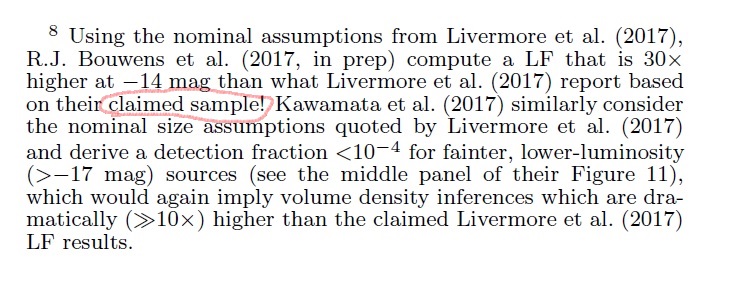
Two footnotes from the Bouwens et al. paper suffice to give a flavour of the tone. This is footnote 8:

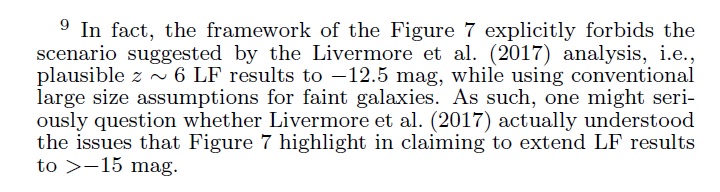
This is footnote 9:

There are a number of inappropriate aspects of these comments (and others made elsewhere in the paper). I’ll mention just two.

First, note the highlighted `claimed sample’ in Footnote 8. The only way I can read this phrase is as an insinuation that the Livermore et al. sample has somehow been fabricated. In other words, it is a snide allegation of research misconduct. This may not be what Bouwens et al intended to say, but that’s certainly how it reads. And the phrase `claimed sample’ appears more than once in their paper. If they don’t mean it that way then I strongly suggest they edit the paper to clarify, as it is potentially extremely defamatory.

Second, note that the Livermore et al. results are published in the Astrophysical Journal. That means that they have therefore passed peer review and are in the public domain. That does not mean that they cannot be challenged, of course, but note that in Footnote 8, Bouwens et al. refer to an article that is not public, not refereed and not even finished.Ā  I don’t think this it is fair to include this in the current paper as the evidence to back up the criticism is simply not available. Note also the implication in Footnote 9 that the referee of this paper did not understand the issues presented in the paper, either.

Now I don’t know who (if anyone) is right about the luminosity function results in these papers. Luminosity function determinations are difficult, being prone to all kinds of selection biases and other problems. I am not going to side with either set of authors on the technicalities. I just think it’s extremely regrettable that Bouwens have adopted this tone towards another group of authors whom they should regard as colleagues. It is perfectly reasonable to criticise the work of another group in the literature, but in my experience this usually only happens after the two teams have discussed the issues in private and failed to reconcile their differences. That can and does happen, but here there does not seem to have been any attempt to sort this out amicably before going on the offensive. I find that deeply regrettable.

By the way, this is the AAS Policy on Professional and Ethical Standards for its journals (including the Astrophysical Journal, to which the Bouwens et al. paper has been submitted):


Christian Ott’s Resignation

Posted in Harassment Bullying etc with tags , , , on August 2, 2017 by telescoper

I heard this morning an unconfirmed report that Christian Ott, the Caltech Professor who had previously been suspended for harassing two female students, and required to attend “rehabilitation”, had finally resigned from his position. Now I have found confirmation in the form of a news item and the following statement (from this source):

Ott

Ott was due to return from his suspension this summer, but instead he will remain off campus and leave the institution for good at the end of December this year.

When I posted about this episode last year, I wrote:

The first thing to say is that I find it very hard to believe that Ott will ever be able to return to his workplace after the revelations of his behaviour even if he does attend ā€œrehabilitative trainingā€. I very much doubt that the faculty or students would want him back. It surprises me that Caltech could even imagine that this is a realistic possibility.

It was never going to work, for all kinds of reasons, and Caltech should have realised that ages ago. I don’t, incidentally, think it’s fair to say his presence on campus would have been `divisive’. I think opinions at Caltech were pretty much united, based on the people I know there: they didn’t want him back.

It remains to be seen what Christian Ott does. I am not familiar with his work but he is, by all accounts, a talented scientist so he may well find a position at another institution. If he does, I hope, for his and for his future colleagues’ sake, that he has learned his lesson.

But it is not Christian Ott’s future that is the most important consideration. The two individuals involved in the case have had to put up with behaviour that simply shouldn’t have happened, and which should have been dealt with much more decisively before so much damage was done to the lives and careers of the young women involved.

This is a depressing story in many ways, but it seems clear to me likely that the Caltech management were afraid to dismiss Ott fearing a lawsuit and associated reputational damage. Unlike the equivalent posts in the UK, positions like Ott’s are fully tenured in the USA so a dismissal can potentially be challenged on a number of legal grounds, especially if such procedures that were in place were not properly followed. Of course it may also be that the procedures were inadequate anyway, which makes litigation even more likely to be successful. If these were the considerations that influenced Caltech’s decision, then I hope they now realise that they would in the long run have been far better advised to do the right thing, and weather any short-term storm.

The only proper reaction now for Caltech to this sorry business is to undertake a complete overhaul of the way it deals with harassment and related forms of misconduct. If done properly that might also help heal the scars this case has left. Not that Caltech is far from being the only institution with a problem in this regard…

Harassment and Confidentiality

Posted in Harassment Bullying etc with tags , , on January 13, 2016 by telescoper

News of yet another sexual harassment scandal in Astronomy has broken, this time at Caltech. The individual concerned was not named by Caltech but has subsequently been identified as Christian Ott (whom I don’t know at all), who was investigated following complaints by two female PhD students. The complaints were upheld and Ott has been suspended.

This case would be difficult enough to comment on even without the complex backstory, some of which is in the public domain: two of the three protagonists appear in this article which dates from 2014. Clearly a lot has happened since then and it would be intrusive and unhelpful for me to speculate publicly about things know I nothing about.

What I will say, as clearly as I possibly can, that it is that due process has been followed and that there is no question the right decision was reached. My only surprise is that Dr Ott was not summarily dismissed.

In the interests of full disclosure I should make it clear that I do know one of the complainants in a professional capacity, Sarah Gossan, who was an undergraduate Astrophysics student at Cardiff while I was there and who started a PhD at Caltech in 2012.

Also for the record I should state that one of my duties as a Head of School here at the University of Sussex is to investigate and deal  with allegations of harassment or other misconduct by staff. I obviously can’t comment on individual cases I have dealt with, but will say that it is probably my least favourite job but someone has do it.

If such a complaint is upheld it can lead to summary dismissal (for very serious misconduct) or, at very least, a formal written warning. It’s worth also stating that the standard applied is that of a Civil rather than Criminal Court, i.e. the decision is based on the “balance of the evidence” rather than “beyond reasonable doubt”.

Concerning the Caltech/Ott case, according to this source:

The university investigation, which concluded in September, found that Ott violated the school’s harassment policies with both women. Ott, a 38-year-old rising star who had been granted tenure the year before, was placed on nine months of unpaid leave. During that time he is barred from campus, his communication with most of his postdoctoral fellows will be monitored, and, with the exception of a single graduate student, he is not allowed to have contact with any other students. Before returning, he must undergo what a school official calls ā€œrehabilitativeā€ training.

The first thing to say is that I find it very hard to believe that Ott will ever be able to return to his worksplace after the revelations of his behaviour even if he does attend “rehabilitative training”.  I very much doubt that the faculty or students would want him back. It surprises me that Caltech could even imagine that this is a realistic possibility.

Another feature worthy of comment is that Caltech itself did not name the perpetrator, although his name very rapidly appeared in the public domain. Disciplinary procedures of this type are also treated confidentially in all UK universities with which I am familiar (including the University of Sussex). I think there are good reasons for this, primarily to protect individuals from false or malicious allegations, but also to protect the complainant(s) from unwelcome publicity or other unwanted attention. However, it has to be said that this often also ends up protecting the culprit too. If  a person ends up getting the sack as as  result of sexual harassment then news will almost certainly leak out about why Dr Bloggs has left suddenly. However, if it leads to a warning then this outcome is generally not disclosed. In such a situation, Dr Bloggs could move to another institution and carry on where he left off.

They have been suggestions in the USA, discussed in this article, that legislation could be intoduced to force institutions to disclose information about harassment cases when an individual moves from one to another. I think this is an idea well worth thinking about, but I am not sure how workable it is in practice.

Failure to act strongly when such behaviour is proven just sends out the message that the institution doesn’t take sexual harassment seriously. In my view, confidentiality is needed during an investigation – to protect both sides and indeed the person doing the investigation – but if the conclusion is that misconduct has taken place, it should  be ackowledged publicly. Justice has to be seen to be done. Sexual assault, of course, is another matter entirely – that should go straight to the police to deal with.

I’ve talked about protocols and procedures, but these can only ever apply a sticking-plaster solution to a problem which is extremely deeply rooted in the culture of many science departments and research teams across the world. These tend to be very hierarchical, with power and influence concentrated in the hands of relatively few, usually male, individuals. A complaint about harassment generally has to go up through the management structure and therefore risks being blocked at a number of stages for a number of reasons. This sort of structure reinforces the idea that students and postdocs are at the bottom of the heap and discourages them from even attempting to pursue a case against someone at the top.

The unhealthy power structures I’ve discussed will not be easy to dismantle entirely, but there are simple things that can be done to make a start. “Flatter”, more democratic, structures not only mitigate this problem but are also probably more efficient by, for example, eliminating the single-point failures that plague hierarchical organisational arrangements.

We are very far indeed from eliminating harassment or the conditions that allow it to continue but although cases like this are painful, I think they at least demonstrate that we are beginning to acknowledge that there’s a problem.