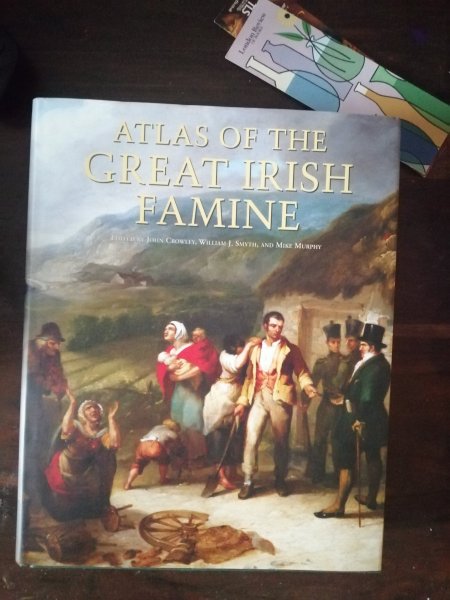
Well here we are, Christmas Day. I got up late this morning and opened the present I bought for myself:
It’s not exactly light reading, but grimly fascinating. I ordered it through the splendid local bookshop, by the way.
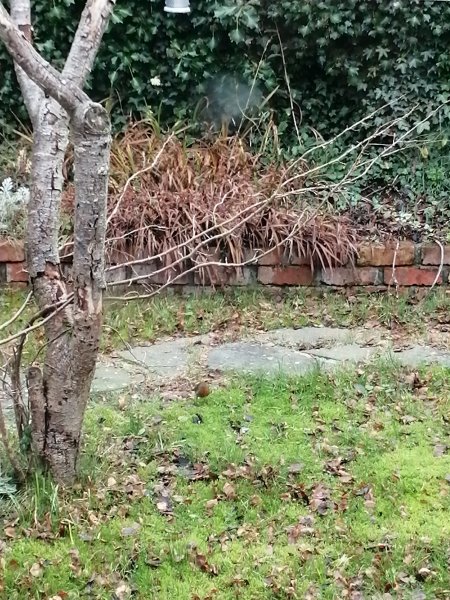
As I had my coffee I had a visit from the local Robin, who seemed to be carrying out a pitch inspection.
A crowd of very noisy seagulls have arrived in the neighbourhood today, which seems to have scared the other birds off.
Now I’m going to have a late breakfast (a fry-up) before preparing this evening’s dinner. I’m not sure it’s worth seeing if there’s anything worth watching on the telly, but there is a complete performance of Handel’s Messiah on the radio this afternoon so I might listen to that.
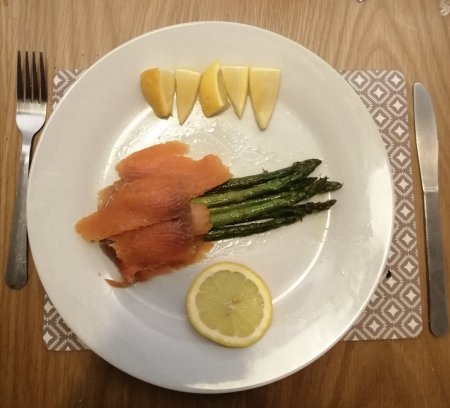
Update: first course. Smoked salmon seasoned with fennel and lemon with pan-fried asparagus.
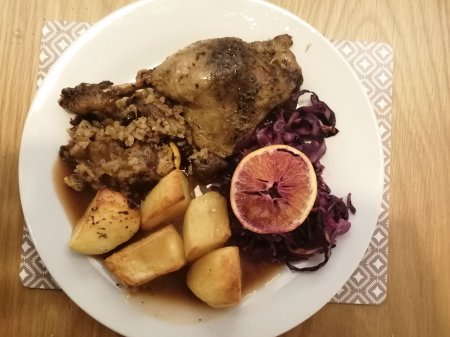
Update: main course. Confit of duck, roast potatoes, red cabbage spiced with cinnamon & apple, chestnut and orange ciabatta stuffing and port sauce.
I don’t mind telling you the duck was delicious!
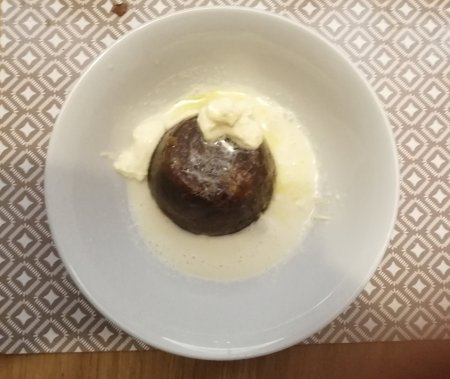
Update 3: Dessert. Plum Pudding with Brandy Cream.
Anyway, let me wish you all a Merry Christmas, Nadolig Llawen, Nollaig Shona, Fröhliche Weihnachten, Joyeux Noël, Buon Natale, Feliz Navidad, Glædelig Jul, etc. And in the words of a traditional Irish toast:
The prehistoric passage tomb at Newgrange in the Boyne Valley North of Dublin is about 1000 years older than Stonehenge. At dawn, around the Winter Solstice, the Sun’s rays penetrate into the inner chamber, as they have done for over 5000 years.
A live stream of this extraordinary sight took place this morning (20th December) and there will be others on Monday 21st and Tuesday 22nd. This is a recording of this morning’s stream.
The Burning of Cork is the name commonly given to a devastating series of fires that swept through the centre of Cork City on the night of 11th December 1920. The burning and the subsequent controversy is one of the most significant events of the Irish War of Independence. During the War of Independence, Cork…
I’ve recently moved on to the part about Special Relativity in my module on Mechanics and Special Relativity and this afternoon I’m going to talk about the Lorentz-Fitzgerald contraction or, as it’s properly called here in Ireland, the Fitzgerald-Lorentz contraction.
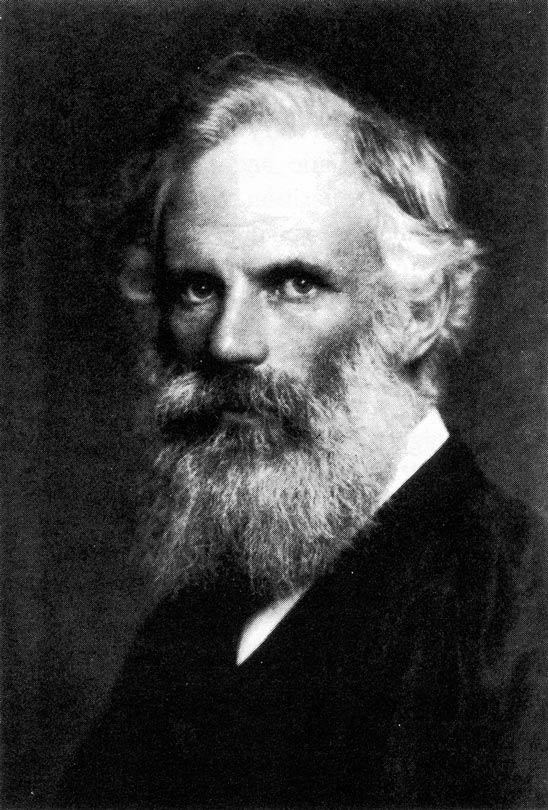
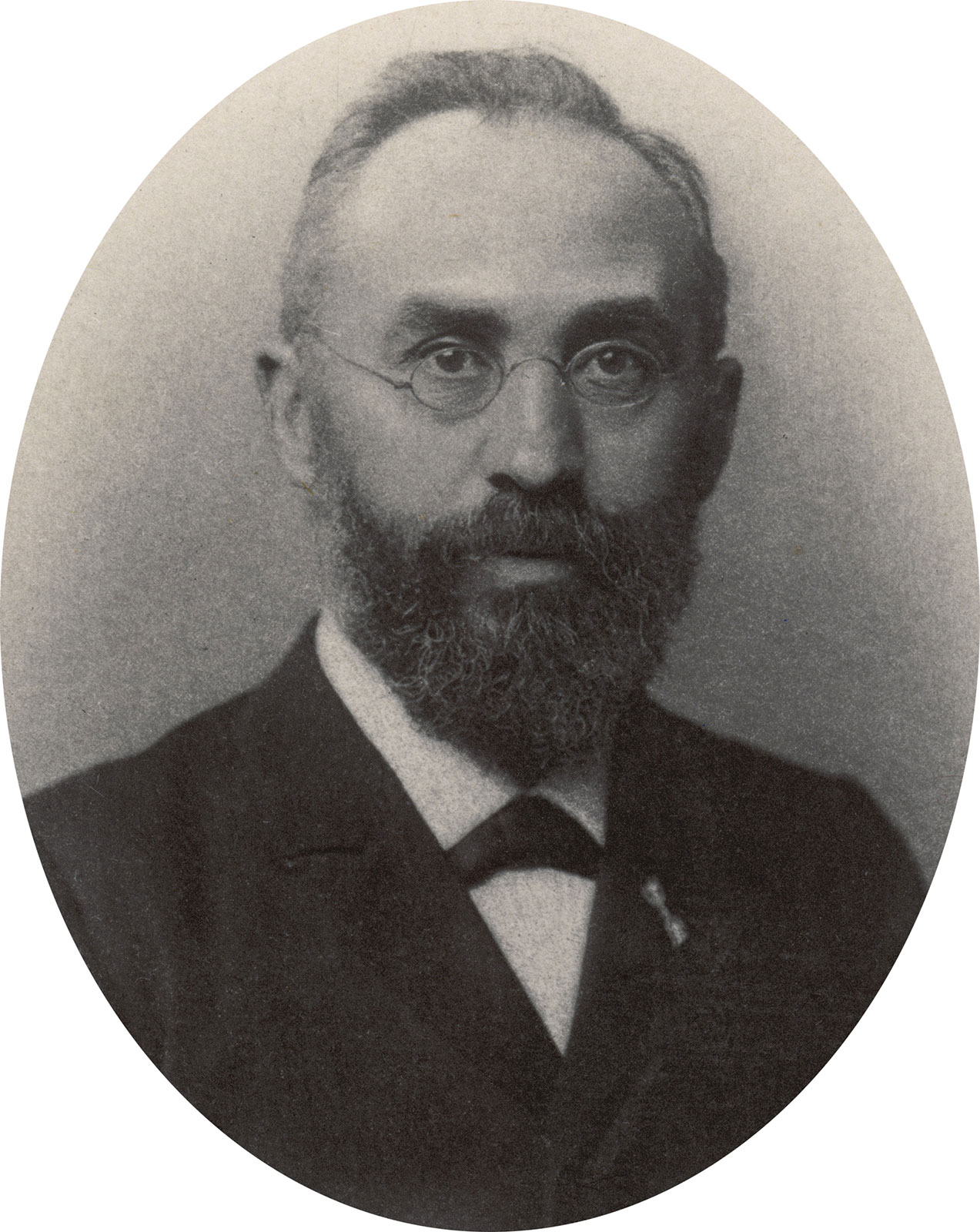
The first thing to point out is that the physicists George Francis Fitzgerald and Hendrik Lorentz, though of different nationality (the former Irish, the latter Dutch), both had fine beards:
George Francis Fitzgerald (1851-1901)
Hendrik Lorentz (1853-1928)
One of the interesting things you find if you read about the history of physics just before Albert Einstein introduced his theory of special relativity in 1905 was how many people seemed to be on the verge of getting the idea around about the same time. Fitzgerald and Lorentz were two who were almost there; Poincaré was another. It was as if special relativity was `in the air’ at the time. It did, however, take a special genius like Einstein to crystallize all that thinking into a definite theory.
Special relativity is fun to teach, not least because it throws up interesting yet informative paradoxes (i.e. apparent logical contradictions) arising from that you can use to start a discussion. They’re not really logical contradictions, of course. They just challenge `common sense’ notions, which is a good thing to do to get people thinking.
Anyway, I thought I’d mention one of my favorite such paradoxes arising from a simple Gedankenerfahrung (thought experiment) here.
Imagine you are in a railway carriage moving along a track at constant speed relative to the track. The carriage is dark, but at the centre of the carriage is a flash bulb. At one end (say the front) of the carriage is a portrait of Lorentz and at the other (say the back) a portrait of Fitzgerald; the pictures are equidistant from the bulb and next to each portrait is a clock.The two clocks are synchronized in the rest frame of the carriage.
At a particular time the flash bulb goes off, illuminating both portraits and both clocks for an instant.
It is an essential postulate of special relativity that the speed of light is the same to observers in any inertial frame, so that an observer at rest in the centre of the carriage sees both portraits illuminated simultaneously as indicated by the adjacent clocks. This is because the symmetry of the situation means that light has to travel the same distance to each portrait and back.
Now suppose we view the action from the point of view of a different inertial observer, at rest by the trackside rather than on the train, who is positioned right next to the centre of the carriage as the flash goes off. The light flash travels with the same speed in the second observer’s frame, but this observer sees* the back of the carriage moving towards the light signal and the front moving away. The result is therefore that this observer sees the two portraits light up at different times. In this case the portrait of Fitzgerald is lit up before the portrait of Lorentz.
Had the train been going in the opposite direction, Lorentz would have appeared before Fitzgerald. That just shows that whether its Lorentz-Fitzgerald contraction or Fitzgerald-Lorentz contraction is just a matter of your frame of reference…
But that’s not the paradoxical thing. The paradox is although the two portraits appear at different times to the trackside observer, the clocks still appear show the same time….
*You have to use your imagination a bit here, as the train has to be travelling at a decent fraction of the speed of light. It’s certainly not an Irish train.
An iconic image of the Great Irish Famine: pen & ink drawing of Bridget O’Donnel and two of her children by (it is believed) James Mahony, published in the London Illustrated News on 22nd December 1849.
The last couple of Monday nights have seen the airing of a two-part documentary series called The Hunger on RTÉ. It was, of course, about the Great Irish Famine, which led to the death of one million (mainly poor) Irish people and the emigration of over two million in the subsequent years. It was a shattering episode that altered Ireland for ever; the population of this island still hasn’t recovered to pre-Famine levels.
The series, based on a serious scholarly book called Atlas of the Great Irish Famine, and narrated by Liam Neeson, was unflinching and sometimes harrowing to watch, the dreadful personal accounts of suffering juxtaposed with equally shocking graphics showing the scale of the depopulation of rural Ireland. I haven’t read the book on which the The Hunger is based, but have ordered it from the local bookshop.
‘No imagination can conceive — no tongue express— no brush paint— the horrors of the scenes which are daily exhibited in Ireland’, observed Senator Henry Clay in 1847 at the height of the Great Hunger.
I think it would be great if The Hunger were shown on British television, though I suspect few would watch it. The British prefer their own propaganda to the truth about the empire. Oscar Wilde once remarked “The problem is the English can’t remember history, while the Irish can’t forget it”. I don’t think the Great Famine will be forgotten soon, but I for one don’t see that as a problem.
It’s November 30th 2020, which means we have just three teaching weeks to go until the end of term. I am currently teaching two modules: Mechanics 1 and Special Relativity for first-year students and Vector Calculus and Fourier Series for second years. We’re now getting to the “and” bit in both modules.
I didn’t want to present the two topics mentioned in the title of the second year module as completely disconnected, so I decided to link them with a lecture in which I use the divergence theorem of vector calculus to derive the heat equation, the solution of which led Joseph Fourier to devise his series in Mémoire sur la propagation de la chaleur dans les corps solides (1807), a truly remarkable work for its time that inspired so many subsequent developments.
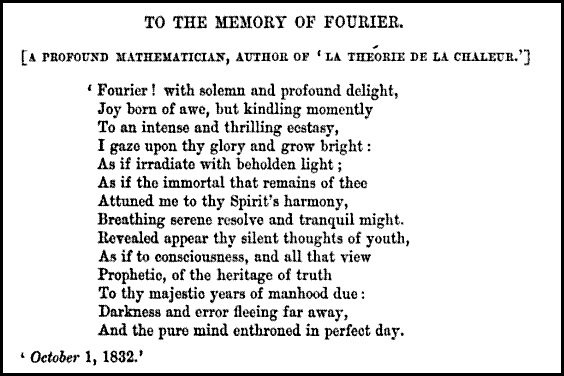
That gives me an excuse to repost the following “remarkable” poem about Fourier by William Rowan Hamilton:
In the first-year module I will be spending most of this week talking about potentials and forces before starting special relativity next week, at the proper time.
This day and age we’re living in Gives cause for apprehension With speed and new invention And things like fourth dimension Yet we get a trifle weary With Mr. Einstein’s theory So we must get down to earth at times Relax relieve the tension And no matter what the progress Or what may yet be proved The simple facts of life are such They cannot be removed
As time goes by, the other thing drawing nigh is the loosening of Ireland’s current Level 5 Covid-19 restrictions which were imposed about six weeks ago though, judging by the crowds drinking in Courthouse Square on Saturday night, a lot of folks have thrown the rules out the window already.
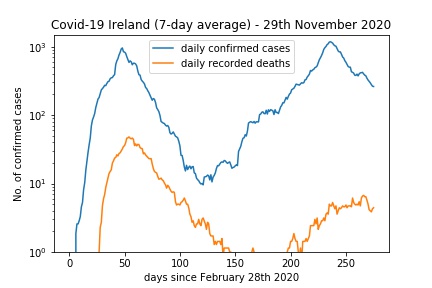
I think it’s a dangerous time. The daily cases are still hovering around the 250-300 mark and will undoubtedly start climbing even before Christmas itself:
The chances of us getting back to anything resembling normality during the early part of next year are exceedingly slim.
Since moving to Ireland almost three years ago I have (somewhat unexpectedly) become a fan of GAA and regularly watch both hurling and Gaelic football on the TV, which is quite often.
Ireland is very keen on sports generally, with big followings for both rugby and soccer but, at least in terms of attendances, hurling and Gaelic football are by far the most popular sports in Ireland. That’s quite remarkable because these are entirely amateur games. One of the great things about the GAA is that it’s a real grass roots organization, where even games between local clubs can attract very big crowds. (I’m talking about the pre-Covid era there, obviously.) The players tend to be local and there’s a strong involvement of the community in the local clubs.
Hurling is my favourite GAA sport – the level of skill on display is truly awesome and it’s played at an amazingly fast tempo – but I do watch the football when I can too and am more gradually getting into it. Incidentally, these two sports are played on the same pitches with the same goals and the same number of players on each side (15) and have basically the same rules – with a player’s hurley (stick) in hurling being in one-to-one correspondence as far as the rules are concerned with a player’s foot in Gaelic football. The ball of course is bigger in football; the small one used in hurling is called a sliotar. Scoring is the same in both: 1 point getting the ball between the two posts over the bar as in rugby and a goal (3 points) for getting the ball into the back of the net below the bar.
I took a break in the early afternoon yesterday to watch the All Ireland Quarter Final match in the hurling between Galway and Tipperary, an entertaining match played in fine weather which was won by Galway 3-23 to 2-24. Later on, I settled down to watch the Leinster provincial final between Dublin and Meath live from Croke Park in the evening. Given that this match was on the same day as Bloody Sunday it was preceded by a solemn commemoration of those that died a hundred years ago which I thought was beautifully done. Here’s a video tribute made by the GAA itself, played at the end of the pre-match commemoration along with specially-composed music.
After the match there was a wreath-laying ceremony involving the players which was unfortunately spoiled on the television broadcast by a commentator who talked all the way over it.
The match itself was a very one-sided affair, which was effectively all over by half time (when the score was Dublin 2-12 Meath 0-2). It ended Dublin 3-21 Meath 0-9, which is a margin of 21 points: quite a thrashing for Meath. I’m not an expert, but the Dublin side were far more mobile and inventive than Meath and thoroughly deserved their win.
There wasn’t a crowd of course. I think the commemorative event would have been even more emotional if there had been. Watching the actual match though it struck me that we’re all getting used to watching sport in an empty stadium. It’s probably going to take some getting used to the noise when (if) live audiences eventually return.
UPDATE: Tipperary beat Cork in Munster final this afternoon to win it for the first time in 85 years. The team were wearing replica jerseys of those worn by the Tipperary team that played Dublin in 1920.
After all the provincial finals, including a surprise win for Cavan over Donegal in Ulster, the four teams in the semi-finals of the All Ireland Senior Football Championship in 2020 is exactly the same as it was in 1920. The final, between Dublin and Tipperary, was not played until 1922.
(The match played on Bloody Sunday was a Challenge Match not part of the Championship.
In the days before lockdown I would often travel past Croke Park on the train from Maynooth into Dublin Connolly station. It’s a magnificent stadium, with a capacity over 80,000, its stands towering up on all sides of the playing field which is used for major sporting events organized by the Gaelic Athletics Association (GAA), chiefly hurling and gaelic football. It’s located quite close to Drumcondra Station, the last stop before Connolly on the way into Dublin. I’ve never actually been inside the ground, and you can’t see much of the interior from the train because of the stands, but I do hope to see a match there one day.
Croke Park looked very different a hundred years ago today, on November 21st 1920 (which was a Sunday).
Croke Park, looking towards Hill 16, taken on the day of November 21st 1920.
Incidentally, the low hill you can see in the background is Hill 16. There’s a story that this was built up using rubble from buildings destroyed during the 1916 Easter Rising, but this seems to be apocryphal.
Anyway, as you can see, there wasn’t much in the way of buildings around the playing field in those days, and not much to give spectators cover if they were trying to flee from gunfire.
A Gaelic football match between Dublin and Tipperary started in Croke Park at 2.45 pm on November 21st. About ten minutes into the game, armed police (including members of the regular Royal Irish Constabulary, Auxiliaries, and some Black and Tans) suddenly arrived at the southern end of the park, panicking some of the spectators who tried to run away. Without warning the police opened fire on the crowd. The first to die was 11 year old William Robinson who was sitting in a tree outside the ground to get a better view. Overall the firing lasted about 90 seconds. Thirteen people were killed outright and another died of his wounds later. Others were injured either by gunfire or in the crush resulting from the panic.
Among the dead was Tipperary’s star player Michael Hogan, who was shot dead on the playing field as he tried to find cover. Information from post-mortems released many years after the event revealed that most of the victims had been shot in the back.
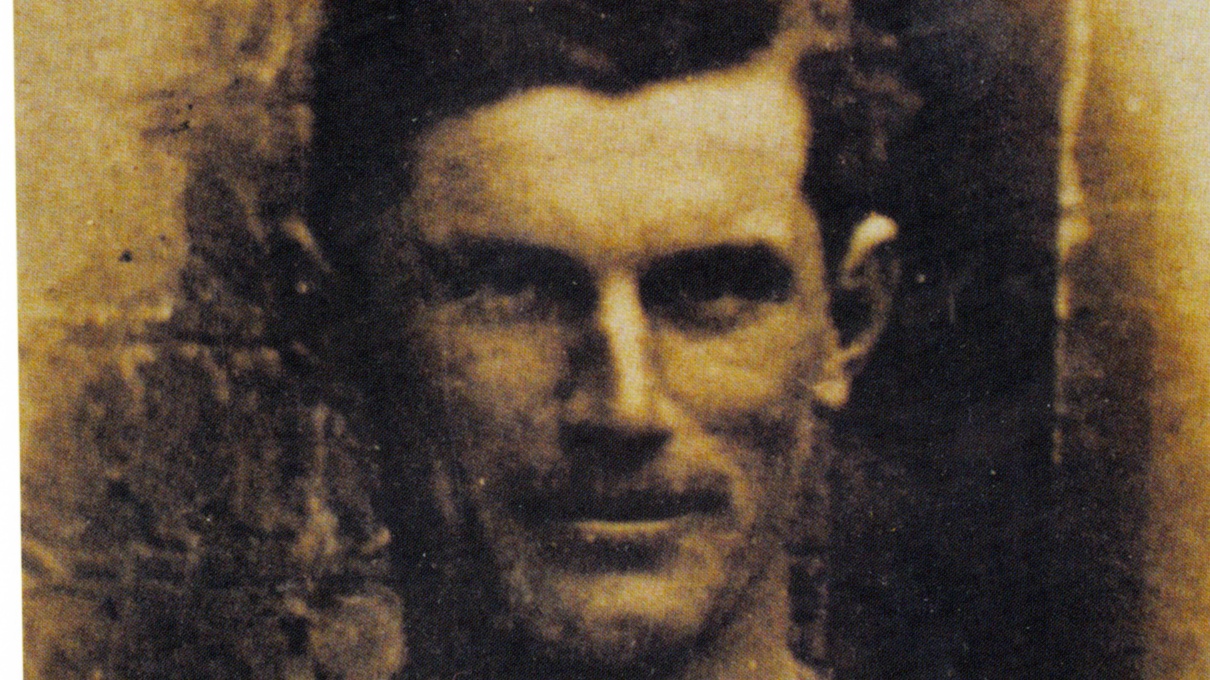
Michael Hogan, star player and Captain for the Tipperary team at Croke Park on Bloody Sunday. He died that day.
The massacre could have been even worse had the British forces at the other end of the ground, who had an armoured car with a machine gun, shown more restraint. The machine gun was fired above the heads of the people running towards this contingent. They didn’t shoot anyone but they did force the crowd back towards the gunfire from the other end of the ground. Had they opened fire at the crowd there would have been a massacre on the scale of Amritsar, where hundreds died.
Witnesses also said that while the security forces let all the Dublin players go, they lined up the entire Tipperary team against a fence and were preparing to shoot them all when a junior officer intervened and ordered them to be released. Tipperary was perceived to be a hotbed of IRA activity. Michael Hogan was in fact a member of the Irish Volunteers.
So what on Earth had happened to trigger this indiscriminate slaughter, on the day known now as Bloody Sunday (Irish: Domhnach na Fola)
The overall context is the Irish War of Independence which started in 1919 and was largely a guerilla campaign waged in rural areas. There had not been large-scale eruptions of violence in Dublin. That changed on November 21st 1920. That morning, members of the Irish Republican Army under the direction of Michael Collins, had carried out an operation across Dublin intended to eliminate the ability of the British forces to gather intelligence on the IRA. Hit squads entered the homes of known or suspected British intelligence operatives across the town and shot them. Fifteen people were killed that morning, including at least two innocent civilians in the process.
The IRA members responsible for the killings on Sunday morning melted away into the city. Once again the police and security services seemed to be fighting an invisible enemy. However, knowing that there was a football match going on that afternoon, and that at least some of those involved with the GAA had strong Republican leanings and may indeed be active IRA members, they decided to search all the spectators at the match of which there were over 10,000. The hope was, presumably, to find in the crowd at least some of those responsible for the morning’s assassinations. Instructions were given that anyone who ran away when the search operation began should be presumed guilty and shot.
News about the morning’s events had spread through Dublin that morning and it was widely anticipated that the British would carry out reprisal killings, probably in their usual indiscriminate fashion they had employed previously. When armed men arrived in vehicles outside the ground, the instinct of many spectators was therefore to run even before the searching began. Nervous and trigger-happy police deployed in a harebrained plan to make the slaughter inevitable. Nobody has ever been brought to justice for the murders at Croke Park.
Later that day two members of the IRA were caught by the security services, taken to Dublin Castle, beaten and then shot under the pretext that they were trying to escape. These killings brought the death toll past thirty. Bloody Sunday indeed.
The events in Croke Park handed a major propaganda victory to the IRA and also sparked an escalation of the violence. Just a week later, at Kilmichael in County Cork, the IRA ambushed two trucks carrying a total of 18 Auxiliaries, killing 17 of them and leaving the other for dead. On December 11th the British burned down a large part of the city of Cork in retaliation against another attack on their forces. And so it went on into 1921 to the point where the British eventually realized that Ireland had become ungovernable (by them) and a process was started that brought about independence (at least for part of Ireland).
As you can imagine there have been many commemorations of the grim events of a century ago. I watched a very interesting documentary on the TV earlier this week and there have been many articles in the newspapers and elsewhere about it, taking different angles. Those I found the most moving were those that dealt with the memory of the innocent lives lost. One very poignant idea was to stage 14 very short plays around Croke Park about each of the victims.
Here is a sort of trailer, featuring the heartbreaking story of Jane Boyle – the only woman to die on Bloody Sunday. Her death was particularly tragic as she was due to marry her fiancé Daniel Byron the following week. The couple went to mass at St Kevin’s Church on Harrington Street on Sunday morning and proceeded to Croke Park afterwards. When the firing started, they fled. In the scramble for safety, Daniel felt Jane’s hand go limp; she had been shot in the back and died instantly. She was buried later that week in her wedding gown.
I’ve been teaching my first-year Mathematical Physics students about Newton’s Laws of Motion so decided to record this little video as an aside discussing the history terminology and use of language.
Unfortunately the only microphone I have is the one built into my laptop and it tends to suffer sometimes from a crackle caused (I think) by the fan inside the machine interfering with the mike. I guess the noise appears when the CPU is working hard causing the machine to heat up so the fan works harder. The sound on video recordings I make this low budget way do break up from time to time, which is rather irritating. Obviously I need to buy an external microphone and when I do I might record this again but in the meantime you’ll just have to put up with it breaking up a couple of times!
It seems that today is the sixth anniversary of the day (November 12th 2014) that the probe Philae, having detached from its parent spacecraft Rosetta, and subsequently landed successfully (ish) on the Comet 67P/Churyumov-Gerasimenko.
I didn’t realise it was so long ago, but who could forget the feeling of intense excitement we felt on that day as Philae approached its objective?
The views presented here are personal and not necessarily those of my employer (or anyone else for that matter).
Feel free to comment on any of the posts on this blog but comments may be moderated; anonymous comments and any considered by me to be vexatious and/or abusive and/or defamatory will not be accepted. I do not necessarily endorse, support, sanction, encourage, verify or agree with the opinions or statements of any information or other content in the comments on this site and do not in any way guarantee their accuracy or reliability.






 In the Dark