Archive for the History Category

An interview with Éamon de Valera

Posted in History with tags , on November 8, 2020 by telescoper

I thought I’d share this old film that I came across a few days ago. It dates from 1955, at which time Éamon de Valera was leader of the opposition. It is quite a strange film. Notice how the camera position keeps changing as does the placing of the interviewer (Professor Curtis Baker Bradford), who at one point is standing up near to the sitting interviewee in a way that looks very unnatural. Notices the frequent changes of camera angle too. I’m guessing they had to change reels quite frequently and the camera operator used those opportunities to change the set up. It all looks rather stilted with de Valera not at all relaxed but that might have been typical of him. He seems particularly uncomfortable, though, talking about the Easter Rising of 1916: notice how he skips from the Proclamation of the Republic directly to the surrender. I’ve heard it said that Éamon de Valera was not a particularly effective leader of the battalion at he commanded Boland’s Mill during the uprising (which would not be surprising because he had no real military training). Some even say that he had some sort of breakdown while under fire and couldn’t really function during the fighting. It may just be what his political opponents who spread that around, of course. Nobody who wasn’t there will ever really know.

P.S. Apart from anything else, this film shows what a great job Alan Rickman did at “doing” Éamon de Valera in the film Michael Collins

Out in the Dark – by Edward Thomas / Killed in Action – by W.H. Davies

Posted in History, Poetry with tags , , , , on November 8, 2020 by telescoper

Out in the dark over the snow
The fallow fawns invisible go
With the fallow doe ;
And the winds blow
Fast as the stars are slow.

Stealthily the dark haunts round
And, when the lamp goes, without sound
At a swifter bound
Than the swiftest hound,
Arrives, and all else is drowned ;

And star and I and wind and deer,
Are in the dark together, – near,
Yet far, – and fear
Drums on my ear
In that sage company drear.

How weak and little is the light,
All the universe of sight,
Love and delight,
Before the might,
If you love it not, of night.

by Edward Thomas (1878-1917).

Edward Thomas was killed in action at the Battle of Arras. His friend W.H. Davies was devastated by this and responded by writing this poem called Killed in Action (Edward Thomas):

Happy the man whose home is still
In Nature’s green and peaceful ways;
To wake and hear the birds so loud,
That scream for joy to see the sun
Is shouldering past a sullen cloud.

And we have known those days, when we
Would wait to hear the cuckoo first;
When you and I, with thoughtful mind,
Would help a bird to hide her nest,
For fear of other hands less kind.

But thou, my friend, art lying dead:
War, with its hell-born childishness,
Has claimed thy life, with many more:
The man that loved this England well,
And never left it once before.


Track and Trace & Ligatures

Posted in Covid-19, History with tags , , , , on November 2, 2020 by telescoper

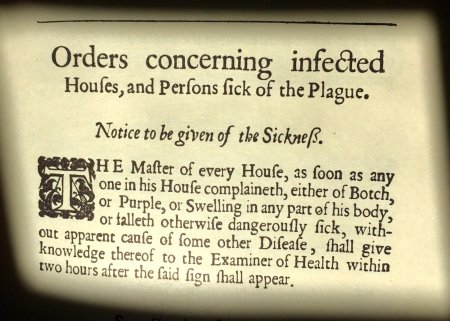
I was interested to see (on Twitter) the above example of track-and-trace from 1665, at the height of the Great Plague of London. I’m not sure how effective this notice was…

Other than its historical context, looking at this piece of text reveals some interesting things about how it was printed.

Note the liberal use of the symbol “ſ’”, for example. This character is sometimes called the “long s”*. There’s a full Wikipedia article on this and I have posted about it before which means there’s no point in repeating here, but I will just mention that the long s was used widely in manuscripts after the distinction arose better upper case and lower-case letters (which was around about the end of the 8th Century) wherein the lower-case form, the “short s” (i.e. s),  was used exclusively at the end of words or before an elision, and the long s everywhere else. It survived into the era of printing, not just in English but also in other languages including German. In fact “ſ” forms the left-hand element of the ligature “Eszett”, written  “ß”, of which the other part is “z”.

Note the use of a ligature that looks like the Eszett at the end of the word “Sickness”. This is not actually an Eszett but is instead a ligature formed from the long s and the short s. I haven’t seen many examples of this in old printed books but I’m by no means an expert in 17th Century orthography but I’m given to  understand this was used in fonts based on the Antiqua class of typefaces, typically used for printing Latin text. I suppose the piece above was produced by a printer used to that form of material. That doesn’t narrow it down much, though, as many scholarly works were published in Latin at that time.

The number of esses (both long and short, as well as capital “S” in “Sickness” and “Swelling”) is quite considerable given its brevity. The last sentence contains quite a tongue-twister too: “said sign shall”!

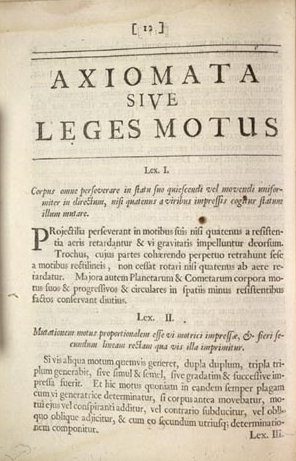
There is another ligature “ct” in the word “infected” in the heading. This is quite common in old printed works, especially in Latin.  Here is an example from Newton’s Principia; see the word “rectam” in the statement of the Second Law of Motion:

The combination “ct” is quite common in Latin, as is “ss”, as are many other digraphs, including “et” (the ligature for which gives the symbol &; “et” means “and” in Latin).

Ligatures were introduced in handwriting, partly to embellish the script and partly to save time. Joining two letters together is a way of eliminating a duplicate stroke of the pen and avoiding having to lift it from the paper. When printing presses were introduced, ligatures were found to make typesetting with movable type easier because one block would replace frequent combinations of letters. It also allows the compositor to reduce the spacing between the characters, saving paper and also making the text easier to read.

*Incidentally, for the mathematically inclined, the long s is also the original form of the integral sign, introduced to mathematics by Leibniz to stand for “summa” (sum), which he wrote “ſumma”.


Black ’47

Posted in Beards, Film, History with tags , , , on October 14, 2020 by telescoper

The film Black ’47 was released in Ireland in 2018 (just after I moved here) but although it got good reviews I didn’t get around to seeing it in the cinema. Last Friday however it turned up on TV so I watched it and thought it was excellent.

The film tells the story of Martin Feeney (played by James Frecheville) who returns home to Ireland having deserted from the British Army, in 1847, only to find his native Connemara in the grip of the Great Famine. Witnessing the callous treatment of his people by landlords, their agents and the British authorities he sets out on a trail of violent retribution against the oppressors. In structure the film is very like that of a classic `revenge’ Western, though set in the Wild West of Ireland rather than America. It’s very well acted by a very fine cast and superbly photographed, grimly convincing in its depiction of the extreme deprivation of the time, with gripping action sequences. Among many other things, I was impressed by the realistic portrayal of the unreliability and inaccuracy of mid 19th Century firearms. The rifles in use by the British Army at that time were muzzle loaded, using paper cartridges, so their rate of fire was very low too.

There are some splendid beards too.

I’m sure there will be people to correct me if I’m wrong but I don’t think there were any feature films made about the Great Hunger, despite its importance in Irish history, before this one.

Here’s the official trailer for the movie. I think it’s well worth watching if you can get to see it, though somehow I doubt it will be on prime time television in the UK like it was here in Ireland…

The Strand at Lough Beg – Seamus Heaney

Posted in History, Poetry, Television with tags , , , , , on September 17, 2020 by telescoper

Last night I watched a harrowing but compelling film called Unquiet Graves which is about the activities of the Glenanne gang, a loyalist paramilitary group which carried out in excess of 120 murders during the 1970s including the horrific bombings in Dublin and Monaghan in 1974. Many members of this gang were serving members of the Royal Ulster Constabulary and the Ulster Defence Regiment which ensured that these heinous crimes were never properly investigated and in many cases the families of the victims are still waiting for justice.

The film makes very difficult viewing but is a timely reminder of a terrible period in Irish history and gives reason to reflect on the importance of the Belfast Agreement that brought peace to a part of the world that so recently stood on the brink of civil war.

One of the victims of the Glenanne gang was a young man called Colum McCartney, a cousin of the poet Seamus Heaney. Colum’s car was stopped not far from Armagh by men in army uniforms. He was made to get out and kneel, and then he was shot in the back of the head. His companion, who tried to run away, was shot in the back as he fled. Seamus Heaney composed this poignant elegy to his murdered relative.

In Memory of Colum McCartney

All round this little island, on the strand
Far down below there, where the breakers strive
Grow the tall rushes from the oozy sand.
–Dante, Purgatorio, I, 100-3

Leaving the white glow of filling stations
And a few lonely streetlamps among fields
You climbed the hills toward Newtownhamilton
Past the Fews Forest, out beneath the stars–
Along the road, a high, bare pilgrim’s track
Where Sweeney fled before the bloodied heads,
Goat-beards and dogs’ eyes in a demon pack
Blazing out of the ground, snapping and squealing.
What blazed ahead of you? A faked road block?
The red lamp swung, the sudden brakes and stalling
Engine, voices, heads hooded and the cold-nosed gun?
Or in your driving mirror, tailing headlights
That pulled out suddenly and flagged you down
Where you weren’t known and far from what you knew:
The lowland clays and waters of Lough Beg,
Church Island’s spire, its soft treeline of yew.

There you used hear guns fired behind the house
Long before rising time, when duck shooters
Haunted the marigolds and bulrushes,
But still were scared to find spent cartridges,
Acrid, brassy, genital, ejected,
On your way across the strand to fetch the cows.
For you and yours and yours and mine fought the shy,
Spoke an old language of conspirators
And could not crack the whip or seize the day:
Big-voiced scullions, herders, feelers round
Haycocks and hindquarters, talkers in byres,
Slow arbitrators of the burial ground.

Across that strand of ours the cattle graze
Up to their bellies in an early mist
And now they turn their unbewildered gaze
To where we work our way through squeaking sedge
Drowning in dew. Like a dull blade with its edge
Honed bright, Lough Beg half shines under the haze.
I turn because the sweeping of your feet
Has stopped behind me, to find you on your knees
With blood and roadside muck in your hair and eyes,
Then kneel in front of you in brimming grass
And gather up cold handfuls of the dew
To wash you, cousin. I dab you clean with moss
Fine as the drizzle out of a low cloud.
I lift you under the arms and lay you flat.
With rushes that shoot green again, I plait
Green scapulars to wear over your shroud.
The Ghost Room in Maynooth

Posted in History, Maynooth, Poetry with tags , , , on September 9, 2020 by telescoper

I stumbled across this rather macabre post about Maynooth University and thought I’d share it….don’t have nightmares!

That reminds me of this poem by Emily Dickinson:

One need not be a chamber to be haunted,
One need not be a house;
The brain has corridors surpassing
Material place.

Far safer, of a midnight meeting
External ghost,
Than an interior confronting
That whiter host.

Far safer through an Abbey gallop,
The stones achase,
Than, moonless, one’s own self encounter
In lonesome place.

Ourself, behind ourself concealed,
Should startle most;
Assassin, hid in our apartment,
Be horror’s least.

The prudent carries a revolver,
He bolts the door,
O’erlooking a superior spectre
More near.

Sam's avatarCome Here To Me!

Path leading down to the College Graveyard at Saint Patrick’s College. (Carax)

Just on the outskirts of Dublin lies the historic university town of Maynooth. It is the home of Ireland’s main Roman Catholic seminary, St Patrick’s College, which has been churning out priests since 1795.

One particular room in the college has been associated with demonic apparitions, suicide and paranormal activity for over 150 years.

In the mid 19th century in Room Two of Rhetoric House, two young seminarists took their own lives, nineteen years apart, and the room has been the source of many tales ever since.

Rhetoric House in the South Campus, built in 1834, was formerly a residential house for trainee priests. It now hosts the Department of History.

Rhetoric House, Maynooth (http://bogwarrior.com)

On 1 March 1841, a young student from Limerick by the name of Sean O’Grady (b. 1820) jumped out of room and fell…

View original post 525 more words

Eddington in Cardiff 100 years ago today: the first proposal that stars are powered by fusion

Posted in Cardiff, History, The Universe and Stuff with tags , , on August 24, 2020 by telescoper

Here’s a fascinating bit of astrophysics history by former Cardiff colleague Bernard Schutz: one hundred years ago today, Arthur Stanley Eddington gave a talk in Cardiff in which he, with great prescience, proposed the idea that stars might be powered by nuclear fusion.

bfschutz's avatarThe Rumbling Universe

One hundred years ago today, on 24 August 1920, with over 1000 people gathered in Cardiff for the annual meeting of the British Association, Arthur Eddington gave his address as the incoming president of the physical and mathematical sciences section. He elected to speak on the subject of the “Internal Constitution of the Stars”. When I first came across the text of the address last year (published in Nature in 1920), I was amazed to find as early as this such an insightful proposal that stars are powered by the synthesis of helium from hydrogen. But what really brought me up short was this sentence:

If, indeed, the sub-atomic energy in the stars is being freely used to maintain their great furnaces, it seems to bring a little nearer to fulfilment our dream of controlling this latent power for the well-being of the human race – or for…

View original post 831 more words

A Revolutionary Manhole Cover

Posted in Architecture, History, Maynooth with tags , , , , , on August 20, 2020 by telescoper

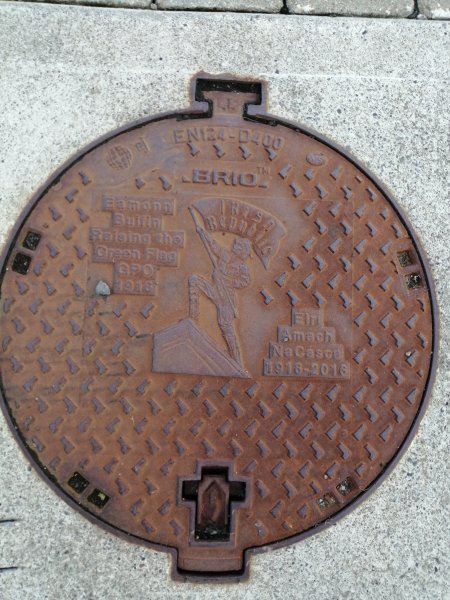
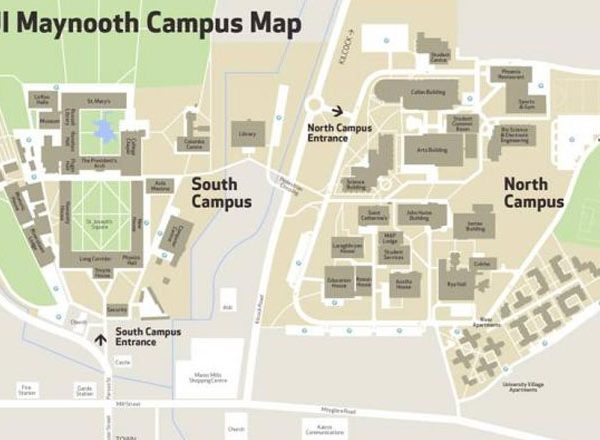
I must have walked dozens of times past the above manhole cover on Maynooth University’s North Campus without paying too much attention. Then I noticed a post on Twitter of another such cover in County Kerry, in the thread following which someone mentioned one on Maynooth campus so I thought I’d take a picture of it. They must have been made for the centenary commemorations in 2016. There’s more than a hint of Soviet-style design in the artwork.

The figure depicts Eamon Bulfin raising the flag of Irish Republic above the GPO on Easter Monday 1916, the start of the Easter Rising. After the end of the rising Bulfin was condemned to death, but his sentence was commuted and, after being imprisoned in Britain for a time, he was deported to Argentina. He returned to Ireland when the Irish Free State in 1922 where he lived until his death in 1968.


Forgotten Fires at Maynooth

Posted in History, Maynooth with tags , , on August 17, 2020 by telescoper

I’m taking the liberty of reblogging this fascinating bit of local Maynooth history. I did know about the 1878 fire on South Campus, having read about it here, but for some reason I had imagined it happened elsewhere in the College. St Mary’s Square, which was designed by Augustus Pugin,  is actually behind St Patrick’s House as you look at it from the larger St Joseph’s Square.


The college chapel was not completed until 1891 so can’t be seen on the picture of the aftermath of the fire shown in the blog post; the spire wasn’t built until 1895. St Mary’s is part of the national seminary, as opposed to Maynooth University.

New House, site of the later fire in  1940 , forms the North side of the quadrangle enclosing St Joseph’s Square which is to your right as you look towards St Patrick’s House. It is home to the Law Department of Maynooth University.

Special Collections's avatarMU Library Treasures

by Sarah Larkin, Archivist, St Patrick’s College Maynooth

Dublin fire brigade attending the fire at New House, 29 March 1940.

This yearSt Patrick’s College, Maynooth celebrates 225years since its foundation in 1795. This blog post is the second in a series highlighting some of the interesting and lesser known events and facts of the College’s history. This postlooks attwo occasions when fire broke out in the College, and how tragedy was avoided.

On 1 November 1878, at 8am in the morning, fire broke out in St Mary’s inMaynooth College. The College fire engine proved to be inadequate. An attempt to summon help from the Dublin fire brigade failed, as the local telegraph failed to work and a message had to be sent from Celbridge. A special train was immediately laid on in Dublin to bring the fire engine to Maynooth. It was thendrawn to the College…

View original post 423 more words

To Fool the Faeries

Posted in History, Maynooth with tags , on August 16, 2020 by telescoper

I follow a fascinating little Facebook group which features old pictures of Maynooth. The above picture is not from there – it’s a private group – but I found it on the net after seeing one of the posts there on the same subject.

The point is that the little kids wearing skirts and dresses in that old photograph are all boys.

Apparently it was a tradition in some parts of rural Ireland until relatively recently (at least until the 1930s) to dress young boys (up to the age of about 12) as girls. The reason for this is both strange and sad.

In poorer communities infant mortality was high. The tragic and otherwise inexplicable deaths of young children were attributed to the malicious actions of the faeries – aos sí – supernatural beings believed in Gaelic tradition to be descendants of the people who built the burial mounds, tumuli and other prehistoric structures found all around Ireland. According to the tradition, the faeries prefer to make off with the souls of male rather than female children. Dressing boys as girls was an arrempt to protect them by fooling the faeries.

The sad fact behind this is that boys are significantly more likely to die young than girls, even in affluent societies where infant mortality is generally low, though it is probably more noticeable where infant mortality is high. The belief in faeries preferring to take boys reflects a kind of folk knowledge of this statistical fact. The reasons why boys are more likely than girls to die in infancy are complex and, as far as I know, not fully understood.

I find these traditional beliefs fascinating because they are not simply quaint superstitions – they are attempts to understand real phenomena.

The world of Gaelic mythology itself is, at least partly, built on folk memory of very ancient history. There were, after all, people in Ireland who built places like Newgrange, long before the arrival of Celtic people from somewhere in Iberia, and nobody really knows what happened to them. In mythology they turned into the little people and went underground, but are still here. Which, in a sense, they are…