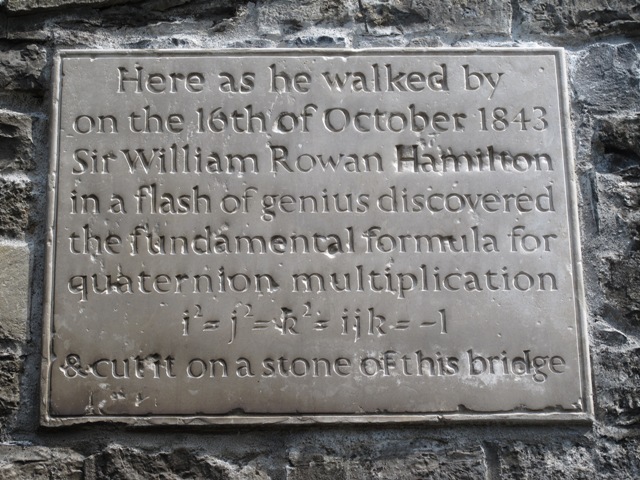
Today, October 16th, is Hamilton day! It was on this day 176 years ago, in 1843, that William Rowan Hamilton first wrote down the fundamental result of quaternions. Apparently he was walking from his residence at Dunsink Observatory into Dublin when he had a sudden flash of inspiration and wrote the result down on the spot, now marked by a plaque:
Picture Credit: Brian Dolan
This episode is commemorated by an annual Hamilton Walk. Sadly, Broombridge (Droichead Broome) is near the bridge (Broom Bridge) where Hamilton had his Eureka moment and it is on the main commuter line from Maynooth into Dublin. This is ironic because Quaternion algebra does not commute. (Geddit?)
Although it is quite easy to reach Broombridge from Maynooth, I sadly can’t attend the walk this year because I’m teaching this afternoon.
P.S. Maynooth is also home to the Hamilton Institute which promotes and facilitates research links between mathematics and other fields.
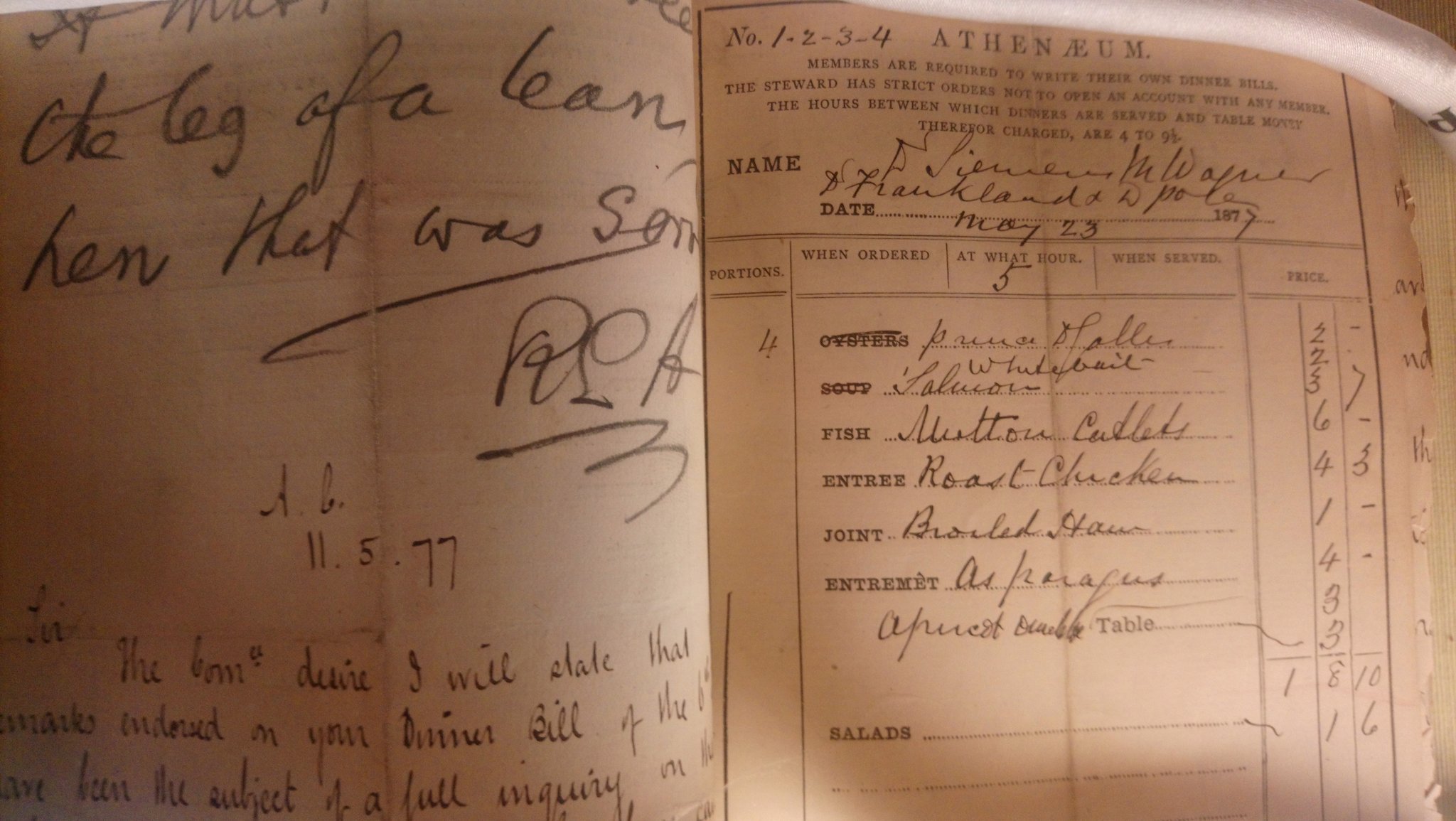
Before dinner with the RAS Club on Friday evening I was looking through the display cabinets at the Athenaeum and saw this, the record of a dinner involving a member and guests on 23rd May 1877. The member was electrical engineer, businessman and Fellow of the Royal Society Carl Wilhelm Siemens and among is guests was Richard Wagner:
Dinner started early and was evidently a lengthy affair, much like Wagner’s operas!
That reminds me of a famous review of one of Wagner’s operas by a critic who clearly wasn’t a fan.
Parsifal is an Opera by Richard Wagner that starts at half past five. Three hours later, you look at your watch and it’s quarter to six.
P.S. There is a photograph taken of Wagner (whose 64th birthday was on 22nd May) during his visit to London in 1877:
I thought I’d do a quick round-up of my little trip around cultural and historic Dublin yesterday after being stood down from duty at the Higher Options fair at the Royal Dublin Society (RDS). I have to say it was wonderful to see so many people out and about in the City’s beautiful parks and public spaces enjoying the September sunshine as I walked around.
The RDS is in the Ballsbridge area in of Dublin, to the East of the City. My route into town from there took me along Northumberland Road, where I took this picture outside Number 25:
A little further along I went across Mount Street Bridge, passing this memorial.
If you want to know more about the significance of these memorials to the events of the Easter Rising in 1916, see my post here.
My main intention during my afternoon off was to visit the National Gallery of Ireland which is situated on one side of Merrion Square. I have to say that this was even better than I’d expected, and I’m sure to visit again many times in the future. The ground floor is dominated by the work of Irish artists from about 1660 to 1965, together with European Art from 1835 to 1965. You will find works by Monet and Picasso in this section, which has much to savour. Among the Irish artists represented in this show is Jack B. Yeats (brother of poet W.B. Yeats), an extremely interesting artist in his own right.
The highlights for me, however, were found on the 3rd floor which displays examples of European Art from the early Renaissance (c. 1300) to the Enlightenment. One of the interesting things about this collection is that it is arranged thematically rather than by artist (or nationality thereof). There is, for example, an entire room of paintings inspired and influenced by Caravaggio, all of them with an intensely dramatic use of light and shadow. The gallery is worth it just for that room, but there are also fascinating juxtapositions of religious paintings from the renaissance with icons and altarpieces from the Byzantine and Russian orthodox traditions from the same period.
Elsewhere in the collection there are notable works by Vermeer, Rembrandt and Perugino as well as a number of British works by, for example, Gainsborough and Reynolds.
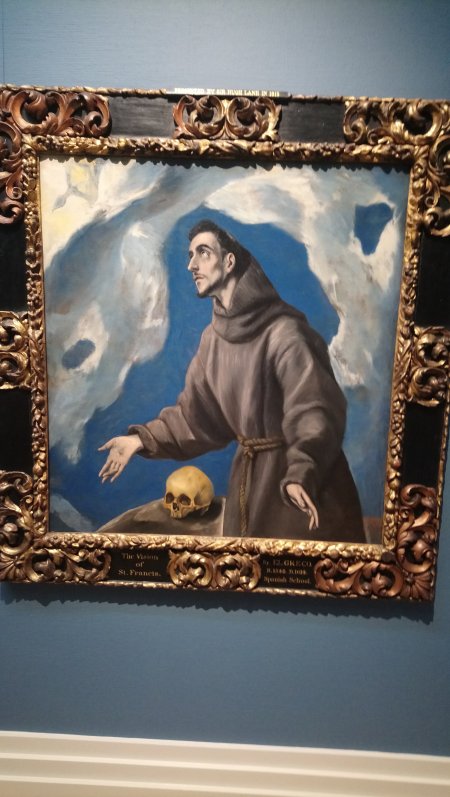
The work that really stopped me in my tracks, however, was this:
This is St Francis Receiving The Stigmata by El Greco. I knew about this painting but had no idea it was in Dublin. Seeing it close up is a revelation: the swirling brushstrokes give it an extraordinary texture that makes it hard to bring the image completely into focus. The hypnotic feel that results is a brilliant depiction of a man undergoing a kind of ecstatic vision. This work has an unbelievably powerful effect on the viewer (or at least on this one).
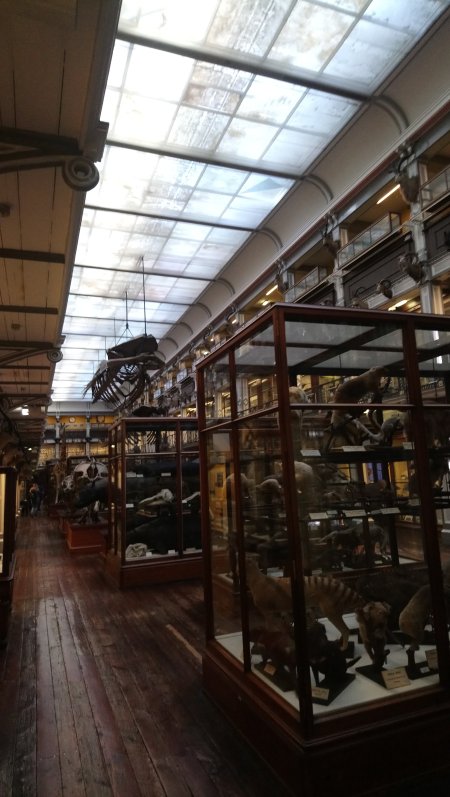
After a break for a sit down and a cup of coffee I visited the Natural History Museum (which is practically next door to the National Gallery). This is a surprisingly old-fashioned affair, with hundreds of stuffed animals and birds crammed into two large rooms:
It reminded me a lot of visits to the Hancock Museum in Newcastle when I was a kid. It’s interesting, but more than a little creepy and would make an excellent setting for a horror story!
After adjourning to a pub for a pint of Guinness the final stop of the day was the National Concert Hall for yesterday’s Culture Night concert. On the way there I saw a big queue of people trying to get into one of the many free events around Dublin. It turns out this Culture Night was the grand opening of the Museum of Literature Ireland, which is situated in Newman House on the South Side of St Stephen’s Green. There’s another one to put on my list of places to visit.
The Culture Night concert was by the RTÉ National Symphony Orchestra conducted by Leonard Slatkin. The opening piece, Kinah, was a composition by the conductor himself and is a sort of memorial to his parents, both of whom were classical musicians, one a violinist and the other a cellist, and together they formed half of the famous Hollywood String Quartet. It was a new piece for me, and I found it very moving indeed. After that there was a bit of reorganization on stage to make way for the Steinway on which the brilliant Xiayin Wang played the Piano Concerto by Samuel Barber, which consists of two fast and furious movements either side of a beautifully lyrical slower movement. This must be a ferociously difficult piece to play – especially the last movement which is at a breakneck pace in 5/8 time – requiring not only dexterity but physical strength. It was a wonderful performance by Xiayin Wang, who rounded off the first half with an encore in the form of a transcription of George Gershwin’s song The Man I Love.
After the wine break interval came the main course in the form of the Symphony No. 4 in E Minor by Johannes Brahms. This is of course a much more familiar work than the previous two, but I really like concerts that mix unfamiliar material with the standard concert repertoire. It also gave me the chance to persevere with Brahms as my friends keep telling me to. It’s not that I don’t like Brahms, it’s just that I don’t find that he moves me as much as many other composers and so many people rave about him that I think I must be missing something. The 4th Symphony is a very fine work, and was performed beautifully last night under the direction of Leonard Slatkin (conducting, incidentally, without a score), but I couldn’t stop myself thinking how much like Beethoven it sounds. That’s not meant to be derogatory, by the way.
But you don’t need to take my word for it. You can listen to (and watch) the whole concert here:
Anyway, after the applause had died down I headed out towards Pearse Station for the train back to Maynooth. I was a bit tired after a very full day and wanted to get the 10.08 train so I didn’t stop to watch any of the numerous musical and artistic events I passed on the way, including an intriguing installation involving images projected onto one of the buildings to the side of St Stephen’s Green. I made it to the station with 5 minutes to spare and discovered that, because it was Culture Night, the train home was free!
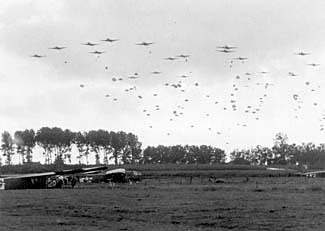
Seventy-five years ago today, on 17th September 1944, the largest airborne operation in military history began. Operation Market Garden (as it was called) saw about 35,000 Allied troops dropped by parachute or landed in gliders behind German lines in Holland, with the aim of seizing key bridges in order to allow infantry and armoured divisions to advance, eventually into Germany. Of more immediate tactical importance was that capture of the Northernmost bridges over the Rhine at Arnhem would prevent German reinforcements from moving South to confront the advancing troops, tanks and armoured vehicles of XXX Corps whose job was to punch a hole in the German defences and link up with the airborne troops.
Motivated by the belief that German armies in the West were exhausted and on the brink of collapse as well as the desire if possible to finish the war before Christmas, Operation Market Garden was daring and imaginative, but began to unravel right from the outset and ended as a disastrous failure, with the loss of many lives.
I’m not a military historian, so am not competent to add anything significant to the huge amount that has been written about what went wrong, but I will add a personal note. A cousin of my Grandfather flew to Arnhem with the 1st British Airborne division whose job was to take and hold the bridges over the Rhine that would open the door to an invasion of Germany. Sadly, he was one of those many troops who never even made it to their objective. In fact he was dead before he even hit the ground; his unit was dropped virtually on top of heavily armed German forces and had no chance of defending themselves. I had always been told that he had been dropped by parachute, but the records at the cemetery revealed that was wrong; he was on a glider which was badly shot up during its approach and crash-landed with no survivors.
The action at Arnhem actually involved two bridges, one a railway bridge at Oosterbeek, and the other a road bridge in Arnhem itself. British paratroopers did manage to capture one end of the road bridge, but never succeeded in securing both ends of the structure. Cut off from the much larger force pinned down near their landing zones they were eventually forced to surrender simply because they had run out of ammunition. The other units that landed near Arnhem never made their objectives and had to dig in and hope for reinforcements that never came. They fought a brave but desperate defensive action until 25th September when some were successfully evacuated across the Rhine. The original battle orders had specified they were to hold their ground for 48 hours until relieved by armour and infantry advancing rapidly from the South, but 30 Corps was heavily delayed by fighting, poor tactical decisions and congestion on the single road.
Some years ago, after attending a conference in Leiden, I took time out to visit Oosterbeek cemetery, where 1437 soldiers lie buried. Such was the chaos at Arnhem that bodies of fallen soldiers are still being discovered in gardens and woods; as there were so many dead that there was only time to bury them in shallow graves where they had fallen. As remains are discovered they are removed and reburied in Oosterbeek. When I visited the cemetery about 25 years ago, there were several brand new graves.
At the time of Market Garden the local people looked on in horror as their potential liberators were cut down. It must have been deeply traumatizing for them. I think it is telling that when, in 1969, the British Army proposed bringing to an end the annual ceremonies in commemoration of these events, local Dutch civilians insisted that they continue.
As I stood by the grave I couldn’t help thinking of how lucky members of my generation are that we have not been called on to make such a sacrifice. Now I fear deeply that the rise of nationalism and xenophobia, not least in Britain, threatens to the peace in Europe that has held for almost 75 years.
The failure of Operation Market Garden had other terrible consequences. The winter of 1944/45 was a terrible time one for Dutch civilians in the part of their country that had not been liberated, with many thousands dying from hunger and the bitter cold.
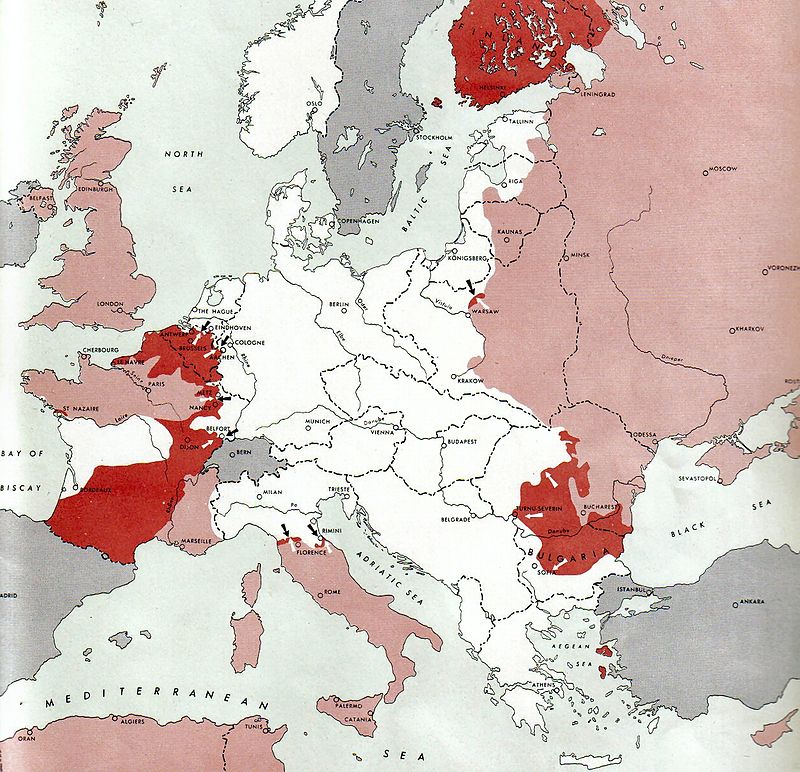
And of course had the Allies succeeded in penetrating into Germany in 1944, the post-war map of Europe would probably have been very different. This is how the front lines were drawn in mid-September 1944, with the Western Front and Eastern Front roughly equidistant from Berlin.
(By Army Map Service – Document “Atlas of the World Battle Fronts in Semimonthly Phases to August 15th 1945: Supplement to The Biennial report of the Chief of Staff of the United States Army July 1, 1943 to June 30 1945 To the Secretary of War”, Public Domain, Link.)
Had Market Garden been successful would there have been 45 years of Cold War?
While at the Irish National Astronomy Meeting last week I picked up a free copy of the magazine Astronomy Ireland. I chuckled when I saw this little item about the stamps issued in Ireland to commemorate the 50th Anniversary of the Apollo 11 first landing on the Moon:
If you can’t read the text it refers to a spelling error in the Irish language version of the caption on the Neil Armstrong stamp at the top image: instead of the Irish word for Moon (Gealach) the text contains the word for Irish (Gaelach). The caption thus translates as the 50th Anniversary of the First Landing on the Irish…
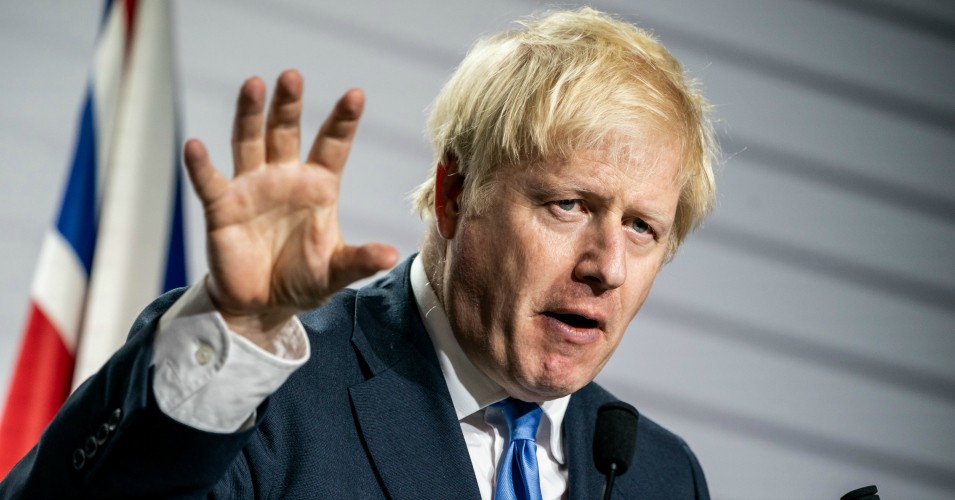
Known liar, charlatan and tinpot dictator Boris Johnson.
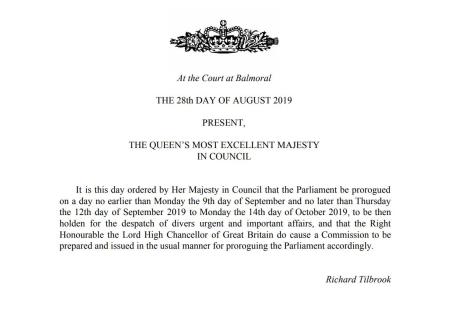
Got back to Ireland this morning to find that the UK Government has decided to suspend Parliament. The deed is already done:
Remind me, what was all that stuff about the European Union being undemocratic?
Any lingering doubts anyone might have had about the direction in which the United Kingdom might go after known liar Boris Johnson became Prime Minister will have been dispelled this morning by the decision (by a small group within the Cabinet) to prorogue Parliament. There can be no doubt that this is a coup d’état. The parallels with 1930s Germany are chilling. If you ever wondered what you would have done in then, as the Nazis took over, that’s what you’re doing now.
This may allow the populist charlatans behind this manoeuvre to force through their chaotic `no deal’ Brexit, but they cannot be allowed to get away with this. I live in hope that one day they will be brought to book for this scandalous act. When that happens the retribution will be a joy to watch.
This disgraceful episode has made much easier a decision I have been putting off for almost two years. I’m putting my house in Wales up for sale and cutting the last of my ties with the United Kingdom. Enough is enough.
With less than a month to go before I take up a position as Head of Department, I thought I’d spend some of the book tokens I got from the Everyman Crossword prize on some preparatory reading material…
Sparked by an exchange on Twitter last week with another person (who has the same surname as me) on the subject of heraldry, I did a little bit of googling about and found a little snippet I found quite intriguing. Although the name Coles is found all over England and Wales, with strong concentrations in the South West of England and in Northamptonshire, according to this source the name is of Anglo Saxon origin and is first recorded in Yorkshire as the family name of George Coles, which was dated 1555, in the “Register of the Freemen of the City of York”, during the reign of Queen Mary 1. The same source also points out that a branch of the Coles family subsequently moved to Ireland, though it gives no details (unless you pay for them).
I subsequently found that in Burkes General Armory (which details all the Coats of Arms registered in the UK and Ireland) the first entry under the surname Coles is indeed in Ireland, where it was confirmed in 1647. That date is during the Irish Confederate Wars, a couple of years before Oliver Cromwell arrived in Ireland with his army. One might surmise that this particular branch of the Coles lineage was somehow caught up in these hostilities, probably on the English side.
Anyway the description of the corresponding Coat of Arms, in typically cryptic heraldic language is:
Gu. on a chev. betw. two lions’ heads erased or, ten ogresses. Crest — A snake wreathed about a marble pillar ppr. garnished or.
The first part refers to the escutcheon (shield): Gu is short for Gules, a tincture (red), and it describes the main colour of the field of the escutcheon; chev is for chevron (an inverted v-shape), one of the Honorable Ordinaries (basic designs for the escutcheon). This and the two lions’ heads are described as `or’ (andother tincture, meaning gold-coloured); erased means `without the body’; an ogress is a special case of a roundel (filled circle) in which the circle is black (the word `pellet’ is also used).
The Crest is self-explanatory other than that `ppr’ is short for `proper’ which means, roughly speaking, `natural-coloured’. I’m not of the significance of the snake and the marble pillar.
Here is a mock-up of the whole thing:
There are several other entries for the name Coles in Burkes General Armory and I’m certainly not claiming that I have the right to use this Coat of Arms but I am intrigued by the Irish connection with the name Coles and will see what more I can find out about it.
The recent circulation to his staff of daft (and in some cases erroneous) rules to be used when writing documents has led to much hilarity on the media we call social. Among the obvious errors are that the correct abbreviation for `Member of Parliament’ is `MP’ not ‘M.P.’ and that `full stop’ is actually two words (not `fullstop’). On top of those his insistence that civil servants use Imperial units for everything actually may be unlawful as the official system of units for the United Kingdom is the metric system.
The latter exhortation has caused a particular outcry among people under the age of about 50 (who have never been taught Imperial units), and especially scientists (who understand the obvious superiority of the SI system).
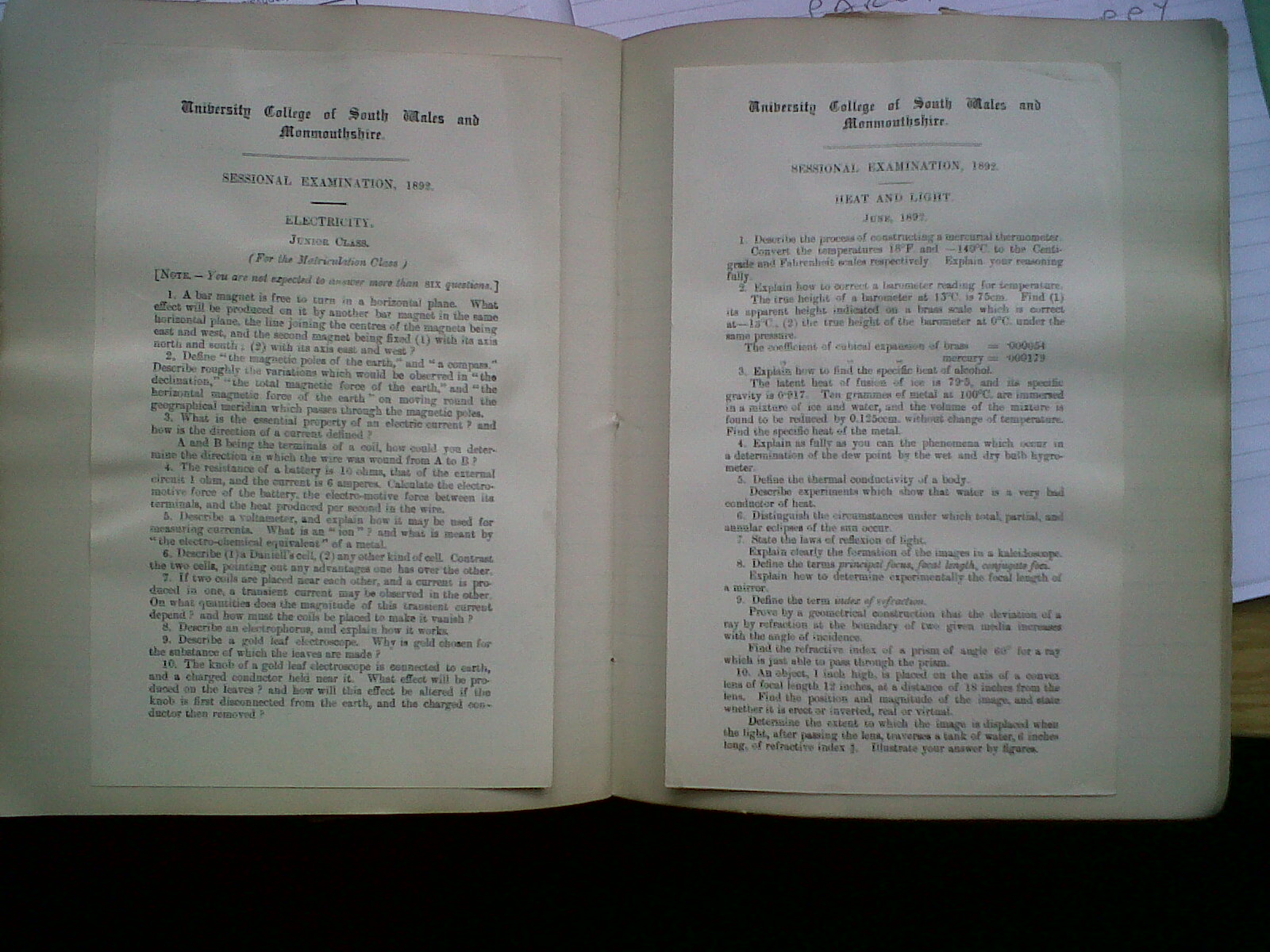
Anyway, all this reminded me that many years ago when at Cardiff there came into my possession a book of very old school and university physics examinations, which are of interest because I’ve been posting slightly less ancient examples in recent weeks. These examinations were set by the University College of South Wales and Monmouthshire, which was founded in 1883, an institution which eventually became Cardiff University. I find them absolutely fascinating.
The papers are rather fragile, as is the book containing them, so I daren’t risk trying to scan them systematically in case flattening them out causes damage. Here instead are a few random examples that I photographed on my desk, in the manner of an old-fashioned secret agent. Sorry they’re not all that clear, but you can see them blown up if you click on them.
The collection is fairly complete, covering most of classical physics, at all examination levels from university entry to final Honours. Of course there are no questions on relativity or quantum physics appear (which had yet to be invented) but other than that – and the units! – they’re not too different from what you might find in the examinations for the early stages of contemporary physics programmes.
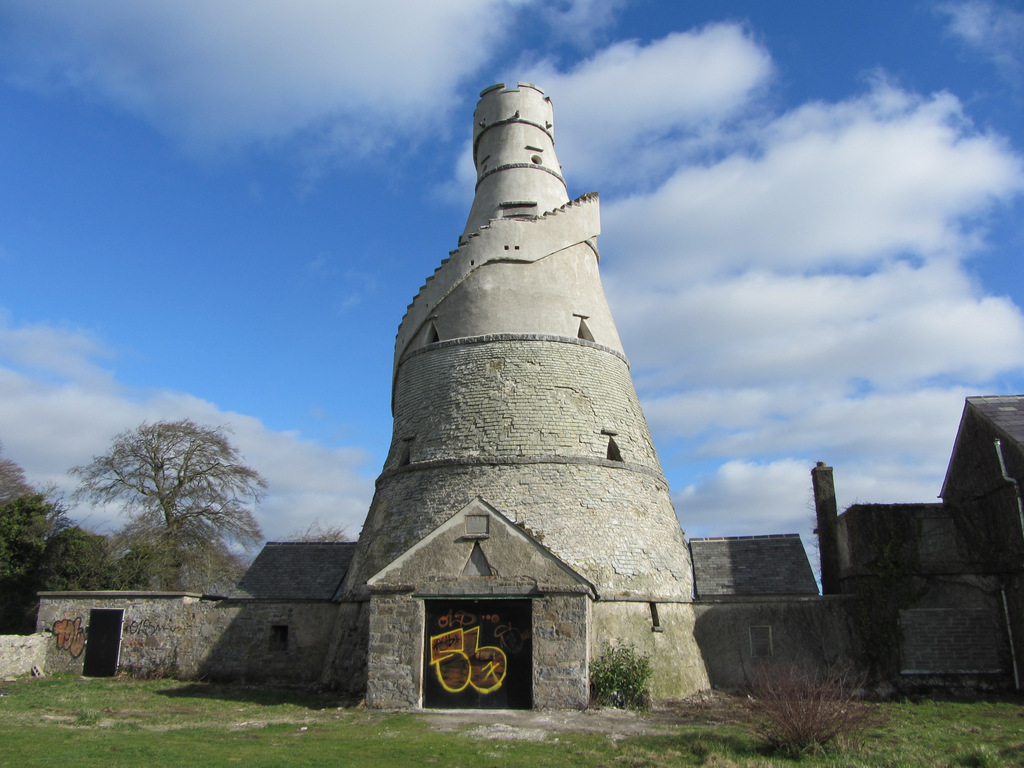
Despite the fact that it’s only a few miles away from Maynooth (in Leixlip) I had never heard of this extraordinary building until yesterday. The Wonderful Barn (for that is its name) is known to have been built in 1743 but nobody actually knows what its purpose was. Probably the best theory is that it was designed to be used as a granary, as it was built immediately after a severe famine (in possible anticipation of others in the future), but alternative possibilities to have been suggested are a tower from which people could shoot game birds, a folly (it was built by the Conolly family, owners of Castletown House and is on the Estate which has another famous folly), and simply as a means of providing work for poor people in a time of great hardship. Anyway, it’s a weird building, built from bricks but faced with what looks like recycled stone rubble.
Here’s a short video that includes some drone footage of the Wonderful Barn that gives you an idea of its corkscrew-shaped construction.
The views presented here are personal and not necessarily those of my employer (or anyone else for that matter).
Feel free to comment on any of the posts on this blog but comments may be moderated; anonymous comments and any considered by me to be vexatious and/or abusive and/or defamatory will not be accepted. I do not necessarily endorse, support, sanction, encourage, verify or agree with the opinions or statements of any information or other content in the comments on this site and do not in any way guarantee their accuracy or reliability.









 In the Dark